Showing posts with label Caribbean. Show all posts

Friday, May 1, 2026

Rudolph on Colonialism and Blackstone's Family Wealth

Julia Rudolph, North Carolina State University, has published William Blackstone, Family Man: New Contexts in Gender, Jurisprudence, and Jamaica in Law and History Review:

While much has been written about William Blackstone, the jurist, politician, and legal writer, this article provides a critical new understanding of Blackstone, the husband, friend, and investor. It considers Blackstone’s legal and economic actions as well as ideas, analyzing his strategies for managing family wealth and comparing them to the strategies employed by a member of his extended family who was a Jamaican planter. Here, the article contributes to recent scholarship on the global dimensions of English and British legal history. It offers a fuller account of Blackstone’s proximity to the colonial plantation economy by investigating how economic change and imperial controversies impacted his personal and professional life. It also exposes Blackstone’s conventionally masculine bias by detailing the different ways in which he privileged male interests when making personal investment choices and when coming to judicial decisions about women’s property claims. A gendered ideology, which positioned male authority as central to the success of the household, state, and empire, furnished the framework within which Blackstone justified the operation of law and directed his own actions as head of his family. Placing Blackstone’s jurisprudence and experience within the contexts of patriarchy and colonialism, the article sheds new light on this influential figure, showing how he embodied the core features of an eighteenth-century family man and shaped modern ideas about male authority, property, and power.
--Dan Ernst

Saturday, November 29, 2025

Weekend Roundup

  • We've spotted an advertisement for a predoc university assistantship with Prof. Dr. Lena Foljanty, Chair for Globalisation and Legal Pluralism, at the Department of Legal and Constitutional History at the University of Vienna
  • Lawbook Exchange's November 2025 catalogue on Scholarly Law and Legal History (Part 1Part 2).
  • ICYMI:  A Very Short History of Freedom of Speech by Oliver Bramley (Constitution Society). How Germany's Nuremberg trial for Nazi crimes transformed international law (rfi).

Weekend Roundup is a weekly feature compiled by all the Legal History bloggers.

Saturday, August 23, 2025

Weekend Roundup

  • "Miscarriage is a Crime Again": over at Nursing Clio, Lara Freidenfelds draws connections between the contemporary U.S. and early modern England.   
  • A recording of Kim Lane Schepple's really terrific Robert H. Jackson Lecturer on the Supreme Court of the United States.at the Chautauqua Institution is here.  "Professor Scheppele’s lecture focused on Robert H. Jackson and constitutional separation of powers": Court-packing, destroyers for basis, North American Aviation, Nuremberg, Youngstown, and Trump v. United States.  With an introduction by John Q. Barrett.
  • Patrick S. O'Donnell on "The Haitian Revolution and Jacob Lawrence: Exemplifying Historical Narrative, Values and Purposes through Art."
  • "The Supreme Court of Ohio is staying open late to the public on Sept. 9 with two evening tour offerings. ... See Ohio’s rich history on full display at the Thomas J. Moyer Ohio Judicial Center" (CNO).  
  • "Three UMass Dartmouth School of Law 2L students, Patrick Wilson, Adyen Artica, and Nathan Gudas, helped North Shore government officials verify approximately 200 property deeds containing racist or discriminatory language, contributing to a broader effort to clean "dirty deeds" in southern Essex County, as part of their legal internships at the Essex Registry of Deeds" (UMass Law).
  • "Patrick T. Conley has donated his 1,500-volume private collection on American legal and constitutional history to the Roger Williams University School of Law" (Warwick Beacon). 
  • The Brennan Center Fellows Eric Ruben and Andrew Willinger's essay on the Supreme Court's reliance  on historical scholarship in Second Amendment case.  
  • Patrick O'Donnell also has an essay on the criminal defense and cause lawyer Charles R. Garry (1909-1991).
  • On September 21, 2025, 5:00 pm -6:00 pm, Jill Lepore will discuss her new book on the Constitution, We the People, at Politics and Prose, 5015 Connecticut Ave NW, Washington, DC PoPVille). 
  • "Tulane University School of Law invites applications from entry-level and lateral candidates for one or more tenure-track faculty positions.  We welcome applications from candidates with teaching and research interests in all topics, but we are particularly interested in candidates who focus on torts, business organizations, and commercial law."  More

Weekend Roundup is a weekly feature compiled by all the Legal History bloggers.

Monday, August 11, 2025

Jansen on Alienage in the British Caribbean

Jan C. Jansen, University of Tübingen, has published Alien Acts in the Age of Emancipation: Mobility Control and Executive Power in the British Caribbean, 1820s–1830s online in Law and History Review:

In reaction to revolutionary upheaval in the 1790s and 1800s, the British parliament at home and colonial legislatures in the Americas passed their first statutory provisions to govern migration and aliens as such. As this paper argues, in their sustained and varied uses, these “alien acts” were much more than about border and migration controls. In a period of fundamental restructuring of imperial rule and of social statuses within the colonies, they increasingly turned into flexible tools of imperial governance. Taking the British Caribbean in the 1820s and 1830s as a case, the paper examines how alien legislation was reused, and reinvented, in two crucial arenas of imperial reconfiguration: the push for political equality by free people of color and the abolition of the slave trade. By their emphasis on sweeping executive power, various actors on the ground but also in the metropole regarded alien acts as an appropriate legal tool to respond to, to avert or subvert what they regarded as challenges or legal complexities of the age of emancipation. In this way, the alien acts also became a central factor in the reconfiguration of British subjecthood—with far-reaching consequences that their creators and users could never fully anticipate or control.

--Dan Ernst

Thursday, May 29, 2025

Auerbach's "Overseer State"

Sascha Auerbach, University of Nottingham, has published The Overseer State: Slavery, Indenture and Governance in the British Empire, 1812–1916 (Cambridge University Press):   

In this compelling work, Sascha Auerbach offers a bold new historical interpretation of late-stage slavery, its long-term legacies, and its entanglement with the development of the modern state. In the wake of abolition, from the Caribbean to southern Africa to Southeast Asia, a fusion of government authority and private industry replaced the iron chains of slavery with equally powerful fetters of law and regulation. This 'overseer-state' helped move, often through deceptive and coercive methods, millions of Indian and Chinese indentured laborers across Britain's imperial possessions. With a perspective that ranges from Parliament to the plantation, the book brings to light the fascinating and terrifying history of the world's first truly global labor system, those who struggled under its heavy yoke, and the bitter legacies left in its wake.

--Dan Ernst

Tuesday, November 28, 2023

English Law, the Legal Profession, and Colonialism

English Law, the Legal Profession, and Colonialism: Histories, Parallels, and Influences, edited by Cerian Griffiths, Northumbria University, and Lukasz Jan Korporowicz, University of Lodz (Routledge, 2024):

Modern legal history is increasingly interested in exploring the development of legal systems from novel and nuanced approaches. This edited collection harnesses the lesser-researched perspectives of the impact of global and imperial factors on the development of law. It is argued that to better understand these timely discussions, we must understand the process and significance of colonisation itself. The volume brings together experts in the field of law and history to explore the ways in which law and lawyers contributed to the expansion of the British Empire, and the ways in which the Empire influenced the Metropole. The book sheds new light on the role of the law and legal actors during the pivotal centuries that saw the establishment of the Empire. Exploring such topics as Atlantic relations, the impact of British jurists upon Indian law, and the development of the law settler colonies, this collection reveals some of the lesser-known intersections between law, history, and empire. The book will be of interest to students and researchers in legal history, comparative history, equity and trusts, contract law, the legal profession, slavery, and the British Empire.
TOC after the jump.

--Dan Ernst

Thursday, July 13, 2023

Davis on Caribbean Comparative Legal History

Kevin E. Davis, New York University School of Law, has posted Haiti and the Uses of Comparative Legal History in the Caribbean:

This essay uses the history of Haiti’s constitution as a launching point for examining the challenges and opportunities inherent in studying comparative legal history in the Caribbean. It begins by explaining why the Caribbean’s remarkable diversity, along multiple dimensions, makes it a useful site for comparative legal history. The following sections illustrate the argument by explaining how a comparative historical approach can shed light on the relationship between law and three social processes implicated by the Haitian Constitution of 1805: state formation, recognition and expansion of citizenship, and economic development. 
--Dan Ernst

Friday, March 31, 2023

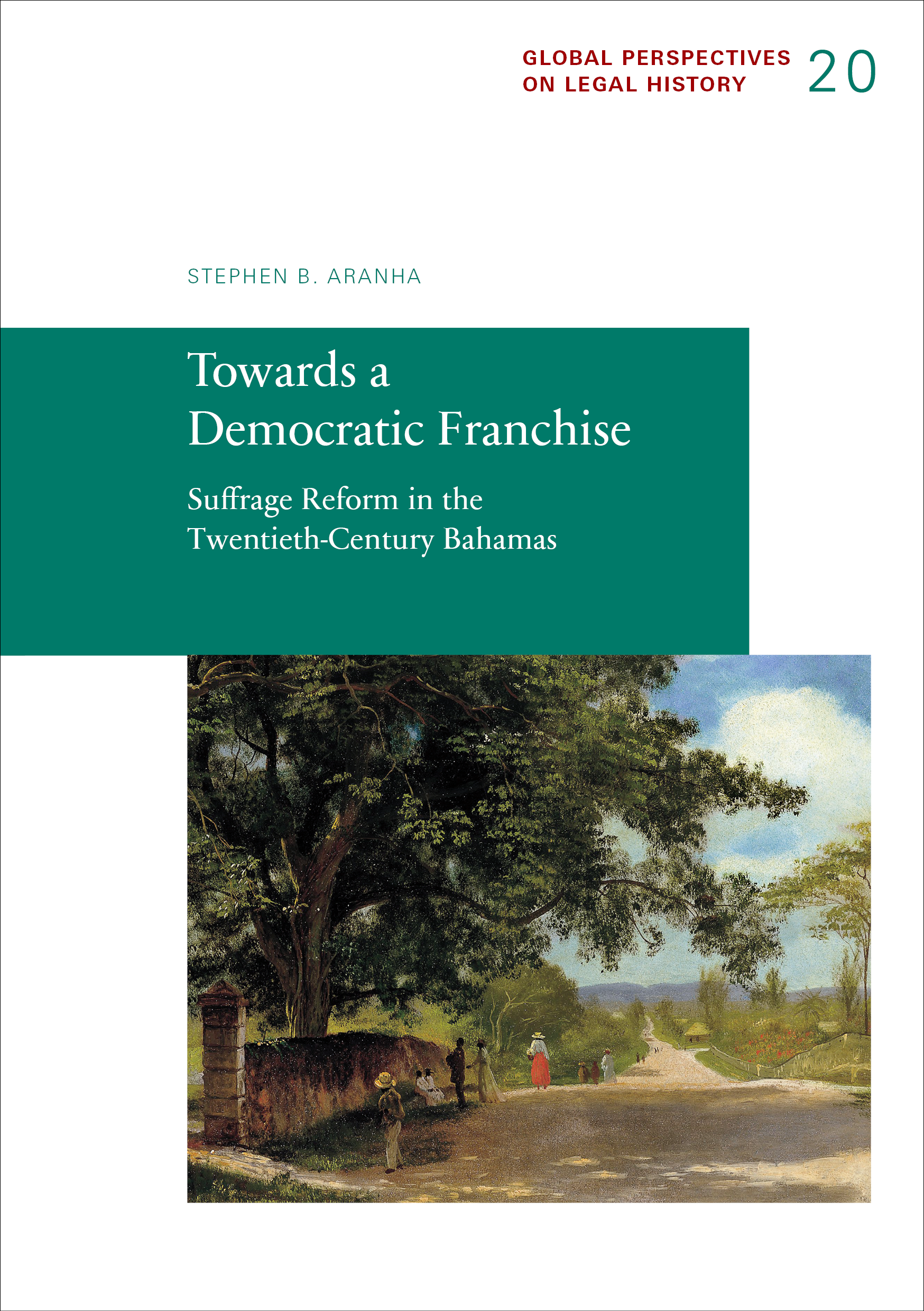
Aranha on Suffrage Reform in the Bahamas

[We have the following announcement.  DRE]

Stephen B. Aranha, Towards a Democratic Franchise. Suffrage Reform in the Twentieth-Century Bahamas (Global Perspectives on Legal History 20), Frankfurt am Main: Max-Planck-Institut für Rechtsgeschichte und Rechtstheorie 2022, XII, 323 p., ISBN 978-3-944773-38-4, eISBN 978-3-944773-39-1

The book examines the process of electoral reform in the Bahamas during the twentieth century in the broader context of decolonisation. Beginning with the General Assembly Elections Act of 1919, which reaffirmed a franchise limited to propertied men, milestones include the introduction of voting by secret ballot between 1939 and 1946, universal adult male suffrage in 1959, women's suffrage in 1961, and the incremental abolition of plural voting between 1959 and 1969.

This legal and political historical study draws on a variety of sources from Great Britain and the Bahamas, such as legislation, legal cases, government records, newspapers and blogs. It also analyses the effect that the electoral reforms have had on the state of democracy in the modern-day Bahamas in shaping the relationship between the postcolonial state and its citizens. The author concludes that since independence in 1973 the reform progress has stalled. Civil society, the driving force behind the twentieth-century reforms, has been largely dormant since then.

After graduating from the Free University of Berlin, Stephen B. Aranha worked in the Bahamas where he joined the then College of The Bahamas as an Assistant Professor in History. In 2016, he returned to Germany as a doctoral student at the Max Planck Institute for Legal History and Legal Theory. He earned his doctorate from the Goethe University in Frankfurt am Main in 2021. 

More information about the book and its availability in Open Access and print [here].

Friday, January 6, 2023

Henning on Puerto Rican Citizenship and Political Development

Now available open access in Studies in American Political Development: The Empty Gift: Citizenship, Imperialism, and Political Development in Puerto Rico by Maye Lan Henning, University of Portland:

After nearly two decades under U.S. rule, the 1917 Jones Act granted American citizenship to Puerto Ricans. I argue that the United States strategically granted collective citizenship in order to strengthen its colonial rule. The convergence of two conditions prompted the grant of citizenship: Congress determined that the islands were strategically valuable to the United States; and Congress registered an independence movement on the island that could threaten colonial control. When Puerto Ricans demanded independence, Congress enveloped them in a bear hug that granted citizenship to weaken their movement. While citizenship was an attractive solution to many of the problems of colonial rule, there were strong objections within the United States to granting citizenship to a population considered to be nonwhite. As a result, Congress created a workaround by disentangling citizenship from statehood and from many of the rights and privileges that typically accompany it. Though citizenship is often associated with democracy and equality, American officials turned citizenship into a mechanism of control for the empire they were building. This work uncovers strategies of American territorial expansion and colonial governance and confronts deeply held notions about American citizenship and political community.

--Dan Ernst

Tuesday, September 13, 2022

Ghosh on Haitian and Cuban Asylum-Seekers in the '90s

Smita Ghosh, Appellate Counsel, Constitutional Accountability Center, and a former LHB Associate Blogger, has published Border Games in the Michigan Journal of Law and Society:

Immigration prisons have become central to immigration law enforcement. Abolishing them is central to immigration reform. But abolition may have unexpected consequences, especially for the large—and growing—portion of asylum-seekers who are confined after a border arrest. Ending or limiting border detention may encourage the government to exclude asylum-seekers altogether.

This Article illustrates this dynamic using archival records. It investigates official responses to the arrival of Haitian and Cuban asylum-seekers in the 1980s, a founding moment in the history of immigrant detention. During these perceived crises, officials responded by detaining asylum-seekers, planting the seeds for today’s system of mass immigrant incarceration. Officials also developed new ways to bar asylum-seekers from the country in the first place. These exclusionary tactics complemented the government’s detention efforts: they were cheaper and more effective than detention. Even after the 1980s, detention and exclusion—the two faces of sovereignty—travel side-by-side. They are time-tested and deeply related ways to control immigration.

What should we take from this history? This Article explains why courts, lawmakers, and reformers must turn their attention to immigration enforcement on both sides of the border. In addition to abolishing immigration prisons, policymakers and reformers should attend to the understudied exclusionary policies that complement imprisonment. Considering detention and exclusion together makes clear that abolition is an important, but incomplete, solution.
–Dan Ernst

Monday, June 21, 2021

2021 Boucher Prize to Wood

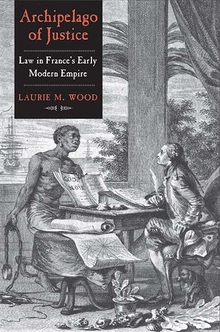
Laurie Wood (Florida State University) has won the 2021 Boucher Prize from the French Colonial Historical Society for her book, Archipelago of Justice: Law in France's Early Modern Empire, published by Yale University Press in 2020. 

Here's the citation: 
Laurie M. Wood’s Archipelago of Justice: Law in France’s Early Modern Empire is the winner of the 2020 Mary Alice and Philip Boucher prize. Archipelago of Justice offers a major contribution to an emerging scholarship seeking to integrate the histories of the Atlantic and Indian Ocean empires in order to better understand how the early modern French empire operated as a whole. Wood achieves this remarkable accomplishment through her focus on the conseils. In the early modern French empire, the conseils—regional law courts—bound a far-flung and diverse imperial system together through a network of institutions, people, and practices. In Archipelago of Justice, Wood focuses our attention across the entire system of these crucial legal institutions (the administrative equivalent of the parlements of metropolitan France), along with the people who staffed them and the subjects who petitioned them, to show how they created power, order, and the very nature of French colonialism. Based on astonishing archival tenacity, the book is beautifully written through powerful case studies and stories that bring to life both the powerful and the marginalized in vivid detail. Its most powerful and creative intervention is surely at the level of framing. Approaching the conseil and its agents as a whole, Wood navigates from the Caribbean to the Indian Ocean, helping us see these frequently separate worlds together, as they were legally bound together in the early modern era through the fascinating history of the conseil.

Professor Wood will be guest blogging at the LHB in the future. In the meantime: many congratulations!

--Mitra Sharafi 

Tuesday, October 6, 2020

Gaffield on international law after the Haitian Revolution

 Julia Gaffield (Georgia State University) has published "The Racialization of International Law after the Haitian Revolution: The Holy See and National Sovereignty" in the American Historical Review, 125:3 (June 2020), 841-68. Here's the abstract: 

The Haitian state shaped international definitions of sovereignty and national legitimacy after the Declaration of Independence in 1804. Haiti’s nineteenth century was not a period of isolation and decline; its first six decades were globally connected because the country’s leaders challenged their postcolonial inequality with diplomacy and state formation. This strategy aimed to establish Haiti’s membership in the “family of nations,” a central metaphor in European and American diplomatic, legal, and religious decision-making. In doing so, the Haitian state forced the Atlantic powers to redefine the boundaries of international relations. Haiti’s decades-long negotiations with the Catholic Church were tied to the racialization of the global hierarchy. After its Declaration of Independence, the Haitian state began clearing a theoretical path toward recognized sovereignty based on the dominant narrative that a society must be considered “civilized” on the world stage. But, as it cultivated internal policies and practices that rejected the dominant racist assumptions, these discriminatory ideologies became increasingly more explicit in international law.

Further information is available here

--Mitra Sharafi

Wednesday, September 30, 2020

Marino on feminism as international human rights movement

 Katherine M. Marino (UCLA) published Feminism for the Americas: The Making of an International Human Rights Movement with the University of North Carolina Press in 2019.


From the publisher: 

This book chronicles the dawn of the global movement for women's rights in the first decades of the twentieth century. The founding mothers of this movement were not based primarily in the United States, however, or in Europe. Instead, Katherine M. Marino introduces readers to a cast of remarkable Latin American and Caribbean women whose deep friendships and intense rivalries forged global feminism out of an era of imperialism, racism, and fascism. Six dynamic activists form the heart of this story: from Brazil, Bertha Lutz; from Cuba, Ofelia Domíngez Navarro; from Uruguay, Paulina Luisi; from Panama, Clara González; from Chile, Marta Vergara; and from the United States, Doris Stevens. This Pan-American network drove a transnational movement that advocated women’s suffrage, equal pay for equal work, maternity rights, and broader self-determination. Their painstaking efforts led to the enshrinement of women's rights in the United Nations Charter and the development of a framework for international human rights. But their work also revealed deep divides, with Latin American activists overcoming U.S. presumptions to feminist superiority. As Marino shows, these early fractures continue to influence divisions among today’s activists along class, racial, and national lines.

Marino's multinational and multilingual research yields a new narrative for the creation of global feminism. The leading women introduced here were forerunners in understanding the power relations at the heart of international affairs. Their drive to enshrine fundamental rights for women, children, and all people of the world stands as a testament to what can be accomplished when global thinking meets local action.

 Praise for the book:

“In this valuable contribution to the historiography of social movements in the Americas, Marino chronicles the impact of the women’s movement of leaders from six countries--Uruguay, Brazil, Panama, Cuba, the US, and Chile--in the interwar years . . . Marino successfully demonstrates that this was a vital period in Pan-American relations.”--Choice Reviews

“A brilliant and ambitious new account of the origins of global feminism . . . . Feminism for the Americas reconstructs a radical, transnational, and influential movement for women’s equality and social justice.”--International Feminist Journal of Politics

“The best book on Western Hemispheric feminism in at least two decades. . . . A necessary starting point for anyone contemplating research on inter-American feminism. . . . Marino has given us a masterpiece.”--Hispanic American Historical Review

The book has also won several book prizes, including the Ida Blom-Karen Offen Prize (International Federation for Research in Women's History), the 2020 Luciano Tomassini Book Award (Latin American Studies Association), and the 2020 Barbara "Penny" Kanner Award (Western Association of Women Historians).

Further information is available here

--Mitra Sharafi

Friday, August 28, 2020

Special issue: Constitutional Legacies of Empire

 The Northern Ireland Legal Quarterly has a special issue out on "The Constitutional Legacies of Empire," edited by Paul F. Scott (University of Glasgow). Here is the Table of Contents for vol.71, no.2 (summer 2020):
The articles by Donal Coffey and Martin Clark are available for download on an open-access basis.

Further information is available here.

--Mitra Sharafi

Thursday, June 11, 2020

Menon on Burke on the "Protection" of Trinidad Slaves

Parvathi Menon, Erik Castren Institute of International Law and Human Rights, has posted Edmund Burke and the Ambivalence of Protection for Slaves: Between Humanity and Control, which is forthcoming in the Journal of the History of International Law:
Edmund Burke (NYPL)
The language of protection came with an ambivalence that was capable of portraying the protector as the benevolent sovereign, i.e., as protecting the slaves from planter brutality (protection as humanity), but also one that allowed the sovereign to exert control over the protected to prevent resistance to authority (protection as control). In this paper, I examine the politics behind protection for slaves in Trinidad in the early 19th century to show how protection, as a legal strategy, served these different ends in the British Empire, of humanity and control alike, and was influenced by the legacy of Edmund Burke. I make two arguments in this paper: First, I argue that Burke’s trusteeship ideas, albeit widely written about as limiting imperial rule (concerning his efforts in India, largely demonstrated by the Warren Hastings trial), can also be described as a tool for imperial expansion in the early 19th century (as in the case of its redeployment in the Mandates model). To re-characterize Burke as neither radical nor conservative, but as a pragmatist who believed that one must ‘allow an evil to correct it’, I examine the underlying meaning of what became his ‘trusteeship model’ from the perspective of his plan to protect slaves. Second, I claim that if we move past the strict international-national delineation present in international law today, we can appreciate that the legal technique of protection was at the center of the exploitation of non-European peoples for much longer during the ‘Pax Britannica’.
--Dan Ernst

Monday, March 16, 2020

Wood on law in the early modern French empire

Out soon by Laurie Wood, Florida State University, is Archipelago of Justice: Law in France's Early Modern Empire, published by Yale University Press. From the publisher: 
This book is a groundbreaking evaluation of the interwoven trajectories of the people, such as itinerant ship-workers and colonial magistrates, who built France’s first empire between 1680 and 1780 in the Atlantic and Indian Oceans. These imperial subjects sought political and legal influence via law courts, with strategies that reflected local and regional priorities, particularly regarding slavery, war, and trade. Through court records and legal documents, Wood reveals how courts became liaisons between France and new colonial possessions.
Praise for the book:

 “Laurie Wood makes innovative and sophisticated use of hitherto ignored legal sources to reconstruct the complex socio-political relationships that shaped life in the eighteenth-century French Caribbean and Indian Ocean.”—Richard B. Allen

"Laurie Wood has written an innovative, original book that will be of great value to anyone interested in early modern France and its overseas empire. She shows, lucidly and on the basis of exhaustive research, how ordinary people throughout the empire, in vastly disparate territories, were able to make use of a remarkably uniform legal system, based in the so-called conseils supérieurs. In short, she shows convincingly how this legal system helped to knit the empire together."—David Bell

Archipelago of Justice combines local and transnational frames of reference to show how the magistrates and litigants of a far-flung network of courts at the outer limits of the monarchy’s sphere of authority helped tie France’s global empire together into a largely unified and cohesive whole.”— Michael Breen

Further information is available here.

--Mitra Sharafi

Saturday, February 1, 2020

Weekend Roundup

  • The American Political Development blog A House Divided is running a symposium on Corey Robin's The Enigma of Clarence Thomas. Here's a recent post by Melissa Murray (New York University School of Law) on the importance of surfacing Thomas's historical views of the black matriarch, alongside his views of the black patriarch, and how "Thomas’s view of race, patriarchy, and conservatism converge in his understanding of reproductive rights."
  • From HNN: Jennifer Wells, George Washington University, on her path to a professional career in history (after law school) and “some tips for current students considering graduate work in history and law.”
  • Last Thursday, Touro Law sponsored a symposium on the life and legacy of Charles A. Reich. [KMT: I tweeted some threads about the presentations, available here.]
  • Brenda Wineapple will speak on her book The Impeachers: The Trial of Andre Johnson and the Dream of a Just Nation at the Franklin Roosevelt Library and Museum at 4:00 p.m. on Wednesday, February 12, 2020.  Also, on February 15, the Library presents “Presidential Leadership: Lincoln & Roosevelt" with Harold Holzer and Craig Symonds.  More.
Weekend Roundup is a weekly feature compiled by all the Legal History bloggers. 

Monday, January 20, 2020

Sovereignty, Law, and Emancipation in the South Atlantic at Emory

[We have the following announcement.  DRE]

Sovereignty, Law, and Emancipation in the South Atlantic, 1850-1900.  Emory University, February 7, 2020.  Organizers: Adriana Chira and Yanna Yannakakis

12:00-1:00 pm Lunch and Welcome

1:00 pm-3:30 pm Fragile Freedoms: Law and Dispossession in the Nineteenth-Century Atlantic World
Mariana Candido, Associate Professor of History, Notre Dame University.  “Legal Changes, Dispossession and Land Commodification in Angola during the 19th Century”

Jon Connolly, Postdoctoral Fellow, Princeton University.  “Indenture as Free Labor: British Ideologies of Freedom in the Shadow of Cuban Slavery”

Mariana Dias Paes, Researcher, Max Planck Institute for European Legal History.  “Lawyers, Courts and Resistance: Fighting Land Dispossession in Colonial Angola”

Anjuli Webster, Graduate Student, Emory University.  “The Dingane-Retief Encounter and the Afterlives of British Abolition in Southern Africa”

Commentators: Kristin Mann (Emory University) and Walter Rucker (Emory University)

3:30 pm-4 pm: Coffee Break

4:00 pm- 6:30 pm Reconfiguring Sovereignty: Subjecthood and Citizenship in the Age of Emancipation

Adriana Chira, Assistant Professor of History, Emory University.  “From Plantations to Penal Colonies: Militarism in Cuba and Equatorial Guinea, 1840s-1890s”

 Anne Eller, Associate Professor of History, Yale University.  “What Does Independence Mean? Popular Parameters for Caribbean Sovereignty in the 1890s”

Natasha Lightfoot, Associate Professor of History, Columbia University.  “Plassy Lawrence's British Subjecthood and Her Struggle against Reenslavement in the Spanish Caribbean”

Dalia Muller, Associate Professor of History, SUNY-Buffalo.  “‘Free Men and Foreigners’: Representation, Afro-Diasporic Thought and Cuban Politics ca. 1900”

Commentators: David Sartorius (University of Maryland) and Brian Vick (Emory University)

Support has been provided by: The American Society for Legal History; The Hightower Fund; Latin American and Caribbean Studies; The Department of Women’s, Gender, and Sexuality Studies; The Department of Spanish and Portuguese, The James Weldon Johnson Institute, Institute of African Studies, and the Fox Center for Humanistic Inquiry, and the History Department.

Friday, January 3, 2020

Scott and Venegas Fornias on slavery and salvation

Rebecca Scott (University of Michigan) and Carlos Venegas Fornias (Instituto Cubano de Investigación Cultural Juan Marinello, La Habana, Cuba) have published the following article: "María Coleta and the Capuchin Friar: Slavery, Salvation, and the Adjudication of Status," William and Mary Quarterly 3d ser., 76:4 (October 2019), 727-62. Here is the abstract:
This article explores the dynamics of the enslavement of free persons of African descent, tracing the process by which acts of force were clothed in robes of law. Freed by the abolition of slavery in Saint Domingue/Haiti, could a young woman called María Coleta maintain her freedom once she left the island of Hispaniola to seek out the father of her unborn child? The answer seemed to be no. In the years that followed her arrival in Havana in 1796, Coleta was claimed and held as a slave by Francisca Lorignac, who had advanced payment for Coleta's passage to Cuba. Each child subsequently born to Coleta was baptized into slavery. In December 1816, Coleta became deathly ill, and a Capuchin friar was called to administer last rites. But Coleta insisted that she would accept absolution only if the friar made a written record of her narrative and submitted it to a judge to initiate a suit for freedom for her daughters. The lawsuit that followed—whose case file opens with a transcript of Coleta's confesiones—reveals both a deep indeterminacy of status emerging from the Haitian Revolution and the uncertain path toward legal redress in a neighboring slaveholding society.
Further information is available here.

--Mitra Sharafi

Saturday, April 20, 2019

A Better Book: Trust Oneself, then Know Oneself


A week ago I had the pleasure of being on a panel focused on my recent book, Almost Citizens. Sophia Lee asked me a question that zeroed in on one of the book’s core claims: ambiguity often acts as a tool and pathway for legal and political actors seeking to alter constitutional meaning. Sophia’s question also cast into relief the topic of this post: the need both to trust one’s instincts and to interrogate them.

Sophia’s question ran along these lines:
Almost Citizens unfolds in two parts.  The first concerns Federico Degetau, a legal idealist. He believed that the Supreme Court would, if squarely presented with the issue, adhere to settled constitutional understandings and judge Puerto Ricans to be rights-rich U.S. citizens of a future state. That never happened. The book’s second half focuses on Puerto Ricans who use politics to gain rights.  They have more success.  Yet the book is sympathetic to Degetau. The afterword pines for a revival of older constitutional understandings.  So which is it: Is law or politics dominant? Was Degetau savvy or naïve?
I was really happy to get the question.  Sophia had identified the tension between my faith in the autonomy of law and my comprehension that law had no existence apart from the broader world. At a general level, these were strands in legal history that another of last week’s panelists, Bob Gordon, had influentially spelled out 35 years ago. This post concerns how that tension mapped onto my own intuitions and research trajectory.

I was a 1L in law school and had yet to start my doctoral program in American Culture when I first encountered the Insular Cases (1901-1905).  It was thus very much as a lawyer (in the making) that I read these cases remaking the constitutional law of U.S. empire. I was struck by the absence of unequivocally binding doctrine to be found in them. Contrast many historians, who were more likely to notice the justices’ racial rhetoric, their dicta sympathetic to empire, and their failure to rein in colonialism.

My initial interpretation of events ran along formalist lines.  By trusting that I was analyzing the cases correctly, I could distinguish myself from a host of prior work. I argued that other scholars over-read the early Insular Cases. Downes v. Bidwell (1901) had no majority opinion. It thus could not have invented as binding doctrine the proposition that Puerto Rico was unincorporated, hence neither destined for statehood nor entitled to non-fundamental constitutional rights.  Gonzales v. Williams (1904) expressly declined to decide whether Puerto Ricans were U.S. citizens, so it did not hold that they were noncitizen nationals.  A justice firmly opposed to the doctrine of territorial nonincorporation joined the majority opinion in Dorr v. United States (1904), so it made little sense to identify that decision as establishing the doctrine as binding law.  Nor was Rasmussen v. United States (1905) a promising candidate. Its author, Justice Edward White, sought to influence how the Supreme Court reporter depicted the decision because he worried that the decision would not settle the question.

But as I moved from dissertation more firmly to book, I gained insight into my predilections.  I was overinvested in Puerto Rico’s first elected representative to Washington, the brilliant lawyer Federico Degetau y González.  As Sophia observed, Degetau shared my soft spot for legal formalism. He knew that citizenship, full constitutional rights, and eventual statehood were the constitutional consequences of annexation under the settled late-nineteenth-century constitutional understandings that I term the Reconstruction Constitution. He saw that new precedents had not overturned the prior case law.  And he expected law to tame politics if courts were provided the proper opportunity. He was wrong.

The more that I researched, the clearer it became that everyone around Degetau saw his legal quest as quixotic.  He left office politically isolated. He made little progress toward citizenship, full constitutional rights, or eventual statehood.  The Court was not opposed to empire and would not confront and overawe politics. The justices were caught between competing impulses: adhere to settled constitutional understandings and avoid dooming the U.S. imperial experiment.

By gaining perspective on Degetau (and myself), I was able to reinterpret the Court’s fractured, evasive decisions.  The justices were not silent on empire; they had not simply left prior constitutional doctrine in place.  The Court was productively ambiguous (for more on legal ambiguity as the handmaiden of empire, see Katrina Quisumbing King’s excellent dissertation-now-book-project). To reconcile the Constitution and empire, it cooperated with nonjudicial actors in a slow, creative process characterized by judicial vagueness.  This became a key claim of the book. Constitutional revolutions are not always marked by landmark cases.  Sometimes they are hidden behind fractured decisions, underdefined terms, narrow holdings, suggestive dicta, and the legal innovations and on-the-ground decisions of bureaucrats, lawmakers, and presidents.

That leads to my answer to Sophia’s questions.  Law never dominated politics. But during the late nineteenth century, the Reconstruction Constitution did slow down imperialistic projects.  As a result, I think there’s value to pursuing a politics dedicated to lodging key commitments in constitutional law.  On that front, we could do worse than to resurrect aspects of the Reconstruction Constitution.  As to Degetau, he was both savvy and naïve.  He was a genius at ginning up citizenship disputes all across the federal government.  But he was overoptimistic in his assessment of the promise of a purely legal strategy.  In making that mistake, he resembles me. I frequently find myself disappointed that courts do not more fully vindicate their professed precedential commitments.  Had I been an elite advocate for Puerto Rico in the early twentieth century, I might have backed Degetau. The value of taking years to write the book decades after the events it depicted were over is that I was able to convey both the attractions and the perils of my and Degetau’s mistaken premise.


--Sam Erman