Showing posts with label sex and gender history. Show all posts

Saturday, March 14, 2020

Weekend Roundup

  • The Organization of American Historians has cancelled its annual meeting. But you can still skim the excellent program that the organizers put together. Margot Canaday (Princeton University) and Craig Steven Wilder (MIT) co-chaired the program committee. AND, if you were scheduled to present, check out this invitation (via Twitter) from The Docket (the online companion to the Law & History Review): "We’re sad about all that awesome #legalhistory scholarship that was going to be at #OAH20 and we’d like to be of service. The Docket will publish abstracts, full papers, etc. for any law, policy, or politics related OAH panel!" 
  • For those who have moved to online teaching, Twitter is filled with good resources right now. For example, Aimi Hamraie (Vanderbilt University) tweeted out an excellent guide to "accessible teaching in the time of COVID-19," tapping into some hard-won wisdom from "disabled culture and community." 
  • The Library of Congress may be closed to the public, but we believe its “crowdsourcing initiative By the People” continues.  The newest campaign to enlist the public’s help in making "digital collection items more searchable and accessible online is Herencia: Centuries of Spanish Legal Documents includes thousands of pages of historical documents in Spanish, Latin and Catalan."
  • ICYMI: An exhibit at the Lombard Historical Society on “the first woman to ever vote in an Illinois municipal election, an attorney named Ellen Martin.”  Patti Smith’s blurb of Ralph Nader’s cookbook: “A wonderful blend of consumer protection and consumer pleasure.” H/t: JLG
  • And if you can face it: Duke University Press has put together this Navigating the Threat of Pandemics collection--free to read online until June 1 (books) and Oct.1 (articles). LHB readers may appreciate this one especially.
Weekend Roundup is a weekly feature compiled by all the Legal History bloggers. 

Friday, February 28, 2020

Women's Enfranchisement: Beyond the 19th Amendment

[We share the following announcement about an upcoming conference on women's enfranchisement at the University of Colorado Law School in Boulder. The conference is in honor of the centennial of the 19th Amendment's ratification, and has a significant emphasis on legal history.]

The University of Colorado Law School’s Byron R. White Center for the Study of American Constitutional Law, directed by Professor Suzette Malveaux, will host its 2020 Ira C. Rothgerber Jr. Conference on Constitutional Law on Friday, April 3, 2020, on the topic:  “Women’s Enfranchisement: Beyond the 19th Amendment.”  This year's conference will feature three exciting panels of diverse scholars and lawyers with a Keynote Address by Reva Siegel. 

2020 marks the centennial of the 19th Amendment, formally extending suffrage to some, but not all, women. This conference will use the centennial to take stock of how far we’ve come and how far we have to go in terms of formal political enfranchisement, as well as the social and economic empowerment of women more broadly. 

6 general CLE credits have been approved for this free conference, and breakfast and lunch will be served to attendees. Register by March 30.

Location: Wittemyer Courtroom | Wolf Law Building (2450 Kittredge Loop Dr, Boulder, CO 80305)

Time: Friday, April 3, 2020 |8:30 am-5:00 pm

Speakers include: 
Keynote: Reva Siegel (Yale Law)  
Panelists: 

Historical Perspectives
Carolyn Ramsey (Colorado Law)
Susan Schulten (University of Denver, Dept. of History)
Julie Suk (CUNY, Graduate Center)
Mary Ziegler (Florida State Law)

Barriers to Political Representation
Ming Chen (Colorado Law)
Atiba Ellis (Marquette Law)
Justin Levitt (Loyola Law)
Bertrall Ross (Berkeley Law)
Dara Strolovitch (Princeton University, Gender & Sexuality Studies)

Lived Equality:  Beyond Formal Political Rights 
Chinyere Ezie (Center for Constitutional Rights)
Diana Flynn (Lambda Legal)
Cary Franklin (University of Texas Law)
Aya Gruber (Colorado Law)
Scott Skinner-Thompson (Colorado Law)

Further information is available here.

--Mitra Sharafi

Monday, February 10, 2020

Roth on reproductive lives in Brazil

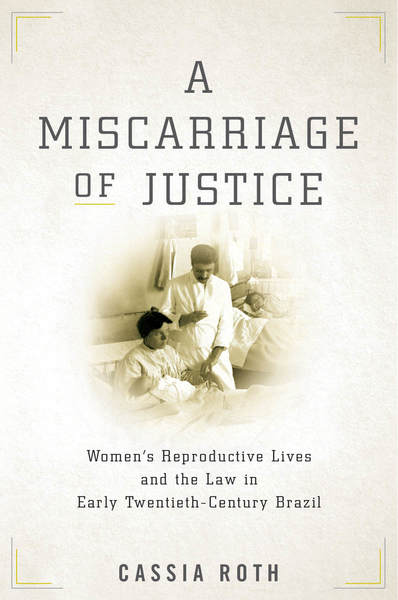
Cassia Roth (University of Georgia) has published A Miscarriage of Justice: Women's Reproductive Lives and the Law in Early Twentieth-Century Brazil with Stanford University Press. From the publisher: 
Cover of A Miscarriage of Justice by Cassia Roth
A Miscarriage of Justice examines women's reproductive health in relation to legal and medical policy in Rio de Janeiro, Brazil. After the abolition of slavery in 1888 and the onset of republicanism in 1889, women's reproductive capabilities—their ability to conceive and raise future citizens and laborers—became critical to the expansion of the new Brazilian state. Analyzing court cases, law, medical writings, and health data, Cassia Roth argues that the state's approach to women's health in the early twentieth century focused on criminalizing fertility control without improving services or outcomes for women. Ultimately, the increasingly interventionist state fostered a culture of condemnation around poor women's reproduction that extended beyond elite discourses into the popular imagination.
By tracing how legal thought and medical knowledge became cemented into law and clinical practice, how obstetricians, public health officials, and legal practitioners approached fertility control, and how women experienced and negotiated their reproductive lives, A Miscarriage of Justice provides a new way of interpreting the intertwined histories of gender, race, reproduction, and the state—and shows how these questions continue to reverberate in debates over reproductive rights and women's health in Brazil today.
Praise for the book:

 "Roth's remarkably wide-ranging research offers a comprehensive and nuanced analysis of the science, law, politics, and lived experiences surrounding women's reproduction in Rio de Janeiro in the first half of the twentieth century. Deeply contextualized in the social, economic, and cultural history of post-abolition Brazil, A Miscarriage of Justice interrogates the dialogue between local and global histories of medical and legal sciences while maintaining focus on individual women whose reproductive lives were increasingly pathologized and criminalized. This remarkable book is sure to become required reading in the fields of Latin American and gender history." - Sueann Caulfield

"With straightforward elegance, Roth conveys the harsh realities of women's reproductive experiences in Brazil in a time of great social transformation. Fully accounting for the historical, political, and cultural complexities of their interactions with the larger community and the state, the author documents both change over time and the continuity of women's legal—and even existential—disenfranchisement through varying political regimes." - Julia E. Rodriguez

"In A Miscarriage of Justice, Cassia Roth provides an innovative and unique history of reproduction in Brazil, weaving together medical and legal directives on childbirth, abortion, and infanticide alongside the intimate, embodied experiences of gendered 'crimes' and social inequalities in Rio de Janeiro. Taking a broad view of reproductive health that explores motherhood, infanticide, and abortion simultaneously, Roth argues that the surveillance and criminalization of women's reproductive practices and of their racialized bodies were critical anchors of Brazilian state-building, especially during the complex years of the authoritarian Estado Novo. This is a deeply researched, sophisticated, and insightful study with significant implications for understanding reproductive justice issues even in contemporary politics." - Okezi T. Otovo

Further information is available here.

--Mitra Sharafi

Tuesday, January 28, 2020

Freidenfelds on miscarriage in America

Lara Friedenfelds (independent scholar) has published The Myth of the Perfect Pregnancy: A History of Miscarriage in America with Oxford University Press. The book includes a chapter on abortion (ch.6) that will be of special interest to legal historians. From the publisher:
Cover for 

The Myth of the Perfect Pregnancy
When a couple plans for a child today, every moment seems precious and unique. Home pregnancy tests promise good news just days after conception, and prospective parents can track the progress of their pregnancy day by day with apps that deliver a stream of embryonic portraits. On-line due date calculators trigger a direct-marketing barrage of baby-name lists and diaper coupons. Ultrasounds as early as eight weeks offer a first photo for the baby book.
Yet, all too often, even the best-strategized childbearing plans go awry. About twenty percent of confirmed pregnancies miscarry, mostly in the first months of gestation. Statistically, early pregnancy losses are a normal part of childbearing for healthy women. Drawing on sources ranging from advice books and corporate marketing plans to diary entries and blog posts, Lara Freidenfelds offers a deep perspective on how this common and natural phenomenon has been experienced. As she shows, historically, miscarriages were generally taken in stride so long as a woman eventually had the children she desired.
This has changed in recent decades, and an early pregnancy loss is often heartbreaking and can be as devastating to couples as losing a child. Freidenfelds traces how innovations in scientific medicine, consumer culture, cultural attitudes toward women and families, and fundamental convictions about human agency have reshaped the childbearing landscape. While the benefits of an increased emphasis on parental affection, careful pregnancy planning, attentive medical care, and specialized baby gear are real, they have also created unrealistic and potentially damaging expectations about a couple's ability to control reproduction and achieve perfect experiences.
The Myth of the Perfect Pregnancy provides a reassuring perspective on early pregnancy loss and suggests ways for miscarriage to more effectively be acknowledged by women, their families, their healthcare providers, and the maternity care industry.
Praise for the book: 

"This lively and informative book is simultaneously an exploration of contemporary 'mommy blogs' and a deeply researched history of childbirth in America. By focusing on the history of miscarriage, it casts new light on almost every aspect of our modern reproductive system, from technological innovations like sonograms to the semantics of abortion debates. It is an innovative and powerful contribution to history and to present-day discourse on childbearing." -- Laurel Thatcher Ulrich

"Bravo! Freidenfelds has delivered a formidable and gripping account of pregnancy loss in America. She weaves the voices of women today and generations past with keen historical and scientific insights. The Myth of the Perfect Pregnancy shines a much-needed light on miscarriage, a subject that has, until now, been hidden from both casual conversations and scholarly scrutiny." -- Randi Hutter Epstein

"Freidenfelds captures the dramatic transformation of the ideal of pregnancy over the past two hundred years, from a normal, accepted part of a colonial woman's life to the highly monitored, commercialized, and emotional-laden experiences of 21st century women. With sensitivity and care she explores the experience of pregnancy loss, which remains a common yet rarely publicly discussed occurrence." -- Rima D. Apple

"The Myth of the Perfect Pregnancy offers far more than a meticulously researched historical perspective on reproductive health and parenting attitudes. It also provides critical insight to the present, with a lesson that much of childbearing and childrearing is out of our control, to expect and accept the ups and downs of life and the inevitable mistakes we will make as parents. Freidenfelds has used facts to illustrate how our perfectionist parenting standards came about, so that we may forgive ourselves our imperfections. This is a message many parents, myself included, need to hear and be reminded of. Freidenfelds' work can help shift the current culture of parenting, and we will all benefit." -- Monique Tello

Further information is available here

--Mitra Sharafi

Thursday, January 23, 2020

Mitra on Indian Sex Life

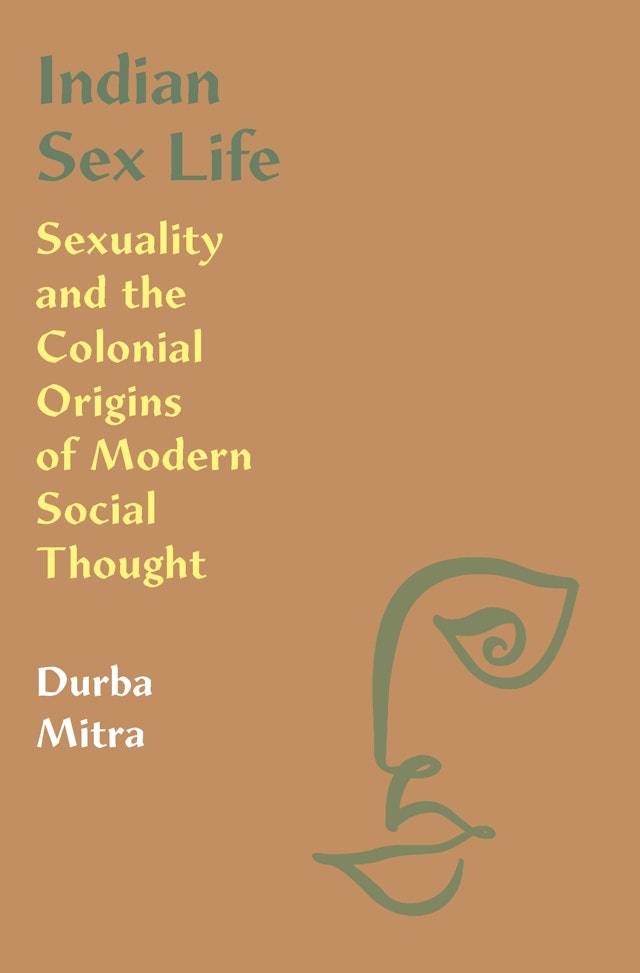
Durba Mitra (Harvard) has published Indian Sex Life with Harvard University Press. From the publisher:
During the colonial period in India, European scholars, British officials, and elite Indian intellectuals—philologists, administrators, doctors, ethnologists, sociologists, and social critics—deployed ideas about sexuality to understand modern Indian society. In Indian Sex Life, Durba Mitra shows how deviant female sexuality, particularly the concept of the prostitute, became foundational to this knowledge project and became the primary way to think and write about Indian society.
Bringing together vast archival materials from diverse disciplines, Mitra reveals that deviant female sexuality was critical to debates about social progress and exclusion, caste domination, marriage, widowhood and inheritance, women’s performance, the trafficking of girls, abortion and infanticide, industrial and domestic labor, indentured servitude, and ideologies about the dangers of Muslim sexuality. British authorities and Indian intellectuals used the concept of the prostitute to argue for the dramatic reorganization of modern Indian society around Hindu monogamy. Mitra demonstrates how the intellectual history of modern social thought is based in a dangerous civilizational logic built on the control and erasure of women’s sexuality. This logic continues to hold sway in present-day South Asia and the postcolonial world.
Reframing the prostitute as a concept, Indian Sex Life overturns long-established notions of how to write the history of modern social thought in colonial India, and opens up new approaches for the global history of sexuality.
The book includes two chapters (at least) that will be of special interest to legal historians: Ch.2, "Repetition: Law and the Sociology of Deviant Female Sexuality" and Ch.3, "Circularity: Forensics, Abortion, and the Evidence of Deviant Female Sexuality." 

Praise for the book: 

"Indian Sex Life is a well-theorized, dense, and provocative addition to current historical scholarship in gender, sexuality, and colonial/postcolonial studies of South Asia. Drawing attention to the surplus of representations around female sexual deviance within historical materials, Durba Mitra makes bold, ambitious claims about the concept of the prostitute and its role in the unfolding of methods in the social study of colonial Bengal."—Anjali Arondekar

"The startling, convincing insight in Durba Mitra's superbly researched concept-history of the prostitute is that ideas about deviant female sexuality undergird modern disciplinary knowledge, shaping debates across fields as diverse as jurisprudence, political economy, and philology. This is a valuable contribution to the global history of sexuality, and essential reading for scholars interested in modernity, colonial knowledge, gender, and cultural history."—Prachi Deshpande

"In Indian Sex Life, Durba Mitra writes with the utmost clarity and precision about female sexuality in colonial India, a topic long regarded as messy and opaque. This innovative and beautifully crafted study of the prostitute makes excellent use of feminist and queer theory to trace the construction of deviancy in social scientific thought. There are crucial insights here for scholars across the disciplines."—Laura Doan

"Pathbreaking and original, Indian Sex Life establishes the central place of deviant female sexuality in discussions about Indian society in a range of disciplines. Departing from other studies about prostitution in the subcontinent, this valuable work makes significant contributions to the literature on colonial India and to the voluminous writings on gender and sexuality in South Asia. It will compel global scholars of sexuality to question their existing assumptions."—Douglas E. Haynes

Further information is available here.

--Mitra Sharafi