Wednesday, March 18, 2009

British Legal History Conference

The organizers of the nineteenth annual British Legal History Conference, to be held at the University of Exeter, 8-11 July 2009, have sent out a reminder that the booking deadline is March 31.

According to the conference announcement:
The conference primarily considers the approaches, perspectives and methodologies of legal history. By drawing together the leading scholars in the field it seeks to stimulate debate, analyse and highlight the fundamental processes in the researching and writing of legal history. It will identify and explore both traditional and novel approaches to the use of diverse source materials, and discuss their nature, relative value and issues of interpretation. This is the first time the methodology of legal history has been an area of focus in an international conference, and it is hoped that through this pioneering collaborative venture a greater understanding and appreciation of the multi-dimensional qualities and diversity of our subject will be achieved. In addressing the making of legal history, the conference provides an opportunity for scholars in law, history and other disciplines to take stock of how they conceive and construct their legal history, while at the same time offering a showcase for substantive legal history research.
A provisional program is here. Other information here.

Hat tip: H-Law

Rosenthal on Original Public Meaning and the Problem of Incorporation

The New Originalism Meets the Fourteenth Amendment: Original Public Meaning and the Problem of Incorporation is a new article by Lawrence Rosenthal, Chapman University School of Law. It is forthcoming in the Journal of Contemporary Legal Issues. Here's the abstract:
This paper, prepared for a symposium on the Bill of Rights and the Fourteenth Amendment at the University of San Diego's Institute for Constitutional Originalism, examines the historical case for incorporation within the Fourteenth Amendment of the rights in first eight amendments to the Constitution in light of the recent turn in thinking about originalist methods of constitutional interpretation.
In recent decades, the historical case for incorporation has made something of a comeback, resting on strong evidence that many of the key framers of the Fourteenth Amendment considered the first eight amendments to be among the privileges and immunities of citizenship protected by the Fourteenth Amendment's Privileges or Immunities Clause. At the same time, however, most originalists have rejected the view that constitutional interpretation should be based on the intent of the framers, and instead have argued that constitutional text should be interpreted in light of its original public meaning. This approach, sometimes called "The New Originalism," seems to have prevailed in the Supreme Court; the Court's recent decision interpreting the Second Amendment's right to bear arms endorses original public meaning as the appropriate method of originalist interpretation.
This paper seeks to demonstrate that the New Originalism poses special problems for incorporation. The view of key framers that because the privileges and immunities of citizenship included the Bill of Rights was not the predominant one; although the concept of the privileges and immunities of citizenship at the time of the Fourteenth Amendment's framing was contested, the most widely shared view was the these privileges and immunities of citizens did not include the first eight amendments. Although many who crafted the Fourteenth Amendment had a different view, the evidence that the drafters succeeded in altering the public's understanding of the privileges and immunities of citizenship is in conflict, and in many respects unsatisfactory. Viewed through the lens of original public meaning, the historical case for incorporation is therefore problematic. The paper concludes that because the meaning of the Privileges and Immunities Clause at the time of ratification with rife with ambiguity, a nonoriginalist approach is a better way to tackle the incorporation problem, even for a New Originalist determined to base constitutional adjudication on methods for ascertaining constitutional meaning that were accepted in the framing era.

Wisconsin Legal History

Here is a website on Wisconsin legal history by the State Bar of Wisconsin's journal, Wisconsin Lawyer. Many of the contributions are by the Madison attorney Joseph A. Ranney, who is the author of Trusting Nothing to Providence: History of Wisconsin's Legal System (Madison: U.W. Law School, Continuing Education & Outreach, 2000).

The website posts the following essays:

* Pioneers in the Law: The First 150 Women

* The Making of the Wisconsin Constitution

* Molders and Shapers of Wisconsin Law: Chief Justices Edward G. Ryan and Luther S. Dixon

* Imperia in Imperiis: Law and Railroads in Wisconsin, 1847-1910

* A Brief History of Wisconsin's Death Penalty:

* The Limitations of Buoyant Opportunism: Law and the Wisconsin Lumber Industry

* Practicing Law in 19th Century Wisconsin

* Law and the Progressive Era, Part 1: The Good Government Movement in Wisconsin

* Law and the Progressive Era, Part 2: The Transformation of Wisconsin's Tax System

* Law and the Progressive Era, Part 3: Reforming the Workplace

* Aliens and "Real Americans": Law and Ethnic Assimilation in Wisconsin 1846-1920

* Wisconsin Law in the Age of Institutions: Chief Justices Winslow and Rosenberg

* The Rise of Labor and Wisconsin's "Little New Deal"

* Looking Further Than the Skin: A History of Wisconsin Civil Rights Law

* The History of Wisconsin's Women's Rights Law, Parts 1 and 2

* Practicing Law in 20th Century Wisconsin, Parts 1 and 2

Tuesday, March 17, 2009

Some Good Books in Asian Legal History (II): Dudden, Japan's Colonization of Korea


“In the summer of 1907, the world declared Korea illegal.” That’s a great first sentence for any book, but for Alexis Dudden, the fact many American readers (and few Korean ones) find the statement startling is precisely what needs explaining. Japan’s Colonization of Korea: Discourse and Power traces the ways that the Meiji government used the discourse of international law “so that Japan would make new international sense, at a time when not making sense in this manner rendered a national ripe for colonization.”

The book draws on legal treatises and political documents to show how Japanese political thinkers used the discourse of international law to frame a precedent for the 1910 annexation of Korea, an event widely recognized as legitimate by the international community. For me, the book was a reminder that the recent upsurge of research on law and empire has not fully included or sensibly theorized Japan’s imperial history; for any legal historian, it's a wonderful history of the political consequences of legal thought.

To be continued ...

Rose to Muse on Clio

Jonathan Rose, Sandra Day O'Connor College of Law, Arizona State University, will speak on "Musing on Clio: Why Study the Past, History, and Legal History," at 3:30 p.m. on Wednesday, March 25, at ASU's Coor Hall. According to the press release, Professor Rose will address two themes:
that there is a commonality between the general interest in the past, the interest of historians, and interest of legal historians, and that several ideas about the past commonly appear in all three contexts. He will explore the various reasons that academic historians and legal historians study the past and the different ways in which they use it. This discussion will also shed light on the nature and development of legal history as an academic discipline.
Update: Professor Rose first delivered the paper as the Fifth Annual Rare Books Lecture of the Tarlton Law Library at the University of Texas School of Law. I understand that it will appear in the Tarlton's publication series.

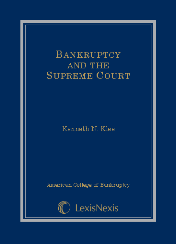
Klee on Bankruptcy and the Supreme Court

Kenneth N. Klee, University of California, Los Angeles School of Law announces his new book, Bankruptcy and the Supreme Court (LexisNexis, 2009), with this SSRN post. The download consist of an excerpt from chapter 1 on Supreme Court Justices papers:
After 7 years, Ken Klee has completed his book on Bankruptcy and the United States Supreme Court. This 6 chapter book is a comprehensive desk reference for lawyers, judges, and scholars examining the Supreme Court's bankruptcy decisions from 1898 through 2008 from six different perspectives. Chapter 1 examines the Court as a governmental and political institution devoting attention to the Court's business and habits, i.e., the processes by which the Court receives bankruptcy cases and decides them and the rules it promulgates to regulate bankruptcy courts and practice.
Chapter 2 looks at how the Court tends to resolve conflicts between bankruptcy law and other areas of state and federal law, such as administrative law, family law, labor law, pension law, probate law, real estate law, and tax law. This discussion is linked closely to Chapter 3 which discusses the constitutional breadth of the bankruptcy power and analyzes how the Court reconciles bankruptcy law with constitutional law, sovereign immunity, federal preemption, and federalism, as well as the use of state law in bankruptcy.
Chapter 4 discusses the Court's treatment of the bankruptcy court as a judicial institution. In particular, it examines how the Court has sculpted and restricted the bankruptcy court's subject matter jurisdiction, powers of the bankruptcy court, and res judicata and collateral estoppel effects of bankruptcy court and non-bankruptcy court judgments.
Chapter 5 analyzes, in considerable detail, bankruptcy law, doctrine, and policies that arise primarily or exclusively of the context of the Bankruptcy Code, such as avoiding powers, dischargeability, claims priority and distribution, and plan confirmation.
Chapter 6 discusses some of the bankruptcy cases over the past 111 years in which the Court sharply changed the course of bankruptcy law. It also includes some favorite cases, regardless of their impact on bankruptcy law or doctrine.

Conference on the Thirteenth Amendment

"Slavery, Abolition, and Human Rights: Interdisciplinary Perspectives on the Thirteenth Amendment" is a conference to be held April 17-18, 2009, at the University of Chicago School of Law. According to its organizers, Amy Dru Stanley, University of Chicago, and Alexander Tsesis, Loyola University of Chicago School of Law:
The conference explores the past and present significance of the Thirteenth Amendment, which abolished slavery and provided constitutional authority for eradicating its badges and incidents and, ultimately, to pass wide ranging civil rights laws. The amendment has offered powerful protections for individual rights and equal treatment against wrongs ranging from peonage and housing discrimination to school segregation and trafficking in persons. Yet the amendment's enduring emancipatory significance has been little studied. The conference looks anew at the foundations and reach of the Thirteenth Amendment, bringing together scholars in the fields of history, law, philosophy, political science, and literature for robust inquiry into its antislavery career.
The keynoter and the speakers and commentators on its four panels ("Promises of Liberty," "Rights," "What Is To Be Done: Coercion," and "What Is to Be Done: Race and Nation") include a firmament of historical and legal luminaries, such as (apologies to the omitted) David Brion Davis, Eric Foner, Martha Nussbaum, David Oshinsky, Rebecca Scott, and Geoffrey Stone. The whole list, and further information, is here. Other contacts are Professor Tsesis's secretary at 312.915.8544 or his email address: atsesis@luc.edu.

Image: "Scene in the House on the Passage of the Proposition to Amend the Constitution, January 31, 1865," Harper's Weekly, February 18, 1865.

Monday, March 16, 2009

New Exhibit: Woman Solicitors in England

The Law Society announces the opening of the exhibit "From Minority to Majority: The Rise of Women in the Solicitors' Profession" in its Reading Room in Chancery Lane. According to the press release, the exhibit, which runs through March 24, draws upon "material from the Law Society's archive and library special collections, which date from 1646."
The exhibition highlights one of the earliest attempts by women to gain permission to sit the Law Society examinations and the implementation of the Sex Disqualification (Removal) Act 1919, which gave women equal access to the legal profession. The Act came into force following a five year battle by women to prove they were just as capable of performing traditionally male-dominated occupations. The Law Times noted on 1 February 1919 that "...the time is arriving when the doors of the Profession should be opened to all persons irrespective of sex."

The first four women to qualify as solicitors in 1922 were Maud Crofts, Carrie Morrison [pictured at left], Mary Pickup and Mary Sykes. After that date an average of thirteen women a year qualified between the years 1923-1943. The Law Society holds details about the gender of its solicitors going back to 1957 when there were 356 female solicitors with practising certificates. In just over fifty years that figure has grown to 47,070 female solicitors (or 43 per cent of the total profession).
Image credit.

Three by Kadens

Recent guest blogger Emily Kadens, University of Texas School of Law, has just posted three papers on SSRN.

The first is Justice Blackstone's Legal Orthodoxy, which is forthcoming in the Northwestern University Law Review 103 (2009). Here is the abstract:
Although William Blackstone served longer as a judge on the English Court of Common Pleas than he had as the inaugural Vinerian Professor of English law at Oxford, his post-professorial legal life has been almost entirely ignored by scholars. Only one brief article, written almost fifty years ago and focused narrowly on legal doctrine, has offered any insight into Blackstone as a judge. And yet the subject is of interest for two reasons. First, Blackstone was the first law professor to become a judge on an English common law court. Second, his judicial opinions provide an alternative, and arguably a more accurate, path into his legal thought. The lectures that became the Commentaries on the Laws of England were written when he was barely thirty years old and had spent fewer than seven unsuccessful years at the bar. By contrast, his judicial opinions are the work of a mature legal thinker. It is not possible to accurately assess how well the jurisprudence expressed in the Commentaries reflects his true legal thought without also studying his opinions and his other available practical legal writing. This article argues that Blackstone's opinions show him to have been a strong and consistent adherent to a basic view of law that all English lawyers shared and that Blackstone advocated in the Commentaries. This view, which is here called the common law orthodoxy, was a set of principles about how law was made and the role of judges in finding it. However, where most lawyers and judges, while taking the orthodoxy as a baseline, were willing to deviate from it as necessary, Blackstone was not. This insistence on principles arguably derived at least in part from his academic habit of seeing the law as a set of abstract rules. Having spent more time and achieved greater success as a teacher than he did as a practitioner, he never came to fully appreciate the practical realities of how the common law worked in the courtroom. Consequently, the man whose work is so admired in American law and who is so often cited as representing the state of the law at the time of the Founders, did not himself have a perfect understanding of the legal mind of his age.
A second paper, The Puzzle of Judicial Education: The Case of Chief Justice William De Grey, continues the theme of eighteenth-century Common Please judges:
Unlike civil law systems in which young lawyers choose between an attorney career track and a judicial one, Anglo-American legal systems mostly select their judges from the whole pool of bar members, regardless of the fact that the appointees may have had no experience with the court on which they are placed. Such a method of selection ensures that many judges come to the bench still needing to prepare themselves for their new positions. This problem is not a new one. At least by the seventeenth century, the specialization of legal practice in England meant that many neophyte judges had a great deal to learn. However, despite the importance of judicial education in forming the sort of judge an appointee becomes, neither modern scholars nor legal historians have given much attention to the issue. This may be due in part to the mystique of the common law judge who is supposed to have been trained on the way to the bench. And it may also be due to the difficulty of finding evidence, as most judges leave no trace of their program of self-education. William de Grey, named Chief Justice of the English Court of Common Pleas in 1771, did. A previously unexplored collection of archival material permits an at least partial reconstruction of his method of training himself for his new job. Examining the approach of de Grey and other eighteenth-century judges demonstrates that not only is the problem of judicial education not a modern one, but the various means by which judges have sought to solve it are also not unique to today.
Image credit.

Finally, Kadens turns to a sanguinary chapter in the history of bankruptcy, The Last Bankrupt Hanged: Bankruptcy Procedure in 18th-Century England:
This paper uses the famous case of John Perrott, hanged for fraudulent bankruptcy in England in 1761, to discuss eighteenth-century English bankruptcy procedure and the threat of capital punishment as a stick to coerce the debtor into divulging his or her assets. The problem the English bankruptcy law faced was balancing the rights of creditors to repayment with the need to prevent debtors from becoming economically disabled. The bankruptcy procedure had numerous chokepoints [as it were--DRE] that made achieving this goal difficult, yet capital punishment proved an unsuccessful means of coercion.
Image credit.

Get Along, Little Legal Historian

Thanks to the prescience of a group of legal secretaries in 1966, the oral history of a long-serving judge in Abilene, Texas, J. R. Black, was recorded and preserved. It's now available on CD, according to a news story, here.

Image credit: Taylor County Courthouse

Call for Papers on Wilsonianism: "World of Power/World of Law"


The Woodrow Wilson Presidential Library, in Staunton, Virginia, will present its next national symposium, "World of Power/World of Law: Wilsonianism and Other Visions of Foreign Policy," on April 14-16, 2010. Organizers have called for papers on such topics as:

"Origins of Wilsonian Internationalism"

"Wilsonianism: Its Effect on World Government and Democracy"

"Twentieth-Century Postwar Visions on American Foreign Policy"

"Civil Liberties in Wartime: Then and Now"

"Is George W. Bush a Wilsonian?"

The program committee will accept 250-word abstracts no later than April 15, 2009. Further details are here. Hat tip: H-Net.

New Legal History Books in the Chronicle of Higher Education


The last few issues of the Chronicle of Higher Education have featured many exciting new books in legal history. Here are a few, along with the brief descriptions from the Chronicle:

True Stories of Crime in Modern Mexico, edited by Robert Buffington and Pablo Piccato (University of New Mexico Press; 276 pages; $27.95). Essays on how accounts of murder, infanticide, kidnapping, and other acts have been used to make sense of Mexican society at different periods of its history.

White But Not Equal: Mexican Americans, Jury Discrimination, and the Supreme Court, by Ignacio M. Garcia (University of Arizona Press; 239 pages; $55 hardcover, $24.95 paperback). A study of Hernandez v. Texas (1954), a murder case that led to a landmark ruling regarding racial bias in jury selection and the rights of Mexican-Americans.

Frontier Constitutions: Christianity and Colonial Empire in the Nineteenth-Century Philippines, by John D. Blanco (University of California Press; 372 pages; $49.95). Topics include the interdependence of Spanish Christianity and indigenous traditions.

Jury, State, and Society in Medieval England, by James Masschaele (Palgrave Macmillan; 271 pages; $89.95). Covers the mid-12th to the end of the 14th centuries, a period that saw the emergence of the Common Law.

Sunday, March 15, 2009

Garrow reviews Satter, Family Properties: Race, Real Estate, and the Exploitation of Black Urban America

FAMILY PROPERTIES: Race, Real Estate, and the Exploitation of Black Urban America by Beryl Satter is reviewed in the Washington Post by David J. Garrow. In this book, the author, a Rutgers University historian, writes about her father, a Chicago lawyer. Garrow finds it "a penetrating examination of the financial discrimination that thousands of African Americans encountered in their northward migration to cities such as Chicago" and "a superbly revealing and often gripping book."
Family Properties
includes the story of Albert and Sallie Bolton, a young African American couple who purchased a home in Chicago's Hyde Park in 1955 on an installment plan "because in the 1950s federal agencies refused to insure mortgage loans for buyers in racially integrated areas."

The seller, a white real estate agent named Jay Goran, specialized in just this kind of deal....After the Boltons signed the contract, Goran added extra fees to their monthly bills. When they called to complain, he refused to speak to them. Then came repeated visits from housing code inspectors....After 18 months, the Boltons fell behind on a payment, and Goran filed for eviction. Prospective buyers were already showing up at the house when the young couple sought help from a hardscrabble Chicago lawyer, Mark Satter.

The novel lawsuit that Satter filed on behalf of the Boltons succeeded only in postponing their ouster until 1959. But in the meantime, Satter researched Goran's tactics, learning, for example, that the real estate speculator had purchased the house for $4,300 just a week before he sold it to the Boltons for triple the price, and that he recently had filed repossession claims on 20 other properties. Satter used the information to publicize how the rigid racial segregation of Chicago's housing market cost the city's black citizens $1 million a day in inflated prices and rents.

Continue reading here.

Saturday, March 14, 2009

Chafetz on Executive Branch Contempt of Congress

Executive Branch Contempt of Congress is a new article by Josh Chafetz, Cornell Law School. It is forthcoming in the University of Chicago Law Review (2009). Here's the abstract:
After former White House Counsel Harriet Miers and White House Chief of Staff Joshua Bolton refused to comply with subpoenas issued by a congressional committee investigating the firing of a number of United States Attorneys, the House of Representatives voted in 2008 to hold them in contempt. The House then chose a curious method of enforcing its contempt citation: it filed a federal lawsuit seeking a declaratory judgment that Miers and Bolton were in contempt of Congress and an injunction ordering them to comply with the subpoenas. The district court ruled for the House, although that ruling has subsequently been stayed.
This Article examines the constellation of issues arising out of contempt of Congress proceedings against executive branch officials. After briefly describing the Miers litigation, it examines the development of legislative contempt against executive officials in Anglo-American law. It shows that the contempt power played a significant role in power struggles between the Crown and Parliament and between the Crown and colonial American legislatures, and that this role was continued into the early state legislatures. It then traces Congress's uses of the contempt power against executive branch officials, including two cases, which have generally been overlooked by both judicial and academic commentators, in which a house of Congress sent its sergeant-at-arms to arrest an executive branch officer.
The Article then uses that history to consider how cases of executive branch contempt of Congress should be dealt with today. It notes the variety of political tools that Anglo-American legislatures have used to enforce their contempt findings, as well as the fact that they did not turn to the courts to resolve such disputes until the late-twentieth century. It then argues that the resolution of such disputes by the courts does significant harm to the American body politic. It therefore concludes both that Congress erred in seeking judicial resolution of this dispute and that the courts erred in finding it justiciable.

Heinze on Law and English Literature

Eric Heinze, Queen Mary, University of London School of Law, has posted two papers on Shakespeare, law and literature. The first, Power Politics and the Rule of Law: Shakespeare's First Historical Tetralogy and Law's "Foundations," is forthcoming in the Oxford Journal of Legal Studies 29 (2009).
Legal scholars' interest in Shakespeare has often focused on conventional legal rules and procedures, such as those of The Merchant of Venice or Measure for Measure. Those plays certainly reveal systemic injustice, but within stable, prosperous societies, which enjoy a generally well-functioning legal order. By contrast, Shakespeare's first historical tetralogy explores the conditions for the very possibility of a legal system, in terms not unlike those described by Hobbes a half-century later. The first tetralogy's deeply collapsed, quasi-anarchic society lacks any functioning legal regime. Its power politics are not, as in many of Shakespeare's other plays, merely latent, surreptitiously lurking beneath the patina of an otherwise functioning legal order. They pervade all of society. Dissenting from a long critical tradition, this article suggests that the figure of Henry VI does not merely represent antiquated medievalism or inept rule. Through Henry's constant recourse to legal process, arbitration, and anti-militarism, the first tetralogy goes beyond questions about how to establish a functioning legal order. It examines the possibility, and meaning, of a just one.
The second, Heir, Celebrity, Martyr, Monster: Legal and Political Legitimacy in Shakespeare and Beyond, will appear in Law and Critique 20 (2009).
The Seventeenth Century places Western political thought on a path increasingly concerned with ascertaining the legitimacy of a determinate individual, parliamentary or popular sovereign. Beginning with Shakespeare, however, a parallel literary tradition serves not to systematise, but to problematise the discourses used to assert the legitimacy with which control over law and government is exercised. This article examines discourses of legal and political legitimacy spawned in early modernity. It is argued that basic notions of 'right', 'duty', 'justice' and 'power' (corresponding, in their more vivid manifestations, to categories of 'heir', 'celebrity', 'martyr' and 'monster') combine in discrete, but always encumbered ways, to generate a variety of legitimating discourses. Whilst transcendentalist versions of those discourses begin to wane, their secular counterparts acquire steadily greater force. In addition to the Shakespearean histories, works of John Milton, Pierre Corneille, Jean Racine, Friedrich Schiller and Richard Wagner are examined, along with some more contemporary or ironic renderings.

Friday, March 13, 2009

Walker on Herbert Wechsler, Legal Process, and Civil Rights

More from Anders Walker, Saint Louis University School of Law. 'Neutral Principles': Herbert Wechsler, Legal Process, and Civil Rights is forthcoming in the Loyola University Chicago Law Journal. Hat tip to the Legal Theory Blog. Here's the abstract:
This paper recovers Columbia Law Professor Herbert Wechsler's constitutional involvement in the long civil rights movement. Derided for criticizing Brown v. Board of Education in 1959, Wechsler first became involved in civil rights litigation in the 1930s, continued to be interested in civil rights issues in the 1940s, and argued one of the most important civil rights cases to come before the Supreme Court in the 1960s. His critique of Brown, this article maintains, derived not from a disinterest in the black struggle but from a larger conviction that racial reform should be process rather than rights-based. By recovering Wechsler's approach, this article suggests a new paradigm for understanding the Supreme Court's role in the civil rights movement, one that focuses on process-based rulings like New York Times v. Sullivan, not Brown.

Gordon to Keynote Washington & Lee Legal Ethics Institute

Robert W. Gordon, the Chancellor Kent Professor of Law and Legal History at Yale Law School and a past president of the American Society for Legal History, will deliver the keynote speech at Washington and Lee University’s Legal Ethics Institute on Friday, March 27, at 4:30 p.m. at the Washington and Lee University School of Law (Lewis Hall). The title of his talk, which is free and open public, is “Are Lawyers Guardians or Subverters of the Rule of Law?”

More and a hat tip here.

Graber on James Buchanan and the Federal Judiciary Act

Mark Graber, University of Maryland School of Law, has posted James Buchanan as Savior? Judicial Power, Political Fragmentation, and the Failed 1831 Repeal of Section 25. Here is the abstract:
James Buchanan is often credited with being the unlikely savior of judicial review in early Jacksonian America. In 1831, Buchanan, then a representative from Pennsylvania, issued a minority report criticizing the proposed repeal of Section 25 of the Judiciary Act of 1789 that is generally credited with convincing a skeptical Congress that fundamental constitutional norms required federal judicial oversight of state courts and state legislatures. This paper claims that federalism and political fragmentation were more responsible than James Buchanan for the failed repeal of Section 25, for the maintenance of judicial power in the United States during the transition from National Republican rule to Jacksonian Democracy that took place during the 1820s and 1830s, and for the maintenance of judicial power in the United States during other political transitions. The Jacksonian experience more generally highlights how political diffusion helps preserve judicial power both during periods of political stability when no existing coalition fully controls the national government and during periods of political reconstruction or realignment when a new coalition gains control of the national government. Judicial power, the evidence from 1831 and other times suggests, thrives in a political environment more characterized by intercurrence than realignment. In political environments characterized by intercurrence, the political institutions that must unite for a successful challenge to federal courts are rarely on the same page. Challenges to judicial authority occur more frequently because, in a world of relatively autonomous elected branches of government, at least one is likely to be seriously at odds with decision making trends on the Supreme Court. These more frequent challenges are also more likely to fail because other elected branches of government are more likely to be moving more in step with the judicial majority than the challenging branch of the national government. Just ask the southern Jacksonians who discovered that the political transformations that gave them the power to elect one of their own Speaker of the House were not sufficient in 1831 to align the rest of the Congress against the Supreme Court.
Hat tip: Robert Richards

Thursday, March 12, 2009

Some Good Books in Asian Legal History (I): Zinoman, The Colonial Bastille

Like most readers of the Legal History Blog, my graduate school training focused almost exclusively on the history of the United States. And, like many other U.S. historians of the last few years, I have taken the “transnational turn,” in my case through an increasing interest in Asian history and U.S.-Asian relations. This post is designed to be the first in a series that introduces blog readers to some really interesting and accessible kind-of-recent books in modern Asian legal history. That’s it: interesting and accessible. Or at least they were to me. I hope that readers—particularly those with advanced expertise in this area—will offer their own suggestions as well. Send them on, either by email or through the Comments feature, and I will compile them for future posts.

In The Colonial Bastille: A History of Imprisonment in Vietnam, 1862-1940 (2001), Peter Zinoman traces French Indochina’s prison system from its construction through the beginning of World War II. Vietnamese Communists often called the colonial prisons a “school for revolution,” and Zinoman traces the ways in which (especially in the 1930s) “the Indochinese prison system provided a curiously stable environment for the reconstitution and expansion” of the Indochinese Communist Party. He also challenges much recent literature on colonial empires that suggests they were “model laboratories” for modern statebuilding. Quite the opposite, he argues. “It was the antiquated and ill-disciplined aspects of the colonial prison that facilitated its transformation into an instrument of anticolonial resistance.”

For me, this book was a reminder of the richness of Vietnamese historiography that U.S. historians rarely (if ever) give to their students when they teach about America’s Vietnam War. Beyond that, The Colonial Bastille is an amazing political and social history of imprisonment that should be of interest to any scholar who has struggled to figure out how to tell the history of prisons.

To be continued…

Walker on Herbert Wechsler, the Model Penal Code, and the Uses of Revenge

American Oresteia: Herbert Wechsler, the Model Penal Code, and the Uses of Revenge is a new paper by Anders Walker, Saint Louis University School of Law. Here's the abstract:
The American Law Institute recently revised the Model Penal Code's sentencing provisions, calling for a renewed commitment to proportionality based on the gravity of offenses, the "blameworthiness" of offenders, and the "harms done to crime victims." Already, detractors have criticized this move, arguing that it replaces the Code's original commitment to rehabilitation with a more punitive attention to retribution. Yet, missing from such calumny is an awareness of retribution's subtle yet significant role in both the drafting and enactment of the first Model Penal Code (MPC). This article recovers that role by focusing on the retributive views of its first Reporter, Columbia Law Professor Herbert Wechsler. Though a dedicated utilitarian, Wechsler became increasingly aware of retribution's value to sentencing over the course of his career, using that awareness to guide both the development and adoption of the MPC. Recovering his view helps us to contextualize and perhaps even better appreciate the current revision's emphasis on proportionality.

Siegel on Heller and Originalism

Reva Siegel, Yale Law School, has posted Heller & Originalism's Dead Hand - In Theory and in Practice. Here is the abstract:
This essay considers whether and how originalism promotes the Constitution's democratic legitimacy, in theory and in practice. In the late twentieth century, critics of the Warren and Burger courts argued that judicial review lacks democratic authority when judges depart from the original understanding of those who ratified the Constitution. Originalism's critics objected that giving past generations this kind of control over the living would vitiate the Constitution's democratic authority. Initially, originalism's theorists belittled this objection to dead hand control; recently, originalists have developed varied and sophisticated responses to it. But these responses generally tend to qualify originalism's claims to democratic legitimacy or to weaken the originalist character of the interpretive method they set out to defend.

The dead hand objection may trouble originalism in theory, but it poses far less of a problem in practice. To show why, the essay examines originalist interpretation in Heller v. District of Columbia. While Heller purports to enforce the decisions of eighteenth-century Americans, this essay identifies several forms of internal evidence that suggest the opinion is enforcing the beliefs of Americans living long after the Constitution's ratification. This evidence, considered alone or with the social movement history of Heller that I have elsewhere examined, shows how originalism can enforce the constitutional convictions of living Americans. In practice, originalism appears to be a species of popular constitutionalism.

If originalism does not enforce dead hand control, what role might constitutional history play in constitutional interpretation? To explore this question, I compare the role of historical argument in Heller and Parents Involved in Community Schools v. Seattle School District No. 1-a recent equal protection decision in which conservative and liberal justices fought over Brown and the post-ratification history of the Fourteenth Amendment. This analysis suggests that collective memory of past lawmaking constrains debate as it enables Americans of very different normative views to make authoritative claims about who we are and what we owe one another.
Hat tip: Legal Theory Blog.

Wednesday, March 11, 2009

Teles and Tushnet on the Conservative Legal Movement

HLS in Focus: The Official JD Admissions Blog at Harvard Law School, has a post on a joint session by Steven Teles and Mark Tushnet on (what else) the Conservative Legal Movement, sponsored by the Federalist Society. The post commences:
As the ‘changing of the guard’ continues to take place down in Washington this spring, conservatives and libertarians are seeing their power crumble and their government job prospects evaporate into the ether of political upheaval. Or are they? The Federalist Society recently invited Professor Mark Tushnet and Steven Teles, a professor of political science at Johns Hopkins and the author of The Rise of the Conservative Legal Movement, to discuss the fate of the Federalist Society in the wake of 25 years of marked success. Is there still work to be done or will it disappear into an ‘end of history’ haze of obsolescence?
More here.

Finkelman to Deliver the Huggins Lectures

W. E. B. Du Bois Institute for African and African American Research, Harvard University, announces that this year's Nathan I. Huggins Lectures will be delivered by Paul Finkelman, Albany School of Law. The lectures, "The Supreme Court and The Peculiar Institution: Marshall, Story, Taney, and the Defense of Slavery," will be delivered at the Thompson Room, Barker Center 12 Quincy Street, Cambridge, Mass. For more information, please contact the Du Bois Institute at 617.495.8508.

Tuesday, March 17, 4 P.M.
"Chief Justice Marshall and Slavery: A Slaveholding Chief Justice Discovers the Limits of National Power"

Wednesday, March 18, 4 P.M.
"Joseph Story of Slavery: The Enigma of an Antislavery Man who Became a Proslavery Justice"

Thursday, Thursday 19, 4 P.M.
"Chief Justice Taney and Slavery: Defending the Cornerstone at all Costs"

Hat tip: Jay Stewart

Tuesday, March 10, 2009

Mack and MacLean Dialogue on Civil Rights History in Law and History Review

Hot off the (electronic) presses! Just posted today on the website of the Law and History Review is a lively exchange between Kenneth W. Mack (Harvard Law School) and Nancy MacLean (Northwestern University) on law and civil rights history that the journal will publish in Volume 27, no. 3 (Fall 2009).

Mack's essay, "Bringing the Law Back into the History of the Civil Rights Movement: Legal History Dialogue with Nancy MacLean," responds to MacLean's recent book, Freedom Is Not Enough: The Opening of the American Workplace. Mack describes the book as the "first major synthesis to bring law back into the social history of civil rights politics," and situates it within recent literature in legal history. (The essay is a must-read for graduate students preparing for general exams.)

MacLean's response, "Ideas for a New Agenda for the Study of African American Legal Liberalism in the Age of Obama," responds to Mack's comments and reflects on possibilities for scholars interested in African-American legal liberalism. The most striking comment that MacLean notes? "The papers of Barbara Jordan held by Texas Southern University have never been consulted by researchers, according to archivists there."

Somebody want to get on that?

Gross, Newman and Campbell on America's First Female Bankrupts

Ladies in Red: Learning from America's First Female Bankrupts is an article by Karen Gross, New York Law School, Marie Stefanini Newman, Pace University School of Law, and Denise Campbell, a New York Law School graduate. It appeared in the American Journal of Legal History (1996), and has just been posted on SSRN. Here's the abstract:
Several years ago, the Honorable Joyce Bihary, a bankruptcy judge in Atlanta, Georgia, asked me why our country's first bankruptcy law specifically referred to debtors using "he" or "she" rather than a gender neutral noun (such as "bankrupts") or the male possessive pronoun "he." Implicitly, she was also asking whether there were any women debtors under our early bankruptcy laws. Although I had read the Bankruptcy Act of 1800 more than once, I did not recollect its use of these gender-inclusive pronouns. Nor did I know why the Act employed them. Despite having given considerable thought to contemporary women in debt, I too had no inkling as to whether there were women debtors under the Bankruptcy Act of 1800. And so I set out, with the help of my co-authors, to find the answers to Judge Bihary's two questions. Those answers led us to new questions and concerns, most particularly questions about how bankruptcy history has been told to date.

Heise on Nuremberg and the Abiguous History of the Tu Quoque Defense

Deciding Not to Decide: Nuremberg and the Ambiguous History of the Tu Quoque Defense is an article by Nicole A. Heise. Based on archival research in Nuremburg-related papers, the article won the Emerson Prize for outstanding academic promise in history, and was published in The Concord Review (2007). Heise wrote the article while a sophomore at Ithaca High School. Here's the abstract:
Tu Quoque forged its historic legacy during the Nuremberg Tribunal following World War II when German Admiral Karl Doenitz used it as a defense to deflect war crime charges brought against him. By raising the Tu Quoque defense, Doenitz argued that he should be acquitted because other leaders and nations also committed the same crimes. Although many scholars note the Tu Quoque defense's importance, its history has largely been ignored. Using original court documents and personal papers from the Nuremberg Tribunal collection archived at Cornell University, this essay argues that the Tu Quoque defense's history is far from clear and that this ambiguous history clouds its legacy.

Monday, March 9, 2009

Maltz on The Presidency, the Electoral College, and the Three-Fifths Clause

The Presidency, the Electoral College, and the Three-Fifths Clause is a new paper by Earl M. Maltz, Rutgers School of Law-Camden. Here's the abstract:
The three-fifths clause of Article I, section 2, paragraph 3 is one of the most controversial provisions of the Constitution. Commentators who view the Constitution as a proslavery document contend that the "extra" representation given to slave states by the three-fifths clause played an important role in maintaining what they view as Southern dominance of the legislative process in the pre-Civil War era. In recent years, a number of scholars, including Akhil Amar, Paul Finkelman, and David Walker Howe have extended this critique to include the claim that the structure of the presidential selection process should also be considered proslavery. Noting that the three fifths clause is a significant factor in determining the makeup of the electoral college, these scholars argue a) that the rejection of a plan for direct election of the President was a concession to the Southern states and b) that in practice, the structure of the electoral college allowed Southerners to unfairly influence presidential choices. This article disputes both of those claims.

Anderson on Charles Hamilton Houston's Criminal Justice Work

The Criminal Justice Principles of Charles Hamilton Houston: Lessons in Innovation has just been posted by José F. Anderson, University of Baltimore School of Law. It appeared in the University of Baltimore Law Review (2006). Here's the abstract:
One of the legal giants in American history is Charles Hamilton Houston. To modern lawyers he is still obscure, but some recognition of his extraordinary legal talent came during the nation's celebration of the fiftieth anniversary of the Supreme Court's decision in Brown v. Board of Education.

Although Houston died over four years before the Supreme Court issued its historic opinion in Brown, he was widely recognized as the architect of that decision, which banned segregation in public school education. Prior to his death, Houston had worked on litigation to eradicate segregation in education since the early 1930's. Houston's first major victory in this effort was in Pearson v. Murray, when he, along with Thurgood Marshall and William I. Gosnell, successfully challenged the racial exclusion policy at the University of Maryland School of Law. The Pearson case was also the first major victory in the National Association for the Advancement of Colored People's (NAACP) legal assault on "Jim Crow."

The legal significance of Houston's civil rights work, however, has obscured his impact on other areas of the law. This is particularly true with regard to his impact on the criminal justice system. During his remarkable career that spanned only about a quarter century, Houston engaged in litigation that still affects some of the most important areas of criminal justice in the nation. This article is an effort to identify a few of those major areas and recognize Houston's rightful place among the criminal justice legends of the twentieth century.

His impact on the law of jury selection, capital punishment, right to counsel, police interrogation and mental state defenses have set the standard for the most important criminal justice jurisprudence in the nation's courts. Although he was not the first lawyer to address these important issues, he certainly had as great an impact on their development as he did on the civil rights work which has been the most visible part of his legacy.

In his brief career his criminal law case choices reflected his profound concern for the criminally accused. Further, his selection of controversial issues, difficult cases and visionary strategies foreshadowed both the modern criminal justice landscape and laid out the battle ground for current criminal justice disputes. Houston's work defies easy categorization. While he was obviously concerned with equal protection under the law involving issues of race he also embraced structures which provided more general fairness in criminal law.

From examining Houston's criminal law work in all criminal cases that either resulted in or were appeals from reported cases, I have concluded that there are several important characteristics that suggest when Houston would invest his time and talent in a criminal case. It was not simply a question of fame or assignment and certainly not money.

Rather, Houston selected extremely difficulty criminal cases to test the system and advance important principles of fairness and justice that he determined to be worthwhile. In the same manner that he approached his systematic Jim Crow strategy, he also attacked the criminal justice system with vigor and passion.The principles that motivated Houston's choice of criminal justice issues and cases are when one or more of the following circumstances existed:

(1) Penalty was severe without adequate process;

(2) Panel of the jury included no African-Americans;

(3) Proof of the criminal case without sufficient integrity of the fact finding process;

(4) Police procedures executed without adequate accountability in obtaining confessions; and when the

(5) Purpose of the prosecution lacked adequate structural limitations.

Hansford on Death by Narrative and the Marcus Garvey Case

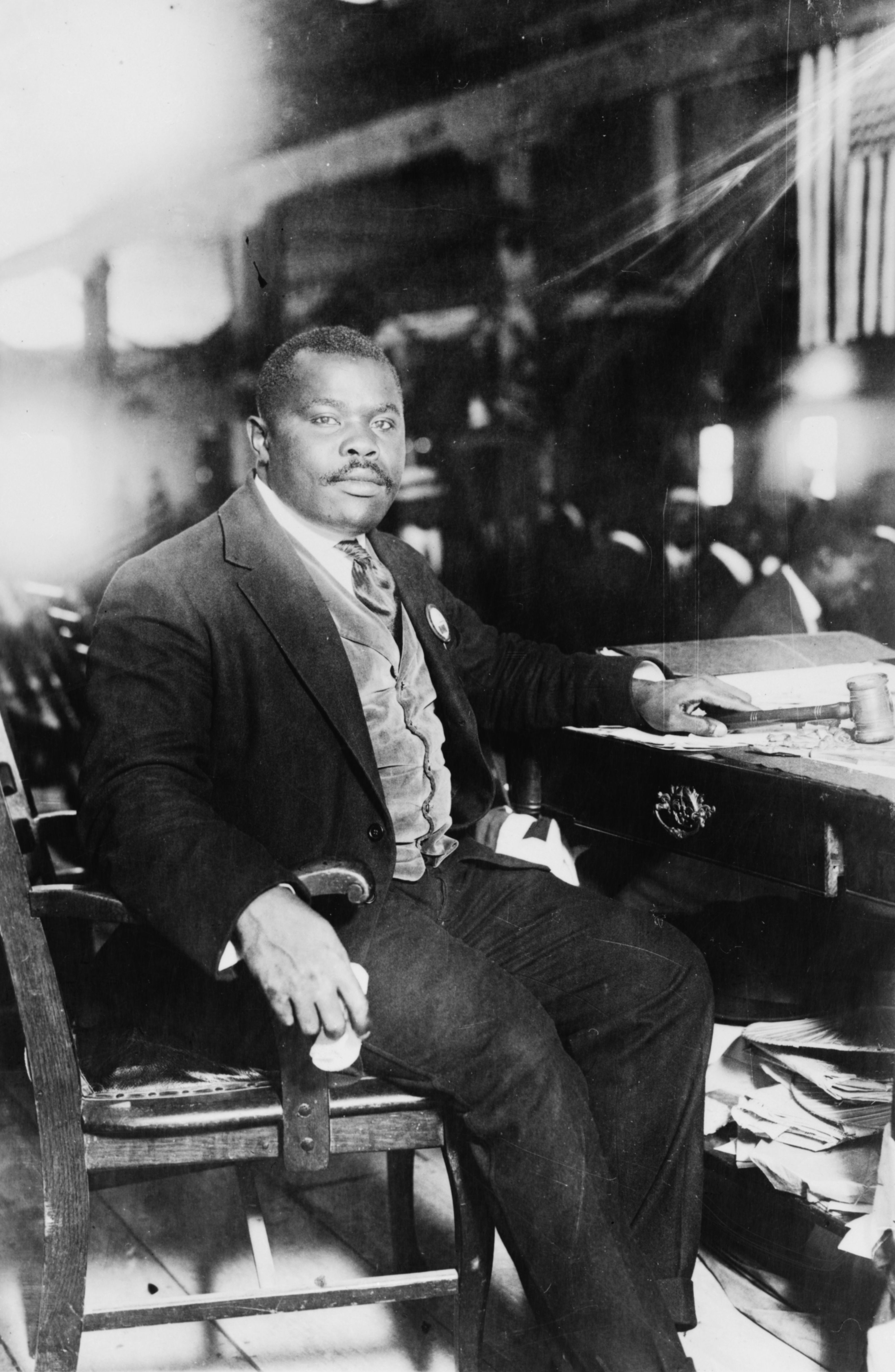
Jailing a Rainbow: Death by Narrative and the Marcus Garvey Case is a new paper by Justin Hansford, Georgetown University Law Center Class of 2007. It is forthcoming in the Georgetown Journal of Modern Critical Race Perspectives (2009). Here's the abstract:
The relevance of narrative in the law continues to reemerge in legal scholarship. This article uses concepts from both Critical Race Theory and Law and Economics to reassess the conviction of Marcus Garvey, the Harlem Renaissance era civil rights activist. In this case, newly discovered evidence suggests that the manipulation of Garvey's legal narrative by his opponents played a larger role in his conviction than first thought; a role decisive enough to raise concerns of unethical judicial bias and warrant possible exoneration hearings.
This paper argues that not only was Garvey unjustly convicted of mail fraud in 1923, but this injustice was also the culmination of an unholy alliance between Garvey's political rivals and Jim Crow era government officials. Together, the legal narrative they crafted contributed to Garvey's untimely death, tainted his legacy for decades, and helped to misshape the future of the 20th century struggle for racial justice.
Many scholars have noted that legal narratives often subordinate the voices of people of color. However, this study goes further, exploring how unjust legal narratives have served to warp our collective cultural and historical narrative. This larger result has had a powerful impact on the course of political events in our country. In this case, Garvey's conviction and deportation facilitated the marginalization and silencing of his philosophy of racial justice, a strategy that focused primarily on economic empowerment for people of African descent throughout the world. As a result of the silencing of this voice, nearly a century later Blacks have obtained the political and social rights favored by Garvey's rivals, but as a whole still suffer from grave economic disparities worldwide.
The federal judiciary has a storied legacy, being peopled by men and women who have defended and fought for our highest values as a nation. This case appears to be one of the sad exceptions to that rule. But most of all, it should serve as a cautionary tale to practitioners who must learn how to identify and fight the destructive use of legal narrative in contemporary contexts.

Sunday, March 8, 2009

Reviewed: Nelson on The Common Law of Colonial America, Shain on Rights at the Founding, and Feldman on Free Expression

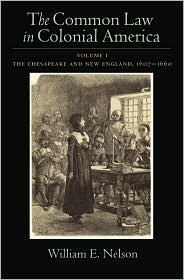
The Common Law of Colonial America: Volume I: The Chesapeake and New England 1607-1660 by William E. Nelson is reviewed by George W. Liebmann, Liebmann and Shively, P.A. of Baltimore and Visiting Fellow of Wolfson College, Cambridge for the Law and Politics Book Review. Liebman writes:

This slender volume by an outstanding scholar of colonial law sheds much light on continuing differences in legal and political culture among states on the Atlantic seaboard. It begins with the conventional premise that “Virginia was founded primarily for economic profit; New England, primarily to create a religious utopia; and Maryland, primarily to provide a haven for persecuted Roman Catholics.” As a result, Virginia law began as a body of coercive statutes (Dale’s Laws of 1611), replaced by a new codification 1n 1650 designed to enforce and extract labor; New England law was founded on views resembling the Protestant approach to the Bible, in which pre-existing English texts were of limited importance; while the Catholic minority in Maryland consciously adopted English common law to provide a fixed standard to shield a religious minority from future majority oppression. Virginia ultimately turned toward the English common law to provide assurance to providers of capital and because the colony could no longer be governed on a military command system.
Continue reading here.

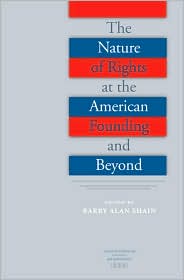
Also in the Law and Politics Book Review, The Nature of Rights at the American Founding and Beyond by Barry Alan Shain (ed) is reviewed by Paul A. Passavant, Department of Political Science, Hobart and William Smith Colleges. There has been much scholarship over the past three decades about rights, Passavant writes.

Many of these interventions, however, take for granted that the United States has always had a liberal or “Lockean” political or legal culture, and that this is a culture of individualism. American historians have troubled such assumptions by returning to the late colonial and founding period in American history to rediscover influences from the Scottish Enlightenment or civic republicanism. THE NATURE OF RIGHTS AT THE AMERICAN FOUNDING AND BEYOND, contains essays, organized more or less historically, from scholars who have added to our understanding of rights in American history and American political thought in especially significant ways over the last thirty years. Its main strength is that it contains exemplary essays from those whose contributions have spanned multiple volumes. Here, in one place, the reader can find an essay that seems to capture a scholar’s most important findings over the course of a career – such as John Philip Reid’s contribution discussing the importance of the British Constitution and the rights of Englishmen to late colonial and early revolutionary struggles.

This collection includes scholars of the revolutionary or founding period who bring their great breadth and depth of knowledge regarding these eras to bear on a particularly specific aspect of rights. Through this focused inquiry, they unpack late 18th century America as a political culture unleashing the potential for future political and legal struggles over rights. Jack Rakove’s [*137] essay, for instance, describes the dilemma of declaring rights the framers faced since any declaration at that historical moment risked both later interpretive ambiguity and risked limiting, unintentionally, rights later generations might find necessary (Thomas Jefferson’s view was that half a loaf was better than none). Gordon Wood’s contribution shows that rights have existed within a variety of political or legal orders and have become reinscribed within new political settings. The medieval king had a right to govern, and the English had their feudal rights, but over the course of the 17th century, rights came to be understood as something to be held against the monarch while Parliamentary sovereignty was understood to be the protector of the people’s rights. The American experience grew out of a tradition of rights claims against a monarch, but after the experiment with state sovereignty under the Articles of Confederation, republicanism developed, in the American context, a recognition that legislatures and executives, though agents of the people, might also threaten the rights of the people as monarchs once had.
Read the rest here.

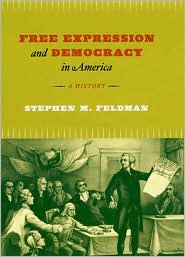
Also reviewed is Free Expression and Democracy in America: A History by Stephen M. Feldman Jerome O’Callaghan, State University of New York at Cortland writes:

Stephen Feldman has created a history of free expression and democracy that describes and analyzes the mainstream of American history through two ever-present and complementary traditions: one of suppression and one of dissent. From the War of Independence to the War on Terror, everyone who matters is engaged in, or by, this tug of war. Presidents, political theorists, judges, and the public, support dissent and then worry that it has gone too far. It is no surprise that in 200 years of American history freedom of expression came to mean different things to different generations, but if there is one trend that you can count on it is this: in times of war the tradition of suppression is in the ascendant. Feldman adds to the basic duality of his suppression-dissent framework an overarching theory of American political history – i.e., the transition from a republican democracy to today’s pluralistic democracy. The result is not a simple four by four matrix; in Feldman’s hands we have a thorough and engaging 470-page treatise (plus 60 pages of footnotes).
Although he quibbles with aspects of the book, O'Callaghan finds that "Nevertheless, given the enormity of this undertaking, Feldman has done a remarkable job."

The full review is here.

Stein on Workplace Injuries in Victoria's Reign

Michael Stein, William and Mary Law School, has posted the paper Victorian Tort Liability for Workplace Injuries, which appeared in the University of Illinois Law Review (2008). Here is the abstract:
The first decision of an injured worker suing his master for a workplace accident was reported in 1837, the year of Queen Victoria's ascension. The second Workman's Compensation Act, a comprehensive social insurance scheme, was passed in 1900, a few months before her death. The Article provides an initial account of the development of employers' liability to their servants for work-related injuries during the Victorian era. It demonstrates that English judges, and especially the Barons of the Exchequer, interpreted the law to resist employers' liability. The means these judges used included creating the defence of common employment, widely applying the doctrines of assumption of the risk and contributory negligence, quashing nearly every innovative attempt to create law favourable to labourers, and avoiding House of Lords precedent that supported a limited form of liability. The Article argues that the dominant influence of political economy as an intellectual schema provides the most complete account of why Victorian judges acted in this manner. It also demonstrates that the three leading rationales for the parallel development of American tort law (judicial restraint, the invisible hand hypothesis, and the subsidy theory) fall short as explanations. By setting forth the first comprehensive treatment of the evolution of English employer/employee liability, the Article provides a comparative perspective into the debate over the development of American tort law, and challenges its reinterpretation. The considerable weaknesses of the traditional historical explanations for the development of tort law when applied to the English context suggest that they may not be as strong for the American context. The Article demonstrates that historical inquiries are important for understanding novel applications of traditional legal doctrines to rapidly changing technological circumstances. Many of the same dilemmas faced by English judges in the aftermath of the Industrial Revolution are being reprised for contemporary American jurists. Understanding how a previous generation of judges approached similar jurisprudential quandaries, as well as what motivated their decisions, lends insight to modern-day struggles with these dilemmas.
Image credit.

Saturday, March 7, 2009

Wildenthal on Commentary on Nationalizing the Bill of Rights, 1867-73

Nationalizing the Bill of Rights: Scholarship and Commentary on the Fourteenth Amendment in 1867-73 is a new article by Bryan H. Wildenthal, Thomas Jefferson School of Law. It will appear in the Journal of Contemporary Legal Issues (2009). Here's the abstract:
This Article is part of a Symposium, "The Fourteenth Amendment and the Bill of Rights: What Have We Learned? Why Does It Matter?" (University of San Diego School of Law, Center for the Study of Constitutional Originalism, Jan. 7, 2009). The general topic of the Symposium, and the articles growing out of it, is the so-called "incorporation debate." That debate concerns whether and to what extent the Bill of Rights (originally applicable only to the federal government) has properly been "incorporated," "enforced," "applied," or "nationalized" (pick your terminology) against the states. Everyone agrees that such a goal was embraced by some leading Reconstruction Republicans, such as Rep. John Bingham and Sen. Jacob Howard. But scholars continue to debate whether (or how broadly) the idea was shared in Congress, out in the states during the ratification process, or among the bench, bar, press, and public generally. This issue has become newly current given speculation that the Supreme Court, in the wake of District of Columbia v. Heller, 128 S. Ct. 2783 (2008), may apply to the states the Second Amendment right to bear arms.
The particular focus of this Article is on what may be learned from the scholarly and press commentary on the Amendment from 1867 to 1873 (up to before the Slaughter-House Cases decided in April 1873). How much weight should such commentary (mostly post-ratification) have as a general matter? Does the commentary support the incorporation thesis or undermine it? The writers considered include well-known legal scholars of the era such as Cooley, Bishop, Wharton, Pomeroy, Farrar, and Paschal, and also a less-well-known but arguably significant figure, Samuel Smith Nicholas of Kentucky. Articles in "The Nation," then a leading Republican-oriented newsmagazine (founded in 1865), and some other news articles, are also considered. While this Article has sought to be thorough in assessing relevant scholarly discussions published in book or law review form during the period covered, it does not exhaustively survey all of the archival newspaper or magazine materials that have recently become more readily available. More work remains to be done in future articles.
This Article concludes that, on the whole, the commentary during this period supports the thesis that nationalizing the Bill of Rights was part of the original public meaning of the Amendment, though the evidence is certainly mixed and others may draw different conclusions. The Article offers some cautious and tentative thoughts about the broader theory of originalism, but generally remains focused on the historical details.
Other articles in this Symposium deal with various related historical and theoretical issues. This Article offers a number of responses to the other articles, all of which will be published in Voume 18 of the University of San Diego's Journal of Contemporary Legal Issues. The other articles posted so far on SSRN include: Michael Kent Curtis, "The Bill of Rights and the States: An Overview From One Perspective," 18 J. Contemp. Legal Issues --- (forthcoming 2009) (http://ssrn.com/abstract=1334687); Kurt T. Lash, "Beyond Incorporation," 18 J. Contemp. Legal Issues --- (forthcoming 2009) (http://ssrn.com/abstract=1323431); and Lawrence B. Solum, "Incorporation and Originalist Theory," 18 J. Contemp. Legal Issues --- (forthcoming 2009) (http://ssrn.com/abstract=1346453).

Reitz on the comparative history of judicial independence

Comparative law scholar John C. Reitz, University of Iowa College of Law, has a new article that draws upon a broad range of sources on the history of judicial independence, Politics, Executive Dominance, and Transformative Law in the Culture of Judicial Independence. It will appear in the University of St. Thomas Law Review. Here's the abstract:
In the last two decades Latin America has experienced a significant resurgence of democracy, yet efforts to strengthen the independence of the judiciary, largely focused on institutional reforms of the judiciary itself, have been disappointing. It is apparently not enough to construct appropriate judicial machinery. How can one keep the nation's politicians from trying to control the judges? Through a wide-ranging historical and comparative method that starts with the debate in ancient China over law and morality, builds on insights from observations of contemporary Islamic courts, and surveys the development of institutional protections for judicial independence in the United States, France, and England, this article seeks to explore the culture of judicial independence by asking what the political and social logic in favor of and opposed to judicial independence is. This article seeks to contribute to the cultural approach, first by understanding the enduring strength of the opposing culture, the culture supporting political control over the courts, and second, by exploring the argument that a belief in law's ability to transform society characterizes cultures supporting reasonable levels of judicial independence. If belief in transformative law is an important feature of the culture of judicial independence, then perhaps that belief can be deployed against the perennial claims for political control. Strategies designed to strengthen belief in transformative law by improving the effectiveness of laws intended to be transformative, it is argued, could be promising ways of supplementing institutional reforms by increasing cultural support for judicial independence.

Friday, March 6, 2009

Grad school and joint programs in a down economy

Applications are up at some law schools this year, in spite of law firm layoffs, although flat elsewhere, and many law schools, like other educational institutions, are cutting back. There is anxiety all around about placement for law grads, but there has been little attention to the question of whether structural changes in legal education are necessitated by the new economic climate. What about graduate school?

The always interesting Anthony Grafton has an essay in The Daily Princetonian, Graduate School in a New Ice Age. Hat tip. Grafton sets the current economic crisis in the context of the dark days for humanities departments in the 1970s. Difficult times moderated in the 1990s and after, but, he writes, "conditions remained difficult — and worse than difficult — for many students, but eased for those in the departments that adapted. It seemed that we had found the way to train students for the world they actually faced."

But now,

the floor beneath us has collapsed again....It has taken colleges and universities only a few months to go from prosperity to austerity. In the humanities, 15 to 20 percent of the jobs originally advertised for this year have been cancelled. And as university after university announces budget cuts and staff layoffs, it seems certain that next year will be even worse.

It’s time to think hard about our graduate programs and their relation to these new realities. Should we cut numbers even further? Emphasize professionalization even more? Can we contrive to give students something of the freedom and possibilities for wide-ranging exploration that their predecessors enjoyed before our permanent crisis took shape? Can we be frank about the professional situation that students face without inspiring despair?

These questions have no simple answers. But if we fail to pose and discuss them publicly, we will see another generation’s relationship with the university ruined by our refusal to face and discuss facts.

A prescient Ralph Luker suggested two years ago that some history PhD programs should close to ease a glut of recent PhD's on the job market.
Perhaps for some humanities departments, it will be a productive time to partner with law schools and other professional schools, and also to rethink the role of the MA in history.
It is always important to be careful about JD/PhD programs. Such programs at law schools that are not strong feeders into the law teaching market might attract students interested in law teaching, but who might then fare poorly on the law job market. But this need not be the only function of joint programs. With renewed interest in the MA, some schools might offer focused MAs in legal history or other areas, even for students or established scholars who earned their PhD elsewhere. The new Columbia/London School of Economics joint program in international history is an interesting model. I can imagine an MA in human rights history, for example, that would benefit scholars who need a background in international and human rights law.
Joint programs with professional schools might also be important for programs that build a strong public history emphasis. I would expect that a history PhD with an MBA might be attractive to students who see a possible career track in museum work, for example.
In the law school world, a down economy may ultimately mean a turn toward practicality, which for some may mean a turn away from interdisciplinarity. Forward looking programs, however, will find productive partnerships and new programs that meet emerging needs, and position them well for a future when the economy picks up again.

Meyerson on The Neglected History of the Prior Restraint Doctrine

The Neglected History of the Prior Restraint Doctrine: Rediscovering the Link between the First Amendment and the Separation of Powers has just been posted by Michael I. Meyerson, University of Baltimore School of Law. It appeared in the Indiana Law Review (2001). Here's the abstract:
The prior restraint doctrine, once so fundamental to Constitutional Jurisprudence, has lost much of its effectiveness over the years. Nevertheless, prior restraint doctrine is crucial to preserving the line between protected and unprotected speech. One of the fundamental problems that contribute to the current ineffectiveness of prior restraint doctrine is that there exists no comprehensive definition of "prior restraint". This article chronicles the historical roots of prior restraint in order to arrive at a generally accepted legal definition. Through the course of this historical journey, the article yields a heretofore unexplored aspect of prior restraint doctrine, namely that prior restraint embodies principles of both free speech and separation of powers.
The history of prior restraint begins in the Fifteenth Century, not coincidentally around the time of invention of the Gutenberg printing press. This article traces censorship laws in England from their inception. It chronicles the growing dissent against prior restraint, beginning with the Seventeenth Century scholars who spoke out against prior restrain. The article then discusses the movement for juror autonomy that grew out of the Eighteenth Century and the laws of the Nineteenth Century enjoining prior restraint on libelous statements. The article traces the transition of prior restraint doctrine to the American Colonies, through the revolution, the cases leading up to Near v. Minnesota in 1931, and to its current permutations. Using this extensive historical background, the article fully and comprehensively defines prior restraint and connects it to the fundamental doctrine of separation of powers.

Balogh on the State in Nineteenth-Century America


Yesterday afternoon, at the American Political History Seminar sponsored by the History Department at Boston University, Brian Balogh of the University of Virginia presented a portion of his soon-to-be-published book, A Government out of Sight: The Mystery of National Authority in Nineteenth-Century America.

Balogh asks "what if our understanding of the nineteenth century allowed for the possibility that the United States governed differently from other industrialized contemporaries, but did not necessarily govern less?" Exploring land distribution policies, the postal system, and legal structures facilitating corporate expansion, Balogh argues that while the state institutions that nineteenth-century Americans referred to as the "General Government" might not always have been visible, they represented a powerful force of governance. Of the laissez-faire Gilded Age, Balogh argues that "no period in America's history was less representative of America's past."

The argument is provocative and I am eager to read A Government out of Sight when it is published in April. The book will go well with several other recent works that have complicated our understanding of the American state, including William Novak's recent essay, "The Myth of the Weak American State," American Historical Review 113 (June 2008).

In fact, it might be time to put to rest what I like to call the "Dr. Seuss Theory of the State": big state, small state; strong state, weak state. (Not to mention red state, blue state!) The U.S. state, as historians are increasingly showing, was more complicated than most explanations of it.

European historians, too, have questioned our assumptions, showing that the "large," "strong" social-welfare states against which many scholars measure the U.S. state were exceptional as well. For a brief introduction to the new European literature that contrasts "statebuilding" with "sovereignty," see James Sheehan, "The Problem of Sovereignty in European History," American Historical Review 111 (February 2006).