On May 17, 1954, the day that the Supreme Court handed down Brown v. Board of Education, essentially four separate school systems existed within the borders of Shelby County, Tennessee. Memphis City Schools ("MCS") served students within the city limits, and Shelby County Schools ("SCS") served the balance of students in the county; within each system were white schools and black schools. The next several decades saw the two districts grapple with implementation of the Supreme Court mandate to remove the vestiges of segregation from public education.
By 2010, both districts had achieved unitary status, freeing them from court supervision and adherence to judicially approved desegregation plans. However, there remained a sense in the community that public education remained very much separate - and that there was a continued racial component to that separation. Indeed, the demographics of the two districts supported this perception. Of the 100,000 students in MCS, nearly 90% were African American. Meanwhile, the majority of the county’s white students were learning in SCS. Coupling these demographic differences with the fact that the county schools performed better educationally, on average, by state accountability standards and the claims of separate, unequal schooling no different than what was confronted in Brown seemed even more legitimate.
Monday, September 5, 2011
Kiel on Desegregation in Memphis and Shelby County, Tennesee
Memphis Dilemma: A Half-Century of Public Education Reform in Memphis and Shelby County from Desegregation to Consolidation is a new article by Daniel Kiel, University of Memphis - Cecil C. Humphreys School of Law. It appears in the University of Memphis Law Review, Vol. 41, p. 787, 2011. Here's the abstract:


Sunday, September 4, 2011
This Week in the Book Reviews
This week's reviews have me thinking about book titles. Is it best to invite the reader in with a clever quote ("This Is Not the Ivy League"), or give it to them straight ("Potato")? At what point does the intriguing title risk mis-shelving in the YA fantasy section ("The Triumph of the Dark")? Ponder this and read on:
The New York Times takes up The Persistence of the Color Line: Racial Politics and the Obama Presidency (Pantheon Books), by Harvard law professor Randall Kennedy. According to the review:
Also in the NYT, a review of This Is Not the Ivy League: A Memoir (University of Nebraska), by English Professor Mary Clearman Blew; an essay on a rediscovered "portal to Bohemia"; and more on Errol Morris's Believing is Seeing (we noted two reviews of the book last Sunday).
From the Los Angeles Times, I recommend critic David Ulin's meditation on his "pursuit of the great 9/11 book." He concludes that "'The 9/11 Commission Report' may be as close as we've yet come." In a separate article, Ulin picks five essential books about 9/11.
 Like many recent history Ph.D.s, I spent my early weeks as a graduate student soaking up Richard J. Evans's In Defense of History (1999), so I enjoy reading his evaluations of historical scholarship. This week in the New Republic, he reviews The Triumph of the Dark: European International History 1933-1939 (Oxford University Press), by Zara Steiner. In his estimation, the book is well researched, well argued, and "brilliantly written, full of pungent judgments, arresting phrases and sarcastic asides."
Less dark, still tragic: Potato: A History of the Propitious Esculent (Yale University Press), by John Reader, also reviewed this week in the New Republic.
In the past months, we've mentioned several reviews of Richard White's Railroaded. This week in the Nation, Robin Einhorn takes a turn. Here's a taste:
 Also in the Nation: reviews of Mañana Forever? Mexico and the Mexicans (Knopf), by political scientist Jorge G. Castañeda (here); and 1861: The Civil War Awakening (Knopf), by Adam Goodheart (here) (subscribers only).
A new issue of the London Review of Books is out. Enjoy open access to Ferdinand Mount's review of Supermac: The Life of Harold Macmillan (Pimlico), by D.R. Thorpe, and The Macmillan Diaries Vol. II: Prime Minister and After 1957-66 (Macmllan), edited by Peter Catterall. Subscribers may read "Don't Marry a Christian," Amanda Vickery's review of Women in Eighteenth-Century Europe (Longman), by Margaret R. Hunt. Also of interest: J.G.A. Pocock's review of two recent books by the late Judith Binney, the important historian of New Zealand.
This week the Washington Post covers What It Is Like to Go to War (Atlantic Monthly Press) by Vietnam veteran Karl Marlantes. It is "a from-the-gut psychological and philosophical meditation on what happens to human beings in combat and afterward." The Post also spotlights 3 books about the city of Washington and reviews Showdown: JFK and the Integration of the Washington Redskins (Beacon), by Thomas Smith.
As usual, much of the book review content from the Wall Street Journal is for subscribers only, but the website shows reviews of Dick Cheney's autobiography (here); William Adler's biography of "labor-union troubadour Joe Hill" (here); and Benjamin Ginsberg's chronicle of the "rise of the all-administrative university" (The Fall of the Faculty) (here).
 |
| Randall Kennedy (image credit) |
[Kennedy] argues with considerable force that the candidate deliberately set out to blacken himself in the public mind — while taking care not to go too far — and would have lost the election had he not done so. He sees Obama’s courtship of black voters not as tertiary, but as the main event and as the perfect vantage from which to view the campaign and the presidency.Listen to Kennedy discuss the book here, in the Book Review Podcast.
Also in the NYT, a review of This Is Not the Ivy League: A Memoir (University of Nebraska), by English Professor Mary Clearman Blew; an essay on a rediscovered "portal to Bohemia"; and more on Errol Morris's Believing is Seeing (we noted two reviews of the book last Sunday).
From the Los Angeles Times, I recommend critic David Ulin's meditation on his "pursuit of the great 9/11 book." He concludes that "'The 9/11 Commission Report' may be as close as we've yet come." In a separate article, Ulin picks five essential books about 9/11.
Less dark, still tragic: Potato: A History of the Propitious Esculent (Yale University Press), by John Reader, also reviewed this week in the New Republic.
In the past months, we've mentioned several reviews of Richard White's Railroaded. This week in the Nation, Robin Einhorn takes a turn. Here's a taste:
While White tells many horrifying and entertaining stories about corruption and incompetence, his overarching argument is primarily about the fundamental characteristics of capitalism and modernity. For White, “modernity” has nothing to do with bureaucratic rationality and efficiency. Rather, in the transcontinentals he sees a blundering form of corporate capital that reorganized everyone’s lives “but did so unevenly and chaotically" . . . . Modernity was “a world dominated by large, inept, but powerful failures whose influence could not be avoided,” and it remains “as much a product of disaster as of success; both can bring the new into being.”

A new issue of the London Review of Books is out. Enjoy open access to Ferdinand Mount's review of Supermac: The Life of Harold Macmillan (Pimlico), by D.R. Thorpe, and The Macmillan Diaries Vol. II: Prime Minister and After 1957-66 (Macmllan), edited by Peter Catterall. Subscribers may read "Don't Marry a Christian," Amanda Vickery's review of Women in Eighteenth-Century Europe (Longman), by Margaret R. Hunt. Also of interest: J.G.A. Pocock's review of two recent books by the late Judith Binney, the important historian of New Zealand.
This week the Washington Post covers What It Is Like to Go to War (Atlantic Monthly Press) by Vietnam veteran Karl Marlantes. It is "a from-the-gut psychological and philosophical meditation on what happens to human beings in combat and afterward." The Post also spotlights 3 books about the city of Washington and reviews Showdown: JFK and the Integration of the Washington Redskins (Beacon), by Thomas Smith.
As usual, much of the book review content from the Wall Street Journal is for subscribers only, but the website shows reviews of Dick Cheney's autobiography (here); William Adler's biography of "labor-union troubadour Joe Hill" (here); and Benjamin Ginsberg's chronicle of the "rise of the all-administrative university" (The Fall of the Faculty) (here).
Saturday, September 3, 2011
Weekend Roundup
- The Law Library at University of California, Hastings has posted, here, "Legal History of Immigrant Groups in the United States: Basic Resources Guide."
- Georgetown Law's Special Collection Department has a new exhibit, drawn from its holdings: Controversial Imprints: Sedition and Publishing in 17th-c. England
Solve a Historical Mystery, Win $1K
The Virginia Historical Society has announced its 2011-12 Historical Mystery Prize. The person who best solves the mystery wins $1000.
The problem we pose for 2011–12 concerns a Thomas Jefferson letter. We do not know the answer. Perhaps it is an unsolvable mystery, but perhaps you can find an answer that makes sense. The person who submits the most cogent explanation by May 1, 2012, will receive a check for $1,000 at the annual VHS awards luncheon in July.
On January 13, 1807, President Thomas Jefferson included a cryptic comment when he wrote a letter to his treasury secretary, Albert Gallatin. The relevant passage in the president's letter reads, "The appointment of a woman to office is an innovation for which the public is not prepared, nor am I."The mystery: who was the woman? More details about the letter and the contest are here. Hat tip: H-Law.
Friday, September 2, 2011
ASLH Conference Registration Open
You can now register on-line for the 2011 American Society for Legal History conference. Hotel registration is here. The preliminary program is here. Hat tip.
Rakove to Lecture on the Radicalism of Religious Liberty
The Clough Center for the Study of Constitutional Democracy at Boston College announces “Beyond Belief: The Radical Significance of the Free Exercise of Religion,” a Constitution Day lecture by Jack Rakove. Professor Rakove teaches history and political science at Stanford University. He is the author of six books on early American history. He won a Pulitzer Prize in 1997 for his book Original Meanings. The event, which is free and open to the public, will take place on Thursday, September 15, 2011, at 4:40 pm in Boston College’s McGuinn Hall 121. It is sponsored by the BC Law School Legal History Roundtable, History Department, and Political Science Department.
Thursday, September 1, 2011
History in the Journal of Legal Education
A new issue of the Journal of Legal Education is out, and it includes a number of historical pieces:
Two articles by historian and education scholar Bruce A. Kimball (Ohio State University):
I can't find the articles on-line, but if you're on a law faculty you'll get a copy in your mailbox, courtesy of the AALS (the publisher).
Two articles by historian and education scholar Bruce A. Kimball (Ohio State University):
Before the Paper Chase: Student Culture at Harvard Law School, 1895–1915Also, a review essay by Christopher Tomlins, titled "The Consumption of History in the Legal Academy: Science and Synthesis, Perils and Prospects." Tomlins discusses Gordon Wood's Empire of Liberty (2009), Daniel Walker Howe's What Hath God Wrought (2007) , Sean Wilentz's The Rise of American Democracy (2005), and Brian Balogh's A Government Out of Sight (2010).
Impoverishing "The Greatest Law School in the World": The Financial Collapse of Harvard Law School, 1895–1909
I can't find the articles on-line, but if you're on a law faculty you'll get a copy in your mailbox, courtesy of the AALS (the publisher).
Dinner on the Legal Construction of Sex Equality
The Costs of Reproduction: History and the Legal Construction of Sex Equality is a new article by Deborah Dinner, Washington University in St. Louis School of Law. It appears in the Harvard Civil Rights- Civil Liberties Law Review (CR-CL), Vol. 46, 2011. Here's the abstract:
Today, legal and political actors argue that sex equality does not require society to share the costs of pregnancy, childbirth, and childrearing with individual women and private families. Courts interpret the Pregnancy Discrimination Act of 1978 (“PDA”), amending Title VII of the Civil Rights Act of 1964, to prohibit only market-irrational discriminatory animus. Political pundits oppose paid parental-leave legislation as a mandate that unfairly subsidizes private reproductive choice by shifting its costs onto the larger public.
This Article uses novel historical research to deconstruct the boundaries between cost sharing and sex equality. I recover the redistributive dimensions of the vision for sex equality that legal feminists articulated from the 1960s through the 1980s. Legal feminists’ challenge to the family-wage system entailed efforts to redistribute the costs of reproduction between women and men within the home and between the family and society. The history of feminist mobilization, anti-feminist counter-mobilization, and norm evolution in law and policy, illustrates the overlap in the normative purpose and cost effects of antidiscrimination and cost-sharing mandates. To realize women’s right to social and economic independence, feminists pursued classic antidiscrimination mandates, the accommodation of pregnancy in the workplace, and affirmative social-welfare entitlements related to caregiving. All of these reforms, moreover, shifted the costs of reproduction from individual women to the larger society.
The history related in this Article holds significant implications for legal and political debates. The history suggests that courts adopt an artificially narrow perspective when they interpret the PDA to fall short of requiring structural change in the workplace. It also suggests that Congress might build upon an evolving commitment to cost sharing as a critical component of sex equality by augmenting the entitlements created by the Family and Medical Leave Act of 1993 (“FMLA”).
Welcome to Lawrence Friedman


Finally, anyone who attended ASLH meetings when Lawrence was President knows that he could have had a second career as a stand-up comic.
Welcome to Lawrence!
Wednesday, August 31, 2011
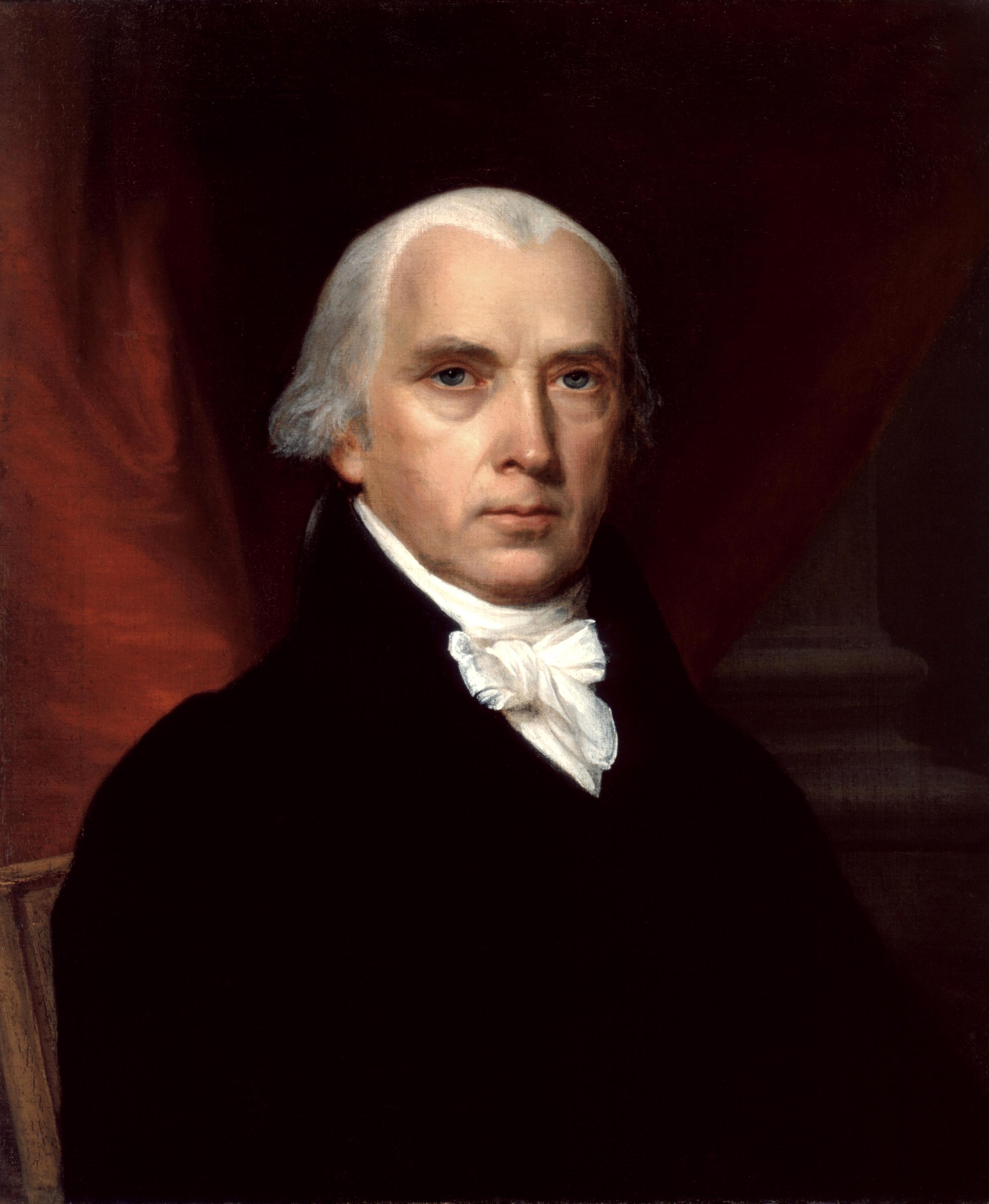
Bilder on James Madison as a Law Student
James Madison, Law Student and Demi-Lawyer by Mary Sarah Bilder, Boston College Law School, appeared in the Law and History Review, Vol. 28, pp. 389-449, May 2010. The abstract is now on SSRN, however for the publication itself, you'll need to go to the Law and History Review. Here's the abstract:
We think of James Madison as a political theorist, legislative drafter, and constitutional interpreter. Recent scholarship has fought fiercely over the nature of his political thought. Unlike other important early national leaders - John Adams, Alexander Hamilton, Thomas Jefferson, John Marshall, Edmund Randolph, James Wilson - law has been seen as largely irrelevant to Madison’s intellectual biography. Madison, however, studied law and, at least in one extant manuscript, took careful notes. These notes have been missing for over a century, and their loss contributed to the sense that Madison must not have been that interested in law. Now located, these notes reveal Madison’s significant grasp of law and his striking curiosity about the problem of language. Madison’s interest in interpretation is certainly not news to scholars. These notes, however, help to establish that this interest predated the Constitution and that his interest in constitutional interpretation was an application of a larger interest in language. Moreover, Madison thought about the problem of legal interpretation as a student of law, never from the secure status of lawyer. Over his lifetime, he advocated a variety of institutional approaches to constitutional interpretation, and this comfort with nonjudicial interpreters, along with a peculiar ambivalence about the proper location of constitutional interpretation, may owe a great deal to his self-perception as a law student but never a lawyer.
James Madison
Symposium: The Legal Heritage of the Civil War
Northern Kentucky University's Chase College of Law is holding a symposium on The Legal Heritage of the Civil War, October 22, 2011.
The Civil War changed the fabric of the United States as a nation and also led to a number of landmark legal developments. These developments have had wide-reaching impacts on both national and international levels. The legal influence of the Civil War era can be seen in a number of areas of modern law, include the U.S. monetary system, the rise of federal power, military trials of terrorists, and the laws of war.
To commemorate the 150th anniversary of the Civil War, Chase College of Law and the Northern Kentucky Law Review will host its Fall Symposium on the Legal Heritage of the Civil War on October 22, 2011. The Symposium is an opportunity for academics, practitioners, and students to exchange ideas and explore current legal issues that originate from the Civil War era. The Northern Kentucky Law Review invites you to attend this unique Symposium as the crossroads of history and modern law are explored.
The symposium will be held in the Student Union Ballroom at Northern Kentucky University, in Highland Heights, Kentucky. Contact them here to register or for more information.
Dale, Criminal Justice in the United States, 1789-1939
Our former guest blogger Elizabeth Dale, University of Florida, has just published a smart new book Criminal Justice in the United States, 1789–1939, in the New Histories of American Law Series at Cambridge University Press.
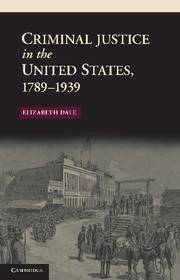 Here's the book description:
You can find the cloth and kindle copies on Amazon, and they'll ship the paperpack later, but in the meantime you can request an examination copy from the press.
Here's the book description:This book chronicles the development of criminal law in America, from the beginning of the constitutional era (1789) through the rise of the New Deal order (1939). Elizabeth Dale discusses the changes in criminal law during that period, tracing shifts in policing, law, the courts, and punishment. She also analyzes the role that popular justice – lynch mobs, vigilance committees, law-and-order societies, and community shunning – played in the development of America's criminal justice system. This book explores the relation between changes in America's criminal justice system and its constitutional order.And the blurbs:
"This is a highly comprehensive, thoughtful, and insightful overview of the history of American criminal justice over the course of the long nineteenth century. Remarkably sensitive to larger trends and local nuance in the development of American criminal justice, Elizabeth Dale's masterful book should be read by all interested in the history of American law." – Michael J. Pfeifer, author of The Roots of Rough Justice: Origins of American Lynching
"This fine book provides both a broad synthesis and a thought-provoking interpretation of criminal justice in the United States from 1789 to 1939. Elizabeth Dale's analysis contains many moving parts: federal and state governments, courts and legislatures, judges and juries, constitutional rulings and lynch mobs, and more. The book's emphasis on the ever-changing interplay between formal law and popular notions of justice invites readers to reflect on the enduring tension between the rule of law and democracy." – John Wertheimer, Davidson College
Tuesday, August 30, 2011
Swan on Gender and Erotic Triangles and Tort Law History
A New Tortious Interference with Contractual Relations: Gender and Erotic Triangles in Lumley v. Gye is a new article by Sarah Lynnda Swan, Columbia University Law School. It is forthcoming in the Harvard Journal of Law and Gender, Vol. 35, 2012. Here's the abstract:
The tort of interference with contractual relations has many puzzling features that conflict with fundamental principles of contract and tort law. This Article considers how gender influenced the structure of the tort and gave rise to many of these anomalies. Lumley v. Gye, the English case that first established interference with contractual relations, arose from a specifically gendered dispute: two men fighting over a woman. This type of male—male—female configuration creates an erotic triangle, a common archetype in Western culture. The causes of action that served as the legal precedents for interference with contractual relations – enticement, seduction, and criminal conversation – are previous instances where the law regulated gendered triangular conflicts. Enticement prohibited a rival male from taking another man’s servant, seduction prohibited a rival male from taking another man’s daughter, and criminal conversation prohibited a rival male from taking another man’s wife.
In Lumley v. Gye, the court expanded these precedents and created a cause of action that allowed Lumley to bring an action against his male rival for essentially “taking” his contracted female employee. The gendered basis for the tort explains its most problematic aspects, including why it imposes obligations on non-contractual parties, ignores the role of the breaching promisor in causing the wrong, and treats her as the property of the original promisee. In order to remedy these problematic features, the tort should be restructured as one of mixed joint liability. Further, damages should be limited to those available in contract.
Emanuel on Elbert Tuttle and Civil Rights
Anne S. Emanuel, Georgia State Law, has posted the preface to her new biography, Elbert Parr Tuttle: Chief Jurist of the Civil Rights Revolution (University of Georgia Press, 2011). Here is the abstract:
Dennis J. Hutchinson, William Rainey Harper Professor in the College and Senior Lecturer in Law, University of Chicago, says of the book:The preface to the first full biography of Elbert Tuttle, the judge who led the historic Fifth Circuit – the federal court with jurisdiction over most of the deep south – through the most tumultuous years of the Civil Rights Revolution. Tuttle had co-founded a prestigious law firm; litigated two major constitutional cases, Herndon v. Lowry (1937) and Johnson v. Zerbst (1938); earned a Purple Heart in the battle for Okinawa; and led the effort to build a viable Republican Party in Georgia – all before he joined the Fifth Circuit in 1954. When he became Chief Judge in 1960, six years had passed since Brown v. Board of Education had been decided and almost nothing had changed. Jim Crow segregation, our American apartheid, remained firmly in place. His swift, decisive rulings and his unprecedented use of the All Writs Act effectively neutralized the delaying tactics of diehard segregationalists, from school board members and voter registrars to obstructionist judges and governors, across the South.


The role of federal judges in the civil rights movement has been studied thoroughly, but Anne Emanuel has a larger story to tell about the man who served as chief judge of the largest appeals court in the South during the heyday of court-ordered racial desegregation. Elbert Tuttle, raised in Hawaii and educated in New York, led a remarkable life long before being appointed to the bench. He was active working to promote civil liberties during the 1930s, went to war in middle age and became a decorated combat veteran, and helped to secure Dwight Eisenhower’s nomination for President during the bitter 1952 Republican Convention. All the while he was a quiet, unassuming father of two and co-partner in one of the most successful law firms in the region. Emanuel knew the judge, has mined his working papers, and writes with a sure feel for this modest man who cast such a large shadow over his adopted South.And Mark Tushnet, William Nelson Cromwell Professor of Law, Harvard Law School, writes:
Anne Emanuel admirably describes the career—in war, politics, and law—of a judge who was at the center of enforcing civil rights law in the 1960s. Full of interesting detail, Elbert Parr Tuttle tells us much about how one person’s life can shape the law.
Monday, August 29, 2011
University of Virginia Legal History Workshop

The University of Virginia School of Law announces the participants in our legal history workshop this academic year. Here are the presenters and the titles of their workshop papers:
Fall:
October 10: Allison Tirres, DePaul Law School
Title: “Contested Terrain: Citizenship in the Borderlands during Civil War and Reconstruction”
November 14: Ed Larson, Pepperdine Law School
Title: “The Constitutionality of Lame-Duck Lawmaking: The History, Intent, and Meaning of the Twentieth Amendment”
November 28: Cynthia Nicolletti: Mississippi College of Law
Title: "International Law and the American Civil War"
Spring:
February 13: Mitra Sharafi, University of Wisconsin Law School
Title TBA
March 12: Kara Swanson, Northeastern University Law School
Title: “Reproductive Medicine in the Legal Shadows: Artificial Insemination, 1890-1950”
April 9: Al Brophy, University of North Carolina Law School
Title: “The Jurisprudence of Slavery and Freedom at the University of Virginia – History, Natural Law, and Utility, 1831-1861”
April 23: Deborah Dinner, Washington University in St. Louis Law School
Title: “Costs of Life: Maternal Employment, Reproductive Choice, & the Debate over Pregnancy Disability Benefits”
So long, farewell
I often listen to Green Day’s Good Riddance (Time of Your Life), which begins:
Another turning point, a fork stuck in the road
Time grabs you by the wrist, directs you where to go
So make the best of this test, and don't ask why
It's not a question, but a lesson learned in time
These lines remind me of what I enjoy most about editing Law and History Review, and also why I decided to apply for the position in 2004. Although I have always been committed to my own research, after my first book went into production I was not entirely sure what to do next. I was working on a couple of articles, but did not at the time have a good idea for my next book-length project. I had run smack into a fork stuck in the road.
Journal editing, I learned from experienced colleagues, builds contingency into your everyday academic life. You never know when the next submission will arrive, who the author will be, or the topic. Opening my inbox, as I soon discovered, introduced me to people and subjects that were unfamiliar. I continuously reached the limits of my own knowledge of the field. It was (and is) a humbling experience, but also why so many of us became scholars in the first place. As it turned out, manuscripts grabbed me by the wrist and directed me where to go.
Every manuscript is a new test. I’ve already blogged about conducting the “in-house” review, but the next challenge is finding qualified reviewers for those manuscripts that I “send out” for peer review. LHR uses four reviewers per manuscript, which allows me to invite scholars with different perspectives to evaluate every submission. In some instances, I invite one reviewer to serve specifically as a generalist who can push an author to broaden his or her article to reach a larger audience. Occasionally, one or more of the reviewers who I would most like to evaluate a manuscript are unavailable for a variety of reasons. This can throw off the review process. But once you make the commitment to send a manuscript out, you don’t ask why. I also learned not to read reports as soon as they arrived. Instead, I wait until I have all the reports. The first report, which may be overly enthusiastic or negative, can color how you read subsequent ones.
As I have learned, editing a journal is like working on a book. As long as you are excited by the project, you need to continue. Once the enthusiasm is truly gone, you’ve reached another turning point. It is time to be done.
Fortunately, I still love to read new submissions. But soon enough, it will be time for someone else to have the time of their life with Law and History Review.
I truly appreciate the opportunity to have served as a guest blogger for my favorite blog, and look forward to seeing everyone at ASLH in November. Thanks for reading!
Federal Court Records vs. The Shredder, Round 2
Earlier this month I noted the National Archives’ new retention policy on “non-trial” federal district court records created since 1970. The Associated Press reporter Michael Tarm published a story on the policy last Friday, entitled Millions of US Court Records Bound For Shredder. Here is an additional report, relating to criminal case files, which I can make thanks to some communications from Michael J. Churgin, a professor at the University of Texas Law School and chair of the Committee on Documentary Preservation of the American Society for Legal History.
The policy in question, N1-21-11-1, is being considered by the National Archives and Records Administration (NARA) in consultation with the Administrative Office of the United States Courts. It would treat all court files in federal criminal cases created between the 1776 and 1970 as permanent records. It does the same for (1) “case files dated 1970 or later which were terminated during or after trial”; (2) “any criminal case file determined by court officials or by NARA to have historical value”; and (3) “non-trial criminal cases relating to treason and national security or to embezzlement, fraud, or bribery by a public official.” (The national security and treason offenses include alien registration, treason, espionage, sabotage, sedition, Smith Act, and exportation of war materials.)
Two classes of records are deemed temporary. First, under an earlier policy (N1-021-86-1), “misdemeanor and petty offense proceedings conducted by U.S. magistrate judges in cases not assigned a district court docket number” will be destroyed five years after closing. An appraisal conducted for NARA last May explained that the records “document minor routine offenses, such as traffic offenses on Federal property, that have no historical value.”
The second class of temporary records are non-magistrate criminal cases from 1970 on that never reached the trial stage, aren’t deemed to have historical value, and don’t relate to sedition or public corruption. According to the NARA’s appraisal, these case “are generally routine in nature and do not contain the substantive documentation that might make them useful for research.” If they cannot be donated, NARA will dispose of them 15 years after a file was closed. Trial cases, the appraisal opined, “will provide sufficient documentation of the operation of the criminal judicial system.” The largest categories of offenses in this class involve drugs (about 25 percent), immigration (about 25 percent), and property and firearms (about 30 percent).
This summer, Professor Churgin, on behalf of the ASLH’s committee, asked that NARA sample and permanently preserve files from this second class of temporary records. Churgin contrasted the proposed policy for criminal cases with that instituted for bankruptcy cases. Initially, many bankruptcy records created after 1940 were to be destroyed, but after Churgin assured NARA that “bankruptcy records certainly are not regarded as of limited interest by historians,” sampling was instituted. The precedent of the Harvard's Bankruptcy Data Project doubtless was influential. The project had already published several studies based on a random sample of 1500 to 2500 individual bankruptcies filed under Chapter 7 and Chapter 13 from ten districts for 1981, 1991, and 2001. The procedures NARA ultimately adopted will create a much larger and broader sample. For each district and every year, 2.5 percent of the “temporary” files will be preserved.
Churgin commented that “the strength of the bankruptcy schedule . . . is the use of sampling" and asked that non-trial criminal cases be sampled as well. After all, he observed, drug and immigration cases speak to “major issues of national policy." He directed NARA’s attention to California Rule of Court 10.855, which provides for the sampling of the trial and non-trial files of the state's superior courts.
Churgin also suggested that more immediate interests than those of historians and their readers were at stake. This summer the U.S. Sentencing Commission unanimously voted to give retroactive effect to a proposed amendment of the sentencing guidelines to reduce the sentences of federal crack cocaine offenders “who meet certain criteria established by the Commission and considered by the courts.” Had the NARA’s proposed policy been in place, Churgin remarked, “the case file records of countless inmates still in federal custody, who originally pled guilty, would already be destroyed.”
Subscribe to:
Posts (Atom)