Thursday, November 12, 2020

Peterson on "Expounding the Constitution"

Farah Peterson, University of Chicago Law School, has posted Expounding the Constitution, which appears in the Yale Law Journal 230 (2020): 2-84:

Judges and statesmen of the early Republic had heated exchanges over the importance of hewing to the text in constitutional interpretation, and they advanced dueling interpretive prescriptions. That is why contemporary theorists of all persuasions can find support for their positions in the Founding era. But no side of the Founders’ debate over constitutional interpretation maps perfectly onto a modern school of thought. Modern scholarship has misunderstood the terms of the Founders’ debate because it sits on an unfamiliar axis. Instead of arguing over whether the Constitution was, for instance, living or static, this Article demonstrates that early American lawyers debated whether the Constitution should be interpreted according to the methodologies applicable to public or private legislation.

This distinction among different types of legislation has faded from view because modern legislatures almost never pass private laws—statutes that apply only to one person, group, or corporation. But in early America, private legislation was the majority of legislatures’ business. Generally applicable laws, like those Congress busies itself with today, were the minority. What’s more, American courts had fixed, predictable, and familiar rules of interpretation for each type of law. Private acts received stricter, more text-orientated interpretations while public acts were interpreted broadly and pragmatically to effectuate their purposes, taking into account new circumstances that the drafters may not have foreseen.

After ratification, critical policy differences emerged among American statesmen in the first Congress. Hamilton and Madison, once united as authors of the Federalist Papers, found themselves on different sides. Both insisted that the Constitution must be interpreted to vindicate their views, and in the process, they opened a debate about interpretation that would characterize the nation’s constitutional jurisprudence until the 1820s. The Federal Constitution was a novelty. But lawyers don’t tend to make new rules to suit new situations; we prefer to rely on precedent. And that is what these lawyers did, using legal tools devised for interpreting legislation—a form of written law with consistent interpretive rules that were part of the bread-and-butter practice of every American lawyer.

We cannot understand the major cases of the Marshall Court, including Marbury, Martin, and McCulloch without this context. In these cases, litigants argued over, and the Court wrestled with, whether public or private legislation provided the best analogy for the Federal Constitution. The answer dictated whether restrictive or pragmatic rules would govern its interpretation. The terms of these arguments would have been obvious to the legal thinkers of that generation. Yet, in spite of all the attention we have lavished on Hamilton, Jefferson, Madison, Marshall, Story, and their world, this central dynamic of their legal culture has remained unexplored.

This Article argues that, during framing and ratification, many of the Founders thought the Constitution would be interpreted according to the rules applicable to public legislation, although statesmen like Jefferson and Madison later took a different view. Chief Justice Marshall’s enduring commitment to the public-act analogy explains his embrace of “implied powers” in McCulloch and underpins the broad, nationalist vision in his other major decisions. These insights are not only critical to understanding those decisions on their own terms, they are also highly relevant to modern constitutional theorists who rely on early American precedent. If the Founders intended that the Constitution would be interpreted according to the rules of public legislation, then the “original” Constitution is a flexible and pragmatic charter, not a fixed and immutable artifact.
--Dan Ernst

Wednesday, November 11, 2020

Wells on Holmes at the Clough Center

The Clough Center for the Study of Constitutional Democracy is hosting the webinar Author Meets Critics:  Oliver Wendell Holmes: Willing Servant of an Unknown God, by Catharine Wells, Boston College, on Monday, November 16, 2020 at 6:00PM.  The event is free and open to the public, although registration is required. Zoom link will be sent before the day of the event.

Justice Holmes was a pivotal figure in American law. On the Massachusetts Supreme Judicial Court and on the Supreme Court of the United States, he was a towering figure, writing many important opinions that are an integral part of the legal canon we study in the Twenty First Century. Unfortunately, his importance to American Law has led scholars to disregard the depth of his philosophical and spiritual views. This book explores these views and describes the intellectual context that formed them. The result is a fuller picture of the man and of the possibility he poses of leading a meaningful life in the profession of law.

In addition to Professor Wells, panelists include:

Margaret Jane Radin, Henry King Ransom Professor of Law, Emerita, University of Michigan Law School
Scott Brewer, Professor of Law, Harvard Law School
Gregg Fried, Professor of Philosophy, Boston College

And don’t forget Clough Center’s noontime (EST) webinar this Friday: In Congress We Trust? Enforcing Voting Rights from the Founding to the Jim Crow Era, with Franita Tolson.

 --Dan Ernst

ANZLHS 2020

 [We have the following announcement.  DRE]

39th Annual Conference of the Australian and New Zealand Law and History Society

Join us for an intensive 1 day world-wide gathering devoted to law in history on 9 December 2020, hosted by Event Services at the University of Auckland, Aotearoa New Zealand

Keynote plenary sessions will feature:

Joshua Getzler, Oxford University, on "Six Nations of the Grand River, military feudalism, and the roots of 'honour of the Crown'"

Miranda Johnson, Otago University, on "Reckoning with a Pacific empire state: Race, nation, citizenship and the idea of New Zealand"

A Closing Address by Dame Sian Elias, former Chief Justice of New Zealand

The organisers have accepted 39 individual papers and 7 panel presentations. They will be run in four concurrent parallel sessions throughout the day. The programme will be uploaded to the ANZLHS website page shortly.

The timings will be specified according to the NZDT time zone - which is UTC+13. We have attempted to time presentations so that are as reasonable as possible for the presenters (but will be difficult for some). The conference will begin at 9.00am and conclude at 7.00pm NZDT.

To cover Event Services charges, and to ensure a high quality of digital platform delivery utilising Zoom, Vimeo and Twilio, we are asking all attendees to pay a modest registration fee. In addition, the rules of the ANZLHS require all presenters to pay the Society's 2020 annual subscription. So 'full member registration' applies to presenters who have paid the 2020 Society subscription in advance; 'full non-member registration' applies to presenters (some of whom will have been members in the past) who have not yet paid the 2020 Society subscription. We are waiving registration fees for postgraduate student presenters. The portal for registrations will be launched shortly through the website page. The cost for registration is as follows in $NZ:

Full member registration: $130; Full non-member registration: $ 215; Full-time post graduate presenters: Fee waiver; Attendance only registration: $130

Graduate students are invited to apply for Kercher Scholarships. Five scholarship awards will be made that may adorn your cv even though there is no monetary element to the scholarship this year. Please apply to Katherine Sanders: k.sanders@auckland.ac.nz by 20 November if you have not already applied. Graduate attendees may also wish to enter their paper for the Forbes Society Prize. The Society's peer-reviewed journal law&history will consider submissions from those who present papers at the conference. In the meantime further information about the conference may be gleaned from David Williams: dv.williams@auckland.ac.nz

Grey on infanticide in colonial India

 Daniel J. R. Grey (University of Hertfordshire) has published " 'It is impossible to judge the extent to which the crime is prevalent': infanticide and the law in India, 1870-1926," Women's History Review (2 Nov. 2020). Here's the abstract: 

This article examines colonial debates over infanticide in late nineteenth- and early twentieth-century India, including the question of whether new legislation should be introduced to target the crime. Such debates were complicated by Britain’s colonial obsession with specifically eradicating female infanticide, seen as a core element of the so-called ‘civilizing mission’, and the reluctance of authorities to acknowledge that in many cases of Indian child homicide, the experiences of single or widowed women facing an unwanted pregnancy had parallels with infanticide cases that were prosecuted in England and Wales. Drawing in particular on India Office records, the article demonstrates the profound impact of these ongoing tensions and concerns in shaping colonial policy and law. Ultimately, despite a degree of support for such a measure from both indigenous and colonial commentators, this tension made passing an Indian equivalent to the English Infanticide Act 1922 impossible in the interwar period.

Further information is available here.

--Mitra Sharafi 

Tuesday, November 10, 2020

Sposini on Certifying Insanity in Ontario

Filippo Maria Sposini, a PhD candidate at the University of Toronto, has published Just the Basic Facts: The Certification of Insanity in the Era of the Form K in the Journal of the History of Medicine and Allied Sciences 75 (April 2020): 171–192: 

This paper investigates the certification of insanity through a standardized template called Form K which was used in Ontario between 1873 and 1883. My main thesis is that the introduction of the Form K had profound and long-lasting effects on the determination of insanity. In particular, it created a unique case in the history of certification, it grounded civil confinement on a strategy of consensus, and it informed mental health documentation for more than a century. As the result of a transnational mediation from Victorian England, the Form K prescribed an examination setting which involved a high number of participants, including three physicians and several witnesses. By comparing this case with other jurisdictions of the time, this paper shows how Ontario became a distinctive case worldwide. In order to get a closer look at this medico-legal procedure, I consider the archival records of the Toronto asylum and conclude that the certification of insanity relied on a strategy of consensus. While the Form K proved quite successful in preventing legal actions, it produced financial, logistic, and bureaucratic issues. The Form K was thus discontinued after a decade, yet its structure influenced Ontario’s mental health documentation throughout the twentieth century. This paper shows the relevance of the certification of insanity for transnational history and for understanding contemporary issues of involuntary confinement and stigma in mental health.

--Dan Ernst

Wald on In-House Counsel

Eli Wald, University of Denver Sturm College of Law, has published Getting In and Out of the House: The Worlds of In-House Counsel, Big Law, and Emerging Career Trajectories of In-House Lawyers in the Fordham Law Review:

The traditional story of in-house counsel is of a transformation and triumph over “Big Law” in a zero-sum game for power, prestige, and money. That story, however, is inaccurate descriptively, prescriptively, and normatively. Descriptively, in-house lawyers were part of the legal elite dominating corporate counseling before large law firms first rose to power and prominence. In-house counsel then lost ground and the position of general counsel to Big Law lawyers between the 1940s and 1970s, only to mount an impressive comeback to elite status beginning in the 1970s. Yet the in-house comeback was not a simple power struggle with Big Law. Rather, modern in-house lawyers including the “new” general counsel came from within the ranks of Big Law, an offshoot rather than a competitor of large law firms, sharing Big Law’s background, training, and, more importantly, professional values, ideology, and ethos. Thus, the story of in-house lawyers and their relationship with Big Law is one of a complex symbiotic affiliation, not a competitive zero-sum game.
--Dan Ernst

Monday, November 9, 2020

Bradley and Rowland on women's access to law in England

 Kate Bradley (University of Kent) and Sophie Rowland (London School of Hygiene and Tropical Medicine) have published "A poor woman's lawyer? Feminism, the labour movement, and working-class women's access to the law in England, 1890-1935," Women's History Review (17 Aug. 2020). Here's the abstract: 

Women were excluded from both branches of the legal profession before the Sex Discrimination (Removal) Act 1919. Whilst campaigning for women's entry to the law was also part of wider efforts to make the law more accessible. Before and after the 1919 Act, middle-class women were able to offer legal support to working-class women, through feminist and trade unionist networks and the professions that were open to them—factory inspection and social work. By examining key women’s organisations between the 1890s and 1930s, we trace the development of work to both educate women and girls on their legal rights and to directly tackle problems and breaches of the law. We argue that, by looking at the legal activism of women in the factory inspectorate, social work, trade union and women's organisations, fresh insight into the development and ‘mainstreaming’ of working-class claims on citizenship in the early twentieth century can be found.

Further information is available here.

--Mitra Sharafi 

Saturday, November 7, 2020

Weekend Roundup

  • From the Washington Post's "Made by History" section: Julio Capó Jr. (Florida International University) and Melba Pearson (Florida International University’s Center for the Administration of Justice ) on Florida voter suppression as "Jim Crow Esq."; Ashley Farmer (University of Texas, Austin) on Black women running for Congress;
  • "Supreme Court Justice Louis D. Brandeis and Social Justice," a discussion featuring Georgetown Law’s Brad Snyder, who is the author of House of Truth, and Jennifer Lowe, the Director of Programs and Strategic Planning of the Supreme Court Historical Society, will be conducted online on November 18, 2020 at 3 pm.  It is sponsored by the National Archives, the Supreme Court Historical Society, and the Capital Jewish Museum.  Register here.
  • A Call for an upcoming event at the Université de Neuchâtel on historical sources of Swiss law here (9-10 Sept. 2021).
  • Update: a profile of Buffalo Law's Michael Boucai and his article "Before Loving" (UB Now).

Weekend Roundup is a weekly feature compiled by all the Legal History bloggers.  

Friday, November 6, 2020

McClain on the 19th Amendment Centennial and Trollope's Palliser Novels

Linda C. McClain, Boston University School of Law, recently has posted two articles.  The first is What Becomes a Legendary Constitutional Campaign Most? Marking the Nineteenth Amendment at One Hundred, which is forthcoming in the Boston University Law Review 100 (2020): 1753-1769

What most becomes a landmark anniversary in the legendary campaign by women (and some men) for woman suffrage that, in 1920, led to Congress’s ratifying the Nineteenth Amendment to the U.S. Constitution? This framing of the question alludes to the famous, decades-long Blackglama advertising campaign, “What becomes a legend most?,” which (beginning in 1968) enlisted the charisma of famous women (and some men) to glamorize mink coats. This Essay also appeals to the dual meanings of legendary -- “of, relating to, or characteristic of legend” and “well-known, or famous” -- and argues that the campaign for woman suffrage is the stuff of legend in both senses. This is evident in challenges surrounding how best to represent the anniversary in public monuments (such as the recently unveiled Women’s Rights Pioneers Monument in New York City's Central Park) and public exhibitions: Which legendary suffragists are included? Who is left out? What role do legends play in the commemoration? The abundance of invocations of “the Nineteenth” in the buildup to 2020 and in the commemoration itself suggests multiple answers about how best to commemorate it. Some answers look back in time, urging critical reflection on what we do and do not really know about the campaign for woman suffrage and insisting that a deeper, intersectional examination teaches sobering but necessary lessons about inclusion and exclusion and the challenges of coalition building. Such examination also yields valuable role models of agency and action to inspire action in present-day struggles for women’s rights. Other answers focus on the present day and unfinished business: the next hundred years should bring a renewed commitment to advancing women’s political power in the next century, in particular, that of Black women, who stand out for their high levels of political participation yet who have not received sufficient party encouragement and resources as candidates for office. Another forward-looking answer urges attention to how gendered models of who should be a political leader and stereotypes about race and gender work against women’s full participation in governance. This Essay comments on these and other answers offered by the contributors to a symposium in the Boston University Law Review on the centenary of the Nineteenth Amendment: Professors Nadia Brown and Danielle Casarez Lemi, Lolita Buckner Inniss, Kelly Dittmar, Paula Monopoli, Virginia Sapiro, and Katharine Silbaugh.

The second article is her contribution to that symposium, A "Woman's Best Right" - To a Husband or the Ballot?: Political and Household Governance in Anthony Trollope's Palliser Novels:

Stanford International Junior Faculty Forum

[We have the following announcement.  DRE]

Call for Abstracts: Fourteenth International Junior Faculty Forum

Sponsored by Stanford Law School, the International Junior Faculty Forum (IJFF) was established to stimulate the exchange of ideas and research among younger legal scholars from around the world. We live today in a global community– in particular, a global legal community. The IJFF is designed to foster transnational legal scholarship that surmounts barriers of time, space, legal traditions and cultures, and to create an engaged global community of scholars. The Fourteenth IJFF will be held at Stanford Law School in fall 2021 (the exact date has not yet been fixed; but it will probably be in October).
 
In order to be considered for the 2021 International Junior Faculty Forum, authors must meet the following criteria:

Citizen of a country other than the United States
Current academic institution is outside of the United States
Not currently a student in the United States
Have held a faculty position or the equivalent, including positions comparable to junior faculty positions in research institutions, for less than seven years as of 2021; and
Last degree earned less than ten years before 2021.
Papers may be on any legally relevant subject and can make use of any relevant approach: they can be quantitative or qualitative, sociological, anthropological, historical, or economic. The host institution is committed to intellectual, methodological, and regional diversity, and welcomes papers from junior scholars from all parts of the world. Please note, however, that already published papers are not eligible for consideration. We particularly welcome work that is interdisciplinary.
 
Those who would like to participate in the IJFF must first submit an abstract of the proposed paper. Abstracts should be no more than two (2) pages long and must be in English. The abstract should provide a roadmap of your paper—it should tell us what you plan to do, lay out the major argument of the paper, say something about the methodology, and indicate the paper’s contribution to scholarship. The due date for abstracts is Friday, February 5, 2021, although earlier submissions are welcome. To submit your abstract, please complete our Abstract Submission Form. Abstracts must have the name of the author(s) and title of the abstract on the document that is submitted to be considered for the forum.
 
After the abstracts have been reviewed, we will invite, no later than the end of March 2021, a number of junior scholars to submit full papers of no more than 15,000 words, electronically, in English, by a deadline of approximately mid-May 2021. Please include a word count for final papers. There is no fixed number of papers to be invited, but in the past years, up to 50 invitations have been issued from among a much larger number of abstracts.
 
NOTE:  Because of the pandemic, the 2020 Forum was held virtually; participants took part through zoom.  At this point, it is not possible to predict the form of the 2021 forum; it is possible that it will be conducted remotely, with presenters and commentators connecting from their home institutions and countries; but it may also be possible, by October 2021, to have the forum at least partially an in-person affair.
 
An international committee of legal scholars will review the papers and select a small number of them, but at least seven, for full presentation at the conference, where two senior scholars will comment on each paper. After the remarks of the commentators, all of the participants, junior and senior alike, will have a chance to join in the discussion. One of the most valuable—and enjoyable—aspects of the Forum, in the opinion of many participants, has been the chance to meet junior and senior scholars and to talk about your work and theirs.
 
Participants are encouraged to seek funding from their home institutions. In default, Stanford will cover expenses of travel, including airfare, lodging, and food for participants. Questions about the forum should be directed to ijff@law.stanford.edu.
 
Professor Lawrence M. Friedman                  
Stanford Law School                                      

Professor Deborah Hensler
Stanford Law School

Thursday, November 5, 2020

Hirsch's "Soviet Judgment at Nuremberg" at WHS

The next meeting of the Washington History Seminar will be devoted to Francine Hirsch, University of Wisconsin-Madison, and her book, Soviet Judgment at Nuremberg: A New History of the International Military Tribunal After World War II.  It will be held on Thursday, November 12 at 4:00 pm ET.  Click here to register.

Organized in the wake of World War Two by the victorious Allies, the Nuremberg Trials were intended to hold the Nazis to account for their crimes and to restore a sense of justice to a world devastated by violence. As Francine Hirsch reveals in her groundbreaking new book, a major piece of the Nuremberg story has routinely been left out: the critical role of the Soviet Union. Soviet Judgment at Nuremberg offers a startlingly new view of the International Military Tribunal and a fresh perspective on the movement for international human rights that it helped launch.

--Dan Ernst

Astorri on Lutheran Theology and Contract Law in Early Modern Germany

Here's a 2019 publication that we missed somehow: Lutheran Theology and Contract Law in Early Modern Germany (ca. 1520-1720) (Verlag Ferdinand Schoningh, 2019), by Paolo Astorri (post-doc at the Center of Privacy Studies, University of Copenhagen; faculty member at the Catholic University of Leuven). A description from the Press:

It is clear that the Lutheran Reformation greatly contributed to changes in theological and legal ideas – but what was the extent of its impact on the field of contract law? Legal historians have extensively studied the contract doctrines developed by Roman Catholic theologians and canonists; however, they have largely neglected Martin Luther, Philip Melanchthon, Johann Aepinus, Martin Chemnitz, Friedrich Balduin and many other reformers. This book focuses on those neglected voices of the Reformation, exploring their role in the history of contract law. These men mapped out general principles to counter commercial fraud and dictated norms to regulate standard economic transactions. The most learned jurists, such as Matthias Coler, Peter Heige, Benedict Carpzov, and Samuel Stryk, among others, studied these theological teachings and implemented them in legal tenets. Theologians and jurists thus cooperated in resolving contract law problems, especially those concerning interest and usury. 

H/t New Books Network, where you can find an interview with the author.

-- Karen Tani

Wednesday, November 4, 2020

Tolson on Voting Rights in BC Legal History Roundtable

The Legal History Roundtable at the Boston College Law School announces its next session, In Congress We Trust? Enforcing Voting Rights from the Founding to the Jim Crow Era, a webinar with Franita Tolson, on Friday, November 13, 2020, 12:00PM-12:55PM:
Registration is required. Zoom link will be sent before the day of the event.  Please join Professor Mary Bilder and Professor Dan Farbman as they welcome Franita Tolson, Vice Dean for Faculty and Academic Affairs and Professor of Law at USC Gould School of Law, to discuss her forthcoming book and the election.  Following the discussion will be a Q&A session.  Free and open to the public.

--Dan Ernst

Concepcion on Waite and Blatchford

Cattleya M. Concepcion, Head of Reference, Georgetown Law Library, has posted Happy Birthday, My Dear Chief Justice: Three Letters from Samuel Blatchford to Morrison R. Waite, which appears in the Green Bag Almanac & Reader:

CJ Morrison R. Waite (LC)
Much has been written on the legacy of Morrison R. Waite, the seventh Chief Justice of the United States, including his ability to preside over the Associate Justices who served during his tenure. With a bench full of forceful characters like Samuel F. Miller, Stephen J. Field, Joseph P. Bradley, and John Marshall Harlan, Waite’s relationships with the other Justices who served beside him have received less attention. One of his more obscure relationships was with Samuel Blatchford, a wealthy New Yorker who possessed “grace and courtesy and strict[ly] observ[ed] the first principles of amenity.” It is perhaps due to these characteristics that a small peek into their relationship exists today. Found among Waite’s personal papers were three letters that Blatchford sent to him while they served together on the Supreme Court from 1882 to 1888. Addressed to “My dear Chief Justice” on the occasion of Waite’s birthday, the letters reveal a warm and collegial friendship during the final years of Waite’s life.
-Dan Ernst

SAPD 34:2

Studies in American Political Development 34:2 (October 2020) is open access through the end of the month:

Racism Is Not Enough: Minority Coalition Building in San Francisco, Seattle, and Vancouver
Jae Yeon Kim

The Political Effects of Policy Drift: Policy Stalemate and American Political Development
Daniel J. Galvin, Jacob S. Hacker

Privatizing Employment Law: The Expansion of Mandatory Arbitration in the Workplace
 Sarah Staszak

Democratic Representation of all “the People”: Antislavery Petitions in the U.S. Senate
John D. Griffin, Grace Sager 

--Dan Ernst

Tuesday, November 3, 2020

Ohnesorge: A Hurstian View on Chinese Econonomic Development

John K.M. Ohnesorge, University of Wisconsin Law School, has posted Development is Not a Dinner Party: A Hurstian Perspective on Law and Growth in China, which is forthcoming in the Wisconsin Law Review Forward:

Much has been written, and remains to be written, about the many roles law has played in China’s economic development since 1978. Without minimizing the value of what has been written so far, this essay seeks to broaden the discussion by applying to China’s recent history certain ideas of the great historian of 19th Century American law and economic development, James Willard Hurst. The essay proceeds by providing a brief introduction to Hurst and his work on law and economic growth in the United States, then explores how those ideas might be applied to assist our understanding of what has happened in China.

--Dan Ernst

Lakier on Freedom of Speech beyond the First Amendment

Genevieve Lakier, University of Chicago Law School, has posted The Non-First Amendment Law of Freedom of Speech, which is forthcoming in volume 134 of the Harvard Law Review:

The First Amendment dominates popular and scholarly debate about freedom of speech in the United States. Yet it is not the only legal instrument that protects expressive freedom, the rights of the institutional press, or the democratic values that these rights facilitate. A rich body of local, state, and federal laws also does so, and does so in ways the First Amendment does not. This Article explores the history, and the present-day operation of what it calls the non-First Amendment law of freedom of speech. Doing so changes our understanding of both the past and the present of the American free speech tradition. It reveals that the nineteenth century was not a period in which there was little legal protection for freedom of speech, as scholars have long assumed. It also makes evident that the contemporary system of free expression is much more majoritarian, and much more pluralist in its conception of what freedom of speech means and requires than the we commonly assume. Recognizing as much is important not only as a descriptive matter but as a doctrinal one. This is because in few other areas of constitutional law does the Court look more to history to guide its interpretation of the meaning of the right. And yet, the Court’s view of the relevant regulatory history is impoverished. Missing from the Court’s understanding of freedom of speech is almost any recognition of the important non-constitutional mechanisms that legislators have traditionally used to promote it. The result is a deeply inconsistent body of First Amendment law that relies on a false view of both our regulatory present, and our regulatory past — and, as a result, is able to proclaim a commitment to laissez faire principles that, in reality, it has never been able to sustain.
--Dan Ernst

Monday, November 2, 2020

CFP: Michigan Law Junior Scholars Conference

 [We have the following announcement.  DRE]

Michigan Law School 2021 Junior Scholars Conference, April 16-17, 2021.  Call for Papers.  Deadline for Submission: January 4, 2021

The University of Michigan Law School is pleased to invite junior scholars to attend the 7th Annual Junior Scholars Conference which will take place virtually on April 16-17, 2021.

The conference provides junior scholars with a platform to present and discuss their work with peers and receive feedback from prominent members of the Michigan Law faculty. The Conference aims to promote fruitful collaboration between participants and to encourage their integration into a community of legal scholars. The Junior Scholars Conference is intended for academics in both law and related disciplines. Applications from graduate students, SJD/PhD candidates, postdoctoral researchers, lecturers, teaching fellows, and assistant professors (pre-tenure) who have not held an academic position for more than four years, are welcomed.

Cooperation with Michigan Law Journals: We are excited that this year the Conference will collaborate with several Michigan Law journals, all of which are among the highest ranked in their respective fields. The Michigan Law Review, Michigan Journal of International Law, Michigan Journal of Law Reform, Michigan Journal of Gender and Law, Michigan Journal of Race and Law, Michigan Journal of Environmental and Administrative Law, and the Michigan Business & Entrepreneurial Law Review will give serious consideration to publish papers selected for the Conference that are within each journal’s research agenda and meet its requirements. Additional details on the publication process will be provided after selection for participation in the Conference itself has been completed. In any event, there will be no obligation to accept any offer of publication that you may receive.

Submission: To apply to the conference, please submit an abstract of no more than 500 words reflecting the unpublished work that you wish to present and a copy of your CV through the online submission form by January 4, 2021. Please save all files as word documents in the following format: LAST NAME – FIRST NAME – ABSTRACT/CV. Selection will be based on the quality and originality of the abstract as well as its capacity to engage with other proposals and to foster a collaborative dialogue. Decisions will be communicated no later than February 1, 2021. Selected participants will be required to submit final papers by March 16, 2021, so that they may be sent to your faculty commentator and circulated among participants in advance.

Questions can be directed to the Organizing Committee Chair through the email address below.

Hannah Van Dijcke, Chair; Mohanad Salaimi, Co-Chair 200 Hutchins Hall
Junior Scholars Conference Organizing Committee 625 South State Street
Center for International and Comparative Law Ann Arbor, MI 48109-1215
University of Michigan Law School U.S.A.

Gomez-Arostegui and Bottomley on Injunctions in Patent Cases c. 1789

Tomas Gomez-Arostegui, Lewis & Clark Law School, and Sean Bottomley, Northumbria University, have posted The Traditional Burdens for Final Injunctions in Patent Cases c.1789 and Some Modern Implications, which is forthcoming in 71 Case W. Res. L. Rev. (2020):

This Article reassesses the first two eBay factors for final injunctions—irreparable injury and the inadequacy of legal remedies—in light of tradition-al equitable principles gleaned from the Court of Chancery in England at the end of the 18th century. Tracking most closely with tradition would require the Federal Circuit to recognize that: (1) an injury it seeks to redress with a final injunction is future infringement itself, not just follow-on harms caused by future infringement; (2) it can presume future infringement from past infringement; (3) it can presume that legal remedies are inadequate to remedy future infringement; and (4) it need not require a plaintiff to show that alternative equitable remedies, like ongoing royalties, would in-adequately redress future infringement. Moreover, the Federal Circuit can recognize, without relying on presumptions, that the burden on the first two eBay factors is not onerous. A patentee can satisfy them by showing that a defendant is likely to infringe again and that any legal damages award-ed at trial did not fully compensate the patentee for the life of the patent.

--Dan Ernst

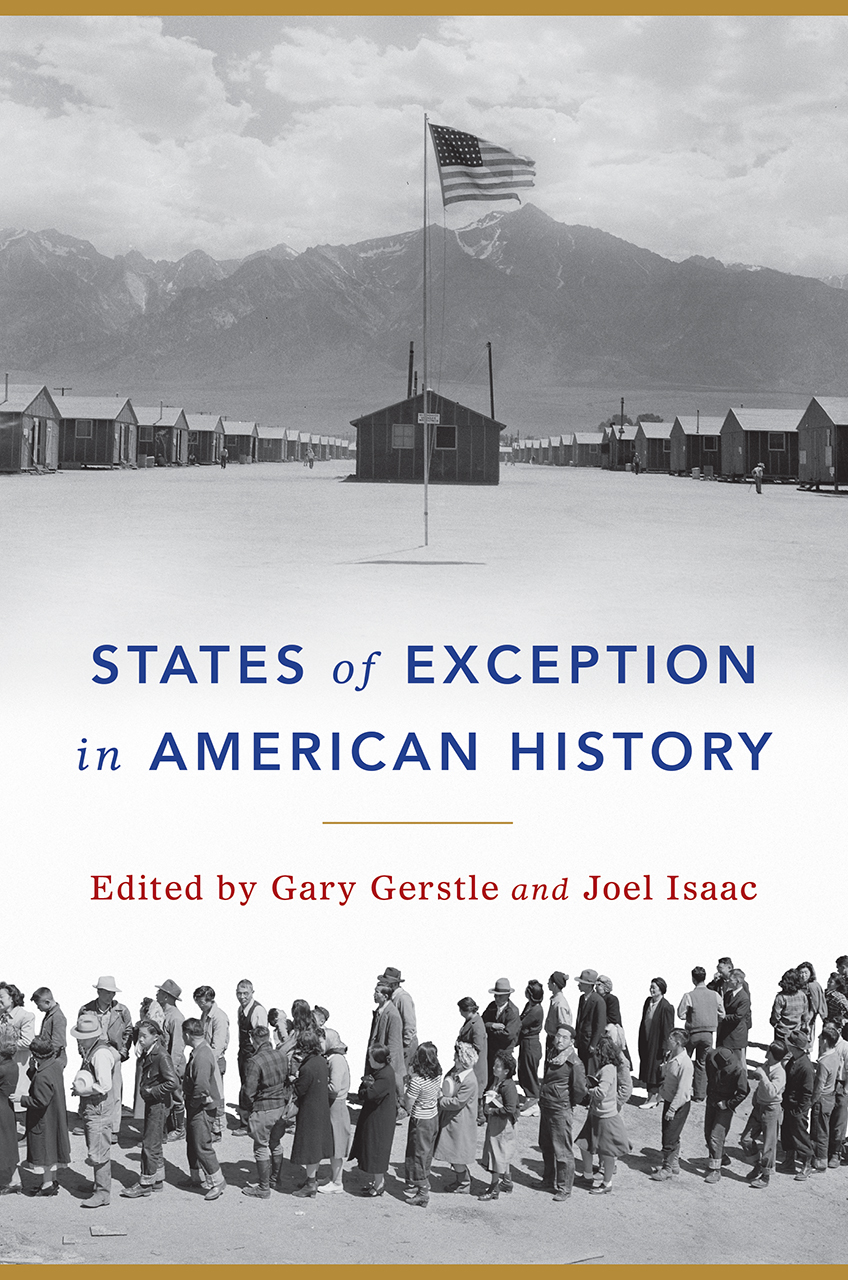
Gerstle & Isaac, eds., "States of Exception in American History"

New from the University of Chicago Press: States of Exception in American History, edited by Gary Gerstle (University of Cambridge) and Joel Isaac (University of Chicago). A description from the Press:

States of Exception in American History brings to light the remarkable number of instances since the Founding in which the protections of the Constitution have been overridden, held in abeyance, or deliberately weakened for certain members of the polity. In the United States, derogations from the rule of law seem to have been a feature of—not a bug in—the constitutional system.

The first comprehensive account of the politics of exceptions and emergencies in the history of the United States, this book weaves together historical studies of moments and spaces of exception with conceptual analyses of emergency, the state of exception, sovereignty, and dictatorship. The Civil War, the Great Depression, and the Cold War figure prominently in the essays; so do Francis Lieber, Frederick Douglass, John Dewey, Clinton Rossiter, and others who explored whether it was possible for the United States to survive states of emergency without losing its democratic way. States of Exception combines political theory and the history of political thought with histories of race and political institutions. It is both inspired by and illuminating of the American experience with constitutional rule in the age of terror and Trump.

Some chapters that are especially likely to interest our readership:

2 Negotiating the Rule of Law: Dilemmas of Security and Liberty Revisited
Ewa Atanassow and Ira Katznelson

4 The American Law of Overruling Necessity: The Exceptional Origins of State Police Power
William J. Novak

5 To Save the Country: Reason and Necessity in Constitutional Emergencies
John Fabian Witt

6 Powers of War in Times of Peace: Emergency Powers in the United States after the End of the Civil War
Gregory P. Downs

9 Constitutional Dictatorship in Twentieth-Century American Political Thought
Joel Isaac

10 Frederick Douglass and Constitutional Emergency: An Homage to the Political Creativity of Abolitionist Activism
Mariah Zeisberg
 
More information is available here.
 
-- Karen Tani

Sunday, November 1, 2020

LHR 38:3

Now available online is Law and History Review 38:3 (August 2020):

Introduction: Rebecca Scott's History of Public Rights
Amy Chazkel

Discerning a Dignitary Offense: The Concept of Equal “Public Rights” during Reconstruction
Rebecca J. Scott

The Right to Come and Go
Miranda Spieler

Response to Rebecca Scott's “Discerning a Dignitary Offense”
Laura F. Edwards

“I Could Not Come in Unless over their Dead Bodies”: Dignitary Offenses
Thavolia Glymph

Rights, Dignity, and Public Accommodations
Christopher W. Schmidt

Public Rights
Joseph William Singer

--Dan Ernst

Saturday, October 31, 2020

Thank you, Stefan Kirmse!

 We're very pleased to have had Stefan Kirmse (Leibniz-Zentrum Moderner Orient, Berlin) as our guestblogger for October 2020. He took us behind the curtain to share the inner workings of his research for The Lawful Empire: Legal Change and Cultural Diversity in Late Tsarist Russia (CUP, 2019). Here are his posts: 

Thank you, Dr. habil. Kirmse!

--Mitra Sharafi

Into the future. Gender, sexuality, and minority matters in Russian imperial history


As my time as an LHB blogger is coming to an end, I wanted to mention a few things that, for various reasons, have not received the attention they deserve in my research on law in late imperial Russia. I would count the issues of gender, sexuality, comparisons with other empires, and changes in the early twentieth century among them. At least in some of these cases, help is nigh.

First, while the experience of women is, in some ways, all over “The Lawful Empire (Cambridge 2019)”, coming up in numerous court cases in both Crimea and Kazan, it is not addressed in a systematic manner. Sex and gender clearly led to different experiences of legal culture after the Great Reforms, partly because of the way they were legally framed at the macro level, and partly because of the way they were embedded in social expectations shaped by religion, estate, and many other factors at the micro level of society. Most of the sources I consulted for my research remain silent on the subject, though, or treat it only in passing, which means that this gap is not easily filled. I feel encouraged by the fact that one of my students at Humboldt University recently decided to write their thesis on gender and law in late tsarist Russia and has already discovered a wealth of intriguing material.

Second, sexuality as a factor shaping legal experience is even more difficult to grasp. Granted, in the regions I focus on, Crimea and Kazan, I came across a substantial number of court cases dealing with “sodomy” (muzhelozhstvo) - a “crime” that could only be committed by men. While these cases did not make it into the final version of my recent book, they contain much fascinating detail. For example, in virtually all of the cases I saw, the defendants – Tatar, Russian, or other – were acquitted by the jury courts because they invariably argued that they had been drunk beyond all belief when performing the sexual act, in which they were caught on beaches, in forests, and public bathhouses. Apparently, the vodka argument easily swayed Russian juries. That said, as interesting as this may sound, I did not feel comfortable approaching sexual diversity exclusively as a criminal act, which is why I have not addressed it more prominently so far. While I have no reason to believe that nineteenth-century society was any less diverse than current society, this diversity is not easily captured.

Third, the fate of Russia’s “lawful empire” in the early twentieth century must be subjected to further scrutiny. What did the new legal situation after the 1905/06 revolution and constitution mean for the courts, and for ethnic and religious minorities therein, in particular? An analysis of this cannot limit itself to a discussion of new legislation and institutions at the center, but must take a close look at how these changes played out in the regions. While the records of the Kazan and Crimean courts are very patchy for this period (I explained the reasons here), other regional court archives may have more substantial collections. Either way, a focus on this period will also allow me to include contemporary contributions in languages other than Russian in the discussion (not least, the rich Tatar press), which mushroomed after 1905.

Finally, and this is currently the most concrete project I am pursuing, the Russian case gives plenty of grounds for inter-imperial comparison. I touched upon such questions in earlier work (“One Law for All?”, 2012), and Lauren Benton and Richard Ross (“Empires and Legal Pluralism”, 2013), among others, have started a more focused conversation on how different imperial formations treated cultural diversity and enshrined it in law and legal procedure. Yet, there is still much to be done. I am therefore in the middle of developing a volume with 20 specialists of different empires addressing similar and pressing questions on “minorities in imperial space”. The work has only just begun.


-- Stefan Kirmse 

Weekend Roundup

  • The Federal Judicial Center has another in its series of essays.  The latest, by Winston Bowman, is FF's Soliloquy, from the Supreme Court's deliberations in from Ex parte Quirin.  
  • The Washington Post's "Made by History" section ran a few different takes on Amy Coney Barrett's Supreme Court nomination this week: one by Kenneth Cohen (University of Delaware) and another by Simon Gilhooley (Bard College). Also: Melissa Borja (University of Michigan) on the history of Hmong Americans and how it explains their potentially decisive role in the election.
  • Dr. Viviana Kluger and Ezequiel Abásolo, University of Buenos Aires, were interviewed on their article Enseñar Historia del Derecho en tiempos del Coronavirus, published in El regreso príncipe Galeoto: escritos sobre este tiempo de coronavirus y su cuarentena, ed. Leandro Javier Lescano (2020).
  • The Oxonian Review interviews Annette Gordon-Reed.
  • ICYMI: Benjamin Barros, Rebecca Zietlow and other University of Toledo professors on the election (Toledo Blade).   Henry Dundas and the British slave trade (Scottish Legal News).  Maeva Marcus on why an even number of Supreme Court justices in 1789 (Mental Floss).  CBS Sunday Morning on the 1876 election.  John Fabian Witt's American Contagions reviews (NYT). 
Weekend Roundup is a weekly feature compiled by all the Legal History bloggers.

Friday, October 30, 2020

Insider Trading: A Symposium on Chiarella v. United States

[We have the following announcement.  DRE.]

Insider Trading: Honoring the Past.  A Program Commemorating the 40th Anniversary of Chiarella v. United States.  Thursday, November 5th, 10:00 am - 12:00 pm Eastern Time

Sponsored by the NYU Pollack Center for Law & Business; Indiana University Maurer School of Law; and Securities and Exchange Commission Historical Society

This virtual program will explore the fascinating backstories of the Chiarella prosecution and the Supreme Court argument as well as the SEC's and DOJ's insider trading enforcement strategies in the wake of the Court's ruling.

Schedule and Panelists

10:00am - Welcome by Stephen Choi, Murray and Kathleen Bring Professor of Law, NYU School of Law, Co-Director Pollack Center for Law and Business
 
10:10-11:10am - Session I: The Chiarella Prosecution and Supreme Court Litigation

John S. Siffert, Co-Founding Partner, Lankler Siffert Wohl; Adjunct Professor—NYU School of Law (Assistant US Attorney in the SDNY 1974-1979, prosecuted the Chiarella case and argued the 2nd Circuit appeal)

John “Rusty” Wing, Partner, Lankler Siffert Wohl (Chief of the Securities and Business Fraud Unit for the SDNY’s U.S. Attorney’s Office 1971-1978)

Hon. Judge Jed S. Rakoff, U.S. District Judge SDNY (Chief of the Securities and Business Fraud Unit for the SDNY’s U.S. Attorney’s Office 1978-1980)

Stanley S. Arkin, founding member of Arkin Solbakken (represented Vincent Chiarella at his criminal trial, 2nd Circuit appeal, and argument before the Supreme Court)

Panel Moderator: Donna M. Nagy, C. Ben Dutton Professor of Law, Indiana University Maurer School of Law

11:10am-12:00pm Session II: The SEC and DOJ’s Response to the Supreme Court’s Chiarella Decision

Donald C. Langevoort, Thomas Aquinas Reynolds Professor of Law, Georgetown University Law Center (SEC Special Counsel, Office of General Counsel, 1978-1981)

Lee S. Richards III, Co-Founding Partner, Richards Kibbe & Orbe, (Assistant US Attorney in the SDNY 1977-1983, prosecuted US v. Newman based on the misappropriation theory advanced in, but left undecided by, the Court’s Chiarella ruling)

Hon. Judge Jed S. Rakoff, U.S. District Judge SDNY (SDNY Fraud Unit Chief during the Newman investigation, later served as defense counsel in Carpenter v. United States)

Panel Moderator: Robert B. Thompson, Peter P. Weidenbruch, Jr. Professor of Business Law Georgetown University Law Center

Conference Organizers:

Stephen Choi, Murray and Kathleen Bring Professor of Law, NYU School of Law, Co-Director Pollack Center for Law and Business

Donna M. Nagy, C. Ben Dutton Professor of Law, Indiana University Maurer School of Law

Jane Cobb, Executive Director, SEC Historical Society

Campbell on Natural Rights, Positive Rights and the Second Amendment

Jud Campbell, University of Richmond School of Law, has posted Natural Rights, Positive Rights, and the Right to Keep and Bear Arms, which appears in Law and Contemporary Problems 32 (2020): 31

The first judicial opinions interpreting the right to bear arms embraced vastly divergent views of the right, leading scholars to perceive these decisions as being in disarray. This article argues that these conflicts reflect exactly the sorts of disagreements that one would expect given that Americans viewed the right to bear arms as a natural right and as a positive right. Indeed, the first right-to-bear-arms decisions exemplified tensions that emerged when judges confronted claims about natural rights and positive rights in a changing social and legal landscape. As a natural right, the right to carry firearms could only be limited in promotion of the public good, which was quintessentially a question of legislative judgment. Yet emergent attitudes about judicial review counseled against absolute deference to legislatures. As a positive right, the right to bear arms offered more determinate legal protection. But its tradition-based content did not specify how to resolve novel problems, and entrenched norms posited that judges could only apply existing law — not make it up. Enforcing natural rights and positive rights in novel circumstances thus required judges to adopt rules that were over-inclusive, under-inclusive, or a combination of both. And that is precisely what one sees in the first right-to-bear-arms cases. The article concludes with a discussion of how this history bears on contemporary debates about the Second Amendment.

--Dan Ernst

African History and Legal History

 [We have the following announcement on an online event, sponsored by the Max Planck Institute for European Legal History.  DRE]

On November 5th, the "Global Legal History on the Ground" project will host an online event on court cases in the writing of African History and Legal History.

Time: 10 am - Atlanta; 12 pm - Brasília; 4 pm - Frankfurt am Main and Luanda.  Registration per e-mail: diaspaes@rg.mpg.de


Mariana Dias Paes (Max Planck Institute for European Legal History) - Introdução e apresentação das integrantes do projeto

Fernanda Thomaz (Universidade Federal de Juiz de Fora) - Fontes judiciais e conflitos de formas normativas na história de Moçambique

Mariana Candido (Emory University) - As mulheres na documentação do Tribunal da Comarca de Benguela: novas fontes e questões para a história de Angola no século XIX

José Évora (Arquivo Nacional de Cabo Verde) - O acervo documental do ANCV e o desafio de uma história vista a partir do rés-do-chão: pistas para uma história do direito cabo-verdiano

This event will be held in Portuguese, but we will organize other talks in English and Spanish during 2021.  For more information on the project, [here].

Thursday, October 29, 2020

Stern on Proximate Causation in Legal Historiography

Simon Stern. University of Toronto Faculty of Law, has posted Proximate Causation in Legal Historiography, which is forthcoming in History and Theory (2020):

The variety of legal history published in general-interest law journals tends to differ from the variety published in history journals. This study compares the two varieties by examining footnote references in five general-interest law journals, and footnote references in two journals of legal history. In the law journals, cases and statutes accounted for the single largest group of footnotes (approximately 35%), followed by references to other law journal articles (nearly 25%). In the legal history journals, these two categories accounted for less than 20% of all references; primary and secondary historical materials predominated in the footnotes.

To be sure, legal decisions and law journal articles can also be historical sources: rather than being used as evidence of what the law is, they might be studied for what they reveal about legal reasoning or rhetoric in an earlier age. However, in most legal historical research that attends primarily to cases and statutes, these materials figure as evidence of the state of the law at that time. When the analysis relies on legal sources to trace the development of a certain doctrine, and treats them as sufficient to account for that development, the result is the distinctive style of research that I seek to contrast against approaches that cast the net of historical inquiry more widely.

To account for these different approaches, I suggest that law professors rely on a notion of proximate causation as a historiographic method. According to this approach, legal developments are proximately caused by other developments in the legal sphere, and other social and cultural developments play a more attenuated role, such that their influence is less significant. By proposing this explanation, I hope to draw more attention to assumptions about causation in legal historiography, and to question their persuasive force.

--Dan Ernst

McSweeney, Ello and O'Brien on old universities

 Thomas J. McSweeney, Katharine Ello, and Elsbeth O'Brien (all of William and Mary) have published "A University in 1693: New Light on William & Mary's Claim to the Title "Oldest University in the United States," William & Mary Law Review (Oct.15, 2020). Here's the opening:

William & Mary has traditionally dated its transformation from a college into a university to a set of reforms of December 4, 1779.On that date, Thomas Jefferson and his fellow members of the Board of Visitors reorganized William & Mary, eliminating the grammar school and the two chairs in divinity and creating chairs in law, modern languages, and medicine. Five days after the reforms were adopted, a William & Mary student wrote that “William & Mary has undergone a very considerable Revolution; the Visitors met on the 4th Instant and form’d it into a University....” Just over three years later, when Jefferson received an honorary doctorate in civil law from William & Mary, his Latin diploma stated that it was granted by the “president and professors of the university or College” (universitatis seu collegii) of William & Mary in Virginia. In the late 1770s and early 1780s, there certainly seems to have been a campaign to broadcast William & Mary’s status as a university, and William & Mary grounds its claim to be the oldest university in the United States in that historical moment. There is a strong argument to be made, however, that William & Mary became a university long before the reforms of 1779. In fact, it was granted the status of a university in its royal charter of February 8, 1693.

 Few scholars appear to have noticed the relevant language in the charter. There are good reasons for that. The term used in the charter is not one that is familiar to us today. The drafters did not use the word “university.” Instead, they used a technical term for a university that developed in the Middle Ages, one that had gone out of regular use in the British Isles even by the seventeenth century. Moreover, it only really becomes clear that William & Mary was granted the status of a university in the Latin version of the charter. In the English version, the terminology is hidden behind an overly literal translation. In the English version of the charter, the one that is read every year at William & Mary’s Charter Day celebration, William III and Mary II declare that they are granting their license “to make, found, and establish a certain Place of universal Study, or perpetual College of Divinity, Philosophy, Languages, and other good Arts and Sciences.” The key words are “place of universal study.” In the English, they do not look significant. But they are a translation of a very significant phrase that appears in the Latin charter: studium generale.

Further information is available here.

--Mitra Sharafi

Wednesday, October 28, 2020

The Skariatin Code. Legal History Research on Imperial Russia

„By order of the Highest Manifesto, promulgated on May 15, the case against the former Kazan governor Skariatin, processed by the Criminal Cassation Department of the Governing Senate, has been closed and will not be heard.“

At first sight, this sober piece of news may not strike you as very important or exciting. But when I first came across these lines in the reading room of the Russian Academy of Sciences, I was moved and relieved. It must have been May 2012. It was an odd and rather special moment during the research that went into my book The Lawful Empire (Cambridge 2019). Let me explain why.

The short note published somewhere towards the end of the Novoe Vremia (New Time) newspaper on July 13, 1883, was not an eye-catcher. I had almost moved on to the next page, and I had to read it several times before I believed it. I had spent the last few weeks going through every available newspaper published in St. Petersburg in the first half of 1883. What on earth had happened to governor Skariatin? Between 1879 and early 1883, the fate of this governor – revered by some, despised by others – had kept large parts of the Russian press occupied. But something must have happened in 1883 that made his name disappear from the headlines. It was almost like he had vanished into thin air.

Nikolai Iakovlevich Skariatin was the protagonist and anti-hero of my book’s final chapter. Thoroughly unlikeable in many respects (not least because of his racism, penchant for violence, and disrespect for the law), in a bizarre way, he had also grown on me. Perhaps it was the fact that I had spent so much time piecing together the trajectory and impact of this man, whose life had gone almost completely unnoticed by biographers and historians. As the governor of Kazan Province from 1866 to 1880, he was the kind of mid-level imperial administrator who did not leave many traces. Back in November 2011, I had given a talk in DC (and shortly afterwards, another one in Berlin) on Skariatin’s inglorious role in the Tatar riots of 1878, and while I had been able to show how this over-ambitious governor had been sacked and put on trial for using excessive violence when putting down an uprising, I had not been able to answer questions on what happened to him in the end. It was vexing.


Playing detective

In many historical studies, we are now concerned with offering new perspectives on established material. We develop "mental maps" or use transregional or global history approaches, and we follow the spatial, performative, or emotional turns (among a dizzying array of other turns) to gain new insights from our material. And there’s nothing wrong with this. Most of the time, though, we already know what happened. It’s more a question of new interpretations and challenging, or deconstructing, old narratives. In legal history, though, the situation is different. Once you move beyond key historical cases that caused public outcry or major legal and political debate, you often enter the unknown. Dozens of legal cases in my research on Russian imperial history had not been addressed by other researchers (also evidenced by the archival registers in Crimea and Kazan, which showed that many files I ordered were completely untouched). It would then take me weeks or even months to gather all the details (as the handwritten files for ordinary criminal and civil cases could be hundreds of pages long). I remember moments at the Kazan archive when I suddenly felt like Tom Hanks in the Da Vinci Code, as yet another detail had just emerged from a new file and given things a completely new twist. Historical research can be surprisingly suspenseful. It certainly was in the Skariatin case. 


Prophets and pardons

The case of the governor was also a prime example of a journey into the unknown. Admittedly, bits and pieces of the story had been told before. A highly authoritarian governor had subjected several Muslim Tatar villages to severe corporal punishment in reaction to their alleged rebellion; in what almost sounded like a caricature of a Russian conservative, different sources confirmed that he had moved through rows of Tatars, tied down and birched by his soldiers, and with every lash he reportedly shouted things like “This is for Muhammad!” and “This is for the Qur’an!” To make matters worse, some of the victims were even taken to court for resisting the authorities. What had received far less, if any, attention in the literature was the second part of the story: that about two years after the incident, complaints about Skariatin’s cruelty had reached the highest level of the empire’s judiciary, which proceeded to dismiss the governor and press criminal charges against him. In a protracted, two-year judicial process he was eventually put under house arrest and scheduled to be tried by a jury. By this time, a virtual war was raging in the Russian press on Skariatin's alleged guilt, on the merits of the jury courts, and on appropriate policies towards Muslim "fanatics". 


While it had taken me over a year to make sense of all the details belonging to the second part of the Skariatin story (his gradual fall from grace), I still had no answer to the question of what happened to him in the end. This is when I discovered the lines mentioned at the beginning of this blog post. The simple truth was that Skariatin had been pardoned by the tsar, and so there was not much point in the press continuing the debate about his virtues and vices. But let’s be clear about this. When you look at the actual manifesto mentioned by Novoe Vremia, you will not find any names in it. The category of crime the former governor was accused of, “serious beatings”, was among those selected for broad pardons on the occasion of the coronation of Alexander III. In other words, the crime was pardoned, not the person.

In a way, and given the extraordinary circumstances and cultural implications of Skariatin's brutal actions, this was a soundless and somewhat unsatisfactory end to the final chapter. And yet, it also reflected the ambiguities and unpredictability of legal culture in reform-era Russia. 

-- Stefan Kirmse

Socio-Legal Studies Job at Ryerson

 [We share the following job posting.]

The Department of Criminology at Ryerson University (Toronto, Canada) welcomes applications for a tenured or tenure track position at the rank of Assistant or Associate Professor effective 1 July 2021.

 Preference will be given to candidates who have both research expertise and lived experience in the realities of colonialism, systemic racism, or other forms of discrimination. The area of focus is Socio-Legal Studies,  which may include, but is not limited to, research with communities disproportionately impacted by policing and state violence; the over-representation of Black and Indigenous peoples in criminal justice and carceral systems; the ongoing effects of settler colonialism and racial capitalism; the role of Islamophobia, anti-Asian, and anti-Latinx racism in various socio-legal contexts; and activist, policy, and legislative responses to these issues within Canada or at international levels.

 Ryerson Criminology is an interdisciplinary department with faculty backgrounds in sociology, history, women’s studies, law, political science, geography, social and political thought, and criminology.

 Applications must be submitted on Ryerson’s ‘Faculty Recruitment Portal’ by the end of day on Monday November 16, 2020.

 More information is available here.

 Here is the Ryerson Criminology website.

--Mitra Sharafi

Tuesday, October 27, 2020

"Democracy Contested"

[We have the following announcement.  DRE]

Democracy Contested? A virtual event of Cornell University to be held Thursday, October 29, 2020 at 7:00pm to 8:00pm.

As the U.S. Presidential Election nears, the nation’s courts, political systems and media are preparing for the possibility of a contested outcome. A panel of Cornell faculty experts will examine the history of contested elections in the United States and worldwide, while also discussing how disinformation and fake news reports might influence the election result and voter participation.

Moderator:
David Bateman, Associate Professor, Government

Panelists:

Kenneth Roberts, Richard J. Schwartz Professor, Government
Alexandra Cirone, Assistant Professor, Government
Julilly Kohler-Hausmann, Associate Professor, History

Phillips and Yoo on Originalism and Impeachment

James Cleith Phillips, Chapman University, The Dale E. Fowler School of Law, and John Yoo, University of California at Berkeley School of Law have posted Your Fired: The Original Meaning of Presidential Impeachment, which is forthcoming in the Southern California Law Review 94 (2021):

With just the third impeachment of a President in the nation’s history, questions about the Constitution’s original meaning of presidential impeachment are again salient. Unlike other constitutional provisions, the Impeachment Clause has generated neither much historical practice nor case law with regard to the removal of a President. The Supreme Court has deemed impeachment the ultimate political question. Thus, the original meaning takes on great weight. Further, previous scholarship has only either incidentally or in piecemeal fashion looked at the originalist evidence, and thus been akin to the tale of the blind men each feeling a different part of an elephant and consequently coming to wildly differing views as to what was before them.

This article systematically examines that original meaning in light of the Philadelphia Convention debates, the Federalist Papers (and Anti-Federalist responses), and the state ratifying conventions. This article is the first to both provide a corpus linguistic analysis of the term “high crimes and misdemeanors” and to publish findings from the Corpus of Early Modern English (COEME).

In short, the article finds that the original meaning of presidential impeachment was both narrower and broader than the criminal law. Not every crime was an impeachable offense, but not every impeachable offense was a crime. Further, the corpus analysis shows that the term the Founders adopted was not by accident but was an established legal term of art in Great Britain. The article then applies these findings to the impeachment of President Trump, provides an in-depth analysis of the proceeding in light of the Constitution’s original meaning, and critiques arguments made on both sides.
–Dan Ernst.  H/t: Legal Theory Blog

A Symposium on Sullivan's "Church State Corporation"

The symposium Secularism, religion, and the public sphere has recently concluded over at The Immanent Frame, the blog of the Social Science Research Council.  It is devoted to Church State Corporation: Construing Religion in US Law (University of Chicago Press, 2020), by Winnifred Fallers Sullivan, Indian University-Bloomington.

First, here is the publisher’s copy and TOC for Professor Sullivan’s book:

Church and state: a simple phrase that reflects one of the most famous and fraught relationships in the history of the United States. But what exactly is “the church,” and how is it understood in US law today? In Church State Corporation, religion and law scholar Winnifred Fallers Sullivan uncovers the deeply ambiguous and often unacknowledged ways in which Christian theology remains alive and at work in the American legal imagination.

Through readings of the opinions of the US Supreme Court and other legal texts, Sullivan shows how “the church” as a religious collective is granted special privilege in US law. In-depth analyses of Hosanna-Tabor v. EEOC and Burwell v. Hobby Lobby reveal that the law tends to honor the religious rights of the group—whether in the form of a church, as in Hosanna-Tabor, or in corporate form, as in Hobby Lobby—over the rights of the individual, offering corporate religious entities an autonomy denied to their respective members. In discussing the various communities that construct the “church-shaped space” in American law, Sullivan also delves into disputes over church property, the legal exploitation of the black church in the criminal justice system, and the recent case of Masterpiece Cakeshop v. Colorado Civil Rights Commission. Brimming with insight, Church State Corporation provocatively challenges our most basic beliefs about the ties between religion and law in ostensibly secular democracies.

Here’s the TOC:

Introduction. The Definite Article
Chapter 1. The Church Makes an Appearance: Hosanna-Tabor v. EEOC
Chapter 2. “The Mother of Religion”: The Church Property Cases
Chapter 3. Hobby Lobby: The Church, the State, and the Corporation
Chapter 4. The Body of Christ in Blackface
Conclusion. The Church-in-law Otherwise
 
And here is the SSRC symposium:

Introduction:  Mona Oraby (Amherst)

Leora Batnitzky (Princeton):  An American Political Theology
?
Samuel Moyn (Yale): Jurisdictions of the Church

Nandini Chatterjee (Univ. of Exeter):  Imagining Community
Linda Greenhouse (Yale and the New York Times):  Why Not Just Abolish the Religion Clauses?
Julian Rivers (Univ. of Bristol Law): "... by law established": A transatlantic dialogue

--Dan Ernst.  H/t: FK

Monday, October 26, 2020

Goldsworthy on History of British Constitutional Theory

Jeffrey Denys Goldsworthy, Monash University Faculty of Law, has posted A Brief History of Constitutional Theory in Britain, which is forthcoming in The Cambridge Constitutional History of the United Kingdom (Cambridge UP):

This paper surveys the development of constitutional theory in England, and later Britain, from the Twelfth Century until today. It shows how contending theories attempted to reconcile the need for strong central authority to maintain order and justice, with the need to control that authority - either through law or political struggle - to prevent its misuse. It describes a gradual transition from theories of monarchical rule to those of mixed government and finally parliamentary democracy, and how they understood the place or role of the Church, the law, “the community” and “the people”.
--Dan Ernst