More after the jump.
Thursday, August 20, 2026
Teaching for Research
Saturday, August 1, 2026
Weekend Roundup
- ASLH President (and former Legal History Blog co-moderator) Mitra Sharafi discusses her new book, Fear of the False: Forensic Science and the Law of Crime in Colonial South Asia (Cornell University Press) over at the New Books Network.
- Penn Carey Law announces the awarding of its first Certificate of Study in History and Historical Research Methods, which provides students with "a structured pathway to build expertise in legal history without the multi-year commitment of Penn Carey Law’s JD/PhD Program in American Legal History."
- Over at JOTWELL: Ilya Somin (Scalia Law) spotlights Anna O. Law's Migration and the Origins of American Citizenship: African Americans, Native Americans, and Immigrants (2026); Reuel Schiller (UC Law San Francisco) reviews Alma Steingart, One Person, One Vote? The Gap between Representative Equity and Mathematical Equality after Baker v. Carr, 112 J. Am. Hist. 702 (2026).
- Todd C. Peppers and Madison Mycoff on how Chief Justice Warren Burger celebrated the Declaration of Independence in 1971 (SCHS).
- From Nursing Clio's "undergraduate writing series": “Presumptive Testimony Only”: From Esther Davis to Patience Rousseau, Two Centuries of Criminalizing Pregnancy Loss, by Rachel Kuhn.
- "Cooley Law School Professor Joseline Jean-Louis Hardrick recently premiered, “If These Headlines Could Talk,” an original historical documentary musical that brings the landmark decisions of the Warren Court to life through storytelling, music, archival materials, and legal history" (Florida Bar News).
- Kali N. Murray, Marquette Law, on the haunting of American trademark law (by fugitive slave advertisements) (Marquette Today).
- Over at Shugerblog, Jed Shugerman (Boston University School of Law) has been "fact-checking" the U.S. Supreme Court. The latest installment is here.
Weekend Roundup is a weekly feature compiled by all the Legal History bloggers.
Saturday, June 13, 2026
Weekend Roundup
- ASLH President Mitra Sharafi discusses Fear of the False, "her new book about colonial South Asia's critical role in the development of forensic science" on Law in Action, the podcast of the University of Wisconsin Law School.
- From the American Historical Association's Perspectives on History: John Fea (Messiah University) on "Historical Thinking, AI, and the Formation of College Students."
- Another memorial to the late Gordon Wood, via History News Network x Bunk History.
- "The History, Archives, and Records Preservation Project (HARPP) has released 'The Federal Assault on History: A Record of Executive Actions,' the first comprehensive report documenting and analyzing the Trump administration’s sweeping, coordinated effort since January 2025 to reshape how the American past is recorded, preserved, and shared with the public" (OAH).
- Steven Hahn reviews Born Equal: The Remaking of America’s Constitution, 1840–1920
by Akhil Reed Amar (The Nation).
- Via H-Disability: a memorial to Richard K. Scotch, author of multiple landmark histories of disability law and policy.
- A call for papers for a conference on the Legal History of Tamilnadu. Deadline for abstracts: June 15.
- The conference "Rebellion, Resistance, and Refuge: Slavery and Border-Crossing during the American Revolution" will take place at UMass Amherst from Thursday, July 9 to Sunday, July 12, 2026 (H-Law).
- "Students from Stanford Law School’s Center for Racial Justice recently helped bring Wong [Kim Ark]’s story to life through a Bay Area public-history project that joins law, art, and community memory" (Stanford Lawyer).
- U.S. Representative French Hill has introduced a bill to require the Department of the Interior to study the preservation and incorporation into the National Park System of the home of Scipio Jones (QQ)
- A recording of the webinar, Equality and Exclusion: Israel's Constitutional Order and Its Palestinian-Arab Minority (1948–2025), with Ofra Bloch, moderated by Jon D. Michaels (UCLA).
- ICYMI: Eric Segall asks that we "Please Stop Calling the Roberts Court Justices Originalists" (Dorf of Law). Jamelle Bouie discusses the so-called "Colored Conventions" of the nineteenth century in arguing that "The Supreme Court Doesn’t Own the Constitution" (NYT).
Weekend Roundup is a weekly feature compiled by all the Legal History bloggers.
Tuesday, January 19, 2021
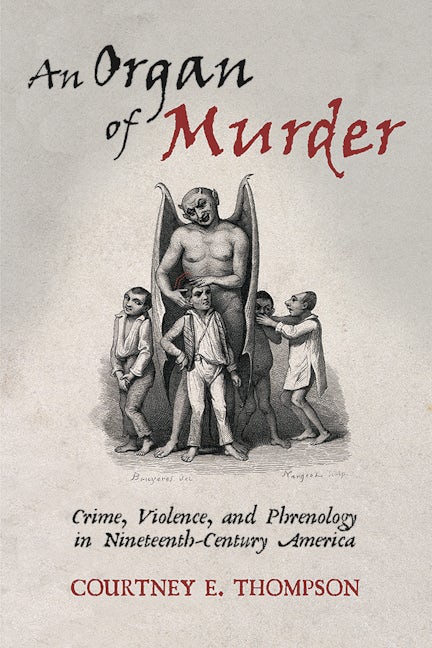
Thompson on crime, violence, and phrenology
An Organ of Murder explores the origins of both popular and elite theories of criminality in the nineteenth-century United States, focusing in particular on the influence of phrenology. In the United States, phrenology shaped the production of medico-legal knowledge around crime, the treatment of the criminal within prisons and in public discourse, and sociocultural expectations about the causes of crime. The criminal was phrenology’s ideal research and demonstration subject, and the courtroom and the prison were essential spaces for the staging of scientific expertise. In particular, phrenology constructed ways of looking as well as a language for identifying, understanding, and analyzing criminals and their actions. This work traces the long-lasting influence of phrenological visual culture and language in American culture, law, and medicine, as well as the practical uses of phrenology in courts, prisons, and daily life.
Praise for the book:
"Courtney Thompson provocatively measures the face, head, and soul of American phrenology and invites us to a discovery of the historical origins of scientific criminology." - Stephen Casper
"In this compelling book, Courtney Thompson takes readers to the prisons, courtrooms, and streets of antebellum cities to expose just how phrenology claimed authority on criminality. Rich in detail and analysis, An Organ of Murder vividly illustrates the long history of making criminal minds and bodies into objects of medical and scientific inquiry." - Carla Bittel
Further information is available here.
--Mitra Sharafi
Monday, July 13, 2020
Ginio on death investigation in French Africa
This article examines the practice of autopsies in French-ruled West Africa in the interwar era. It contributes to the discussion of medical knowledge and its employment in the colonies and raises a set of questions regarding the administration’s motives for performing autopsies and the African responses to this practice. In order to answer these questions, I briefly examine the practice of autopsies in France and move to the colonies to look at the problematic ways in which they were performed under colonial conditions. I then delve into local practices of ritual autopsies that also aim to explain death, but in different ways. Finally, I demonstrate what the differences and similarities between practices of colonial and ritual autopsies can teach us about the idea of the Civilising Mission and its perception by African colonial subjects.
cropped.jpg)

