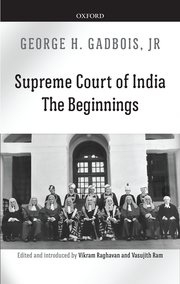
 George Gadbois' Supreme Court of India: The Beginnings was published by Oxford University Press last month. The book is Gadbois' 1965 Duke PhD dissertation in political science. It has been published posthumously with an introduction to George Gadbois' life and work by co-editors Vikram Raghavan and Vasujith Ram. George Gadbois taught at the University of Kentucky and passed away in 2017 (we noted earlier this obituary by Vikram Raghavan). From the publisher:
This work
seeks to determine the roles played by the paramount judiciary in the Indian
polity between 1937 and 1964. The discussion starts with an examination of the
Federal Court, the establishment of which in 1937 brought into existence India's
first central judicial institution. After a consideration of events leading to
the creation of the Federal Court, the nature of its jurisdiction and
representative decisions are analysed. Other matters considered include the
relationship of the Federal Court with the Privy Council, and the unsuccessful
efforts made to empower the Federal Court with a jurisdiction to hear civil
appeals. In addition, the major part of this work is devoted to the present
Supreme Court of India, which replaced the Federal Court in 1950. After
discussing the general features of the new judicial establishment, attention is
focused upon the nature of its review powers and the manner in which the Court
can exercise these powers. Against the background of debates in the Constituent
Assembly that reflect the attitudes of the Constitution-makers towards judicial
review, the important decisions which provoked clashes between the judges and
politicians have been analysed.
Here is the Table of Contents:
- Introduction
by Vikram Raghavan and Vasujith Ram
- Chapter 1:
Evolution of the Federal Court of India
- Chapter 2:
The Federal Court of India: 1937-1950
- Chapter 3:
The New Judicial Establishment
- Chapter 4:
Jurisdiction and Powers of the Supreme Court
- Chapter 5:
The Supreme Court in the Indian System of Government
- Chapter 6:
Judicial Review in a Modern Democratic Welfare State
- Chapter 7:
Summary and Conclusions
There have been multiple book launch events in India and the US, including this, this, this, and this. Here is an excerpt from the book.
Further information about the book is available here.
Out with the University of Chicago Press' Law and Society series, we missed this one when it appeared in 2015. Luise White (University of Florida) has published Unpopular Sovereignty: Rhodesian Independence and African Decolonization. From the press:
 In 1965 the white minority government of Rhodesia (after 1980 Zimbabwe) issued a unilateral declaration of independence from Britain, rather than negotiate a transition to majority rule. In doing so, Rhodesia became the exception, if not anathema, to the policies and practices of the end of empire. In Unpopular Sovereignty, Luise White shows that the exception that was Rhodesian independence did not, in fact, make the state that different from new nations elsewhere in Africa: indeed, this history of Rhodesian political practices reveals some of the commonalities of mid-twentieth-century thinking about place and race and how much government should link the two.
White locates Rhodesia’s independence in the era of decolonization in Africa, a time of great intellectual ferment in ideas about race, citizenship, and freedom. She shows that racists and reactionaries were just as concerned with questions of sovereignty and legitimacy as African nationalists were and took special care to design voter qualifications that could preserve their version of legal statecraft. Examining how the Rhodesian state managed its own governance and electoral politics, she casts an oblique and revealing light by which to rethink the narratives of decolonization.
Praise for the book:
“This is a thorough, comprehensive, and well-researched book that will be the essential starting point for the reconsideration of Zimbabwe’s recent history and historiography. A sharply acute and very readable study that resets the foundations for the understanding of Rhodesia’s Unilateral Declaration of Independence in 1965, it sets the events surrounding and following UDI in the context of African decolonisation and in their international context. With fascinating accounts of the constitutional machinations and the regime of economic sanctions and its failures, it is unrivalled as a rich resource for the period based on a very wide range of sources.” -Martin Chanock
“White’s Unpopular Sovereignty is a groundbreaking contribution to studies of decolonization. She places the seemingly anomalous history of Rhodesian independence within the decolonization of the rest of Africa. This is combined with a reanimation of the history of the ‘high politics’ of late colonialism by incisive accounts of the effects of various franchise commissions and experiments at constitution writing. The result is one of the most decisive challenges to linear versions of decolonization: of Rhodesia-into-Zimbabwe, to be sure, but also, more broadly, of colonies into nation-states. Written with characteristic brilliance, verve, and wit, Unpopular Sovereignty will become indispensable reading for scholars of colonialism and of the postcolonial world.” -Mrinalini Sinha
“Set in the late-colonial context of decolonization in Africa, this masterful book demonstrates that sovereignty does not flow in a linear fashion and according to preordained coordinates; and, that its predicates and foundations—political autonomy and self-government, on the one hand, and political identity and subjectivity, on the other—abide time and space in unpredictable ways. Relating the arguments to contemporary Zimbabwe, White demonstrates once and for all that the nature of sovereign power or associated political processes and outcomes are better understood through the manners in which shifting terrains of global, regional, and local alliances shaped the interests and the terms of the quest for power for protagonists—white minorities and so-called native populations alike. This is a truly impressive intervention in the historiography (and theory) of decolonization in Zimbabwe that holds significant insights for accounts of postcolonial sovereignty everywhere. Simply wonderful and a joy to read.” -Siba N'Zatioula Grovogui
Further information is available here.
Here's the abstract:
This article analyses
the role of the legal profession and the evolution of aspects of Indian nationalist
ideology during the Non-Cooperation Movement of 1920–22. Very few legal
professionals responded to Gandhi's call to boycott the British courts despite
significant efforts to establish alternative institutions dedicated to
resolving disputes. First identified by leading legal professionals in the
movement as courts of arbitration, these alternative sites of justice quickly
assumed the name ‘panchayats’. Ultimately, this panchayat experiment failed due
to a combination of apathy, repression, and internal opposition. However, the
introduction of the panchayat into the discourse of Indian nationalism
ultimately had profound effects, including the much later adoption of
constitutional panchayati raj. Yet this discourse was then and remains today a
contested one. This is largely a legacy of Gandhi himself, who, during the
Non-Cooperation Movement, imagined the panchayat as a judicial institution
based upon arbitration and mediation. Yet, after the movement's failure, he
came to believe the panchayat was best suited to functioning as a unit of
village governance and administration.

