Showing posts with label transportation. Show all posts

Friday, October 11, 2019

Russell on Streetcar Torts

Thomas D. Russell, University of Denver Sturm College of Law, has posted Blood on the Tracks: Turn-of-the-Century Streetcar Injuries, Claims, and Litigation in Alameda County, California:
Richmond Road 1887 (NYPL)
Streetcars were great American tortfeasors of the turn-of-the-century, injuring approximately one 331 urban Americans in 1907. In this empirical study, I consider the entire run of streetcar injuries, claims, trial-court suits, and appeals. My conclusions are based upon data drawn from the claims department records of Alameda County's principal street railway company, from all of the personal injury suits filed in the county's Superior Court, from all appellate cases involving the street railway company, and also from other sources concerning the street railway industry.

Plaintiffs in street railway cases very rarely won their cases against the company, and when they did, they won little money. In terms of the bite taken out of the street railway company, I characterize the Superior Court as a flea. I argue that Professor Gary Schwartz was wrong to characterize tort law as generous and that Judge Richard Posner is wrong to call tort law efficient. Like Professor Lawrence M. Friedman and Morton Horwitz, I see the amount taken from the street railway companies as quite small, but I see no evidence of deliberate efforts to subsidize the industry.

I argue that the term "dispute pyramid," which is common among Law & Society scholars, is misleading. I propose that we instead think in terms of a salmon run, with very large drop-offs from the levels of injuries to claims and, especially, to litigation.

I also examine in detail the operation of the street railway's claims department. I describe the relationship of the amount of money paid out through the claims department to the amount paid out in Superior-Court judgments and costs. I show that the average amounts of money that successful claimants received were very small indeed and argue, contra Posner and others, that the bargaining that took place in the claims department was very distant from the level of the trial court. For example, where Posner derived an average figure of about $5,000 for wrongful death claims using appellate data, I show that in the claims department, claimants in death cases averaged $127.32.

I also consider some of the fine work done by constitutive theorists, particularly Barbara Welke, of the University of Minnesota. I agree with most of her conclusions regarding the manner in which tort law instantiated gender norms, but I remain convinced that the operation of street railways, as social and economic activities, and also the conduct of trials had much more formative influence on norms of gender than did legal doctrine. That is, along with Chris Tomlins, I think that Welke makes too much of the formative influence of law on American discourse or ideology. This may be a small quibble.

I adapt the methods of the constitutive theorists and try to build upon Welke's excellent work to show that the streetcar companies helped to instill norms of negligence within their women riders. This made some women safer and kept others from making claims when they were injured. I argue that the street railway companies' ability to shape norms of negligence show another flaw in Posner's theory regarding the regulatory effect of tort law.

Earlier drafts of this work have been cited in the Harvard Law Review, Vanderbilt Law Review, Tulane Law Review, Wisconsin Law Review, Harvard Women’s Law Journal, Law & Social Inquiry, Journal of Tort Law, and the Connecticut Journal of Insurance Law. The author is looking for a place to publish this either as a long article or a monograph.

--Dan Ernst

Monday, May 20, 2019

Motor Carrier Regulation and the Law, 1920-1955

[Longtime LHB readers will recall that for the exam in my legal history course at Georgetown Law i write an essay about some regulatory regime I did not cover in class and ask students to draw comparisons with those we did.  (Last year's, on meat inspection, is here, and earlier one on the US Commerce Court is here)  This year's essay, on the regulation of motor carriers, follows.  Dan Ernst.]

“Motor carriers unit gets underway” (LC)
“The story of transportation in the United States,” wrote David Lilienthal, who had studied with Felix Frankfurter at the Harvard Law School in the early 1920s, “has been marked by constant and almost bewildering changes in the facilities by which the movement of men and goods has been effected.”  In the early twentieth century, one of the most bewildering changes was the transformation of motor vehicles from a rich person’s plaything to a major competitor of railroads for the nation’s freight.  Already in 1920, the states had registered 1 million trucks; by 1929, the number was 3.7 million.  Railroads considered such motor carriers pests that threatened to consume their revenue, and they looked to government to bottle them up.

Until 1935, motor carrier regulation was the province of the states.  By the 1920s, most already had “public utility commissions” that regulated railroads; water, gas, and electric companies; and other “businesses affected with a public interest.”  Perhaps for that reason, as a scholar wrote, it was ‘but natural” that these commissions would regulate motor carriers as well.  Still, motor transport companies differed from railroads in important respects, including especially their much lower fixed costs. Trucks operated on publicly owned roads; railroads had to pay for their rights of way and lay their own tracks.  Also, trucks were much less expensive than locomotives and train cars.  Thus, barriers to entering the motor carrier industry were far lower than the railroad industry.  If the core mission of railroad regulation had been to ensure that railroads allocated their fixed costs to shippers fairly; the core mission of motor carrier regulation was to limit competition, thereby making, it was said, the transportation industry more stable and safe.

The foundation for motor carrier regulation was the “certificate of convenience and necessity,” issued by a commission not as a property interest but a revocable license to serve the public for a fixed period of time.  Commercial motor carriers could not operate without one.  To get one they had to show that the public needed their services and that they had the financial wherewithal to meet that need.  Motor carriers also had to abide by “tariffs” set by the commission.  These schedules fixed minimum, maximum or actual charges for the transport various classes of goods.  The commissions also issued a host of safety regulations and oversaw the mergers, issuance of securities, and other financial actions of regulated companies. Disputes could arise when commissions denied applicants certificates or revoked them for malfeasance, which were quasi-adjudicative acts.  They could also arise in rate-setting, a quasi-legislative act.

Tuesday, October 3, 2017

Kassel on the Desegregation of American Airports

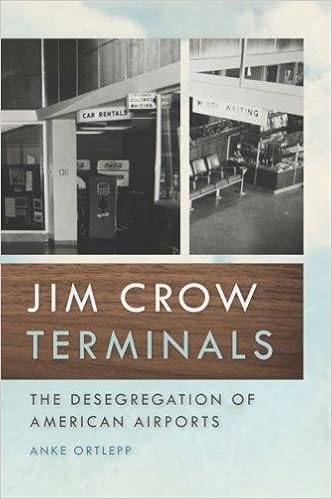
New from the University of Georgia Press: Jim Crow Terminals: The Desegregation of American Airports (July 2017), by Anke Ortlepp (University of Kassel). A description from the Press:


Historical accounts of racial discrimination in transportation have focused until now on trains, buses, and streetcars and their respective depots, terminals, stops, and other public accommodations. It is essential to add airplanes and airports to this narrative, says Anke Ortlepp. Air travel stands at the center of the twentieth century’s transportation revolution, and airports embodied the rapidly mobilizing, increasingly prosperous, and cosmopolitan character of the postwar United States. When segregationists inscribed local definitions of whiteness and blackness onto sites of interstate and even international transit, they not only brought the incongruities of racial separation into sharp relief but also obligated the federal government to intervene. 
Ortlepp looks at African American passengers; civil rights organizations; the federal government and judiciary; and airport planners, architects, and managers as actors in shaping aviation’s legal, cultural, and built environments. She relates the struggles of black travelers—to enjoy the same freedoms on the airport grounds that they enjoyed in the aircraft cabin—in the context of larger shifts in the postwar social, economic, and political order. Jim Crow terminals, Ortlepp shows us, were both spatial expressions of segregation and sites of confrontation over the re-negotiation of racial identities. Hence, this new study situates itself in the scholarly debate over the multifaceted entanglements of “race” and “space.”
More information is available here.

Friday, February 17, 2017

Kyer on Streetcar Law

More of our Commonwealth round-up from 2015, when Irwin Law published A Thirty Years' War: The Failed Public/Private Partnership that Spurred the Creation of the Toronto Transit Commission, 1891-1921 by C. Ian Kyer, RPM Technologies. From the press:
A Thirty Years’ War coverBetween 1891 and 1921, the Toronto Railway Company operated Toronto’s streetcars under a franchise granted by the City. The arrangement brought the City a modern electric streetcar system, but the relationship between the two entities was a tempestuous one, marked and marred by almost constant conflict and confrontation. Remarkably, the many court battles that resulted went to the Judicial Committee of the Privy Council on fourteen separate occasions. This book details these legal disputes, and along the way, links them to the city’s expansion and development, its municipal politics, the provincial debates over public ownership of many kinds of utilities, and the legal culture of the day, which reveals a remarkable faith in the courts. This is a fascinating historical story set in its own time and milieu, but which also has considerable contemporary relevance as Toronto — and Canada’s other major urban centres — wrestle with their modern transportation problems. It will be of interest not only to legal historians, but also to those interested in transit and municipal history, and in the correct balance between public and private ownership.
Praise for the book:

“[A] thoughtful and very timely book. . . . A Thirty Years’ War describes, in great detail, a dynamic and a political dialogue that is still so relevant today. . . . [The book] provides invaluable guidance on how to avoid pitfalls from the past. . . . [I]t flags lessons learned, as, once again, injection of private cash is being mooted as an option to renew and expand our transit system.” -Andy Byford

“To understand the evolution of cities at the end of the nineteenth century and the first two decades of the twentieth, Ian Kyer’s study of the relationship between Toronto’s councils and the City’s privately owned transportation system is essential reading. Kyer writes with authority, but with no hint of stodginess. I do not hesitate to recommend A Thirty Years’ War, not only to today’s Torontonians, but to readers across the country.” -R.B. Fleming

"Civil litigators, municipal law specialists, transportation law counsel and members of the solicitors' bar interested in the psychology of negotiating contracts to the point of brinksmanship (not to mention those, like me, interested in legal history) are invited to read this 254 page gem [ . . .] The study of an historical legal subject, when ably undertaken as in this case, serves contemporary needs and draws much needed light on present-day controversies. A Thirty Year's War may be enjoyed on many levels, but will prove valuable for advocates and for those who wish to avoid litigation." - Gilles Renaud

Further information is available here.