Wednesday, April 23, 2008
Lyons on Doing Justice to History in the Courts of the European Union
A Door into the Dark: Doing Justice to History in the Courts of the European Union is an interesting new paper by Carole Lyons, European University Institute. Here's the abstract: The European Court of Justice in Luxembourg has been issuing judgments since 1954. It is beyond doubt that this body has, in these judgments, influenced the nature of European integration, indeed the nature of Europe itself, in a far reaching manner. Over the years, this Court has been called upon many times to judge in cases and claims originating in wartime Europe. The first of these occurred in 1975 and there are still, in 2008, several cases rooted in the Second World War awaiting judgment. In other words, the legacy of what happened in Europe between 1933 and 1945 is very much a live, if not very well known, issue before the judges of the European Union. This paper examines how the European Court of Justice responds to wartime based claims and how its jurisprudence deals with the history of the Member States of the EU. It is, in other words a specific analysis of the Vergangenheitsbewältigung (the management of the past) by one institution of the Union. This analysis is framed within an appreciation of the difficulties inherent in confronting memories within the European Union. The Court of the Union is no different in this respect and it emerges as closed and restrained when faced with wartime narratives. This struggle to judicially handle its own history, and the narratives which are unearthed in individual, isolated, modest cases, collectively expose a European Union still very much required to confront the past.


Tuesday, April 22, 2008
McLennan, The Crisis of Imprisonment: Protest, Politics, and the Making of the American Penal State, 1776-1941
The Crisis of Imprisonment: Protest, Politics, and the Making of the American Penal State, 1776-1941 by Rebecca McLennan has just been published by Cambridge University Press as part of the series Cambridge Historical Studies in American Law and Society edited by Chris Tomlins.

Here's the CUP book description:
In the Age of Jackson, private enterprise set up shop in the American penal system. Working hand in glove with state government, contractors in both the North and the South would go on to put more than half a million imprisoned men, women, and youth to hard, sweated toil for private gain by 1900. Held captive, stripped of their rights, and subject to lash and paddle, convict laborers churned out vast quantities of goods and revenue, in some years generating the equivalent of more than $30 billion worth of work. By the 1880s, however, a growing mass of Americans came to regard the prison labor system as immoral and unbefitting of a free republic: it fostered torture and other abuses, degraded free citizen-workers, corrupted government and the legal system, and stifled the supposedly ethical purposes of punishment. The Crisis of Imprisonment tells the remarkable story of this controversial system of penal servitude:-how it came into being, how it worked, how the popular campaigns for its abolition were ultimately victorious, and how it shaped and continues to haunt the American penal system. The author takes the reader into the morally vital world of nineteenth-century artisans, industrial workers, farmers, clergy, convicts, machine politicians, and labor leaders and shows how prisons became a lightning rod in a determined defense of republican and Christian values against the encroachments of an unbridled market capitalism. She explores the vexing ethical questions that prisons posed then and remain exigent today: What are the limits of state power over the minds, bodies, and souls of citizens and others-is torture permissible under certain circumstances? What, if anything, makes the state morally fit to deprive a person of life or liberty? Are prisoners slaves and, if so, by what right? Should prisoners work? Is the prison a morally defensible institution? The eventual abolition of prison labor contracting plunged the prisons into deep fiscal and ideological crisis. The second half of the book offers a sweeping reinterpretation of Progressive Era prison reform as, above all, a response to this crisis. It concludes with an exploration of the long-range impact of both penal servitude and the anti-prison labor movement on the modern American penal system.
In the Age of Jackson, private enterprise set up shop in the American penal system. Working hand in glove with state government, contractors in both the North and the South would go on to put more than half a million imprisoned men, women, and youth to hard, sweated toil for private gain by 1900. Held captive, stripped of their rights, and subject to lash and paddle, convict laborers churned out vast quantities of goods and revenue, in some years generating the equivalent of more than $30 billion worth of work. By the 1880s, however, a growing mass of Americans came to regard the prison labor system as immoral and unbefitting of a free republic: it fostered torture and other abuses, degraded free citizen-workers, corrupted government and the legal system, and stifled the supposedly ethical purposes of punishment. The Crisis of Imprisonment tells the remarkable story of this controversial system of penal servitude:-how it came into being, how it worked, how the popular campaigns for its abolition were ultimately victorious, and how it shaped and continues to haunt the American penal system. The author takes the reader into the morally vital world of nineteenth-century artisans, industrial workers, farmers, clergy, convicts, machine politicians, and labor leaders and shows how prisons became a lightning rod in a determined defense of republican and Christian values against the encroachments of an unbridled market capitalism. She explores the vexing ethical questions that prisons posed then and remain exigent today: What are the limits of state power over the minds, bodies, and souls of citizens and others-is torture permissible under certain circumstances? What, if anything, makes the state morally fit to deprive a person of life or liberty? Are prisoners slaves and, if so, by what right? Should prisoners work? Is the prison a morally defensible institution? The eventual abolition of prison labor contracting plunged the prisons into deep fiscal and ideological crisis. The second half of the book offers a sweeping reinterpretation of Progressive Era prison reform as, above all, a response to this crisis. It concludes with an exploration of the long-range impact of both penal servitude and the anti-prison labor movement on the modern American penal system.
And the blurbs:
"Deeply researched and deeply reflective, The Crisis of Imprisonment redefines the central themes of 19th and early 20th century American prison history. Its story of the rise and fall of contractual penal servitude shows how questions of imprisonment, prison labor, and the treatment of prisoners lay at the heart of ongoing struggles over the meaning of freedom and unfreedom in America. Few scholars have succeeded so well in tracing the reciprocal relations between the institutions of punishment and the broader fields of economic and political power with which they are connected. Written with clarity and conviction, this is a major new work on the formation of the American penal state." - David Garland, New York University
"Although there have been several fine studies of the thinking and influence of American prison reformers, McLennan has written a revealing study of the impact of popular politics, and especially of the prisoners themselves on the shaping and reshaping of state prison systems. She helps us understand the huge prison business of our times by analyzing controversies and prison revolts that led first to the development of contract prison labor then to its abolition in the nineteenth and early twentieth centuries." - David Montgomery, Yale University
"A timely, penetrating look into the horrors of the nineteenth-century prison system, its brutal-and brutalizing-convict labor system, and the mass of ordinary Americans who confronted its abuses and, ultimately, brought about its abolition." - Sister Helen Prejean, author of Dead Man Walking and The Death of Innocents
"This is an extraordinary investigation and analysis of penal servitude and anti-prison labor campaigns in American history. Wonderfully insightful and illuminating, this work has much to teach us about where we've been and what we must consider in confronting the politics of legal punishment." - Bryan Stevenson, New York University School of Law, Executive Director, Equal Justice Initiative
"One of the smartest books about punishment I have ever read. And this is not just a book about prisons. The story Rebecca McLennan narrates so powerfully in these pages-the controversial career of penal servitude in a liberal democratic republic--has much to tell us about the history of American society, politics, and institutions." - Michael Willrich, Brandeis University, author of City of Courts: Socializing Justice in Progressive Era Chicago
ALSH book, dissertation and paper prize deadlines
Several prize deadlines are announced in the Winter/Spring issue of the American Society for Legal History Newsletter.
Conference papers submitted for the Kathryn T. Preyer Scholars award are due June 15, 2008. The program of Kathryn T. Preyer Scholars is designed to help legal historians at the beginning of their careers. At the annual meeting of the Society two younger legal historians designated Kathryn T. Preyer Scholars will present what would normally be their first papers to the Society.
The deadline for the John Phillip Reid Book Award for the best book published in 2007 in English in any of the fields broadly defined as Anglo-American legal history is May 30, 2008. Nominations for this year’s prize should include a curriculum vitae of the author and be accompanied by a hard copy version of the work (no electronic submissions, please).
Cromwell book prize and dissertation prizes
Cromwell book prize
The William Nelson Cromwell Foundation awards annually a $5000 prize for excellence in scholarship in the field of American Legal History by a junior scholar. The prize is designed to recognize and promote new work in the field by graduate students, law students, and faculty not yet tenured. The work may be in any area of American legal history, including constitutional and comparative studies, but scholarship in the colonial and early national periods will receive some preference. The Foundation awards the prize on the recommendation of the Cromwell Prize Advisory Committee of the American Society for Legal History. In 2006, the Committee considered books and articles published, or dissertations accepted, in the previous calendar year.
Cromwell Dissertation Prize
The Cromwell Foundation has also established a $2500 prize for dissertations accepted or student articles written in the previous year in the general field of American legal history (broadly conceived), with some preference for those in the area of early America or the colonial period.
Anyone may nominate works for the Cromwell Prizes. The Committee will accept nominations from authors, dissertation advisors, presses, or anyone else. Nominations for this year’s prizes should include a curriculum vitae of the author and be accompanied by a hard copy version of the work (no electronic submissions, please) sent to each member of the Committee and postmarked no later than May 31, 2008.
More information about all of these prizes, including addresses for members of prize committees is here.
Don't be shy about asking your press (or your professor) to nominate you, or send your book or dissertation in yourself. Presses are often unaware of book prizes like this, and sometimes deadlines are missed. The bottom line is: you have to be the advocate for your own work.
Farber, Security v. Liberty: Conflicts Between Civil Liberties and National Security in American History
SECURITY V. LIBERTY: CONFLICTS BETWEEN CIVIL LIBERTIES AND NATIONAL SECURITY IN AMERICAN HISTORY, edited by Daniel Farber, U.C. Berkeley -- Boalt School of Law, has just been published by the Russell Sage Foundation. Farber has posted this abstract on SSRN:

Threats to national security generally prompt incursions on civil liberties. The relationship has existed since the presidency of John Adams and has continued through two World Wars, the Cold War, Vietnam, and to the present day. Though this historical phenomenon is commonplace, the implications of that history for our post-9/11 world are less clear.
In the long run, if we are to cope with present and future crises, we must think deeply about how our historical experience bears on a changing world. This book, published by the Russell Sage Foundation, addresses the past and present relationship between civil liberties and national crises, with contributions from leading legal scholars and historians. They seek both to draw historical lessons and to explore how the present situation poses unique issues. The contributors include Alan Brinkley, Daniel Farber, Stephen Holmes, Ronald D. Lee, Jan Ellen Lewis, L.A. Powe, Jr., Ellen Schrecker, Paul M. Schwartz, Geoffrey R. Stone, and John Yoo.
Russell Sage has a more extensive book description, including this description of some chapters:
Security v. Liberty focuses on periods of national emergency in the twentieth century—from World War I through the Vietnam War—to explore how past episodes might bear upon today’s dilemma. Distinguished historian Alan Brinkley shows that during World War I the government targeted vulnerable groups—including socialists, anarchists, and labor leaders—not because of a real threat to the nation, but because it was politically expedient to scapegoat unpopular groups. Nonetheless, within ten years the Supreme Court had rolled back the most egregious of the World War I restrictions on civil liberties. Legal scholar John Yoo argues for the legitimacy of the Bush administration’s War on Terror policies—such as the detainment and trials of suspected al Qaeda members—by citing historical precedent in the Roosevelt administration’s prosecution of World War II. Yoo contends that, compared to Roosevelt’s sweeping use of executive orders, Bush has exercised relative restraint in curtailing civil liberties. Law professor Geoffrey Stone describes how J. Edgar Hoover used domestic surveillance to harass anti-war protestors and civil rights groups throughout the 1960s and early 1970s. Congress later enacted legislation to prevent a recurrence of the Hoover era excesses, but Stone notes that the Bush administration has argued for the right to circumvent some of these restrictions in its campaign against terrorism. Historian Jan Ellen Lewis looks at early U.S. history to show how an individual’s civil liberties often depended on the extent to which he or she fit the definition of “American” as the country’s borders expanded. Legal experts Paul Schwartz and Ronald Lee examine the national security implications of rapid advances in information technology, which is increasingly driven by a highly globalized private sector, rather than by the U.S. government.
Security v. Liberty focuses on periods of national emergency in the twentieth century—from World War I through the Vietnam War—to explore how past episodes might bear upon today’s dilemma. Distinguished historian Alan Brinkley shows that during World War I the government targeted vulnerable groups—including socialists, anarchists, and labor leaders—not because of a real threat to the nation, but because it was politically expedient to scapegoat unpopular groups. Nonetheless, within ten years the Supreme Court had rolled back the most egregious of the World War I restrictions on civil liberties. Legal scholar John Yoo argues for the legitimacy of the Bush administration’s War on Terror policies—such as the detainment and trials of suspected al Qaeda members—by citing historical precedent in the Roosevelt administration’s prosecution of World War II. Yoo contends that, compared to Roosevelt’s sweeping use of executive orders, Bush has exercised relative restraint in curtailing civil liberties. Law professor Geoffrey Stone describes how J. Edgar Hoover used domestic surveillance to harass anti-war protestors and civil rights groups throughout the 1960s and early 1970s. Congress later enacted legislation to prevent a recurrence of the Hoover era excesses, but Stone notes that the Bush administration has argued for the right to circumvent some of these restrictions in its campaign against terrorism. Historian Jan Ellen Lewis looks at early U.S. history to show how an individual’s civil liberties often depended on the extent to which he or she fit the definition of “American” as the country’s borders expanded. Legal experts Paul Schwartz and Ronald Lee examine the national security implications of rapid advances in information technology, which is increasingly driven by a highly globalized private sector, rather than by the U.S. government.
Ng on Natural Law, the Pursuit of Knowledge and Authorship
Natural Law, the Pursuit of Knowledge and Authorship is a new paper by Alina Ng, Mississippi College School of Law. Here's the abstract: This paper considers the emergence of the concept of authorship in copyright history as a response to the commercial market for literary and artistic works. Copyright law developed in the eighteenth century to create ownership in creative works and ensure that those who produce and distribute creative works to the public would be remunerated through the mechanisms of the commercial marketplace. Authors however, write and create for a variety of reasons, some of which are not purely economic or rational. Beyond writing for public recognition and reward through the market, authors may create and produce creative works purely as a natural human response to a deeper moral aspiration to pursue knowledge. This aspect of authorship is one that is not explored in copyright law and this paper applies natural law philosophy to copyright law by regarding authorship in the pursuit of knowledge as a common human good. By removing from copyright law the assumptions that all authors are purely rational actors seeking to maximize their economic benefits from the market and seeing authors as pursuing knowledge as a practical reasonable choice, doctrines in copyright law can be reconsidered in light of this natural law claim. This paper concludes that natural law philosophy provides an important insight into the manner in which laws and legal systems can be analyzed and clarifies many of the legal problems we face today.
Rothchild Reviews The Cambridge Companion to Ancient Greek Law
 John Rothchild, Wayne State University Law School, has posted a review essay on The Cambridge Companion to Ancient Greek Law. It is forthcoming in the American Journal of Comparative Law. Here's Rothchild's abstract:
The book under review, The Cambridge Companion to Ancient Greek Law, consists of twenty-two essays on various aspects of the law of ancient Greece - principally that of Athens in the fifth and fourth centuries BCE. These essays do a good job of conveying to the reader a sense of the law, in all of its strangeness to modern eyes, that developed in the society often viewed as the birthplace of democracy. The contributors to the volume include the leading scholars in the subject from Europe and the United States. The book will be of interest to comparativists, to classicists with an interest in ancient law, and to legal scholars who wish they had studied classics.
In the review itself, Rothchild finds the book "an enormously worthwhile read for fans of diachronic comparativism, for classicists with an interest in ancient law, and for legal scholars who wish they had studied classics. In general it is quite accessible to the nonspecialist."
Here's the Cambridge University Press book description:
This Companion volume provides a comprehensive overview of the major themes and topics pertinent to ancient Greek law. A substantial introduction establishes the recent historiography on this topic and its development over the last 30 years. Many of the 22 essays, written by an international team of experts, deal with procedural and substantive law in classical Athens, but significant attention is also paid to legal practice in the archaic and Hellenistic eras; areas that offer substantial evidence for legal practice, such as Crete and Egypt; the intersection of law with religion, philosophy, political theory, rhetoric, and drama, as well as the unity of Greek law and the role of writing in law. The volume is intended to introduce non-specialists to the field as well as to stimulate new thinking among specialists.
This Companion volume provides a comprehensive overview of the major themes and topics pertinent to ancient Greek law. A substantial introduction establishes the recent historiography on this topic and its development over the last 30 years. Many of the 22 essays, written by an international team of experts, deal with procedural and substantive law in classical Athens, but significant attention is also paid to legal practice in the archaic and Hellenistic eras; areas that offer substantial evidence for legal practice, such as Crete and Egypt; the intersection of law with religion, philosophy, political theory, rhetoric, and drama, as well as the unity of Greek law and the role of writing in law. The volume is intended to introduce non-specialists to the field as well as to stimulate new thinking among specialists.
Contents
Part I. Law in Greece:
1. The unity of Greek law;
2. Writing, law and written law Rosalind Thomas;
3. Law and religion Robert Parker;
4. Early Greek law Michael Gagarin;
Part II. Law in Athens I: Procedure:
5. Law and oratory at Athens Stephen Todd;
6. Relevance in Athenian courts Adriaan Lanni;
7. The influence of procedural choice on Athenian court-room strategies Lene Rubinstein;
8. The role of the witness in Athenian law Gerhard Thur;
9. Theories of punishment David Cohen;
10. The rhetoric of law in fourth-century Athens Harvey Yunis;
Part III. Law in Athens II: Substantive Law:
11. Crime, punishment, and the rule of law in Classical Athens David Cohen;
12. Gender, sexuality, and law Eva Cantarella;
13. Family and property law Alberto Maffi;
14. Athenian citizenship law Cynthia Patterson;
15. Commercial law Edward E. Cohen;
Part IV. Law Outside Athens:
16. The Goryns laws John Davies;
17. Greek law in foreign surroundings Hans-Alpert Rupprecht;
18. Hellenistic law: general framework Joseph Meleze Modrzejewski;
Part V. Other Approaches to Greek Law:
19. Law, Attic comedy, and the regulation of comic speech Robert Wallace;
20. Greek tragedy and law Danielle Allen;
21. Law and political theory Josiah Ober;
22. Law and nature in Greek thought A. A. Long.
Monday, April 21, 2008
Benshalom on Stages in the Development of International Taxation
The Quest to Tax Interest Income: Stages in the Development of International Taxation is a new article by Ilan Benshalom, Northwestern University School of Law. It will appear in the Virginia Tax Review (2008). Here's the abstract: The Article offers a new perspective on the way international income tax has developed from its nascency, 85 years ago, to the present day. Its main claim is that, due to the lack of a clear normative tax agenda, trade considerations unduly eroded the income tax base. Such trade considerations highlight the importance of reducing tax obstacles on trade and investment to liberalize and integrate international markets. These considerations penetrated international income tax discourse during the Cold War period, when liberalizing trade was part of a broader western agenda to establish dominance through the liberalization of international markets. The Article demonstrates that the tax allocation conventions developed in the periods prior to the Cold War -- and thereafter -- were unable to counter successfully an endemic trend of tax erosion. To establish this claim, the Article frames three novel chronological phases and shows how different themes governed each phase. It then connects each theme and the relevant parallel global geo-political occurrences of that phase. The Article presents an original "macro" perspective of the development of international taxation sourcing conventions. It encapsulates this broad topic by focusing on a number of key issues arising from the conventions regarding the allocation of interest income. Access to foreign capital markets and foreign lenders is paramount to economic growth. Therefore, the tax treatment of interest income has always been a pivotal and controversial issue. The centrality of interest income allocation conventions and their modifications over the years make them a good proxy for understanding the more general evolution of international tax law. Since tax law research is the art of tying big themes with devils hiding in the details, the Article engages in an in-depth critical analysis of a number representative interest allocation mechanisms to demonstrate the dynamics of the income tax erosion it identifies. The Article builds on its historical analysis to open a wider discussion over the proper allocation method for taxing financial income. The mobility and tax sensitivity of capital assets make them the subject of tax planning (by taxpayers) and tax competition (by sovereigns). This renders the analysis important and interesting, but also more multilayered and difficult. The Article concludes with a discussion of the principled normative pillars of any future reform in the allocation of tax revenues arising from financial income. This discussion promotes the notion that, at least in the case of financial transactions within multinational enterprises, there is a need for an immediate strategic shift, if tax authorities wish to maintain the integrity of the corporate income tax.
Two from Wells on Anti-duelling and the history of Corporate Social Responsibility
Harwell Wells, Temple University Beasley School of Law, has posted to articles. The Cycles of Corporate Social Responsibility: An Historical Retrospective for the Twenty-First Century appeared in the University of Kansas Law Review (2002). Here's the abstract: Debates over Corporate Social Responsibility stretch from the 1930s to the twenty-first century, and have engaged some of the leading minds of the era. In the legal academy, these debates have tended to focus on whether corporate managers and directors should owe duties to shareholders alone, or whether the scope of their legal responsibilities should be widened to include employees, communities, consumers, and other "stakeholders" in the enterprises. But there is a problem with these debates: they rarely seem to have gone anywhere. Viewed in historical perspective, each new round of debate on corporate social responsibility seems merely to recapitulate earlier debates in a slightly altered form. This Article traces out these debates over corporate social responsibility in order to provide contemporary students of CSR a vantage-point from which they can critically evaluate their predecessors, and separate out the still-vital elements in those debates from the lost causes.
The End of the Affair? Anti-Dueling Laws and Social Norms in Antebellum America appeared in the Vanderbilt Law Review (2007). Here's the abstract: The story of anti-dueling laws has become a favorite tale for many social norms theorists. In their tellings, the spread of anti-dueling laws in the antebellum South and the subsequent end of dueling illustrates how properly drafted laws can change social norms and thus alter behavior. The actual history of these laws, however, teaches a different lesson. While the laws were carefully crafted to undermine the social norms promoting dueling, they failed. The very social norms that encouraged dueling prevented effective enforcement of laws passed to end the practice, and the affair of honor in the South was ended not by well-intentioned laws but by the social catastrophe of the Civil War. This account in turn suggests that there will be limits on modern-day attempts to alter social norms through legal sanctions.
The End of the Affair? Anti-Dueling Laws and Social Norms in Antebellum America appeared in the Vanderbilt Law Review (2007). Here's the abstract: The story of anti-dueling laws has become a favorite tale for many social norms theorists. In their tellings, the spread of anti-dueling laws in the antebellum South and the subsequent end of dueling illustrates how properly drafted laws can change social norms and thus alter behavior. The actual history of these laws, however, teaches a different lesson. While the laws were carefully crafted to undermine the social norms promoting dueling, they failed. The very social norms that encouraged dueling prevented effective enforcement of laws passed to end the practice, and the affair of honor in the South was ended not by well-intentioned laws but by the social catastrophe of the Civil War. This account in turn suggests that there will be limits on modern-day attempts to alter social norms through legal sanctions.
Sunday, April 20, 2008
The Sixties, Panama, War and more in the Sunday Book Reviews
 The Sixties Unplugged: A Kaleidoscopic History of a Disorderly Decade by Gerard J. DeGroot (Harvard University Press) gets a critical review from Michael S. Roth, president of Wesleyan University (and blogger!), in the San Francisco Chronicle. According to Roth, "DeGroot wants to destroy the notion that the '60s had a consistent, logical development with a clear legacy. But he never mentions any historians who hold this view about the decade, or, for that matter, any other time period." The book offers "useful reminders of global events that are not often juxtaposed with the protest movements of the time." But ultimately the author's "conceit of being 'unplugged' is also his disguise for being an objective observer without an agenda. But cynicism is an agenda. Good history is not just scornful debunking, and thoughtful historical accounts require empathy, not just irony."

Historians concerned with American empire will have an interest in Panama Fever: The Epic History of One of the Greatest Engineering Triumphs of All Time: The Building of the Panama Canal by Matthew Parker (Doubleday), reviewed today in the Philadelphia Inquirer. Chris Patsilelis finds the book "panoramic in its geographic, scientific and political scope, and focusing closely on the sensitive social and labor issues," and "a marvelously comprehensive work about an epic engineering triumph."
Betrayal: How Black Intellectuals Have Abandoned the Ideals of the Civil Rights Era by Houston A. Baker Jr. (Columbia University Press) is "an urgent, absorbing read," but "its blanket condemnation of the most prominent black public intellectuals is not entirely fair," writes Erin Aubry Kaplan in  the Los Angeles Times.
 the Los Angeles Times.
For young readers, Why War Is Never a Good Idea, written by Alice Walker, illustrated by Stefano Vitale (HarperCollins) "is an important and beautiful book," writes Liz Rosenberg for the Boston Globe. Vitale's beautiful and powerful artwork is reason alone to click over to the Globe's review. "It may be too easy for children - American children perhaps especially - to believe war has nothing to do with them or their world," writes Rosenberg. Walker's text "pulls no punches with her young readers, nor does she pretend that war is something separate from our existence." The result is a book that "stands alongside Mark Twain's famous 'The War Prayer' as an American antiwar classic."
RETRIBUTION: The Battle for Japan, 1944-45 by Max Hastings (Knopf), arguing that the atom bombing of Japan was justified, is critically reviewed by Kai Bird in the Washington Post. B ird describes the book as "military history as told from the foxhole -- or, in the case of this narrative of the last year of the Pacific war, as told from the decks of aircraft carriers." But on the book's central argument about Hiroshima and Nagasaki, "Hastings abandons his critical faculties," and "does not alert his readers" to new evidence in recently published books. Bird finds this "unfortunate," for "Hastings's narrative is fully compatible with a more nuanced interpretation of how the Pacific war ended."
 ird describes the book as "military history as told from the foxhole -- or, in the case of this narrative of the last year of the Pacific war, as told from the decks of aircraft carriers." But on the book's central argument about Hiroshima and Nagasaki, "Hastings abandons his critical faculties," and "does not alert his readers" to new evidence in recently published books. Bird finds this "unfortunate," for "Hastings's narrative is fully compatible with a more nuanced interpretation of how the Pacific war ended."
The Post also carries a review of TERROR AND CONSENT: The Wars for the Twenty-first Century by Philip Bobbitt (Knopf) by Daniel Byman, Georgetown. Byman writes that Bobbit, "despite his establishment pedigree...is a thoroughgoing contrarian. Defying the nearly universal criticism among academics of the term 'war on terror,' Bobbitt embraces it, making a strong case -- better than the Bush administration has -- that the challenge can best be thought of as a series of wars." In Byman's view, "readers should approach Terror and Consent with a mixture of caution and open-mindedness. Not all of Bobbitt's pronouncements may be convincing. But his book constantly prods us to reexamine our preconceptions about terrorism, which is by itself some preparation for what may lie ahead."
Saturday, April 19, 2008
Aubuchon on The Origin of Long Prison Sentences in America
The Origin of Long Prison Sentences in America: A Case Study of Pennsylvania, 1829-1865, is a new paper by Ashley T. Aubuchon, U.C. Berkeley. Here's the abstract: Penal historian David J. Rothman has described early American prison sentences as "very long" while French emissaries Gustave de Beaumont and Alexis de Tocqueville, writing in 1833, described the American penitentiary system as "severe." Though there exists a rich body of literature interpreting the birth of the prison, few scholars have written on the length of prison sentences that accompanied this birth. Using the length of prison sentences assigned to 1,727 convicts sentenced to the Eastern State Penitentiary in Pennsylvania in a dozen years falling between 1829 and 1865, this study investigates how long prison sentences were in Pennsylvania, what factors (race, age, gender, nationality, state of origin, recidivist status) affected sentence length, and how sentence length changed over time. Additionally, it compares Pennsylvania‘s sentence lengths to other American states to determine how representative Pennsylvania‘s prison sentences were of American prison sentences generally. Finally, it compares Pennsylvania‘s sentence lengths to those of Great Britain. While acknowledging the difficulty in comparing prison sentence lengths of different penal regimes in different states or countries, this study determines that Pennsylvania generally distributed shorter sentences than most other American states, but longer sentences than those in Great Britain. These quantitative differences are then situated in the "American exceptionalism" debate regarding contemporary penality in the United States and abroad.
Campbell and Groves on Parliamentary Privilege and the Courts: Questions of Justiciability
Parliamentary Privilege and the Courts: Questions of Justiciability is a recent article by Enid M. Campbell and Matthew Groves, both of Monash University (Australia). It appeared in the Oxford University Commonwealth Law Journal (2007). Here's the abstract: Much of the history of the doctrine of parliamentary privilege is one of dispute between parliaments and the courts. One source of dispute has been the disagreement between parliaments and the courts about which body may make the final pronouncement on questions of parliamentary privilege. The 1839 case of Stockdale v. Hansard represented a modern landmark in this dispute because it suggested that parliaments and the courts could occupy different complimentary roles. In Stockdale the court claimed the jurisdiction to determine questions about the existence and ambit of parliamentary privileges, but disclaimed the jurisdiction to rule upon the exercise once it has been held to exist. But the dividing line between a case concerning the existence or ambit of a privilege of parliament and one concerning the exercise of a privilege is difficult to draw. This article examines the basis upon the courts claim the jurisdiction to determine the existence and ambit of parliamentary privileges. It also analyzes three modern Australian cases in which courts have been required to rule upon questions of parliamentary privilege. These cases suggest that uncertainty remains about the jurisdiction of courts to rule upon questions of parliamentary privilege.
Friday, April 18, 2008
Three from Chin on U.S. Immigration History
Gabriel J. (Jack) Chin, University of Arizona James E. Rogers College of Law, has just posted on SSRN three articles on U.S. immigration law history. To place this work in a comparative context, see also Satvinder Juss's recent article on citizenship in the United Kingdom in the 60s and 70s, noted in the previous post.
The Civil Rights Revolution to Immigration Law: A New Look at the Immigration and Nationality Act of 1965 appeared in the North Carolina Law Review (1996). Here's the abstract:
The Civil Rights Revolution to Immigration Law: A New Look at the Immigration and Nationality Act of 1965 appeared in the North Carolina Law Review (1996). Here's the abstract:
The Immigration and Nationality Act of 1965 may prove to be the most consequential of the Great Society civil rights initiatives. The Act removed a reference for whites which had been a central feature of American immigration and nationality law since 1790; the resulting diversification of the immigrant stream will make America a "majority minority" nation within a few decades. Many commentators contend that the diversification that resulted from race-neutral immigration policy was unanticipated, undesired or both, from the perspective of the Congress that passed the Act. This article reexamines the question, drawing on legislative history as well as interviews with key legislators such as Gerald R. Ford, cabinet members including Nicholas deB. Katzenbach, and other participants in the development of the Act. The article concludes that it is more likely that Congress, largely the same one that passed the Civil Rights Act of 1964 and the Voting Rights Act of 1965, rejected the idea of America as a white nation. Congress actually intended to eliminate racial discrimination, and welcomed the diversification that it knew would result.Segregation's Last Stronghold: Race Discrimination and the Constitutional Law of Immigration appeared in the UCLA Law Review (1998). Here's the abstract:
For over a century, the Supreme Court has granted federal immigration laws a unique immunity from judicial review. Relying on the so-called plenary power doctrine, the Court has said that "over no conceivable subject" is federal power greater than it is over immigration; even modern federal cases, for example, state that Congress may freely discriminate on the basis of race in this context. In recent years, the Court has defended this approach primarily on stare decisis grounds. In this Article, Professor Gabriel Chin suggests that the plenary power doctrine should be reexamined because the foundational cases are unsound. Chae Chan Ping v. United States and Fong Yue Ting v. United States, the cases that established the plenary power doctrine and remain the leading cases, upheld federal discrimination against immigrants based on race. The plenary power cases were decided by the same Court that decided Plessy v. Ferguson; like Plessy, they reflect principles that have been emphatically rejected by the Court since Brown v. Board of Education.The Plessy Myth: Justice Harlan and the Chinese Cases was published in the Iowa Law Review (1996). Here's the abstract:
For a century, the vision of racial equality expressed in John Marshall Harlan's dissent in Plessy v. Ferguson has captured the legal imagination in a way matched by few other texts. Even today, the symbolic power of Harlan's rejection of segregation of African Americans and whites in New Orleans streetcars is rivaled only by the Reverend Martin Luther King, Jr.'s I Have a Dream speech and Brown v. Board of Education. There is a tiny fault in Harlan's Plessy dissent, a slip. After arguing that the government should guarantee "equality before the law of all citizens of the United States, without regard to race," the next paragraph begins like this: "There is a race so different from our own that we do not permit those belonging to it to become citizens of the United States. Persons belonging to it are, with few exceptions, absolutely excluded from our country. I allude to the Chinese race. But by the statute in question, a Chinaman can ride in the same passenger coach with white citizens of the United States, while citizens of the black race [cannot]...." This essay explores Justice Harlan's attitude towards Chinese Americans in this and other cases in an effort to contextualize his Plessy dissent, and concludes that his anti-Chinese attitude is reasonably consistent. Many scholars ignore the anti-Chinese language in Plessy and other cases, making no effort to square his words with the idea that Harlan's view is worth following today. The essay concludes by suggesting that while Harlan was ahead of his colleagues on the Plessy Court in recognizing that "separate but equal" was catastrophically flawed, he failed to offer an understanding of equal protection of the laws which is useful today. Instead, Harlan's vision of a Constitution protecting some non-whites, yet approving of racial discrimination against other non-whites, was ultimately as unprincipled and unstable as the particular form of race hierarchy he rejected.
Juss on The Slow Death of Citizenship Rights (in the U.K.)
The Slow Death of Citizenship Rights is a recent article by Satvinder Juss, King's College, London. It appeared in the King's Law Journal (2007). The article deals with citizenship law in Britain. Here's the abstract:
Juss's article provides an interesting comparison with the expansion of immigration in the United States in the 1960s. Jack Chin has just posted an article on this topic, noted here with more recently posted works.
This article explains how the shift from birthright principle to parentage citizenship, which the 1960's legislation came to epitomize, was bound to lead to difficulties for citizens and state alike. The argument will be advanced that legal machinations in citizenship laws are to date an unedifying spectacle of a departure from what was once a classic principle of law. Indeed, such is the opprobrium that attaches to the event that Kevin Wilson has cautioned the United States against using anti-immigrant sentiment as a basis for migration law policies. The article will re-visit the East African Asians Case, including the events leading up to it, because, as will be argued, the full lessons of this case have still not been entirely learned by governments and lawyers alike. The East African Asians Case became a cause célèbre amongst human rights lawyers, in part because it highlighted how issues of race and culture can distort the policy-making process, destroying a person‘s legal and civil status in a community. Legal policy on an issue of such fundamental importance should not be distorted in this way. Principle should not be sacrificed to ill-conceived expediency.To fill this in for non-UK readers, the text of the article explains:
In the East African Asians Case, a group of British citizens of Asian descent living in East Africa, and lacking the parentage connection to Britain, were denied admission when they sought to enter the country in 1970. The European Commission on Human Rights resoundingly found that racial discrimination, to which the applicants had been publicly subjected by the application of UK immigration legislation, constituted an interference with their human dignity, which in the special circumstances of the case amounted to ‘degrading treatment’ in the sense of Article 3 of the European Convention on Human Rights.6 ‘Degrading treatment’ means interferences with human dignity of a particularly serious nature. The fact that the applicants had historical and cultural associations with the United Kingdom, but not racial connections, only helped to underscore how differential treatment by a state can become unacceptable, as did the fact that such differential treatment was carried but by a European country in respect of one of its own nationals.Developments in the U.K. in the 1960s were in response, in particular, to Asian immigration from Kenya, which became independent in 1963. The other East African country with an especially important crisis over Asian citizenship was Uganda. The 1970 East Africa Asians case preceded by a couple of years the mass expulsion of Asians from Uganda by Idi Amin.
Juss's article provides an interesting comparison with the expansion of immigration in the United States in the 1960s. Jack Chin has just posted an article on this topic, noted here with more recently posted works.
Thursday, April 17, 2008
Gupta-Kagan on Civil Rights, Expert-Advocates, and Parent Politics in Head Start 1964-1980
Empowerment and Education: Civil Rights, Expert-Advocates, and Parent Politics in Head Start 1964-1980 is an article by Josh Gupta-Kagan of the Children's Law Center, Washington D.C. It appeared in Teachers College Record (2002). Here's the abstract: Much has been written about Head Start in the form of evaluations of the program's effectiveness, but little unbiased work about the program's politics has emerged. This essay asks how Head Start has survived and even thrived over thirty-five years when other Great Society programs have died. To answer this question, it explores the coalition that emerged between civil rights activists, intellectuals studying child development and social programs for children, and community action embodied in Great Society legislation. The essay traces the development of Head Start out of the emerging academic interest in "compensatory education for cultural deprivation" and the New Left's desire to build a movement focused on civil rights and community action. These two groups, united in their support for Head Start and for broader reform of public education, fought over its treatment of parents of children enrolled in the program. However, neither side could correctly predict how parents actually experienced Head Start or how parents helped to ensure Head Start's political survival.
Siegel on Constitutional Conflict and the Spread of Woman-Protective Antiabortion Argument
Reva Siegel, Yale Law School, has posted a new essay, The Right's Reasons: Constitutional Conflict and the Spread of Woman-Protective Antiabortion Argument. It is forthcoming in the Duke Law Journal. Here's the abstract: This Lecture investigates the social movement dynamics that produced woman-protective antiabortion argument. The Lecture explores the political conditions under which leaders of the antiabortion movement began to supplement or even to supplant the constitutional argument abortion kills a baby with a new argument, abortion hurts women - a claim that achieved widespread public notice with the Supreme Court's 2007 decision in Gonzales v. Carhart. The Lecture's genealogy of a social movement claim begins in the 1980s, when members of the antiabortion movement asserted that abortion subjects women to regret, trauma, and psychological illness, a condition they termed post-abortion syndrome (PAS). My story then follows changes in the abortion-harms-women claim as it was transformed from PAS - a therapeutic discourse initially employed to dissuade women from having abortions and to recruit women to the antiabortion cause - into woman-protective antiabortion argument (WPAA), a political discourse forged in the heat of social movement conflict that sought to persuade audiences outside the movement's ranks in electoral campaigns and in constitutional litigation. Whereas PAS grew up as a mobilizing discourse deployed primarily among women volunteers and clients in the antiabortion movement's crisis pregnancy network - a context in which abortion-hurts-women testimonials had important expressive functions - WPAA took shape in political contexts in which the abortion-hurts-women argument had important strategic functions. In the 1990s, antiabortion advocates sought to explain to audiences that ambivalently supported the abortion right why women would benefit from legal restrictions on abortion. As they did so, they fused PAS claims and stories with traditional gender-paternalist argument, justifying restrictions on women's agency as needed to protect women from male coercion and to free women to be mothers. As a political discourse designed to rebut feminist, pro-choice claims, WPAA came to internalize elements of the very arguments it sought to counter - fusing the public health, trauma, and survivors idiom of PAS with the idiom of the late twentieth-century feminist and abortion-rights movements. As the Lecture shows, social movement mobilization, conflict, and coalition each played a role in the evolution and spread of the woman-protective antiabortion argument, in the process forging new and distinctly modern ways to talk about the right to life and the role morality of motherhood in the therapeutic, public health, and political rights idiom of late twentieth-century America. The Lecture concludes by considering the new gender-paternalist justifications for abortion restrictions discussed in Carhart. With the spread of woman-protective antiabortion argument and its seductively modern justifications for using law to impose motherhood on women, Justice Kennedy and the nation will once again have to decide - not only how to balance the liberty of the pregnant woman against the state interest in protecting potential life - but more fundamentally, about the kind of women that constitutional guarantees of liberty and equality protect. This question is far from abstract, as South Dakota once again considers whether to adopt an abortion ban, justified by fetal-protective and woman-protective argument, in the 2008 elections.
Wednesday, April 16, 2008
Maillard on The Multiracial Epiphany of Loving
The Multiracial Epiphany of Loving is a new essay by Kevin Noble Maillard, Syracuse University College of Law. It is forthcoming in the Fordham Law Review. Here's the abstract: The year 1967 becomes the temporal landmark for the beginning of an interracial nation. That year, the United States Supreme Court ruled state antimiscegenation laws unconstitutional in Loving v Virginia. In addition to outlawing interracial marriage, these restrictive laws had created a presumption of illegitimacy for historical claims of racial intermixture. Not all states had antimiscegenation laws, but the sting of restriction extended to other states to forge a collective forgetting of mixed race. Defenders of racial purity could depend on these laws to render interracial relationships illegitimate. Looking back to Loving as the official birth of Multiracial America reinforces the prevailing memory of racial separatism while further underscoring the illegitimacy of miscegenations past. By establishing racial freedom in marriage, Loving also sets a misleading context for the history of mixed race in America. Even though Loving instigates the open acceptance of interracialism, it unintentionally creates a collective memory that mixed race people and relationships did not exist before 1967. To imagine and realize a pre-1967 miscegenated America directly challenges the legal legitimacy of the racial reality that antimiscegenation law attempted to enforce. I approach this subject by examining contemporary claims of mixed race that are rooted in the past. This conflict usually entails opposing narratives: one venerating the involvement of a prominent historical figure as party to an interracial relationship; the other steadfastly holds that such claims are unfounded as specious. Placing miscegenation upon narratives and figures that are faintly characterized and understood as racially white turns private claims of mixed identity into public contemplations of interracial intimacy. To imagine historic figures as "Founding Fathers" of another sort destabilizes an implicit understanding of ingrained racial limitations.
Wells on The Rise of the Close Corporation and the Making of Corporate Law
The Rise of the Close Corporation and the Making of Corporation Law is a new article by Harwell Wells, Temple University Beasley School of Law. It is forthcoming in the Berkeley Business Law Journal (2008). Here's the abstract: Who makes corporation law? The study of corporation lawmaking has been a lively area in recent years, but scholars have limited their studies by focusing on only one kind of corporation law, the law of the public corporation. This article takes a new approach to the question through a legal historical case study of the law of the close corporation. Corporation statutes in the first half of the twentieth century were crafted by legislatures to fit public, not close, corporations. Close corporation participants found the standard-issue mechanisms provided by these statutes unsatisfactory, however, and sought instead to organize their firms through private agreements among themselves. Such agreements were common, but courts would void them if they diverged too far from corporation law's statutory norms. This created a process in which close corporations adopted, and judges later approved (or disapproved) a range of agreements and arrangements designed to privately order the close corporation; in the end, this incremental back-and-forth produced a common law of close corporations. Only after the development of a common law of close corporations did legislators change corporation statutes to further legitimize close corporations' special agreements. This account challenges our understandings of how corporate law is made, for it shows that close corporation law was made not only by legislators, courts, and interest groups, but by close corporation participants themselves. This Article thus not only illuminates understudied areas of corporation law and legal history, it provides us a new account of the production of a vital area of modern American law.
Tuesday, April 15, 2008
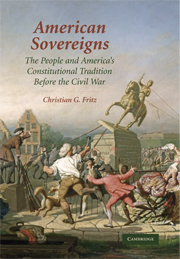
Fritz, American Sovereigns, just out from Cambridge UP
More from Christian G. Fritz, University of New Mexico: his new book, American Sovereigns: The People and America's Constitutional Tradition Before the Civil War, is just out from Cambridge University Press. Fritz has posted the prologue on SSRN.
"This is a superb and radical book, radical in the sense that it goes to the roots of the American constitutional tradition, pushes aside the crusty generations of constitution worship that have enshrined the federal constitution as a fixed, settled and static resolution of the nation's constitutional tradition and complicates matters enormously." Ronald Formisano, University of Kentucky, Lexington
"Professor Fritz's American Sovereigns tells a complicated story of constitutional development from the period of the Revolution to the Civil War. It is not a conventional account that takes its beginning from 1787 and a focus on the Federal Constitution; rather it offers an intimate account of change that reckons with the extraordinary role of the people as sovereigns. To be sure, Fritz discusses many questions that usually enter accounts of constitutions, but he gives these questions an unusual twist, and adds a fresh perspective through analysis of state constitutions, federal action with constitutional meanings; popular behavior in extraordinary events such as the Whiskey Rebellion and the Rhode Island crisis. In all of this intricate story, the people as sovereigns, a much contested proposition-as he demonstrates-serves to give his study its coherence. His book is not only a revisionist account; it is a beautifully written piece of history that illuminates a supremely important field." Robert Middlekauff, University of California, Berkeley
Shame on Cambridge University Press for pricing the book at $80 (before discounts). This ensures that mere mortals, including graduate students, will be unable to purchase it, and then also makes it hard for a book to garner the sales to justify a paperback. Be sure that your library knows that you want them to purchase a copy. If you want to assign the book but can't because of the price, let the author know. That will help him argue for a paperback.
Here's the book description:
Here's the book description:
American Sovereigns: The People and America's Constitutional Tradition Before the Civil War challenges traditional American constitutional history, theory, and jurisprudence that sees today's constitutionalism as linked by an unbroken chain to the 1787 federal constitutional convention. American Sovereigns examines the idea that after the American Revolution, a collectivity - the people - would rule as the sovereign. Heated political controversies within the states and at the national level over what it meant that the people were the sovereign and how that collective sovereign could express its will were not resolved in 1776, in 1787, or prior to the Civil War. The idea of the people as the sovereign both unified and divided Americans in thinking about government and the basis of the Union. Today's constitutionalism is not a natural inheritance, but the product of choices Americans made between shifting understandings about themselves as a collective sovereign.
John Dinan, Department of Political Science, Wake Forest University finds the book "painstakingly researched and richly rewarding," in a review on H-Law.
And the blurbs:
"This is a superb and radical book, radical in the sense that it goes to the roots of the American constitutional tradition, pushes aside the crusty generations of constitution worship that have enshrined the federal constitution as a fixed, settled and static resolution of the nation's constitutional tradition and complicates matters enormously." Ronald Formisano, University of Kentucky, Lexington
"Professor Fritz's American Sovereigns tells a complicated story of constitutional development from the period of the Revolution to the Civil War. It is not a conventional account that takes its beginning from 1787 and a focus on the Federal Constitution; rather it offers an intimate account of change that reckons with the extraordinary role of the people as sovereigns. To be sure, Fritz discusses many questions that usually enter accounts of constitutions, but he gives these questions an unusual twist, and adds a fresh perspective through analysis of state constitutions, federal action with constitutional meanings; popular behavior in extraordinary events such as the Whiskey Rebellion and the Rhode Island crisis. In all of this intricate story, the people as sovereigns, a much contested proposition-as he demonstrates-serves to give his study its coherence. His book is not only a revisionist account; it is a beautifully written piece of history that illuminates a supremely important field." Robert Middlekauff, University of California, Berkeley
Fritz on Recovering the Lost Worlds of America's Written Constitutions
Recovering the Lost Worlds of America's Written Constitutions is an essay by Christian G. Fritz, University of New Mexico School of Law. It appeared in the Albany Law Review (2005). Here's the abstract: "Recovering the Lost Worlds of America's Written Constitutions," originating as the sixth Brennan Lecture delivered at Oklahoma City University Law School on November 7, 2002, explores the transformation of the right of revolution in the wake of the American Revolution. The significance of displacing the singular sovereign in the person of the king with the collective sovereign of "the people," gave rise to constitutional understandings that are at odds with today's constitutionalism that emphasizes the necessity of procedural regularity to effect legitimate constitutional revision. The article explores how "circumvention" of such procedures was consistent with an earlier concept of the people who retained practical sovereignty.
Monday, April 14, 2008
Conference: Plural Jurisdictions and Islamic Law
Plural Jurisdictions: Lawyers Reflect on the Archbishop of Canterbury's Speech
15 April 2008, 18:00 - 19:30
Speakers
ANDREA LOUX JARMAN, JD, Roehampton University; Associate Research Fellow, IALS
DR. PRAKASH SHAH, Queen Mary, University of London; Associate Research Fellow, IALS
Description: This evening has been organised to engage in further discussion and debate on how lawyers and legal policymakers should respond to the Archbishop's lecture on 'crafting a just and constructive relationship between Islamic law and the . . . . . law of the United Kingdom'. For further information, please click here
Institute of Advanced Legal Studies
University of London
Charles Clore House
17 Russell Square
London WC1B 5DR
Inner Temple Book Prize
The Inner Temple as part of the 2008 renewal of its commitment to furthering the study and development of the law and the education and training of those who practise or intend to practise it, has established a valuable prize, to be known as the Inner Temple Book Prize. There will in fact be two prizes, one of £10,000 and one for “young authors” of £2,500, to be awarded for the first time in December 2008, and thereafter every three years.
The Prize is intended to encourage and reward the writing of books which make an outstanding scholarly contribution to the understanding of the law as administered in England and Wales. The Prize will be open to authors of any nationality or domicile, provided their book is published in the English language.
The two thousand five hundred pound prize will be confined to “young authors” i.e. those who, at the date of publication are within ten years of being awarded a first degree or being admitted as a practising lawyer (whether in any part of the United Kingdom or elsewhere) whichever period is the shorter. It is intended that the Prizes will be offered again in 2011, and thereafter at three-yearly intervals.
To be eligible for an award, the book must be an original work, first published in print (whether in the United Kingdom or elsewhere) between 1 January 2006 and 1 April 2008. The book must be in the English language (although a published English translation of a work first written in another language will be considered). Books jointly authored by no more than three writers are eligible (the prize in such a case being shared between the authors) but reprints, reissues and multi-authored collections of essays, conference proceedings and the like are not. The criterion to be applied in deciding on the award of the Prizes is the extent to which the book makes an outstanding scholarly contribution to the understanding of the law as administered in England and Wales. But subject to that consideration, works dealing with international law, comparative law, the law of the European Union, the Commonwealth (or other international organisation), legal history, legal philosophy, sociology of law, or criminology and the treatment of offenders will be eligible for consideration.
For further information, see: http://www.innertemplebookprize.org/index.html
Brophy, Reparations: Pro and Con
Reparations Pro and Con by Alfred L. Brophy, University of Alabama (moving to the University of North Carolina) was published by Oxford University Press (2006), and is noted on SSRN. Here's the abstract: 
Long before the phrase 40 acres and a mule was coined to describe what black Americans were owed for slavery, abolitionists discussed compensating slaves for what had been unjustly taken from them. Today, the debate over reparations for slavery and Jim Crow--whether African-Americans should be compensated for decades of racial subjugation--stands as the most racially divisive issue in American politics.
Discussion of reparations leads often to more animosity than serious consideration of the issue, with reparations advocates and skeptics taking extreme positions, rather than reaching for common ground. In a concise compass, Reparations Pro and Con considers the debate over reparations from the 1700s to the present, examining the arguments on both sides of the current debate. Brophy tells the story of the black reparations movement from Thaddeus Stevens, through the dark days of Jim Crow and then the Harlem Renaissance, to critical race theory, and relates it to other movements for racial justice. Most importantly, he puts the debate into context of the practice of reparations, such as for Jewish victims of the Holocaust, Native Americans, and for the detainment of Japanese Americans during World War II. The book also considers litigation and legislation past and present, examining failed and successful lawsuits, and reparations actions by legislatures, newspapers, schools, and businesses, including apologies and truth commissions. Reparations: Pro and Con concludes with a frank and sober look at the case for reparations and where, if anywhere, the movement is going. It suggests that the movement may lead to a renewed advocacy of social-welfare programs regardless of race.
And here are blurbs and a review:
"Amidst the often rancorous national debate over reparations for slavery, Alfred Brophy's Reparations: Pro and Con stands out as a work of rare balance and judiciousness. Rather than offering another partisan polemic, Brophy takes seriously the arguments of both advocates and opponents of reparations, illuminating the complex historical, political, legal, and moral questions entailed by any confrontation with historical injustice. Whatever your politics, you will profit from reading this book."--James T. Campbell, author of Middle Passages and Songs of Zion
"Professor Alfred Brophy has written a book about reparations and its contentious qualities that is a must-read for all. While reparations was a dormant subject in the twentieth century, Alfred Brophy has raised it to an exalted status: if you want to know the essence of the debate, this book is for you."--Charles K. Ogletree, Jr., Jesse Climenko Professor, Harvard Law School, and Executive Director of Harvard's Charles Hamilton Houston Institute for Race and Justice
"In spite of our victory over master race theory in World War II, in spite of Brown vs. Board of Education and the heartwrenching victories of the civil rights struggle, Jim Crow lives on in fact if not in law. Brophy's book operates in the realm of fact. How would we act if repairing injustice were the true goal of our hearts? What world would we make? Answering the questions posed in this book is the way to peace, at last."--Mari Matsuda, co-author, with Charles Lawrence, of We Won't Go Back: Making the Case for Affirmative Action and Professor, Georgetown University Law Center
"A comprehensive yet very accessible book on a controversial topic...an outstanding source. Recommended."--CHOICE
Claeys: Jefferson Meets Coase: Land-Use Torts, Law and Economics, and Natural Property Rights
History isn't highlighted in the abstract of Eric Claeys's new paper (George Mason Univ. School of Law), but the paper is in part an exploration of the intellectual history of torts. Jefferson Meets Coase: Land-Use Torts, Law and Economics, and Natural Property Rights is posted on SSRN. Here's the abstract: In tort scholarship, conventional wisdom assumes that economic analysis explains doctrine more determinately than philosophical analysis. This Article challenges that assumption, using land-use torts as a point of contact. The Article studies cattle trespasses, pollution nuisances, train-sparks cases, and other basic rules of tort liability Ronald Coase popularized in The Problem of Social Cost. The Article compares standard economic analyses of these torts against an interpretation that follows from the natural-rights theory that informed the content of these torts when "tort" was forming into a single field of legal study. The "Jeffersonian" natural-rights theory predicts the contours of doctrine more determinately and accurately than "Coasian" economic analysis. It also anticipates and finesses a significant normative challenge to Coasian economic tort analysis - its tendency to demand that triers of fact process unrealistically volatile and fact-specific information to prescribe legal results. The comparison teaches that conventional impressions about tort philosophy and economics have been misguided in at least three important respects. First, in a significant swath of doctrine, Jeffersonian natural-rights moral theory shapes the contours of tort quite determinately. Second, if philosophical tort scholarship has a bad reputation for being indeterminate, it does so at least in part because it has chosen to focus on the general corrective-justice architecture of tort - to the exclusion of specific theories of political morality informing particular doctrines. Finally, standard economic tort analysis cannot prescribe determinate results without making simplifying assumptions more characteristic of moral philosophy than of social science.
Berg on The Free Excercise of Religion Clause
Another book taking up religion in early U.S. history is The Free Exercise of Religion Clause: Its Constitutional History and the Contemporary Debate by Thomas Berg, University of St. Thomas, St. Paul/Minneapolis (Prometheus Books, 2007), just noted on SSRN. Here's the abstract: 
This book, the second in a series published by Prometheus Books on the provisions of the Bill of Rights, collects excerpts from important recent academic scholarship on the Free Exercise Clause. The central question is that addressed by the Supreme Court in the Peyote Case, Employment Division v. Smith: the extent to which free exercise encompasses the right to be free from burdens imposed upon religious practice by laws or regulations not specifically directed at religious practice. Topics covered include, among others, the historical background of religious freedom in the founding era, the normative debate on whether and why religious practice merits special constitutional protection, the challenge of identifying principled boundaries between religious freedom and legal duties, the relative roles of legislatures and courts in protecting religious freedom, and the distinctive considerations raised by the free exercise claims of religious institutions as opposed to individuals. The book is intended to serve as a supplement to case materials on religion and the First Amendment. In addition, because recent debates have focused on whether free exercise is best protected by legislatures as opposed to courts, and by context-specific exemptions as opposed to general constitutional or statutory standards, the book should be of use to those studying the dynamics of governmental institutions and of civil liberties protection.

This book, the second in a series published by Prometheus Books on the provisions of the Bill of Rights, collects excerpts from important recent academic scholarship on the Free Exercise Clause. The central question is that addressed by the Supreme Court in the Peyote Case, Employment Division v. Smith: the extent to which free exercise encompasses the right to be free from burdens imposed upon religious practice by laws or regulations not specifically directed at religious practice. Topics covered include, among others, the historical background of religious freedom in the founding era, the normative debate on whether and why religious practice merits special constitutional protection, the challenge of identifying principled boundaries between religious freedom and legal duties, the relative roles of legislatures and courts in protecting religious freedom, and the distinctive considerations raised by the free exercise claims of religious institutions as opposed to individuals. The book is intended to serve as a supplement to case materials on religion and the First Amendment. In addition, because recent debates have focused on whether free exercise is best protected by legislatures as opposed to courts, and by context-specific exemptions as opposed to general constitutional or statutory standards, the book should be of use to those studying the dynamics of governmental institutions and of civil liberties protection.
Saturday, April 12, 2008
Reviewed: books on Religion and the Founders and Ida B. Wells

FOUNDING FAITH: Providence, Politics, and the Birth of Religious Freedom in America by Steven Waldman (Random House) gets a positive review in the New York Times from Richard Brookhiser, who finds it "entertaining" and "provocative." Brookhiser writes that "Waldman’s conclusion is that 'the Founding Faith ... was not Christianity, and it was not secularism. It was religious liberty — a revolutionary formula for promoting faith by leaving it alone.'"
Gordon Wood reviews two books on religion and the founders in the New Yor k Review of Books: Ten Tortured Words: How the Founding Fathers Tried to Protect Religion in America...and What's Happened Since by Stephen Mansfield (Thomas Nelson) and So Help Me God: The Founding Fathers and the First Great Battle over Church and State by Forrest Church (Harcourt). Not one to mince words, Wood finds Mansfield's book "very biased and polemical," concluding that if one wants to make an argument about the intentions of the framers "one had better have one's history straight." Wood is happier with Church. "Instead of taking sides in our present-day cultural war over religion, he has sought to write a reasonably detached, objective, and sometimes iro
 nic history of what he calls 'the first great culture war in American political history.'" The result is "an illuminating and entertaining work of history, and the best account of the first five presidents and their relation to religion that we have."
 k Review of Books: Ten Tortured Words: How the Founding Fathers Tried to Protect Religion in America...and What's Happened Since by Stephen Mansfield (Thomas Nelson) and So Help Me God: The Founding Fathers and the First Great Battle over Church and State by Forrest Church (Harcourt). Not one to mince words, Wood finds Mansfield's book "very biased and polemical," concluding that if one wants to make an argument about the intentions of the framers "one had better have one's history straight." Wood is happier with Church. "Instead of taking sides in our present-day cultural war over religion, he has sought to write a reasonably detached, objective, and sometimes iro
 nic history of what he calls 'the first great culture war in American political history.'" The result is "an illuminating and entertaining work of history, and the best account of the first five presidents and their relation to religion that we have."
Glenda Gillmore reviews Paula Giddings, IDA:A Sword Among Lions (Amistad), about the extraordinary anti-lynching activist and journalist Ida B. Wells, in the Washington Post. According to Gillmore, "Giddings set out to write a definitive biography and has succeeded spectacularly."
Ferguson lauds Bobbit, Terror and Consent
TERROR AND CONSENT: The Wars for the Twenty-First Century by Philip Bobbitt (Alfred A. Knopf) is reviewed for the New York Times by Niall Ferguson. He finds it "quite simply the most profound book to have been written on the subject of American forei gn policy since the attacks of 9/11 — indeed, since the end of the cold war." According to Ferguson, "Bobbitt’s originality lies in his almost unique ability to synthesize three quite different traditions of scholarship": history, law, and military strategy.
In The Shield of Achilles (2002), Bobbit argued that "in the aftermath of the cold war, the traditional post-Westphalian ideal of the sovereign nation-state had become obsolescent. In the increasingly borderless world we associate with globalization, something new was emerging, which Bobbitt called (and continues to call) the 'market-state,'" in which the "state’s relationship to its citizens resembles that between a corporation and consumers."
In his new book,
gn policy since the attacks of 9/11 — indeed, since the end of the cold war." According to Ferguson, "Bobbitt’s originality lies in his almost unique ability to synthesize three quite different traditions of scholarship": history, law, and military strategy.In The Shield of Achilles (2002), Bobbit argued that "in the aftermath of the cold war, the traditional post-Westphalian ideal of the sovereign nation-state had become obsolescent. In the increasingly borderless world we associate with globalization, something new was emerging, which Bobbitt called (and continues to call) the 'market-state,'" in which the "state’s relationship to its citizens resembles that between a corporation and consumers."
In his new book,
Bobbitt’s central premise is that today’s Islamic terrorist network, which he calls Al Qaeda for short, is like a distorted mirror image of the post-Westphalian market-state: decentralized, privatized, outsourced and in some measure divorced from territorial sovereignty. The terrorists are at once parasitical on, and at the same time hostile toward, the globalized economy, the Internet and the technological revolution in military affairs. Just as the plagues in the 14th century were unintended consequences of increased trade and urbanization, so terrorism is a negative externality of our borderless world.Continue reading here. Also this weekend, Steve Weinberg reviews Bobbitt in the Boston Globe.
Goodrich on Druids and Common Lawyers
Peter Goodrich, Cardozo Law School, has a new article, Druids and Common Lawyers: Notes on the Pythagoras Complex and Legal Education. It appears in Law and Humanities, Vol. 1, No. 1. Here's the abstract: The long haired Pythagoras is an unlikely figure after to whom to name a complex specific to common lawyers. Ironically, however, the mythical figure of Pythagoras "and his school" was one of the most often declared sources of the distinctiveness of common law. His followers, the Druids, were the first lawyers in Anglia - specifically, the dark island - and the strange sacrificial and mystagogic practices of the Druid law givers founded the early rites of the tradition of unwritten law. Using the humanistic technique of history and reminiscence, this article traces the idiosyncracies of the pythagorean philosophy: the refusal to put law in writing, the use of hieroglyphs, the dependence upon oracular judgment, the belief in multiple lives, askesis and akousmata, and places them at the root of what is most emblematically common law.
Anderson on Colonial Genocide and International Law
Rachel J. Anderson, University of Nevada, Las Vegas, has posted an article, Redressing Colonial Genocide: The Hereros' Cause of Action Against Germany. It appeared in the California Law Review (2005). Here's the abstract: In February 2003, the Herero People's Reparations Corporation filed a complaint against Germany in the District Court of the District of Columbia alleging violations of international law, crimes against humanity, genocide, slavery, and forced labor before, during, and after the German-Herero War (1904-07). The German government, modern scholars, and other commentators have long taken the position that genocides committed by colonial governments in the nineteenth century did not violate international law at that time. Arguments for this position rely, inter alia, on the belief that all forms of genocide were first criminalized and made punishable by the 1948 U.N. Convention on Genocide. However, an analysis of contemporaneous international customary and treaty law shows this position to be wrong and supports the position that colonial acts of annihilation in Africa were illegal by the end of the nineteenth century. This article further argues that this law was directly applicable to the German-Herero War. It concludes that the Hereros' case for legal redress is stronger than heretofore assumed and examine the implications for the claims of other similarly situated victims of genocide.
Thursday, April 10, 2008
Lecture on Nineteenth-Century Prisons
"Separation and Silence: Looking Again at the Nineteenth Century Prison"
23 April 2008, 18:00 - 19:00
Event Type: Lecture
Speaker: RICHARD IRELAND, Department of Law, University of Aberystwyth, Wales
Description: Issues in Legal History Prison history has been much discussed in recent years and has attracted both detailed archival study and influential theoretical commentary. This paper argues that there are still important things to be said about the prison and uses the celebrated nineteenth century debate over the competing penal regimes of "silence" and "separation" as a starting point to consider more generally the obstacles which may stand in the way of recovering important elements of the history of punishment in the period up to prison nationalization under the Act of 1877. It draws upon a detailed investigation of the daily operation of one particular gaol and the network of connections in which it was situated. It will also introduce some remarkable though not very eminent Victorians and call for a rather greater appreciation of the experience of the Welsh!
Institute of Advanced Legal Studies
University of London
Charles Clore House
17 Russell Square
London WC1B 5DR
Zurcher on Consideration, Contract, and the End of the Comedy of Errors
 Consideration, Contract, and the End of the Comedy of Errors is an essay by Andrew Zurcher, Queens College, Cambridge. It appeared in Law and Humanities (2007). Here's the abstract:
To address methodological and critical issues at stake in the conferral of legal historical and literary studies. The major part of the paper concerns Shakespeare's interest, in The Comedy of Errors, in contractual theory, and the problems this throws up for understanding the function of comedy; but this leads to further reflections on the way we bring legal ideas to bear on literary texts in this period.
Lash on The Second Adoption of the Free Exercise Clause
Kurt T. Lash, Loyola Law School Los Angeles, has posted on SSRN his article "The Second Adoption of the Free Exercise Clause: Religious Exemptions Under the Fourteenth Amendment." It appeared in the Northwestern University Law Review (1994).
More folks seem to be using SSRN to make earlier articles more accessible, which strikes me as a great idea. It your journal or press wouldn't let you post on-line when an essay was published, you might want to check back later.
Here's Lash's abstract: This Article explores the proposition that the Free Exercise Clause was adopted a second time through its incorporation into the Privileges or Immunities Clause of the Fourteenth Amendment and that the scope of the new Free Exercise Clause was intended to include protections un-anticipated at the Founding. Contrary to Jeffersonian notions of "separate spheres," the nation by the time of Reconstruction had experienced decades of clashes resulting from the overlapping concerns of religion and government. In particular, the suppression of slave religion called into question the government's power to interfere, even indirectly, with legitimate religious exercise. Accordingly, the Privileges or Immunities Clause incorporated a conception of religious liberty vastly different from that intended in 1791 and constitutes a constitutional modification of the original "rights of conscience." Religious exemptions from generally applicable laws, considered unnecessary and improbable at the Founding, now became necessary and proper.
Wednesday, April 9, 2008
Call For Papers: Rape in Wartime
Rape in wartime: a history to be written
Date: 11 - 12 May 2009
Rapes committed during armed conflicts are often assumed to have a kind of inevitability. Over the last thirty years, the subject has been studied in a number of different disciplines. The aim of this conference is to promote rape in wartime as an historical subject. The intention is not to claim in advance that it constitutes either a supreme form of wartime violence or a forgotten one, but rather, by taking account of the actors, the actions and the occasions on which rape occurred, to pose the question of its place in war. The idea is also to chart the visibility of rape both at the time and afterwards. The question will be posed of how rape could on some occasions symbolize the entire conflict and summarize the atrocities for which the enemy was condemned while on other occasions it was passed over in silence by both the private and the public narratives of the war.
Details: Proposals should be a maximum of 2,500 characters (360 words) and should be sent with a short biographical note before 1 June 2008 to: rapeinwartime@univ-paris1.fr.
Conference organisers: R. Branche, I. Delpla, J. Horne, P. Lagrou, D. Palmieri, F. Virgili
Venue: University of Paris I Panthéon-Sorbonne
Email: rapeinwartime@univ-paris1.fr
Deadlines: Call for papers: 1 June 2008
Likhovski on The Invention of "Hebrew Law" in Mandatory Palestine
The Invention of 'Hebrew Law' in Mandatory Palestine has just been posted on SSRN by Assaf Likhovski, Tel Aviv University - School of Law. It appeared in the American Journal of Comparative Law (1998). Here's the abstract: This paper examines the attempt of some Jewish nationalists to create a Jewish legal system in early 20th century Palestine. Like many nationalist movements, Zionism, the Jewish nationalist movement, sought to revive its cultural past. The best known aspect of Zionist cultural activity was the revival of the Hebrew language, but linguistic revival was not the only item on the cultural agenda. Some Zionists also sought to revive what they called "Hebrew law" and make it the legal system of the Jewish community in Palestine. In this article, I will argue that the revival of Hebrew law, like the revival of a large part of Hebrew culture was not meant to be a continuation of the Jewish past, but a break with it; not so much the restoration of an old tradition, as the invention of a new one. Hebrew law, like the rest of Zionist culture, was constructed by its early advocates, most of whom were secular Jews, as a reflection of Zionist ideology and identity needs. It was to be a new legal system, not the restored old system of the Jews of the Diaspora. Hebrew law, I will conclude, was a new legal entity defined and assembled by its revivers in a way which would entice its potential subjects - the Jewish community in Palestine - to adopt it.
Many more Guggenheims to Law Professors this year
The new Guggenheim in Constitutional Studies has been awarded to Randy E. Barnett, Georgetown and Richard Primus, Michigan.
In addition, Guggenheims in Law have been awarded to: Samuel Moyn, Columbia (History); Richard H. Pildes, NYU; Susan S. Silbey, MIT (Anthropology and Sociology); Katherine V. W. Stone, UCLA. Robin Stryker, Professor of Sociology and Affiliated Professor of Law, University of Minnesota, also received an award, in the field of Sociology.
In the past few years, there have been only two Guggenheims in the law category. Because some fellowships in law go to scholars in other fields (last year Michael McCann, Political Science, University of Washington), that meant as few as one Guggenheim to a scholar whose appointment was in a law school (last year me).
To go from one or two fellows to four law professors in one year is a major shift.
Guggenheims in History this year go to:
Economic History, Howard Bodenhorn; Medieval History, Brigitte Miriam Bedos‑Rezak; Renaissance History, Christopher S. Celenza; German and East European History, Margaret Lavinia Anderson; French History; Laurent Dubois; Italian History; Alan M. Stahl; Iberian and Latin American History; João Biehl, Mary Kay Vaughan; British History, Deborah Cohen; United States History, Leon Fink, Allan Greer, Wendy Griswold, Daniel Horowitz, Joanne Meyerowitz.
More details are here. Congratulations to all!
Tuesday, April 8, 2008
Farmer on the emergence of the "Notable Trial" in England and Scotland
Lindsay Farmer, University of Glasgow, has a new paper, 'With All the Impressiveness and Substantial Value of Truth': Notable Trials and Criminal Justice, 1750-1930. It appears in Law and Humanities, Vol. 1, No. 1, 2007. Here's the abstract: This paper examines the changing forms of trial narratives, between 1750 and 1930, looking in particular at the way in which these mirror changes in the form of the criminal trial and legitimate a certain understanding of the adversarial criminal trial as the pre-eminent symbol of criminal justice. Initially the primary focus is on the political function of the criminal trial and jury, but over the period the focus comes to be the on the character of the participants, and the truths that can be revealed about crime and society through the drama of the law. This process culminates in the emergence of the 'notable trial' in England and Scotland at the end of the century. Through the study of these narratives we can see how the trial was reordered and produced as a new kind of popular spectacle in the latter half of the nineteenth century.
Dragomir on the History of Corporate Governance
Highlights for a History of Corporate Governance is a new paper by Voicu D. Dragomir, Academy of Economic Studies of Bucharest. It will appear in the European Journal of Management (2008). Here's the abstract: This paper argues for the pivotal role played by accountability in both corporate governance theory and practice. The reader is invited to take a journey through the history of the concept, by highlighting ten major points of interest, either real-life events or academic debates, which can be summarized as follows: the emergence of the corporation and the criticisms expressed by Adam Smith; the birth of the modern theory of corporate governance - Berle and Means (1932), Jensen and Meckling (1976) and Freeman (1984) - as proponents of agency theory, and stakeholder theory, respectively; corporate governance codes and the European Union's policy concerning corporate governance; the Enron case and the fall of Arthur Andersen, followed by the controversy surrounding the Sarbanes-Oxley Act; finally, the globalization of corporate governance and the responsibility of the true and fair reporting as promoted by the OECD Principles of Corporate governance. The aim of devising accountability is the set up of trust in governance institutions. However, the turbulent history of global governance points to the increasing fragility of businesses worldwide.
Subscribe to:
Posts (Atom)