[We have the following call for papers.]
The Washington Area
Early American Seminar, hosted by the University of Maryland, College Park,
invites proposals from scholars wishing to present work in progress in the next
academic year.
The seminar meets on Fridays (monthly during term-time) and our regular members
include faculty and graduate students from a variety of DC-area institutions.
Papers are pre-circulated and our afternoon (4-6pm) seminars are followed by a
dinner at a local restaurant.
To propose a paper, please send a brief cv and a tentative title along with a
300 word description of the topic and its connection to your publishing plans
to Rick Bell (rjbell@umd.edu) and Holly
Brewer (hbrewer@umd.edu). We especially
welcome proposals from scholars farther afield who will be visiting the DC area
for research this coming year. For consideration for the 2013-14 academic year,
please send proposals before 1 July 2013.
Monday, June 24, 2013
Altman Accepts Amherst VAP
 Congratulations to Clara Altman, Legal History Blogger and Facebook Coordinator, for landing a position as Visiting Assistant Professor of Law, Jurisprudence, and Social Thought, which she will shortly take up at Amherst College. Clara is completing her dissertation, “Courtroom Colonialism: Philippine Law and U.S. Rule, 1898-1935,” at Brandeis University. She has just completed a year as a fellow in the Miller Center for Public Affairs at the University of Virginia. All of us Legal History Bloggers are grateful to Clara for her faithful and imaginative work as Facebook Coordinator and regular creator of our Sunday book review post.


First issue of Comparative Legal History
We recently announced the launch of Comparative Legal History, the journal of the European Society for Comparative Legal History. The first issue is now out. Full access is limited to subscribers, but here's a glimpse of the table of contents:
Editorial Articles
The Challenges of Comparative Legal History
David Ibbetson
American Responses to German Legal Scholarship: From the Civil War to World War I
David M Rabban
The Political Offence and the Safeguarding of the Nation State: Constitutional Ideals, French Legal Standards and Belgian Legal Practice (1830-1870)
Bram Delbecke
Sex, Crime and the Law: Russian and European Early Modern Legal Thought on Sex Crimes
Marianna Muravyeva
Review Article
Comparative and Economic Approaches to Law: A Tale of Wilful Misunderstanding?
Jaakko Husa
Book Reviews
Manlio Bellomo, Inediti della giurisprudenza medievale
Reviewed by Emanuele Conte
Alejandro Guzmán-Brito, Codificación del Derecho Civil e Interpretación de las Leyes: Las normas sobre interpretación de las leyes en los principales Códigos civiles europeo-occidentales y americanos emitidos hasta fines del siglo XIX
Reviewed by MC Mirow
Turan Kayaoglu, Legal Imperialism: Sovereignty and Extraterritoriality in Japan, the Ottoman Empire and China
Reviewed by Zülâl Muslu
Mia Korpiola (ed), Regional Variations in Matrimonial Law and Custom in Europe, 1150-1600
Reviewed by Richard Mc Mahon
MC Mirow, Florida's First Constitution, the Constitution of Cádiz: Introduction, Translation, and Text
Reviewed by Peter L Reich
Anthony Musson and Chantal Stebbings (eds), Making Legal History: Approaches and Methodologies
Reviewed by Adelyn LM Wilson

Sunday, June 23, 2013
Book Review Roundup
- Over at History Today, you'll find a review of Anthony Pagden, The Enlightenment and Why it Still Matters (Oxford University Press, 2013).
- From History News Network: a review of Richard Breitman and Allan Lichtman's FDR and the Jews (Belknap, 2013)
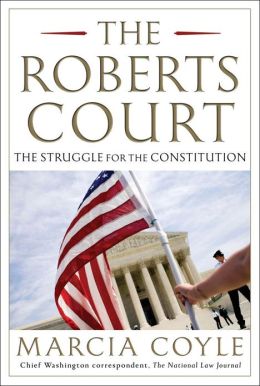
- Subscribers to the Nation magazine will surely want to read Michael O'Donnell's review of The Roberts Court: The Struggle for the Constitution, by Marcia Coyle.
- From the New York Times: a review of Robert Kuttner, Debtors' Prison: The Politics of Austerity Versus Possibility (Alfred A. Knopf, 2013).
- The NYT also covers two books on higher education: Is College Worth It? A Former United States Secretary of Education and a Liberal Arts Graduate Expose the Broken Promise of Higher Education (Thomas Nelson), by William J. Bennett and David Wilezol, and College (Un)bound: The Future of Higher Education and What It Means for Students (New Harvest/Houghton Mifflin Harcourt), by Jeffrey J. Selingo.
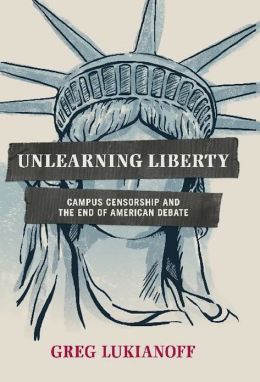
- From the Chronicle of Higher Education: check out Carlin Romano's thoughtful essay on "civility and sex speech," in which he spotlights Unlearning Liberty: Campus Censorship and the End of American Debate (Encounter Books, 2012), by Greg Lukianoff.
Saturday, June 22, 2013
Weekend Roundup
- CALI does constitutional history! Hat tip: Ross Davies and Roger Skalbeck.
- Over at JOTWELL: William Baude (Stanford Law School) writes a glowing review of Clyde Spillenger's "Risk Regulation, Extraterritoriality, and the Constitutionalization of Choice of Law, 1865-1940."
- If you've never perused the website of the Historical Society of the New York Courts it is worth a look.
- From the New York Review of Books Blog: Spying on Americans: A Very Old Story.
- Over at H-Law, Kenneth J. Hirsh, Cincinnati Law, plugs the Louis Marshall Papers at the Jacob Rader Marcus Center of the American Jewish Archives at the Cincinnati campus of Hebrew Union College.
- Lori Clune, an assistant professor of history at California State University, Fresno, makes the case for sparing the Rosenbergs at HNN.
- Scott Douglas Gerber (Ohio Northern University Law), editorializes in the Providence Journal on Law and the Lively Experiment in Colonial Rhode Island.
- The American Academy in Berlin invites applications for its residential fellowships for 2014-2015, as well as early applications for the academic years 2015-2016 and 2016-2017. The deadline is Monday, September 2, 2013 (12 pm EST or 6 pm CET). More.
- The University of Pennsylvania Law Review is looking for contributors to “its online companion, Heightened Scrutiny. Essays selected for HS go through the full editorial process and are published to the major databases, in addition to being perpetually available on our website. We typically run shorter pieces with an eye towards more timely commentary on current events in the law.”
- It's still June, so there's still hope for our summer writing agenda. If you're feeling the need to be sternly talked to on the subject, try Rachel Toor in the Chronicle of Higher Education: I Don't Write Enough Because ... Hat tip: Linda Przybyszewski.
- From Books & Ideas: on the Commons, Old and New: From Land Use to Information Sharing.
Friday, June 21, 2013
Solicitors General: The New York Influence
 |
| Charles Evans Hughes, Jr. |
Dutch New York and the Law
Just out from SUNY Press is the collection of essays, Opening Statements: Law, Jurisprudence, and the Legacy of Dutch New York, edited by Albert M. and Julia C. Rosenblatt.
No society can function without laws, that set of established practices and expectations that guide the way people get along with one another and relate to ruling authorities. Although much has been written about the English roots of American law and jurisprudence, little attention has been paid until recently to the legacy left by the Dutch. In Opening Statements, a broad spectrum of eminent scholars examine the legal heritage that New Netherland bequeathed to New York in the seventeenth century. Even after the transfer of the colony to England placed New York under English Common Law rather than Dutch Roman Law, the Dutch system of jurisprudence continued to influence evolving American concepts of governance, liberty, women’s rights, and religious freedom in ways that still resonate in today’s legal culture.
The TOC after the jump.
Thursday, June 20, 2013
Goluboff on "Lawyers, Law and the New Civil Rights History"
Update: I just want to second Tomiko on the importance of this exchange. It strikes me as the likely point of departure for the legal historiography of the civil rights movement for the foreseeable future. Further, analogous issues arise in the histories of other fields of law. DRE
CFP: Law, Peace, and Violence
The symposium "Law, Peace, and Violence: Jurisprudence and the Possibilities of Peace" will be held at Seattle University School of Law on March 14, 2014. It is organized by Professor Yxta Murray of Loyola Law School and hosted by the Seattle Journal of Social Justice.
Can the law help forge a more peaceful world? In this symposium, legal scholars will study law’s potential to increase domestic and international peace. We will also focus on the problems that peace rhetoric creates for rights developments, particularly in the ways that it is used to marginalize outsiders’ direct action efforts.
Another Report on the Taussig Collection
. . . from the National Law Journal. Our earlier post on this acquisition by the Yale Law School is here.
Dubrow Wins Mellon New Directions Fellowship
According to the North Adams Transcript, "Sara Dubow, associate professor of history at
Williams College, has been awarded a New Directions Fellowship from the
Andrew W. Mellon Foundation to develop research projects that focus on
the legal history of reproductive and sexual politics." More.
Wednesday, June 19, 2013
Constitutional History and the Defense of Humanities and Social Science
Today’s Washington Post reports on the American Academy of Arts and Sciences’ attempt to STEM the flight from humanities. Here’s a report of a similar intervention that combines constitutional history and classical notions of citizenship.
Cromwell Research Fellowships: Deadline July 15
[And, while we are at it, here is a reminder that the deadline for the Cromwell Research Fellowship is less than a month away.]
Note the July 15, 2013 deadline for the Cromwell Research Fellowships in American Legal History. These are annual awards of up to $5000 made to dissertators and scholars in the early stages of their careers to support research and writing. Applicants should submit a description of their proposed project (double-spaced, maximum 6 pages, with working title), a budget, a timeline, and a short c.v. (no longer than 3 pages. Two letters of recommendation from academic referees should be sent directly to the committee chair via email attachment. Applications must be submitted electronically (preferably in one .pdf file) to the committee chair, Cornelia H. Dayton. Notification of the awards occurs in early November. More information is here.
Note the July 15, 2013 deadline for the Cromwell Research Fellowships in American Legal History. These are annual awards of up to $5000 made to dissertators and scholars in the early stages of their careers to support research and writing. Applicants should submit a description of their proposed project (double-spaced, maximum 6 pages, with working title), a budget, a timeline, and a short c.v. (no longer than 3 pages. Two letters of recommendation from academic referees should be sent directly to the committee chair via email attachment. Applications must be submitted electronically (preferably in one .pdf file) to the committee chair, Cornelia H. Dayton. Notification of the awards occurs in early November. More information is here.
The Paul Murphy Award: Deadline June 30
[The deadline for the Murphy Award (June 30) is fast approaching, so we are moving this post up.]
The American Society for Legal History announces the Paul Murphy Award to support the completion of a book on the history of civil liberties that addresses any topic or any time in American history. This is a two-year award only, and this is the second and final year award will be given. Recipients will receive $5000 to support their work. Nominees at all levels of seniority will be considered, however the award is not for the completion of a dissertation. The 2012 Murphy Award is announced here:
The American Society for Legal History announces the Paul Murphy Award to support the completion of a book on the history of civil liberties that addresses any topic or any time in American history. This is a two-year award only, and this is the second and final year award will be given. Recipients will receive $5000 to support their work. Nominees at all levels of seniority will be considered, however the award is not for the completion of a dissertation. The 2012 Murphy Award is announced here:
The award honors Paul L. Murphy (1923-1997), who spent much of his career at the University of Minnesota where he rose to the rank of Regent's Professor of History and American Studies. At the time of his death, he was in the second year of his term as president of the ASLH. During his tenure at Minnesota he became one of the nation's leading constitutional historians and a mentor to generations of undergraduate and graduate students. Among his most important books were: The Meaning of Freedom of Speech: First Amendment Freedoms from Wilson to FDR (1972); World War I and the Origin of Civil Liberties in the United States (1979); and Historic Background of the Bill of Rights, Vol. 1 (1990). In addition, civil liberties played a fundamental role in the argument he developed in what was likely his most influential book, The Constitution in Crisis Times 1918-1969 (The New American Nation Series, 1972). Murphy's commitment to civil liberties and his passion for the subject was evident in his deeds as well as his words. He was an ardent and committed member of the American Civil Liberties Union throughout his life. For additional information on Murphy please see the tribute to him in the Law and History Review, 16 (Spring 1998), ix-xi.
To be considered for this award, authors or nominators should send a book proposal with chapter descriptions, a discussion of the book's contributions, and a time-line for completion; a sample chapter; and a c.v. to committee chair Mary L. Dudziak (mary.l.dudziak@emory.edu). The proposal should indicate how the award will assist you in completing your book. Submissions via e-mail are preferred, and attachments can be in Word or PDF. Please put "Murphy Award" in the subject line. If you must submit by hardcopy, please send four copies of these materials to arrive by the deadline to this address: Professor Mary L. Dudziak, Emory School of Law, 1301 Clifton Rd NE Atlanta Georgia 30322. The deadline for receipt of proposals for this year's award is June 30, 2013.
Members of the Murphy Award Committee are:
Mary L. Dudziak, Chair, Emory University
Robert Kaczorowski, Fordham University
Serena Mayeri, University of Pennsylvania
David M. Rabban, University of Texas
Irving on Constitutional Interpretation and the Discipline of History
Helen Irving, University of Sydney Law, has posted Constitutional Interpretation and the Discipline of History, Federal Law Review 41 (2013). Here is the abstract:
The use of history in constitutional interpretation is widespread. It is defended by scholars and practiced by judges, both in Australia and, in particular, the United States; it also attracts many critics. Originalism, (as this practice has come to be known), comes in many forms, but common to all is the assumption that the meaning of constitutional provisions is to be found in the past. What originalists and critics alike rarely consider is whether, and if so, how it is possible to know the relevant history. Surprisingly little attention has been paid to this fundamental methodological question: If history is to guide constitutional interpretation, how should the courts ‘do’ history? What are the disciplinary rules of research that should be followed if historical meaning is genuinely to be delivered?Hat tip: Legal Theory Blog
This paper explores what conventional historians do, (and the fallacies and errors they attempt to avoid), and identifies some of the basic rules of historical methodology, an awareness of which is a precondition for any claim to interpret historically. It considers several alternative ways in which judges might approach the use of history methodologically, albeit without becoming historians. It neither defends nor contests originalism, but concludes that history should be used in constitutional interpretation only with great care and only rarely.
Luff, "Commonsense Anticommunism: Labor and Civil Liberties Between the World Wars"
Via Historically Speaking, we've learned that the June 2013 issue of the Journal of the Historical Society features a forum on Commonsense Anticommunism: Labor and Civil Liberties between the World Wars (University of North Carolina Press, 2012), by Jennifer Luff (Kalmanovitz Initiative for Labor and the Working Poor, Georgetown University). Here's the Press's description of the book:
Between the Great War and Pearl Harbor, conservative labor leaders declared themselves America's "first line of defense" against Communism. In this surprising account, Jennifer Luff shows how the American Federation of Labor fanned popular anticommunism but defended Communists' civil liberties in the aftermath of the 1919 Red Scare. The AFL's "commonsense anticommunism," she argues, steered a middle course between the American Legion and the ACLU, helping to check campaigns for federal sedition laws. But in the 1930s, frustration with the New Deal
order led labor conservatives to redbait the Roosevelt administration and liberal unionists and abandon their reluctant civil libertarianism for red scare politics. That frustration contributed to the legal architecture of federal anticommunism that culminated with the McCarthyist fervor of the 1950s.
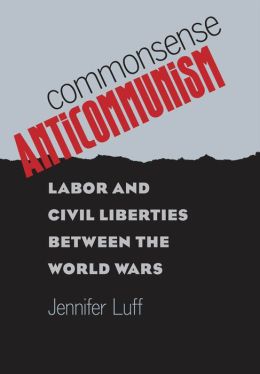
Relying on untapped archival sources, Luff reveals how labor conservatives and the emerging civil liberties movement debated the proper role of the state in policing radicals and grappled with the challenges to the existing political order posed by Communist organizers. Surprising conclusions about familiar figures, like J. Edgar Hoover, and unfamiliar episodes, like a German plot to disrupt American munitions manufacture, make Luff's story a fresh retelling of the interwar years.A few blurbs:
"Truly an original piece of scholarship that makes a substantial contribution to the history of communism, anticommunism, labor, and American political history. This well-written and provocative book is evenhanded in its approach to controversial issues--readers will learn a great deal from it."
--Eric Arnesen, George Washington University
Here's a sneak peak of what you'll find in the Journal of the Historical Society forum. Luff writes:
"A learned, nuanced, and comprehensive exploration of the role labor conservatives played in constructing the postwar Red Scare. This much needed and painstakingly researched book will be required reading of anyone looking to understand the origins and scope of the Red Scare."
--Ellen Schrecker, Yeshiva University
I tried to follow the clues that the testimony of John Frey and J. Edgar Hoover gave me. In the end, I came up with Commonsense Anticommunism. The book argues that conservative officials of the American Federation of Labor were the vanguard of American anticommunism in the interwar years. The AFL's antisocialism and ingrained suspicion of state power produced an organic and reflexive opposition to Soviet Communism that pervaded the AFL from the first days of the Bolshevik Revolution. Yet AFL leaders played a paradoxical role, evangelizing against Communism while opposing statutory restrictions on Communist activity, and often clandestinely collaborating with federal repression of Communists while rejecting formal authority for federal repression. In keeping with their longstanding ethos, AFL leaders advocated a voluntarist approach to contain Communism, which relied on private citizens and organizations to identify and repudiate reds in their midst. AFL leaders viewed Communism as an obnoxious but legitimate political movement, not a cultural tendency or a catch-all for all sorts of radicalism, which put them at odds with many other antiradical and patriotic groups in the interwar years. I call their approach “commonsense anticommunism,” and I argue that labor anticommunists were a crucial backstop protecting civil liberties in the 1920s and early 1930s.More information about the book is available here.
Tuesday, June 18, 2013
Yale Law Acquires the Taussig Collection
In case you missed the story in yesterday's New York Times:
A pocket-size 14th-century handwritten copy of Magna Carta, the first book on the legal rights of women published in England, letters from the 18th-century jurist William Blackstone and papers belonging to a real-life London lawyer praised by Charles Dickens’s fictional yes-man Uriah Heep are among the highlights of a rich trove of rare legal books and manuscripts just acquired by Yale University.More.
Rethinking the History of American Legal Thought
[Here is the last in a series of post by David Rabban on his book Law's History: American Legal Thought and the Transatlantic Turn to History. The series begins here. All of here at LHB thank David for contributing them.]
In prior posts about my new book, Law's History: American Legal Thought and the Transatlantic Turn to History, I emphasized the dominance of the "historical school of American jurisprudence" during the late nineteenth-century. In this final post, I discuss the implications of this historical school for modern understandings of the history of American legal thought. In brief, the historical school's analysis of law as an inductive science rejected deductive theories and supported moderate legal reform, views that refute the conventional twentieth-century attributions of formalism and conservatism to late nineteenth-century legal thought.
During most of the time that I worked on my book, I did not intend to devote much of it to these implications. Even as I increasingly realized that my findings challenged conventional wisdom, I worried about deflecting attention from my primary focus on recovering the intellectual world of the historical school. Yet helped by discussions with many colleagues as I worked on and gave presentations about my work in progress, I ultimately concluded that these implications were too significant to ignore or to minimize. I decided to address them directly while hoping that doing so would not overshadow the nineteenth-century scholars themselves. I added two long chapters at the end of the book on twentieth-century interpretations of late nineteenth-century American legal thought. One chapter is on Roscoe Pound, who in the decade before World War I formulated much of the critique of legal formalism. The other chapter is on the scholars who followed Pound, from the legal realists Felix Cohen and Karl Llewellyn through important late twentieth-century commentators, especially Robert Gordon, Thomas Grey, Morton Horwitz, Duncan Kennedy, and Stephen Siegel.
Roscoe Pound was the key figure both in ending the dominance of historical explanation in American legal scholarship and in creating the influential, though often inaccurate, interpretation of late nineteenth-century legal thought that persisted throughout the twentieth century. Pound's crucial role in these major intellectual developments has been obscured by subsequent scholars, who have mostly concentrated on his nasty debate with Karl Llewellyn about legal realism in the 1930s. That debate, whose intellectual significance did not approach its emotional venom, occurred during the long twilight of Pound's career.
Pound's critique of his late nineteenth-century American predecessors derived largely from his strong personal belief that the traditional individualism of American society had become dysfunctional. In articles that made him a leading American legal scholar, Pound maintained that the social problems of twentieth-century industrial society could only be solved by recognizing collective interests. He stressed that prior jurisprudential schools, including what he called the school of "historical jurisprudence" that had prevailed in the United States since roughly 1870, both reflected and provided legal support for the excessive individualism that stood in the way of needed social reform. Throughout his critique of historical jurisprudence, Pound linked individualism with deductive formalism. Subsequent American legal scholars have largely followed Pound's criticisms of his nineteenth-century predecessors while losing sight of his emphasis on the centrality of history in their thought.
As Pound himself emphasized, his call for a collectively oriented and pragmatic sociological jurisprudence to supersede the individualism and deductive formalism of historical jurisprudence was part of a transatlantic intellectual trend. Both in Europe and in the United States, many maintained that collectivism should replace the individualism of the past in order to achieve necessary social and economic changes. Just as the general turn to history in many Western countries and scholarly disciplines affected American legal thought during the late nineteenth century, the movement from individualistic to collective perspectives across countries and disciplines affected it in the early twentieth century, especially through Pound's influential work.
Pound's criticism of historical jurisprudence focused on Savigny. In founding historical jurisprudence, Pound claimed, Savigny was as individualistic and as committed to formal deduction as the previous school of philosophical jurisprudence. Savigny simply substituted historical research for philosophical analysis as the method for identifying the legal principles from which to deduce a timeless legal structure. Just as philosophical jurisprudence derived individualistic legal principles from theories of natural rights, historical jurisprudence derived them from historical sources. It portrayed legal history as an unconscious and inevitable process that revealed the gradual unfolding of the idea of individual freedom and left no room for human will. It thereby produced a "juristic pessimism" incompatible with reform and oblivious to justice, which allowed the perpetuation of laws that did not serve current needs. Throughout his work, Pound made clear that he borrowed substantially from Jhering's earlier critique of historical jurisprudence in Germany in analyzing what he treated as an inferior, derivative version in the United States, to which he devoted substantially less attention.
In my chapter on "Pound's Successors," I observe that beginning with Duncan Kennedy's pioneering work in the 1970s on the structure of "classical legal thought," some commentators have treated their late nineteenth-century predecessors more respectfully and in greater detail than had Pound and the legal realists. Especially since 1990, when Stephen Siegel published his groundbreaking article on "Historism in Late Nineteenth-Century Constitutional Thought," legal historians have redirected attention to the importance of history in late nineteenth-century legal thought while providing more extensive and nuanced explorations of its content. Yet much of this excellent recent work perpetuates Pound's claims about the deductive formalism and resulting conservatism of his predecessors.
As previous posts have indicated, my book reveals that the widely held consensus about late nineteenth-century American legal scholarship is largely inaccurate. It prompts suspicion that this consensus derives more from the progressive intellectual and political agenda of twentieth-century scholars than from a close reading of their nineteenth-century predecessors. Evolutionary understandings of law, not unchanging deductive formalism, pervaded the legal thought of late nineteenth-century American legal scholars. As part of their rejection of "mere theory," they emphasized that their reliance on the empirical evidence of history made law an inductive science, in contrast to the deductive science of mathematics. Legal scholars often invoked history to reform rather than to justify existing law, identifying dysfunctional survivals from the past that should be eliminated. As some recent revisionist work has observed, in their personal politics they were more likely to be Mugwump reformers or Jacksonian democrats than conservative apologists for laissez-faire capitalism. They frequently spoke out against the increasing materialism of American society and denounced the excesses and inequalities produced by the growth of corporate capitalism. Some participated actively in public affairs, from opposition to slavery before the Civil War to postwar efforts combating municipal and corporate corruption, promoting civil service reform, and urging better treatment of American Indians. Yet unlike Pound and many twentieth-century progressives, they did not see American society in a state of crisis or view law as a pragmatic means to address contemporary social problems that required immediate attention.
In writing about the late nineteenth-century American legal scholars, my primary goal has been to understand them on their own terms. Immersed in the evolutionary social thought that dominated nineteenth-century Western intellectual life, the first professional legal scholars in the United States had confidence in the power of the past to explain, and potentially to reform, the present. Subsequent generations have lost this confidence, perhaps historians most of all. My attempt to recover the intellectual world and professional achievements of the late nineteenth-century American legal scholars, freed from the frequent misrepresentations and condescension of their successors, is a very different kind of history, reflecting very different assumptions and goals, from their own. I hope it provides insights into the intellectual history of American legal thought and adds to the healthy diversity of methodological approaches among modern legal historians.
I close this final post by thanking Dan Ernst for inviting me to contribute to the Legal History Blog. I have enjoyed hearing from some readers of these blogs, and I welcome additional comments.
Monday, June 17, 2013
Book Chat: George Washington and the Presidency
Over at New Books in History, Marshall Poe interviews Logan Beirne, an Olin Scholar at Yale Law, on Blood of Tyrants: George Washington and the Forging of the Presidency (Encounter Books, 2013):
You sometimes see bumper stickers that say “What would Jesus do?” It’s a good question, at least for Christians. You don’t see bumper stickers that say “What would Washington do?” But that, Logan Beirne says, is a question Americans should be asking. In Blood of Tyrants: George Washington & the Forging of the Presidency (Encounter Books, 2013), Beirne shows that the American presidency was born as much out of the personality of one man–George Washington–as it was out of the political philosophies of the founding fathers. After all, the framers had never seen a presidency before–almost all previous states were led by monarchs, and that was not an option for the new American Republic. So they looked at Washington, what he had done during the Revolutionary War, and modeled the presidency after him. Not surprisingly since Washington was a military man, they got a presidency that was, well, rather martial. Listen in and find out why.
Two Reviews on Race, Family & Law in U.S. History
The new Interim issue of Common-place includes two reviews of interest.
In Legally Free, Unable to Live Freely Eva Sheppard Wolf, Almost Free: A Story about Family and Race in Antebellum Virginia (University of Georgia Press, 2012).
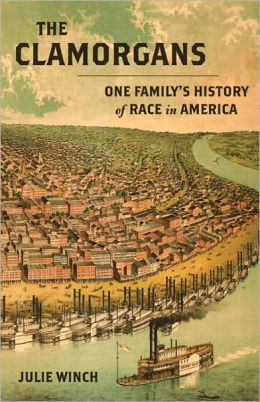 The Law Could Make You RichJulie Winch, The Clamorgans: One Family's History of Race in America (Hill & Wang, 2011). Hardesty begins the review as follows:
In Legally Free, Unable to Live Freely Eva Sheppard Wolf, Almost Free: A Story about Family and Race in Antebellum Virginia (University of Georgia Press, 2012).
Governor Riggins, a leader of Boston's nineteenth-century black community, once publicly admonished a fellow person of color, William Patterson, and took the opportunity to offer a lesson to the community at large. Patterson had purchased unlicensed liquor for some fellow African Americans, and the authorities in Boston caught him red-handed. In the midst of dressing Patterson down, Riggins expressed the hope that the "law will make you smart." His proclamation to his fellow Afro-Bostonians—the law could be a source of empowerment for African Americans—may have been lost on Patterson, but it was a message that blacks across the United States heard loud and clear. Half a continent away in St. Louis, Missouri, the mixed-race grandsons of Jacques Clamorgan geared up to file suit and lay claim to their grandfather's extensive lands. For them, Riggins's message carried special resonance and an additional caveat. For the Clamorgan men, the law not only made them smart, but could also make them rich.
Did the Clamorgans have a legitimate chance to win their legal battles? In her wonderful The Clamorgans: One Family's History of Race in America, Julie Winch answers this question by offering readers a thorough examination of the family's past, especially their relationship with the law. . . .The full issue is available here.
Women in the Life and Law of the D.C. Circuit Courts
[We are moving this post up, because the symposium takes place tomorrow.]
The Historical Society of the District of Columbia Circuit presents Women in the Life and Law of the D.C. Circuit Courts, a symposium to be held on Tuesday, June 18, 2013, from 4:30 – 6:00 p.m. in the Ceremonial Courtroom, 6th Floor, E. Barrett Prettyman U.S. Courthouse, 3rd Street & Constitution Avenue, N.W., Washington, D.C.
Women in the Life and Law of the D.C. Circuit Courts will bring together participants in the life of the D.C. Circuit – judges, administrators, law clerks and practicing attorneys – to speak from their experience about the past, present and future of women in the Courts of the Circuit. The program will open with stage-setting remarks by Emerita Professor Barbara Babcock of Stanford Law School who clerked for Circuit Judge Henry Edgerton and writes and teaches about women’s issues. This will be followed by a panel discussion moderated by Professor Babcock.
Participants in the panel will be Justice Ruth Bader Ginsburg (D.C. Circuit Judge 1980-93); Senior Judge Gladys Kessler (Member of the District Court since 1994); Chief Judge Royce C. Lamberth (Member of the U.S. District Court since 1987); Nancy Mayer-Whittington (Clerk of the District Court 1991-2009); Michele A. Roberts (Partner, Skadden, Arps, Slate, Meagher & Flom and advocate before the District Court); Hon. Patricia M. Wald (D.C. Circuit Judge 1979-99, Chief Judge 1986-91); and Helgi C. Walker (Partner, Wiley Rein and advocate before the Court of Appeals for the D.C. Circuit).
Sunday, June 16, 2013
Book Review Roundup
- From Baseball Prospectus: Jason Wojciechowski reviews Stuart Banner's The Baseball Trust.
- From Lawfare: Stephen C. Neff and Amy J. Sennett review John Fabian Witt’s Lincoln’s Code.
- Kerry Abrams reviews Joanna Grossman and Lawrence Friedman’s Inside the Castle: Law and the Family in the 20th Century
- "Berkeley: What We Didn't Know": Writing for the New York Review of Books, Adam Hochschild reviews Seth Rosenfeld, Subversives: The FBI’s War on Student Radicals, and Reagan’s Rise to Power (Farrar, Straus and Giroux).
 From H-Law: Nancy L. Rhoden reviews Paul Rasor & Richard E. Bond, eds., From Jamestown to Jefferson: The Evolution of Religious Freedom in Virginia (University of Virgina Press, 2011).
- "Founding Father frenemies Hamilton and Burr 'Duel With the Devil'": the LA Times reviews Paul Collins, Duel With the Devil: The True Story of How Alexander Hamilton and Aaron Burr Teamed Up to Take on America's First Sensational Murder Mystery (Crown, 2013).
- From H-Law: Greta Austin reviews Karl Shoemaker, Sanctuary and Crime in the Middle Ages, 400-1500.
- "The Lost Boys": The New Republic covers Charles Glass, The Deserters: A Hidden History of World War II (Penguin Press, 2013).
Saturday, June 15, 2013
Weekend Roundup
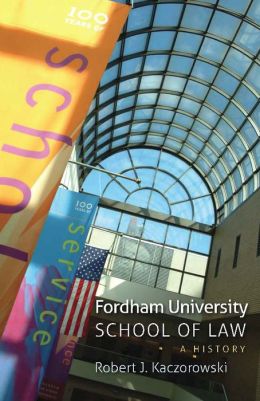
- Over at Concurring Opinions, Danielle Citron plugs Robert Kaczorowski's Fordham University School of Law: A History. “Ever since the inception of the recession, we have been embroiled in a conversation about legal education–its costs, value, and flaws," she writes. “Amidst this debate, legal historian Robert Kaczorowski has written a brilliant and engrossing history of Fordham Law School, one that highlights, among many issues, the struggles that law schools have with their universities about the funds they generate.” More.
- The Washington Post's story on the National Archives' Founders Online project, is here. The project puts on the web “over 119,000 searchable documents, fully annotated,” by or relating to George Washington, Benjamin Franklin, John Adams (and family), Thomas Jefferson, Alexander Hamilton, and James Madison, “from the authoritative, federally funded Founding Fathers Papers projects.”
- Emory Law's profile of LHB Founder Mary L. Dudziak is here.
- From History News Network: You’ve Come a Long Way, Baby? Fifty Years Since the Equal Pay Act of 1963.
- Over at the New Books in History podcast: an interview of Michael Burlingame on Abraham Lincoln: A Life (Paperback; Johns Hopkins University Press, 2013)
Friday, June 14, 2013
Hutchinson on Lochner, Progressive Constitutionalism, and African-American Progress Now
Harry G. Hutchison, George Mason Law, has posted Achieving Our Future in the Age of Obama?: Lochner, Progressive Constitutionalism, and African-American Progress, which is forthcoming in the Journal of Gender, Race & Justice. Here is the abstract:
It is clear that the New Deal era was the most important and wide-ranging period of constitutional change since the Civil War. Equally clear, the events that catalyzed the New Deal were echoed more recently by the economic and financial collapse of 2008, which sparked President Obama’s current efforts to save American capitalism. In this regard, three things are worth noting: first, President Obama’s recovery plans, taken together will leave the government permanently bigger, more costly, and more intrusive; second, his approach to the current crisis recalls the efforts of his predecessor and model, Franklin D. Roosevelt; and third, such efforts appear to be marred by contradiction. Despite President Obama’s efforts, and in spite of sporadic evidence that the United States is beginning to emerge from one of the most devastating economic slides in its history; American workers, black and white, must tackle anxiety that is elevated by allegations of falling or stagnant wages, increasing employment uncertainty, and growing disparities in nonwhite versus white unemployment rates. Amidst recent evidence that the latter trend has accelerated, the pertinent question that confronts us today is whether the fundamental change offered by the Obama administration will lead to consequences which mirror results that dogged the New Deal.
It is, therefore, an opportune time to consider whether the constitutional law and policy implications that can be drawn from the New Deal offer a secure foundation for questioning various Obama administration initiatives that are tied to progressive teleology. And this issue is particularly important to the lives and future of African Americans, despite the Supreme Court’s acclaimed commitment to the protection of, “discrete and insular minorities." Emphasizing an ethical and consequentialist dimension, and based on a 2012 symposium presentation at the University of Pennsylvania Law School, this article shows that African Americans and other outsiders have much to fear from the replication of FDR’s policies by the Obama administration. Unless the Supreme Court can muster the courage to intervene on behalf of the truly disadvantaged among us, which is highly doubtful, it is probable that history will repeat itself.
Armitage on Why "Every Great Revolution is a Civil War"
 Only earlier this year did I discover the Sussex Lectures in Intellectual History, available on iTunes and here. The latest, delivered last month, was by David Armitage on the topic, "Every Great Revolution is a Civil War." In these times, Stefan Collini's "The Very Idea of a University" is also very much worth a listen.
Thursday, June 13, 2013
Abrams on the History of the Derivative Domicile Rule
Kerry Abrams, University of Virginia School of Law, has posted Citizen Spouse, which appears in California Law Review 101 (2013): 407. Here is the abstract:
Marriage and citizenship have a complicated relationship to one another. Marriage is often the primary way in which a person can exercise and demonstrate his or her identity under law, by claiming legal benefits and by performing legal obligations. This Essay examines the history of one particularly salient example of marriage-as-citizenship — the derivative domicile rule — and uses this history to consider how the relationship between marriage and citizenship has changed and developed over time. The derivative domicile rule linked a woman’s domicile, and her state citizenship along with all the rights and obligations it carried, with her husband’s domicile by operation of law. This happened regardless of where she actually lived or what state she subjectively owed allegiance to. Derivative domicile remains pertinent today because many states still use it to determine state citizenship for married people, either as a presumption rebuttable by a married woman or as a rule that applies to both spouses and links their domicile by presuming they will each regard one single place as their home. The history and current application of the derivative domicile rule demonstrate that these presumptions fail to accurately reflect the preferences of many married people whose domiciles do not match their spouses’. This Essay argues that derivative domicile illustrates the dangers of uncritically eliding marriage and citizenship.
New Release: Calloway, "Pen and Ink Witchcraft"
New from Oxford University Press: Pen and Ink Witchcraft: Treaties and Treaty Making in American Indian History, by Colin G. Calloway (Dartmouth College). Here's a description from the Press:
A few blurbs:Indian peoples made some four hundred treaties with the United States between the American Revolution and 1871, when Congress prohibited them. They signed nine treaties with the Confederacy, as well as countless others over the centuries with Spain, France, Britain, Mexico, the Republic of Texas, Canada, and even Russia, not to mention individual colonies and states. In retrospect, the treaties seem like well-ordered steps on the path of dispossession and empire. The reality was far more complicated.
In Pen and Ink Witchcraft, eminent Native American historian Colin G. Calloway narrates the history of diplomacy between North American Indians and their imperial adversaries, particularly the United States. Treaties were cultural encounters and human dramas, each with its cast of characters and conflicting agendas. Many treaties, he notes, involved not land, but trade, friendship, and the resolution of disputes. Far from all being one-sided, they were negotiated on the Indians' cultural and geographical terrain. When the Mohawks welcomed Dutch traders in the early 1600s, they sealed a treaty of friendship with a wampum belt with parallel rows of purple beads, representing the parties traveling side-by-side, as equals, on the same river. But the American republic increasingly turned treaty-making into a tool of encroachment on Indian territory. Calloway traces this process by focusing on the treaties of Fort Stanwix (1768), New Echota (1835), and Medicine Lodge (1867), in addition to such events as the Peace of Montreal in 1701 and the treaties of Fort Laramie (1851 and 1868). His analysis demonstrates that native leaders were hardly dupes. The records of negotiations, he writes, show that "Indians frequently matched their colonizing counterparts in diplomatic savvy and tried, literally, to hold their ground."
Each treaty has its own story, Calloway writes, but together they tell a rich and complicated tale of moments in American history when civilizations collided.
"Indian treaties were major historical events, and today they are still important sources of legal rights. Pen and Ink Witchcraft is a masterful overview of the complex processes by which these treaties were created." --Stuart Banner, author of How the Indians Lost Their Land: Law and Power on the Frontier
"This extraordinary analysis of Indian treaties and treaty-making reveals the complexity and objectives of the United States government in negotiating nearly 400 ratified agreements. In a book wide in scope--addressing political ceremony, kinship alliances, council meetings, native law, oratorical power, gift-giving diplomacy, and sovereignty--Colin Calloway has produced a masterpiece for Indian treaties to be understood by everyone. This leading scholar of Indian history explains the historical development of Native American legal rights today." --Donald L. Fixico, editor of Treaties with American Indians: An Encyclopedia of Rights, Conflicts, and SovereigntyFor more information, including the TOC, follow the link.
Subscribe to:
Posts (Atom)