Monday, August 19, 2013

Cushman on the Four Horsemen's Clerks

John Knox, McReynolds Clerk
Barry Cushman, Notre Dame Law School, has posted The Clerks of the Four Horsemen.  Here is the abstract:    
The names of Holmes clerks such as Tommy Corcoran and Francis Biddle, of Brandeis clerks such as Dean Acheson and Henry Friendly, and of Stone clerks such as Harold Leventhal and Herbert Wechsler ring down the pages of history. But how much do we really know about Carlyle Baer, Tench Marye, or Milton Musser? This article follows the interesting and often surprising lives and careers of the men who clerked for the Four Horsemen - Justices Van Devanter, McReynolds, Sutherland, and Butler. These biographical sketches confound easy stereotypes, and prove the adage that law, like politics, can make for strange bedfellows.

Barker on "Fugitive Slaves and the American Revolution"

Out from McFarland recently is Fugitive Slaves and the Unfinished American Revolution: Eight Cases, 1848-1856, by Gordon S. Barker, an associate professor of history at Bishop’s University in Sherbrooke, Quebec, Canada:
This book posits that the American Revolution-- waged to form a "more perfect union"--still raged long after the guns went silent. Eight major fugitive slave stories of the antebellum era are described and interpreted to demonstrate how fugitive slaves and their abolitionist allies embraced Patrick Henry’s motto "Give me Liberty or Give me Death" and the principles enshrined in the Declaration of Independence. African Americans and white abolitionists seized upon these dramatic events to exhort citizens to complete the Revolution by extending liberty to all Americans. Casting fugitive slaves and their slave revolt leaders as heroic American Revolutionaries seeking freedom for themselves and their enslaved brethren, this book provides a broader interpretation of the American Revolution.
Robert A. Gross, author of The Minutemen and Their World blurbs:

"No one acted on the promises of the American Revolution with greater commitment and courage than the little-known African Americans at the heart of Gordon S. Barker’s stirring new book. Caught up in the dramatic fight over the Fugitive Slave Law of 1850, these brave souls, along with their abolitionist allies, demanded ’liberty or death’ and thereby summoned Americans to renew the ’spirit of 1776.’ They were, in Barker’s apt phrase, the ’minutemen’ of their own day, on the front lines of freedom for a nation that has not yet paid them their due. Barker’s insightful and inspiring account rightly recognizes these unsung heroes of American democracy."

Brophy on Popular Constitutionalism and the Antebellum Cemetary

Alfred L. Brophy, University of North Carolina Law, has posted “These Great and Beautiful Republics of the Dead”: Public Constitutionalism and the Antebellum Cemetery.  Here is the abstract:    
Mt. Auburn Cemetery (Credit: LC)
“Public Constitutionalism and the Antebellum Cemetery” joins the growing literature on public constitutionalism by focusing on the seventy addresses given at cemetery dedications from Supreme Court Justice Joseph Story’s address at Mount Auburn Cemetery in Cambridge, Massachusetts, in 1831, through the addresses of Edward Everett and Abraham Lincoln at Gettysburg in November 1863. The addresses were part of a vibrant public discussion of constitutional principles, which spanned such diverse occasions as July Fourth celebrations, arguments in great constitutional cases (like Daniel Webster’s Dartmouth College argument), dedication of public monuments (like Daniel Webster’s speech at the placement of the cornerstone of the Bunker Hill Monument in 1824), lyceum addresses, and college literary society lectures. For Americans, especially those of the Whig Party, the Constitution was a key component of culture and a key unifier of the nation.

Rural cemeteries provided support for such constitutional values. They brought beauty and order to the landscape; they served to mediate an impersonal, commercial world and brought uplift through the lessons of morality and patriotism that people learned when they visited the cemeteries. The cemetery supported constitutional values of Union, respect for property, and obedience to the rule of law. For visitors to the cemetery learned about the importance of each of those values at the cemetery. It was an instructor of values; its ordered lanes and graves also served as a sign of the health of the Christian republic. For the cemetery fulfilled duties owed the past. The cemetery inspired sentiments of love of family and country. People would leave the cemetery inspired to preserve the United States as a Christian republic. Finally, these abstract ideas were promoted through private charitable corporations. Those private organizations brought the community together to promote the republic.

The cemeteries were, thus, one important institution – along with the schools, churches, civic associations, and businesses – that helped create and preserve the Union. The cemetery dedication addresses, like other addresses designed to promulgate constitutional ideas, mixed appeals to economics, morality, religion, and political theory with legal and constitutional ideas. Rural cemeteries promoted Whig constitutional ideals about order, patriotism, and Union. Those values were at the center of the debate over the response to secession and they were put into practice by soldiers along Cemetery Ridge at Gettysburg in 1863. Lincoln’s address at Gettysburg, thus, reflects the appeals to sentiment and Constitution that were so frequently invoked in the thirty years before the War.

This article reveals an important and neglected role of oratory in disseminating constitutional ideas, as well as the significance of rural cemeteries to public constitutional thought. This hidden history reveals how those ideas mobilized support for Union and, thus, how public constitutional thought affects the actions of voters, jurists, and politicians.

Sunday, August 18, 2013

Sunday Book Round-up

NPR looks at "when fashion and law collide" in an author interview with Ruthann Robson. Her new book is Dressing Constitutionally: Hierarchy, Sexuality, and Democracy from Our Hairstyles to Our Shoes (Cambridge University Press). Here's an excerpt:
"On local laws that ban 'cross-dressing' 'It often acts as a cipher for other sorts of problems, right. So that if people dress decently, then there won't be gambling, then there won't be theft, then there won't be muggings — as if those two things go together. And of course, people's notions of what's 'decent' really varies across class, varies across time, and varies across age. And one way to look at some of these is really about older people policing the sexuality of younger people."
The new August issue of The Federal Lawyer has a couple of book reviews of interest this week. Michael Ariens reviews Joanna Grossman and Lawrence Friedman's Inside the Castle: Law & the Family in 20th Century America (Princeton University Press, 2011). Louis Fisher reviews Robert Bork's Saving Justice: Watergate, the Saturday Night Massacre, and Other Adventures of a Solicitor General (Encounter Books).

Over at The New Republic Andrew Delbanco has written a review essay of several works on Lincoln and slavery in "Lincoln's Long Game: The morally painful road to slavery's end."

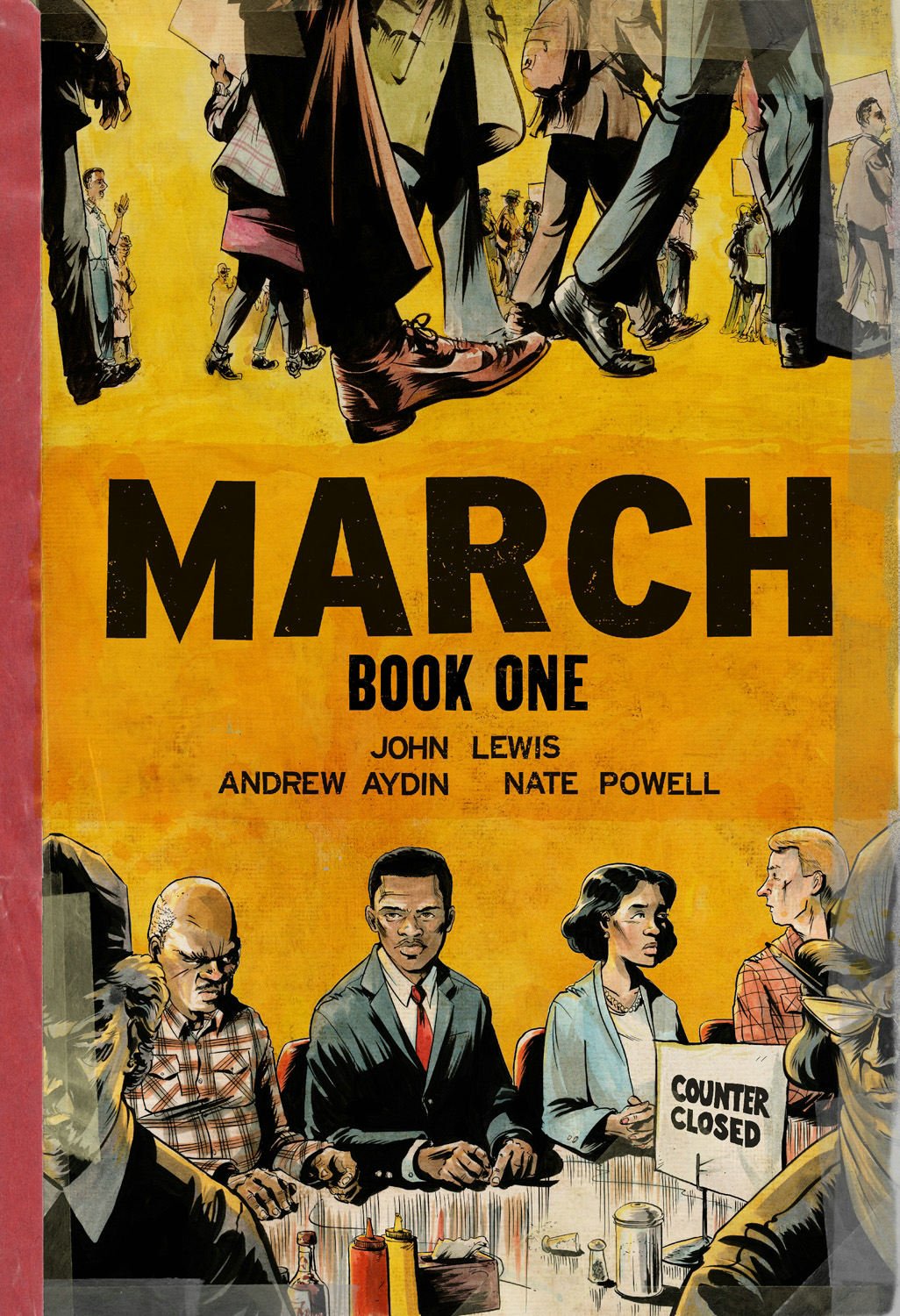
NPR reviews March (Top Shelf) which has been co-written by civil rights activist and member of the U.S. House of Representatives John Lewis, his staffer Andrew Aydin, and graphic novelist Nate Powell. Reviewer Jody Arlington writes:
"And yet March is a fresh and sometimes shocking work, even for those familiar with Lewis' life. Not just for its violence and its graphic re-creation of a dark time, but for its inside look at the leaders of the civil rights movement. In one disturbing scene, they shout insults at each other and enact other indignities as a way to prepare for the resistance and abuse they'll face in public."

The New York Times's David Garrow also takes up the topic of civil rights in his review of William Jones's The March on Washington (Norton). 

Jeannette Cockroft has reviewed Keira V. Williams's Gendered Politics in the Modern South: The Susan Smith case and the Rise of a New Sexism (Louisiana State University Press) for H-Net here.

Excerpts from Evan Mandery's book on death penalty lawyers in the 1960s and 1970s, A Wild Justice (Norton), can be found on Salon here. Salon has also published adapted excerpts from an e-book essay about the history of forced sterilization, For the Public Good (New New South).

This week the Guardian has reviewed another book about American death penalty policy, Injustice: Life and Death in the Courtrooms of America by Clive Stafford Smith.

Finally, John Yoo reviews A Principled Stand: The Story of Hirabayashi v. United States (University of Washington Press) by Gordon K. Hirabayashi in the Wall Street Journal.

Saturday, August 17, 2013

Weekend Roundup

  • Around the web, friends and admirers continue to pay tribute to Pauline Maier (1938-2013). MIT's obituary is here; the New York Times write-up is here; the Washington Post's, here. Chris Beneke penned a nice note here, at the Historical Society. (A taste: "Maier treated her fellow historians with the same honest consideration that she tendered her historical subjects, remaining ever open to the possibility that the lowly might possess more insight than their better appointed counterparts (as well as the possibility that they might be out of their senses).").
  • I love the opening to this op-ed, by Catherine O'Donnell (Arizona State University): "I am an historian with a secret. I don’t think studying the past tells us what to do in the present. I should qualify that: If you are considering whether to invade Russia in winter, history provides the answer." The rest is good, too. (Hat tip- History News Network) (KMT)
    • From In Custodia Legis: a compilation of unusual (from today's perspective) and now defunct laws from the United Kingdom, including "the common law offense of being a 'common scold'" and the statutory offense of gambling in a library. 
      Weekend Roundup is a weekly feature compiled by all the Legal History bloggers.

      Friday, August 16, 2013

      Gillies's Essays on Vermont Legal History

      Paul S. Gillies, a Vermont lawyer, has published Uncommon Law, Ancient Roads, and other Ruminations on Vermont Legal History, with the Vermont Historical Society, which describes it as twenty-five essays that “ examine the foundations of legal thought in Vermont, historical issues ranging from log drives to keeping of sheep and blue laws, the state's legal luminaries, and contemporary issues including ancient roads and Act 250.” As Gillies elaborates in today's Green Mountain Outlook:
      All important issues wind up in court. If only courtrooms could speak, they could tell stories about people and their concerns more lurid, more complicated, and more interesting than you would expect, meeting the people on the street. Public and private turmoils stir up controversies that show us the character of the parties and the integrity of the judicial system, and give us the ability to capture a moment in history otherwise lost to memory.
      Gillies will preside at a book signing on August. 20, from 4:30 to 6:30 p.m., at the Vermont History Museum, 109 State Street, Montpelier.

      World War II Law and Lawyers

      Out earlier this summer from the American Bar Association’s publishing arm is World War II Law and Lawyers: Issues, Cases, and Characters, by Thomas J. Shaw, Esq..  According to the ABA’s press release, the book
      chronicles the evolving stories of more than 50 major legal issues from that period and profiles more than 300 lawyers and judges from 20 countries involved with related cases and laws.

      The book, written by attorney Thomas J. Shaw, presents these legal issues through a global perspective of seven key countries. It presents each issue through the laws or decrees enacted and the people who enacted them. The book also highlights individual cases, spotlights lawyers and judges who were involved in them, and explores how these various factors affected subsequent events, including future conflicts.

      The people and personalities depicted in the book — some famous as national or global leaders while others historically obscure — provide a fascinating backdrop to understanding the legal story of the war. Through its content and comprehensive coverage, the book speaks to many different audiences, including those interested in legal research and resources and others keen on better understanding World War II historical figures and filling in their knowledge of the war.

      Word War II Law and Lawyers presents a wide perspective of the war period. It details, for instance, how the United States prepared for war as well as how European nations dealt with issues like neutrality, collaboration, annexation and looting of assets. The book also explores how the major Axis powers subverted legal institutions and created a military machine that supported genocide.

      Thursday, August 15, 2013

      Military Justice in "The Federal Lawyer"

      The July 2013 issue of The Federal Lawyer (“The premier bar association serving the federal practitioners and the federal judiciary”), available on-line, has two articles of interest on the administration of military justice: The U.S. Court of Appeals for the Armed Forces Courthouse: A History, by the Honorable Scott W. Stucky, and A History of Extraordinary Relief in the U.S. Court of Appeals for the Armed Forces, by Bradley Richardson. The same issue includes Honoring Our Own: The WWII Veteran Judges of the Eastern District of New York–among them The Honorable Jack B. Weinstein, pictured in his uniform as a lieutenant commander on the submarine USS Jallao.

      Chin, Chiang and Park on Lee Kum Hoy

      Gabriel J. Chin, UC Davis Law, Cindy Hwang Chiang and Shirley S. Park have posted The Lost Brown v. Board of Education of Immigration Law, which appears in the North Carolina Law Review 91 (2013).  Here is the abstract:
      This Article proposes that in 1957, the Supreme Court came close to applying Brown v. Board of Education to immigration law. In Brown, the Supreme Court held that school segregation was unconstitutional. Ultimately, Brown came to be understood as prohibiting almost all racial classifications. Meanwhile, in a line of cases exemplified by Chae Chan Ping v. United States and Fong Yue Ting v. United States, the Supreme Court held that Congress enjoyed plenary power to discriminate on any ground, including race, in immigration law. These holdings have never been formally overruled. Immigration, then, is said to be an exception to the general rule of Brown and Bolling v. Sharpe.

      In 1957, however, the Supreme Court granted certiorari in United States ex rel Lee Kum Hoy v. Murff, to resolve the question of the permissibility of race discrimination in the immigration context. The case involved a policy under which immigration officials tested the blood of Chinese people immigrating as children of U.S. citizens to determine whether they were related to their claimed parents, but not the blood of similarly situated members of other races. The Second Circuit, over the dissent of Judge Jerome Frank, upheld the discriminatory policy, so the Court had no reason to take the case unless it thought the decision was incorrect. While the Supreme Court ultimately granted the petitioners relief on other grounds, records of the Court and the short per curiam opinion suggest that the Court may have been prepared to hold at least this form of discrimination in immigration unconstitutional.

      Welcome to the Blogosphere: History and the Law

      A hearty welcome to the blogosphere to History and the Law, the brainchild of Rohit De, a legal historian of South Asia and the Mellon Postdoctoral Fellow at the Centre for History and Economics at the University of Cambridge, and Fei-Hsien Wang, a legal historian of modern China.  They describe their project as “a set of digital resources for legal historians, particularly those working on the non-Western world.”  They are creating an online directory of scholars, and their directory of digital resources already has two curated section.  One focuses on ways of reading primary legal sources; the other consists of conversations with legal historians whose books have recently been published: Rachel Sturman, Mitra Sharafi, and Issa Husin.

      Wednesday, August 14, 2013

      Scott on Farge, "The Allure of the Archives"

      Via LHB reader Rebecca Scott (University of Michigan) we have word that Yale University Press will soon publish an English translation of The Allure of the Archives, by Arlette Farge (Director of Research in Modern History, Centre National de la Recherche Scientifique in Paris). Normally we post whatever description the press has offered, but Professor Scott generously allowed us to publish her own write-up on the book:
      In 1989 the French historian Arlette Farge published an elegantly-written small book on judicial archives and the ways in which historians can engage the documents those archives contain. The book was titled _Le Goût de l'archive_ , a play on words implying both the taste of & a taste for the archive. Insightful, witty, and erudite, the work became a classic among readers in France, and was translated into Spanish and into Portuguese. Farge vividly evokes the vision of life in ancien régime Paris that emerges from police records and the archives of the Bastille, while warning of the traps that archives have laid for us, the illusions of immediacy that can lead us astray. In short, astringent chapters she reflects on the difficulty of confronting "Traces by the Thousands," and the lure of finding "Captured Speech."

      For years no publisher took on the task of translating Farge's (nearly poetic) prose into English. So aficionados of the book who wanted to teach it had to try to coax students into reading it in the original French, or attempt to convey Farge's brilliance in paraphrase. But this month the book will appear from Yale University Press, under the title THE ALLURE OF THE ARCHIVES, translated by Thomas Scott-Railton, with a forward by Natalie Zemon Davis. The advance reviews are admiring.

      The book will apparently be available from Yale University Press as of Monday, August 19, in time for last-minute additions to syllabi in courses on methodology, on legal history, on historical writing. . . or any course in which one needs to discuss what it is that historians do and how they do it. (I will be assigning selections, for example, in a seminar on law and slavery, by way of preparing law students to use raw testimony from U.S. court records in developing their own analyses.)

      Call for Legal History Workshop Schedules

      Karen's posting of the fall line-up for the Osgoode Hall Legal History group reminds me to issue this general invitation to the organizers of legal history workshops, colloquia, and seminars to send us your schedules once you've finalized them.  Please indicate whether they are open to non-members of the host institution and, if so, on what terms.

      Tuesday, August 13, 2013

      A Legal History "CRN" for the Law and Society Association

      [We have the following announcement.]

      Greetings from Law & History, recently established as a Collaborative Research Network (CRN) within the Law and Society Association. We are currently putting together a group of legal historians who might be interested in presenting at LSA meetings, and using this list to organize papers and panels.

      This CRN brings together scholars interested in legal history, both American and non-American, of any time period from contemporary to ancient.  We welcome a broad array of scholarly interests and methodological approaches.  Our scholars explore the development of legal doctrines and jurisprudence, the evolution of legal institutions, and the changing role of law in society.  They apply and develop a diverse set of methods, including those of social, intellectual, cultural, and critical history.  The Law and Society Movement has long welcomed both legal historians and legal history and we hope this CRN extends the benefits of that relationship.  Our goals include supporting methodological discussions across sub-specialties and between historical and other approaches to studying law and society; creating opportunities for cross-generational and inter-disciplinary professionalization; and encouraging publication of CRN research, such as edited volumes and symposia in law and society journals, law reviews, and outlets in our home disciplines.  We discuss teaching methods and share syllabi and other teaching resources for undergraduate, graduate, and professional school classes on law and social movements.

      The next LSA conference is May 29-June 1, 2014; the deadline is Sept. 15, 2013. More information is here.

      If you are interested in joining, please email Joanna Grisinger at joanna.grisinger@northwestern.edu.

      Sincerely,

      Joanna Grisinger, Senior Lecturer, Center for Legal Studies, Northwestern University
      Kimberly Welch, Assistant Professor, Department of History, University of West Virginia 
      Logan Sawyer, Assistant Professor, University of Georgia Law School
      Kathryn Schumaker, Lecturer, Institute for the American Constitutional Heritage, University of Oklahoma

      Call for Papers: Brandeis Conference on "Blacks, Jews, and Social Justice in America"

      On June 10-12, 2014 Brandeis University will host a conference entitled “Blacks, Jews, and Social Justice in America" to commemorate the 50th anniversary of the slaying of James Chaney, Andrew Goodman, and Michael Schwerner. A call for papers has been issued. The conference organizers
      invite proposals addressing the relations between members of these two groups in campaigns for social justice--whether in politics or the arts-- throughout American history. Though the postwar civil rights movement will be highlighted, cognate topics might include, but need not be limited to: the Leo Frank case, the campaign against The Birth of a Nation (1915), the trials of the Scottsboro Boys; representations of blacks by Jews and Jews by blacks in literature, theater, film, television, and digital media; collaborations and appropriations in jazz, rock, pop, and hip hop; the roles of the Anti-Defamation League, the Communist Party USA, and the NAACP; black and Jewish feminist activism; and political alliances and antagonisms over issues such as black separatism and affirmative action.
      Additional information is available here.

      Levinson to Lead ICH Seminar "Assessing the Constitution"

      [Note that the deadline of August 23 is rapidly approaching.]

      Our friends at the Institute for Constitutional History have announced another Robert H. Smith seminar for advanced graduate students and junior faculty: "Assessing the US Constitution: Twenty-first-Century Responses to Eighteenth-Century Assumptions.”  It will be led by Sanford Levinson, the W. St. John Garwood Jr. Centennial Chair in Law, University of Texas Law School, and Professor of Government, University of Texas at Austin.  It will meet Thursday evenings, 6:00–8:00 p.m., September 12, 19, October 3, 10, 24, and November 7,  at The George Washington University Law School, 2000 H Street NW, Washington, DC 20052.

      The Institute explains:

      The United States Constitution was drafted at least in part under the sway of particular conceptions of government and politics (putting entirely to one side the role that out-and-out political bargaining played at the Philadelphia Convention).  This seminar will examine some of these central assumptions, particularly concerning the nature of what the Constitution itself calls a “Republican Form of Government” and ask to what degree we—or, more accurately, you as students within the seminar—agree in 2013 with the assumption set out, often with both candor and eloquence, in 1787–88.  Course materials will be drawn almost entirely from primary sources, including materials collected in Philip Kurland and Ralph Lerner, eds., The Founders' Constitution and The Federalist, though it is also likely that Professor Levinson’s recent book Framed: America’s 51 Constitutions and the Crisis of Governance will also be assigned.  Reading will not be particularly heavy in quantity, but the assumption is that what is assigned will be read and then discussed quite intensely.
      Instructor: Sanford Levinson is the W. St. John Garwood Jr. Centennial Chair in Law, University of Texas Law School, and Professor of Government, University of Texas at Austin.  Among other books, he has written: Constitutional Faith (Princeton U. Press, 1988, 2nd ed. 2011), and Our Undemocratic Constitution:  Where the Constitution Goes Wrong (and How We the People Can Correct It) (Oxford U. Press, 2006, pb. ed. 2008).  He is also the co-editor of a widely used casebook, Processes of Constitutional Decision Making (5th ed. 2006).  He has written over 350 articles in law reviews as well as more general venues.  He was elected to the American Academy of Arts and Sciences in 2001.
      Eligibility and Application Procedure: The seminar is designed for graduate students and junior faculty in history, political science, law, and related disciplines.  All participants will be expected to complete the assigned readings and participate in seminar discussions.  Although the Institute cannot offer academic credit directly for the seminar, students may be able to earn graduate credit through their home departments by completing an independent research project in conjunction with the seminar.  Please consult with your advisor and/or director of graduate studies about these possibilities.  Space is limited, so applicants should send a copy of their c.v. and a short statement on how this seminar will be useful to them in their research, teaching, or professional development.   

      Materials will be accepted only by email at MMarcus@nyhistory.org until August 23, 2013.  Successful applicants will be notified soon thereafter. 

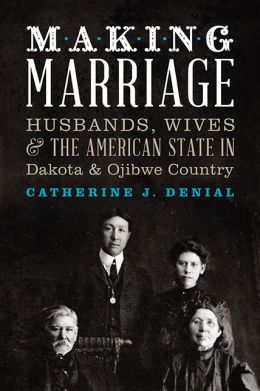
      New Release: Denial, "Making Marriage: Husbands, Wives, and the American State in Dakota and Ojibwe Country"

      The Minnesota Historical Society Press has released Making Marriage: Husbands, Wives, and the American State in Dakota and Ojibwe Country by Catherine J. Denial (Knox College). Here's a description:
      The debate over the meaning of marriage in the United States and specifically in Minnesota is not a recent development. From 1820 to 1845, when the first significant numbers of Americans arrived in the region now called Minnesota, they carried the belief that good government and an orderly household went hand in hand. The territorial, state, and federal governments of the United States were built upon a particular vision of civic responsibility: that men, as heads of households, enter civic life on behalf of their dependents—wives, children, servants, and slaves. These dependents were deemed unfit to make personal decisions or to involve themselves in business and government—and they owed labor and obedience to their husbands, fathers, and masters.

      These ideas clashed forcibly with the conceptions of kinship and social order that existed among the Upper Midwest's long-established Dakota, Ojibwe, and mixed-heritage communities. In resisting the new gender and familial roles advocated by military personnel, Indian agents, and missionaries, the region’s inhabitants frustrated American attempts to transform Indian country into a state. Indeed, many Americans were forced to compromise their own beliefs so that they could put down roots.

      Through the stories of married—and divorcing—men and women in the region, Catherine J. Denial traces the uneven fortunes of American expansion in the early nineteenth century and the nation-shaping power of marital acts.

      Monday, August 12, 2013

      Rest in Peace, Pauline Maier (1938-2013)

      Via H-Law, Richard B. Bernstein just circulated this very sad news:
      credit
      Pauline Maier, the William R. Kenan, Jr., Professor of History at MIT and a leading scholar of American colonial, revolutionary, and early republic history, died this morning, 12 August 2013, after a brief illness.

      A fuller essay detailing Maier's life, career, and scholarship will appear on H-LAW later today or tomorrow.
      We will update this post as tributes and remembrances come in.

      UPDATE: Richard B. Bernstein has now circulated a full and heartfelt obituary. Here's a particularly evocative excerpt:
      [Pauline Maier] was not only a role model to me, as to so many other historians, but she also brought out the sheer fun of doing history, of digging through sources and framing arguments and testing them against our colleagues and against the existing literature. She also was one of the premier explainers of our profession, elucidating complex ideas and tangled historical events and processes in clear, graceful language, and always with a wry and creative sense of humor. And she epitomized the best of the profession in her ability to reach out – whether to colleagues, to prospective colleagues, or to a general audience – with infectious joy and excitement.
      Read on here, at H-Net.

      UPDATE: Fond remembrances continue to pour in --

      Supreme Court Records at the Texas State Archives

      The Texas State Library and Archives Commission recently posted the following:
      Disputes over land and slaves in pre-Civil War Texas are among the courtroom conflicts recorded in the 19th century case files of the Texas Supreme Court. These records capture not only state legal history, but also social and cultural life during the Republic and early statehood years. Today, they reside in the Texas State Archives, which is in the midst of a long-term preservation project aimed at providing researchers with improved access to these fragile yet revealing records.

      Thanks to a $5,000 grant from the Texas Historical Foundation (THF) in 2012, the State Archives, which is part of the Texas State Library and Archives Commission, initiated a comprehensive conservation and indexing project with the goal of preserving these aged documents for future scanning and the subsequent creation of an online database.
      More

      Sunday, August 11, 2013

      Sunday Book Roundup

      There are several book reviews to read this weekend. In the Times Literary Supplement, Laura Jockusch's COLLECT AND RECORD! Jewish Holocaust documentation in early postwar Europe (Oxford University Press) is reviewed.

      HNN has posted two reviews of interest. The first is a review of Niall Ferguson's The Great Degeneration: How Institutions Decay and Economies Die (Penguin). The second is a review of William J. Reese's Testing Wars in the Public Schools: A Forgotten History (Harvard University Press).

      History Today reviews a uniquely edited volume of books by editor and author Emily Rosenberg, A World Connecting 1870-1945, (Belknap Press).


      Ecstatic Nation: Confidence, Crisis, and Compromise, 1848-1877 (Harper Collins), by Brenda Wineapple is reviewed in the LA Times. The New York Times also reviews the book here.

      Also in the LA Times is a review of Brenda Stevenson's The Contested Murder of Latasha Harlins: Justice, Gender, and the Origins of the LA Riots (Oxford University Press).

      H-Net reviews David Mayers's FDR's Ambassadors and the Diplomacy of Crisis: From the Rise of Hitler to the End of World War II (Cambridge University Press).

      And finally, the Washington Post reviews A Death at Crooked Creek: The Case of the Cowboy, the Cigarmaker, and the Love Letter by Marianne Wesson.

      Update: In The Atlantic, Andrew Cohen reviews Thomas Healy’s The Great Dissent: How Oliver Wendell Holmes Changed His Mind-- and Changed the History of Free Speech in America.

      Saturday, August 10, 2013

      Weekend Roundup

        David Garland (credit)
      • Over at the Faculty Lounge, Roman Hoyos, reflecting upon Sally Gordon's post on legal historians and the hiring market and an accompanying comment, points out that among our attractions for law faculties is our interest in teaching a variety of high-traffic and required courses.
      • The Law Librarians at the Library of Congress have put together a useful Beginner's Guide to researching Congressional debates.
      • Over at the New Books in Law podcast, David Garland, NYU Law, discusses his book Peculiar Institution: America’s Death Penalty in an Age of Abolition (Harvard University Press, 2010).
      Weekend Roundup is a weekly feature compiled by all the Legal History bloggers.

      Friday, August 9, 2013

      Phillips Sawyer on Godcharles v. Wigeman

      We've previously noticed Laura Phillips Sawyer's article on the Godcharles decision.  Until August 31, Camridge Journals is letting us read it for free: Contested Meanings of Freedom: Workingmen's Wages, the Company Store System, and the Godcharles v. Wigeman Decision, Journal of the Gilded Age and Progressive Era 12 (July 2013): 285-319.  Here is the abstract:
      In 1886, the Pennsylvania Supreme Court struck down a law that prohibited employers from paying wages in company store scrip and mandated monthly wage payments. The court held that the legislature could not prescribe mandatory wage contracts for legally competent workingmen. The decision quashed over two decades of efforts to end the “truck system.” Although legislators had agreed that wage payments redeemable only in company store goods appeared antithetical to the free labor wage system, two obstacles complicated legislative action. Any law meant to enhance laborers' rights could neither favor one class over another nor infringe any workingman's ability to make voluntary contracts. These distinctions, however, were not as rigid and laissez faire-oriented as depicted by conventional history. Labor reformers argued that principles of equity must supplement these categories of class legislation and contract freedom. This essay explores how legal doctrine helped both sides of the anti-truck debate articulate the contested meanings of liberty. Ultimately, the Godcharles ruling enshrined the specialness of workingmen's labor contracts and rejected the use of equity principles to justify contract regulations, but the controversy also informed future labor strategies, especially the turn to state police powers as the rubric under which workers' safety, morals, and health could be protected.

      The History of Federal Jurisdiction

      Our friends at the Federal Judicial History Office of the Federal Judicial Center has commenced
      a kind of on-line encyclopedia on the history of federal jurisdiction.  The Office's website explains:
      The jurisdiction of the federal courts has been defined by the Constitution, congressional statutes, and decisions of the Supreme Court of the United States. Article III provides that the judicial power “shall extend” to nine types of “cases” and “controversies”: all cases in law and equity arising under the Constitution, laws, and treaties of the United States; all cases affecting ambassadors, other public ministers and consuls; all cases of admiralty and maritime jurisdiction; controversies to which the United States is a party; controversies between two or more states; controversies between a state and citizens of another state; controversies between citizens of different states; controversies between citizens of the same state claiming lands under grants of different states; and controversies between a state or its citizens and foreign states, citizens, or subjects. The Constitution grants the Supreme Court original jurisdiction over cases affecting ambassadors and public ministers and cases in which a state is a party, leaving the remainder of cases within the judicial power to the Court’s appellate jurisdiction, with “such exceptions, and under such regulations as the Congress shall make.”

      Article III of the Constitution left for the Congress to determine the distribution of federal jurisdiction within a system of federal courts and between the federal and state courts. The Judiciary Act of 1789 provided for cases to enter a federal court through an original filing, through removal of a case originally filed in state court, and through an appeal from the highest court of a state to the Supreme Court of the United States. Over the past two centuries, Congress has passed numerous statutes redefining the jurisdiction of the federal courts within the limits set by the Constitution. Throughout its history, the Supreme Court in its decisions has established additional rules and doctrines governing federal court jurisdiction.

      The accompanying essays describe the history of the principal subjects of federal jurisdiction, with an emphasis on congressional statutes and Supreme Court decisions affecting each subject of jurisdiction. The essays also provide a summary of caseload trends in each type of jurisdiction.
      Completed entries after the jump.

      New Release: Fleegler, "Ellis Island Nation"

      New from the University of Pennsylvania Press: Ellis Island Nation: Immigration Policy and American Identity in the Twentieth Century, by Robert L. Fleegler (University of Mississippi). The Press describes the book as follows:
      Though debates over immigration have waxed and waned in the course of American history, the importance of immigrants to the nation's identity is imparted in civics classes, political discourse, and television and film. We are told that the United States is a "nation of immigrants," built by people who came from many lands to make an even better nation. But this belief was relatively new in the twentieth century, a period that saw the establishment of immigrant quotas that endured until the Immigrant and Nationality Act of 1965. What changed over the course of the century, according to historian Robert L. Fleegler, is the rise of "contributionism," the belief that the newcomers from eastern and southern Europe contributed important cultural and economic benefits to American society.

      Early twentieth-century immigrants from southern and eastern Europe often found themselves criticized for language and customs at odds with their new culture, but initially found greater acceptance through an emphasis on their similarities to "native stock" Americans. Drawing on sources as diverse as World War II films, records of Senate subcommittee hearings, and anti-Communist propaganda, Ellis Island Nation describes how contributionism eventually shifted the focus of the immigration debate from assimilation to a Cold War celebration of ethnic diversity and its benefits—helping to ease the passage of 1960s immigration laws that expanded the pool of legal immigrants and setting the stage for the identity politics of the 1970s and 1980s. Ellis Island Nation provides a historical perspective on recent discussions of multiculturalism and the exclusion of groups that have arrived since the liberalization of immigrant laws.
      More information, including the TOC, is available here. It looks like you can see full content here, at Project Muse (subscribers only).

      Thursday, August 8, 2013

      "ON THE MARKET"

      In August, the annual recruitment of new professors for law schools officially gets underway. Later this month, the AALS will release the first batch of “FAR” forms for the 2013-14 hiring season. This deceptively simple on-line questionnaire is just the beginning of what, for most candidates, is a grueling, months’-long process.

      We thought it might be interesting and useful to talk with several candidates who are “on the market” this year, to see how they are thinking about the process, and what kinds of advice they have received.  Over the past two decades, I have been involved with this process from various vantage points, as a member or chair of hiring committees, as an adviser to graduate students in both legal history and American religious history. 

      I interviewed three of this years’ candidates, each of whom has a law degree and one of whom has finished the Ph.D.  The other two are at various stages of work on the dissertation, one quite far along, the other less so, but still having made considerable progress on research and some writing.  Two are doing joint degrees; one has done the J.D. and Ph.D. degrees seriatim.

      New Release: "In the Clutches of the Law: Clarence Darrow's Letters "

      The University of California Press has released In the Clutches of the Law: Clarence Darrow's Letters, edited by Randall Tietjen. Cribbing from the UC Press website:
      This volume presents a selection of 500 letters by Clarence Darrow, the pre-eminent courtroom lawyer of the late nineteenth and early twentieth century. Randall Tietjen selected these letters from over 2,200 letters in archives around the country, as well as from one remarkable find—the kind of thing historians dream about: a cache of about 330 letters by Darrow hidden away in the basement of Darrow’s granddaughter’s house. This collection provides the first scholarly edition of Darrow’s letters, expertly annotated and including a large amount of previously unknown material and hard-to-locate letters. Because Darrow was a gifted writer and led a fascinating life, the letters are a delight to read. This volume also presents a major introduction by the editor, along with a chronology of Darrow’s life, and brief biographical sketches of the important individuals who appear in the letters.
      A few blurbs:
      “Clarence Darrow was an American original: at once idealistic and pragmatic, a hopeful reformer and a hopeless determinist; revered and reviled. In this first-ever comprehensive compilation of Darrow’s wide-ranging personal correspondence, we learn the private side of America’s most celebrated lawyer. This remarkable collection will deepen our understanding of a near-legendary figure.”—Edward J. Larson, Pulitzer Prize winning author of Summer for the Gods: The Scopes Trial and America’s Continuing Debate Over Science and Religion

      "This is one of the three best books on Clarence Darrow ever published. It stands with the Arthur Weinberg collection of Darrow’s courtroom speeches and Darrow’s autobiography. Tietjen has not only collected letters that provide insight into Darrow’s life and character; he has provided commentary and narrative context that make this book a joy to read.”—Michael E. Tigar, lawyer, Emeritus Professor of Law, Washington College of Law and Duke University
      More information is available here.

      Wednesday, August 7, 2013

      Yeazell on the Emergence of Civil Litigation as a Political Issue

      Stephen C. Yeazell, UCLA Law, Unspoken Truths and Misaligned Interests: Political Parties and the Two Cultures of Civil Litigation, UCLA Law Review 60 (2013).  Here is the abstract:    
      During the last four decades the United States has witnessed first the emergence and then the disappearance of civil litigation as a topic of partisan debate in national politics. Following two centuries in which neither party thought the topic worth mention, in the last decades of the twentieth and first of the twenty-first century, both parties made it part of their agendas. Republican candidates and presidents denounced litigation as a blight; Democratic candidates and presidents embraced it as a panacea. This Essay traces the emergence of this issue, the apparent oddness of the two parties’ stances toward civil litigation, and the ways in which both parties chose to ignore salient characteristics of modern civil litigation — the unspoken truths of my title. Finally, I’ll tentatively suggest some reasons for the disappearance of this issue — at least temporarily — from the political scene.

      The Political Economy of Transnational Tax Reform

      Just out from the Cambridge University Press is The Political Economy of Transnational Tax Reform: The Shoup Mission to Japan in Historical Context, edited by W. Elliot Brownlee, University of California, Santa Barbara, Eisaku Ide, Keio University, Tokyo, and Yasunori Fukagai, Yokohama National University, Japan.  Cambridge explains:
      This volume of essays explores the history of the U.S. tax mission to Japan during the occupation following World War II. Under General MacArthur, economist Carl S. Shoup led the mission with the charge of framing a tax system for Japan designed to strengthen democracy and accelerate economic recovery. The volume examines the sources, conduct, and effects of the mission and situates the mission within the history of international financial and fiscal reform. The book begins by establishing the context of progressive social investigations of taxation, including Shoup's earlier tax missions to France and Cuba. It then goes on to explore the Japanese background to the Shoup mission and the process by which American and Japanese tax experts shaped their recommendations. The book then assesses and explains the mission's accomplishments in the context of the political economies of the United States and Japan. It concludes by analyzing the global implications of the mission, which became iconic among international tax reformers.
      TOC after the jump.

      Dedek on Tristam Shandy and Individual Rights

      Helge Dedek, McGill University Law, has posted De Iure Homini et Homunculi: Rights, Tristram Shandy, and the Legal Language of Isolation, which is forthcoming in Rechtsanalyse als Kulturforschung, ed. Werner Gephart & Jan Christoph Suntrup (Frankfurt am Main: Vittorio Klostermann, 2013).  Here is the abstract:    
      In Laurence Sterne’s 1759 comic novel, Tristram Shandy, we encounter a startling invocation of protected individual rights, the individual in this case being the hapless proto-human Homunculus destined to become the titular character. Decades before the revolutionary declarations of rights, Sterne, Thomas Jefferson’s favorite author in matters of moral philosophy, blatantly ridicules the idea of the self-evidence of rights. Sterne’s satirical “rights-talk” captures two important facets: the atomistic, alienating aspect of perceiving human relations through the lens of rights, as famously criticized by Marx and so many others ever since; and the way in which drawing on genuinely legal concepts has contributed to the development of this often criticized language of isolation. In this paper, I trace, in particular, the ideas of Natural law scholars like Grotius and Pufendorf (who is explicitly referred to by Sterne) who conceptualized rights as non-relational, as domains, modeled on the Roman law concepts of dominium, ownership, and patria, the power of a pater familias over his household, both concepts that are characterized by domination over objects or human beings. Yet a theory of rights that insists on the integrity of exclusive spheres of power cannot easily accommodate non-transgressive intersubjective action – most importantly, contract. Nonetheless, the rhetoric of the protected sphere of the subjective right never left the language of law.

      Boever & Schmidt review Shepard, "Privileging the Press: Confidential Sources, Journalism Ethics, and the First Amendment"

      The Law & Politics Book Review has posted a review of Privileging the Press: Confidential Sources, Journalism Ethics, and the First Amendment (LFB Scholarly Publishing), by Jason M. Shepard. Here's an excerpt of the review, by Bess Boever and Patrick Schmidt (Macalester College):
      . . . . If society has tasked journalists with the responsibility of keeping citizens informed about our public officials, and a promise of confidential to journalists’ sources is a beneficial or even necessary part of that work, what protections should journalists receive from subpoenas asking them to testify? Shepard’s work seeks to examine the connections between the legal and ethical development of standards surrounding the respect for confidential sources. By providing a historical perspective on the question, along with numerous contemporary case studies, Shepard most importantly demonstrates how the rise of journalism ethics as a part of the wider professionalism movement in the American media prefigured public acceptance of the interest in protection of sources confidentiality. In an account that opens up new levels of appreciation for the multi-faceted nature of the problem, Shepard aims to show how the journalists’ privilege then found its way — haltingly and unevenly — into legislative and judicial arenas.
      Continue reading here.

      Tuesday, August 6, 2013

      Civil Rights Collections at the Library of Congress

      In the July-August 2013 edition of the Library of Congress Magazine, Adrienne Cannon, African American history and culture specialist for the Manuscript Division, discusses the scope of the Library’s civil rights collections.

      Hat tip: Library of Congress Blog

      Burak on "The Second Formation of Islamic Law"

      Until August 31, Cambridge Journals Online is providing free access to The Second Formation of Islamic Law: The Post-Mongol Context of the Ottoman Adoption of a School of Law, by Guy Burak, Bobst Library, New York University, in Comparative Studies in Society and History 55 (2013): 579-602.  Here is the abstract:
      This article proposes a comparative analytical framework to study changes in Islamic law during the post-Mongol period, particularly the rise of the official school of law (or state madhhab). Taking as my case study the Ottoman adoption of a particular branch within the Sunni Hanafi school of law, I suggest that this adoption marks a new chapter in Islamic legal history. In earlier periods, while rulers appointed judges and thus regulated the adjudication procedures, they did not intervene, at least theoretically, in the structure and doctrine of the schools of law, which remained the relatively autonomous realm of the jurists. The Ottoman adoption of the school, by contrast, was not merely an act of state patronage, since the dynasty played an important role in regulating the school's structure and doctrine. To this end, it employed a set of administrative and institutional practices, such as the development of an imperial learned hierarchy with standardized career and training tracks and the appointment of jurisconsults (muftis). Some of these practices were found in other polities across the eastern Islamic lands in the post-Mongol period, but these similarities have not been treated comparatively in modern historiography. They suggest that the Ottoman case was part of a broader legal culture that spanned several polities across the region. This article outlines a framework that will enable historians of Islamic law to treat these similarities in a more coherent manner. The framework raises key issues in the historiography of Islamic law and its nineteenth-century modernization.

      Monday, August 5, 2013

      Tirres reviews Hirota on the State Origins of Federal Plenary Power

      JOTWELL's Legal History Section has posted some new content: JOTWELL contributor Allison Tirres (DePaul University College of Law) encourages readers to check out Hidetaka Hirota's "The Moment of Transition: State Officials, the Federal Government, and the Formation of American Immigration Policy," which appeared in Volume 99 of the Journal of American History (March 2013). Here's the first paragraph of Tirres's review:
      Where does federal plenary power over immigration come from? For a long time now, scholars have pinpointed the definitive starting point in the 1889 Supreme Court case of Chae Chan Ping v. U.S. (aka The Chinese Exclusion Case), which announced that immigration control was “an incident of sovereignty” and thus a matter for Congressional—not state or judicial—power. In an excellent new article, historian Hidetaka Hirota challenges this basic assumption. He argues convincingly that federal plenary power arose not only from the Court’s reading of international and constitutional law, but also from a long history of state practices of migrant policing and control. The federal government took political, administrative, and procedural cues from the state immigration regimes that predated Chinese Exclusion, particularly those in the influential states of New York and Massachusetts.
      Read on here.

      Grogan reviews Watson, "Buying America from the Indians"

      The Law & Politics Book Review has posted a review of Blake A. Watson, Buying American from the Indians: Johnson v. McIntosh and the History of Native Land Rights (University of Oklahoma Press, 2012). The book "succeeds in giving a new spin to the 1823 Supreme Court case," writes reviewer Susan E. Grogan (St. Mary’s College of Maryland). Here's a bit more:
      Scholars of indigenous peoples, even those well beyond the North American continent, are alert to Johnson v. McIntosh as clearly one of the “10 Worst Indian Law Cases Ever Decided,” to use Walter EchoHawk’s (2010) damning characterization. From this perspective, Chief Justice John Marshall’s opinion in Johnson is infamous for at least three reasons. First, it denies to native people legal title to their land, leaving them only a right of occupancy. Second, it vests the legal title to the lands in North America in the European crowns and their successor American governments, elevating the Doctrine of Discovery (that the lands of non-Christian peoples, “discovered” by a European adventurer, belong to his monarch and the successor governments) from a generally, but not universally, accepted understanding in international law to positive domestic law sanctioned by the High Court. Third, in justifying the Doctrine of Discovery, Marshall’s opinion permanently inscribes into the U.S. Reports a disparaging view of the native peoples of North America. They were, Marshall wrote, “fierce savages, whose occupation is war” (21 U.S, 543, 590).

      By the end of the book, Watson makes it clear that he subscribes to the “Worst Indian Law Case” assessment and directly calls for Johnson’s repudiation (pp.351-58). How he gets there is what makes this book interesting. . . .
      The full review is available here.