Tuesday, March 14, 2023

Heeren on Immigration Law and Slavery

Geoffrey Heeren, University of Idaho College of Law, has posted Immigration Law and Slavery: Rethinking the Migration or Importation Clause, which is forthcoming in the Wisconsin Law Review:

The traditional account of the origins of federal immigration law mostly glosses over its deep connection to slavery. An examination of that connection calls the constitutional foundation for immigration law into question, alters the calculus for judicial review of federal immigration action, reframes our understanding of federalism, and lays bare the nation’s exploitative dependence on immigrant labor. This article makes this paradigm shift by focusing on a long-neglected textual source for federal immigration power: the Migration or Importation Clause of Article I, Section 9, Clause 1 of the Constitution. Scholars have almost uniformly discounted the Migration or Importation Clause as a source for federal immigration power because of its connection to slavery. In sharp contrast, this article contends that the Migration or Importation Clause makes sense as a source for the federal immigration power because of its connection to slavery, which was deeply intertwined in the early Republic with immigration.

The history of the Constitutional Convention reveals that the framers specifically discussed slavery and immigration together and were aware that their chosen wording for the Migration or Importation Clause would apply to free immigrants. An originalist understanding of the Clause therefore supports a federal immigration power under the Commerce Clause, which was the presumptive basis for regulating the slave trade after the 1808 date set out in the Migration or Importation Clause.

The legacy of the Migration or Importation Clause continues to be felt in immigration law. Slavery was an atrocity that inflicted intergenerational harm on blacks; in contrast, immigrants have often enjoyed opportunities and passed on wealth. Nonetheless, the current structure of immigration law perpetuates nineteenth century labor norms for the millions of undocumented workers who under threat of deportation do much of the nation’s most difficult work for lower pay and with fewer legal protections than documented workers. Reckoning with the ties between immigration law and slavery offers an opportunity to reflect on the failures of this system, and also reveals a redemptive path forward. In the face of an exploitative system, the strategies and logic of abolitionism offer hope for a better immigration future.
--Dan Ernst

Monday, March 13, 2023

Touro Law Review Conference on "The Life & Work of Felix Frankfurter"

On April 19, 2023, the Touro Law Review will convene a conference on "The Life & Work of Felix Frankfurter": 

Felix Frankfurter may have been the most influential lawyer in the United States during the first half of the 20th century. In 1939, President Roosevelt appointed Frankfurter to the Supreme Court, where he championed judicial restraint until his retirement in 1962.

Frankfurter’s biography is a story of immigration, academic achievement and scholarship, political activism, and public service as a prosecutor, advisor to Presidents, and judge.

Please join us for a conference exploring the life, work, and legacy of the lawyer and justice known as “FF.”

Participants include Professor Brad Snyder, author of the recent acclaimed biography of Frankfurter; the Hon. Jed Rakoff; and Professors John Q. Barrett; R. B. Bernstein; Rodger Citron; Tiffany Graham; Jeremy Kessler; Helen Knowles-Gardner; William Nelson; Noah Rosenblum; Dalia Tsuk; and John Witt.

More information is available here. 

-- Karen Tani

Spring Break

 Posts may be less frequent this week.  If so, look for them to resume at their usual rate starting March 20.

--Dan Ernst

Saturday, March 11, 2023

Weekend Roundup

  • Earlier this week, the White House announced appointments to Permanent Committee for the Oliver Wendell Holmes Devise.  The Committee is composed of the Librarian of Congress and four additional members appointed by the President.  The new appointees are Risa Lauren Goluboff, Martha S. Jones, and Trevor Morrison.  UVA's notice on Dean Goluboff's appointment is here; NYU's on Dean Emeritus Morrison's is here.  
  • On March 23, Kevin Butterfield, director of the John W. Kluge Center at the Library of Congress, will discuss his book, The Making of Tocqueville’s America: Law and Association the Early United States, in support of the ongoing exhibit at the Library of Congress, Join In: Voluntary Associations in America.
  • Nicole Carlson Maffei has posted Lucile Lomen (1920-1996), an essay on the first woman to serve as a clerk to a justice of the U.S. Supreme Court, on the Supreme Court Historical Society website.
  • “An archive belonging to attorney Linda Coffee, who filed the initial lawsuit in Rowe v. Wade, will go up for auction" (Dallas Morning News).
  • "Stanford University Historian Gregory Ablavsky will lecture on 'The Past, Present, and Future of Native Sovereignty in Federal Law' at 5 p.m. March 15 Shideler Hall room 152," University of Miami (Ohio).

  • Queen Mary, University of London, announces its new LLM in Common Law Theory and Practice. “Unique in the landscape of legal postgraduate education, this programme combines theoretical and applied study of the common law. Whether you are you are unfamiliar with the common law or have studied in a common law jurisdiction and wish to deepen your knowledge, this programme offers a contextual and critical insight into the common law and its workings.” 
  • ICYMI: From the Poor Laws to the Social Security Act (History Channel). A library exhibit on the buildings that housed the University of Arkansas School for Law.  A notice of Norman Silber’s oral history of Judge Guido Calabresi. (Law.com).  Diane Minear, an attorney in the Spencer Fane Overland Park, Kansas, on Myra Bradwell.
  • Updates: A notice of  Laura M. Weinrib’s lecture,“Money, Politics, and the Constitution in the ‘Golden Age’ of Capitalism,” at an event honoring her 2021 appointment as the Fred N. Fishman Professor of Constitutional Law at the Harvard Law School (Harvard Crimson).  Also, we noted with interest that the William Nelson Cromwell Foundation supported this digitization project (NYT).

 Weekend Roundup is a weekly feature compiled by all the Legal History bloggers.

Friday, March 10, 2023

Andrias on Labor's Antimonopoly Vision

Kate Andrias, Columbia Law School, has posted Beyond the Labor Exemption: Labor's Antimonopoly Vision and the Fight for Greater Democracy, which is forthcoming in Antimonopoly and American Democracy, edited by Daniel A. Crane and William J. Novak (Oxford University Press):

Although the labor movement and the antimonopoly movement both oppose concentrated economic power and bemoan rising inequality, their projects are frequently viewed as divergent, if not incompatible. After all, courts have long used antitrust law against workers’ collective activity, and antimonopoly advocates have tended to deemphasize problems of class, focusing on breaking up business in ways that do not necessarily provide workers more power. This Essay shows, however, that the industrial unions of the early and mid-twentieth century saw themselves as antimonopoly advocates. They sought not only to free workers’ collective activity from antitrust law’s sanction, but also to advance an affirmative antimonopoly agenda. Yet their agenda was different in important respects from that of prominent antimonopolists, including Louis Brandeis: Labor’s focus was not on making business smaller, but rather on building workers’ countervailing power and increasing democratic control over the workplace and the economy, through a range of strategies including industrial organizing; changes to antitrust, tax, and banking policy; new forms of national economic planning; and public control of key industries. By examining labor’s antimonopoly vision beyond the struggle for a labor exemption, this Essay draws a more complicated picture of the American antimonopoly tradition—one that challenges the dominant narrative about the relationship between labor and antitrust and enriches our understanding of what the Progressive and New Deal-era antimonopoly vision entailed. It also suggests that, to unite the interests of workers, consumers, and citizens, the primary focus of a reform agenda going forward ought not be the size or even the market power of the firms in question, although those are certainly important factors, but rather the degree to which firms’ autonomy and power are democratically constrained either by the public or by the firms’ workers—in short, a program for greater democracy.

--Dan Ernst

Thursday, March 9, 2023

Solimine and Walker on the Three-Judge District Court

Michael E. Solimine, University of Cincinnati College of Law, and, posthumously, James L. Walker, Wright State University, have published The Strange Career of the Three-Judge District Court in the Case Western Reserve Law Review 72 (2022): 909-975:

The three-judge district court has had a long and strange career in the history of the federal court system. Congress created the court in 1910 as a response to the canonical decision of Ex parte Young two years earlier, which permitted federal court suits against state officials to facilitate constitutional challenges to state laws. The three-judge court statute was a reaction by Progressive Era politicians to such perceived judicial overreach, and required any such challenges to be brought before a specially convened trial court of three judges, with a direct appeal to the Supreme Court available. First established as a presumed limit on judicial activism, decades later, plaintiffs in the Civil Rights Era came to see the court as advancing their agenda. Particularly in the South, some plaintiffs preferred to have their suits decided by three judges rather than the usual one, with a direct appeal available to a relatively friendly Warren Court. For that and other reasons, the total number of such cases in the district courts, and direct appeals to the Supreme Court, swelled in the 1960s and 1970s. But at the same time, the court came to be seen by many as administratively burdensome and unnecessary, and Congress in 1976 severely restricted the jurisdiction of the court, limiting it to hearing only reapportionment cases.

Analysis of the three-judge district court has so far largely relied on anecdotal evidence, and limited empirical studies, to examine whether some plaintiffs in the Civil Rights Era were correct to consider the court as friendly to their interests, as compared to a typical single district judge with the normal appeal process. This article breaks new ground and extends those studies by systematically reexamining these assumptions through a unique, nationwide database of 885 three-judge district court decisions, regarding constitutional challenges to state laws, handed down from 1954 (the start of the Warren Court) to 1976 (when Congress limited the Court’s jurisdiction). The study provides greater and more complete information on the number, types and results of cases litigated in the court, as well as on the dispositions of appeals to the Supreme Court. Among our findings are that such court decisions were  disproportionately in favor of plaintiffs, both in and outside the South, and that there was a high rate of appeal to the Supreme Court. We then consider how the decisions of the three-judge court, and its direct appeal mechanism, affected jurisprudential developments in several areas of civil rights litigation, including reapportionment and judicial abstention. We also address how these decisions impact the Judicial Capacity model, which posits that the sheer number of cases that come to the Court for review affects doctrinal developments. The study situates the three-judge district court in a richer historical context, and sheds light on the continued use of the court in more limited contexts to the present day.

--Dan Ernst

Wednesday, March 8, 2023

Funk and Mayson on Bail at the Founding

Kellen Funk, Columbia Law School, and Sandra G. Mayson, University of Pennsylvania Carey Law School, have posted Bail at the Founding:

How did criminal bail work in the founding era? This question has become pressing as bail, and bail reform, have attracted increasing attention, in part because history is thought to bear on the meaning of bail-related provisions in state and federal constitutions. To date, however, there has been no thorough account of bail at the Founding. This Article begins to correct the deficit in our collective memory by describing bail law and practice in the founding era, from approximately 1790 to 1810. In order to give a full account, we surveyed a wide range of materials, including founding-era statutes, case law, legal treatises, and manuals for justices of the peace; and original court, jail, administrative, and justice-of-the-peace records held in archives and private collections.

The historical inquiry illuminates three key facts. First, the black-letter law of bail in the founding era was highly protective of pretrial liberty. A uniquely American framework for bail guaranteed release, in theory, for nearly all accused persons. Second: Things were different on the ground. The primary records reveal that, for those who lived on the margins of society, bail practice bore little resemblance to the law on the books, and pretrial detention was routine. The third key point cuts across the law and reality of criminal bail: Both in theory and in practice, the bail system was a system of unsecured pledges, not cash deposits. It operated through reputational capital, not financial capital. This fact refutes the claim, frequently advanced by opponents of contemporary bail reform, that cash bail is a timeless American tradition. The contrast between the law-on-the-books and the practice of bail in the founding era, meanwhile, highlights the difficulty of looking to the past for a determinate guide to legal meaning.
--Dan Ernst

Tuesday, March 7, 2023

Park on Title Registries and Dispossession

My Georgetown Law colleague K-Sue Park has posted Property and Sovereignty in America: A History of Title Registries & Jurisdictional Power.  It is forthcoming in the Yale Law Journal:

This Article tells an untold history of the American title registry—a colonial bureaucratic innovation that, though overlooked and understudied, constitutes one of the most fundamental elements of the U.S. property system today. Prior scholars have focused exclusively on its role in catalyzing property markets, while mostly ignoring their main sources in the colonies -- expropriated lands and enslaved people. This analysis centers the institution’s work of organizing and “proving” claims that were not only individual but collective, to affirm encroachments on tribal nations’ lands and scaffold colonies’ tenuous but growing political, jurisdictional power. In other words, American property and property institutions did not issue from sovereigns with established authority to govern a territory—as in the understanding drawn from European legal traditions—but rather preceded and ushered in colonial and U.S. sovereign title to Native homelands.

Using established scholarship on the colonies and original research on county-creation for the United States, this analysis presents new questions about how the legal infrastructure of property furthered conquest, and how the progression of conquest on the ground produced the national jurisdiction and real estate market. It shows that in the haphazard process toward the American title registry, colonists borrowed the English legal forms of the registry and county to remake them into local nuclei of colonial territorial expansion—the key governmental forms that drew settlers into Native nations’ territories and encouraged them to claim lands by reassuring them that those claims would become real property. The United States adopted this colonial approach to perfecting the Discovery claims it inherited or acquired from other Empires. The timed map of county creation— not the creation of territories, nor states, nor treaties— most accurately tracks where the United States grew its jurisdictional power, and when. For between its plans to invade and ability to govern lands-- between mere white entitlement and actual title—it created counties and registries, before transitional territories and often before obtaining Native cessions to the lands by treaty. In this way, counties came to underpin the national jurisdiction and the local institution of the registry became the common and continuous infrastructure for the entire national real estate market.

This history of the title registry underscores the conceptual and practical stakes of redressing the erasure of race from our understanding of legal institutions and legal development. In particular, it also challenges us to recognize less obvious ways that the legacies of conquest and enslavement survive to structure our landscape and lives. Race works to shape law and legal outcomes in different ways, including through the familiar dynamics of exclusion from institutional protections and benefits and the predatory risks of formal inclusion. But the registry’s history also illustrates a third phenomenon: legal innovation spurred by the willingness to view racial violence as an economic resource, or the development of new institutions and practices that may appear to be facially “race-neutral,” but promote the production of property value through the dehumanizing logic of race. The minimal, low-accountability design of the title registry encouraged the proliferation of market claims without authenticating them, prioritizing the collective goal of building jurisdictional power at the direct expense of Native and Black communities whose lands and people colonists rapaciously claimed as property for that ever-growing market. The result was an institution that continues to privilege the production of property value above all—above protecting individual property interests, and above sustaining homes, communities, and life, in ways that now affect us all.
--Dan Ernst

Pritchard and Thompson's "Securities Law in the Supreme Court"

A.C. Pritchard, Michigan Law, and Robert B. Thompson, Georgetown Law, have published A History of Securities Law in the Supreme Court (Oxford University Press):

A History of Securities Law and the Supreme Court explores how the Supreme Court has made (and remade) securities law. It covers the history of the federal securities laws from their inception during the Great Depression, relying on the justices' conference notes, internal memoranda, and correspondence to shed light on how they came to their decisions and drafted their opinions. That history can be divided into five periods that parallel and illustrate key trends of the Court's jurisprudence more generally.

The first saw the administration of Franklin Delano Roosevelt--aided by his filling eight seats on the Court-triumph in its efforts to enact the securities laws and establish their constitutional legitimacy. This brought an end to the Court's long-standing hostility to the regulation of business. The arrival of Roosevelt's justices, all committed to social control of finance, ushered in an era of deference to the SEC's expertise that lasted through the 1940s and 1950s. The 1960s brought an era of judicial activism-and further expansion--by the Warren Court, with purpose taking precedence over text in statutory interpretation. The arrival of Lewis F. Powell, Jr. in 1972 brought a sharp reversal. Powell's leadership of the Court in securities law produced a counter-revolution in the field and an end to the SEC's long winning streak at the Court. Powell's retirement in 1987 marked the beginning of the final period of this study. In the absence of ideological consensus or strong leadership, the Court's securities jurisprudence meandered, taking a random walk between expansive and restrictive decisions.

--Dan Ernst

Monday, March 6, 2023

Witt on Kinsella on Lieber's Code and Settler Empire

In Lieber at Sand Creek: A New Critical Reinterpretation of the Laws of War, a post on Just Security, John Fabian Witt comments on Helen M. Kinsella’s Settler Empire and the United States: Francis Lieber on the Laws of War, which appeared in the American Political Science Review. The post concludes:

[T]he most exciting feature of Kinsella’s article is the foundational puzzle it raises for legal historical interpretation. What counts as an adequate historical explanation when the regime under study is pervasively conditioned by empire? On the one hand, empire’s ubiquity powerfully conditioned the Lieber Code, as it did virtually every development in the nineteenth-century laws of war. On the other hand, the very fact of empire’s pervasiveness limits its capacity to explain the distinctive features of something like the Lieber Code. Neither the Code’s special vices, nor its particular virtues, stand out in Kinsella’s account. And that is a loss – for it undoubtedly had plenty of both.

--Dan Ernst

Tilley on the 1st Amendment and the Women of the ACLU

Cristina Tilley, University of Iowa College of Law, has posted The First Amendment and the Second Sex, which is forthcoming in the Arizona Law Review:

Crystal Eastman (NYPL)
Modern American law describes speech in stereotypically masculine terms: it is a “marketplace” where participants “joust” for dominance. Predictably, today’s speech jurisprudence can be hostile to the female voice, implicitly condoning gendered death threats, rape threats, doxing, and trolling as the necessary price of a vibrant national discourse. Unpredictably, the American Civil Liberties Union (“ACLU”) and its leading women drafted the blueprint for this modern speech edifice. The First Amendment and the Second Sex traces the ACLU campaign to dismantle a nineteenth-century speech regime that silenced some men while protecting many women. And it suggests that ACLU feminists—intent on securing full legal and cultural equality with men—were complicit in this effort because they scoffed at the domesticated version of womanhood shielded by protective speech torts like slander.

This Article begins by surfacing the deep architecture of nineteenth-century life and law, with its bright boundaries between public and private. When speech regulation was commonplace and the First Amendment slept, public law was free to punish government criticism in the public sphere—a distinctly anti-democratic phenomenon. At the same time though, women in the private sphere targeted by domestic gossip had generous remedies in private law—a distinctly empowering phenomenon. It then shows how, throughout the twentieth century, the ACLU urged the Supreme Court to treat all law as public law and all life as public life. Across this new public terrain, the group argued, speech regulation should be replaced with self-help in the form of muscular counterspeech. ACLU luminaries on the distaff side joined this campaign, convinced that women were on the cusp of full public citizenship. Because this cultural turn would give women status to counterspeak, they were certain the protection of remedial speech torts would grow obsolete.

Today it appears that the women of the ACLU fatally miscalculated. American law has adopted the premise that all can navigate the deregulated marketplace of ideas by marshaling ideas and intellect. But American culture clings to the preference for private womanhood, producing gendered consequences for female speech. Modern women who bring their ideas into the public sphere are just as likely to be refuted with attacks on their domestic status or sexuality as they are with intellectual rejoinders. Stripped of the private law that used to repel such threats, these women are left either to counterspeak in ways that aggravate their personal peril or to withdraw from the speech arena altogether. The Article contends the time has come to acknowledge the tax that speech law extracts from women, and to ask whether today’s expressive marketplace is fair or foul.
--Dan Ernst

Saturday, March 4, 2023

Weekend Roundup

  • The Federal Judicial Center is seeking applications for Assistant Division Director for Judicial and Legal Education.
  • We received a CFP for “Legal Infrastructures of Democracy. Legal Fields, Public Spheres, and the Twin Challenges of State and Market.”  The workshop will take place in Frankfurt on September 7-8.
  • From Environment, Law, and History: David Schorr's series of posts on "Nature and the Common Law" continues, here and here.

Weekend Roundup is a weekly feature compiled by all the Legal History bloggers.

CFP: Law, Culture, & the Humanities Twenty-Fifth Annual Conference

A Call for Papers has been posted for the 2023 Law, Culture, & the Humanities Conference, to be held at the University of Toronto on June 22 and 23, 2023. This year's theme is "Absence, the Present and the Past": 

The last few years have been marked by palpable absence: the absence of face-to-face encounters, shared meals, shared lives; the absence of in-person study, of spontaneous meetings in hallways and coffee shops — a seemingly interminable stretch of missed experiences and encounters. As we come back together and restart our offline lives, we carry the absences and missed opportunities of the recent pandemic with us. Absence signals both a void and a clearing: a call for us to be present once more to ourselves and each other. In some instances, we know what we have missed; at other times, we find ourselves surprised and undone by what we have not realized has been missing all this time. To dwell on this absence is not only to live in a state of lament or regret; it is also to imagine the possibilities that arise when we attend closely to what has been missing.

In this spirit of absence as loss and potential, we invite papers from across the disciplines that consider law in relation to absence. How might we conceive of law in the absence of justice, or imagine jurisprudence in the absence of precedent? What juridical potential arises in a moment of crisis and deprivation? What does law miss in entering these moments—and how might law’s missed encounters bring into relief the gaps in the interstices of contemporary culture? What does law miss—and what does it engage—when it serves as a source of social meaning and remediation?

More information is available here. The deadline for submissions is March 17, 2023.

-- Karen Tani

Friday, March 3, 2023

"Scholars of Contract Law"

New from Hart Publishing/Bloomsbury: Scholars of Contract Law, edited by James Goudkamp and Donal Nolan:

This book provides a counter-balance to the traditional focus on judicial decisions by exploring the contribution of legal scholars to the development of private law.

In the book the work of a selection of leading scholars of contract law from across the common law world, ranging from Sir Jeffrey Gilbert (1674–1726) to Professor Brian Coote (1929–2019), is addressed by legal historians and current scholars in the field. The focus is on the nature of the work produced by the scholars in question, important influences on their work, and the impact which that work in turn had on thinking about contract law. The book also includes an introductory chapter and an afterword by Professor William Twining that explore connections between the scholars and recurrent themes.

The process of subjecting contract law scholarship to sustained analysis provides new insights into the intellectual development of contract law and reveals the central role played by scholars in that process. And by focusing attention on the work of influential contract scholars, the book serves to emphasise the importance of legal scholarship to the development of the common law more generally.

TOC after the jump. I can recommend my colleague Greg Klass's illuminating chapter on Arthur Corbin.

--Dan Ernst

Thursday, March 2, 2023

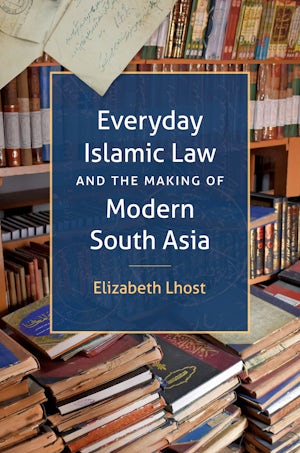
Lhost, "Everyday Islamic Law and the Making of Modern South Asia"

The University of North Carolina Press has published Everyday Islamic Law and the Making of Modern South Asia (2022) by Elizabeth Lhost (Dartmouth College). A description from the Press:

Beginning in the late eighteenth century, British rule transformed the relationship between law, society, and the state in South Asia. But qazis and muftis, alongside ordinary people without formal training in law, fought back as the colonial system in India sidelined Islamic legal experts. They petitioned the East India Company for employment, lobbied imperial legislators for recognition, and built robust institutions to serve their communities. By bringing legal debates into the public sphere, they resisted the colonial state’s authority over personal law and rejected legal codification by embracing flexibility and possibility. With postcards, letters, and telegrams, they made everyday Islamic law vibrant and resilient and challenged the hegemony of the Anglo-Indian legal system.

Following these developments from the beginning of the Raj through independence, Elizabeth Lhost rejects narratives of stagnation and decline to show how an unexpected coterie of scholars, practitioners, and ordinary individuals negotiated the contests and challenges of colonial legal change. The rich archive of unpublished fatwa files, qazi notebooks, and legal documents they left behind chronicles their efforts to make Islamic law relevant for everyday life, even beyond colonial courtrooms and the confines of family law. Lhost shows how ordinary Muslims shaped colonial legal life and how their diversity and difference have contributed to contemporary debates about religion, law, pluralism, and democracy in South Asia and beyond.

Advance praise:

“Opening a window on a virtually unexplored domain, Elizabeth Lhost foregrounds lawmaking in South Asian Islam as a process, providing a diachronic view of how the relationship between Muslim judges and the British state developed throughout the colonial period. Lhost also gives readers an unprecedented glimpse into the everyday lives of litigants, especially women, who attempted to use the law to better their lives. A landmark study of Islamic law in any time or period.”—Brannon Ingram

“Elizabeth Lhost draws on a remarkable and largely unexplored collection of archives, many of which require rare skill sets to interpret. The result is a lively, bottom-up perspective on everyday legal encounters. For historians and legal scholars alike, this book enriches our understanding of the ongoing importance of non-state legal forums and their complex interfaces with state courts and legislation.”—Julia Stephens

More information about the book is available here. An interview with Professor Lhost is available here, at New Books Network.

-- Karen Tani

Wednesday, March 1, 2023

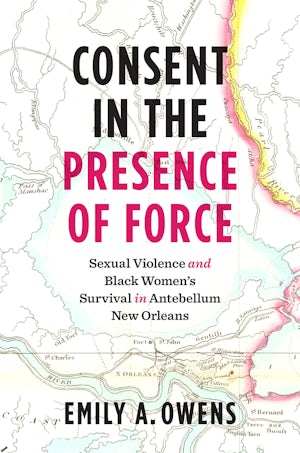
Owens, "Consent in the Presence of Force Sexual Violence and Black Women's Survival in Antebellum New Orleans"

The University of North Carolina press has published Consent in the Presence of Force
Sexual Violence and Black Women's Survival in Antebellum New Orleans
(2022), by Emily A. Owens (Brown University). A description from the Press: 

In histories of enslavement and in Black women's history, coercion looms large in any discussion of sex and sexuality. At a time when sexual violence against Black women was virtually unregulated—even normalized—a vast economy developed specifically to sell the sexual labor of Black women. In this vividly rendered book, Emily A. Owens wrestles with the question of why white men paid notoriously high prices to gain sexual access to the bodies of enslaved women to whom they already had legal and social access.

Owens centers the survival strategies and intellectual labor of Black women enslaved in New Orleans to unravel the culture of violence they endured, in which slaveholders obscured "the presence of force" with arrangements that included gifts and money. Owens's storytelling highlights that the classic formulation of rape law that requires "the presence of force" and "the absence of consent" to denote a crime was in fact a key legal fixture that packaged predation as pleasure and produced, rather than prevented, violence against Black women. Owens dramatically reorients our understanding of enslaved women's lives as well as of the nature of violence in the entire venture of racial slavery in the U.S. South. Unsettling the idea that consent is necessarily incompatible with structural and interpersonal violence, this history shows that when sex is understood as a transaction, women are imagined as responsible for their own violation.

Advance praise:

"In Consent in the Presence of Force, Owens exactingly demonstrates the gaping and lingering question in the historiography of gender and slavery—how do we read sexual relations between enslaved women and white men beyond the failing dichotomy of consent and coercion? This question has been raised, theorized, and analyzed without a satisfying resolution that approximates the actual legal, social, and affective conditions of female-gendered enslavement. Owens offers completely new ways to account for Black women's subtle, but not less violent, vulnerability to sexual danger in the antebellum South."—Marisa J. Fuentes

"A necessary and highly anticipated work that dramatically upends current conceptions of sexual violence. Owens has given us a book that both crucially advances the historical literature and supersedes that historiography with broader scholarly and political reverberations."—Sarah Haley

More information is available here. An interview with Professor Owens about the book is available here, at New Books Network.

-- Karen Tani

SCHS Event: Kalman on "FDR's Gambit"

Registration (here) closes at 5PM (ET) today for the Supreme Court Historical Society-sponsored event, a conversation with Professors Laura Kalman and Brad Snyder about Professor Kalman’s latest book, FDR’s Gambit: The Court Packing Fight and the Rise of Legal Liberalism.  It takes place via Zoom tomorrow, March 2, 2023 at 7:00 pm (ET).

--Dan Ernst

Tuesday, February 28, 2023

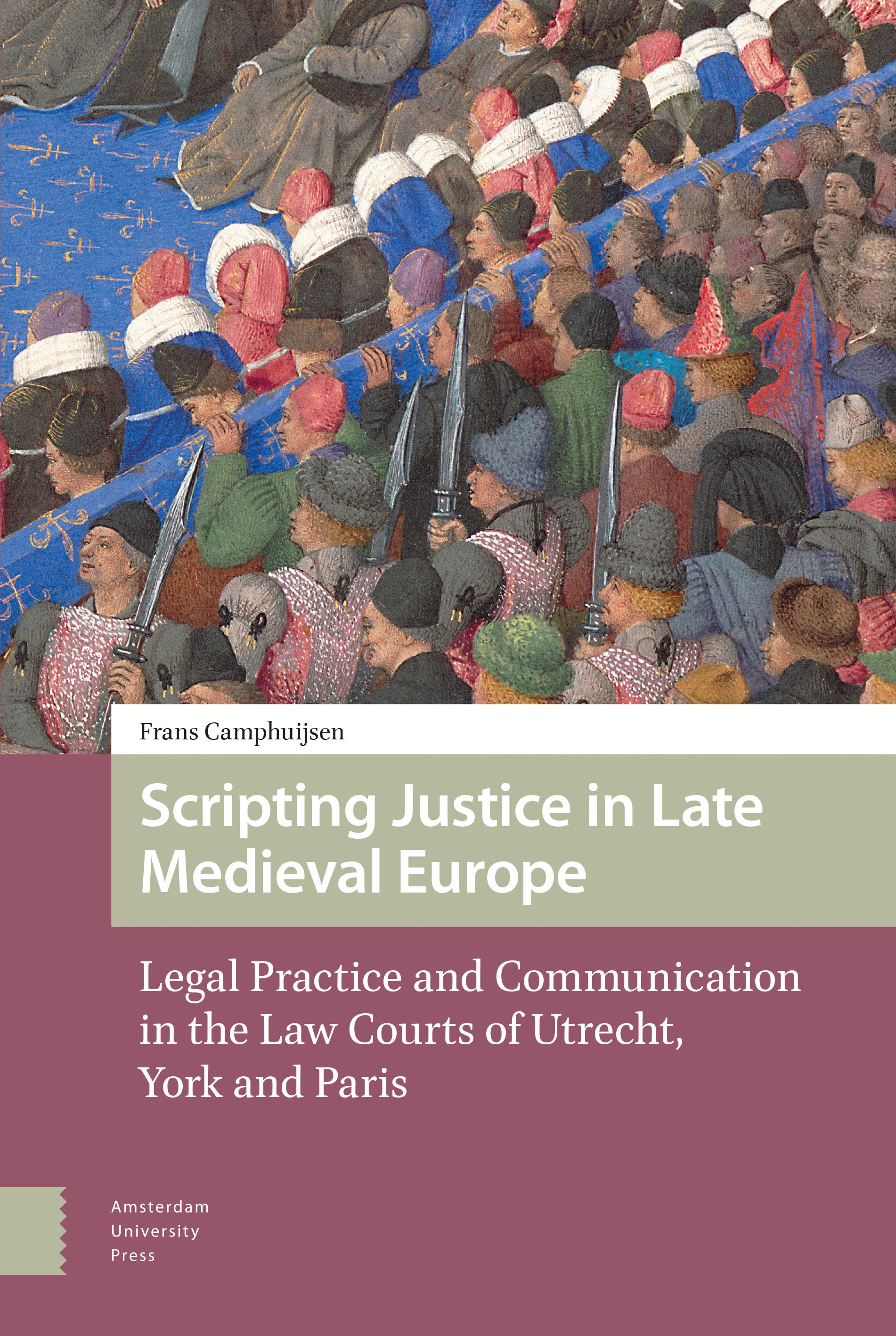
Camphuijsen, "Scripting Justice in Late Medieval Europe: Legal Practice and Communication in the Law Courts of Utrecht, York and Paris"

Amsterdam University Press has published Scripting Justice in Late Medieval Europe: Legal Practice and Communication in the Law Courts of Utrecht, York and Paris, by Frans Camphuijsen. A description from the Press:

Late medieval societies witnessed the emergence of a particular form of socio-legal practice and logic, focused on the law court and its legal process. In a context of legal pluralism, courts tried to carve out their own position by influencing people’s conception of what justice was and how one was supposed to achieve it. These “scripts of justice” took shape through a range of media, including texts, speech, embodied activities and the spaces used to perform all these. Looking beyond traditional historiographical narratives of state building or the professionalization of law, this book argues that the development of law courts was grounded in changing forms of multimedial interaction between those who sought justice and those who claimed to provide it. Through a comparative study of three markedly different types of courts, it involves both local contexts and broader developments in tracing the communication strategies of these late medieval claimants to socio-legal authority.

More information is available here. An interview with the author is available here, at New Books Network.

 -- Karen Tani

Thank You, Michael Ariens!

We're grateful to Michael Ariens for his posts this month on his new book, The Lawyer's Conscience.

Honor, Conscience, and Rules
The Zealous Rufus Choate
David Dudley Field and the Limits of Conscience
Lon L. Fuller and the 1969 ABA Code of Professional Responsibility
What's the Point of an Ethics Code?  The ABA's 1983 Model Rules
The Professionalism Crisis and Core Values

--Dan Ernst

Monday, February 27, 2023

Book Talk: Zhang's "Ideological Foundations of Qing Taxation"

[We have the following announcement.  DRE]

Please join the Lillian Goldman Law Library for a talk with Professor Taisu Zhang about his new book, The Ideological Foundations of Qing Taxation: Belief Systems, Politics, and Institutions, with commentary by Professor Samuel Moyn.  This event will take place on Thursday, March 9, at 12:10 PM in SLB 127.  Boxed lunch will be available for those who register here by March 7.  This book talk will be recorded and available to watch on the Law Library’s YouTube channel following the event.

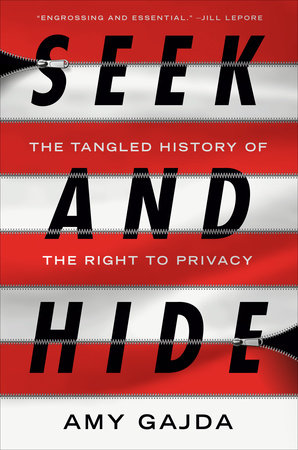
Gajda, "Seek and Hide: The Tangled History of the Right to Privacy"

We missed this book when it came out last year: Amy Gajda (Tulane Law School), Seek and Hide: The Tangled History of the Right to Privacy (Viking, 2022). A description from the Press:

Should everyone have privacy in their personal lives? Can privacy exist in a public place? Is there a right to be left alone even in the United States? You may be startled to realize that the original framers were sensitive to the importance of   privacy interests relating to sexuality and intimate life, but mostly just for powerful and privileged (and usually white) men. 

The battle between an individual’s right to privacy and the public’s right to know has been fought for centuries. The founders demanded privacy for all the wrong press-quashing reasons. Supreme Court jus­tice Louis Brandeis famously promoted First Amend­ment freedoms but argued strongly for privacy too; and presidents from Thomas Jefferson through Don­ald Trump confidently hid behind privacy despite intense public interest in their lives.  
 
Today privacy seems simultaneously under siege and surging. And that’s doubly dangerous, as legal expert Amy Gajda argues. Too little privacy leaves ordinary people vulnerable to those who deal in and publish soul-crushing secrets. Too much means the famous and infamous can cloak themselves in secrecy and dodge accountability.
Seek and Hide carries us from the very start, when privacy concepts first entered American law and society, to now, when the law al­lows a Silicon Valley titan to destroy a media site like Gawker out of spite. Muckraker Upton Sinclair, like Nellie Bly before him, pushed the envelope of privacy and propriety and then became a privacy advocate when journalists used the same techniques against him.  By the early 2000s we were on our way to today’s full-blown crisis in the digital age, worrying that smartphones, webcams, basement publishers, and the forever internet had erased the right to privacy completely.
Praise from reviewers:

“For anyone who mistakenly believes that the debate about press freedom and privacy is a twenty-first-century problem, Amy Gajda’s Seek and Hide is a reminder that ‘gotcha’ journalism, political sex scandals, and hand-wringing over new technologies date back to the Founding Era. In this gorgeously written, rollicking account of a very complicated, very Ameri­can history of the smackdown between privacy versus the right to know, Gajda offers indispensable and timely context for contemporary debates about the boundaries of both. Ultimately Seek and Hide also serves as a bracing reminder that the laws of privacy and politics are often shaped by self-interested parties with the most to gain and the most to hide.” -- Dahlia Lithwick 

“A magnificent book that shows us that the tension between the right to privacy and freedom of expres­sion is as old as this country yet as recent as social media and doorbell cameras. At a time when we all must be concerned about what it all means for each of us, Amy Gajda has written the definitive book about privacy and the right to know.”— Erwin Chemerinsky

An excerpt is available here, via the American Bar Association. An interview with Professor Gadja is available here, at New Books Network.

-- Karen Tani

Saturday, February 25, 2023

Weekend Roundup

  • John Mikhail, Georgetown Law, will deliver a Law Day lecture for the Supreme Court Historical Society on James Wilson and "We The People” on Tuesday, May 2, 2023 at Noon (ET) via Zoom.
  • John Witt on reanimating the modern Torts curriculum, collaborating with students, and writing legal history from the baseball field, as part of the Inside Yale Law School podcast.
  • The Policy History Conference in Columbus, Ohio from Wednesday, June 7 to Friday, June 9, 2023, has extended its paper and panel submission deadline to March 1, 2023.
  • Kevin M. Kruse and Julian E. Zelizer discuss Myth America: Historians Take On the Biggest Legends and Lies About Our Past on the ABA Journal’s Modern Law Library podcast.
  •  ICYMI: George Boyer Vashon, New York’s first Black lawyer (Law.com).  Elizabeth Jennings and the Desegregation of Public Transportation in New York City (Historical Society of the New York Courts).  Hidetaka Hirota, University of California, Berkeley, on the historical stigma of undocumented immigrants at Boston College (The Heights).

  Weekend Roundup is a weekly feature compiled by all the Legal History bloggers.

Friday, February 24, 2023

Schlag's "Twilight of the American State"

Pierre Schlag, Colorado Law, has published Twilight of the American State (University of Michigan Press) open access, at the press’s website and on Kindle:

The sudden emergence of the Trump nation surprised nearly everyone, including journalists, pundits, political consultants, and academics. When Trump won in 2016, his ascendancy was widely viewed as a fluke. Yet time showed it was instead the rise of a movement—angry, militant, revanchist, and unabashedly authoritarian.

How did this happen? Twilight of the American State offers a sweeping exploration of how law and legal institutions helped prepare the grounds for this rebellious movement. The controversial argument is that, viewed as a legal matter, the American state is not just a liberal democracy, as most Americans believe. Rather, the American state is composed of an uneasy and unstable combination of different versions of the state—liberal democratic, administered, neoliberal, and dissociative. Each of these versions arose through its own law and legal institutions. Each emerged at different times historically. Each was prompted by deficits in the prior versions. Each has survived displacement by succeeding versions. All remain active in the contemporary moment—creating the political-legal dysfunction America confronts today.

Pierre Schlag maps out a big picture view of the tribulations of the American state. The book abjures conventional academic frameworks, sets aside prescriptions for quick fixes, dispenses with lamentations about polarization, and bypasses historical celebrations of the American Spirit.
--Dan Ernst

Thursday, February 23, 2023

Freedom of Speech, 1500-1850

We missed the publication of Freedom of speech, 1500-1850, a collection of essays edited by Robert Ingram, Jason Peacey and Alex W. Barber appearing in the University of Manchester Press’s book series, Politics, Culture and Society in Early Modern Britain:

This collection brings together historians, political theorists and literary scholars to provide historical perspectives on the modern debate over freedom of speech, particularly the question of whether limitations might be necessary given religious pluralism and concerns about hate speech. It integrates religion into the history of free speech and rethinks what is sometimes regarded as a coherent tradition of more or less absolutist justifications for free expression. Contributors examine the aims and effectiveness of government policies, the sometimes contingent ways in which freedom of speech became a reality and a wide range of canonical and non-canonical texts in which contemporaries outlined their ideas and ideals. Overall, the book argues that while the period from 1500 to 1850 witnessed considerable change in terms of both ideas and practices, these were more or less distinct from those that characterise modern debates.
TOC after the jump.

--Dan Ernst.  H/t: RC

Armitage to Lecture on Opera and International Law

The Centre for Chinese and Comparative Law, City University of Hong Kong in partnership with Wuhan University School of Law and Fudan University School of Law announce the latest in its series of Distinguished Lectures in the History of International Law: What Has Opera To Do with International Law? by David Armitage, the Lloyd C. Blankfein Professor of History, Harvard University. It will take place via Zoom on March 27, 2023, at 9 pm Hong Kong Time, which is 2 pm London Time, 9 am Eastern Standard Time.  Register here.

--Dan Ernst

The Professionalism Crisis and Core Values

[Guest Blogger Michael S. Ariens's posts on his new book, The Lawyer's Conscience, continues.  DRE]

At its 1983 annual meeting, the ABA promoted a "Presidential Showcase" on the subject of the lawyer's professional independence. The panelists largely concluded that such independence was diminishing. The lawyer's desire for independence from clients was being replaced by "commercialism," the "basic posture of 'my client, first, last, and always.'" The triumph of the client's interests over the lawyer's duty to the public generated what was called the "professionalism" crisis. In his last column for the ABA Journal, President Morris Harrell inveighed against commercialism. He urged lawyers embrace professionalism, which he defined as "involv[ing] acceptance of high ethical standards, which generally include a dedication to public services for the benefit and protection of society that looks beyond the mere earning of a livelihood." The importance of the topic led the ABA to showcase another panel on lawyer independence at its 1984 annual meeting. In between those showcases, Chief Justice Warren Burger spoke to the ABA at its February 1984 Midyear meeting about a loss of professionalism. The ABA responded to Burger's speech by creating a Committee on Professionalism. That committee issued a Report, known as the Stanley Report, recommending a recovery from this loss.

In 1988, the ABA's Tort and Insurance Practice Section (TIPS) adopted a "Lawyer's Creed of Professionalism," At the same meeting the ABA agreed to send to its members a "Lawyers' Pledge of Professionalism." As of 1990, "forty-five states ha[d] issued formal reports on lawyer professionalism." The ABA and state bar associations were joined in the professionalism crusade by the Conference of Chief Justices, which issued a "National Action Plan" on professionalism in 1999.

These efforts (and others) emphasizing the lawyer's duty to meet the tenets of professionalism were spurred by fears of economic insecurity and decline. The lawyer income premium over the median worker dropped significantly. Lawyers in private practice were "sorted" into those representing individuals and those representing corporations and other organizations. They were further sorted as legal specialization narrowed more finely the work of lawyers. With the notable exception of some personal injury lawyers, the income of those who ordinarily represented individuals stalled. The income of lawyers who represented organizations increased, but remaining a well-paid member of firm serving corporations became less secure for those other than "rainmakers" (a newly-coined term). Additionally, elite lawyers regularly wrote bemoaning the consequences of "rapid change" in technology and society, which generated an anxiousness regarding their status.

The professionalism crisis has arguably continued through the present. At the very least, it lasted until the turn of the millennium. In a 2015 count, 123 courts and lawyer organizations had adopted a civility or professionalism creed. If lawyers truly faced a professionalism crisis, the organizational adoption of creeds was a useful but insufficient response. An additional response began during the late 1990s. The ABA looked to identify the professional ideals all (or at least many) lawyers acknowledged. What were the profession's "core values"?

Although today the phrase "core values" is commonly used by private organizations, universities, and other institutions, particularly when an employee is charged with behaving contrary the employer's values, the phrase was not used within the legal profession until the publication in 1990 of an article titled The Future of the Legal Profession, written by Geoffrey Hazard, the most prominent American legal ethics expert of the era. Soon after Hazard's article was published, an important ABA Task Force listed four "fundamental values of the profession," which both overlapped and underdetermined such values.

At the end of the decade, two issues brought the question of core values back to the forefront of the ABA's work. First, the American Institute of Certified Public Accountants announced its intention to adopt a "vision statement" encouraging accountants to undertake work lawyers believed was in their domain. This led to a committee to assess whether law firms should be permitted to offer multidisciplinary practice, services that included both law and non-legal services in an institution owned by lawyers and non-lawyers alike. Second, the ABA created a committee to review the 1983 Model Rules and suggest amendments.

The ABA eventually rejected a proposal by the Multidisciplinary Practice Commission, which included the influential Hazard as a member, to permit multidisciplinary practice. It did so even though the Commission declared its recommendation fully protected the "core values of the legal profession." In 2001, the committee reviewing the Model Rules proposed two major amendments permitting a lawyer to disclose a client's confidential communication. The proposal was defeated after its opponents claimed they were the steadfast defenders of the profession's core values.

By early 2002, Enron and other high-flying businesses were bankrupt, and the ABA was engaged in damage control. It had created a Task Force to reassess the circumstances in which a lawyer might disclose a client's confidential communication. When the ABA debated in 2003 the proposed adoption of rules killed in 2001, proponents and opponents used the language of core values in attempting to persuade the undecided. This included comments made by two future ABA presidents, who voiced opposing views. Though they disagreed, both agreed that their position best protected the core values of the profession. Core values was an empty vessel, sufficiently capacious to store whatever struck a lawyer's fancy.

Wednesday, February 22, 2023

Barbas's "Actual Malice"

Just in time to rally support for its subject, Samantha Barbas, Buffalo Law, has published Actual Malice: Civil Rights and Freedom of the Press in New York Times v. Sullivan (University of California Press).  

Actual Malice tells the full story of New York Times v. Sullivan, the dramatic case that grew out of segregationists' attempts to quash reporting on the civil rights movement. In its landmark 1964 decision, the Supreme Court held that a public official must prove "actual malice" or reckless disregard of the truth to win a libel lawsuit, providing critical protections for free speech and freedom of the press.

Drawing on previously unexplored sources, including the archives of the New York Times Company and civil rights leaders, Samantha Barbas tracks the saga behind one of the most important First Amendment rulings in history. She situates the case within the turbulent 1960s and the history of the press, alongside striking portraits of the lawyers, officials, judges, activists, editors, and journalists who brought and defended the case. As the Sullivan doctrine faces growing controversy, Actual Malice reminds us of the stakes of the case that shaped American reporting and public discourse as we know it.

Today's notice in the NYT is here.

--Dan Ernst

Irish Legal History Student Essay Prize

[We have the following announcement.  DRE.]

The Irish Legal History Society is now accepting entries for its second student-essay competition.  Essays on any period of Irish legal history should submitted by the end of May 2023.  The winning entrant will receive a prize of €250.  The competition is open to under-graduate and post-graduate students.

Essays must be written in English, and be the work of students who are enrolled in a third-level institution in Ireland or abroad, or within a one-year expiration of that enrolment.  Essays must be no longer than 5,000 words – including all references.

The inaugural competition was won jointly by Jessica Commins (UCD/Amsterdam) and Andrew Byrne Keefe (TCD/Harvard).

Founded in 1988, the society examines, explores, and engages with all issues relating to legal history on the island of Ireland, from earliest times to the present day – including the work of Irish lawyers abroad.  Its mission is to encourage the study of, and advance the knowledge of, the history of Irish law.

Tuesday, February 21, 2023

What's the Point of an Ethics Code? The ABA's 1983 Model Rules

[Guest Blogger Michael S. Ariens's posts on his new book, The Lawyer's Conscience, continues.  DRE]

In 1977, when the ABA began another evaluation of ethical standards, the American legal profession was still reeling from the effects of the Watergate scandal, the increasing entry of baby boomers into the profession, and a concomitant fall in real income. The effect of Watergate on lawyers may have been best encapsulated by the uproarious laughter by the audience when disgraced White House counsel John Dean mused to a congressional committee (a hearing nationally televised) that "there certainly are an awful lot of lawyers involved" in criminal behavior related to Watergate. In an inflationary era, with lawyer supply rising every year, real median income would fall 21% during the 1970s. The public's perception of lawyers was poor, and the economic prospects of lawyers was declared "grim" in a 1972 Business Week article. The proposed (partial) solution to these troubles was to re-think standards of lawyer conduct.

The Kutak Commission (named for its chair, ABA insider Robert Kutak) charged with this task had two options: It could follow the alleged ethos of the 1969 Code, what the Kutak Commission's Reporter Geoffrey C. Hazard, Jr. called the "basic posture of 'my client, first, last and always,' [which] allowed little room for development of the attorney's role as an officer of the court." The other approach was to emphasize the "theme" of "lawyer autonomy," the lawyer as social trustee, as one who represented private clients as well as a "determinable public interest."

The breadth of the Kutak Commission's perceived mandate was made clear at a 1977 meeting of its members The unattributed comment of one member asserted, "[O]ur Committee ought not to hesitate to promulgate statements of ethics it believes to be correct but which may not meet with the general approval of the Bar." It was unclear how that member thought the Commission's proposals would be approved by the very "Bar" that apparently disapproved. 

One consequence of Watergate was the view that sunlight was always the best disinfectant. Consequently, when Kutak sent a working draft to some interested ABA members ahead of its 1979 annual meeting, critics assailed the Commission for making only a limited release. Then they picked apart provisions of the working draft, though Kutak had emphasized that none of the provisions had been approved by the Commission, and the draft included "portions with which a majority disagree." A discussion draft was released by the Commission in early 1980. This draft emphasized that "lawyers are responsible to demands beyond those of their immediate clients."

Many who opposed the discussion draft rejected the Commission's rejection of the "basic posture." They equated the lawyer's duty to client and duty to the legal system. Relatedly, some critics considered duty to client and duty to the public interest as a zero-sum game. Thus, any duty to the public interest undermined the lawyer's duty to serve one's clients.

By the time the proposed final draft was released in May 1981, it had largely capitulated. Few references to "fairness" and to a duty to serve a determinable public interest remained. However, Kutak's introduction to this draft was steadfast in maintaining a lawyer was both a representative of a client and an officer of the court or of the legal system. Another year had passed when the final draft was sent to ABA leaders for discussion and vote at it 1982 annual meeting. The Commission portrayed the final draft as offering only a modest reform, shorn of all radical proposals. Nearly all references to the lawyer's duty to the public has disappeared, and the Commission's Report argued its rules "work[ed] no such shift in the profession's values."

Despite declaring defeat, the Commission's work was roundly criticized by the victors. The discussion in the House of Delegates in August 1982 was a disaster for the Commission. After lengthy debate, only one rule was adopted. When the ABA's Midyear Meeting rolled around in February 1983, Robert Kutak was dead from a heart attack, and the opponents of the Model Rules had filed 216 proposed amendments. The debate in the House of Delegates unveiled only extraordinary disagreement among lawyers about the social role of lawyers. An informal meeting of the disputants led to resolution, and the Model Rules of Professional Conduct were adopted by the ABA at its August 1983 meeting.

Even then, one delegate who may not have gotten the message proposed striking the following sentence from the hortatory Introduction: "Thus, when an opposing party is well represented, a lawyer can be a zealous advocate on behalf of a client and at the same time assume that justice is being done." The delegate believed that any statement indicating a lawyer might look beyond the client's immediate interest was unsupportable. The proposed amendment failed, but the idea animating it had taken hold.

The Model Rules ignored ethical considerations; the Rules were about rules, standards below which no lawyer was to act. The inward turn of lawyers was complete; no lawyer was bound (or even encouraged) to inquire into any determinable public interest. Yet somehow bar leaders were surprised when lawyers, after adoption of the Model Rules, looked "at nothing but the rules."

Monday, February 20, 2023

Roberts on Labor Control and Development in the British Empire

Christopher M. Roberts, Chinese University of Hong Kong Faculty of Law, has posted Labor Control, Resistance, and the Advent of "Development": Modalities of Governance in the British Empire, C. 1926-1940, which is forthcoming in the Minnesota Journal of International Law:

This article examines the manner in which a new approach to governance, that of ‘development,’ evolved within the British Empire over the course of the late 1920s and 1930s. Throughout the period in question, and in continuity with previous periods, the British governed their empire through a range of coercive measures designed to control the population and compel their labor. Measures adopted and frequently relied upon included the delegation of police powers to private authorities, restrictive and extractive tax, movement and labor laws, recourse to forced labor, increasing reliance on militarized police, and growth in the intelligence services. Over the course of the 1930s protests broke out in numerous territories, both in opposition to British governance as a whole and in support of better conditions of work. These protests were threatening both in their own right and insofar as they made the empire susceptible to criticism by other great powers. In response, British colonial authorities adopted a new policy approach, under the heading of ‘development.’ While this new approach was in part sincerely motivated, the vision of ‘development’ adopted was also profoundly limited.
--Dan Ernst

Zhang's "Ideological Foundations of Qing Taxation"

Taisu Zhang, Yale Law School, has published The Ideological Foundations of Qing Taxation: Belief Systems, Politics, and Institutions (Cambridge University Press):

How states develop the capacity to tax is a question of fundamental importance to political science, legal theory, economics, sociology, and history. Increasingly, scholars believe that China's relative economic decline in the 18th and 19th centuries was related to its weak fiscal institutions and limited revenue. This book argues that this fiscal weakness was fundamentally ideological in nature. Belief systems created through a confluence of traditional political ethics and the trauma of dynastic change imposed unusually deep and powerful constraints on fiscal policymaking and institutions throughout the final 250 years of China's imperial history. Through the Qing example, this book combs through several interaction dynamics between state institutions and ideologies. The latter shapes the former, but the former can also significantly reinforce the political durability of the latter. In addition to its historical analysis of ideological politics, this book makes a major contribution to the longstanding debate on Sino-European divergence.

Here are some encomia:

A theoretically elegant, evidence-rich, and innovative explanation for why imperial China declined and fell. The Ideological Foundations of Qing Taxation sheds light on the roots of the 'Great Divergence' in economic development between China and Europe. A tremendous achievement that deserves to be widely read.' Yuhua Wang, Professor of Government, Harvard University

'This book is a brilliant new take on comparative economic history. Skillfully integrating institutional analysis, economics, and political thought, Zhang provides us with an erudite, deeply learned account of the Qing's failure to expand tax capacity, drawing us into contemplation of a path not taken.' Tom Ginsburg, Leo Spitz Distinguished Service Professor of International Law, University of Chicago

'In this refreshing and incisive work, Taisu Zhang shows us how the weakness of the late Qing regime depended less on structural constraints than on a specific worldview about the proper role of the state. Low taxation was a deliberate choice, made in response to the presumed lessons of history, and it would have far-reaching implications. This will be of interest to anyone who wants to understand long trends in Chinese political development.' David Stasavage, Julius Silver Professor, New York University

'In this characteristically ambitious book, Taisu Zhang looks for obstacles on China's path to modernization in a surprising place: tax capacity. He explains the unwillingness of China's nineteenth-century rulers to raise taxes neither in terms of eternal cultural values nor structural factors, but rather as the outcome of a specific type of conservatism that can be explained historically.' Michael Szonyi, Frank Wen-hsiung Wu Professor of Chinese History, Harvard University

--Dan Ernst

Saturday, February 18, 2023

Weekend Roundup

  • Over at Environment, Law, and History, David Schorr has been blogging about his article on "Nature versus the Common Law." Here and here.
  • That Supreme Court Historical Society-sponsored lecture, "Frederick Douglass and African-American Claims to Constitutional Citizenship," by Bradley Rebeiro, Brigham Young University Law, is now viewable on YouTube.
  • Kurt Lash and Kermit Roosevelt discuss the Slaughterhouse Cases with Jeffrey Rosen on the National Constitution Center's podcast.
  • The new Editor-in-Chief of the Virginia Law Review has a shout-out to Cynthia Nicoletti for her legal history courses.
  • On February 27, 2023, from 4:00 - 5:00 p.m. ET, via YouTube Livestream, the Levin Center for Oversight and Democracy of Wayne State University Law School will host an interview of U.S. Representative Bennie Thompson “on his long and distinguished career in Congress and the important oversight work he has led culminating in his recent chairmanship of the U.S. House Select Committee to Investigate the January 6 Attack on the U.S. Capitol.”
  • In the Pittsburgh Post-Gazette, Ph.D. candidate Angus McLeod (University of Pennsylvania) offers a historian's take on the big school finance case recently decided in Pennsylvania.
  • ICYMI: Emily Bazelon on Bakke (NYT Magazine).  Allan Levine on “the tragic case of Pesach Rubenstein, sentenced to die in 1876 after a sensational murder trial” (The Tablet).  Originalism will kill women, says Madibe Dennie (The Atlantic).
Weekend Roundup is a weekly feature compiled by all the Legal History bloggers.

Friday, February 17, 2023

Gomez-Arostegui and Bottomley on 18th-C Patent Infringement Suits

Tomas Gomez-Arostegui, Lewis & Clark Law School, and Sean Bottomley, Northumbria University, have posted Patent-Infringement Suits and the Right to a Jury Trial, which is forthcoming in the American University Law Review:

This Article analyzes whether the Seventh Amendment affords a right to a jury trial in suits in which the owner of a patent seeks only equitable relief against an accused infringer. The existence of jury rights carries important consequences for litigants. Like many issues involving application of the Constitution, the availability and scope of the right to a jury depends on 18th-century English legal history. Current doctrine holds that litigants in equity had no right to a jury in patent cases in England c.1791 and that therefore litigants today who seek only injunctive relief possess no such right either. But as we demonstrate here, the relevant historical record shows the contrary, and thus many litigants have a constitutional right to a jury where the courts presently deny them. We reach our conclusion after undertaking the most comprehensive treatment of the subject to date, which includes marshaling hundreds of 18th-century records (mostly in manuscript) from the National Archives of the U.K. and elsewhere.
--Dan Ernst

Thursday, February 16, 2023

Lon L. Fuller and the 1969 ABA Code of Professional Responsibility

[Guest Blogger Michael S. Ariens's posts on his new book, The Lawyer's Conscience, continues.  DRE]

It is a mystery why the ABA agreed in the early 1950s to let its unauthorized practice committee undertake an effort to investigate the professional responsibility of lawyers, and to do so jointly with a committee of the Association of American Law Schools (AALS). It's a further mystery why the ABA-AALS Joint Conference's final result was so popular with the ABA. Finally, it's a mystery why Harvard Law School Professor Lon L. Fuller decided to shoulder most of the Conference's work.

In mid-1954, Fuller, then an AALS member of the Joint Conference, wrote a "second revised draft" for the Joint Conference. He wrote in the aftermath of the televised Army-McCarthy hearings, which may account for the draft's focus on why lawyers engage in public service when representing unpopular clients. He received comments from members, was named joint chairman, and followed up with a May 2, 1955 "final draft" to the Joint Conference. Two years passed before Fuller's second final draft (October 1, 1957) was distributed. This draft included an expanded section on the role of the lawyer as courtroom advocate. This draft was published in the ABA Journal (December 1958) and the South Carolina Law Quarterly (Spring 1959).

Professional Responsibility: A Statement, begins with a call to the "special obligations" of those who claim membership in a profession. One aspect of the lawyer's special obligations was to consider, not merely the legal task at hand, but one's work in light of the "ideals" giving meaning to that work. Dedication to these ideals allowed the lawyer to "reconcile a fidelity to those he serves along with an equal fidelity to an office." Such dedication moved the lawyer beyond the concerns of self-interest. When lawyers recognized the important social role they played, they considered the reasons that supported the profession's ethical "restraints," not merely the restraints themselves.

The Joint Conference's focus on the legal profession's "ideals," purposes, and goals was unusual. The Statement avoided lapsing into mere platitudes. And its brevity allowed Fuller to ignore the mind-numbing discussions of the details regarding ethical "restraints." The Statement offered a positive message that the ordinary work of the ordinary lawyer was crucial to the functioning of a democratic society.

An ABA committee began working on a new code of professional responsibility in 1964. Fuller played no role in its deliberations or conclusions. However, the committee's reporter, John F. Sutton Jr., was an admirer of Fuller's work. A University of Texas law professor, Sutton had led a Texas effort to amend its code of ethics a few years earlier. As finally adopted by the ABA in 1969, the Code of Professional Responsibility consisted on nine "axiomatic" canons, followed by Ethical Considerations "aspirational in character," and Disciplinary Rules "mandatory in character." Sutton adapted Fuller's view (found in The Morality of the Law (1964)) that law comprised two moralities, one of aspiration and the other of duty, to the professional responsibilities of the lawyer, thus leading to Ethical Considerations and Disciplinary Rules. Sutton also relied on the Joint Conference's Statement when drafting the Code. The Statement was cited more than twenty times in the Code, more than any other reference.

The Code was adopted without amendment by the ABA House of Delegates in August 1969. In less than three years it was adopted as law in forty-three states and the District of Columbia, ordinarily with few changes. (An additional four state bar associations adopted it as applicable to their members.) And by 1977, the ABA Code of Professional Responsibility was attacked in the ABA Journal as jejune, a mere "transitional document representing a middle stage in the development of a law for lawyers." This was appellation was particularly directed toward the Ethical Considerations, initially understood as the heart of the Code. The Code, as Sutton knew better than anyone, had some major problems, including a bias for some traditional ethical rules that Sutton decried as "at worst obstreperous and obstructionistic." But the die had been cast. The ABA had decided to embark on another effort to re-state the ethical constraints binding the actions of lawyers. The debates on these Model Rules of Professional Conduct exposed a yawning divide among lawyers.

JACH 1:1

The inaugural (Winter 2023) issue of the Journal of American Constitutional History, published by the University of Wisconsin Law School, whose David S. Schwartz is Editor-in-Chief, is now live.  

The Soul of a Free Government: The Influence of John Adams’s A Defence on the Constitutional Convention by Mary Sarah Bilder

Contrary to the conventional modern view, John Adams’s A Defence of the Constitutions of Government of the United States of America (1787) was deeply influential on the Constitutional Convention.
“Not a Lawyer’s Contract:” Reflections on FDR’s Constitution Day Address by Gerard N. Magliocca
Franklin Roosevelt’s oration marking the sesquicentennial of the Constitution’s proposal is the most profound discussion of our founding document by a modern president.
The Public Defender Movement in the Age of Mass Incarceration: Georgia’s Experience by Robert L. Tsai
Focusing on the efforts of the Southern Center for Human Rights, this article offers a grassroots history of the creation of the first statewide public defender in the State of Georgia in 2003.

--Dan Ernst