Monday, March 15, 2010
this week
If you happen to be in Leicester, hope to see you later today. (The paper for my lecture is here.) Otherwise, apologies, dear reader. It will be a light week.


Metger on Smith's Historical Jurisprudence
Ernest Metzger, University of Glasgow School of Law, has posted Adam Smith's Historical Jurisprudence and the 'Method of the Civilians,” which was originally given at the “Smith in Glasgow" Conference, University of Glasgow, March 31-April 2, 2009. Here is the abstract:
Image creditAdam Smith lectured in jurisprudence at the University of Glasgow from 1751 to 1764, and various records of these lectures survive. Since Smith never completed a treatise on law, these records are the principal source for his theory of lawmaking. In his final year at Glasgow, Smith undertook to reorganize the course of lectures: he began with a series of lectures on “forms of government,” where formerly these lectures had fallen at the very end. He explained that his reorganized lectures followed the method of the civilians (i.e., contemporary writers on Roman law), and that this method was to be preferred.
This paper discusses Smith’s theory of lawmaking and seeks to explain why he undertook to reorganize his lectures. Some scholars have argued that Smith had a substantive reason for his decision, i.e., that the change was demanded by his developing theory of law. This paper, to the contrary, argues that his decision was far more innocent. He had occasionally sought to explain how certain laws came about by reference to the “ages of society.” This is the theory that societies tend to present themselves under the model of one of four ages, each age identifiable by a certain mode of subsistence. This “stadial theory,” however, though adequate to explain the genesis of a handful of rights, was inadequate to explain the genesis of most laws. For the latter, Smith used a more immediate cause: form of government. Yet exposition of this thesis was difficult when the lectures on government were postponed to the end. Smith’s decision to reorganize the course of lectures helped to cure the problem.
The method of the civilians, whom Smith claims to be following, is the method of contemporary institutional literature. Civilian works that were written to follow the order of Justinian’s Institutes began, as the Institutes began, with a discussion of government.

Sunday, March 14, 2010
How to write an article this summer
Jacqueline Lipton started a discussion at the Faculty Lounge about summer writing strategies. I offered a couple of suggestions, and thought I'd repost  here in case they are of help.
here in case they are of help.Here are two different ideas about writing, since not all writers are the same:
First is the 1000 words a day idea, which I've seen other writers use extremely well. When I was at the Rockefeller Center in Bellagio, one colleague sat at her desk every morning after breakfast, and stayed there until the 1000 words were done. How long that took varied. But sometimes she was finished in the early afternoon, and then she took the afternoon off, and had more time for strolls along Lake Como than I did, with my less disciplined/more erratic approach to writing. If the 1000-words-a-day approach fits you as a writer, I highly recommend it.
So what's an alternative? An approach based on time and space, rather than quantity of words. Pick a time of day that is your writing time. Spend that time in a space that is reserved for writing. You go to your space at the designated time, and then all you can do is write. No phone, no email, nothing else. If you're at your office, put a "do not disturb/available after __ p.m." sign on your door. You might feel that you should spend 8 hours a day doing nothing but writing, but that is unrealistic (unrealistic for every day, as compared w/ days when the momentum is going, and you can't seem to stop). To really protect that time, it might need to be 2-3 hours. If you need to make a lot of progress in a short time, perhaps schedule two writing blocks during a day. But I think you'll find that if you actually spend 2-3 solid hours writing every day, with no email and nothing but writing, you will have an article by the end of the summer. (The revision/reading/research go on at other times. It's easier to go back & forth between revisions and email than between writing and various distractions.)
I am a rather erratic writer: some days there are pages, other days if I end up with one really good sentence, that's all I can show for it. On those days I may write many paragraphs and then delete them in disgust. But luckily for me, projects seem to gather momentum, and then I get swept into the writing. I forget to stop for a meal, and will look up from the page at 2 a.m., wondering how it got to be so late. If you're that kind of writer, the problem is that you can't plan momentum (in the way that you can plan 1000 words a day). So you have to create conditions that might lead to it. A regular writing time & place might help you get there.
Good luck to all this summer!
Saturday, March 13, 2010
Levin on Haley on Japanese Legal History
Mark Levin, William S. Richardson School of Law, University of Hawai'i at Ma-noa, has posted Continuities of Legal Consciousness: Professor John Haley’s Writings On Twelve Hundred Years of Japanese Legal History. Here’s the abstract:
In Authority Without Power: Law and the Japanese Paradox, Professor John Haley stated, “One cannot understand the present without an appreciation of the past and the role of present perceptions of that past. To appreciate the historical dynamics of Japan’s legal tradition is vital both to comprehend more fully the present as well as to predict more accurately the future.”
Working from Professor Haley’s division of the historical process into four major temporal elements — Nara, Kamakura, Tokugawa, and Meiji, this review piece analyzes how aspects of the historical puzzle are evidenced in Japanese legal dynamics today and assessing what we may be able to imagine coming in Japan’s future.

A Student's View of Prosser's Torts, 1938-39
 [I'm moving up this post, which originally appeared in January 2009, because an updated version of Professor Robinette's article, forthcoming in the University of Illinois Law Review, is now available, here. And, while I’m at it, I’ll note that Neil M. Richards, Washington University School of Law in St. Louis and Daniel J. Solove, George Washington University Law School have just posted Prosser's Privacy Law: A Mixed Legacy, forthcoming in California Law Review, Vol. 98, 2010 ]
As a sometime user of student notebooks--it happens that I'm about to add a citation to Carl McFarland's notes on Felix Frankfurter's administrative law seminar in the 1931-32 academic year to a paper of mine--I was intrigued with the post on the SSRN paper by Christopher J. Robinette, Widener University School of Law, The Prosser Notebook: Classroom as Biography and Intellectual History, which I first saw on Legal Theory Blog. (Professor Solum also noted that Robinette blogs on the notebook here.)
I know that some law libraries actively collect student notes on the classes the more illustrious and departed members of their faculties. See Karen S. Beck's "One Step at a Time: The Research Value of Law Student Notebooks,” Law Library Journal 91 (Winter 1999): 29-138. I’d be pleased if readers would add their favorite examples in the comments. How many readers have an ancestor's notebooks on legal classes moldering in an attic? (For the record, I have my paternal grandfather's for the University of Iowa in the 1920s and my father's for the University of Michigan in the 1950s.)
Here's the abstract for Professor Robinette's paper:
When a former student offered to let me see his grandfather's Torts notebook, I was intrigued. The 70-year-old black notebook has developed a patina, but is in remarkably good condition. The sides have a lightly textured surface. The spine, not damaged by cracks, has several small gold stripes running across it. The notebook belonged to a first-year law student named Leroy S. Merrifield during the 1938-39 academic year at the University of Minnesota Law School. Merrifield used it to record notes during his Torts class. His professor was William Prosser.
Because Prosser's papers likely have been destroyed, Merrifield's notebook offers a unique "behind the scenes" look at Prosser during a very significant period in his professional development. During 1938-39, Prosser was finishing a draft of the first edition of Prosser on Torts, the most influential treatise ever published on tort law. Furthermore, Prosser's article legitimizing intentional infliction of emotional distress as an independent tort appeared in the spring of 1939. In addition to insights into these particular projects, the notebook allows a better understanding of Prosser's place in the intellectual history of twentieth century legal theory. Prosser's 1938-39 Torts class took place at the height of the realist influence in the academy. The notebook demonstrates Prosser's realism in the classroom, as well as his connection to the two major consequentialist torts rationales of the twentieth century: compensation and deterrence. In short, the notebook sheds light on both the origins and the content of one of the law's most influential thinkers.
This Article accomplishes three things. First, with no biography available on Prosser, the Article provides an account of his life, drawn heavily from archival research. Second, the Article presents new details of several of Prosser's seminal accomplishments. Third, the Article helps situate Prosser in the jurisprudential development of law in the twentieth century.
Friday, March 12, 2010
Thomas G. Barnes has died
I'm sorry to report the death of legal historian Thomas G. Barnes of t he University of California, Berkeley. The author or editor of eight books, Professor Barnes was a member of the American Society for Legal History, the Royal Historical Society of England and the Selden Society. He was also the editor of the Gryphon Legal Classics Library. He served as co-chair of UC Berkeley's Canadian Studies Program, and he served as the director for the ABA Anglo-American Legal History Project from 1965 to 1986.
From the Daily Californian:
A tribute to Barnes is Law and authority in early modern England: essays presented to Thomas Garden Barnes (2007).
From the Daily Californian:
Professor Barnes is remembered warmly by his former student, Dean C. Rowan, Director, Reference & Research Services, University of California, Berkeley, Law Library:UC Berkeley history and law professor emeritus Thomas Garden Barnes, who was known as an erudite academe of English, French, American and Canadian law and history, died Tuesday. He was 80.
Born April 29, 1930, Barnes graduated Magna Cum Laude from Harvard University in 1952, and went on to receive his doctorate in history at Oxford University three years later.
Barnes began teaching history and law at UC Berkeley in 1960 and retired in 2005 after 45 years of service. He was named a professor of history and law emeritus in January 2006, and i
s considered one of the leading historians of legal history in the 17th century, according to Roger Hahn, a campus history professor emeritus and long-time colleague of Barnes...
Sheldon Rothblatt, a professor emeritus of history and long-time colleague, said Barnes was devoted to the campus and students...
In 1982, Barnes co-founded the campus Canadian Studies Program, serving as co-director of the program from 2006 until his death....
Due to his support and dedication to the program, the Thomas Garden Barnes Endowed Chair was created in his honor in 2005.
Prof. Barnes was a warm, gregarious, funny man, whose enthusiasm for legal history was catching. I took his English Legal History seminar in 2003 or '04. It wBarnes' publications include The emergence of the European world, with Jerome Blum and Rondo E. Cameron, and Shaping the Common Law: From Glanvill to Hale, 1188-1688, .as attended by both law students and assorted specialists from elsewhere on campus. I remember a couple of medievalists, for instance, who didn't want to miss his lectures. During class, he was instructive but eager to promote discussion. Before and after class we'd chat about hedonic values, say, beverages. We learned that he liked a particular brand of dark rum and a particular variety of soda pop. So we presented him with both at the end of the semester. He made that sort of personal connection with the entire class. I wish I had spoken with him more often about his beloved Nova Scotia, where he will be interred. He was a lovely, happy person.
A tribute to Barnes is Law and authority in early modern England: essays presented to Thomas Garden Barnes (2007).
A Question of Rights: CFP deadline on Monday
The deadline is Monday, March 15, for submissions for the annual conference on rights in history, politics, and society, at San Francisco State University, noted here. This is an especially good opportunity for graduate students. And September is such a great time to be in San Francisco! (...actually, any time is a great time to be in San Francisco.) Hat tip: H-Law.
Tucker and Fudge on The Freedom to Stike in Canada
The Freedom to Strike in Canada: A Brief Legal History has just been posted by Eric Tucker, Your University, Osgoode Hall Law School, and Judy Fudge, University of Vic toria Faculty of Law. It is forthcoming in the Canadian Labour and Employment Law Journal. Here's the abstract:
toria Faculty of Law. It is forthcoming in the Canadian Labour and Employment Law Journal. Here's the abstract: In the B.C. Health Services Subsector case [2007] 2 S.C.R. 391, the Supreme Court Canada relied, in part, on the history of Canadian labour law to support the conclusion that collective bargaining was an activity that was protected under the freedom of association guaranteed by the Canadian Charter of Rights and Freedoms. Thus, it is likely that the Court will consider Canadian labour law history to determine whether or not constitutional protection also extends to the freedom to strike. The two principal purposes of this paper are: 1) to provide an analytic framework for approaching the history of the right to strike; and 2) to sketch out the contours of that history. First, we claim that it is only possible to understand the legal “right” to strike in the labour relations context in relation to the freedom to associate and the freedom to bargain collectively. Second, the paper draws upon W.N. Hohfeld’s typology of jural relations in order to analyze and to evaluate the rules that shape the legal relationships between individuals and social groups. Third, we map the complex and historically evolving legal relations governing the freedom of association, collective bargaining and striking during successive regimes of industrial legality in Canada.Image: Meat cutters union strike, 1937.
Thursday, March 11, 2010
Call for Papers: Cold War Cultures
COLD WAR CULTURES
Transnational and Interdisciplinary Perspectives
Conference at the University of Texas at Austin
September 30 - October 3, 2010
Transnational and Interdisciplinary Perspectives
Conference at the University of Texas at Austin
September 30 - October 3, 2010
Submission Deadline: April 1, 2010
If war is the continuation of politics by other means, then Cold War politics can be seen as a continuation of war by other means. This interdisciplinary conference seeks to explore these means in the context of global encounters between states and "Blocs" as well as engagements with "East" and "West." Indeed, after the end of the Second World War, a new kind of "war" continued and expanded as governments and/or interest groups created and continually reshaped institutions, media, popular culture, and various elements of social and political life. Globally, these broad-based transformations took place in the shadow of Cold War politics, especially as expressed through rhetoric of threat and mutual annihilation. In particular, cultural phenomena shaped by Cold War power conflicts take on myriad forms in a host of geographic contexts, both in and outside the Bloc, from iconic public representations to distinctive media advertising, memorable political speeches, world expositions, spy novels and films, and a plethora of official and popular modes of expression. In some places, of course, military or paramilitary conflagrations translated Cold War politics into "hot" wars, which further fueled the fire of Cold War imaginations.
We invite proposals for individual 20-minute papers that explore any geographic area or disciplinary field of Cold War studies, as well as contributions that might engage the notion the of "Cold War" theoretically. Full panels of three papers may also be proposed (however, please submit all papers and biographies for full panels together in a single email).
SUBMISSIONS
- Deadline: April 1, 2010
- Submit your abstract of 150-200 words in an email (no attachments) to coldwarcultures@gmail.com.
- Put "ABSTRACT: Cold War Conference" in the subject line of the email.
- Include a brief biographical statement (max. 150 words) in the email.
POSSIBLE PAPER & PANEL TOPICS include, but are not limited to:
- Material and consumer cultures
- Popular culture and everyday life
- Borders, walls, and the Iron Curtain
- Surveillance, torture and show trials
- Literature, music, art and architecture, film and other media
- The space and arms races
- Commodities, trade and the environment
- Cold War client states, arms dealing and proxy wars
- Spies and intelligence communities (in fact or fiction)
- Dissidents and defections
- "Neutral" sites, nonalignment, and the intersection of North-South and East-West dynamics
- International institutions and Trans-national networks
For more information, consult the conference website at www.coldwarcultures.org OR contact the organizing committee at coldwarcultures@gmail.com.
Hat tip: H-Law.
Historic American Newspapers
Check out Chronicling America, the Library of Congress's on-line collection of historic American newspapers. According to the Library:
Chronicling America is a Website providing access to information about historic newspapers and select digitized newspaper pages, and is produced by the National Digital Newspaper Program (NDNP). NDNP, a partnership between the National Endowment for the Humanities (NEH) and the Library of Congress (LC), is a long-term effort to develop an Internet-based, searchable database of U.S. newspapers with descriptive information and select digitization of historic pages. Supported by NEH, this rich digital resource will be developed and permanently maintained at the Library of Congress. An NEH award program will fund the contribution of content from, eventually, all U.S. states and territories. More information on program guidelines, participation, and technical information can be found here or here.

Wednesday, March 10, 2010
Deer on Sex Trafficking of Native Women in the United States
Relocation Revisited: Sex Trafficking of Native Women in the United States has just been posted by Sarah Deer, William Mitchell College of Law and Tribal Law and Policy Institute. It appears in the William Mitchell Law Review (2010). Here's the abstract:
The Trafficking Victim Protection Act of 2000 (TVPA) signaled a comprehensive campaign by the United States (US) government to address the scourge of human trafficking in the US and abroad. The US rhetoric about sex trafficking suggests that the problem originates in foreign countries and/or is recent problem. Neither claim is correct. This article details the historical and legal context of sex trafficking from its origin among the colonial predecessors of the US and documents the commercial trafficking of Native women over several centuries. Native women have experienced generations of enslavement, exploitation, exportation, and relocation. Human trafficking is not just a problem of poor, underdeveloped nations but an ongoing issue in the US and Canada that ties into the growth of the sex industry in these nations, where Native women are significantly overrepresented.
Seidman on the Ninth Amendment and the Impossibility of Textualism
Originalists take heed! My colleague Louis Michael Seidman, Georgetown University Law Center, has posted Our Unsettled Ninth Amendment: An Essay on Unenumerated Rights and the Impossibility of Textualism. Here's the abstract:
The Ninth Amendment - our resident anarchic and sarcastic "constitutional jester" - mocks the effort of scholars and judges alike to tame and normalize constitutional law. It is not as if the stern disciplinarians haven't tried. We now have two generations worth of painstaking, erudite, and occasionally brilliant scholarship that attempts to rein it in. Yet the amendment stubbornly resists control. It stands as a paradoxical, textual monument to the impossibility of textualism, an entrenched, settled instantiation of the inevitability of unsettlement. If it did not exist, constitutional skeptics would have had to invent it.
This essay has two parts. In Part I, I present a new and, I hope, persuasive, originalist account of the Ninth Amendment. My claim is that the Amendment deliberately leaves unsettled the status of unenumerated rights. Because of the Ninth Amendment, the Constitution does not "deny" or "disparage" these rights, but neither does it embrace or imply them. The amendment puts off to another day a final reckoning of the extent to which we are bound by constitutional text.
Although I use originalist methodology in Part I, I do not want to be understood as embracing originalism. Instead, this Part is an exercise in internal critique. As Part II explains, the Ninth Amendment states a truth that we would have to deal with whether or not it was part of the original text: No matter how comprehensive, no text can control the force of ideas and commitments that lie outside the text. This simple truth leaves the status of liberal constitutionalism permanently and inevitably unsettled. The day of final reckoning will never arrive.
Stein on tenBroek's "Right to Live in the World"
Michael Stein, William and Mary Law School, has posted Jacobus tenBroek, Participatory Justice, and the UN Convention on the Rights of Persons with Disabilities, which was published in the Texas Journal on Civil Liberties & Civil Rights 13 (2008): 167. Here's the abstract:
Image credit.Writing with prescience, Professor Jacobus tenBroek eloquently argued mid-century on behalf of participatory justice for individuals with disabilities. Nothing “could be more essential to personality, social existence, [and] economic opportunity” he determined, “than the physical capacity, the public approval, and the legal right to be abroad in the land.” Some fifty years later, Professor tenBroek’s “right to live in the world” -- the ability of persons with disabilities to have equally meaningful contact with the population at large -- became a central feature of the values underlying the United Nations Convention on the Rights of Persons with Disabilities (hereinafter CRPD, or Convention), the first human rights treaty of the twenty-first century. Accordingly, this Article explores the extent and manner that participatory justice animates the CRPD, first as a general matter and then specifically in reference to Article 30, the provision governing the obligations of State Parties to “[p]articipation in cultural life, recreation, leisure and sport.”
Part I sets forth Professor tenBroek’s jurisprudence in regard to participatory justice. Next, Part II highlights aspects of the Convention that are especially notable for their substantive and procedural inclusion of persons with disabilities and reflective of a deeply participatory model of justice that is consistent with Professor tenBroek’s vision. Part III illustrates these assertions by focusing on CRPD Article 30 and its mandate for inclusive cultural life, recreation, leisure and sport, and explains that provision’s practical significance for the worldwide community of persons with disabilities. We conclude with a few reflections on the Convention’s future impact as a vehicle for social change.

Tuesday, March 9, 2010
Dudziak to Deliver the American Studies Lecture at Leicester
[We have the following press release heralding Mary Dudziak's delivery of an annual lecture at the University of Leicester. The event is also sponsored by the U.S. Embassy in London.]
At the University of Leicester's Annual American Studies Lecture called 'Law, War, and the History of Time', Professor Mary L. Dudziak will look at the relationship between war and time to ask if we are already in a state of endless war.
War is often understood as a temporary state, but America's continuous involvement in military action overseas throughout the twentieth century challenges this notion. In her lecture, Professor Dudziak will examine differing legal interpretations of the end of wars in the United States. In particular, she will take World War Two as an example of a conflict that is commonly believed to have taken place for a clearly defined period of time, despite the fact that legal attempts to define the war's end cover a span of 7 years.
Lindsay on the Sovereignty, Security, and the Origins of the Federal Immigration Power
Immigration as Invasion: Sovereignty, Security, and the Origins of the Federal Immigration Power has been posted by Matthew J. Lindsay, University of Baltimore School of Law. It is forthcoming in the Harvard Civil Rights-Civil Liberties Law Review (Winter 2010). Here's the abstract:
This Article offers a new interpretation of the modern federal immigration power. At the end of the nineteenth century, the Supreme Court and Congress fundamentally transformed the federal government’s authority to regulate immigration, from a species of commercial regulation firmly grounded in Congress’ commerce authority, into a power that was unmoored from the Constitution, derived from the nation’s “inherent sovereignty,” and subject to extraordinary judicial deference. This framework, which is commonly referred to as the “plenary power doctrine,” has stood for more than a century as an anomaly within American public law. The principal legal and rhetorical rationale for the plenary power doctrine was and remains the supposition that the regulation of immigration is always inherently related to the conduct of foreign affairs, and, especially, to national security.
By situating this radical yet extremely durable doctrinal transformation within its appropriate intellectual and political context, this Article seeks to denaturalize the “national security rationale” for immigration exceptionalism. It argues that the plenary power doctrine was borne of an urgent sense of national peril, the basic terms of which most contemporary policymakers, judges, and scholars would emphatically reject. Although the doctrine made its judicial debut in the Chinese Exclusion Case, its historical origins in fact lie largely beyond Chinese exclusion in a much broader contemporaneous critique of (mostly European) immigration. The late nineteenth-century architects of the plenary power doctrine believed that the unchecked immigration of economically degraded, politically inassimilable, and racially unfit immigrants had created a virtual state of national emergency. In response, the Court fashioned an immigration power adapted not to the regulation of labor, or economic dependency, or crime - issues that, then as now, characterize most immigration lawmaking - but rather to the defense of the nation against foreign aggression.
Although the immigrants upon whom this power was exercised were citizens of ostensibly “friendly” nations, policymakers and judges re-imagined them as enemy aliens. Through this process, the Court in effect invented the “immigrant” as a distinct, and distinctly consequential, legal construct.
Florence Kelley's Letters, at the Woodrow Wilson Center
Kathryn Kish Sklar, SUNY Binghamton, and Beverly Wilson Palmer, Pomona College, present their edition of The Selected Letters of Florence Kelley, 1869-1931, on Wednesday, April 7, 2010, 3:00 – 5:00 p.m., at the 5th Floor Conference Room, Woodrow Wilson Center, 1300 Pennsylvania Avenue N.W., Washington, D.C. Sponsored by the Wilson Center's United States Studies Program and the National Consumers League, this is a free public event, but RSVPs are requested, to usstudies@wilsoncenter.org. Commentators are Kirsten Downey, Sally Greenberg, and Dorothy Ross. The Wilson Center explains:
Florence Kelley ran the National Consumers’ League from its founding in 1899 until her death in 1932 – Supreme Court Justice Felix Frankfurter said about Kelley that she probably had a greater impact on social reform than any other American in the first three decades of the 20th Century. Kelley helped lead the fight for the Pure Food and Drug Act of 1906, got enacted the first laws providing for an eight-hour workday and the minimum wage. An ally of W.E.B. Du Bois, she was a founding member of the National Association for the Advancement of Colored People. This volume collects nearly three hundred of Florence Kelley’s letters, embracing such topics as improved working conditions for women and children, efforts to combat race discrimination and the politics of equal rights versus special protections for working women. Please join us for a stimulating discussion of Florence Kelley’s lasting contributions to labor rights in the United States.

Monday, March 8, 2010
Literature and Law at John Jay
 On-line registration is now open for the Second Biennial Literature and Law Conference at the John Jay College of Criminal Justice, to be held on Friday April 16, 2010. The complete schedule and other information is here. Papers include:
Debra Jackson, Metropolitan Museum of Art, “Their Books Will Give Character to Their Laws: Antebellum Literature and Law in the Fight for Civil Equality”
R. B. Bernstein, New York Law School, “Enlightenment And Experiment In American Revolutionary Constitution-Making: The Cases Of John Adams And Thomas Paine”
Raffaele Ruggiero, University of Bari, "Enlightenment theories about the origin of criminal law in Italy"
Candace Barrington, Central Connecticut State University, "Legal Rhetoric in John Gower's Trentham Manuscript"
Daniel O'Gorman, Loyola University of Chicago,
"Memorialization or Ossification? Accumulating Earlier Law Codes in 11th-Century Anglo-Saxon England"
Karl B. Shoemaker, University of Wisconsin-Madison, "Sanctuary Law and a Strong Anglo-Saxon State?"
Sara McDougall, New York University School of Law, "Bigamy Stories from Medieval France"
Jamie L. McDaniel, Case Western Reserve University, “‘Her house was no longer hers entirely:’ Legal Classification and the Law of Intestacy in Virginia Woolf’s Orlando”
Katherine Gilbert, Drury University, “‘There is no private life which has not been determined by a wider public life:’ George Eliot’s Felix Holt (1866)”
Courtney Marshall, University of New Hampshire, “Law, Literature, and the Construction of a Black Female Subject: Zora Neale Hurston as Legal Storyteller”
Sascha Auerbach, University of Northern British Columbia, “‘Playing Hamlet in a Barn:’ Comedy, Tragedy, and Drama in the London Police Courts, 1890–1930”
Hat tip: H-Law
Williams on Bracton and "the 3 R's"
 The Institute of Advanced Legal Studies and the Institute of Historical Research, School of Advanced Study, University of London, and the London Legal History Seminar announces the session Bracton and the 3Rs in Early Modern Common law: Reading, Reception and Regicide, by Ian Williams, Faculty of Law, University College London. The session will be chaired by Professor Michael Lobban, Queen Mary, University of London. It will be held on Friday 19 March 2010, 5.30pm-7pm, at the Institute of Advanced Legal Studies, 17 Russell Square, London WC1B 5DR. Admission is free to this open event, but RSVP to Belinda Crothers, IALS.Events@sas.ac.uk
Image Credit: Bracton On-Line
Leeson on Ordeals: An Update
[I'm moving up this post from January to note that the University of Chicago Law Faculty Blog has recently posted a lengthy account, by the student blogger Hanna Chung, of Professor Leeson's presentation of the paper to Chicago's Law and Economics Workshop.]
Peter T. Leeson, George Mason University’s Department of Economics, has posted Ordeals. Here is the abstract:
Peter T. Leeson, George Mason University’s Department of Economics, has posted Ordeals. Here is the abstract:
For 400 years the most sophisticated persons in Europe decided difficult criminal cases by asking the defendant to thrust his arm into a cauldron of boiling water and fish out a ring. If his arm was unharmed, he was exonerated. If not, he was convicted. Alternatively, a priest dunked the defendant in a pool. Sinking proved his innocence; floating proved his guilt. People called these trials ordeals. No one alive today believes ordeals were a good way to decide defendants' guilt. But maybe they should. This paper investigates the law and economics of ordeals. I argue that ordeals accurately assigned accused criminals' guilt and innocence. They did this by leveraging a medieval superstition called iudicium Dei. According to this superstition, God condemned the guilty and exonerated the innocent through clergy conducted physical tests.
Sunday, March 7, 2010
Habeas Corpus, the 1970s, Mrs. Dred Scott, and more in the book pages
Habeas Corpus: From England to Empire by Paul D. Halliday is reviewed by Adrian Vermeule for the New Republic. Vermeule writes:
 DEED: The 1970s: The Golden Age of Paranoia by Francis Wheen is reviewed in the Washington Post. "Some historians believe in the great man theory of history," writes Peter Carlson. "Not Francis Wheen. In 'Strange Days Indeed,' Wheen advances what might be called the 'crazy man theory of history.' And it makes perfect sense because he's writing about the 1970s, when world leaders exhibited astonishing levels of lunacy."
Mrs. Dred Scott: A Life on Slavery's Frontier by Lea VanderVeld is reviewed at Books and Culture. "What eminent legal scholar Lea VanderVelde does in her exhaustively sourced treatment," writes Amos N . Jones, "is shed light on the famous Supreme Court decision's principal from the perspective of the proverbial great woman behind the great man, a woman invisible on the legal complaint's face but transformative in her insistence on achieving her freedom." Hat tip to Ralph Luker.
Martha C. Nussbaum discusses her new book, From Disgust to Humanity: Sexual Orientation and Constitutional Law, at The Nation.
And for you library lovers, THIS BOOK IS OVERDUE: How Librarians and Cybrarians Can Save Us All by Marilyn Johnson is reviewed in the New York Times.
After the first phase of Paul Halliday’s superb history of habeas corpus, circa 1615, the judges of King’s Bench—the highest ordinary court—are riding high, using the Great Writ to consolidate their control over the bewildering myriad of lower English courts, administrative bodies, and special jurisdictions. As the book nears its close, circa 1815, the judges have lost control of habeas and of law’s subjects, and are increasingly subservient to an increasingly imperial state. How did this happen? Part legal drama, part subtle causal analysis, this book proves that a gripping history of a legal writ is no contradiction in terms.STRANGE DAYS IN
DEED: The 1970s: The Golden Age of Paranoia by Francis Wheen is reviewed in the Washington Post. "Some historians believe in the great man theory of history," writes Peter Carlson. "Not Francis Wheen. In 'Strange Days Indeed,' Wheen advances what might be called the 'crazy man theory of history.' And it makes perfect sense because he's writing about the 1970s, when world leaders exhibited astonishing levels of lunacy."Mrs. Dred Scott: A Life on Slavery's Frontier by Lea VanderVeld is reviewed at Books and Culture. "What eminent legal scholar Lea VanderVelde does in her exhaustively sourced treatment," writes Amos N
. Jones, "is shed light on the famous Supreme Court decision's principal from the perspective of the proverbial great woman behind the great man, a woman invisible on the legal complaint's face but transformative in her insistence on achieving her freedom." Hat tip to Ralph Luker.Martha C. Nussbaum discusses her new book, From Disgust to Humanity: Sexual Orientation and Constitutional Law, at The Nation.
And for you library lovers, THIS BOOK IS OVERDUE: How Librarians and Cybrarians Can Save Us All by Marilyn Johnson is reviewed in the New York Times.
Saturday, March 6, 2010
A Symposium on Hamburger's Nature of Judicial Duty
The Center for Law, Philosophy and Culture of the Catholic University of America announces the symposium, The Nature of Judicial Duty: A Reflection on Philip Hamburger's Law and Judicial Duty, to be held at the the Columbus School of Law, The Catholic University of America, on Thursday and Friday, April 8-9, 2010. The symposium is free of charge.
An announcement for the event explains:
An announcement for the event explains:
Speakers include Philip Hamburger (Columbia University), Richard A. Epstein (University of Chicago), The Honorable Emilio M. Garza (United States Court of Appeals for the Fifth Circuit), R.H. Helmholz (University of Chicago), H. Jefferson Powell (Duke University), Lloyd L. Weinreb (Harvard University), and Michael P. Zuckert (University of Notre Dame).In his recent book, Law and Judicial Duty, Philip Hamburger traces the early history of what is today called "judicial review." Working from previously unexplored historical evidence, he shows that common law judges had the authority to hold governmental acts unconstitutional, not because of a special power over constitutional law, but only pursuant to a distinctive requirement of the judicial office that generally obligated them to follow "the law of the land." Judges honored their offices precisely by adhering to the "Law." While judges could strike down purported laws as unconstitutional, they did so always bound by a duty as strictly limiting themselves as any other. By reviving an understanding of these common law ideals, Law and Judicial Duty calls into question the modern assumptions that judicial review is a power within a scheme of conflicting powers, or a power, in any sense, to make law. It places in view a very different paradigm of law and judging. The book also sheds new light on a host of misunderstood problems, including intent, manifest contradiction, the status of foreign and international law, the cases and controversies requirement, and the authority of judicial precedent.
This symposium gathers leading scholars in the areas of the history of law and politics, constitutional law, and jurisprudence to take up the challenge posed by Philip Hamburger in his provocative work. From their various disciplinary perspectives, participants enter into in a dialogue with Hamburger over the meaning of the history of the common law, the nature of adjudication, and the true significance of judicial review as we experience it in our constitutional system today.

Bressler on Jury Nullification and the 14th Amendment
A press release of the Harvard Law School announces the receipt of the Irving Oberman Memorial Prize by Jonathan Bressler (2010) for his paper The Right of Jury Nullification in Reconstruction-Era Originalism: The Fourteenth Amendment and the Constitutionalization of Judicial Precedent. According to the announcement, Bressler discusses "Reconstruction-era judicial practices, legal treatises, dictionaries, Congressional debates, and Congressional legislation in order to explain of how the Fourteenth Amendment’s framers, ratifiers, original interpreters, and original enforcers understood the ‘new’ Constitution and their amendment to affect the right of juries to ‘nullify,’ that is, to refuse to apply existing law in a given case.”
Friday, March 5, 2010
Orbach on the Johnson-Jeffries Fight and Censorship of Black Supremacy
The Johnson-Jeffries Fight and Censorship of Black Supremacy has just been posted by Barak Y. Orbach, University of Arizona. Here's the abstract:
The United States has gone through many waves of movie censorship, but one of the darkest waves of all has been largely ignored and forgotten: In the summer of 1910, states and municipalities adopted bans on prizefight films in order to censor black supremacy. On the Fourth of July, 1910, the uncompromising black heavyweight champion, Jack Johnson, knocked out the “great white hope,” Jim Jeffries, in what was dubbed by the press and promoters as “the fight of the century.” Jeffries, a former heavyweight champion himself, returned to the ring after a five-year retirement to try to reclaim the heavyweight championship for the white race. He failed. The knock out that sent the great white hope down to the floor shook the nation, prompted deadly racial riots, and induced one of the most disturbing waves of movie censorship in American history. This Article brings to light the story of a national movement to censor black supremacy, a movement that had significant success. The Article is a tribute to Jack Johnson and should serve as a contemporary warning about the risks and threats of content regulation, with lessons to the controversy over “community standards” in the law of obscenity.Image credit.
Thursday, March 4, 2010
Judge on Eighteenth-Century Fan Fiction, Copyright Law and the Custody of Fictional Characters
Elizabeth F. Judge, University of Ottawa Faculty of Law, has posted the abstract for Kidnapped and Counterfeit Characters: Eighteenth-Century Fan Fiction, Copyright Law and the Custody of Fictional Characters. The essay appears in ORIGINALITY AND INTELLECTUAL PROPERTY IN THE FRENCH AND ENGLISH ENLIGHTENMENT, Reginald McGinnis, ed. (Routledge, 2009). Here's the abstract: 
Analyses of the intellectual history of eighteenth-century copyright typically focus on unauthorized printed editions (that is, the entire copying of another author’s works verbatim) and the associated copyright case law in the literary property debates, such as Millar v. Taylor and Donaldson v. Becket, which tested the status of authors’ common-law rights. This chapter turns to eighteenth-century fan fiction, to import today's term for referring to newly written fiction by fans featuring fictional characters created and made famous by another author, and especially online publication of fan fiction, in order to examine the early relationship of readers and authors to fictional characters, rather than to printed works, and the ongoing custodial interests that both readers and authors felt toward fictional characters in this period. While seemingly an anachronistic pairing to speak of “fan fiction,” which has been so strongly associated with the internet, and the eighteenth century, the characteristics that define internet fan fiction appositely describe the eighteenth-century phenomenon, excepting the medium of dissemination. As with fan fiction today, which has been at the locus of cultural and legal debates around the meanings of authorship, originality, interests, and rights, fan fiction in the eighteenth century was a focal point for unresolved and evolving views on those same issues, especially the nature of authorship, and originality, the integrity of fiction, and the reader’s role. This chapter examines the cultural discourse around fan fiction in the eighteenth century in order to shed light on eighteenth-century interpretations of originality and imitation, and the extent to which copyright law shaped (and was shaped by) cultural perceptions about the ownership and care of fictional characters and how competing interests in fictional characters contributed to the debate on copyright law. It re-considers the role that author’s rights, in the sense of moral rights and the droit d’auteur tradition played in English copyright history. Well-documented examples of extensive reader response to fictional characters that became cultural phenomena, including Samuel Richardson’s Pamela and Clarissa and Daniel Defoe’s Robinson Crusoe, spawning numerous unauthorized sequels in novels, plays, and short stories, lively correspondences between fans and the author, satires by rival established authors, and character merchandising, illustrate how appealing fictional characters who reach iconic status within a culture are subject to competing claims of ownership as well as competing affections. The chapter focuses especially on when and why popular, creative, and often even affectionate inclusions of these eighteenth-century fictional characters into works by other people were, more often than not, treated by the original authors as akin to legal wrongs against a person - ravishing, counterfeiting, and kidnapping - and treated analogously to the word-for-word copying of entire works that was condemned as “pirating,” despite the lack of legal foundation in eighteenth-century English copyright law to underlie these assertions.Image credit.
"Law as" at UC-Irvine: An Update
We've previously posted an announcement for "Law as," a legal history conference at the University of Irvine. Christopher Tomlins, one of the organizers, has since sent out an update on H-Law:
Further details of the April 16th-17th legal history conference at UC-Irvine's School of Law, "'LAW AS ...': THEORY AND METHOD IN LEGAL HISTORY," are now available on the law school's web site: go here to register for the conference and download your very own copy of the official conference poster!
Registration for the conference is now open. Please register AS SOON AS POSSIBLE AND NO LATER THAN 15th MARCH. Remember, registration is free.
Grechenig and Gelter on American Law and Economics vs. German Doctrinalism
The Transatlantic Divergence in Legal Thought: American Law and Economics vs. German Doctrinalism has just been posted by Kristoffel R. Grechenig, Max-Planck-Institute and University of St. Gallen Department of Law, and Martin Gelter, Fordham University School of Law. It appeared in the Hastings International and Comparative Law Review (2008). Here's the abstract:
Economic analysis plays a major role in the American legal discourse, while its position in the German-speaking legal debate remains comparatively limited. In Germany and Austria, a widespread aversion against law and economics can be observed among legal scholars. This article advances an explanation for this divergence on the basis of two main factors: First, American legal realism enjoyed great success, whereas the German free-law movement failed to leave a lasting impression. While legal realism transformed American legal thought and opened up the discourse to policy arguments, the predominant German legal theory emphasizes the internal coherence of the legal system, and assigns only a limited role to external elements. Second, the different philosophical roots and attitude towards utilitarianism and consequentionalist thinking in general can explain why law and economics takes a prominent position in the US legal academia.
Wednesday, March 3, 2010
Stern on Sentimental Frauds
Sentimental Frauds is a new article by Simon Stern, Faculty of Law, University of Toronto. It is forthcoming in Law and Social Inquiry. Here's the abstract: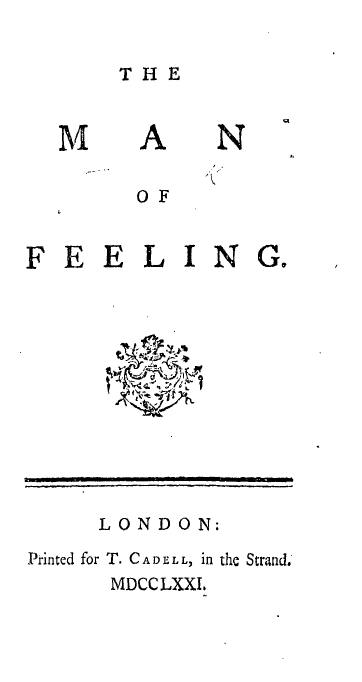
This paper examines the class action filed against James Frey for his inaccuracies in A Million Little Pieces. Memoirs often include inaccuracies or elaborate fabrications - including demonstrably false claims about the author's background and experiences - and yet, until the suit against Frey, there had never been a lawsuit against a memoirist alleging fraud on this basis. I argue that when the book was promoted on “Oprah’s Book Club,” members of the club felt compelled to respond emotionally, and conceived of these responses as a form of testimony, so that Frey’s falsehoods made their testimony seem like perjury. To explore this idea, I turn to the eighteenth-century sentimental novel, which siImage credit, and here.milarly linked readers’ reactions to the author’s emotional authenticity. Fraud was an ongoing concern for sentimental novelists, some of whom used elaborate editorial to ploys to disavow responsibility for the text, while others populated their novels with fraudulent characters, intended as foils for the protagonist. I focus in particular on the examples of Henry Mackenzie's The Man of Feeling (1771), usually seen as the paradigmatic example of the genre, and Sarah Fielding's David Simple (1744), an early contribution to the genre, and an example that is unusual, for reasons explored in the article. Following a discussion of these novels, I conclude by considering the implications of the Frey case for future claims of literary fraud, and I compare this example with the suit against Laura Albert for fraud in transactions relating to her novel Sarah (1999), published under the name J.T. LeRoy.
Oman on Reynolds v. United States, Polygamy, and Imperialism
Natural Law and the Rhetoric of Empire: Reynolds v. United States, Polygamy, and Imperialism has just been posted by Nathan B. Oman, William & Mary Law School. Here's the abstract:
In 1879, the U.S. Supreme Court construed the Free Exercise Clause for the first time, holding in Reynolds v. United States that Congress could punish Mormon polygamy. Historians have interpreted Reynolds and the massive wave of anti-polygamy legislation and litigation that it midwifed as an extension of Reconstruction into the American West. This Article offers a new historical interpretation, one that places the birth of Free Exercise jurisprudence in Reynolds within an international context of Great Power imperialism and American international expansion at the end of the nineteenth century. It does this by recovering the lost theory of religious freedom that the Mormons offered in Reynolds, a theory grounded in the natural law tradition. It then shows how the Court rejected this theory by using British imperial law to interpret the scope of the first amendment. Unraveling the work done by these international analogies reveals how the legal debates in Reynolds reached back to natural law theorists of the seventeenth-century such as Hugo Grotius and forward to fin de siècle imperialists such as Theodore Roosevelt. By analogizing the federal government to the British Raj, Reynolds provided a framework for national politicians in the 1880s to employ the supposedly discredited tactics of Reconstruction against the Mormons. Embedded in imperialist analogies, Reynolds and its progeny thus formed a prelude to the constitutional battles over American imperialism in the wake of the Spanish-American War. These constitutional debates reached their dénouement in The Insular Cases, where Reynolds and its progeny appeared not as Free Exercise cases but as precedents on the scope of American imperial power. This Article thus remaps key events in late nineteenth-century constitutional history, showing how the birth of Free Exercise jurisprudence in Reynolds must be understood as part of America’s engagement with Great Power imperialism and the ideologies that sustained it.
Tuesday, March 2, 2010
Balkin on The Reconstruction Power
The Reconstruction Power is a new paper by Jack M. Balkin, Yale Law School. Here's the abstract:
This essay argues that modern doctrine has not been faithful to the text, history and structure of the Thirteenth, Fourteenth, and Fifteenth Amendments. These amendments were designed to give Congress broad powers to protect civil rights and civil liberties; together they form Congress’s Reconstruction Power.Hat tip: Legal Theory Blog.
Congress gave itself broad powers because it believed it could not trust the Supreme Court to protect the rights of the freedmen. The Supreme Court soon realized Congress’s fears, not only limiting the scope of the Reconstruction Amendments but also Congress’s powers to enforce them in decisions like United States v. Cruikshank, 92 U.S. 542 (1875) and the Civil Rights Cases 109 U.S. 3 (1883). Due to these early cases, Congress was often forced to use its Commerce Power to protect civil rights. Modern decisions beginning with City of Boerne v. Flores, 521 U.S. 507 (1997) and United States v. Morrison, 529 U.S. 598 (2000) have compounded these errors.
When we strip away these doctrinal glosses and look at the original meaning and structural purposes underlying the Reconstruction amendments, we will discover that the Reconstruction Power gives Congress all the authority it needs to pass modern civil rights laws, including the Civil Rights Act of 1964. That was the original point of these amendments, and that should be their proper construction today.
Lash and Hamburger on Privileges or Immunities
The Privileges or Immunities Clause of the 14th Amendment is in the news today, with the Supreme Court hearing arguments in McDonald v. City of Chicago. The case raises the question of whether the 2nd Amendment right to bear arms in District of Columbia v. Heller applies to the states via either the Due Process Clause or the Privileges or Immunities Clause of the 14th Amendment.
Right on cue, two legal scholars have just posted new papers on the history of the clause.
The first is The Origins of the Privileges or Immunities Clause, Part II: John Bingham’s Epiphany by Kurt Lash, Loyola Law School Los Angeles. Here's the abstract:
Breaking news: here's what happened with the privileges or immunities clause today at the Court -- from SCOTUS Blog:
Right on cue, two legal scholars have just posted new papers on the history of the clause.
The first is The Origins of the Privileges or Immunities Clause, Part II: John Bingham’s Epiphany by Kurt Lash, Loyola Law School Los Angeles. Here's the abstract:
Historical accounts of the Privileges or Immunities Clause of Section One of theIn tension with Lash is a paper by Philip Hamburger, Columbia University Law School, Privileges or Immunities. Here's the abstract:Fourteenth Amendment generally assume that John Bingham based the text on Article IV of the original Constitution and that Bingham, like other Reconstruction Republicans, viewed Justice Washington’s opinion in Corfield v. Coryell as the definitive interpretation of Article IV. According to this view, Justice Miller in the Slaughterhouse Cases failed to follow both framers’ intent and obvious textual meaning when he sharply distinguished Section One’s privileges or immunities from Article IV’s privileges and immunities.
This article, the second in a three-part investigation of the origins of the Privileges or Immunities Clause, presents historical evidence which strongly suggests that none of these assumptions are correct. Although John Bingham’s first draft of the Fourteenth Amendment used the language of Article IV, mid-way through the Reconstruction debates Bingham realized he had made a mistake. Withdrawing his initial proposal, Bingham abandoned the language of Article IV and drafted a second version of the Amendment. This second version protected the “privileges or immunities of citizens of the United States ”— a phrase which mirrored antebellum language regarding the rights of national citizenship. Bingham insisted that his second and final version of Section One did not refer to the common law state-conferred rights of Corfield and Article IV, but instead nationalized a different and limited set of constitutionally recognized privileges and immunities, in particular the first eight amendments to the Constitution. Understanding the difference between Bingham’s first and second drafts not only explains what otherwise appear to be inconsistencies in Bingham’s speeches, it also calls into question contemporary efforts to read the Privileges or Immunities Clause as a source of un-enumerated natural rights. Like other moderates in the Thirty-Ninth Congress, Bingham wished to expand the protection of individual rights in the states, but not at the expense of the retained right of the people in the states to regulate the content of most civil rights, subject only to the requirements of due process and equal protection.
What was meant by the Fourteenth Amendment’s Privileges or Immunities Clause? Did it incorporate the U.S. Bill of Rights against the states? Long ignored evidence clearly shows that the Clause was an attempt to resolve a national dispute about the Comity Clause rights of free blacks. In this context, the phrase “the privileges or immunities of citizens of the United States” was a label for Comity Clause rights, and the Fourteenth Amendment used this phrase to make clear that free blacks were entitled to such rights.Larry Solum discusses both papers at the Legal Theory Blog.
Breaking news: here's what happened with the privileges or immunities clause today at the Court -- from SCOTUS Blog:
The first argument to collapse as the hearing unfolded was the plea by the lawyer for gun rights advocates, Alan Gura of Alexandria, Virginia, that the Court should “incorporate” the Second Amendment into the 14th Amendment through the “privileges or immunities” clause. In the first comment from the bench after Gura had barely opened, Chief Justice John G. Roberts, Jr., noted that the Court had essentially scuttled that argument with its ruling in the SlaughterHouse Cases in 1873. And within a few minutes, Justice Antonin Scalia — the author of the Heller opinion and the Court’s most fervent gun enthusiast — was sarcastically dismissing the “privileges or immunities” argument.Image credit: John Bingham.“Why,” Scalia asked Gura, “are you asking us to overrule 140 years of prior law….unless you are bucking for a place on some law school faculty.” The Justice said the “privileges or immunities” argument was “the darling of the professorate” but wondered why Gura would “undertake that burden.” And Scalia noted that the “due process” clause — an open-ended provision that he has strongly attacked on other occasions– was available as the vehicle for incorporation, and added: “Even I have acquiesced in that.” Gura somewhat meekly said “we would be extremely happy:” if the Court used the “due process” clause to extend the Second Amendment’s reach.
Kelly on the Trial of Thomas More
On Tuesday, February 23, Henry Ansgar Kelly, Emerit Distinguished Professor, Department of English, University of California at Los Angeles, delivered the paper Thomas More's Trial by Jury as part of the Georgetown University Law Center’s Thomas More Seminar Series. The paper is not available, but video of the event is here. Professor Kelly’s abstract follows:
Holbein's portrait of More is from Douglas Linder's website on the case, part of Professor Linder's wonderful on-line exhibit on famous trials.Duncan Derrett's 1964 analysis of Thomas More's trial has generally been accepted by historians, specifically in agreeing that the judges accepted More's objections against the first parts of the Indictment against him, alleging malicious silence and malicious conspiracy with Fisher, and dismissed those charges, leaving in place only the accusation by Richard Rich; this was the only charge argued before the Jury, upon which he was convicted. Derrett also construed More's final statement, against the validity of the statutory title of Supreme Head of the English Church, as a motion to invalidate the Jury's verdict.
I argue that the Indictment as a whole was presented to the Jury, and that More was found guilty of the whole; and that More's final statement was an explanation of his true mind concerning the King's churchly title, asserted with no expectation that the verdict could be reversed. The Judges should not be faulted for failing to declare the Supremacy Statutes "unconstitutional," as beyond Parliament's powers; but they should be found guilty of bowing to political pressure and convicting More against the clear intention of Parliament. Parliament insisted that malice must be established before any resistance to the King's titles could be judged to be high treason, but the Justices on More's Commission had dismissed this requirement as irrelevant, or as self-evident.

Natelson on Drafting Practices and the Executive Vesting Clause
Robert G. Natelson, University of Montana, has posted The Original Meaning of the Constitution's "Executive Vesting Clause"--Evidence from Eighteenth-Century Drafting Practice, which appears in the Whittier Law Review 31 (2009): 1-46. Here is the abstract:
Advocates of presidential power from the days of George Washington at least to the time of George W. Bush have claimed that the Constitution's so-called "Executive Vesting Clause," the first sentence of Article II, not only designates the President as chief executive, but also confers broad authority. Some commentators support that view, while others maintain that the President's powers are limited to those enumerated elsewhere in the Constitution.
This study addresses the previously-overlooked question of which interpretation is more consistent with contemporaneous drafting customs. It concludes that treating the "Executive Vesting Clause" as a mere designation is consistent with those customs, while treating it as a grant is not. Indeed, the grant interpretation would result in a document structure so anomalous as to render it unlikely that the Founders intended that interpretation.
This study marshals evidence overlooked by prior commentators, such as the royal commissions to American colonial governors, power granting documents employed by the Continental Congress, and the eighteenth-century law governing grants
Monday, March 1, 2010
LaCroix on Federalists, Federalism, and Federal Jurisdiction
Federalists, Federalism, and Federal Jurisdiction has just been posted by Alison L. LaCroix, University of Chicago Law School. Here's the abstract:
This Article provides a new interpretation of the origins of three central obsessions of federal-courts and constitutional-law scholarship: the question whether lower federal courts are constitutionally required; the relative powers of Congress, the Supreme Court, and the lower federal courts to define federal jurisdiction; and judicial supremacy. The Article argues that the extension of federal judicial power to the lower federal courts was a crucial element of the Federalists’ project of building national supremacy into the Republic’s structure. Chief Justice John Marshall, like many other federalist theorists who were affiliated with the Federalist Party, viewed the lower federal courts as essential to the establishment of a union in which national supremacy was instantiated through judicial structure. Marshall and his fellow federalists/Federalists shared a substantive commitment to structure – namely, a judiciary-centric federalism. In the early nineteenth century, most notably in two cases involving the Second Bank of the United States – Bank of the United States v. Deveaux (1809) and Osborn v. Bank of the United States (1824) – the Marshall Court carried out through case law what the political branches had been unable to do following the election of 1800: grant the lower federal courts the power to hear all cases arising under federal law. Judge-made doctrines therefore operated as a substitute for a legislative grant of jurisdiction, and federal courts throughout the period opposed Congress’s attempts to claim ultimate authority over federal jurisdiction. The traditional story of the Marshall Court’s nationalism has overlooked both this link between law and politics and the importance of the lower federal courts to early republican beliefs about federal structure.Image: Chief Justice John Marshall.
Benedict to Lecture on Constitutional Politics in Gilded Age America
We have the following from the "ECU Notes" section of the Greenville (N.C.) Daily Reflector:
One of the nation’s leading constitutional scholars will give a free, public lecture Wednesday on “The First Question: Constitutional Politics in the Gilded Age.”
Michael Les Benedict, professor emeritus at The Ohio State University, will discuss a time when people considered almost every political question to involve constitutional issues, when the constitutional authority to enact laws was “the first question” to be decided, and when the people themselves made most of the decisions about how the Constitution should be interpreted.
The presentation will be at 7:30 p.m. in Room 0C-209 of the Science and Technology Building [on ECU's campus in Greenville, N.C.]
Benedict received his doctoral degree from William Marsh Rice University Graduate School, and his master of arts and bachelor of arts degrees from the University of Illinois. He spent 34 years at Ohio State, where he taught courses on American Legal and Constitutional History, American Civil War, Philosophy of History and Historical Methods, and U.S. Constitutional Law.
This presentation is sponsored by Charles W. Calhoun, ECU professor of history and the 2009 Thomas Harriot College of Arts and Sciences Distinguished Professor. Through this professorship, a scholar is invited to campus each academic year to give a free, public presentation on his or her area of expertise. For additional information, contact Calhoun at 328-6666 or calhounc@ecu.edu.

Sunday, February 28, 2010
Levinson on Annotated Constitutions and more in the book pages
The Citizen's Constitution by Seth Lipsky, and The Annotated U.S. Constitutio n and Declaration of Independence by Jack Rakove are reviewed on The New Republic book blog by Sanford Levinson. "One must always avoid the temptation to view the Constitution as consisting solely of what has gained the attention of the judiciary," Levinson writes. "Now two new books help give us a view of the entire document." He finds each book to have strengths and weaknesses.
If you haven't managed to read Sarah Palin, Going Rouge, you might try the cartoon version, Sarah Palin, Going Rote, at the Village Voice.
And for the baseball fans out there, WILLIE MAYS: The Life, the Legend by James S. Hirsch is reviewed in the New York Times.
n and Declaration of Independence by Jack Rakove are reviewed on The New Republic book blog by Sanford Levinson. "One must always avoid the temptation to view the Constitution as consisting solely of what has gained the attention of the judiciary," Levinson writes. "Now two new books help give us a view of the entire document." He finds each book to have strengths and weaknesses.Rakove’s book may be more elegant, but Lipsky’s is more reader-friendly, because of the amount of information (and opinions) that Lipsky is free to provide....Rakove is one of the most gifted writers among contemporary American historians, and he provides an iRead the rest here.lluminating overview of the political history that generated both the Declaration in 1776 and then, only eleven years later (following the failure of our first constitution, the Articles of Confederation) the Constitution that was drafted in Philadelphia.
Inevitably, one will prefer either Rakove’s or Lipsky’s specific annotations. Rakove, for example, is better on Congress’s power to declare war, while Lipsky is better on Congress’s p
ower to pass “an uniform Rule of Naturalization.”

If you haven't managed to read Sarah Palin, Going Rouge, you might try the cartoon version, Sarah Palin, Going Rote, at the Village Voice.
And for the baseball fans out there, WILLIE MAYS: The Life, the Legend by James S. Hirsch is reviewed in the New York Times.
Saturday, February 27, 2010
Fletcher on Inland Treaty Rights in Michigan
Matthew L. M. Fletcher, Michigan State University College of Law, has posted “Occupancy” and “Settlement”: Anishinaabemowin and the Interpretation of Michigan Indian Treaty Language. This one hits close to home, as, since the age of two, I’ve vacationed on land settled as a result of the treaty. Here is the abstract:
Image credit: Henry Schoolcraft, Indian AgentThe 2007 Consent Decree in United States v. Michigan, a major victory for the tribal interests, recognized that the lands in ownership by the state, federal, and tribal governments – vast swaths of Michigan – would stand in for the lands not yet “required for settlement.” The Michigan Indians’ “privilege” to continued “occupancy” acquired legal determinacy. This short essay examines how Michigan Indian treaty negotiators would have understood the meaning of the words “settlement” and “occupancy,” and how that understanding strongly influenced the land base in which Michigan Indians can continue to exercise their inland treaty rights in accordance with the 1836 Treaty.


Friday, February 26, 2010
Gordon-Reed awarded National Humanities Medal
 Legal Historian Annette Gordon-Reed, author of The Hemingses of Monticello and other works, was awarded a National Humanities Medal at the White House yesterday. Also honored were Robert A. Caro ("The Years of Lyndon Johnson: The Path to Power, Means of Ascent and Master of the Senate"), David Levering Lewis ("W.E.B. Du Bois: The Fight for Equality and the American Century, 1919-1963") and William H. McNeill ("Plagues and Peoples"). Others honored ranged from Bob Dylan to Elie Weisel to Kennedy speechwriter Theodore Sorensen. The story is here. Hat tip to Ralph Luker.
Blog Rountable on Walker, The Ghost of Jim Crow
In case you missed it, Anders Walker's new book, The Ghost of Jim Crow, has been the focus of a book discussion at PrawfsBlawg. Contributors include:
Willoughby Anderson, A Smarter Southern Strategy
Al Brophy, Attack on the Moderates
Chris Schmidt, Strategic Constitutionalism and Resistance to Brown
Walker and others respond in the comments to the posts.
Subscribe to:
Posts (Atom)