Wednesday, August 11, 2021
NARA Virtual Town Hall on New Strategic Plan
National Archives and Records Administration Hosts Public Town Hall
The National Archives and Records Administration (NARA) invites you to a virtual town hall to introduce its new draft Strategic Plan and answer questions about the plan and the planning process [on] Tuesday, August 17, 2021, 1-2pm, ET (WebEx Virtual Meeting). Join the town hall here. Closed captions for webinar available here.
Please note, the deadline for submitting written comments on the draft Strategic Plan is August 20. . . . Please indicate what part of the plan you’re commenting on.
Read more about the plan and changes in this revision in NARA's press release, National Archives Seeks Feedback on Draft Strategic Plan.
Research Property in the Iberian World at Max Planck
[We have the following announcement. DRE]
The Max Planck Institute for Legal History and Legal Theory in Frankfurt/Main is a world leader in fundamental research on law. Its three research departments with more than 60 scholars, the unrivaled collections of its specialized library, and its numerous national and international co-operations make it the central research hub for a global scientific community investigating the past, present, and future of legal regimes.
We are looking to recruit from March 2022 onwards, three PhD researchers (m/f/d/) for the ERC research group IberLAND, "Beyond Property: Law and Land in the Iberian World(1510-1850)" directed by Dr. Manuel Bastias Saavedra, with a case study compatible with the following focus: (1) Goa (and Old Conquests), 1510-1630; (2) New Spain, 1520-1630; (3) Cape Verde, 1600-1730.
IberLAND explores the history of land tenure in a long-term and global perspective by focusing on the territories of the former Portuguese and Spanish empires in what has recently been labelled the Iberian world. The Iberian crowns of Portugal and Castile, beginning in the 15th century, connected diverse peoples and communities across Africa, Asia, Europe, and the Americas. In doing so, they for the first time transformed the questions of how to own and how to use land into an issue of global dimensions. While this age of discovery and colonialism has often been regarded as the first phase of the transplantation of European concepts of property from Europe to the non-European world, IberLAND seeks to disrupt this narrative by looking at the history of land tenure not as a process of diffusion from Europe to the world, but as a process of decentred legal innovation. To do this, the project will move beyond the idea of property and focus on land relations to understand the sets of social relations established between people and land. This conceptual approach provides a way of observing how law was produced at the local level through the combination of practice and doctrine. To connect legal doctrines to local practices, the project's analysis will focus on different sets of institutions that structured land relations in different places in the Iberian world. This conceptual and analytical framework will be applied to six case studies focusing on New Spain, Goa, Cape Verde, Spain, Brazil and the Philippines, enabling us to overcome the diffusionist mindset that has pervaded the study of law and empire.
Tuesday, August 10, 2021
Sabin, "Public Citizens: The Attack on Big Government and the Remaking of American Liberalism"
W.W. Norton has released Public Citizens: The Attack on Big Government and the Remaking of American Liberalism, by Paul Sabin (Yale University). A description from the Press:
In the 1960s and 1970s, an insurgent attack on traditional liberalism took shape in America. It was built on new ideals of citizen advocacy and the public interest. Environmentalists, social critics, and consumer advocates like Rachel Carson, Jane Jacobs, and Ralph Nader crusaded against what they saw as a misguided and often corrupt government. Drawing energy from civil rights protests and opposition to the Vietnam War, the new citizens’ movement drew legions of followers and scored major victories. Citizen advocates disrupted government plans for urban highways and new hydroelectric dams and got Congress to pass tough legislation to protect clean air and clean water. They helped lead a revolution in safety that forced companies and governments to better protect consumers and workers from dangerous products and hazardous work conditions.
And yet, in the process, citizen advocates also helped to undermine big government liberalism—the powerful alliance between government, business, and labor that dominated the United States politically in the decades following the New Deal and World War II. Public interest advocates exposed that alliance’s secret bargains and unintended consequences. They showed how government power often was used to advance private interests rather than restrain them. In the process of attacking government for its failings and its dangers, the public interest movement struggled to replace traditional liberalism with a new approach to governing. The citizen critique of government power instead helped clear the way for their antagonists: Reagan-era conservatives seeking to slash regulations and enrich corporations.
Public Citizens traces the history of the public interest movement and explores its tangled legacy, showing the ways in which American liberalism has been at war with itself. The book forces us to reckon with the challenges of regaining our faith in government’s ability to advance the common good.
Advance praise:
"Long before 'the Reagan Revolution,' an army of citizen activists launched a searing attack on liberalism, big government, and the administrative state—and helped pave the way for market-oriented conservatism. Paul Sabin’s timely, provocative, and deeply ironic account should be required reading for everyone interested in environmentalism, consumerism, political economy, and the 1970s." -- Laura Kalman
"This book could not be more timely. Paul Sabin powerfully demonstrates that the liberal postwar order was not only undercut by the rise of the right, but also by an activist left that for good reason decried government’s deafness to citizens’ needs and participation. How best to serve the public interest is the greatest challenge of our time, and we could have no better guide through the historical thicket than Sabin." -- Lizabeth Cohen
More information is available here.
-- Karen Tani
Saturday, August 7, 2021
Weekend Roundup
- Joel Seligman reviews Akhil Reed Amar’s The Words That Made Us in the Los Angeles Review of Books. “The great strength” of the book, he writes, “is to place constitutional history in a geostrategic context.”
- The Federal Judicial Center has posted a new entry in its "Spotlight on Judicial History" series: "Elkison v. Deliesseline: The South Carolina Negro Seaman Act of 1822 in Federal Court."
- Matthew Ahern, Library Assistant, Massachusetts Historical Society, has posted “Jennison v. Caldwell: Abolition and the Role of Courts In Eighteenth-Century Massachusetts” on "The Beehive," the MHS's blog.
- Over at JOTWELL: Reuel Schiller (UC Hastings Law) on Kate Masur's Until Justice be Done; Mary Fan (University of Washington) on recent guest blogger Anna Lvovsky's "Rethinking Political Expertise."
- On Thursday, July 22, 2021, Melissa Murray, NYU Law, delivered, online, the Chautauqua Institution’s 17th annual Robert H. Jackson Lecturer on the Supreme Court of the United States. The lecture took the form of a conversation between Professor Murray and John Q. Barrett, Professor of Law, St. John’s University and Elizabeth S. Lenna Fellow, Robert H. Jackson Center, Jamestown, NY. They discussed the U.S. Supreme Court, the Justices, and some leading decisions from the Court’s most recent term. Video here.
- The 2020 Chicago-Kent College of Law Roy C. Palmer Civil Liberties Prize has been awarded to Thomas P. Crocker for Overcoming Necessity: Emergency, Constraint, and the Meanings of American Constitutionalism (Yale University Press 2020). “The annual prize honors exemplary works of scholarship exploring the tension between civil liberties and national security in contemporary American society.” More.
- From the Washington Post's "Made by History" section: Elizabeth Tandy Shermer (Loyola University Chicago), "Policymakers created the student loan industry — and the debt crisis."
Thursday, August 5, 2021
Constitutions in Conflict: Proslavery vs Antislavery
[We have the following announcement of a Bonnie and Richard Reiss Graduate Institute for Constitutional History Seminar of the New-York Historical Society, which ought not to be confused with those of the Institute for Constitutional Studies, held at George Washington University. DRE.]
Constitutions in Conflict: Proslavery vs Antislavery. Presented in person at the New-York Historical Society, 170 Central Park West, New York, NY 10024. Fridays, October 29, November 5 and 19, December 10, 2021 | 2–5 pm ET. Application deadline is September 15, 2021.
The Constitution of 1787 was famously a compromise between proslavery and antislavery delegates. For that very reason, the supporters and opponents of slavery would go on to invoke the Constitution in support of their very different causes. In four discussions that span the Founding Era up through the Civil War, historians James Oakes and Sean Wilentz examine the critical points in the constitutional debate over slavery and consider how Congress and the courts grappled with constitutional contradictions.
Wednesday, August 4, 2021
Labuza on Lawyers and Movie Deals after the Studio System
It’s gated but interesting: Peter Labuza has published When a Handshake Meant Something: The Rise of Entertainment Law in Post-Paramount Hollywood in the JCMS: Journal of Cinema and Media Studies 60 (Summer 2021): 61-84:
Following the end of the Hollywood studio system, the entertainment lawyer emerged as a new profession, uniting studios and independent producers through a process of contract negotiation that became central to the industry’s operations. After United States v. Paramount, Inc. (1948), attorneys adapted to the needs of the industry by using dealmaking contracts to align the incentives of cautious financiers and ambitious creatives to work together. This article follows attorney Leon Kaplan and his role in negotiating the paradoxical motivations of corporate finance and radical art that defined New Hollywood.
--Dan Ernst
Tuesday, August 3, 2021
Stern, "The NAACP's Rape Docket and the Origins of Criminal Procedure"
Scott W. Stern (independent scholar) has posted "The NAACP's Rape Docket and the Origins of Criminal Procedure," which appears in the University of Pennsylvania Journal of Law and Social Change (2021). Here's the abstract:
This Article provides the definitive account of the surprisingly voluminous docket of rape cases argued by the National Association for the Advancement of Colored People (NAACP). It argues, for the first time, that the NAACP’s rape docket was central to the development of modern criminal procedure — to the establishment of the right to counsel, the right to remain silent, the right to a trial free from mob violence or influence, the right to not have a coerced confession used against you, and the right to a jury of your peers selected without discrimination. Drawing on original archival research, this Article demonstrates that all of these rights have their origins in the hundreds of cases argued by the NAACP on behalf of Black men accused of sexual assault by white women.
This Article also argues that these cases were central to the development of the NAACP’s legal department, the relationships between local branches and the national office, and the careers of the famous civil rights attorneys — from Charles Hamilton Houston to Jack Greenberg — who rose to national prominence with the NAACP. Thus, these cases were central to the development of civil rights litigation itself. Indeed, the first significant Supreme Court case argued for the NAACP by a Black attorney was an interracial rape case. The first Supreme Court case ever argued by a Black woman, Constance Baker Motley, was an interracial rape case. The first case that Thurgood Marshall ever argued before the Supreme Court was an interracial rape case. Several scholars have noted how individual rape cases were pivotal in the careers of individual NAACP lawyers, but no scholar has argued that these cases together constituted a significant docket that was pivotal to nearly all of their careers.
Finally, this Article examines cases in which the NAACP advocated for Black women who accused white men of sexual assault. Throughout its history, the national office of the NAACP advocated for Black female rape survivors only rarely. In contrast, the local branches of the Association did advocate for dozens of Black women who had been raped by white men, often pushing the police to investigate, the prosecutors to bring charges, and sometimes even hiring their own attorneys to aid in prosecutions. Yet at no point did NAACP attorneys ever challenge the rape laws that placed punitively high demands on assault survivors and impeded countless prosecutions. This was largely because NAACP attorneys embraced the very politics of respectability that justified sexist rape laws; indeed, NAACP attorneys capitalized on the gendered aspects of these laws in their representation of Black men accused of rape. Many Black women throughout the decades demanded the NAACP engage more often in anti-rape work — demands that usually met with deaf ears. Had the NAACP acceded to these demands and pushed for a criminal procedure focused not just on protecting rape suspects but also on protecting rape survivors, the greater protections for these survivors that are written into modern rape laws could have come about much sooner.
The full article is available here.
-- Karen Tani
Tilley and friends on global medical cultures & law
[We share the following announcement of a new publication.]
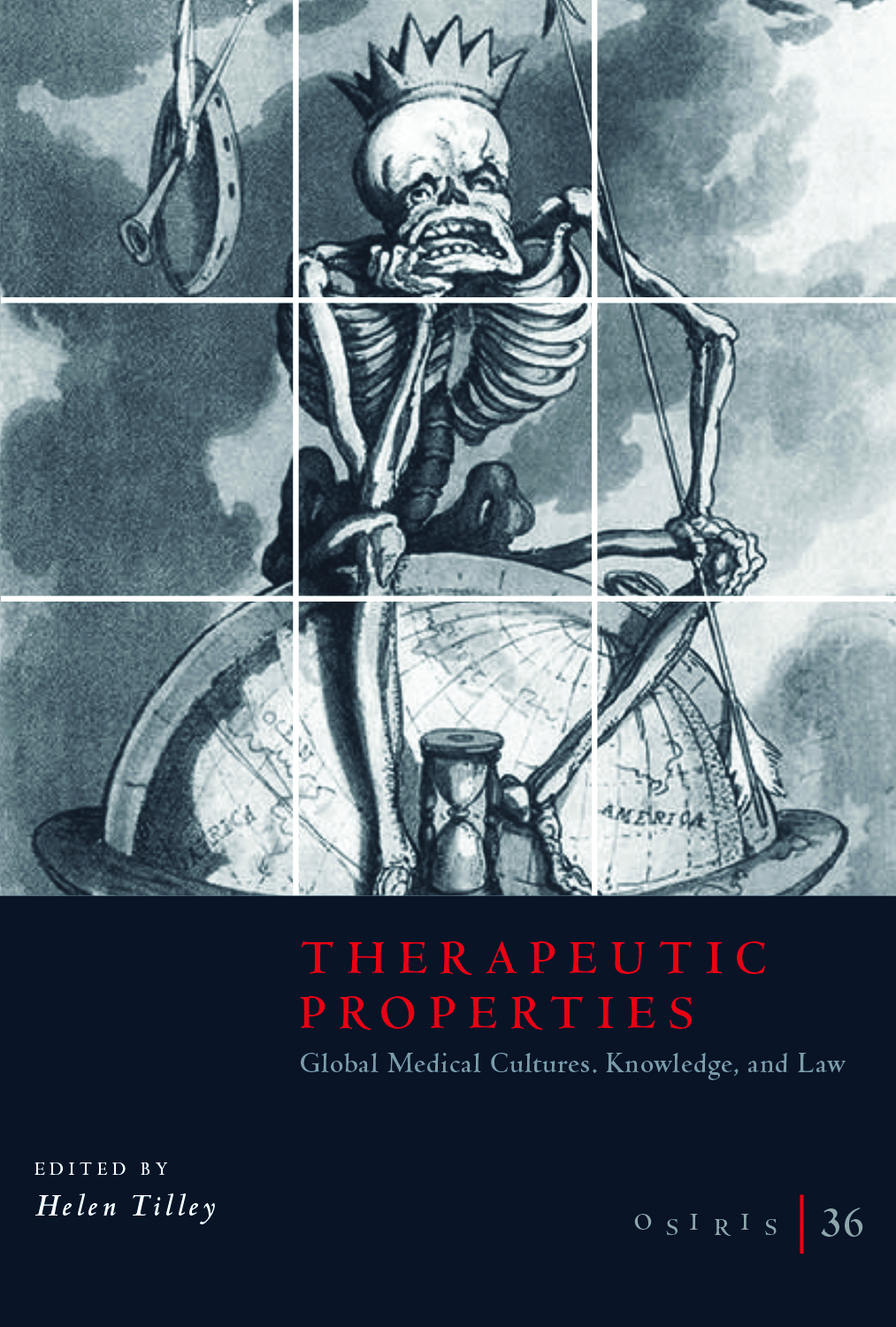
Osiris, Volume 36:
Therapeutic Properties: Global Medical Cultures, Knowledge, and Law
Edited by Helen Tilley
Published by the University of Chicago Press on behalf of the History of Science Society
This volume of Osiris takes as its point of departure a simple premise: we have yet to fully flesh out the complex historical interplay between medicine and law across the globe. Therapeutic Properties takes an inventive look at the issue, presenting welcome insights on the worldwide ascendancy of biomedicine, the persistence of nonofficial and unorthodox approaches to healing, and the legal contexts that have served to shape these dynamics.
The contributions draw upon source material from the Americas, Africa, Western Europe, the Caribbean, and Asia to trace the influence of penal and civil codes, courts and constitutions, and patents and intellectual properties on not only health practices, but also the very foundations of state-sanctioned medicine. The authors explore, too, how institutions of global governance, including those underpinning empires and trade, have historically created feedback loops that enabled laws and regulatory regimes to spread, amplifying their effects and standardizing approaches to diseases, drugs, professions, personhood, and well-being along the way. Highlighting the payoff of interdisciplinary and transnational analyses, Therapeutic Properties adroitly teases apart how different actors fought to write the rules of global health, rendering certain approaches to life and death irrelevant and invisible, others pathological and punishable by law, and others still, normal and natural.
Table of Contents after the jump:
Monday, August 2, 2021
Shugerman on Marbury and Presidential Removal
Jed Handelsman Shugerman, Fordham Law School, has posted Presidential Removal: The Marbury Problem and the Madison Solutions, which appears in volume 89 of the Fordham Law Review (2021):
Marbury v. Madison is not just a puzzling judicial review precedent. It is also a puzzle about presidential removal. Why didn't Jefferson, Secretary of State Madison, or another executive official simply fire Marbury? Why did Chief Justice Marshall also assume that Marbury could not be removed.
James Madison (LC)
This symposium essay summarizes recent research (especially by Jane Manners and Lev Menand) to solve this problem: an office appointed to a term of years limited removal in the Anglo-American tradition, demonstrating that presidential removal was not a default rule. This essay also summarizes my research on the first Congress, showing that this rule was not limited to arguably judicial or quasi-judicial offices like Marbury's office of justice of the peace. The Madison solution here is that then-Rep. Madison in 1789, in the debates creating the new Treasury Department, proposed an office of Comptroller with a limited term of office -- and he and his colleagues understood that such terms would protect the Comptroller from presidential removal.
But Chief Justice Marshall's Marbury decision suggests another problem: He used the word "vest" to connote special legal protection for an office-holder. Does this mean that the word "vest" in the Constitution also had an original public meaning of exclusive and infeasible powers, so that Article II vested complete and exclusive executive power in the president, as the unitary theorists posit?
--Dan Ernst
Katz on Women's Legal Right to Hold Public Office
Elizabeth D. Katz, Washington University in St. Louis School of Law, has posted Sex, Suffrage, and State Constitutional Law: Women's Legal Right to Hold Public Office, which is forthcoming in the Yale Journal of Law & Feminism:
On January 20, 2021, Kamala Harris was sworn in by Justice Sonia Sotomayor as the nation’s first woman Vice President. This occasion, with women of color holding two of the most crucial roles in our national government, would have been unthinkable for most of United States history. While the political efforts necessary to reach this moment have been studied in great depth, the legal challenges have been overlooked and even denied.
Relying on extensive historical research, this Article is the first to examine how women advocated for the legal right to hold public office in state-level litigation, constitutional amendments, legislative lobbying, and other venues for more than a century. From the 1840s through the 1940s, women in many states were excluded from holding even mundane public offices because of state constitutional language and judicial holdings. Opponents of women’s officeholding feared that permitting women to hold posts would deprive men of their rightful opportunities, radically alter gender norms, and fuel the flames of the women’s suffrage movement. The nation’s first women lawyers were particularly active in challenging these restrictions, with results varying by region and reflecting distinct legal, political, and social cultures. Women in the West obtained public offices relatively early, in part because they were the first to secure suffrage. Women in the Northeast and South faced the most difficult hurdles because conservative state judiciaries construed constitutional silences as implying women’s exclusion from office. The Midwest emerged as the contested middle ground; although women could not vote in Midwestern states for most of the studied period, many courts nevertheless held that they were entitled to hold both appointed and elected offices.
Recovering the history of women’s legal right to hold public office challenges three major conventional wisdoms. First, it undermines the commonplace claim in scholarship on women’s legal and political history that officeholding was not a meaningful part of women’s advocacy or experiences until after ratification of the Nineteenth Amendment in 1920. This account instead shows that proponents of women’s rights have long demanded women’s access to public posts, and women held positions more than a half century prior to the federal suffrage amendment. Second, this Article challenges prominent scholarship—mostly focused on interpreting the Reconstruction Amendments—that treats officeholding as an obvious or inevitable twin to suffrage. Foregrounding women’s history and state-level advocacy emphasizes the legal possibility and practical reality of severing these political rights. Third, and relatedly, the Article calls for more attention to state constitutional law and regional variation. The women’s officeholding story clearly demonstrates how focusing on one geographical area, providing a single national account, or limiting analysis to the federal level obscures essential developments in securing rights.
--Dan Ernst
Saturday, July 31, 2021
Thank you, Tom Johnson!
We're delighted to have had Tom Johnson (University of York) join us as guest blogger in July 2021. Many thanks for his insightful series of posts on law in medieval England and many other things methodological and conceptual. Here's the roundup:
- 1. A Hesitant Legal Historian
- 2. Medieval law as local
- 3. Medieval law as material
- 4. Medieval law as document
- 5. Medieval law as rules
Friday, July 30, 2021
New York Courts and the Draft Riots of 1863
![]() |
| (NYPL) |
Program on the 1863 Civil War Draft Riots in NY. September 29 @ 6:00 pm - 8:00 pm EDT
During the Civil War, the Union Army reached a crisis point and required more troops to fight for the nation, leading to federally legislated conscription. As enrollment began, an arrest was made by an enrollment officer – the final straw leading to a multi-day riot against the draft in New York City. This online event will look back to the 1863 draft riots and their impact on New York’s courts, and look to similar issues in a discussion about the attack on the Capitol in 2021.
Panel of Speakers:
Prof. Troy A. McKenzie, Professor of Law, NYU School of Law, Moderator
Prof. Iver Bernstein, Professor of History, African and African American Studies, and American Cultural Studies, Washington University in St. Louis
More Panelists to Be Announced Soon
Thursday, July 29, 2021
Knowles's "Making Minimum Wage"
Just out: Helen J. Knowles, Associate Professor of Political Science at the State University of New York at Oswego, has published Making Minimum Wage: Elsie Parrish versus the West Coast Hotel Company (University of Oklahoma Press):
The US Supreme Court’s 1937 decision in West Coast Hotel v. Parrish, upholding the constitutionality of Washington State’s minimum wage law for women, had monumental consequences for all American workers. It also marked a major shift in the Court’s response to President Franklin D. Roosevelt’s New Deal agenda. In Making Minimum Wage, Helen J. Knowles tells the human story behind this historic case.Here are two endorsements:
West Coast Hotel v. Parrish pitted a Washington State hotel against a chambermaid, Elsie Parrish, who claimed that she was owed the state’s minimum wage. The hotel argued that under the concept of “freedom of contract,” the US Constitution allowed it to pay its female workers whatever low wages they were willing to accept. Knowles unpacks the legal complexities of the case while telling the litigants’ stories. Drawing on archival and private materials, including the unpublished memoir of Elsie’s lawyer, C. B. Conner, Knowles exposes the profound courage and resolve of the former chambermaid. Her book reveals why Elsie—who, in her mid-thirties was already a grandmother—was fired from her job at the Cascadian Hotel in Wenatchee, and why she undertook the outsized risk of suing the hotel for back wages.
Minimum wage laws are “not an academic question or even a legal one,” Elinore Morehouse Herrick, the New York director of the National Labor Relations Board, said in 1936. Rather, they are “a human problem.” A pioneering analysis that illuminates the life stories behind West Coast Hotel v. Parrish as well as the case’s impact on local, state, and national levels, Making Minimum Wage vividly demonstrates the fundamental truth of Morehouse Herrick’s statement.
“In Making Minimum Wage, Helen J. Knowles ingeniously draws on a wealth of sources to make one of the most important of all the Supreme Court’s New Deal decisions come alive. With remarkable humanity, Knowles transforms the story of Elsie Parrish into an illuminating prism on the history of minimum wage legislation for women.” —Laura Kalman, author of The Long Reach of the Sixties: LBJ, Nixon, and the Making of the Contemporary Supreme Court--Dan Ernst. H/t: JQB
“This book brilliantly turns West Coast Hotel v. Parrish inside out, revealing the human struggles and experiences behind the doctrinal revolution of 1937. Helen J. Knowles rightfully places Parrish and her advocates at the center of New Deal labor politics and recovers a critical piece of the forgotten struggle over women’s minimum wages. This highly readable book will delight and fascinate anyone interested in labor history, constitutional development, or the regulation of women’s work in the United States.” —Julie Novkov, author of The Supreme Court and the Presidency: Struggles for Supremacy
Wednesday, July 28, 2021
5. Medieval law as rules
(In keeping with an approach that I am trialling at the moment, and the looser format provided by a blog, I have decided to include some pictures; these are intended to complement the text, rather than to illustrate it, and as such, they are left uncaptioned. All of the images are either in the public domain, or have been permitted for non-commercial reproduction.)
*
If my last post, about law as text, started with a statement
of the bloody obvious, I’m not sure there are expletives strong enough to
capture this one: law is about rules. Once again, this was a realization that I
came to very slowly, and that I am still in the process of working out through
a new project, on which I will say more below. But first it is worth reflecting
briefly on why it took me quite so long to understand this apparently simple
point, and what a closer attention to law’s ruliness could yield for the way we
understand medieval law.
Looking at the historiography of medieval law and society
over the last three decades, it is indeed easy to miss the importance of law’s
ruliness. Following the strand of ‘processualist’ legal anthropology developed
in the 1970s and 1980s, medieval historians made a great deal of hay out of the
insight that court cases might just be one stage, or one arena for a much
broader process of dispute resolution. From tenth-century Tuscany to
thirteenth-century England to fifteenth-century France, multiple monographs
have demonstrated the social processes that underlay these resolutions: the
importance of publicity, of reputation, of peace, trustworthiness, and
hierarchy for the working out of conflict, and as such, the way in which these
cultural logics undergirded the operation of the law.
This was very much the broad approach that framed my own
book. Yet when I came to write the introduction – right at the end, of course!
– I began to have some doubts. I was trying to make a point about the ways in
which ordinary people in fifteenth-century England did not just ‘experience’
the law created by others for them, but actively participated in making law for
themselves. I had in mind a particular body of evidence to support this claim. This
was the huge array of ‘bylaws’ that rural tenants made in manorial courts.
These often concerned agricultural matters (‘everyone must ensure their horses
are properly tied up’), but sometimes intervened in social regulation (‘anyone
who slanders their neighbour shall pay a fine’). These bylaws are very well
known to historians. But they have been catalogued as a part of manorial ‘custom’,
a poor cousin to the real law done elsewhere, and there has not been a real study
of them since the 1960s.
But this problem, I found, was one that others had
identified too. In particular, the ‘Legalism’ group of anthropologists and
historians at Oxford, who ran seminars and workshops and published an excellent
series of books, were elaborating a sophisticated critique of processualist
approaches. I cannot do full justice to this argument here, but it contains the
important insight that rather than treating rules as things which are ‘used’,
often unknowingly, by social actors, and uncovered by clever anthropologists
and historians, we need to take seriously the prescriptions that people make
for themselves. In all societies, people make rules, and these rules betray the
way in which they categorize the world. As such, rulemaking, and the
abstraction that goes with it, needs much closer attention.
I am in the midst of preparing a new project that attempts
to do just this, by examining a huge corpus of rules made by ordinary people in
late-fourteenth-century England. In 1388-9, the royal government asked every
guild – religious associations organized by craft or neighbourhood – to send in
its ordinances for inspection. Still reeling from the mass revolt of 1381,
officials were suspicious of these organizations as potential ‘coventicles’ of political
dissent. Well over 500 guilds from across England obliged, sending in their
rules to the local sheriff, who passed them on to the royal Chancery, where
they were eventually archived.
The ordinances of these guilds follow certain patterns. As religious associations, they tend to include provisions for things like Masses, the basic currency of late-medieval Catholic observation, and the great quantities of wax that were required to leave votive candles burning before altars. But many of them also include more ‘social’ rules: about what to do if two brethren fell into a dispute, how debts to the guild were to be repaid, or what should happen if someone came late to a meeting. By examining hundreds of them together, I am hoping to identify common patterns in their language and structure, the mechanisms and penalties by which they were enforced, and the categories that used to make rules. In so doing, I hope to invigorate an approach to late-medieval law and society that takes seriously the importance of ‘ruliness’, and allows us to properly account for the legal ways of thinking that permeated common life.
Tuesday, July 27, 2021
Muchlinski on property rights in Palestine
David Muchlinski (Georgia Tech) has published the following article: "Swords and Plowshares: Property Rights, Collective Action, and Nonstate Governance in the Jewish Community of Palestine 1920-1948," American Political Science Review (published online on 28 June 2021). Here's the abstract:
Developing states lacking a monopoly over the use of force are commonly seen as having failed to live up to the ideal Weberian sovereign type. Yet rather than being a calling card of anarchy, the devolution of important state functions to subnational actors is a rational strategy for developing states to effectively provide important public goods. The case study of the Jewish Community of Palestine demonstrates one instance where subnational communities provided public goods. This study highlights the causal effect of property rights within institutions to drive behavior consistent with the provision of public and private goods. Analyzing temporal and institutional variation across two agricultural communities demonstrates a unique strategy of subnational governance and public goods provision in a developing state. Devolution of public goods provision to subnational actors may be an alternative strategy of governance for developing states that are not yet able to effectively provide important public goods.
Further information is available here.
--Mitra Sharafi
Monday, July 26, 2021
Klass on Corbin
My Georgetown Law colleague Gregory Klass has posted Arthur Linton Corbin, which is forthcoming in Scholars of Contract Law, ed. James Goudkamp and Donal Nolan (Hart Publishing):
This chapter on Arthur Linton Corbin will appear in the forthcoming collection, Scholars of Contract Law. The chapter provides a brief summary of Corbin’s life, then discusses five topics: Corbin’s Socratic approach to the classroom and his introduction of the caselaw method at Yale; Corbin’s analytic approach, which was inspired by Hohfeld and is illustrated by Corbin’s definitions of “contract” and “consideration”; Corbin’s evolutionary theory of the common law, his understanding of the relationship between law and social mores, and his insistence that legal rules always be treated as mere “working rules”; Corbin’s occasional appeal, despite his general aversion to high theory, to the reliance theory of contract; and Corbin’s account of contract interpretation, where one sees the reliance theory at work, together with a surprisingly narrow conception of meaning.
Credit
--Dan Ernst
Tushnet on Colley and Emerson
--Dan Ernst
Saturday, July 24, 2021
Weekend Roundup
- The Historical Society of the New York Courts has posted the podcast Litchfield Law School’s Influence on NY State Bench & Bar and a Young Nation. Host David L. Goodwin, Society Trustee, interviews Paul DeForest Hicks.
- Joseph D. Kearney, Marquette Law, and Thomas W. Merrill, Columbia Law, “discuss the shenanigans that ultimately gave the city and the state of Illinois one of its most priceless parcels of land and preserves it for public use” in a podcast on the ABA Journal’s Legal Talk Network. They are the authors of Lakefront: Public Trust and Private Rights in Chicago (Cornell University Press).
- The abstracts for papers in the Asian Legal History Conference, July 24-25, are here.
- Congratulations to William & Mary Assistant Professor of History Brianna Nofil, the recipient of the 61st annual Allan Nevins Prize by the Society of American Historians for her dissertation, “Detention Power: Jails, Camps, and the Origins of Immigrant Incarceration, 1900-2002.” (More.)
- New online from Law and History Review and Cambridge Core: From Disestablishment to Dartmouth College v. Woodward: How Virginia's Fight over Religious Freedom Shaped the History of American Corporations, by Alyssa Penick, and Policing, Profits, and the Rise of Immigration Detention in New York's “Chinese Jails,” by Brianna Nofil.
- More CRT: The New Hampshire attorney general says that “teaching about the country’s history of slavery, its racist Jim Crow Laws, the Civil Rights Movement of the 1960s and the modern Black Lives Matter movement won’t violate state law even if those lessons make students uncomfortable, according to legal advice from the state Attorney General’s Office" (Concord Monitor).
- And still more: Over 140 organizations, have signed onto this Joint Statement on Legislative Efforts to Restrict Education about Racism in American History, authored by American Association of University Professors, the American Historical Association, the Association of American Colleges & Universities, and PEN America.
- From the History News Network: Ronald A. Smith (Penn State University), "How Historians Convinced SCOTUS that the NCAA's Idea of Amateurism is a Myth."
- We recently discovered the "Now & Then" podcast, hosted by historians Joanne Freeman (Yale University) and Heather Cox Richardson (Boston College). For a particularly relevant recent episode, checkout "Judging the Supreme Court."
- The Law Library of Congress invites you to a webinar on federal statutes.
- From the Washington Post's "Made by History" section: Adam R. Shapiro, "When opponents decry critical race theory, they’re really fighting against change: the lessons of the Scopes trial for today."
- Fire in the White House! At 7 PM EDT on July 28, the Elk Rapids Area Historical Society hosts a live stream of Craig G. Wright, Herbert Hoover Presidential Library and Museum, discussing the fire that gutted the West Wing and ruined the Oval Office on Christmas Eve, 1929.
- For anyone working on socio-legal history and technology: check out the new Law and Society Fellowship at the Simons Institute at Berkeley.
- ICYMI: George Thomas on America’s Imperfect Founding (The Bulwark). A notice of The Great Dissenter: The Story of John Marshall Harlan, America’s Judicial Hero, by Peter S. Canellos (Courier Journal). Woman suffrage and Prohibition in Iowa (Cedar Rapids Gazette). The Buffalo-Niagara LGBTQ History Project’s first historic marker recognizes “local gay rights activist Bob Uplinger,” whose battle in an entrapment case contributed to decriminalization in New York (Buffalo Rising).
- Update: Colbert King on Karen Hastie Williams (WaPo).
Friday, July 23, 2021
Legal History Review 89: 1-2
Artikelen / Articles / Articles
OK Computer? The digital turn in legal history: a methodological retrospective
Florenz Volkaert
Note minime sul ius dotium in Marziano Capella
Francesco Bono
Did the published Theodosian Code include obsolete constitutions?
Boudewijn Sirks
Forms of suretyship in the Peira in the light of the Basilica
Marios Tantalos
Learned law in late medieval Netherlandish practice: Consilia for the congregation of Windesheim (ca. 1415-1500)
Wouter Druwé
Arguments related to slavery in seventeenth century Dutch legal theory
Gustaaf van Nifterik
La faculté de tester dans le Dell’origine e dell’uffizio del notariato de Michele Cusa: Une illustration de la culture juridique européenne d’un notaire piémontais au XIXe siècle
Anne Dobigny-Reverso
Foreign law without borders in the early vast America: Spanish legal literature in 18th century North America
Angela Ballone
Review essay: ‘Constitutional lawyers are Dutchmen’
Alain Wijffels
Boekbesprekingen / Comptes rendus / Book reviews
Ona’ah und laesio enormis, Preisgrenzen im talmudischen und römischen Kaufrecht, written by Doris Forster. Reviewed by Martin Schermaier
Le marché du mérite, Penser le droit et l’économie avec Léonard Lessius, written by W. Decock. Reviewed by Dirk Heirbaut
Kroniek / Chronique / Chronicle
Bundels / Recueils / Collections
Ontvangen werken / Ouvrages reçus / Publications received
Thursday, July 22, 2021
A Symposium on McCurdy on Cooley's "Constitutional Limitations"
![]() |
| Thomas Cooley (NYPL) |
--Dan Ernst
Giladi on Jews, sovereignty, and international law
Ideology and Ambivalence in Early Israeli Legal Diplomacy with Oxford University Press. From the publisher:
By departing from accounts of a universalist component in Israel's early foreign policy, Rotem Giladi challenges prevalent assumptions on the cosmopolitan outlook of Jewish international law scholars and practitioners, offers new vantage points on modern Jewish history, and critiques orthodox interpretations of the Jewish aspect of Israel's foreign policy.
Drawing on archival sources, the book reveals the patent ambivalence of two jurist-diplomats--Jacob Robinson and Shabtai Rosenne--towards three international law reform projects: the right of petition in the draft Human Rights Covenant, the 1948 Genocide Convention, and the 1951 Refugee Convention. In all cases, Rosenne and Robinson approached international law with disinterest, aversion, and hostility while, nonetheless, investing much time and toil in these post-war reforms. The book demonstrates that, rather than the Middle East conflict, Rosenne and Robinson's ambivalence towards international law was driven by ideological sensibilities predating Israel's establishment. In so doing, Jews, Sovereignty, and International Law disaggregates and reframes the perspectives offered by the growing scholarship on Jewish international lawyers, providing new insights concerning the origins of human rights, the remaking of postwar international law, and the early years of the UN.
Here is the Table of Contents:
Part I: The Sovereign Turn
Prologue: 'With an Eye to the Past', But No Longer 'An Object of International Law'
Introduction: A Radical Transformation?
1:Terms of Engagement
Part II: Voice
2:Lauterpacht in Jerusalem
3:'The Extreme Non-Zionist, Apolitical Concept of Jewish Public Life'
Part III: Protection
4:From a 'Marginal Problem' to the 'Supreme International Jurisdiction'
5:'A False and Perverse Doctrine'
Part IV: Refuge
6:Sovereign Sensibilities and Jewish Refugees
7:'A Better Remedy'
Part V: Creed
Epilogue: Revolutionaries, Torchbearers, and Imperfect Subjects
Further information is available here.
--Mitra Sharafi
Wednesday, July 21, 2021
Erman to Deliver Inaugural SCHS Constitution Day Lecture
CFP: International Congress on Medieval Studies
International Congress on Medieval Studies
This call for papers includes all sponsored and special sessions approved by the Program Committee for the 57th International Congress on Medieval Studies (live on the internet Monday through Saturday, May 9-14, 2022), hosted by Western Michigan University's Medieval Institute.
The sponsored sessions are listed alphabetically by the name of the principal or sole sponsoring organization, and the special sessions follow alphabetically by session title. Email addresses are obfuscated in the page source to reduce the chances of being harvested by spammers.
You are invited to make one paper proposal to one session of papers: that might be to one of the Sponsored or Special Sessions listed here as a session of papers, which are organized by colleagues around the world, OR to General Sessions, which are organized by the Program Committee in Kalamazoo.
You may propose an unlimited number of contributions to roundtables and panel discussions, but you will not be scheduled to actively participate in more than three sessions (including sessions in all formats).
All those hoping or invited to make contributions to sessions or papers, roundtables, and panel discussions at the Congress need to make proposals in the Confex system by the deadline of Wednesday, Sept. 15. Contributions to demonstrations, performances, and workshops are not solicited through our proposal system. Interested individuals should approach the contact person directly.
All proposals for sessions of papers (including general sessions), roundtables, and panel discussions are made through the Confex system, where the sessions are grouped by format and most sessions seeking proposals are described more fully.
4. Medieval law as document
(In keeping with an approach that I am trialling at the moment, and the looser format provided by a blog, I have decided to include some pictures; these are intended to complement the text, rather than to illustrate it, and as such, they are left uncaptioned. All of the images are either in the public domain, or have been permitted for non-commercial reproduction.)
*
Law is to be found in writing: this is a statement of the bloody obvious. But it took me a long time to get there. As I have rehearsed in some of my previous posts, I came to legal history from the outside, from social history. Over the course of my doctoral and postdoctoral work, I was thus principally interested in law’s social qualities – the way it was used to resolve disputes or establish hierarchical relations – and in particular the way it manifested in certain spaces and things. It was only as I began to the extra archival research needed to transform my doctoral thesis into a book that I began to think more about legal texts, and the work that they performed in producing law.
I cannot deny that the ‘allure of the archives’ played a
significant role in this thinking. My favourite discovery was when I found a
little slip of paper, a citation, enclosed inside the parchment binding of a
church court book (which
I describe in more detail in this article). I am fairly sure that it had
been left there about six hundred years ago, and lain undisturbed since. Such
discoveries certainly made me reflect more on texts as artefacts, with material
qualities that shape the way we encounter legal history. But the boredom of the
archives helped me too: when I got fed up with what I was supposed to be
reading, I would ask archivists if they had any little bits and pieces, anything
strange or miscellaneous. Very often, they did. And after having visited a few
dozen local archives, I found I had compiled a strange archive of oddments.
Slowly, then, I came to realize that these writings were not merely a route into the world of late-medieval law, but had played a crucial role in producing it. For example, one genre of oddment I kept finding in local archives were strings of ‘copyholds’. Copyhold was a form of rural property tenure that emerged in the peculiar socio-economic conditions of the English countryside after the Black Death, when the scarcity of peasant tenants meant that they were more easily able to negotiate the duration and condition of their tenure. Many thus began to demand a copy of the court roll which recorded their entry into the land, as a record of their advantageous terms. Hundreds of thousands of such copies, which were written on small pieces of parchment, must have been produced. But very few have survived – only those which were subsequently archived by landlords who bought back the tenure at a later date.
Seeing these copies, however, set me to look out for
mentions of them in the court records. And what I found was that these pieces
of writing were extremely important to their owners as written artefacts,
standing for possession of the property. Thus the widow who asked for her name
to be entered on the very same copy that had previously borne her husband’s
name; or the husbandman who kept copies of all his lands in a strongbox in his
house; or the man who tried to scratch out the name of the previous owner on
his copy, a move which cast doubt on the document’s validity. What I realized,
with these examples and others like them, was the way that copies were a
crucial part of the enactment of manorial property. This realization opened up
further: legal writings in general – from deeds to citations, statutes to court
rolls, were a significant part of what constituted law, what made it.
My thinking here was significantly indebted to Cornelia
Vismann’s remarkable monograph
on files. She traces the ways that the cultural logic of files and filing
has shaped the form of law; from the connections between copying and cancelling
documents in the emergence of the Chancery (Latin: cancellaria) as an institution in late Antiquity, to the
development of public archives in the early nineteenth century in the formation
of the nation-state, we can begin to see the multiple ways in which law and
legal systems have been materialized through writing. As she suggests, the medieval
legal proverb, Quod non est in actis non
est in mundo (‘what is not in documents is not in the world’), could be
rephrased without the double negative: ‘the real world is found in files’.
I have found this line of thinking enormously helpful in trying
to pin down ‘what’ law was in late-medieval England, and how it did its work.
As a perspective, it has the rare virtue of being both ‘etic’ and ‘emic’: that
is to say, it makes sense as an actors’ category, a way of describing law that
would have made sense to contemporaries, but also as a historical category that
allows us to describe and analyze its effects in new ways. It also dovetails
very nicely with exciting new work in medieval studies on codicology and
paleography: on the histories of paper and parchment, scribal work, and
annotation, that are helping to reshape our understanding of medieval writing
more generally.
Of course, it is difficult for any one perspective on law to capture its entirety, its wealth of meanings and power. While a focus on law’s material texts helps to explain a lot, it does not account so well for the many ways in which late-medieval legality was made through speech: in oaths, verdicts, allegations, and the ‘hue and cry’, for example. It also perhaps risks an overly technical account of law, one that takes at face value its claims to systematicity, to smoothly functioning rules administered by literate bureaucrats. But I am optimistic that these problems can be overcome. There is a great deal of research to be done in this area, and I look forward to seeing what it yields. (I have written more about this here.)
Tuesday, July 20, 2021
New in "The Docket"
A new issue of The Docket, the online companion of Law & History Review, the journal of the American Society for Legal History, is now online:
Recent News from the American Society for Legal History
Tanner Allread: “Originalism Across Legal Traditions: An Interdisciplinary Conversation”
When Good Government Meant Big Government: An Interview with Jesse Tarbert
Inge Van Hulle: Vernacular International Law in West Africa
Izidor Janžekovic: The Elgin Marbles: Legitimate Expatriation or Urgent Repatriation?
The editorial team at Law & History Review is seeking a new Associate Editor for Digital Projects. Contact Gautham Rao: grao at american dot edu.
--Dan Ernst
Roberts on American Empire and the Origin of Public Administration
Ungated for now: Alasdair Roberts, Bearing the White Man’s Burden: American Empire and the Origin of Public Administration, Perspectives on Public Management and Governance 3 (September 2020): 185-196:
There is an overlooked chapter in the history of American public administration: the experiment with colonial administration in the two decades following the Spanish-American War. Several scholars now identified as pioneers of American public administration were actively engaged in this project. They studied European empires closely to determine how the new American dependencies should be governed. This work was guided by beliefs about racial superiority and the duty of civilized nations to improve uncivilized peoples through colonization. This episode of administrative history provides insight into how American academics thought about race and public administration in the early decades of the twentieth century, both overseas and within the United States. It compels a reassessment of our understandings about their commitment to democracy, and about the supposed differences between American and European public administration at that time.
--Dan Ernst. H/t Noah Rosenblum
Monday, July 19, 2021
Wells on Shareholder Democracy, Civil Rights and Peck v. Greyhound (1952)
Harwell Wells, James E. Beasley School of Law, Temple University, has posted Shareholder Meetings and Freedom Rides: The Story of Peck v Greyhound:
–Dan ErnstIn 1947 the civil rights pioneers James Peck and Bayard Rustin, members of the radical religious group the Fellowship of Reconciliation and its offshoot the Congress of Racial Equality (CORE), prepared to embark on the Journey of Reconciliation an interracial protest against segregated busing in the American South. But first they did something else radical: they bought shares in a corporation. A year later, after their travels in the South had led to terror, death threats, beatings, and in Rustin’s case a term on a chain gang, they brought their civil rights activism to a new site of protest, the shareholder meeting of that corporation, Greyhound. Invoking the shareholder proposal rule adopted a few years before by the Securities and Exchange Commission (SEC), Peck and Rustin insisted that as shareholders they had a right to voice their opinions about Greyhound’s segregation policies and to poll other shareholders on the issue. When Greyhound refused to send their proposal to other shareholders in its proxy statement, they brought the case that became known as Peck v Greyhound. In 1952, to end the case and future litigation, the SEC changed its rules and held that shareholders could not use the shareholder proposal mechanism “primarily for the purpose of promoting . . . racial, religious, or social or similar causes.” In this landmark case we see the collision of race and the corporate and securities laws, as radicals attempted to use those laws to pursue social justice while those charged with administering them insisted that race had no role to play in the corporation—in the process paradoxically writing race into the nation’s securities laws.
Bayard Rustin, 1964 (LC)
Condos on Franco-British colonial policing
Mark Condos (King's College London) published this article last year: "The Indian 'Alsatia': Sovereignty, Extradition, and the Limits of Franco-British Colonial Policing," The Journal of Imperial and Commonwealth History 48:1 (2020). Here is the abstract:
By the eve of the First World War, the world’s two most powerful imperial powers, Britain and France, had begun to work together in order to defeat the growing menace posed by transnational anti-colonial networks operating within Europe. When it came to the front lines of the anti-colonial struggle, however, Franco-British collaborative policing efforts continued to be plagued by persistent rivalries and contestations between these erstwhile enemies. This is particularly evident in the case of the French-controlled settlement of Chandernagore in India, which was one of the centres of revolutionary activity in Bengal. This article examines how Chandernagore’s unique legal and political status as a French possession enabled it to become a ‘haven’ or ‘Alsatia’ for Indian revolutionaries operating against the British colonial state. It traces how the persistence of this vestige of French sovereignty placed it at the centre of repeated conflicts between British and French colonial authorities over the detection, arrest, and extradition of these revolutionaries, revealing both the possibilities and limitations of colonial police cooperation. Far from being peripheral in nature, these conflicts cut to the heart of even more fiercely contested debates within the imperial metropole about the relationship between national sovereignty and international law in an increasingly global age.
Further information is available here.
--Mitra Sharafi
Saturday, July 17, 2021
Weekend Roundup
- The Centre for English Legal History’s recent talk with former LHB Guest Blogger Thomas McSweeney, William & Mary Law on his book, Priests of the Law: Roman Law and the Making of the Common Law's First Professionals, is available here.
- McCulloch Overruled? The Odyssey of a Landmark Case, a lecture by David Schwartz, University of Wisconsin Law School, is now available on the YouTube channel of the Supreme Court Historical Society.
- From the Washington Post's "Made by History" section: Anna K. Danziger Halperin (New York Historical Society), "Biden has chance to reverse 50 years of failure on child-care policy"; Julia Ott (the New School), "While tax breaks favoring the rich may appear race-neutral, they aren’t"; Samantha Barbas (University at Buffalo School of Law), "A major Supreme Court First Amendment decision could be at risk"; and more.
- From History News Network: Kara Dixon Vuic (Texas Christian University), "A Faulty Court Precedent on Selective Service Leaves the Last Legal Sex Discrimination in Place."
- Ross Davies speculates on the origins of the Green Bag–the legal periodical, we mean, not the cloth, draw-string sack–in Legal-Bibliographical Roots: Fragments of a Green Bag Origin Story.
- In Custodia Legis reports that Congress.gov has added "30,000 Bills and Resolutions from 1799-1873."
- John O'Dowd's appreciation of Andrew Bremner Lyall, a historian of East African land law eighteenth-century Ireland and the law of slavery, appears in the Irish Times.
- Congratulations to former LHB Guest Blogger and current Editor of Law and History Review Gautham Rao upon his election to the Advisory Council of the Society for Historians of the Early American Republic.
- The nicest rejection letter ever turns out to be written by a legal historian.
- From the web-based Journal of the American Revolution: Haimo Li on "The Bolingbrokean Constitutional Argument in John Adams’s 1766 Clarendon Letter."
- From the Career Advice section at Insider Higher Ed: "When Should You Submit Your Scholarly Book Proposal?"
Friday, July 16, 2021
Office of Legal Counsel Indicies Published
Via Just Security, we learned that the Knight Institute has "publish[ed] fourteen indexes cataloging the titles of more than a thousand unclassified opinions authored by the [Office of Legal Counsel of the US department of Justice] between 1945 and 1958." OLC compiled the indicies in response to the Knight Institute's ongoing Freedom of Information Act lawsuit. They "outline the OLC’s unique role in shaping executive branch policy during the postwar period. Their release provides the most comprehensive view to date of the workings of an office that has largely operated in the dark." More.
--Dan Ernst
3. Medieval law as material
(In keeping with an approach that I am trialling at the moment, and the looser format provided by a blog, I have decided to include some pictures; these are intended to complement the text, rather than to illustrate it, and as such, they are left uncaptioned. All of the images are either in the public domain, or have been permitted for non-commercial reproduction.)
*
I did my PhD at Birkbeck, one of the smaller colleges of the
University of London, which has its main campus in Bloomsbury, just off Russell
Square. In 2012, I was piqued by a story in the Evening
Standard which reported that the local council there, to the
annoyance of many residents, had removed many of the double yellow lines from
the area. In England, double yellow lines at the side of the road mean “no
parking at any time” – they are a routine aspect of drivers’ visual literacy.
Yet while the council had removed the lines, they had continued to keep the
stringent parking restrictions in place on these streets. Some motorists were thus
enraged to find that they had incurred a fine for parking illegally, even
though there was no obvious signage. As one said, ‘[This was] simply not an
acceptable thing to do…enforcing laws that no one can see are there.’
That comment stuck with me because at the time I was thinking about the relationship between law and the landscape in late-medieval England, a society in which it was self-evident that law was something you should be able to see. Rights of way and obligations of maintenance were invested in roads and bridges, ditches and rivers; trees or hedges were planted to serve as long-lasting markers in property disputes; and people played a kind of legal ‘tag’ with a post placed in the middle of a parlour to denote the boundary of a sanctuary. The physical environment, both rural and urban, was shot through with rival claims. And jurors and witnesses were frequently asked to rehearse what they knew about it: to recite the customary boundaries of the parish, or adjudge where a communal gutter became the responsibility of a particular neighbour. They too would have been aghast at the notion of ‘invisible law’.
Claiming that law is, and perhaps has always been ‘material’ requires a dramatic shift of perspective in how we understand law and its history: it refuses law’s claims to be an intellectual discourse (and can explore how such boundary-policing takes place), it binds law closely to its physical consequences – to shackles, prisons, and executions, to pain and power – and it opens up the possibility that ‘doing’ law can consist not just in social and cultural processes, but in material actions, networks, and infrastructures. It is thus very timely, because of the way it allows us to connect up legal institutions with ecology (understood in its very broadest sense) in our moment of climate crisis, allowing historians to develop an account of how law has, quite literally, shaped the world in which we live.
For all its excitement and radical potential, however, reframing
law in this way also raises some difficult questions. To begin with, it must be
admitted that claims of law’s materiality are not intuitive. This is perhaps
not a very rigorous objection, and perhaps in an era of machine learning and
bioengineering, the idea that mind and matter, word and world are ontologically
one and the same will seem much more obvious to the next generation of
scholars. But for historians in particular, it suggests two other problems.
First, we still do not have a good account of how and why law has been
‘dematerialized’: if it is in fact a material phenomenon, why have people for
so long insisted that it is not? Or to put it another way, why does it take the
removal of law’s visible signs – the double yellow lines – for us to realize
that it is something that we can see?
And second, concomitantly, how do we differentiate between
the materiality of the law made in courtrooms and the materiality of the law
that subsists in street-signs or barbed wire fences? Materiality is a capacious
concept, carving out the categorical space which it is attempting to undermine;
since everything, in one view, is material (even the faintest figments
of our imaginations are the product of neurons and synapses), it does not in
itself provide us with a direction for analysis. To say that law is ‘material’,
therefore, is not enough. We need to understand the processes by which legal
meaning is invested and maintained through things. How can we account for the
way that legal power – at least in western European contexts – seems to
crystallize in some objects and spaces rather than others? One answer, I think,
is to look at law’s own account of its materiality, the power that it accords
to text. It is to this idea I will turn in my next post.