Julie Novkov’s RACIAL UNION: LAW, INTIMACY, AND THE WHITE STATE INALABAMA, 1865-1954 is a compelling narrative about the regulation of interracial intimacy in the state of Alabama, primarily using appellate court rulings. The text provides a careful analysis of the case law to provide a snapshot of race relations in Alabama during the postbellum period. The book will be of much interest to scholars of the intersection of race and law in the United States and provides a window into the rapidly changing cultural constructions of race during this period of time. Novkov’s analysis will also be illuminating for scholars of gender and sexuality, as the text traces the variety of ways that race, gender, and sexuality intersected to produce differing and sometimes surprising legal outcomes. Novkov’s emphasis on the regulation of interracial intimacy highlights the legitimating influence of family law that defines the parameters of acceptable intimate relationships. Novkov uses this insight to demonstrate the ways that white supremacy was crucial in state development and to highlight the contemporary importance of this history including the residue of institutionalized racism and comparisons between bans on interracial marriage and anti-same sex marriage laws.
RACIAL UNION comes on the heels of the publication of several important texts examining the history of racialized legal structures in the United States. The text differs from others, however, in limiting the scope of the analysis to the regulation of interracial intimacy (laws not only against marriage but also regulating adultery, fornication, rape and property) and to an assessment of state rather than national developments. The limited scope enables a nuanced analysis of the development of legal practices in Alabama relative to local politics, as well as unpacking the complexities of race, class, gender, and sexuality within a particular context. Even further, the historical entrenchment of unequal race relations in Alabama calls for an understanding of the ways that white supremacy has influenced legal development. Novkov argues: “Supremacy was a political doctrine, grounded politically on racist beliefs but also reflecting a particular view of political power and the state’s obligations. Rather than being a simple reflection of racist attitudes, supremacy was emerging in these years as a system for the organization and articulation of governance” (p.72).
The analysis at the state level illuminates the ways that whiteness of citizenship was entrenched within law, culture, and politics in Alabama, using the “normal” family as the baseline for full membership in the political community. Further, while this period of time was tumultuous in terms of the meaning and institutionalization of race, changes in power relations were often motivated by tensions within the white supremacist community, rather than between white supremacists and those who opposed the structure of white power. Indeed, changes in the law were often motivated by the power struggles within the white community and, later, in power struggles playing on and against national politics. Novkov generates a narrative about race in America through reading state-level cases challenging the regulation of interracial intimacy that demonstrates just how deeply entrenched white supremacy was and, perhaps, continues to be.
Tuesday, August 26, 2008
Rasmussen reviews Novkov, Racial Union: Law, Intimacy, and the White State in Alabama, 1865-1954
Sunday, October 5, 2008
Foner on Gordon Reed, Moyn on Bass, Novkov on Dudziak
hat "traces the experiences of this slave family over three generations." In Foner's view, it is "engrossing and suggestive, it is also repetitive," and "the most fascinating parts...deal not with Sally Hemings herself but with other all but unknown members of her extended family." He wishes that Gordon Reed had been more circumspect on the nature of the relationship between Sally Hemings and Thomas Jefferson.Was it rape, psychological coercion, a sexual bargain or a long-term loving connection?...Sometimes even the most skilled researcher comes up empty. At that point, the better part of valor may be simply to state that a question is unanswerable. Gordon-Reed’s portrait of an enduring romance between Hemings and Jefferson is one possible reading of the limited evidence. Others are equally plausible.
claims that the European nineteenth century is a precious and neglected resource for anyone who wants to champion human rights in contemporary politics, especially when atrocities take place in distant lands, provided that the suffering is accurately depicted by a free and disinterested press and armed intervention is the only alternative to standing idly by while evildoers slaughter the innocent. Bass recovers a few early cases of humanitarian intervention he considers legitimate in order to supply today's humanitarians with a noble tradition that can be invoked to defend themselves against conservative realists, leftist anti-imperialists and academic nitpickers who doubt the virtues of "humanitarian intervention."
To his credit, Bass is aware of the long and sordid history in the West, going back to the European discovery of the New World and intensifying in the nineteenth century, of false claims to care about foreign evil and human suffering--and co-optations of true claims to false ends....He simply asks the reader to bracket such contradictions at the outset and see if anything noble is left to be salvaged; he wants us to acknowledge the generally tainted nature of nineteenth-century humanitarianism and move on. "There were some important episodes even in a horribly imperialistic age," he writes. "There were, and are, real universalists."
disquieting possibility that humanitarianism, while universal in its rhetoric, has always turned out to be a specific political project in practice. If this interferes with the search for a glorious tradition, perhaps the search makes no sense. All the same,nineteenth-century history teaches that many people desired a version of humanitarianism beyond the form they knew.The full review is here. A subscription is required, but The Nation has a free trial offer. And of course you can find this in your library.
ritten review in the Law & Politics Book Review that will cause readers to want to rush immediately to read Novkov's thoughtful body of work. Her latest book is noted here. connects two stories – the American path from civil rights reform to the national institutional and cultural rejection of racial transformation and the Kenyan path from the boundless possibility and hope of independence to the rise to power of the repressive regime of Daniel arap Moi. The stories parallel each other loosely through their tragic arcs, particularly in the assassinations of movement visionaries Martin Luther King, Jr. on the balcony of a Memphis hotel in 1968 and Tom Mboya on the streets of Nairobi in 1969. But Dudziak puts the stories into dialogue with each other through the person of Thurgood Marshall, who bridged historic events in both nations through his own struggles to facilitate the triumph of the rule of law and the ideal of democratic governance with guarantees for full participation and protection of minority rights....
The [book's] true genius...is in using Marshall as both a concrete and conceptual link between the two movements. Focusing on Marshall enables Dudziak to make two sterling contributions. First, Dudziak thoughtfully addresses Marshall’s position as a symbol not only of black civil rights advancement but also as the embodiment of the American civic commitment to democracy. This analysis links American racial politics with American foreign policy at the core and opens a swath of subsidiary questions for research about how American racial policies shaped, responded to, and ultimately became integrated with American Cold War politics internally and internationally. Second, the selection of Marshall as the central figure raises painful but necessary questions about the rule of law and its capacity to foster and protect justice. Marshall confronted Black Power’s challenge to the state and its theorists’ identification of rule of law as a mere mask for racialized and politicized power relations. Yet he simultaneously closed his eyes to the Kenyan state’s conscious choice to embrace power at the expense of the rule of law and went so far as to praise Kenyatta’s continued fidelity to rights in the face of concrete repression. Does critical race theory’s analysis of law as a tool for reconfiguring power relations coupled with its pessimism about the possibilities for ever achieving racial justice provide a better framework? Or is it necessary, as Mari Matsuda once wrote (1992), to hold the view that the law is the fundamental source of both the most deeply rooted and ineradicable unjust hierarchies of power and our only realistic hope for transformation? [*866]
EXPORTING AMERICAN DREAMS is a thought provoking and painstakingly researched journey through a crucial transformational moment in two nations’ histories. In reflecting closely on Thurgood Marshall’s triumphs and failures in both nations and with both movements, we are invited to reflect on the potentials and core limits on liberalism, democracy, and law as paths to transformation and justice. The invitation seems particularly apt in an era when the United States is once again confronting its own legacy of racial subordination and grappling with questions around nation building and external threat. It is hard at the end of the book not to be frustrated on Marshall’s behalf as well as with Marshall himself. But it is much harder to know who among the contemporary American political and judicial elite might play a role similar to Marshall’s in struggling fiercely to integrate a commitment to the rule of law, to American ideals of liberty and equality, and to the dream of dismantling unjust hierarchies here and abroad.
Monday, December 13, 2021
Nackenoff and Novkov's "American by Birth"
We’re unaccountably slow to post on this one. Carol Nackenoff, Swarthmore College, and Julie Novkov, University at Albany, State University of New York, have published American by Birth: Wong Kim Ark and the Battle for Citizenship (University Press of Kansas):
American by Birth explores the history and legacy of Wong Kim Ark and the 1898 Supreme Court case that bears his name, which established the automatic citizenship of individuals born within the geographic boundaries of the United States. In the late nineteenth century, much like the present, the United States was a difficult, and at times threatening, environment for people of color. Chinese immigrants, invited into the United States in the 1850s and 1860s as laborers and merchants, faced a wave of hostility that played out in organized private violence, discriminatory state laws, and increasing congressional efforts to throttle immigration and remove many long-term residents. The federal courts, backed by the Supreme Court, supervised the development of an increasingly restrictive and exclusionary immigration regime that targeted Chinese people. This was the situation faced by Wong Kim Ark, who was born in San Francisco in the 1870s and who earned his living as a cook. Like many members of the Chinese community in the American West he maintained ties to China. He traveled there more than once, carrying required reentry documents, but when he attempted to return to the United States after a journey from 1894 to 1895, he was refused entry and detained. Protesting that he was a citizen and therefore entitled to come home, he challenged the administrative decision in court. Remarkably, the Supreme Court granted him victory.
This victory was important for Wong Kim Ark, for the ethnic Chinese community in the United States, and for all immigrant communities then and to this day. Though the principle had links to seventeenth-century English common law and in the United States back to well before the American Civil War, the Supreme Court’s ruling was significant because it both inscribed the principle in constitutional terms and clarified that it extended even to the children of immigrants who were legally barred from becoming citizens. American by Birth is a richly detailed account of the case and its implications in the ongoing conflicts over race and immigration in US history; it also includes a discussion of current controversies over limiting the scope of birthright citizenship.
Here is an endorsement:
“We have long needed a biography of Wong Kim Ark, and American by Birth delivers. It’s the history of American citizenship, the tireless efforts of one man and his lawyers to challenge cruel and racist policies, and Wong Kim Ark’s continuing legacy today. Nackenoff and Novkov’s timely book is a must-read!”
—Erika Lee, author of America for Americans: A History of Xenophobia in the United States, and director of the Immigration History Research Center, University of MinnesotaCheck out the Balkinization symposium, here.
Thursday, January 2, 2014
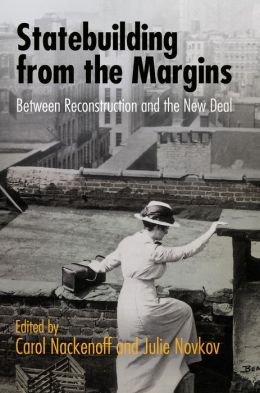
Essays on American Statebuilding from Reconstruction to the New Deal
Here are the blurbs:The period between the Civil War and the New Deal was particularly rich and formative for political development. Beyond the sweeping changes and national reforms for which the era is known, Statebuilding from the Margins examines often-overlooked cases of political engagement that expanded the capacities and agendas of the developing American state. With particular attention to gendered, classed, and racialized dimensions of civic action, the chapters explore points in history where the boundaries between public and private spheres shifted, including the legal formulation of black citizenship and monogamy in the postbellum years; the racial politics of Georgia's adoption of prohibition; the rise of public waste management; the incorporation of domestic animal and wildlife management into the welfare state; the creation of public juvenile courts; and the involvement of women's groups in the creation of U.S. housing policy. In many of these cases, private citizens or organizations initiated political action by framing their concerns as problems in which the state should take direct interest to benefit and improve society.
Statebuilding from the Margins depicts a republic in progress, accruing policy agendas and the institutional ability to carry them out in a nonlinear fashion, often prompted and powered by the creative techniques of policy entrepreneurs and organizations that worked alongside and outside formal boundaries to get results. These Progressive Era initiatives established models for the way states could create, intervene in, and regulate new policy areas—innovations that remain relevant for growth and change in contemporary American governance.
"An engaging and original contribution to our understanding of a critical period in American political development. By surveying a range of different policy domains within a single historical era, these essays effectively catalogue the multiple ways in which private citizens and associations leveraged and augmented the scope of state intervention."—Elizabeth Clemens, University of Chicago
"The Progressive Era remains as controversial as it is vital for understanding the contemporary United States. Carol Nackenoff and Julie Novkov have orchestrated a set of rich, detailed and evocative studies on themes ranging from prohibition, urban government, environmentalism, housing and juvenile justice that together make for a highly original contribution to our understanding of twentieth-century America."—Daniel Carpenter, Harvard University
Sunday, July 20, 2014
Sunday Book Roundup
This week over at Balkinization, Mark Graber reviews Looking for Rights in All the Wrong Places: Why State Constitutions Contain America’s Positive Rights by Emily Zackin (Princeton University Press). He calls the book "an excellent example of the wonderful scholarship that can be produced when exceptional scholars analyze state constitutions through the prism of state constitutional actors rather than through the prism of Warren Court liberalism."“In an enjoyable, well-researched, and well-edited compilation of eclectic case studies edited by Carol Nackenoff and Julie Novkov, scholars examine how non-state actors of various civic, social, and ideological groups during the Progressive Era brought the state back in as a means of achieving desired policy ends. The accounts are notable for drawing attention to previously unexamined policy areas that provide leverage for claims that statebuilding is not always rational or linear, the distinction between public and private actors is not so cut-and-dried, and that the agency of actors is bounded by institutions and prevailing ideologies of the public good. Taken together, the chapters of this important contribution to the subfield of American Political Development exemplify the quintessential nature of the fragmented, piecemeal, inconsistent, and often jarring development of the capacity of the American state."
Abigail Perkiss talks with New Books in History about her new book, Making Good Neighbors: Civil Rights, Liberalism and Integration in Postwar Philadelphia (Cornell University Press).“A recent trend in Native studies is tribal-level examinations on indigenous nation-building and the expanding definitions of sovereignty, as well as examinations regarding citizenship that are inevitably generated from such endeavors. Brian Klopotek, in Recognition Odyssey: Indigeneity, Race, and Federal Tribal Recognition Policy in Three Louisiana Indian Communities, brings a much-needed perspective to these conversations through his detailed analysis of the variability in the recognition process and how success or failure is predicated more on the intersections of larger historical social structures with specific circumstances than on objective qualifications. Using a multidisciplinary approach combining history, anthropology, and sociology, Klopotek has written an immensely impressive and supremely complex history of three distinct Indian communities in late twentieth-century Louisiana seeking state and federal recognition: the Tunica-Biloxi, the Jena Choctaws, and the Clifton-Choctaws.”
Tuesday, July 7, 2009
Novkov reviews memoir of Betty Roberts, first woman justice on the Oregon Supreme Court
v finds the book a "fascinating personal account" of Roberts' liberal feminist journey from a hardscrabble existence in Texas as a child to the Oregon Supreme Court. While Roberts is telling her own story, she narrates two other stories as well: one of a state and its sometimes tumultuous political development, and another of the path of professional American women from the era of the feminine mystique to an era of equal rights under the law. Roberts is justly proud of the progress she identifies in both of these narratives, but she is by no means complacent that feminism has completed its work. Overall, the book is a lively, arresting read in which Roberts establishes herself as a tireless worker and keen political strategist, but also speaks in a no-nonsense, lightly humorous, and quintessentially Oregonian voice....
Overall, the reader gains a sense of her as a relentless optimist, a woman who never allowed others’ negative attitudes or the adverse circumstances she faced to prevent her from moving forward. Her tone is deceptively conversational and down-to-earth, at times almost obscuring the extraordinary nature of her accomplishments: her repeated breaking of gender barriers with electoral successes in the state house and senate, her near capture of nominations for two state-wide offices, and her service as an appellate, and then supreme court judge. She achieved these milestones not just as a woman, but as a divorced woman with children in a time when both divorce and motherhood were seen as political millstones. While Roberts does not reflect extensively on why she was able to overcome these barriers, attributing it mostly to her persistence and good fortune, her narrative suggests that both elite Oregonians and Oregon voters appreciated her straightforward, matter-of-fact attitude.
Liberal feminism – the belief that women are inherently equal to men – has been a lifetime lodestone for Roberts. She writes frankly about her own path toward extending her personal liberal principles of equality to incorporate sexual orientation; she eventually performed Oregon’s first same-sex marriages in Multnomah County. She has less to say about race, but most of her active political career encompassed a period in Oregon’s politics when racial struggles tended to be more local and often occurred outside of formal political structures. The liberal feminist principle of choice also characterized Roberts’ active career, both in her decisions to run for various offices and her decision in 1985 to step back from active engagement in high-level law and politics. Some might frame her choice to follow her husband into retirement as an anti-feminist act, but Roberts clearly understands it as representing her own secure capacity to choose her life path with wisdom and sensitivity toward achieving an appropriate balance for herself and her family.
I recommend Roberts’ memoir as an engaging read for anyone interested in the real world of law and politics. In particular, it would make a great gift for a starting law student or for someone who has just completed the bar exam.
Monday, July 23, 2018
Should I do an edited collection? Advice to Authors
![]() |
| Credit: British Library Flickr |
- What works and what doesn’t?
- What did you learn the hard way or wish you had known from the start?
- Was it worth it in the end?
- Were there any unexpected benefits?
- “It's fun to work with/get feedback from people you know and trust, and I've had good experiences. In my experience, they are held hostage by the slowest author, so they tend to come out a few years later than initial (pessimistic) estimates. (I assume this blog post will be full of synonyms for ‘herding cats.’) I've been relatively fortunate that I haven't needed things to come out by a certain deadline for tenure/promotion, but I'd definitely warn junior scholars away from them if that was a concern.”
- “My thoughts on contributing, particularly for untenured folks, is to be very careful about committing to something highly specialized or getting too much ‘in the weeds’ on a project, because a publisher can and will pull the plug, even on a finished volume. If you can't easily repurpose the chapter for another project, this can really impair your publishing agenda.”
- “Here is my edited volume horror story: Workshop in 2011, I committed to publish piece (pre-tenure), book still languishing with [the publisher], although I corrected proofs about 2 (maybe 3) years ago (after tenure decision made without publication). AND I signed publication agreement that embargoes piece for 5 years after publication, which means that every year not published extends that embargo. AND I am now deeply embarrassed for the piece to appear with a current…date, when I wrote it using the literature of 2011. I will look like I completely ignored years of relevant work. No idea what is going on, but makes my last experience with an edited volume (5 years from conference to book) look speedy.”
- “I had a mixed experience with an edited volume…I was very flattered to be asked and spent a decent chunk of my pre-tenure time writing an original contribution. But then years passed in which nothing happened, publication-wise, and I worried about the chapter getting stale. During that time, I received zero credit for this piece of scholarship within my own institution. The piece did not make it into my tenure file. But there were positives, too. I learned some valuable things from writing the chapter, and participating in the volume put me in scholarly and real-life conversation with some people I really admire.”
- “One bandaid remedy to the staleness problem is to say in footnote 1: ‘This article was written in 2013.’ Obviously it’s still not great if your piece doesn’t come out until 5+ years after you wrote it (I’m in this situation with an article right now), but at least this tells the reader: ‘here is why you’re not seeing post-2013 literature in this piece, even though it has a 2019 publication date.’ I don’t usually post drafts on SSRN, academia.edu, or elsewhere, because I try to have only one version out there—the final one. But with the chapter I wrote several years ago whose edited volume shows no signs of coming out soon, I have asked the editors if I may post a draft of my chapter online, just to get it out there in some form.”
- Jim Jaffe: “As a contributor, I’ve been fortunate enough to have excellent editors, but the entire process is a long one and can take much longer than publishing an article in a journal. Of course, some or most edited volumes are not peer reviewed, so the quality of the finished product varies. One might want to be aware of these things.”
- Dan Klerman: “I have contributed chapters to several edited volumes and special issues recently. I have found the process to be very easy. The editors had a very light touch, and everything went smoothly. The only sticking point is that the slowest contributor (or editor) determines the publication date. So for one of these books, I think the delay between submitting my final draft and publication was about 4 years.”
- Intisar Rabb reports some good experiences as an author. However, as an author, “my main complaint is the time it takes to go from submission to publication, and the lack of communication from the editors sometimes in that process. I have often submitted materials, and 5 years later have waited on news of review or publication. I wish editors would be more timely and follow a schedule of publication that is reasonable (2 years is fine; 5 years is excessive). My other main complaint is the time it takes to go from solicitation [by the editors] to submission [by me], and the lack of communication from me sometimes in that process!”
- Julie Novkov: “Meet your deadlines, for the love of whatever deity you worship!”
- “It is important to ask yourself: how does this count for tenure or promotion? My view is that if you are counting on an edited volume to get you tenured or promoted you either shouldn’t do it or should not be promoted. I think it is important for individuals to have their own, independent pedigree and to use edited volumes as a way to advance an argument or to build something good for a field. Otherwise, do something else.”
- Kelly Kennington: “I have not yet participated in an edited volume as either an author or an editor, largely because my university does not count such publications or work toward tenure and promotion unless it is peer reviewed. Even if it is peer reviewed, edited collections count less than journal articles or, of course, monographs. I was asked to be an author in a couple of edited collections and said no both times to focus on my book and articles that will count toward my promotion file. I wish that the administration valued edited volume contributions, but until they do, I don't think I will get involved in one. My time for research and writing is so limited…that I have to be careful with how I choose to spend it.”
- “As an author, I have contributed to several…volumes. The stinkers are those that just throw stuff together. For me, the process is often indicative of the result. I have twice been asked last-minute to contribute to something in order to ‘round out’ a volume. In both cases, the urgency was mere pretense (the volumes only appeared years later) and the resulting volumes were [a hodge-podge]. I regret doing those, but was trying to help someone in both cases. The best volumes as an author, for me, have been those that resulted from a coherent project (often including a preceding meeting/conference) in which contributors get a good sense of what the larger aim is…Moral? Don’t contribute to volumes where the point/purpose is not clear. Edited volumes, like everything, should have an argument, say something new. If they don’t, skip. If they do, and you like the direction, embrace the goal and make your contribution an integral part of the overarching effort."
- Sally Gordon: “In terms of being an author, the difficulty that I have found is figuring out how best to craft my piece given [the parameters of the group publication].”
- Julie Novkov: “As an author, it’s great if you can read the other chapters as they are in progress, or at least the ones in the same section of the volume as yours. If you can get either the introduction or a sense of the broad themes the editors are emphasizing, that really helps too.”
- Jim Pfander: “I just published a chapter in a historical collection…It was on balance a worthwhile experience although the volume took a very long time to appear. The editors did a lovely job writing intros and other narrative material to stitch the various chapters together. Whether the end result has a genuine coherence and whether the chapters add to one another I cannot really say. But there’s more coherence than in some collections, partly because the editors encouraged the contributors to think in terms of historical periods.”
- Laura Edwards: “it seems like my best experiences with edited collections have come as a contributor, when the volume was connected to a conference, organized around the theme of the volume, where we presented papers and discussed them before revising. I suspect there are a lot of reasons why that seemed to work so well. For one, we all had an initial deadline for the conference, where we were all presenting. Then the discussion of the papers was really helpful in thinking through revisions and also making a cohesive volume."
- “In some sub-fields, people do book chapters, not law review articles (in part because it's hard to get published in a top law review coming from this sub-field). I wonder if people who do comparative legal history feel similarly? [A friend] felt that there was just no way to get around these volumes [in her field]. And she perceived a big risk in saying ‘no’ to participating in a volume that included big names in her field.”
- John Wertheimer: “As an author, a down side can be that sometimes scholarly indexes don’t include book chapters as they do journal articles and book titles. Consequently, the edited collection chapter can sort of fall off the edge of the earth, not to be heard from again. Folks working in your field might not ever find your piece if you publish it in an edited collection. It’s a line on your CV, but might not move the needle in the scholarly conversation.”
- Sally Gordon: “[One] difficulty with such projects is that so few of them are available digitally, and I have generally advised early career scholars that participating in a symposium issue of a journal is likely to yield more readership than a traditional edited volume."
- Dan Klerman: “Another issue is that book chapters seem to be hard for researchers to find. Anything you can do to increase visibility and citations (e.g. get the chapters indexed in the standard services, into Google Scholar, or somehow into Westlaw or Lexis) would be really helpful. Sometimes I feel like these chapters seldom get read (or cited).”
- Julie Novkov: “Every volume I’ve ever worked on, as a chapter author or as an editor, has been worth it!”
- Sally Gordon: “there are occasions where a new field emerges that can be productively defined and explained in an edited volume as nowhere else, because it includes multiple perspectives and examples of scholarship.”
- "There is apparently a new phenomenon called ‘pop up’ books. The idea is to do a volume on a super-expedited basis. Since everyone knows that's the deal in advance, I guess it solves some of the ‘herding cats’ issues that tend to arise later in the process.”
Tuesday, May 26, 2009
Book panels at Law & Society
anel, and there are several interesting book panels at this year's meeting. Here are some of the panels on new legal history books or other books of interest:Session Participants:
Chair: Mark A. Graber (University of Maryland)
Author: Robert Tsai (American University)
Reader: Susan Burgess (Ohio University)
Reader: Lief Carter (Colorado College)
Reader: Julie Novkov (University at Albany, SUNY)
Abstract:
Eloquence and Reason explores how the words in the Constitution become culturally salient ideas, inscribed in the habits and outlooks of ordinary Americans. Professor Robert Tsai employs the First Amendment as a case study to illustrate that liberty is achieved through the formation of a common language and a set of organizing beliefs. He explicates the structure of First Amendment language as a distinctive discourse and illustrates how activists, lawyers, and even presidents help to sustain our First Amendment belief system. When significant changes to constitutional law occur, they are better understood as the results of broader linguistic transformations. The book concludes by positing a model of judicial review in which jurists are responsible for the management of prevailing political discourses, quite apart from any obligations they may have to substantive conceptions of the good. These fascinating ideas will be explored by experts on the First Amendment, on constitutional culture, on law and society, and on legal discourse.
Author Meets Reader--In Reckless Hands: Eugenics, the Depression, and the New Deal Constitution, by Victoria Frances Nourse
Session Participants:
Chair: Brad Snyder (University of Wisconsin)
Author: Victoria Frances Nourse (Emory U/U of Wisconsin)
Reader: Catherine Albiston (University of California, Berkeley)
Reader: Dorothy Brown (Emory University)
Reader: Andrew Coan (University of Wisconsin)
Reader: Lawrence M. Friedman (Stanford University)
Reader: Anders Walker (Saint Louis University)
Abstract:
This book session addresses the history and historiography of a single United States Supreme Court case, best known among lawyers as a precursor to Roe v. Wade. The book tells the untold story of how a group of prisoners inside an Oklahoma prison during the Depression challenged eugenics in the case of Skinner v. Oklahoma, despite the fact that the Supreme Court had upheld its constitutionality in the infamous Buck v. Bell decision. The book not only addresses the actual, rather violent events, that led to the court's decision but also the key concepts that make the case incomprehensible today -- the court's invocation of equality, the idea of race and its role in eugenics, the transitional state of rights discourse in 1942, and the ways in which the criminology of the day propelled eugenics, as well as the New Deal constitutional revolution that led to the decision.
Session Participants:
Chair: Penelope Andrews (Valparaiso University)
Author: Henry J. Richardson (Temple University)
Reader: Maxwell O. Chibundu (University of Maryland)
Reader: Ruth Gordon (Villanova University)
Reader: Jeremy Telman (Valparaiso University)
Reader: Jeremy Levitt (Florida A & M University)
Abstract:
This book explores the birth of the African-American international tradition and, particularly, the roots of African Americans’ stake in international law. Richardson considers these origins as only formally arising about 1619, the date the first Africans were landed at Jamestown in the British North American colony of Virginia. He looks back to the opening of the European slave trade out of Africa and to the 1500s and the first arrival of Africans on the North American continent. Moving through the pre-Independence period, the American Revolution, the Constitutional Convention, and the Westward Migration, the book ends around 1820.
Session Participants:Fri, May 29 - 2:30pm - 4:15pm
Chair: Clyde Spillenger (University of California, Los Angeles)
Author: Ariela Gross (University of Southern California)
Reader: Bethany Berger (University of Connecticut)
Reader: Adrienne Davis (Washington University) Reader: Jason Gillmer (Texas Wesleyan University)
Reader: Neil Gotanda (Western University)
Abstract:
Unearthing the legal history of racial identity, Ariela J. Gross’s WHAT BLOOD WON’T TELL (Harvard University Press, 2008) examines the paradoxical and often circular relationship of race and the perceived capacity for citizenship in American society. It tells the history of race and racism in the U.S. through the lens of "trials of racial identity," from the early republic through the present, in cases involving people of European, African, and Indian ancestry, as well as immigrants from Asia and Mexico. The panel will include discussion from the perspectives of legal history, critical race theory, and American Studies.
Session Participants:
Chair: Taunya Banks (University of Maryland)
Author: Mary Dudziak (University of Southern California)
Reader: H. Kwasi Prempeh (Seton Hall University)
Reader: Henry J. Richardson (Temple University)
Abstract:
In Exporting American Dreams, Mary Dudziak recounts with poignancy and power the untold story of Marshall's journey to Africa. African Americans were enslaved when the U.S. constitution was written. In Kenya, Marshall could become something that had not existed in his own country: a black man helping to found a nation. He became friends with Kenyan leaders Tom Mboya and Jomo Kenyatta, serving as advisor to the Kenyans, who needed to demonstrate to Great Britain and to the world that they would treat minority races (whites and Asians) fairly once Africans took power. He crafted a bill of rights, aiding constitutional negotiations that helped enable peaceful regime change, rather than violent resistance.
Session Participants:
Chair: Mary Nell Trautner (University at Buffalo, SUNY)
Author: Ann Southworth (University of California, Irvine)
Reader: Robert Granfield (University at Buffalo)
Reader: Laura J. Hatcher (Southern Illinois University, Carbondale)
Reader: David Wilkins (Harvard University)
Abstract:
This session will discuss Ann Southworth's new book on conservative cause lawyers, focusing on the elements of the conservative coalition that create coherence and division, examining lessons for cause lawyering on the left, and discussing the impact of the recent political transformation on the power of conservative cause lawyers in the future.
Session Participants:
Chair: Rachel F. Moran (University of California, Berkeley)
Author: John Tehranian (Chapman University)
Reader: Lisa Hajjar (University of California, Santa Barbara)
Reader: Leila Kawar (Bates College)
Reader: Kathleen Moore (University of California, Santa Barbara)
Reader: Galya Ruffer (Northwestern University)
Abstract:
The Middle Eastern question lies at the heart of the most pressing issues of our time: the war in Iraq and on terrorism, the growing tension between preservation of our national security and protection of our civil rights, and the debate over immigration, assimilation, and our national identity. Yet paradoxically, little attention is focused on our domestic Middle Eastern population and its place in American society. Unlike many other racial minorities in our country, Middle Eastern Americans have faced rising, rather than diminishing, degrees of discrimination over time; a fact highlighted by recent targeted immigration policies, racial profiling, a war on terrorism with a decided racialist bent, and growing rates of job discrimination and hate crime. Oddly enough, however, Middle Eastern Americans are not even considered a minority in official government data. Instead, they are deemed white by law. In Whitewashed, John Tehranian combines his own personal experiences as a Middle Eastern American with an experts analysis of current events, legal trends, and critical theory to analyze this bizarre Catch-22 of Middle Eastern racial classification. He explains how American constructions of Middle Eastern racial identity have changed over the last two centuries, paying particular attention to the shift in perceptions of the Middle Easternerfrom friendly foreigner to enemy alien, a trend accelerated by the tragic events of September 11. Focusing on the contemporary immigration debate, the war on terrorism, media portrayals of Middle Easterners, and the processes of creating racial stereotypes, Tehranian argues that, despite its many successes, the modern civil rights movement has not done enough to protect the liberties of Middle Eastern Americans.
Session Participants:Sat, May 30 - 4:30pm - 6:15pm
Chair: Kunal M Parker (Cleveland Marshall University)
Author: Ritu Birla (University of Toronto)
Reader: Teemu Ruskola (Emory University)
Reader: Christopher Lawrence Tomlins (American Bar Foundation)
Reader: Leti Volpp (University of California, Berkeley)
Abstract:
Ritu Birla's book "Stages of Capital: Law, Culture and Market Governance in Late Colonial India" charts the legal institutionalization of 'the market' as an abstract object of governance and places commercial law at center of broader debates about colonial modernities, governmentality, and subject-formation. The argument traces the introduction of categories of public and private into colonial law relating to the economy, categories, Birla argues, that distinguish the realm of economy from that of culture. At the same time, Birla explores the ways in which the language of contract translates the "embedded" value-systems of indigenous kinship-based capitalists.
Session Participants:
Chair: Peter Yu (Drake University)
Author: Mark Kende (Drake University)
Reader: Penelope Andrews (Valparaiso University)
Reader: Taunya Banks (University of Maryland)
Reader: Miguel Schor (Suffok University)
Abstract:
The South African Constitutional Court has issued internationally prominent decisions abolishing the death penalty, enforcing socio-economic rights, allowing gay marriage, and promoting equality. By contrast, the U.S. Supreme Court has generally ruled more conservatively on similar questions. This book examines the Constitutional Court in detail to determine how it has functioned during South Africa's transition and compares its ruling to those of the U.S. Supreme Court on similar rights issues. The book also analyzes the scholarly debate taking place in South Africa about the Constitutional Court. It furthermore addresses the arguments of those international scholars who have suggested that constitutional courts do not bring about social change. In the end, the book highlights a transformative pragmatic method of constitutional interpretation, a method the U.S. Supreme Court could employ. This Author meets Readers panel will consist of scholars who discuss, critique, and expand on the book's themes.
Tuesday, February 17, 2026
JACH (Winter 2026)
Sovereign Power and the Sweeping Clause
John Mikhail
Contemporary disputes involving the separation of powers take on a different light when they are framed in terms of powers of the Government of the United States itself. The “all other powers” provision of the Necessary and Proper Clause distinguishes government powers from executive powers and gives Congress distinct legislative authorities with respect to each of these categories.Symposium: A Tribute to Kenneth Kersch
Ken Kersch and the New Legal History: Beyond the Internalist/Externalist Divide
Dennis J. Wieboldt III
Sanford Levinson
Ken Kersch’s remarkable scholarship generates profound questions about the difficulties—and even limits—of truly engaging with those who do not share certain ontological or epistemological commitments.Ken Kersch and the Meaning of Development: Law, Ideas, and the Politics of Constitutional Change
Michael A. Dichio and Paul E. Herron
Ken Kersch showed us that constitutional development is not a story of inevitable progress, but of contested traditions, shifting coalitions, and the discontinuous, non-linear unfolding of political development.
Broadening The Terrain of Political and Constitutional Thought, Unmasking Delusional Constitutional Arguments
Carol Nackenoff
By broadening the terrain of political and constitutional thought, Kersch brilliantly examined how constitutional faiths are forged and “law stories” are woven to create common identities.
The Roberts Court and the Past and Future of Religion as a Constitutional Concern
Julie Novkov
The Roberts Court’s reconfiguration of free exercise and anti-establishment doctrine is not a simple conservative backlash. Rather, it creates a viable path for empowering a right-wing religious political project.The Roberts Court’s Reconstruction of Church and State
George Thomas
Chief Justice John Roberts’s opinion in Trinity Lutheran v. Comer (2017) breaks with past understandings of the Free Exercise Clause by merging a state discriminating against religious individuals with a state declining to fund religious institutions.Five Lessons from Ken Kersch’s Conservatives and the Constitution for the Present Moment
James E. Fleming and Linda C. McClain
Ken Kersch’s Conservatives and the Constitution helps us see the second Trump Administration, not as an aberration, but as the fulfillment of certain conservative ideas that have been “hiding in plain sight.”
Forgetting Nothing, Learning Nothing: Constitutional Scholarship and the Political Development of the Modern Supreme Court
Calvin TerBeek
The "Lochner Era" was invented decades after the fact, and the 1970s were legal liberalism's zenith, not its decline. Constitutional law professors' standard story of legal liberalism gets it wrong on the front and back ends.
States’ Rights and Civil Rights: Barry Goldwater, Bill Buckley, Richard Nixon, and Southern Realignment
Sean Beienburg
Did invocations of states’ rights by southern segregationists permanently discredit constitutional federalism? A re-examination of the 1960s political realignment suggests Americans can embrace—or re-embrace—this feature of our Constitution, while remembering state autonomy is a strong presumption but one that has always been checked by the Constitution’s rights guarantees.
The Phenomenal Constitution
Austin Steelman
In Conservatives and the Constitution, Ken Kersch demonstrated that the continually reimagined Constitution is a “phenomenon” in American life, not an epiphenomenal result of more substantial politics.
Orthodox Originalism and Conservative Identity after Ken Kersch
Logan Everett Sawyer III
Kersch’s Conservatives and the Constitution showed not just that the conservative political movement shaped arguments about the Constitution, but that arguments about the Constitution were key to transforming a varied group of interests disaffected by New Deal and Great Society Liberalism into a coherent political identity and thus a powerful political order.
Friday, December 17, 2010
CFP: Race, Gender, and Sexuality in Law and the Development of the American State
Call for Papers: Race, Gender, and Sexuality in Law and the Development of the American StateThe Center for Law, Justice & Culture at Ohio University invites proposals for a workshop, “Race, Gender, and Sexuality in Law and the Development of the American State” to be held May 20 - 21, 2011. This two-day meeting will bring together scholars in politics, history and law to address emerging ideas about race, gender and sexuality in the development of governmental institutions.
Work on the intersection of identity and politics began by examining how race, gender, and sexuality inform the political and civic status of citizens. Increasingly, scholars are now demonstrating that race, gender, and sexuality are central to the development of legal and political institutions and their capacity to carry out administrative and regulatory policies. Through the legal rules of marriage, political access, and crime--to name a few--the categories of race, gender, and sexuality become entrenched in formal institutions of the state. Race, gender, and sexuality thus remain available for the establishment, operation, and legitimation of institutions.
We welcome proposals from scholars of American political development and related fields to directly explore and question the role of race, gender, and sexuality in institutional development and to further discuss the impact this trend on our scholarship and the disciplines of political science, law and history more broadly. Please submit a proposal of no more than 500 words describing a past or current project that addresses the following questions: How does a focus on identity or identities shift our understanding and interpretation of legal and political development? How does a focus on law and political development change our understandings of identity? What role does race, gender and sexuality play in conceptualizing change or continuity? What mechanisms or processes can we illuminate? What role do political actors play in the relationship between institutions and identity?
For the workshop, participants will prepare a draft article- or chapter-length essay either building on work they have already done or from a new research project that they believe can shed light on these issues. Workshop participants will circulate their drafts a few weeks in advance of the workshop. We will ask all to contribute to the discussion at the workshop and respond to the written work of fellow participants in a round-robin system of commenting that we will organize in advance. The workshop is sponsored by a grant from the Law and Social Sciences Division of the National Science Foundation, which will cover the costs of travel, lodging, and meals for participants.
Please submit your proposal, along with contact information, to sullivak@ohio.edu by December 22, 2010.
Please direct any questions to the workshop organizers:
Julie Novkov
Professor and Director of Graduate Studies
Departments of Political Science and Women’s Studies
University at Albany, SUNY
jnovkov@albany.eduKathleen Sullivan
Associate Professor
Department of Political Science
Ohio University
sullivak@ohio.eduPriscilla Yamin
Assistant Professor
Department of Political Science
University of Oregon
pyamin@uoregon.edu
Saturday, April 28, 2018
Weekend Roundup
- The Organization of American Historians recently announced the winners of its annual awards. You can see them all here.
- Over in JOTWELL's Worklaw section, you'll find an admiring review of legal historian Deborah Dinner's "Beyond 'Best Practices': Employment-Discrimination Law in the Neoliberal Era," Indiana Law Journal (2017). Reviewer Henry L. Chambers, Jr. (Richmond School of Law) suggests that it should be required reading for anyone studying employment discrimination law.
- On May 14, 2018, from 14:15 - 15:15, the seminar Legal Transfer in the Common Law World continues at the Max Planck Institute for European Legal History with a presentation by Valentin Seidler, University of Vienna, Legal Transfers and Development in British Colonies in the 20th Century?
- “Harvard Law School Professor Intisar Rabb has been awarded the Trailblazer Award by the Massachusetts Black Lawyers Association. Rabb, the director of Islamic Legal Studies at HLS, was recognized on March 22 at the organization’s 45th anniversary gala.” More.
- Congratulations to Anne Fleming, Georgetown Law, upon her election to the Board of Trustees of the Business History Conference.
- Keith Whittington’s Workshop in Constitutional Development at Princeton had quite a double bill last Monday: "The Jacksonian Makings of the Taney Court," by Mark Graber, University of Maryland Francis King Carey School of Law; and "Building the Administrative State: Courts and the Admission of Chinese Persons to the United States, 1870s-1920s," by Carol Nackenoff, Swarthmore College, and Julie Novkov, State University of New York-Albany.
- A recording of the ceremony for my installation at Georgetown Law as Carmack Waterhouse Professor of Legal History is here. DRE
- ICYMI: A powerful memorial in Montgomery remembers the victims of lynching in WaPo. And here. Also the HLS press release on Tomiko Brown-Nagin's appointment as dean of the Radcliffe Institute for Advanced Studies. Rebeca Zietlow on the fiftieth anniversary of the Fair Housing Act, over at Faculty Lounge.
Saturday, February 15, 2025
Weekend Roundup
- Over at JOTWELL, Josh Gupta-Kagan has posted an admiring review of Laura Briggs, Haaland v. Brackeen and Mancari: On History, Taking Children, and the Right-Wing Assault on Indigenous Sovereignty, 56 Conn. L. Rev. 1121 (2024).
- In a recent episode of Strict Scrutiny, Kate Shaw and Leah Litman speak with Jonathan Gienapp (Stanford University) "about what originalists get wrong
about history and how the founders thought about the law."
- Another report of that “wide-ranging discussion” at Stanford Law between Jonathan Gienapp and Michael McConnell “on how history, law, and politics intersect in constitutional interpretation” (SLS).
- Is it surprising that, in these times, so many of the new leaders of the Organization of American Historians are scholars of legal and constitutional history? Congratulations to Annette Gordon-Reed, President; Marc Stein, President Elect; and Donna Clare Schuele, a new member of the Executive Board. Margot Canaday is a continuing member of the Executive Board.
- Melissa Murray, NYU Law, will discuss History and the Courts with Christen Hammock Jones, doctoral student in American legal history at University of Pennsylvania; Christina D. Ponsa-Kraus, professor at Columbia Law, and Noah Rosenblum, NYU Law, at Brooklyn College on April 2 from 11:00 am to 12:15 pm. Anna Law, Brooklyn College, will moderate.
- The recording of that terrific National Constitution Center town hall on Reconstruction and the Constitution: A Historical Perspective is now available online.
- John Q. Barrett on FDR's plans to resist a negative decision from the U.S. Supreme Court in the Gold Clause Cases (Jackson List).
- Julie Novkov reviews Anthony Michael Kreis’s Rot and Revival: The History of Constitutional Law in American Political Development (S-USIH).
- Talbot Publishing has published an edition of Gottfried Wilhelm Leibniz’s Model of Certainty or Demonstrations in Law Expounded in the Doctrine of Conditions (1669), “a unique, unprecedented collection of Roman and canon law rules regarding the application of conditions in contract, inheritance and marriage law. “
- ICYMI: Jack Goldsmith on Departmentalism and DJT (Executive Functions). Scott Bomboy on the History of the Constitution and Tariffs (NCC).
- Update: A compilation of trackers of DJT's executive orders by the Pence Law Library at American University-Washington College of Law. H/t: MD.
Weekend Roundup is a weekly feature compiled by all the Legal History bloggers.
Tuesday, April 17, 2012
Gilman, Graber, and Whittington's "American Constitutionalism"
This is a book of cases and materials for teaching the history of American constitutionalism, and we think it is something of a landmark in the extent to which it integrates a developmental perspective into constitutional law teaching and makes available historical context and non-U.S. Supreme Court materials for constitutional scholars and instructors. The book includes everything from Gibbons v. Ogden to Daniel Webster’s Speech opposing a military draft, from Missouri v. Holland to Theodore Roosevelt’s remarks on presidential power, from Printz v. United States to Caroline Krass’ memo on the use of military force in Libya. Volume 2 will provide similar coverage of constitutional rights and liberties, from Fletcher v. Peck to Amy v. Smith, from Goodridge v. Department of Public Health to Attorney General Ashcroft’s letter to the National Rifle Association.More particularly:
Julie Novkov, University of Albany, enthuses:Constitutionalism in the United States is not determined solely by decisions made by the U.S. Supreme Court. Moving beyond traditional casebooks, American Constitutionalism takes an innovative approach to the teaching of American constitutional law and politics. Organized into the standard two-semester sequence, with volume one covering institutions and volume two covering rights and liberties, the text is distinctive in presenting the material in a historical organization within each volume and fully integrating the material into a political and legal context for students.
Many scholars have deepened our understanding of the development of our constitutional system, while also providing more interesting and sophisticated analyses of the political forces that shape constitutional debates and outcomes. American Constitutionalism has incorporated these lessons about how our constitutional system actually works while at the same time preserving what instructors and students find most engaging about the topic. These new materials allow instructors to develop more interesting explanations and debates about familiar issues, while at the same time introducing students to vitally important questions that are often excluded from Court-centered textbooks.
American Constitutionalism offers a number of useful features. It covers all important debates in American Constitution (not just those that have been recently litigated before the Supreme Court), organized by historical era. It incorporates readings from all the prominent participants in those debates. It clearly lays out the political and legal contexts of those materials. It integrates more documents and cases than any other text on the market, including decisions made by elected officials and state courts. The book offers numerous pedagogical features, including topical sections within each historical chapter, bulleted lists of major developments, explanatory headnotes for the readings, questions on court cases, illustrations and political cartoons, tables and figures, and suggested readings. The text is supported by websites for students and teachers with extensive supplementary materials, including additional readings, sample syllabi, instructor guides, and presentation slides.
American Constitutionalism marks a new age in the teaching of constitutional law. The book elegantly presents a historicized and developmental account that unveils the political and institutional roots of contemporary constitutional controversies. History and politics come alive for students as they engage constitutional problems as concrete political and legal struggles with stakes that span all American institutions, not just the courts. After using this text, I can't imagine teaching constitutional law any other way.Other blurbs, the table of contents, and sample chapters are here.
Update
"Con Law in the Round," Ken Kersch's Balkinization post on American Constitutionalism is here.
Saturday, May 2, 2009
Thanks to Robert Tsai!
his unfolding new project on failed and American constitutions, and we will follow the news here!Wednesday, December 17, 2025
A Symposium in Honor of Ken Kersch
[We have the following announcement from Boston College’s Clough Center for the Study of Constitutional Democracy. DRE]
Constructing the Constitutional Imagination: A Symposium in Honor of Ken I. Kersch
On February 20, 2026, the Clough Center will host a conference in honor of Ken I. Kersch, who passed away last November. In addition to directing the Clough Center from 2008 to 2012, Kersch served as a professor in BC's Political Science Department, where he taught classes on American conservatism, political thought, constitutional development, and civil liberties. A revered teacher and author of 5 books, Kersch was the recipient of, among other honors, the American Political Science Association's 2020 C. Herman Pritchett Award for the best book on law and courts.
The Clough Center's conference will coincide with the publication of a special issue of the Journal of American Constitutional History that engages with Kersch's work in political science, history, and law. Speakers include Aziz Rana (Boston College), Sophia Lee (Penn), Mark Graber (Maryland), Justin Dyer (UT Austin), Mary Ziegler (UC Davis), Sanford Leinvson (UT Austin), Julie Novkov (SUNY Albany), Jonathan Gienapp (Stanford), Rogers Smith (Penn), Linda McClain (BU), James Fleming (BU), George Thomas (Claremont McKenna), Logan Sawyer (Georgia), Michael Dichio (Utah), Paul Herron (Providence), Sean Beienburg (Arizona State), Clement Fatovic (Florida International), Austin Steelman (Clemson), and Calvin TerBeek (Claremont McKenna).
The Law School and Political Science departments are co-sponsoring this event. [Register here to attend.]
Update: The program is here.
Tuesday, March 29, 2011
Book Review Edition of Tulsa Law Review
Two polemics inspired this issue of the Tulsa Law Review. Writing in the May 2009 Texas Law Review, Levinson bemoaned the decline of book reviews in law student edited journals. Noting that a majority of the so-called "top" law reviews published no book reviews at all, he complained of the "willful refusal ... of America's leading law reviews to serve as a venue for serious discussion of important books relevant ... to thinking about law." n1 In his view, "both serious scholars and general readers alike" regard "book reviews as invaluable filtering mechanisms" for determining what of the many works published merit reading and which are best left on library shelves. Graber, in the spring 2002 issue of Law and Social Inquiry, had earlier condemned the failure of prominent law professors to engage relevant political-science literature. ....
Both are delighted that the reviews that follow not only think critically about major books recently published on constitutionalism, jurisprudence, and legal history, but also provide opportunities either for law professors to discuss works by political scientists/historians or for political scientists/historians to engage law professors on subjects of mutual interest and concern.
The volume includes reviews by Mark Tushnet, Gerald Rosenberg, Jamal Greene, Daniel Hamilton, Ernest Young, Rebecca Zietlow, Stephen Feldman and Julie Novkov, among others, who cover a wide range of works on subjects of interest to legal historians. The book review's table of contents is here. The volume itself is accessible through Lexis-Nexis.