I want to thank the editors of the Legal History Blog for having me as a guest blogger. It’s an honor and I’m delighted to have my words on here. As Professor Tani mentioned in her introduction, I recently published a book and I want to tell you about it.
My book is called Injury Impoverished: Workplace Accidents,
Capitalism, and Law in the Progressive Era. It's my first book and is based on my dissertation. I think of the book as a study in
the intellectual life of governance - how power relationships are
conceptualized, mostly by powerful people, and what concepts are implied within
power relationships, whether or not anyone actually thought them explicitly. In
my view, inquiry is enriched by emphasis on both of these facets, the actual
thoughts of people and the implicit logics enacted within institutional
practices. I’m aware that this all sounds pretty abstract. In addition to
talking about abstract matters, I also tried to foreground the real human
beings who died, suffered, and lived despite all the harms to which
working-class people are subjected. In my view, that dying and suffering was (and
still is) largely organized by the kinds of abstractions I talk about in the
book.
Showing posts with label US legal history. Show all posts
Showing posts with label US legal history. Show all posts
Wednesday, July 1, 2020
Thursday, April 16, 2020
AHR Roundtable on Age
- Ishita Pande (Queen's University), "Power, Knowledge, and the Epistemic Contract on Age: The Case of Colonial India": on the implementation of age-of-consent legislation in high courts across colonial India
- Corrie Decker (University of California, Davis), "A Feminist Methodology of Age Grading and History in Africa": on how colonial authorities expanded the legal importance of chronological age while precolonial African societies assessed age in relative terms (juniors versus seniors). Faced with two incommensurable systems for understanding life stages, African women found new ways to assert a sense of generational belonging and new definitions of maturity.
- Bianca Premo (Florida International University), "Meticulous Imprecision: Calculating Age in Colonial Spanish American Law": on how indigenous, enslaved, and property-less individuals in Spain’s American colonies multiplied privileges based on age calculations that proved situational rather than numerically exact. The ages that Spanish American officials set down on paper in criminal trials, censuses, and freedom suits derived from complicated cultural equations; Premo contends that age proved a critical guarantee of rights, a language colonial subjects could use to turn legal incapacities into beneficial protections.
- Ashwini Tambe (University of Maryland), "The Moral Hierarchies of Age Standards: The UN Debates a Common Minimum Marriage Age, 1951-1962": on United Nations efforts to consider a universal minimum age of consent for marriage. This involved a series of tense deliberations, as former colonial powers framed early and forced marriage in newly independent states as forms of slavery. Debates about a universal marriage age came to mark differences between imperial powers and decolonizing nations.
- Corinne Field (University of Virginia) and Nicholas Syrett (University of Kansas), "Age and the Construction of Gendered and Raced Citizenship in the United States": on how the postbellum state relied upon age to reinforce inequalities rooted in female dependence and chattel slavery. Congress denied equal benefits to the families of black Civil War soldiers because they lacked adequate proof of age. Postbellum legal majority differentiated between men and women, shoring up gender inequality even as women gained new rights and opportunities. Chronological age, Field and Syrett conclude forcefully, is not a neutral fact, but a vector of power through which officials and ordinary people construct and contest the boundaries of citizenship and belonging.
Further information is available here.
--Mitra Sharafi


Tuesday, December 31, 2019
Thank you, David Schwartz!
We are happy to have had Professor David S. Schwartz (University of Wisconsin) join us as our last guest blogger of the decade. Here are his posts from December 2019:
- Letting Go
- How do you find good cover art?
- Don't Fear the Index
- Texas v. United States and the Recurring Myth of State Destruction
- Revisionism and Rehabilitation
- Originalism and the Limits of Semantic Meaning
Thank you for sharing your insights on everything from indexing to originalism, Prof. Schwartz!
--Mitra Sharafi
Friday, November 29, 2019
Thank you, Dirk Hartog!
We are delighted to have had Professor Dirk Hartog (Princeton) join us as guest blogger in November 2019. His blogposts are Legal History Through a Rear View Mirror 1, 2, 3, and 4, along with this post on the opening of the Betsy Clark Living Archive. Thank you for sharing your thoughts on everything from when to drop a project to the history (and coolness) of our field, Prof. Hartog!
--Mitra Sharafi
--Mitra Sharafi
Wednesday, November 13, 2019
Legal History Through a Rear View Mirror 2
Back in the later 1970s, when I was beginning work on what became my first book, I had a
revelation. At the New-York Historical Society, in the papers of several merchants, I found and began reading the “waterlot grants” that the eighteenth century Corporation of the City of New York (basically the city government) negotiated with those merchants. Through those complex deeds, the city offered shoreline that it owned (according to its corporate charter), in exchange for commitments on the part of merchants to construct “public” wharves and slips and the streets that bordered the shore, to build the infrastructure of a mercantile city. Such “waterlot grants,” which it turned out filled many pages of the municipal records, as well as the private papers of merchants, allowed me to explore how an early modern corporation “worked.”
In doing so, and in constructing a narrative founded on the discontinuity between the corporate history I was studying and modern corporate histories, I built on historiographical insights that came from several literatures that I had been reading into. My readings were ones characteristic of a 1970s graduate student who wanted to become an American legal historian. That is, I drew from English municipal histories, from some of the classics of English legal history (particularly my reading of Frederick Maitland), from my critical engagement with the regnant texts in American corporate history at that time, from the growing literature on civic republicanism, and from my crude understanding of Foucault’s arguments in Les Mots et Les Choses (which had not long before appeared in English as The Order of Things). I was also trying to make space for myself within a legal historical field that I felt was defined by the terms articulated by Morton Horwitz (my teacher), in his first Transformation of American Law.
I spent many hours reading and rereading those waterlot deeds. I wrote many pages that
unpacked much of the arcane property law doctrine that waterlot grants incorporated. In the end, I managed to put together what at the time felt to me like a satisfying portrait of how a waterlot grant exemplified early modern governance. I argued that corporate leaders were solving a fundamental problem of the time: about how to achieve necessary public purposes — like building wharves and docks for a seafaring city and also street construction and cleaning —without either a municipal workforce or a capacity to levy taxes. By exchanging waterlots for services and development by individual proprietors, the corporation enlarged the borders of the city, and it laid the foundation for what would become a global port, a world city.
In those days, I relentlessly situated those waterlot grants within the history of the corporation, implicitly situating the “municipal corporation” of New York City within the history of the business corporation. My attention was always focused on the public-private split, and little else. Which is not really surprising, given how much attention the public-private split held at that time in what I was reading, in the contemporary and argumentative field of legal history.
At various times since then, I have wondered about what I did not attend to. At the time I thought little about the actual shipping that those merchants who received waterlot grants engaged in. The commercial life of the city I left to others, who would explore what the merchants actually did with their properties. I thought about the waterlots through the lens of a certain kind of 1970s political economy, what might be called an “older” history of capitalism, but not through the lens of the transAtlantic slave trade. And not through what later would be called the “new” history of capitalism. And I left the environmental impacts of reclaiming land from the rivers and from the sea to others, to those who were plying the then new field of environmental history.
Still, I thought I had worked through all the ways that those waterlot grants exemplified
eighteenth century private property law. And I had read them closely for those purposes.
And yet, now I find myself reading Debjani Bhattacharyya’s new book on ecology and Calcutta, Empire and Ecology in the Bengal Delta. And that offers a new revelation. Back in the late 1970s it never occurred to me that watery spaces are a very odd form of property, if property at all. It never occurred to me, though it should have, that both the merchants and the members of the corporation (who often were the same men) were engaged in a difficult and imaginative enterprise, of making land from water. I never really thought about the watery spaces that surrounded the city as a commons. Or if I did, implicitly I might have assumed (in a quasi Turnerian way) that those watery spaces were “empty lands” awaiting settlement and colonization by “the city.” And I probably assumed, as legal historians often do, that there was a body of private law — property law — that could be drawn out of medieval and early modern England to be applied by the legally adept commercial leaders of the tiny colonial city of New York. English property could be naturally and unproblematically plastered on to the space that was, or would be, the waterlot. Law was a known and eminently useful set of resources.
But from Bhattacharyya, I learn that watery places are something more than space waiting for an expanding city. Her book “maps the transformation of what may be called soaking ecologies into a political economy of property from the late eighteenth century onward. This process of transformation happened through a braiding together of two registers of colonial power. . . One was the legal register where the ecologically variable entities of the marshes and bogs were literally translated into landed property through naming, classifying[,] and arbitrating ownership.
The other technological register consisted of the operations of drying and draining the landscape.” In addition she theorizes brilliantly about the ways that the process of making watery space into land is followed by processes of “forgetting,” that make the new, the reclaimed, land look as it was always merely landed property, and nothing else.
The conversion of watery places into land is and was arduous legally, just as it was physically difficult. To produce land — the draining and drying of land — required creative and innovative lawyering. There were models in the available legal past (I remember looking at deeds used for wharves built on early modern English cities. And there was, though I didn’t attend to them, many models available from Dutch and Flemish history). But turning water into land was (always? inevitably?) a bespoke process.
There is so much I would do differently today, if I chose to write once again about New York’s waterlot grants. Bhattacharyya’s book shows some of the ways I would do so. In particular, I would read those deeds differently. They needed different contexts. They needed the kind of imaginative work that Bhattacharyya’s book exemplifies to reveal what lay beneath (or in the water). They needed attention to the legal processes involved in draining and drying. And they needed attention to the work of forgetting.
I write this not apologetically. Rather, it is to remind myself (and others) that we always write
within a historically given disciplinary and interdisciplinary context. And those contexts change. We learn different things. We attend to what seems “right” at the time. Some older ways of doing things fall by the wayside. Others reappear. We are not prisoners of our time, but we live in a historical moment. And we live with constrained historical imaginations.
--Dirk Hartog
revelation. At the New-York Historical Society, in the papers of several merchants, I found and began reading the “waterlot grants” that the eighteenth century Corporation of the City of New York (basically the city government) negotiated with those merchants. Through those complex deeds, the city offered shoreline that it owned (according to its corporate charter), in exchange for commitments on the part of merchants to construct “public” wharves and slips and the streets that bordered the shore, to build the infrastructure of a mercantile city. Such “waterlot grants,” which it turned out filled many pages of the municipal records, as well as the private papers of merchants, allowed me to explore how an early modern corporation “worked.”
In doing so, and in constructing a narrative founded on the discontinuity between the corporate history I was studying and modern corporate histories, I built on historiographical insights that came from several literatures that I had been reading into. My readings were ones characteristic of a 1970s graduate student who wanted to become an American legal historian. That is, I drew from English municipal histories, from some of the classics of English legal history (particularly my reading of Frederick Maitland), from my critical engagement with the regnant texts in American corporate history at that time, from the growing literature on civic republicanism, and from my crude understanding of Foucault’s arguments in Les Mots et Les Choses (which had not long before appeared in English as The Order of Things). I was also trying to make space for myself within a legal historical field that I felt was defined by the terms articulated by Morton Horwitz (my teacher), in his first Transformation of American Law.
I spent many hours reading and rereading those waterlot deeds. I wrote many pages that
unpacked much of the arcane property law doctrine that waterlot grants incorporated. In the end, I managed to put together what at the time felt to me like a satisfying portrait of how a waterlot grant exemplified early modern governance. I argued that corporate leaders were solving a fundamental problem of the time: about how to achieve necessary public purposes — like building wharves and docks for a seafaring city and also street construction and cleaning —without either a municipal workforce or a capacity to levy taxes. By exchanging waterlots for services and development by individual proprietors, the corporation enlarged the borders of the city, and it laid the foundation for what would become a global port, a world city.
In those days, I relentlessly situated those waterlot grants within the history of the corporation, implicitly situating the “municipal corporation” of New York City within the history of the business corporation. My attention was always focused on the public-private split, and little else. Which is not really surprising, given how much attention the public-private split held at that time in what I was reading, in the contemporary and argumentative field of legal history.
At various times since then, I have wondered about what I did not attend to. At the time I thought little about the actual shipping that those merchants who received waterlot grants engaged in. The commercial life of the city I left to others, who would explore what the merchants actually did with their properties. I thought about the waterlots through the lens of a certain kind of 1970s political economy, what might be called an “older” history of capitalism, but not through the lens of the transAtlantic slave trade. And not through what later would be called the “new” history of capitalism. And I left the environmental impacts of reclaiming land from the rivers and from the sea to others, to those who were plying the then new field of environmental history.
Still, I thought I had worked through all the ways that those waterlot grants exemplified
eighteenth century private property law. And I had read them closely for those purposes.
And yet, now I find myself reading Debjani Bhattacharyya’s new book on ecology and Calcutta, Empire and Ecology in the Bengal Delta. And that offers a new revelation. Back in the late 1970s it never occurred to me that watery spaces are a very odd form of property, if property at all. It never occurred to me, though it should have, that both the merchants and the members of the corporation (who often were the same men) were engaged in a difficult and imaginative enterprise, of making land from water. I never really thought about the watery spaces that surrounded the city as a commons. Or if I did, implicitly I might have assumed (in a quasi Turnerian way) that those watery spaces were “empty lands” awaiting settlement and colonization by “the city.” And I probably assumed, as legal historians often do, that there was a body of private law — property law — that could be drawn out of medieval and early modern England to be applied by the legally adept commercial leaders of the tiny colonial city of New York. English property could be naturally and unproblematically plastered on to the space that was, or would be, the waterlot. Law was a known and eminently useful set of resources.
But from Bhattacharyya, I learn that watery places are something more than space waiting for an expanding city. Her book “maps the transformation of what may be called soaking ecologies into a political economy of property from the late eighteenth century onward. This process of transformation happened through a braiding together of two registers of colonial power. . . One was the legal register where the ecologically variable entities of the marshes and bogs were literally translated into landed property through naming, classifying[,] and arbitrating ownership.
The other technological register consisted of the operations of drying and draining the landscape.” In addition she theorizes brilliantly about the ways that the process of making watery space into land is followed by processes of “forgetting,” that make the new, the reclaimed, land look as it was always merely landed property, and nothing else.
The conversion of watery places into land is and was arduous legally, just as it was physically difficult. To produce land — the draining and drying of land — required creative and innovative lawyering. There were models in the available legal past (I remember looking at deeds used for wharves built on early modern English cities. And there was, though I didn’t attend to them, many models available from Dutch and Flemish history). But turning water into land was (always? inevitably?) a bespoke process.
There is so much I would do differently today, if I chose to write once again about New York’s waterlot grants. Bhattacharyya’s book shows some of the ways I would do so. In particular, I would read those deeds differently. They needed different contexts. They needed the kind of imaginative work that Bhattacharyya’s book exemplifies to reveal what lay beneath (or in the water). They needed attention to the legal processes involved in draining and drying. And they needed attention to the work of forgetting.
I write this not apologetically. Rather, it is to remind myself (and others) that we always write
within a historically given disciplinary and interdisciplinary context. And those contexts change. We learn different things. We attend to what seems “right” at the time. Some older ways of doing things fall by the wayside. Others reappear. We are not prisoners of our time, but we live in a historical moment. And we live with constrained historical imaginations.
--Dirk Hartog
Friday, November 1, 2019
Welcome, Dirk Hartog!
We are delighted that our guest blogger in November 2019 is Prof. Hendrik Hartog, Class of 1921 Bicentennial Professor in the History of American Law and Liberty and Professor of History Emeritus at Princeton University.

Hendrik "Dirk" Hartog has spent his scholarly life obsessed with the difficulties and opportunities that come with studying how broad political and cultural themes have been expressed in everyday legal conflicts. He has worked on everything from the history of marriage to old age to slavery. His books include Public Property and Private Power: the Corporation of the City of New York in American Law, 1730-1870 (1983), Man and Wife in America: a History (2000), Someday All This Will Be Yours: A History of Inheritance and Old Age (2012), and The Trouble with Minna: A Case of Slavery and Emancipation in the Antebellum North (2018). He has been awarded a variety of national fellowships and lectureships, and for a decade he co-edited Studies in Legal History, the book series of the American Society for Legal History. In 2016, he was made an Honorary Fellow of the American Society for Legal History. Before coming to Princeton, he taught at the University of Wisconsin Law School (1982-92) and at the Indiana University (Bloomington) School of Law (1977-82).
Currently, Prof. Hartog is beginning work on a history of property law as a teaching subject, focusing on the significance of the Cold War as an underlying presence.
Dirk Hartog has trained generations of legal historians of the US, the British empire, South Asia, and beyond.
Welcome, Dirk!
--Mitra Sharafi
--Mitra Sharafi
Tuesday, May 21, 2019
New Stories about the Warren Court
In Locking Up Our Own, James Forman described the work of public defenders as “the unfinished work of the civil rights movement.” Nearly two generations after the Warren Court’s due process revolution—which was supposed to protect minorities and the poor in the criminal justice system—our country is grappling with mass incarceration (and mass arrests, according to recent scholarship that has shed light on the much larger proportion of misdemeanor cases that never end in imprisonment). It seems that not a day goes by without another story in the papers highlighting the themes of poverty, race, and criminal (in)justice.
In recent years, there’s been a reexamination of the due process revolution, especially as we’re confronting a carceral state with a prison population made up disproportionately of racial minorities and the poor. To explain how we got to this point, Linda Greenhouse and Michael Graetz argued in The Burger Court and the Rise of the Judicial Right that any progress that the Warren Court had made was undone by the subsequent Burger Court’s counter-revolution. By contrast, William Stuntz argued that the Warren Court had erred by creating procedural rights rather than establishing substantive rights. The technical nature of proceduralism, he maintained, worsened inequality in the criminal justice system.
I don’t disagree with the main contours of these accounts. But they share a premise that the Warren Court was indeed revolutionary and that the justices took sides in the “battle” between crime control and due process. Herbert Packer famously coined the “Two Models of the Criminal Process,” a paradigm that has deeply informed histories written on American criminal justice (see more here).
Much of my scholarship so far has focused on telling a different history. For example, one of the main arguments in Policing the Open Road is that twentieth-century jurists—beginning with Chief Justice Taft and including liberal justices on the Warren Court, not to mention Chief Justice Warren himself—embraced proceduralism in order to legitimize discretionary policing. Many midcentury jurists, and not just law enforcement advocates, argued that liberty and security were compatible. The perspectives of those who appreciated order and security while celebrating American due process have been overshadowed in the literature about the Warren Court.
One explanation for this oversight may be that the adversarial nature of criminal litigation can tend to overemphasize conflict. Another reason may be that those writing about the Warren Court themselves view criminal justice in battle mode. But it’s one thing to describe past historical actors as thinking within a dualistic framework and quite another for a historian herself to adopt that perspective. Making this distinction in my writing has been surprisingly challenging, in part because the opposition between crime control priorities and individual rights is entrenched in our understanding, perhaps even more so today than when Packer published his article in 1964.
As a result, there’s been a general over-emphasis in the literature not only on the dichotomy, but also on one side of it, the due process side. What I mean here is that many histories of twentieth-century criminal procedure focus on the landmark cases that have most advanced due process rights. And if we look only at cases like Miranda v. Arizona, Gideon v. Wainwright, and Mapp v. Ohio, then it makes sense that our current woes would lead us to conclude that these cases either got it wrong (Stuntz) or that later developments gutted them (Greenhouse and Graetz). Focusing on a limited set of cases makes it more difficult to see that our issues are not the same as those the Warren Court was trying to address, and that that might be the reason why Miranda, Gideon, and Mapp have not been, and may not be, the solutions to today’s problems.
So, what did midcentury reformers, lawyers, and judges see as problems in the criminal justice system? How did the Warren Court think its criminal procedure decisions would solve those problems? What were the justices hoping to accomplish? Did they think they were starting a revolution?
Because I offer my answers to these questions in Policing the Open Road, I’ll end this post with what it doesn’t tackle. The book focuses on the Fourth Amendment cases that expanded the police’s powers, so the Court’s landmark cases on due process receive fuller treatment in “Democratic Policing before the Due Process Revolution.” This essay offers a theory for synthesizing the Warren Court’s Fourth, Fifth, and Sixth Amendment jurisprudence by examining how midcentury jurists understood due process as a democratic constraint on the police. It took me years to finally realize that their concept of due process was not the same as my concept of due process.
Once I was able to set aside my own entrenched understandings, it became clear that the midcentury idea of due process was not intended to constrain discretionary policing. No wonder, then, that the Supreme Court’s criminal procedure cases have done little to stem the imprisonment crisis. In fact, by sanctioning police discretion, they’ve done more to facilitate the buildup of our carceral state.
Sarah Seo
In recent years, there’s been a reexamination of the due process revolution, especially as we’re confronting a carceral state with a prison population made up disproportionately of racial minorities and the poor. To explain how we got to this point, Linda Greenhouse and Michael Graetz argued in The Burger Court and the Rise of the Judicial Right that any progress that the Warren Court had made was undone by the subsequent Burger Court’s counter-revolution. By contrast, William Stuntz argued that the Warren Court had erred by creating procedural rights rather than establishing substantive rights. The technical nature of proceduralism, he maintained, worsened inequality in the criminal justice system.
I don’t disagree with the main contours of these accounts. But they share a premise that the Warren Court was indeed revolutionary and that the justices took sides in the “battle” between crime control and due process. Herbert Packer famously coined the “Two Models of the Criminal Process,” a paradigm that has deeply informed histories written on American criminal justice (see more here).
Much of my scholarship so far has focused on telling a different history. For example, one of the main arguments in Policing the Open Road is that twentieth-century jurists—beginning with Chief Justice Taft and including liberal justices on the Warren Court, not to mention Chief Justice Warren himself—embraced proceduralism in order to legitimize discretionary policing. Many midcentury jurists, and not just law enforcement advocates, argued that liberty and security were compatible. The perspectives of those who appreciated order and security while celebrating American due process have been overshadowed in the literature about the Warren Court.
One explanation for this oversight may be that the adversarial nature of criminal litigation can tend to overemphasize conflict. Another reason may be that those writing about the Warren Court themselves view criminal justice in battle mode. But it’s one thing to describe past historical actors as thinking within a dualistic framework and quite another for a historian herself to adopt that perspective. Making this distinction in my writing has been surprisingly challenging, in part because the opposition between crime control priorities and individual rights is entrenched in our understanding, perhaps even more so today than when Packer published his article in 1964.
As a result, there’s been a general over-emphasis in the literature not only on the dichotomy, but also on one side of it, the due process side. What I mean here is that many histories of twentieth-century criminal procedure focus on the landmark cases that have most advanced due process rights. And if we look only at cases like Miranda v. Arizona, Gideon v. Wainwright, and Mapp v. Ohio, then it makes sense that our current woes would lead us to conclude that these cases either got it wrong (Stuntz) or that later developments gutted them (Greenhouse and Graetz). Focusing on a limited set of cases makes it more difficult to see that our issues are not the same as those the Warren Court was trying to address, and that that might be the reason why Miranda, Gideon, and Mapp have not been, and may not be, the solutions to today’s problems.
So, what did midcentury reformers, lawyers, and judges see as problems in the criminal justice system? How did the Warren Court think its criminal procedure decisions would solve those problems? What were the justices hoping to accomplish? Did they think they were starting a revolution?
Because I offer my answers to these questions in Policing the Open Road, I’ll end this post with what it doesn’t tackle. The book focuses on the Fourth Amendment cases that expanded the police’s powers, so the Court’s landmark cases on due process receive fuller treatment in “Democratic Policing before the Due Process Revolution.” This essay offers a theory for synthesizing the Warren Court’s Fourth, Fifth, and Sixth Amendment jurisprudence by examining how midcentury jurists understood due process as a democratic constraint on the police. It took me years to finally realize that their concept of due process was not the same as my concept of due process.
Once I was able to set aside my own entrenched understandings, it became clear that the midcentury idea of due process was not intended to constrain discretionary policing. No wonder, then, that the Supreme Court’s criminal procedure cases have done little to stem the imprisonment crisis. In fact, by sanctioning police discretion, they’ve done more to facilitate the buildup of our carceral state.
Sarah Seo
Friday, May 3, 2019
Burney, Hamlin and friends on Global Forensic Cultures
Out now with Johns Hopkins University Press is Global Forensic Cultures: Making Fact and Justice in the Modern Era, edited by Ian Burney, University of Manchester and Christopher Hamlin, University of Notre Dame. From the publisher:
Table of Contents after the jump:
Contemporary forensic science has achieved unprecedented visibility as a compelling example of applied expertise. But the common public view—that we are living in an era of forensic deliverance, one exemplified by DNA typing—has masked the reality: that forensic science has always been unique, problematic, and contested. Global Forensic Cultures aims to rectify this problem by recognizing the universality of forensic questions and the variety of practices and institutions constructed to answer them.Groundbreaking essays written by leaders in the field address the complex and contentious histories of forensic techniques. Contributors also examine the co-evolution of these techniques with the professions creating and using them, with the systems of governance and jurisprudence in which they are used, and with the socioeconomic, political, racial, and gendered settings of that use. Exploring the profound effect of "location" (temporal and spatial) on the production and enactment of forms of forensic knowledge during the century before CSI became a household acronym, the book explores numerous related topics, including the notion of burden of proof, changing roles of experts and witnesses, the development and dissemination of forensic techniques and skills, the financial and practical constraints facing investigators, and cultures of forensics and of criminality within and against which forensic practitioners operate.Covering sites of modern and historic forensic innovation in the United States, Europe, and farther-flung imperial and global settings, these essays tell stories of blood, poison, corpses; tracking persons and attesting documents; truth-making, egregious racism, and sinister surveillance. Each chapter is a finely grained case study. Collectively, Global Forensic Cultures supplies a historical foundation for the critical appraisal of contemporary forensic institutions which has begun in the wake of DNA-based exonerations.

Tuesday, April 9, 2019
A Better Book: Living Descendants
Three and a half years ago, I had
the good fortune to join Barbara Welke, Mitra Sharafi, and Daniel Sharfstein at
the 2015 Annual Meeting of the American Society for Legal History for a roundtable on working with the living
descendants of historical actors. As we
explained:
Online databases and communication technologies, the transnational turn, the study of memory and agency, and genealogy all lead legal historians to work with descendants of subjects. . . . Scholar-descendant exchanges shape and enrich legal history, making the past recoverable and vivid. Joint projects that broaden arguments and audiences can result. . . . The scholar offers new strands in family or community histories. Descendants’ experiences and understandings reveal impacts, limits, and reverberations of legal dynamics or push scholars to move beyond legal frames in productive and unfamiliar ways.
I
joined the panel to discuss the topic of today’s post, my experience working
with a descendant of a central character in Almost Citizens. The story began around eight years ago.
Just weeks after receiving final approval of my dissertation,
which centered on a 1904 Supreme Court litigant names Isabel Gonzalez, I
received an email from Belinda Torres-Mary.
She was also researching Isabel Gonzalez and had been for years. I held my breath. She was fascinated to learn new details about
Gonzalez’s unsuccessful experience as the first Puerto Rican person to demandU.S. citizenship from the Supreme Court.
She was not an academic historian.
Gonzalez was her great-grandmother. Belinda was a passionate
genealogist. Exhale.
Soon, Belinda and I were trading research leads. She told me anecdotes. Tacking back and forth, we discovered many
more records. A long-passed woman I had spent years getting to know came to
life once again, now in a new way. As a
result, the book’s account of Gonzalez is much richer than the dissertation’s.
As our collaboration deepened, we discussed how we each understood
Isabel Gonzalez. I saw her as a tragic
hero of sorts. When she sought to migrate from San Juan to a better life in New
York, Ellis Island inspectors discovered that she was an unmarried mother who
was also pregnant and ordered her to be deported as an undesirable alien.
Gonzalez filed a suit that eventually reached the Supreme Court. She argued that
Puerto Ricans could not be deported because they had become U.S. citizens after
the annexation of Puerto Rico in 1899. The claim tapped into longstanding
interpretations of the Fourteenth Amendment as making citizens of all Americans
other than American Indians. But the justices ruled more narrowly: Puerto
Ricans were not aliens, hence not subject to deportation. Nothing needed to be
said regarding citizenship. The tentativeness was typical of the
early-twentieth-century Insular Cases, through which the Court contributed to a sea change in constitutional law alongside
lawmakers, bureaucrats, presidents, and private actors. But the sum result was
momentous, a turn away from the Reconstruction Amendments, rights, citizenship,
and statehood and toward colonialism.
Belinda declared Gonzalez to be the Puerto Rican Rosa Parks.
Initially, the comparison typified for me the difference between our
projects. Belinda saw her ancestor as a
heroic figure in a long U.S. march toward inclusion and liberty. If asked, I probably would have said that
even Rosa Parks was no Rosa Parks.
Certainly, the professional historian in me felt compelled to emphasize
differences between the women.
Gonzalez’s activism had not made her famous. It had not arisen out of a commitment to a
mass social movement or come to be supported by one. She had engaged in legal maneuvers rather
than direct action. She did not
prevail. The unmarried and pregnant
Gonzalez was not a model of respectability.
She was from a different community and drew on a heritage of Spanish
rather than U.S. rule. It was not clear
that she had African ancestry; she seemingly never identified as of color.
But the deeper I have delved, the
more wisdom I have found in Belinda’s analogy.
However Gonzalez self-identified, racial prejudice lay behind the effort
to deny her U.S. citizenship and behind the Court’s tepid response to her challenge. Both controversies were profoundly
shaped by being launched by women. Law played crucial roles in both cases, in
part because its future shape was uncertain.
Although neither dispute resulted in a constitutional ruling, both
quickly came to be understood as signal events in processes of major
constitutional change. Both cases asked federal
courts to reinvigorate legal legacies of Reconstruction.
Gonzalez and her allies deployed honor in ways that prefigured later uses of respectability. They argued that Puerto Ricans’ honor made
them worthy of equal treatment, and that denial of such treatment unjustly
dishonored them. In both cases, a
modestly situated actor meaningfully influenced constitutional change. Both disputes were key events in iterative
processes of legal transformation involving a diverse array of officials. And as recent events sharply remind us, the
constitutional revolutions that resulted in both cases were incomplete and
unstable.
Working with Belinda also made my process of researching Almost Citizens feel similar to my experience of reading good fiction.
The book’s characters, themes, insights, and events kept overrunning the interpretive bounds within which I sought to contain them. I found the world that emerged from the
archives to be immersive and consuming.
I aimed to capture these novelistic sensations with a character-driven
approach that attended to narrative and people as much as it did to analysis
and argument. Of course, I did not
have the luxury of inventing plot turns and characters at will. But I did have characters who were
real and compelling. Their struggles
helped form the world we now inhabit.
For Belinda, that was doubly true.
Isabel Gonzalez’s decisions brought Belinda’s ancestors into existence. Unsurprisingly, strongly felt familial ties linked great-granddaughter to great-grandmother. Perceiving Belinda’s passion
for Gonzalez’s story inspired me to deepen my depictions of Gonzalez, her
choices, and their consequences – all to the book’s benefit.
That Belinda and I even met reflects a sea change in the practice
of history. Since I began graduate school,
innumerable primary documents have become text-searchable online. Books, census manuscripts, passenger
manifests, judicial documents, legislative hearings, and newspaper articles
that required research trips, microfilm readers, hours of painstaking review,
and no small amount of luck now spit up information on a person or theme of concern
with little more than an entry in a search box.
In many cases, the impetus behind this mass digitization and metadata
creation has not been the needs of academic historians, but the demands of
genealogists and the growing sophistication of character recognition software. Increasingly, scholars seeking to learn about
particular historical figures find themselves
working in tandem or collaboration with genealogists investigating their roots. One additional reason is that the digitization revolution
has made scholars' output ever more accessible, as Belinda discovered when she began
searching mentions of her great-grandmother.
The rise of genealogy and new
research technologies has transformed the ethics of researching and telling
history. I am lucky not to have encountered the more acute conflicts that can
arise. Belinda encouraged me to make my own decisions about what to include in
the book and how. Here, it helped that Belinda had developed her own writerly
voice. She expressed aspirations soon
after we met to write a young adult biography of Isabel Gonzalez. I think it’s a great idea. With any luck,
I’ll interest her in letting me assist while she takes her turn in the author’s
chair.
Even in functional partnerships, working together involves give,
take, and the question of whether each person is doing their share of both.
Early on, I worried that I was more of a taker. Belinda offered up family
history that I had no other way to access.
To my delight, I came to realize that the scarce commodity that I could
contribute was undigitized archival material and historical methods with which
to make better use of what was online. I was pulling my own weight because history
had something unique to contribute.
If I stumbled, it was in over-skepticism. When Belinda recounted
the family lore that Gonzalez had married a gentleman before migrating to New
York, my first thought was that many more families claim ancestral earls than actually have them. Silly me. As our research continued,
Belinda remembered that the story was told in Spanish. Gonzalez
had married a “caballero.” Perhaps that was a last name, not an adjective? Some
searches in digitized church and county records confirmed it.
Gonzalez’s first husband, Juan Caballero, died of tuberculosis in his early 30s, shortly after Gonzalez became pregnant with his second child.
Working with Belinda was also a reminder that Gonzalez has many other living descendants. Some knew her well. All share in her history. Few would accept every interpretive choice that I made. Yet I am obliged to them, especially Belinda. I hope they recognized Isabel Gonzalez in what I wrote, even as they also saw her in a new light.
--Sam Erman
Saturday, April 6, 2019
A Better Book: The ASLH Book Series
Perhaps
the most important decisions of my transition from dissertation to book was mine
to publish with the American Society of Legal History’s book series at Cambridge University Press and theirs to
have me. In a word, the reason was: editing. In a person, it was: Sally Gordon. More
specifically, I gained a mentor, a booster, a reader, a quarterback, and a
promoter.
From the
outset, Sally shared and shaped my vision for the project. I first reached out
to her about the book on the suggestion and introduction of my mentor Dan Ernst, himself a former editor of the series. To my amazement, she read my entire
dissertation with her discerning and constructive eye. She saw the same promise
in the dissertation that I did. It already had characters, a narrative, and
evidence that constitutional change sometimes occurred outside of courts. The promising
strands it had left dangling included the place of Reconstruction in U.S.
empire, mechanics and details of who drove what legal change how, the
relationship between Puerto Ricans and both American Indians and mainland women
and minorities, and the shadow that U.S. colonial rule in the Philippines cast
over everything.
An
unexpected (but not surprising) benefit of publishing with the ASLH series is
that it brings instant credibility with society members. At the annual meeting of the American Society for Legal History, Sally also introduced me as an up-and-coming scholar with
plans to publish in the series. Anyone
who’s seen Sally in action knows that means meeting a lot of society members.
I’ve always felt welcome at the annual meetings, but since then the meetings
have been a sea of friendly faces.
Joining the series also meant receiving a
level of editing and mentorship that I associate with literary presses of yore,
not the tight margins of modern academic publishing. Almost Citizens was my first book,
so I had no experiences identifying – much less making – many of the decisions
that book writing requires. Fortunately,
as I wrote (and rewrote), Sally read (and re-read)–the book proposal, an annotated
table of contents, individual chapters, and finally the full manuscript. Every major element of the book bears her
mark. Through emails, phone calls, and coffees, she pressed me to specify and
“surface” my biggest claims and to open my geographic and temporal lenses wide
enough to bring those claims fully into focus. We discussed what books I liked,
how they were structured, what writerly voice the authors had employed, who
read those volumes, and who might read mine.
Equally important, Sally was an
enduring source of encouragement. She kept me optimistic and energized
throughout the long and lonely endeavor that is book writing. Our conversations
spanned years. During each she reminded me what I had accomplished, then identified
the further progress now within reach.
As my draft chapters accumulated, Reuel Schiller joined Sally as a
co-editor of the series, to its and my good fortune. Sally and Reuel were a
crack pair of text massagers and arrangers. They also knew how to leverage
their insights. When they saw room for improvement but lacked the time to
provide detailed feedback (the series had other authors; they had day jobs–and
lives), they recommended that I use development editors (a subject of an
upcoming post).
Working with the series also meant
that I had experienced editors in my corner as I navigated the unfamiliar, far-from-intuitive
publishing process. When I negotiated my
contract, Sally knew which details mattered: commit to a number of images and
ask for preapproval; ensure that the series can choose the copy editor and
indexer; choose a publication deadline that can slip a month or two without
endangering your tenure case. Someone
had to pay for editing, indexing, and the like. The series helped me ask my
home institution for the funds by providing me evidence that peer institutions
were already providing such funds to their junior faculty. When I became
concerned with one or another of the press’s decisions, Sally and Reuel helped
me sort out which items were worth raising in what ways. They were always
willing to speak on my behalf to Cambridge, with whom they maintained a strong
and cooperative relationship.
Mostly, the series steered me away
from pitfalls. I never had to contemplate the disadvantages of a machine-made
index because my contract let me hire the wonderful Derek Gottlieb. Where some authors tell horror stories of overseas
copy editors who insert more typos than they correct, the series snagged for me
the excellent Julie Hagen.
With my
book now out under the series imprint, I can add that I am happy being judged
by the company I keep. Cambridge University Press’s august imprimatur makes it
more likely that readers will pick up the book. The American Society for Legal
History is my foremost academic home. It has also published many of the legal
historians that I most admire, including the first books of several of the best
up-and-coming scholars in the field.
--Sam Erman
--Sam Erman
Wednesday, January 23, 2019
Slauter on copyright
Out this month with Stanford University Press is Who Owns the News? A History of Copyright by Will Slauter, Université Paris Diderot. From the press:
You can't copyright facts, but is news a category unto itself? Without legal protection for the "ownership" of news, what incentive does a news organization have to invest in producing quality journalism that serves the public good? This book explores the intertwined histories of journalism and copyright law in the United States and Great Britain, revealing how shifts in technology, government policy, and publishing strategy have shaped the media landscape.
Publishers have long sought to treat news as exclusive to protect their investments against copying or "free riding." But over the centuries, arguments about the vital role of newspapers and the need for information to circulate have made it difficult to defend property rights in news. Beginning with the earliest printed news publications and ending with the Internet, Will Slauter traces these countervailing trends, offering a fresh perspective on debates about copyright and efforts to control the flow of news.Praise for the book:
"This history of the idea and practice of trying to control news by treating it as intangible property is an important and hugely timely work—brilliantly researched and presented with real sophistication." —Lionel Bently
"Who Owns the News? is a meticulous and fascinating history of attempts over four centuries to copyright news, but it is also much more than that. Will Slauter has given us a commercial history of journalism, which demonstrates that news is a public good that always needs to be embedded in a set of favorable arrangements in order to survive. It is a useful corrective to today's bromides about the promise of new forms of market support for news, at a time when its economic base has severely eroded." —Nicholas Lemann
"A gripping tale, mixing the high principle of Supreme Court opinions with the low subterfuge of editors concocting fake news to expose pilfering rivals. At a moment of peril for both the news industry and the culture that depends on it, there could be no better demonstration of our need for a historical perspective on the most pressing issue of our time." —Adrian Johns
Further details are available here.
Thursday, January 10, 2019
Clune on Realist Legal Pedagogy at Wisconsin
William H. Clune, University of Wisconsin Law School, has posted Legal Realist Innovation in the Wisconsin Law School Curriculum 1950-1970: Four Influential Introductory Courses:
This paper is about four courses developed by faculty of the Wisconsin Law School from about 1950-1970 that reflected the law-in-action instructional goals of American legal realism: Legal history by Willard Hurst; Criminal Justice Administration by Frank Remington, Herman Goldstein and colleagues; The Wisconsin contracts course by Stewart Macaulay, Bill Whitford and colleagues; Legal Process by Willard Hurst, Lloyd Garrison, Carl Auerbach and colleagues.
Eight themes in the courses are discussed: 1. Major flaws in the legal reasoning of appellate decisions (e.g., as internally incoherent, un-predictive of later results, politically biased under the guise of formal reasoning) 2, The importance of practical remedies over theoretical rights 3. The importance of legal agencies and law practice beyond appellate and other court decisions (e.g., legislation, administrative law) 4. The importance and impact of discretionary decisions of lower level public officials (for lawyers and citizens) 5, How private actors react to law and influence outcomes (and the role of lawyers in advising them) 6. Growth of legal policies over time in relationship to the wider society & economy (legal history) 7. The gap between social needs and justice and real legal outcomes and workable legal reforms (political progressivism) 8. The importance of empirical research on law, interdisciplinary research and social scientists on law school faculties or in collaboration with law faculty membersOn Hurst's legal history and the Hurst et al. Legal Process course (previously, Hurst & Garrison, "Law in Society"), see William Eskridge and Philip introduction to their edition of Hart and Sack's The Legal Process (separately published here) and the symposium on Hurst in 18:1 of Law and History Review.
Wednesday, June 27, 2018
Parise on ownership in American Civil Law jurisdictions
 Agustín Parise, Maastricht University, has published Ownership Paradigms in American Civil Law Jurisdictions: Manifestations of the Shifts in the Legislation of Louisiana, Chile, and Argentina (16th-20th centuries) with Brill. From the publisher:
 In Ownership Paradigms in American Civil Law Jurisdictions, Agustín Parise assists in identifying the transformations experienced in the legislation dealing with ownership in the Americas, thereby showing that current understandings are not uncontested dogmas.
This book is the result of research undertaken on both sides of the Atlantic, and covers the 16th to 20th centuries. Agustín Parise offers readers a journey across time and space, by studying three American civil law jurisdictions in three successive time periods. His book first highlights the added value that comparative legal historical studies may bring to Europe and the Americas. It then addresses, in chronological order, the three ownership paradigms (i.e., Allocation, Liberal, and Social Function) that he claims have developed in the Americas.Full Contents after the break:
Friday, May 18, 2018
Happy Endings in History
Do I want my story to have a happy ending or a sad ending? As
I was completing The Sit-Ins: Protest and
Legal Change in the Civil Rights Era, I found myself, to my surprise, stuck
on this question.
Not the typical question the historian asks, right? If the
history ends happily, then go happy. If not, go sad. Of course academic
historians are serious folk, we write serious history, and sad is more serious
than happy, so we usually go sad. If things are looking bright, point out the
shadows. If things are looking dark, show just how serious (systemic,
structural, durable) the dark is.
I suppose we’re allowed a happy-ending pass if we focus on
groups who are working against immeasurable odds and resisting oppressive
circumstances. But here too, even as we praise remarkable accomplishments, we
must then rein in that optimism by ensuring the reader’s attention never strays
far from the oppressive forces that remain, of setbacks down the road, of other
groups that remain left behind.
Here’s the problem: I’m a happy guy. My glass is half full.
I tend to be more curious about why good things happen than why bad things
happen. This surely helps explain why I first became fascinated with the 1960
lunch counter sit-in movement, a moment in history that even the most
pessimistic of historians would recognize as a remarkable achievement.
But, still, as I finished writing The Sit-Ins, I was stuck. Did I want to close the book by
emphasizing what was achieved by this protest movement and the ensuing national
debate over racial discrimination in public life? Or did I want to emphasize
what the sit-ins failed to achieve? Was this to be a story of victory or noble
defeat?
I went with a victory. I wanted to write a book that could
not just explain but also inspire. Plus, historians are trained to listen
carefully to the words of those whose lives they describe, and the students who
sat in protests at lunch counters in the spring of 1960 talked all the time
(during and afterwards) about the movement’s victories.
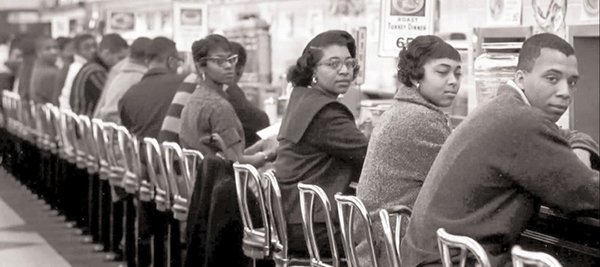
It is important to note that I had a choice here. And the
reason I had a choice is because there are so many viable options for measuring
victory. This point holds whether we impose our own definition of victory or
whether we locate a definition of victory held by the historical actors
themselves.
The most obvious measure of victory for the sit-in movement was
the desegregation of pubic accommodations, a process that culminated in the passage
and successful implementation of Title II of the 1964 Civil Rights Act. But well
before that unmistakable achievement, the students themselves identified
countless other measures of success. Standing
(and sitting) alongside thousands of other college students as part of this
new, defiant movement was an achievement. Creating student-run
organizations that would strategize and coordinate sit-in protests might be
cited as a win for the movement. Students
saw going to jail as a valuable experience, both for the individual protester
and the larger movement. For the most dedicated of freedom fighters, even
enduring a beating was a victory. “This was an experience we needed,”
one participant explained about the violence against sit-in protesters. The Sit-Ins documents the many
opportunities the protesters found to declare victory.
But there is another side to this story, one that emphasizes
the conspicuous failures of the sit-in movement. Even as they strategized and
touted these attainable movement victories, activists and their allies also
defined their goals in a more idealistic, aspirational register. The sit-ins,
as Ella Baker famously proclaimed, “are concerned with something much bigger
than a hamburger or even a giant-sized Coke.” The true goal of the movement,
she said, was “to rid America of the scourge of racial segregation and
discrimination—not only at lunch counters, but in every aspect of life.”
“We are willing to
go to jail, be ridiculed, spat upon and even suffer physical violence to obtain
First Class Citizenship,” one student group declared. For James Baldwin,
the sit-in movement was aimed at “nothing less than the liberation of the
entire country from its most crippling attitudes and habits.”
Measured by these standards, the sit-in movement might be
classified as, at best, a qualified success. Or perhaps, if we use Baldwin’s
standard as the benchmark, a noble failure.
In the midst of the battle over discrimination in public
accommodations, few questioned the importance of the issue they were fighting
over. The mere fact that white southerners fought so hard to protect their
“right” to discriminate confirmed the importance of the issue. Yet once the
battle was won, and Title II of the 1964 Civil Rights Act was the law of the
land, people on both sides began questioning the significance of the victory.
“Desegregation of public accommodations does not basically
alter the pattern of social life anywhere,” observed a Mississippi restaurant
operator. “That is why it has been accomplished as easily as it has.”
From a very different perspective, civil rights organizer
Bayard Rustin arrived at much the same conclusion. “[W]e must recognize that in
desegregating public accommodations, we affected institutions that are
relatively peripheral both to the American socio-economic order and to the
fundamental conditions of life of the Negro people,” he wrote in his famous 1965
essay, “From Protest to Politics.” The sit-ins had targeted “Jim Crow precisely
where it was most anachronistic.” They had toppled an “imposing but hollow
structure.”
Or, as the African American comedian Dick Gregory once
explained: “I sat in six months once at a Southern lunch counter. When they finally served me, they didn’t have
what I wanted.” It’s a funny line, with enough truth to cast a shadow over any
victory celebration.
What I settled on in the end was to acknowledge these voices
of caution and pessimism but to not let them be the final word. I sought to convey
the limitations of the changes the sit-in movement made possible, but to leave
the reader with something more hopeful. Not quite a happy ending, but something
closer to happy than sad.
Here are the closing paragraphs of The Sit-Ins:
The resolution of the issue first
given prominence by the students sitting at lunch counters in the winter of
1960 was one of the greatest achievements of the civil rights era. This book
is, in part, an effort to celebrate the sit- in movement and the legal battles
over discrimination in public accommodations that the movement sparked. It is
an effort to draw attention to this triumphant moment in our ongoing struggle
for racial justice, to better understand why this campaign for social and legal
change worked, when so many others did not.
Other battlefronts in the African
American freedom struggle proved far more difficult to uproot than racial
exclusion in public accommodations. The powerful synergy between social protest
and legal change that made the campaign against racial discrimination in public
accommodations so powerful and consequential was hard to replicate in other
areas. The struggle to implement Brown
dragged out for decades, and we still face pervasive segregation in our
schools. Disparities of wealth and income across racial lines persist, a
particularly stubborn reminder of the continuing effects of slavery and Jim
Crow. Racial disparities in our criminal justice system—from the stunning
overrepresentation of racial minorities in our bloated prison populations to
racially discriminatory police practices—remain one of the most significant
challenges we face as a nation.
Our challenge is to find new ways
combine social protest and legal claims to disrupt those practices and policies
that perpetuate old inequalities and create new ones. The lunch counter sit- in
movement shows that it can be done.
Saturday, March 31, 2018
Weekend Roundup
- An article in Politico on the demoralization of workers in the federal government includes the report that officials at the National Archives and Records Administration forbid the presentation of a program on “the historic context of immigration to the United States because it might attract ‘unwanted attention’" and jeopardize NARA funding.
- On Tuesday, April 10, 2018, at 4:30 p.m., at Barat House, Boston College Law School, BC’s Clough Center for the Study of Constitutional Democracy will host The Public Roots of Private Ordering: An Institutional Account of the Origins of Modern American Arbitration, a lecture by Amalia D. Kessler, Stanford University.
- We’re indebted to H-Law for posting Dominique Clement’s report that a complete collection of briefs to Canada's Special Joint Committee on the Constitution (1980-1) has been posted to Canada's Human Rights History.
- We realized the other day that the Great Courses is marketing a lecture series by Douglas O. Linder, University of Missouri–Kansas City School of Law, entitled The Great Trials of World History and the Lessons They Teach Us. For many years, Professor Linder has performed an invaluable public service by gathering well-chosen materials on dazzling and ever-expanding collection of famous trials and making them available gratis. If any professor deserves the patronage of the public for such a venture, he does!
- Harvard Law School hosted a panel discussion on George H. Gadbois Jr.' Supreme Court of India: The Beginnings this past week, featuring LHB blogger Mitra Sharafi, Mark Tushnet, and Sugata Bose. The session was chaired by Vasujith Ram, co-editor of the book, which is a posthumous publication of Gadbois' 1965 PhD dissertation. Here is an obituary for George Gadbois, who passed away in 2017, by the other co-editor of the book, Vikram Raghavan.
- On May 8, the Supreme Court Historical Society and the John Simon Guggenheim Memorial Foundation will cosponsor a conversation between Professors Randy Barnett and Richard Primus about Modes Of Constitutional Interpretation. Judge Patricia A. Millett will moderate the discussion.
- The Riots of 1968: Hitting Home Here in Washington, a presentation by Jamie Stiehm, a Creators Syndicate columnist, on Saturday, April 14, 1:00pm, in the Peabody Room at Georgetown Neighborhood Library.
- ICYMI: Jed Shugerman and Ethan J. Leib, Fordham University School of Law, on the Take Care Clause and presidential pardons, in WaPo. Also, we’ve previously noted the SSRN draft of Martin S. Lederman’s “The Law(?) of the Lincoln Assassination.” The article is now out in the Columbia Law Review 118 (March 2018): 323-489.
Thursday, November 30, 2017
Rethinking the Role of State Courts in the Lives of Black Southerners: What I've Learned
I've very much appreciated the opportunity to blog about the research in my new book Litigating Across the Color Line this month. Today, on my final day of blogging here, I thought I would reflect on some of the things that I have noticed and learned about black southerners’ participation in civil cases in state courts during this project.
1) Shifts in Legal Rights Were Aligned with Voting

There was no sudden shift in what appellate civil cases between black and white southerners looked like as Reconstruction gradually ended in southern states. Instead, the shifts seem to be aligned to some extent with voting rights. The types of cases black litigants could participate in became much more narrow at the end of the 19th century as disfranchisement set in. Then, beginning in the 1920s as the Great Migration led to increases in black voting around the nation, black southerners' civil cases became much less constrained once again and began to engage a wide variety of issues. This broadening of cases continued in the 1940s as voter registration drives had some success in the U.S. South.
2) Civil Litigation continued throughout different periods, but shifted to fit the constraints of the time
Even as black southerners’ ability to litigate different kinds of civil cases in southern appellate courts widened or narrowed during different periods, African Americans continued to litigate civil cases against whites from 1865 to 1950. In other words, at no time did they actually stop interacting with state governments through the legal sphere. Instead, as their political and social constraints narrowed, they shifted the kinds of cases they litigated and how they presented themselves in their cases.
3) Black Southerners engaged with the government at multiple levels
In the cases I looked at, I found African Americans at times engaging the government at multiple levels over a single dispute– including engaging with the local, state, as well as the federal government. The case of Henry Buie that I discussed in my blog post yesterday gives us one example of this engagement with the government at multiple levels. After his master took his mule, Henry Buie turned for assistance to the local branch of the Freedmen’s Bureau and successfully convinced them to take action in his cause. But it was not only federal power – but also state power that the freedman accessed. When his former master filed a civil suit to regain the mule, the former slave responded by hiring his own lawyer and fighting his former master’s claim in the local county court and then in the state supreme court. In this case alone, then, the suit was fought on at least three levels – before the Freedmen’s Bureau, before the local court, and before the state supreme court. In other cases, I found similar attempts to bring cases before multiple arbitrators and to attempt to pick the arbitrator that would be most sympathetic to their cause.
4) Government Institutions that seemed hostile could still be possible realms to exercise rights – if you could align your interests with the interests of those making decisions in that realm, or at least make your case seem harmless
I learned that government bodies that seem initially to be hostile to African Americans could still be institutions in which African Americans could have some success. Again and again – not only during Reconstruction, but in the two decades following as well as in the first half of the 20th century – some African Americans were able to negotiate the white-dominated southern legal system to gain decisions in their favor. To win civil cases against whites in state and county courts, black litigants often had to align their cases with whites’ interests, so that it was in the interests of the legal system to rule for them, rather than for the opposing white litigant. At the very least, they had to make it appear that ruling for them would have a net zero effect on the larger system of white supremacy. But when African Americans’ cases directly confronted the interests of larger numbers of whites in a substantial way – even when they appealed to rights such as property, they were frequently unsuccessful.
5) It was necessary to use whites to access the southern legal system and government power
In order to access government power through the courts, African Americans had to use and appeal to whites – white lawyers, white judges, white witnesses, and white jury members. Black litigants could not have litigated in southern courts without these whites. But working with whites had consequences. White lawyers limited the kinds of cases black southerners could litigate and shaped the arguments their cases could make. The important role of white witnesses in such trials also gave preference to suits in which whites agreed to testify. Moreover, black litigants’ dependence upon white juries and judges for favorable decisions at times led them to tailor their testimony and cases to their audiences, presenting themselves as more loyal or uneducated than they really were.
6) These suits were often intensely personal, involving long histories between the black and white litigants
In two-thirds of these cases during Reconstruction and about a third of cases in the two decades after Reconstruction, men and women who had been considered property now sued the very people who had owned them or their former owners’ heirs. They carried with them into court their long histories together during slavery.
7) The actions of black litigants played an important role in the outcomes
African Americans negotiated within the white-dominated courts by recognizing the interests of the people wielding power in this realm, and framing their claims to appeal to such parties. Often, black litigants had been coached by their lawyers on what to say in their testimony. But black litigants also made decisions about what to say in their testimony based on their knowledge about race relations in their communities and, at times, their understanding of relevant law and the facts of the case. Their testimony and other choices during the course of litigation often played an important role in the success of their cases.
8) Not just the usual suspects participated in civil cases.
The final lesson I learned was that participants in the state courts went far beyond educated black men. Ordinary black men and women all played a part in the courts during the 85 years after the Civil War. During the three and a half decades after the Civil War, even the African Americans who gained a hearing of their case before a state’s highest court usually had very little formal education. Many had lived part of their lives as slaves or were the children of former slaves. In addition, in an era when white men dominated politics, almost half of these black litigants were women. Between 1865 and 1950, black women formed approximately 41 percent of African American litigants in civil cases between black and white litigants in the eight appellate courts examined. The role of ordinary black men and women in these cases re-envisions the courts as not only a forum for test cases backed by organizations, but as a place where ordinary black and white southerners challenged each other and worked out their economic disputes against each other.
Please feel free to be in touch (contact details here) if you have any questions about my research. I will continue to release the transcripts and archival records of some key cases related to my research on my website in the coming months as well. Thank you again for the opportunity to blog here this month!
1) Shifts in Legal Rights Were Aligned with Voting

There was no sudden shift in what appellate civil cases between black and white southerners looked like as Reconstruction gradually ended in southern states. Instead, the shifts seem to be aligned to some extent with voting rights. The types of cases black litigants could participate in became much more narrow at the end of the 19th century as disfranchisement set in. Then, beginning in the 1920s as the Great Migration led to increases in black voting around the nation, black southerners' civil cases became much less constrained once again and began to engage a wide variety of issues. This broadening of cases continued in the 1940s as voter registration drives had some success in the U.S. South.
2) Civil Litigation continued throughout different periods, but shifted to fit the constraints of the time
Even as black southerners’ ability to litigate different kinds of civil cases in southern appellate courts widened or narrowed during different periods, African Americans continued to litigate civil cases against whites from 1865 to 1950. In other words, at no time did they actually stop interacting with state governments through the legal sphere. Instead, as their political and social constraints narrowed, they shifted the kinds of cases they litigated and how they presented themselves in their cases.
3) Black Southerners engaged with the government at multiple levels
In the cases I looked at, I found African Americans at times engaging the government at multiple levels over a single dispute– including engaging with the local, state, as well as the federal government. The case of Henry Buie that I discussed in my blog post yesterday gives us one example of this engagement with the government at multiple levels. After his master took his mule, Henry Buie turned for assistance to the local branch of the Freedmen’s Bureau and successfully convinced them to take action in his cause. But it was not only federal power – but also state power that the freedman accessed. When his former master filed a civil suit to regain the mule, the former slave responded by hiring his own lawyer and fighting his former master’s claim in the local county court and then in the state supreme court. In this case alone, then, the suit was fought on at least three levels – before the Freedmen’s Bureau, before the local court, and before the state supreme court. In other cases, I found similar attempts to bring cases before multiple arbitrators and to attempt to pick the arbitrator that would be most sympathetic to their cause.
4) Government Institutions that seemed hostile could still be possible realms to exercise rights – if you could align your interests with the interests of those making decisions in that realm, or at least make your case seem harmless
I learned that government bodies that seem initially to be hostile to African Americans could still be institutions in which African Americans could have some success. Again and again – not only during Reconstruction, but in the two decades following as well as in the first half of the 20th century – some African Americans were able to negotiate the white-dominated southern legal system to gain decisions in their favor. To win civil cases against whites in state and county courts, black litigants often had to align their cases with whites’ interests, so that it was in the interests of the legal system to rule for them, rather than for the opposing white litigant. At the very least, they had to make it appear that ruling for them would have a net zero effect on the larger system of white supremacy. But when African Americans’ cases directly confronted the interests of larger numbers of whites in a substantial way – even when they appealed to rights such as property, they were frequently unsuccessful.
5) It was necessary to use whites to access the southern legal system and government power
In order to access government power through the courts, African Americans had to use and appeal to whites – white lawyers, white judges, white witnesses, and white jury members. Black litigants could not have litigated in southern courts without these whites. But working with whites had consequences. White lawyers limited the kinds of cases black southerners could litigate and shaped the arguments their cases could make. The important role of white witnesses in such trials also gave preference to suits in which whites agreed to testify. Moreover, black litigants’ dependence upon white juries and judges for favorable decisions at times led them to tailor their testimony and cases to their audiences, presenting themselves as more loyal or uneducated than they really were.
6) These suits were often intensely personal, involving long histories between the black and white litigants
In two-thirds of these cases during Reconstruction and about a third of cases in the two decades after Reconstruction, men and women who had been considered property now sued the very people who had owned them or their former owners’ heirs. They carried with them into court their long histories together during slavery.
7) The actions of black litigants played an important role in the outcomes
African Americans negotiated within the white-dominated courts by recognizing the interests of the people wielding power in this realm, and framing their claims to appeal to such parties. Often, black litigants had been coached by their lawyers on what to say in their testimony. But black litigants also made decisions about what to say in their testimony based on their knowledge about race relations in their communities and, at times, their understanding of relevant law and the facts of the case. Their testimony and other choices during the course of litigation often played an important role in the success of their cases.
8) Not just the usual suspects participated in civil cases.
The final lesson I learned was that participants in the state courts went far beyond educated black men. Ordinary black men and women all played a part in the courts during the 85 years after the Civil War. During the three and a half decades after the Civil War, even the African Americans who gained a hearing of their case before a state’s highest court usually had very little formal education. Many had lived part of their lives as slaves or were the children of former slaves. In addition, in an era when white men dominated politics, almost half of these black litigants were women. Between 1865 and 1950, black women formed approximately 41 percent of African American litigants in civil cases between black and white litigants in the eight appellate courts examined. The role of ordinary black men and women in these cases re-envisions the courts as not only a forum for test cases backed by organizations, but as a place where ordinary black and white southerners challenged each other and worked out their economic disputes against each other.
Please feel free to be in touch (contact details here) if you have any questions about my research. I will continue to release the transcripts and archival records of some key cases related to my research on my website in the coming months as well. Thank you again for the opportunity to blog here this month!
Wednesday, November 29, 2017
Black Southerners' Suits Against their Former Masters: Cases and Teaching Resources
I'm back for a final week of blogging about the research in my book Litigating Across the Color Line. Today I'll be discussing the cases that I found between former slaves and their former masters and the heirs of both parties. These cases make up about two-thirds of the appellate civil cases between black and white litigants in the eight states I examined during the Reconstruction era (1865-1877) and about one-third of such appellate cases during the two decades after Reconstruction (1878-1899). These cases are a particularly rich source to examine African Americans' experiences during slavery and their shifting interactions with their former masters and mistresses after emancipation as well as an important source to examine the legal strategies that these groups used against each other in the years after emancipation.
Cases involving former slaves and former masters are often intensely personal, with both parties testifying in court not only about their changed relations after the Civil War, but also about their decades of previous interactions with each other during slavery. Both former slaves and former masters characterized their experiences with each other during slavery in certain ways to win their suits. At times during trials, former masters argued that their former slaves were disloyal or dishonest. In contrast, some formerly enslaved men and women presented themselves as particularly hardworking or faithful. Other black litigants boldly challenged their former masters and their former masters' heirs, claiming that their former masters' heirs and executors had fraudulently taken funds directed for them or earned by them. At the same time, former slaves and former masters (and their heirs) both frequently drew on their long-term knowledge of each other to gain the advantage in their suits. Former slaves noted in their testimony conversations and experiences that they had had with their former masters to support their legal claims. Meanwhile, former slaveholders sometimes used their previous experiences with the black litigants to try to hurt former slaves' reputations.
In a number of cases, former slaves challenged their former masters' wills. At times, they asserted that bequests to send them to Liberia could be received without such migration. In the 1872 Missisippi case of Cowan v. Stamps a slaveholder named Abner Cowan had written a will in 1850 that directed that all of his slaves and their "increase" be sent to Africa after his death. According to the will, all of his property should be sold after his death to pay for their travel and any remaining funds were to be given to his former slaves for their "use and benefit" upon "their arrival on that Continent." However, Abner Cowan did not die until the end of 1864 and at the time, the area of Missisippi in which he lived was a no-man's land between Union and Confederate forces, making it impossible to initiate probate proceedings. After the war, about 30 of his former slaves became litigants in the civil action over his will and claimed that they should be able to receive the proceeds of his estate without immigrating to Liberia.
In other cases, former slaves challenged their former masters' ability to control them or their property after the war. In the 1869 North Carolina case of Buie v. Parker, Henry Buie had found a mule that had been abandoned by General Sherman's forces during the last months of the Civil War. At the time that he found the mule, his master had recently fled before the Union Forces, telling his slaves that "they could go to the Yankees or stay at home, as they pleased." Henry Buie remained on his former master's plantation, but when his master eventually returned after the war's end, he insisted on keeping the mule for himself. He continued working on the same plantation, though, now as paid labor. Matters came to a head sometime between the end of 1865 and the beginning of 1868, when Henry Buie's former master John Buie forcibly took possession of the mule. In response, the freedman made a claim to the local office of the Freedmen's Bureau which mobilized the Union Army to return the mule to the former slave. To try to regain the mule, his former master then filed a suit against him in the local county court. Henry Buie responded by hiring a lawyer of his own and requesting not only that he retain possession of the mule but also that the court award him "one hundred dollars damages" for his former master "taking and withholding" the mule.
In a few cases, former slaves litigated suits against their former masters claiming funds that they had earned while they had been enslaved. In the 1869 North Carolina case of Lattimore v. Dixon, Abner Lattimore claimed that his former master Thomas Dixon had stolen over $1,000 in promissory notes that he had earned as a slave through livestock trading and money lending. In a limited number of other cases, the sexual violence that enslaved women experienced played a role in ensuing litigation. The 1877 Alabama case of Potter v. Gracie revolved around whether or not Mary Gracie -- who had a son fathered by her former master -- had been her former master's "mistress" after emancipation (a piece of property hung on the answer to this question).
In some of these cases, we can see the shifts in the interactions of former slaves and former masters taking place -- and at times such shifts seem to be spurred in part by the litigation itself. During the course of the litigation with his former master, for instance, Henry Buie changed his actual name, throwing off the surname of his former master and taking on the name Henry Parker. Appealing to the memory of their former masters could be a useful tactic to win cases, therefore, but litigation itself could also shift the relations of former masters and former slaves as well.
On my website, www.melissamilewski.com, I have put up transcripts and scans of the case files of a number of cases involving former slaves and former masters (including the cases mentioned here). After the jump below are also brief excerpts from the Lattimore v. Dixon and the Cowan v. Stamps cases.
 |
| Courtesy Mississippi Dept. of Archives & History |
In a number of cases, former slaves challenged their former masters' wills. At times, they asserted that bequests to send them to Liberia could be received without such migration. In the 1872 Missisippi case of Cowan v. Stamps a slaveholder named Abner Cowan had written a will in 1850 that directed that all of his slaves and their "increase" be sent to Africa after his death. According to the will, all of his property should be sold after his death to pay for their travel and any remaining funds were to be given to his former slaves for their "use and benefit" upon "their arrival on that Continent." However, Abner Cowan did not die until the end of 1864 and at the time, the area of Missisippi in which he lived was a no-man's land between Union and Confederate forces, making it impossible to initiate probate proceedings. After the war, about 30 of his former slaves became litigants in the civil action over his will and claimed that they should be able to receive the proceeds of his estate without immigrating to Liberia.
In other cases, former slaves challenged their former masters' ability to control them or their property after the war. In the 1869 North Carolina case of Buie v. Parker, Henry Buie had found a mule that had been abandoned by General Sherman's forces during the last months of the Civil War. At the time that he found the mule, his master had recently fled before the Union Forces, telling his slaves that "they could go to the Yankees or stay at home, as they pleased." Henry Buie remained on his former master's plantation, but when his master eventually returned after the war's end, he insisted on keeping the mule for himself. He continued working on the same plantation, though, now as paid labor. Matters came to a head sometime between the end of 1865 and the beginning of 1868, when Henry Buie's former master John Buie forcibly took possession of the mule. In response, the freedman made a claim to the local office of the Freedmen's Bureau which mobilized the Union Army to return the mule to the former slave. To try to regain the mule, his former master then filed a suit against him in the local county court. Henry Buie responded by hiring a lawyer of his own and requesting not only that he retain possession of the mule but also that the court award him "one hundred dollars damages" for his former master "taking and withholding" the mule.
In a few cases, former slaves litigated suits against their former masters claiming funds that they had earned while they had been enslaved. In the 1869 North Carolina case of Lattimore v. Dixon, Abner Lattimore claimed that his former master Thomas Dixon had stolen over $1,000 in promissory notes that he had earned as a slave through livestock trading and money lending. In a limited number of other cases, the sexual violence that enslaved women experienced played a role in ensuing litigation. The 1877 Alabama case of Potter v. Gracie revolved around whether or not Mary Gracie -- who had a son fathered by her former master -- had been her former master's "mistress" after emancipation (a piece of property hung on the answer to this question).
In some of these cases, we can see the shifts in the interactions of former slaves and former masters taking place -- and at times such shifts seem to be spurred in part by the litigation itself. During the course of the litigation with his former master, for instance, Henry Buie changed his actual name, throwing off the surname of his former master and taking on the name Henry Parker. Appealing to the memory of their former masters could be a useful tactic to win cases, therefore, but litigation itself could also shift the relations of former masters and former slaves as well.
On my website, www.melissamilewski.com, I have put up transcripts and scans of the case files of a number of cases involving former slaves and former masters (including the cases mentioned here). After the jump below are also brief excerpts from the Lattimore v. Dixon and the Cowan v. Stamps cases.
Friday, November 17, 2017
What Kinds of Civil Cases Black Southerners Litigated Against Whites in Southern Courts, 1900-1950
 |
| Courtesy: Library of Congress |
In one 1907 Alabama fraud case, the white defendant J.W. Abercrombie had defrauded the elderly black plaintiff, 81-year-old Andrew Carpenter, by telling him that he was signing a mortgage when he was actually deeding away his property. In response, Carpenter brought a civil suit against Abercrombie. In his testimony, just as in the testimony of almost every other black litigant in an appellate fraud suit during this period, Carpenter emphasized his lack of business knowledge, stating “I do not know anything about the significance of deeds and mortgages, or legal papers.” But even as they emphasized their lack of education in such suits, African Americans' defiance and assertions of their rights still sometimes clearly came through. Carpenter also testified that when he confronted the white man about the fraud, Abercrombie had offered to pay him a small fraction of the costs of the property. Carpenter then testified, “I told him I would not take $100 but before I took that I would die first.” He continued, “I came on then to see if I could get any rights in court.”* Despite such assertions of individual rights, however, most such cases during the first two decades of the 20th century made no larger claims for African American rights as a whole.
Then, between 1921 and 1950, the kinds of cases that black southerners could litigate in southern appellate courts broadened once again. In addition, more and more seemingly everyday kinds of suits litigated by individuals over personal injury, property, contracts, and wills began to include challenges to the racial status quo. Unlike the personal injury cases of the first decades of the 20th century, for instance, Ethel New's mid-1940's personal injury case challenged racial discrimination as well as claiming damages for the plaintiff's injury. New’s husband was stationed in Virginia as WWII came to an end and when the incident occurred, she had been returning from a visit to him, three months pregnant. She stood up for the first 81-mile leg of her bus journey as there were no seats in the section on the back of the bus reserved for African Americans. Finally, in Lynchburg, Virginia, she obtained a seat in the second to last row. A few minutes later, though, a bus driver ordered her to move to the last row of the bus to accommodate the white passengers who had just boarded. Seeing that the back bench was hard and did not recline, New refused to move. In response, the bus driver and an officer dragged her off the bus by her shoulders and legs. After reaching her destination of Kentucky, New’s back and leg ached and she suffered a miscarriage. She hired a lawyer to file a personal injury suit. The suit protested not only her own treatment and the loss of her unborn child, but also the segregation laws that required her to sit in the back of the bus. Indeed, the suit stated that New’s injuries had been a direct result of her race. While New's case was ultimately unsuccessful in both the trial and appellate courts, she had asserted not only her own individual rights, but the rights of African Americans to equal treatment on public transportation.**
These largely individual-led civil cases challenging discrimination during the 1920s, 1930s, and 1940s existed alongside the NAACP's legal efforts to challenge discrimination. Ethel New's law firm, for instance, also played a part in representing Irene Morgan in the 1946 NAACP-led suit Morgan v. Virginia over interstate bus travel. In general, though, the civil suits during this time that challenged discrimination in southern appellate courts seem to have been brought by individuals who had economic stakes in the suits, as well as concerns over equal rights. In these ways, these suits had many similarities to the many civil appellate suits between black and white southerners that had occurred in the decades before.
* Abercrombie v. Carpenter, 150 Ala. 294 (1907).
** New v. Atlantic Greyhound Corporation, 186 Va. 726 (1947)
Subscribe to:
Posts (Atom)