Showing posts with label African legal history. Show all posts

Monday, May 25, 2020

Murder Mystery, Legal History Part II: Death in the Colony


“A flock of pelicans, their white wings dyed apricot by the setting sun, sailed low over the acacia trees of the garden with a sound like tearing silk, and the sudden swish of their passing sent Alice’s heart into her throat and dried her mouth with panic”
            The opening lines of M.M. Kaye’s Death in Kenya, transports the reader into Flamingo a sprawling plantation on the banks of Lake Naivasha dominated by the huge sprawling single storied house with “thatched roofs, wide verandahs and spacious rooms paneled in undressed cedar wood, that defied all architectural rules and yet blended with the wild beauty of the Rift Valley” dominated by the septugenaraian Kenyan settler, Lady Emily De Brett, tramping about the estate in her scarlet dungarees, flashing diamonds and a pith helmet. Despite the gardens bursting with color, frolicking hippos, tea on the verandah, the army of servants, the heady round of picnics to the Crater Lake and sundowners with friends, there’s at atmosphere of lurking menace. The year is 1955, and despite the official narrative being that the Mau Mau rebellion had been crushed, characters worry about the Mau Mau on the run or being disguised among the plantation staff, particularly rumors around the mysterious “General Africa” (a reference to Waruhiru Itote, the real life Mau Mau fighter who went by the name General China) who was rumored to be in hiding near Naivasha. Flamingo itself had successfully held off a Mau Mau attack in the past, though it’s manager had died in the crossfire. As the settlers drink they umpteenth gin and tonic, they look over their shoulders convinced that the “secret ceremonies, extortion, intimidation-same old filthy familiar ingredients simmering away again ready to boil over in the drop of the hat”. The lurking tension spills into outright fear, as one by one characters are murdered, and while it could well be the Mau-Mau (the choice of weapons includes a panga and an poison tipped Masai arrow), it’s equally likely to be one of the small community of Europeans living around the plantation.

I read Death in Kenya in the Fall of 2016, after a day’s research at the National Archives of Kenya in Nairobi where the files I was reading portrayed another kind of terror, unleashed upon the Kenyan population by the colonial state. As documented extensively by scholars like Caroline Elkins and David Anderson and leading up to a High Court case for reparations, the Kenyan Emergency saw the suspension of civil liberties, tens of thousands of deaths, the imprisonment of around 400,000 Kikuyu into concentration camps and “enclosed villages, torture, beating, mutilation, castration and sexual assault. Ostensibly to curb the Mau Mau insurgency, a guerilla movement prompted by the expropriation of land by White settlers, the retaliation attacked not  just the Mau Mau gureilla fighters but a large majority of the civilian population. By 1957, in a secret memoranda, the Attorney General advised the Governor that the situation was prompting “comparisons with Nazi Germany” and argued for a legal regulation of torture, famously saying those who administerviolence … should remain collected, balanced and dispassionate".
How does one read light fiction set amid such unspeakable violence? At first, Kaye’s sympathies with the settlers seem clear, as she says in the Authors note, much of opinions voiced by her characters were taken from life, and very few of the Kenya born settlers would believe the “winds of change” would blow strongly enough to blow them out of the country they looked upon as their own. This comes through brutally when Drew Stratton, the swarthy sunburned settler, who walked like a cowboy displays a tally of “Mau Mau” kills on the verandah to the queasy Victoria Caryll, newly arrived from England. Stratton and his friends are reported to have gone underground, with blackface, to infiltrate the Mau Mau groups. Describing the horrors of the Mau Mau, and the losses suffered by loyalist Africans and Europeans, Stratton roughly rejects Victoria’s plaintive statement that “it is their country” making the case for settler colonialism in the crudest possible terms, “I want to stay here, and if that is immoral and indefensible colonialism, then every American whose pioneer forebears went in the covered wagon to open up the West is tarred with the same brush; and when the UNO orders them out, we may consider moving”.

            It is here, in its crudest and most violent articulation, that the uncertainties of the settler imagination are also highlighted. The awareness that their methods are under critique, the role of the UN and the shift in power towards the United States. The self-awareness comes through in Stratton’s apology for “the grossly oversimplified lecture on the Settler’s point of view”.  Settler society is seen as a corrupted European society, as the gentle Alice de Brett shudders at the “casual attitude of most women towards firearms and the sight and smell of blood”. Morals are seen as lax, and several married characters are having affairs outside their marriages. Kenneth Brandon, the Byronic 19 year old, “capacity for falling in love with other men’s wives” makes him qualified as the right type for Kenya.
            Kenyan settlers, particularly the hedonistic aristocrats who belonged to the Happy Valley Set had making international scandal pages including its very own real life murder mystery, when the  Earl of Errol was foundmysteriously shot in his Buick in Ngong road. His lover’s husband another British aristocrat was tried and acquitted of his murder and would later commit suicide. As Lady De Brett asserts, it would unlikely that any jury in Kenya would find her (and by implication any prominent settler) guilty of murder. Martin Weiner and Elizabeth Kolsky have documented that Europeans were rarely found guilty of violence in colonial trials. The impunity of white violence and close, besieged nature of settler society, also makes it awkward for the police inspector to conduct his investigation having to interrogate and detain his friends and social acquaintance.
While Kaye had spent a short period of time in Kenya, her powers of observation on local culture are acute and are reflected in the book. A key alibi is established by several African staff members hearing a suspect play a piano, and when the suspect suggests that “none of the servants would know the difference between one tune and another”, the inspector points out that the average African has a better ear for music than one imagines. Peter Leman’srecent work traces how orality in accounts of legal trials has the “the capacity to challenge the narrative foundations of colonial law and its postcolonial residues and offer alternative models of temporality and modernity that give rise, in turn, to alternative forms of legality”. Songs, verbal oath takings and music formed a key part of the evidence in the famous Kapenguria trial, which sought to prosecute Jomo Kenyatta and other Kikuyu leaders for managing the Mau Mau. 
The violence against Africans during the Emergency is an uncomfortable reminder offstage, as a character worries about her maid giving evidence to the police, “they may take here away and hold her for questioning. You know what they are like”. Another notes that the police had roped into the house servants for questioning and turned the labour lines on the plantation “into the nearest thing to a concentration camp”. The role of the Brandons, Flamingo’s neighbours,  in the brutal suppression of the revolt, offers a possibility that the Mau-Mau might take revenge by putting poison in their medicine box. As Lady Brett acknowledges, there are things worse than murder, including, “trials, hanging, suspicion, miscarriage of justice”.
             As Erik Lindstrum shows in his recent article, British knowledge about violence in the colonies was both widespread, but also “fragmented and ambiguous”. British newspapers trying to position themselves as neutral failed to convey the extent of colonial violence and some of the most widely circulated narratives were framed by fiction and film. The solution to Death in Kenya (not to give away spoilers) is an ambiguous statement to the question of the settler colony. The serial murders insanity is driven by their desire to mark out a permanent presence in the colony, to master its future, even though it requires the sacrifice of English men and women. The murder is also revenged by an African, posing a problem for the British policeman, who don’t know what to do with an African who had killed a European but in the process saved the life of another.  
Murder by the Panga: The Bassan Murder Case

In 1960, the plot of Death in Kenya seemed to take real life turn. Satyavadi Bassan, a young Kenyan-Indian and her two infant daughters were found hacked to death by a panga in their car on the road to Nyeri. Pyarelal Bassan, her husband and her four year old daughter were also found gravely injury and recounted at attack by three African men who had stopped their car, demanded money and attacked the family. The Indian Association of Nyeri rejected the idea of a robbery gone awry and insisted the murder was political, linking it to secret gatherings of Africans and the targeting of Indians as “outsiders” and “parasites” in Kenyan nationalist rhetoric. The use of the panga (like the wounds of Alice de Brett in Death in Kenya) were seen as “reminiscent of the Mau Mau killings”.  As Sana Aiyyar in her study of the Indian diaspora in Kenya notes, “the use of the panga and mutiliation..became the catalyst for politicization of the Nyeri murder”. Aiyar argues that wile the Indian leaders in Kenya attacked African leadership for not condemning the violence, the emergent African political leaders also assumed that the attack was carried out by Africans and marked a “resurgence of ritualistic violence that threatened their leadership”
            The subsequent trial and investigation revealed, as in Kaye’s who-dunnit, the crime originated neither from economic reasons nor the political churn of nationalism,  but from a domestic setting. Pyarelal Bassan was found to have hired the men to murder his wife and children, and the trial hinted at both Pyarelal and Satyavati having extra-martial liaisons. Once again we see a crime that originates in the "malice domestic" of a settler society, being initially framed as a crime arising out of the violent churn of African politics.

Crime in the Colony:   Elspeth Huxley’s Murders in Chania 
Colonial Kenya also forms the setting for a series of murder mysteries by ElspethHuxley. Huxley, the author of over 42 books is best known for her memoir, TheFlame Trees of Thika, serialized in television and frequently analysed by literary scholars working on colonialism, memory and nostalgia. Huxley’s murder mysteries set in the fictional country of Chania (standing in for Kenya) draw richly from colonial legal sources.

            Katherine Luongo opens her compelling study of Witchcraft and Colonial Rule in Kenya, 1900-1950 with an extract from Huxley’s first crime novel, Murder at Government House (1937), a long digression from the process of investigating the murder of the Governor of Chania in his study. 
“included a lengthy, elaborate anecdote about another high-profle murder case in the colony, the “Wabenda witchcraft case.”  Chania’s secretary for Native Affairs recounted the local narrative of the “Wabenda witchcraft case” to the detective in charge of investigating the governor’s murder: The Wabenda, among whom witchcraft was more strongly entrenched than among most Chania tribes, had put to death an old woman, who, they alleged, was a witch. The woman had stood trial before the elders and the chiefs of the tribe, had been subjected to a poison ordeal, and found guilty of causing the death of one of the head chief’s wives and the deformity of two of his children. Then, following the custom of the tribe, she had been executed, in a slow and painful manner. . . . It was a horrible death, but meted out after due trial, and for the most anti-social crime in the Wabenda calendar.  After outlining the circumstances surrounding the witch-killing, the secretary for Native Affairs turned to how Wabenda and British conceptions and processes of justice collided in the context of the case. He elaborated, The chiefs and elders were put on trial for the murder of the old witch. Forty-i ve of them appeared in the dock – a special dock built for the occasion. They did not deny that the witch had died under their instructions. They claimed that in ordering her death they were protecting the tribe from sorcery, in accordance with their obligations and traditions. They were found guilty and condemned to death. There was no alternative under British law; the judges who pronounced sentence did so with reluctance and disquiet.
But as the secretary for Native Affairs noted, the “Wabenda witchcraft case” was not easily resolved by the sentencing of the forty-i ve Wabenda in the British courts. He noted, The Government was in an awkward position. It could not, obviously, execute forty-five respectable old men, many of them appointed to authority and trusted by the Government, who had acted in good faith and according to the customs of their fathers. In the end it had compromised. Thirty-four of the elders had been reprieved and pardoned. Ten had been reprieved and sentenced to terms of imprisonment. In one case, that of the senior chief who had supervised the execution, the death sentence had been allowed to stand. 4 Finally, the secretary for Native Affairs addressed some of the ways in which the case was figured in additional “judicial settings”; in the Supreme Court of Chania, in the governor’s Privy Council, and in the equally salient “courts of opinion” of various metropolitan and Chanian publics. He explained, The case was not yet over. The sentenced chief, M’bola, had appealed to the Supreme Court, lost, and finally appealed to the Privy Council. Feeling in native areas ran high. Agitators had seized upon the case as an example of the tyranny and brutality of British rule. Administrators feared serious troubles should it be carried out.”
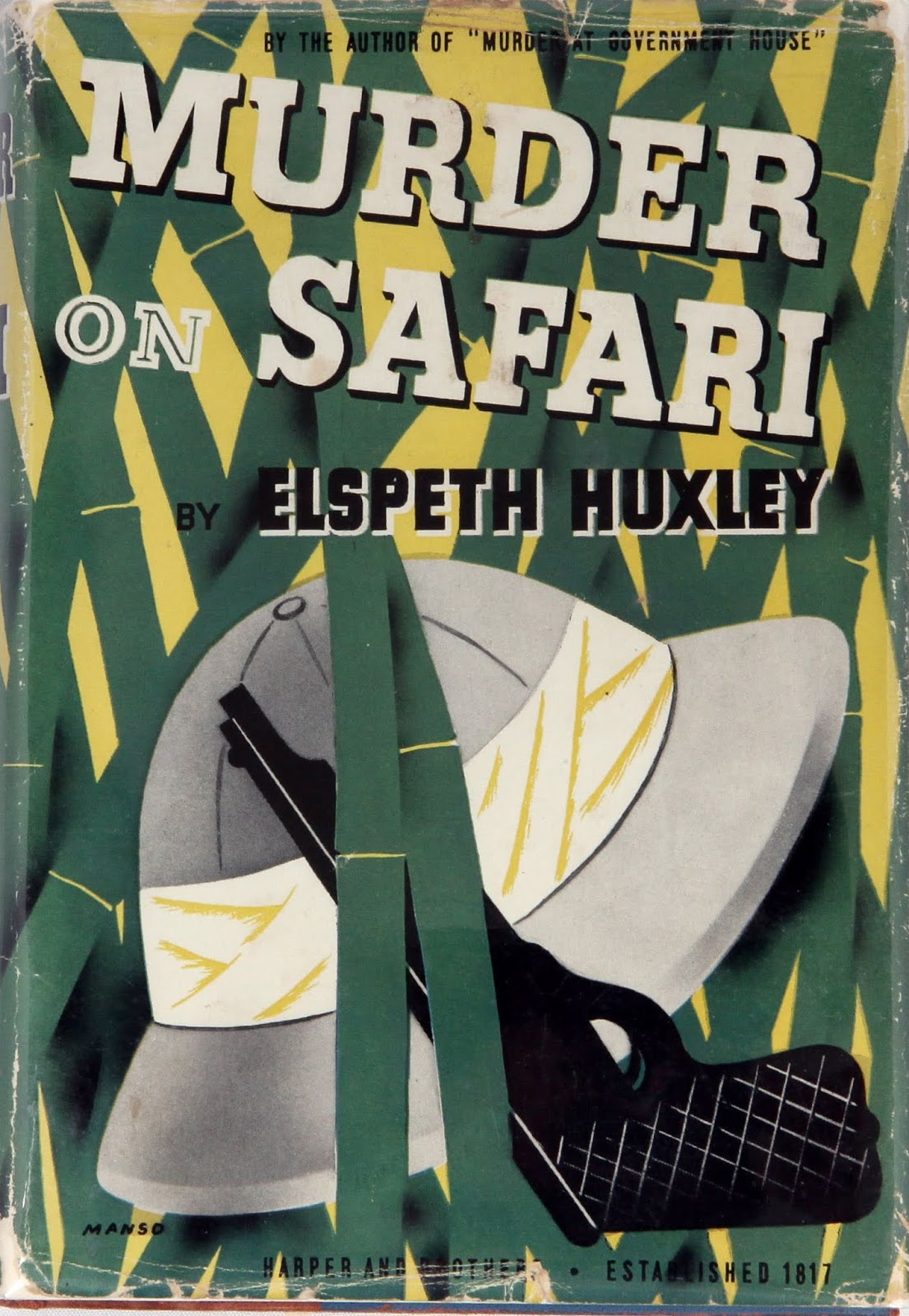
As Luongo asks,  “Why would a story of witchcraft, law, and the colonies have resonated with British reading publics at home and abroad?”. She does on to show that these fictional events mirrored  a real life witch killing case in the 1930s, i.e. the Wakamba Witch trials, which “long-standing, circuitous, imperial story of African witchcraft beliefs and practices challenging the ability of colonial states to achieve law and order in the British African Empire”.  Huxley’s who-dunnits are not Mayhem Parva imported to the colony, but arise from it’s settings. For instance, in Death of a Safari, a lions kills and a charging buffalo are turned into weapons of murder. or in African Poisons shows extensive knowledge of land use rights, animal husbandry and African toxins.

Huxley, unlike Kaye, was a long term resident in Kenya and her murder mysteries offer better rounded characters and complex accounts of the changing political situation. The women are not damsels in distress, but professionals. 
In Murder in Government House, the detective is assisted by Olivia Brandeis is an anthropologist who documents a Kenyan secret society with rituals of seizing power from the English (possibly inspired by Mary Leakey), the safari in Murder on an African Safari (1938) is led by the dashing aviatrix (modelled on real life Beryl Markham) who flies ahead to spot the wild game; The African Poison Murders (1939) has a female solicitor trying to set up a practice (modelled on K.P Hurst, the sole female Barrister in Kenya who was one of the rare European lawyers who had engaged to defend Africans accused as Mau-Mau) and Thomasina Labouchiere is an assistant to the British commission negotiating independence an at the Incident at the Merry Hippo (1963) (mirroring perhaps Huxley’s own experience as an independent member of the commission for the Federation of Rhodesia and Nyasaland)  . Her who-dunnits spaced out over two decades offer an acutely changing awareness of politics, for instance in African Poison Murders tensions break out between English and German settlers, when a possible Nazi sympathizing German is found poisoned on his farm. She demonstrates acute insights into the nature of the colonial bureaucracy, outlining the differences between different kinds of training in Murder in Government House, or the awareness that the Governor can suspend the right of a solicitor to practice in African Poison Murders.
The Historian as a Detective: Richard Rathbone's Murder and Politics in Colonial Ghana


How can legal historians draw from structures of detective novels? In many ways, their methods of collecting and evaluating evidence, building off fragments and constructing the "who dunnit" is the same. One model is Richard Rathbone's Murder and Politics in Colonial Ghana,  which as reviewer notes, “is not the West African companion to Elspeth Huxley's East African whodunnit, Murder at Government House. Nor, despite its trailer of 'Colonial Ghana' (itself a curious chronological byline), is it a critique of Colonial Office administration” Rathbone uses the “ritual murder” of an Ghanian chief during a royal funeral procession, and subsequent investigation and trial to trace how traditional and new Ghanian elites engaged with the local and imperial administration during the transition from late colonial rule to independence. The book is also a whodunit, as Rathbone seeks to also solve the mystery of Akea Mensa’s death (aided by none other than mystery writer and British civil servant P.D James, who is acknowledged in the book). Did Mensa really die or did he go into exile? Was this suicide, an accidental fall into a mineshaft or a public lynching? Was the motive “ritual murder” or unpopular treasury reforms?

In my next post, I'll return to M.M Kaye's sojourns to Zanzibar, Cyprus, India and Germany and reflect upon the absence/presence of empire in the Golden Age Detective Novel 

PS: I am grateful to Surabhi Ranganathan for talking through some of these ideas.

Monday, April 13, 2020

Akech on Judicial Review in Kenya

Migai Akech, University of Nairobi, has posted Judicial Review in Kenya: The Ambivalent Legacy of English, which is forthcoming in Judicial Review of Administrative Action: Origins and Adaptations Across the Common Law World, ed. Lawin Swati Jhaveri and Michael Ramsden (Cambridge University Press, 2020):

This Chapter considers the evolutions in the practice of judicial review in Kenya, and the continued relevance of English law, in the broader context of the role of judicial review in facilitating the attainment of democratic governance. It argues that English law bequeathed to Kenya an ambivalent legacy that continues to shape the exercise of the judicial review power. In theory, law has promised to provide a bulwark against the abuse of governmental power. In practice, however, it has largely served to facilitate authoritarianism. The Chapter begins by locating judicial review in the context of governance in colonial and post-colonial Kenya. It then examines the nature and role of judicial review in the Kenya colony, Independent Kenya, and more recently after the promulgation of the Constitution of Kenya 2010.
--Dan Ernst

Wednesday, January 8, 2020

Pioneer African Women in Law Project

[We noted the following on H-Announce.  DRE]

Pioneer African Women in Law Project (PAWLP)

Women across the continent of Africa have historically played important leadership roles. Today, despite colonial re-gendering of our societies, African women continue to rise. The Pioneer African Women in Law Project (PAWLP) is a digital archive project designed to document in one collection, the lives and contributions of African women pioneers in the different fields of law across Africa.

What areas of the law are included? AND What is the measure of a pioneer?  A “pioneer” is measured by any woman who was the “first” in any  field of the legal professions in any country-- first woman lawyer, magistrate, judge, prosecutor, attorney general, chief justice, first president of apex court,  law professor, first female Senior Advocates of Nigeria (SAN), first woman president of a legal association, e.g. national bar association, Commonwealth association of judges or lawyers etc.

Who can submit an entry?  Entries are open to all interested authors. Cross and interdisciplinary submissions are especially welcome.  Entries should be original and not previously published elsewhere

Deadline for submissions?  Send an email of expression of interest to confirm if the entry is still available. Once you have the greenlight, you have one month to submit your entry.  Entries are accepted on a rolling basis till all “pioneers” are covered.

What are the requirements for an entry?  All submissions have to meet the following criteria:
    Typed in microsoft word and no more than 2000 words (including all references)
    Use endnotes to cite all references and outside work consulted
    Provide a picture of the person where possible (please make sure there are no copyright restrictions).

Content of entries.  All entries should aim to include the following information:
    Early life, including family background
    Educational background
    Professional achievements, focusing especially on the “first” role.
    Contributions the person made to the law, the profession and other social, cultural and political areas as applicable.
    A closing statement why you think the person is a pioneer in the field.

How do I submit my entry?  Email your entry as a word attachment to info@africanwomeninlaw.com. In the subject line use “PAWLP SUBMISSION”

Enquiries: All inquiries should be directed to: info@africanwomeninlaw.com.

What happens after I submit my entry? We will review your entry and get back to you as soon as we are done editing. Once your submission is approved, it will be published on our website and in a forthcoming book project.

Contact Info: Institute for African Women in Law; info@africanwomeninlaw.com

Tuesday, November 26, 2019

Surkis on sex, law, and sovereignty in French Algeria

Judith Surkis, Rutgers University has published Sex, Law, and Sovereignty in French Algeria, 1830-1930 with Cornell University Press. From the publisher:
Sex, Law, and Sovereignty in French Algeria, 1830–1930
During more than a century of colonial rule over Algeria, the French state shaped and reshaped the meaning and practice of Muslim law by regulating it and circumscribing it to the domain of family law, while applying the French Civil Code to appropriate the property of Algerians. In Sex, Law, and Sovereignty in French Algeria, 1830–1930, Judith Surkis traces how colonial authorities constructed Muslim legal difference and used it to deny Algerian Muslims full citizenship. In disconnecting Muslim law from property rights, French officials increasingly attached it to the bodies, beliefs, and personhood. Surkis argues that powerful affective attachments to the intimate life of the family and fantasies about Algerian women and the sexual prerogatives of Muslim men, supposedly codified in the practices of polygamy and child marriage, shaped French theories and regulatory practices of Muslim law in fundamental and lasting ways. Women's legal status in particular came to represent the dense relationship between sex and sovereignty in the colony. This book also highlights the ways in which Algerians interacted with and responded to colonial law. Ultimately, this sweeping legal genealogy of French Algeria elucidates how "the Muslim question" in France became—and remains—a question of sex.
Praise for the book:

 "Sex, Law, and Sovereignty opens up new ways to understand debates about religious and sexual pluralism, and marvelously demonstrates how attention to the paradoxical effects of instability and the workings of transgression, scandal, and crisis, lead to critical analytic perspectives." - Todd Shepard

"This is a masterful study of the ways in which sex and law were inextricably intertwined in the elaboration of French rule in Algeria. Its great virtue is to demonstrate in careful detail, with an impressive range of material (from court records to novels), exactly how the conquest of Algeria repeatedly challenged the very ideals of the secular universalism in whose name colonization was carried out." - Joan Wallach Scott

Further information is available here.

--Mitra Sharafi

Sunday, September 15, 2019

ASLH Pre-Conference Symposia on Local Government and African Legal History

We would like to alert LHB readers to two "pre-conference" symposia at the November 2019 annual meeting of the American Society for Legal History.  Both will be on Thursday, November 21, immediately before the events usually demarcating the start of the annual meeting.

The first is a Symposium on Legal History and the Persistent Power of State and Local Governments:
On Thursday, November 21, immediately before the main conference begins, the American Society for Legal History (with the support of Stanford Law School and Colgate University) is hosting a half-day symposium on the legal history of state and local governments and the persistence of their power across United States history. The symposium will consist of a range of presentations and discussions. Lunch will be made available to those attending.

The workshop will take place in the Conference Hotel. Anyone registered for the main conference is welcome to register for the symposium, though space is limited to thirty-four attendees. Click here to register for the symposium.
The second is an African Legal History Symposium:
On Thursday, November 21, immediately before the main conference begins, the American Society for Legal History is hosting a symposium on African Legal History. This symposium will feature four panels over the course of the day with twenty-two presentations.

This symposium is open to the public and ASLH members are warmly welcomed to attend. Click here to register for the symposium.
 And if you haven't registered for the annual meeting itself, it's time!

--Dan Ernst

Saturday, September 14, 2019

Weekend Roundup

  • Katherine Hermes, Central Connecticut State University, will present “Connecticut’s Indigenous People and Their Use of the Law,” on September 25 at the Torrington Historical Society in Torrington, CT.  The Torrington Register Citizen reports that Professor Hermes’s “current work is on the Wongunk (Wangunk), a Native tribe whose lands stretched from Hartford to Saybrook along the Connecticut river, some of whom later joined the Brothertown Movement and moved westward with the Tunxis, or went to live near the Schaghticoke.”  More, and also here
  • The Supreme Court Historical Society's website on the Court-Packing Plan of 1937 is now online.
  • Among this fall's additions to the HLS facultry profiled in Harvard Law Today are Molly Brady and Laura Weinrib.
  • The Constitutional Accountability Center seeks applicants for the Douglas T. Kendall Fellowship, “a one-year fellowship for recent law school graduates to join CAC’s litigation team” and help it develop arguments “rooted in the text, history, and values of the whole Constitution.”  H/t: JLG.
  • We've received a CFP, with a deadline of September 30, 2019) for the next Research Forum of the European Society of International Law, to take place April 23-24, 2020 at the Department of Law, University of Catania, Italy.  It "targets scholars at an early stage of their careers. Approximately 15-25 paper submissions will be selected. During the Forum, selected speakers will receive comments on their presentations from members of the ESIL Board and invited experts. The Forum will address the topic ‘Solidarity: The Quest for Founding Utopias of International Law’ and it aims to further a dialogue between scholars working within the broad discipline of law in history." More.
  • The Italian Society of Law and Economics welcomes submissions of papers, including those on “History of Law and Economic Thought,” for its 15th annual conference to be held in Milan at the University of Milan (La Statale) on December 19-21, 2019.  Deadline: September 15, 2019.
  • Over at History and the Law: "Law is more than words. It’s buildings and boxes, filled with people; it’s images and sounds." More here from Paul Halliday on envisioning law's empire in Ceylon.
 Weekend Roundup is a weekly feature compiled by all the Legal History bloggers.

Sunday, September 8, 2019

Boston College Law School Legal History Roundtable

[We have the following announcement from our friends at Boston College.]

In the fall of 2019, the Boston College Law School Legal History Roundtable begins its 18th successful year. The Roundtable draws on Boston College Law School’s and Boston College’s strength and interest in legal history. It offers an opportunity for Boston College faculty and faculty from other area institutions, students, and members of the Boston College community to meet and discuss a pre-circulated paper in legal history. Meeting several times each semester, the Roundtable seeks to promote an informal, collegial atmosphere of informed discussion.

For the 2019-2020 academic year, Professor Mary Sarah Bilder, Professor Daniel R. Coquillette, Professor Frank Herrmann and Professor Daniel Farbman are conveners.

The Roundtable usually meets several times during the semester in the afternoon at 4:30 pm in the Library Conference Room of the Boston College Law School Library. Refreshments are available beginning at 4:15 pm, unless otherwise noted.

Papers will be available when appropriate before each presentation.

Thursday, September 19 (lunch talk)
Martha Jones, Society of Black Alumni Presidential Professor and Professor of History, Johns Hopkins University: Lunchtime, co-sponsored with the Clough Center for the Study of Constitutional Democracy

Professor Jones will give a public book talk for a Constitution Day Lecture, discussing her prize-winning book.

Before the Civil War, colonization schemes and black laws threatened to deport former slaves born in the United States. Birthright Citizens: A History of Race and Rights in Antebellum America recovers the story of how African American activists remade national belonging through battles in legislatures, conventions, and courthouses. They faced formidable opposition, most notoriously from the US Supreme Court decision in Dred Scott. Still, Martha S. Jones explains, no single case defined their status. Former slaves studied law, secured allies, and conducted themselves like citizens, establishing their status through local, everyday claims. All along they argued that birth guaranteed their rights. With fresh archival sources and an ambitious reframing of constitutional law-making before the Civil War, Jones shows how the Fourteenth Amendment constitutionalized the birthright principle, and black Americans’ aspirations were realized. Birthright Citizens tells how African American activists radically transformed the terms of citizenship for all Americans.

Tuesday, October 24
Roundtable with Bryan Garner, Law Prose, Inc., co-sponsored with Law Library in honor of its upcoming Law Dictionary exhibit, "Dictionaries and the Law"

At his presentation, Garner will discuss the history of legal lexicography and his own work on Black's Law Dictionary and other law-related dictionaries.

Bryan A. Garner is a noted speaker, writer, and consultant regarding legal writing and drafting, and regularly teaches Advanced Legal Writing at the Southern Methodist University’s Dedman School of Law. Garner is editor in chief of Black’s Law Dictionary among many other leading works on legal style, and he is president of LawProse, Inc., the foremost provider of CLE training in legal writing, editing, and drafting.

Thursday, January 30
Roundtable with Lael Weinberger, Harvard Law School, Berger-Howe Legal History Fellow 2019-20, "Judicializing International Relations: Internationalism, Courts, and American Lawyers in the Progressive Era"

This paper, part of Weinberger's project on internationalism in the legal profession, reconstructs an unfamiliar period at the start of the twentieth century when American lawyers across political divides tended to believe that world courts and robust international law were the future of international relations—even suggesting that law would replace diplomacy and that international litigation would replace war. From a modern vantage point the “legal internationalism” of the period looks unrealistic or even utopian. But its very unfamiliarity provides an ideal starting point for examining the intellectual, political, and legal conditions of possibility for legal internationalism.

Lael Weinberger is the Raoul Berger-Mark DeWolfe Howe Legal History Fellow at Harvard Law School. He is a PhD candidate in the Department of History at the University of Chicago, where he studies American legal history. Lael earned a JD with high honors from the University of Chicago Law School and clerked for Judge Frank Easterbrook on the Seventh Circuit Court of Appeals and for Chief Justice Daniel Eismann on the Idaho Supreme Court. Lael is currently writing a dissertation on American lawyers’ ideas about international law, world order, and human rights in the first half of the twentieth century. His research interests include constitutional law, international law, civil procedure, law and religion, and the legal profession.

Thursday, February 27
Roundable with Professor Erin Braatz, Suffolk Law School, "Civilization & Sovereignty: The Birth of the “Native” Prison"

This paper describes the rise of so-called “native” prisons on the Gold Coast of Africa in the mid-nineteenth century (present-day Ghana) and argues that these prisons arose out of jurisdictional struggles between British colonial officials and indigenous leaders on the coast.  It then situates these struggles within the history of the global spread of the prison during the nineteenth century, contending that the prison played a central role in defining civilization and articulating changing notions of sovereignty.

Erin Braatz is an assistant professor of law at Suffolk University Law School.  She received a J.D. and Ph.D. in Law and Society from New York University where she also held a Golieb Fellowship in Legal History.  Prior to joining Suffolk’s faculty, she served as a law clerk to the Honorable Richard Stearns of the District of Massachusetts and the Honorable Juan Torruella of the United States Court of Appeals for the First Circuit.  Her research examines the history of criminal law and punishment in British West Africa in the nineteenth and twentieth centuries as well as the history of the Eighth Amendment.

Thursday, April 2
Roundtable with Kunal Parker, Professor and Dean's Distinguished Scholar, University of Miami Law School, "The Turn to Process: Law, Politics, and Economics in America, 1900 - 1970"

Over the course of the first three quarters of the twentieth century, American legal, political, and economic thinkers increasingly turned away from thinking in terms of ends to thinking in terms of means. Why did this happen? What did this transformation look like? Parker is working on a book-length study of the turn towards processes, means, methods, techniques, procedures, and protocols in twentieth-century American legal, political, and economic thought that looks at the connections and differences across these three fields to help make sense of this shift.

Kunal M. Parker is a Professor of Law and Dean's Distinguished Scholar at the University of Miami School of Law. He is the author of Common Law, History, and Democracy in America, 1790 - 1900: Legal Thought Before Modernism (Cambridge University Press, 2011) and Making Foreigners: Immigration and Citizenship Law in America, 1600 - 2000 (Cambridge University Press, 2015).

Friday, March 1, 2019

Thank you, Elizabeth Thornberry!

Many thanks to Elizabeth Thornberry for her great guest posts on teaching strategies, project ideas, archive finds, and other aspects of her work on African legal history in February 2019! 

Here they are, all in one place:

Please join us in thanking Professor Thornberry. 

CFP: African Legal History Symposium

[We have the following call for papers for an African Legal History Symposium, hosted by the American Society for Legal History with support from the African Studies Association.  H/t: Joanna Grisinger.]

Co-conveners: Erin Braatz, Suffolk University Law School; Trina Hogg, Oregon State University; Elizabeth Thornberry, Johns Hopkins University; Charlotte Walker-Said, CUNY-John Jay College

Fortuitously, the 2019 annual meetings of the African Studies Association and the American Society for Legal History will both take place November 21-23 in Boston. In hopes of sparking a more sustained engagement across these two fields, and marking what we see as an inflection point in scholarship on African legal history, we invite paper proposals for an African Legal History preconference symposium, to be held in Boston on November 21, 2019.  The symposium will be hosted by the American Society for Legal History in coordination with the African Studies Association, with sponsorship from the Suffolk University Law School.

We seek papers in the field of African legal history, broadly construed, and are particularly excited about papers that extend the insights of established scholarship, with its focus on customary law, in new directions. We encourage paper and panel proposals on law in Africa in the pre-colonial, colonial, and post-colonial periods, British, French, Islamic, Lusophone, and indigenous African traditions, and on all types of law (family, criminal, property, constitutional, business, customary, imperial, pluralist, international, etc.) Papers may focus on any region of the continent (including North Africa and the island territories).

Please email abstracts for proposed papers to bmello@suffolk.edu, with “African Legal History Symposium” in the subject line, by 5 April 2019.  Abstracts should be no more than 300 words in length.  Full papers to be presented at the symposium will be due by November 1, 2019, for circulation to all participants. 

Limited funding will be available to assist with the costs of travel.  Funding priority will be given to scholars based on the African continent, graduate students, adjunct instructors, and other scholars who do not have access to research funding through other sources. 

We encourage symposium participants to consider submitting proposals directly to the ASA and ASLH as well, for inclusion in the main program of those conferences.

Friday, February 1, 2019

Welcome, Elizabeth Thornberry!

We are excited to introduce our guest blogger for February 2019. Elizabeth Thornberry is Assistant Professor of History at Johns Hopkins University.

Elizabeth ThornberryProfessor Thornberry is a historian of South Africa. Her work spans the history of gender, sexuality, empire, and law in Southern Africa and across the continent. Her first book, Colonizing Consent: Rape and Governance in South Africa's Eastern Cape was published recently by Cambridge University Press (we noted it here).

After doing a BA at Harvard and a Master's degree at Oxford, Professor Thornberry obtained a PhD in History at Stanford. She taught at Hobart and William Smith Colleges from 2011-16 and has been a member of the History department at Johns Hopkins since 2016. Prof. Thornberry was a visiting scholar at the Centre for Law and Society at the University of Cape Town in 2013. In 2018-19, she is a Davis Center fellow at Princeton's History department.

Prof. Thornberry has published articles on sexual and domestic violence, virginity testing, forced marriage, and custom in journals including the Journal of Southern African Studies and the African Studies Review. With Richard Roberts and Emily Burrill, she is co-editor of the volume, Domestic Violence and the Law in Colonial and Postcolonial Africa (Ohio University Press, 2010). Elizabeth Thornberry is currently working on her second book, whose provisional title is Imagining African Law: Black Intellectuals and the Politics of Custom in South Africa, 1880-1927. 

For further information on Prof. Thornberry's research, see her faculty profile here.

Thursday, October 25, 2018

Legal History Workshop at Penn

Image result for UPenn law schoolHere is the Penn Legal History Workshop line-up for fall 2018:    

  • September 13, 2018: Professor Michael Lobban, London School of Economics, “Martial Law, the Privy Council and The Zulu Rebellion of 1906”
  • November 5, 2018: Professor Hidetaka Hirota, Waseda University, “The Genealogy of Alien Contract Labor Law"
  • November 15, 2018: Professor Anna Lvovsky, Harvard Law School, “Queer Expertise: Urban Policing and the Discovery of the Gay World, 1920-1970"

Wednesday, October 10, 2018

Crouch on writs & constitutions in former British colonies

Melissa Crouch (University of New South Wales Law School) has published "The Prerogative Writs as Constitutional Transfer" in the Oxford Journal of Legal Studies (7 Sept. 2018). Here is the abstract:
The courts are often a key site in the struggle for the protection and enforcement of constitutional rights and accountability. In this article, I draw attention to an important avenue for both the historical and contemporary study of comparative administrative law: the incorporation of the prerogative writs into written constitutions. I offer a global genealogy of the writs as a colonial common law transfer that took on a new life in written constitutions across former British colonies, particularly across South Asia, including India, Pakistan, Bangladesh, Sri Lanka and Myanmar, as well as parts of Africa, the Pacific and the Caribbean. I illustrate the history, development and variations of this model, transforming from the common law remedies of England to a constitutional means of protecting rights. Through the case of Myanmar, I demonstrate the history of transnational constitutional borrowing and innovation in former British colonies. The importance of the writs lies in their symbolic status as a constitutional remedy and, despite present limitations, comparative experience offers future scope for judicial activism in Myanmar.
Further information is available here.

Friday, September 28, 2018

Feingold on decolonizing Tanzania

Ellen R. Feingold (museum curator and faculty affiliate, Georgetown University) has published Colonial Justice and Decolonization in the High Court of Tanzania, 1920-1971 with Palgrave Macmillan. From the publisher: 
This book is the first study of the development and decolonization of a British colonial high court in Africa. It traces the history of the High Court of Tanzania from its establishment in 1920 to the end of its institutional process of decolonization in 1971. This process involved disentangling the High Court from colonial state structures and imperial systems that were built on racial inequality while simultaneously increasing the independence of the judiciary and application of British judicial principles.  Feingold weaves together the rich history of the Court with a discussion of its judges – both as members of the British Colonial Legal Service and as individuals – to explore the impacts and intersections of imperial policies, national politics, and individual initiative. Colonial Justice and Decolonization in the High Court of Tanzania is a powerful reminder of the crucial roles played by common law courts in the operation and legitimization of both colonial and post-colonial states. 
Table of Contents after the jump:

Thursday, September 13, 2018

Freedman on the first ICC trial

Jim Freedman, Western University published A Conviction in Question: The First Trial at the International Criminal Court with the University of Toronto Press in 2017. From the publisher:
A Conviction in QuestionA lively narrative account of the first case to appear at the International Criminal Court, A Conviction in Question documents the trial of Union of Congolese Patriots leader and warlord, Thomas Lubanga Dyilo. Although Dyilo’s crimes, including murder, rape, and the forcible conscription of child soldiers, were indisputable, legal wrangling and a clash of personalities caused the trial to be prolonged for an unprecedented six years. This book offers an accessible account of the rapid evolution of international law and the controversial trial at the foundation of the International Criminal Court. 
The first book to thoroughly examine Dyilo’s trial, A Conviction in Question looks at the legal issues behind each of the trial’s critical moments, including the participation of Dyilo’s victims at the trial and the impact of witness protection. Through eye-witness observation and analysis, Jim Freedman shows that the trial suffered from all the problems associated with ordinary criminal law trials, and uses Dyilo’s case to further comment on the role of international courts in a contemporary global context.
Praise for the book:

"While containing a startling amount of scholarly content, A Conviction in Question reads like a well-told detective story, and I read it from cover to cover in one sitting, turning page after page to get to the next revealing detail." -Joanna Quinn

"Freedman delivers a rich and comprehensive account of the prosecution of warlord Thomas Lubanga. Including lively trial quotes, A Conviction in Question is gripping and accessible." -Mark Drumbl

Further information is available here.