Wednesday, October 5, 2011

Bush I Remembered on Tape


The Miller Center for Public Affairs at the University of Virginia considers its leading role in preserving presidential history with the release next week of oral history interviews on George H.W. Bush's presidency.  The Center's announcement, given in part below, notes that White House Counsel Boyden Gray was interviewed and that among the topics covered in the various interviews were Bush I's two Supreme Court nominations.  In that respect, the release is quite timely, as we are coming up on the twentieth anniversary of the Hill-Thomas hearings.  Here is the Center's announcement:
On Oct. 14, the Miller Center will release the oral history of President George H.W. Bush. Comprised of interviews with more than 50 senior officials from the Bush White House and Cabinet, the oral history provides an intimate look at the 41st presidency in the words of those who were part of it. The interviews were conducted by teams of scholars, with most lasting 7 to 10 hours each.

The oral history will be released at a two-day event in Charlottesville on Oct. 14 and 15 at which former Bush administration officials and scholars from across the country will discuss interviews that have been cleared for release and reflect on the many historic issues the Bush administration confronted, including the end of the Cold War, the Persian Gulf War, the no-new-taxes pledge, and filling two Supreme Court vacancies. Participants will include Bush National Security Adviser Brent Scowcroft, White House Chief of Staff John Sununu, and White House Counsel Boyden Gray.

This event, which will start on Oct. 14 at 1:00 p.m., will be streamed live [here]. Opened interview transcripts will be posted online at that time. An archived webcast of the event will also be available soon after the initial presentation.

Advice on Mentoring: Don't Talk about It

Karen offers excellent advice to job seekers.  Here's another thought. Whether young scholars are seeking an initial job or already have one, they need guidance about how to navigate the academy. At insidehighered.com, Kerry Ann Rockquemore has launched a career advice column that may be of interest to job seekers, tenure-track, and recently-tenured scholars across disciplines.  Prof. Rockquemore's initial  post, "Don't Talk about Mentoring," is insightful. Here's a snippet.

[T]here’s a pervasive sense that mentoring is some mystical, uncontrollable, unpredictable relationship between senior and junior faculty on a particular campus. As a result, administrators tend to assume that the best they can possibly do is randomly match senior and junior faculty, encourage them to have coffee and hope for the best. If some people get "mentored" and others don't, it's O.K. because nobody has really figured it out anyway.
I'm going to not only challenge these assumptions but also suggest some different approaches to mentoring that: 1) start with an assessment of faculty members needs, 2) empower individuals to both maximize formal programs AND also construct their own networks of support, mentoring, and accountability, 3) democratize the "secret knowledge" that faculty members need to be successful, 4) rely on empirically tested strategies, and 5) respond to the core challenges faced by all tenure-track faculty.

[O]ur insistence on using the very word "mentoring" negatively impacts professors for two reasons: 1) the term "mentoring" means so many different things to different people that it’s meaningless and 2) using the all-encompassing term "mentoring" focuses professors on connecting with a person instead of identifying their needs. ... So instead of talking about “mentoring” and hoping that everyone means the same thing (when we know we don’t), let’s shift our thinking and our language to focus on two questions: 1) What do I need? and 2) How can I get my needs met?

Advice for legal historians on the entry-level law market: Part III

For the past months I've been offering tidbits of advice (earlier posts are here and here) for legal historians seeking entry-level law teaching jobs. These are based on my own very limited experience, but also on the wise counsel I received from mentors and colleagues. Tim Zinnecker's Faculty Lounge post on AALS interviews (a.k.a. the "meat market") reminded me that it's time for the latest installment.

Here goes: during AALS interviews and after, you will encounter many situations in which you'll be asked to talk about your scholarship -- from an informal hallway encounter to an intense one-on-one office interview to the job talk itself.  Practice giving responses of appropriate length and detail.  For example, your hallway encounter will require a one- or two-sentence response, ideally something pithy and memorable.  The opening minutes of a group interview, something a bit longer.  Say you're at a lunch interview.  Be prepared to give a five-minute version of your job talk while everyone else is eating their soup.  It's hard to predict when or how the question will come up, so prepare yourself to take advantage of every opportunity.

If you have no one to practice on, write these responses out. Think not only about how you would describe the general topic or problem, but about your argument, your method, and, as Mary has put it, your project's "cash out value."  This preparation will help you sound polished and professional, and also allow you to set the stage for a productive conversation about your work.

I'm underscoring this common piece of advice because, in my experience, putting it into practice is harder than it looks.  Clear, concise oral communication is a skill that historians certainly value, but that I didn't learn in my own history coursework. As a law student, I practiced communicating with clarity and precision, but looking back, I was often reiterating someone else's argument: I was playing the role of a particular justice, litigant, or legal theorist, not describing my own research or articulating original ideas.

The takeaway is this: no matter how much thought you've put into your research project, don't assume that explaining it to others will be easy, or that you'll figure it out as you go. What has worked for you in other contexts (say, a history conference) won't necessarily work in this context. Practice now, preferably with legal scholars of various backgrounds and scholarly orientations. It will be time well spent.

Readers, do you have other advice for legal historians gearing up for their AALS interviews?

Tuesday, October 4, 2011

Grants in Support of Indiana Legal History

Indiana Humanities and the Indiana Supreme Court announce a grant competition in support of research on Indiana’s legal history.  The application deadline in December 1, 2011.  The announcement explains that the grants are intended
To support research and educational projects related to Indiana’s legal history; including cases brought before Indiana’s courts, histories of courthouses, and family histories of those involved with courts and the matters brought before them.

Ashe on "Privacy and Prurience"

Marie Ashe (Suffolk University Law School) has posted "Privacy and Prurience: An Essay on American Law, Religion, and Women." The essay appeared in Volume 51 of the American Journal of Legal History (2011). Here's the abstract:
In my studying of American law – in its relation to religion and to privacy and to women – the current bookends of my readings consist of two sets of texts: the first, certain writings from the 17th-century Massachusetts Bay Colony; the second, certain writings from the United States Supreme Court of very recent years. The first set consists of reports and records generated in Massachusetts incident to the Antinomian Controversy of 1836-1838, particularly reports of the trials of Anne Hutchinson and Mary Dyer, and accounts of the “monstrous births” of each. The second set includes writings from year 2007: the United States Supreme Court’s opinion in Gonzales v. Carhart (its most recent abortion decision), and the amicus briefs filed therein.


Examining and juxtaposing those sets of writings, this essay discloses striking resonances between the 17th-century and the 21st-century texts. It documents in each: religio-judicial prurience in examinations and constructions of female bodies; and disappearance of “privacy” as a protector of women’s autonomy and women’s liberty.
The full article is available here.

Monday, October 3, 2011

Five Chiefs: Justice Stevens' Memoir is Released

Justice John Paul Stevens' memoir, Five Chiefs: A Supreme Court Memoir (Brown, Little, 2011), has been released. The book will be of interest to legal historians, including because Justice Stevens reportedly  expresses strong opinions about history as a source of constitutional interpretation. Here is the publisher's description of the book.

When he resigned last June, Justice Stevens was the third longest serving Justice in American history (1975-2010)--only Justice William O. Douglas, whom Stevens succeeded, and Stephen Field have served on the Court for a longer time.  In Five Chiefs, Justice Stevens captures the inner workings of the Supreme Court via his personal experiences with the five Chief Justices--Fred Vinson, Earl Warren, Warren Burger, William Rehnquist, and John Roberts--that he interacted with. He reminisces of being a law clerk during Vinson's tenure; a practicing lawyer for Warren; a circuit judge and junior justice for Burger; a contemporary colleague of Rehnquist; and a colleague of current Chief Justice John Roberts. Along the way, he will discuss his views of some the most significant cases that have been decided by the Court from Vinson, who became Chief Justice in 1946 when Truman was President, to Roberts, who became Chief Justice in 2005. Packed with interesting anecdotes and stories about the Court, Five Chiefs is an unprecedented and historically significant look at the highest court in the United States.
Geoffrey Stone (Chicago-Law) reviews the book here. The Kirkus review is here.  See also features about the memoir in the Washington Post, Time, and the New York Times, as well as this transcript of an ABC news interview of the Justice about his memoir. Finally, see Justice Stevens' reminisces about life on the Court during this 2010 C-Span interview, conducted after he announced his retirement from the bench.

Mehrotra and Thorndike on the National Tax Association

Ajay K. Mehrotra, Indiana University Maurer School of Law, and Joseph J. Thorndike, University of Virginia College of Arts and Sciences and Tax Analysts, have posted From Programmatic Reform to Social Science Research: The National Tax Association and the Promise and Perils of Disciplinary Encounters which is also out in Law & Society Review 45 (2011): 593-630.  Here is the abstract:
This article uses the history of the National Tax Association (NTA), the leading twentieth-century organization of tax professionals, to strengthen our empirical understanding of the disciplinary encounter between law and the social sciences. Building on existing sociolegal scholarship, this article explores how the NTA embodied tax law’s ambivalent historical interaction with public economics. Since its founding in 1907, the NTA has changed dramatically from an eclectic and catholic organization of tax professionals with a high public profile to an insular, scholarly association of mainly academic public finance economists. Using a mix of quantitative and qualitative historical evidence, we contend that the transformation in the NTA’s mission and output can be explained by the increasing professionalization and specialization of tax knowledge, and by the dominant role that public economics has played in shaping that knowledge. This increasing specialization allowed the NTA to secure its position as a bastion of scholarly tax research. But that achievement came at a cost to the organization's broader civic mission. This article is thus a historical account of how two competing professional disciplines – tax law and public economics – have interacted within a particular organizational field, namely the research and analysis of tax law and policy.

Corey Robin on The Reactionary Mind

Corey Robin (Brooklyn--Political Science) has published The Reactionary Mind: Conservatism from Edmund Burke to Sarah Palin (Oxford, 2011).  The book historicizes conservative thought, and some readers may find it of interest. Here is the publisher's description of the book.


Late in life, William F. Buckley made a confession to Corey Robin. Capitalism is "boring," said the founding father of the American right. "Devoting your life to it," as conservatives do, "is horrifying if only because it's so repetitious. It's like sex." With this unlikely conversation began Robin's decade-long foray into the conservative mind. What is conservatism, and what's truly at stake for its proponents? If capitalism bores them, what excites them?

Tracing conservatism back to its roots in the reaction against the French Revolution, Robin argues that the right is fundamentally inspired by a hostility to emancipating the lower orders. Some conservatives endorse the free market, others oppose it. Some criticize the state, others celebrate it. Underlying these differences is the impulse to defend power and privilege against movements demanding freedom and equality.

Despite their opposition to these movements, conservatives favor a dynamic conception of politics and society--one that involves self-transformation, violence, and war. They are also highly adaptive to new challenges and circumstances. This partiality to violence and capacity for reinvention has been critical to their success.

Written by a keen, highly regarded observer of the contemporary political scene, The Reactionary Mind
ranges widely, from Edmund Burke to Antonin Scalia, from John C. Calhoun to Ayn Rand. It advances the notion that all rightwing ideologies, from the eighteenth century through today, are historical improvisations on a theme: the felt experience of having power, seeing it threatened, and trying to win it back.
 Hear an illuminating interview with Prof. Robin by an NPR affiliate here.

On the road

Please excuse sparse posting from me for a few days....

And if you've sent me something recently, please be patient.  I will catch up soon.

Becker's Medicine, Law and the State in Imperial Russia

Elisa M. Becker has published Medicine, Law and the State in Imperial Russia with the Central European University Press.  Here is the publisher's description:
Elisa Becker's book is a brilliant study of the conjuncture of law and forensic medicine that sheds new light on the evolution of the professions in late Imperial Russia following the Great Reforms. Theoretically sophisticated and based on a wide range of archival and heretofore unexamined primary documents, it is a model of multi-disciplinary history. The great strength of the study and its originality rests on her ability to view the different perspectives of the two professional outlooks, their contrasting discourses and their interaction on the political level.  Her work further informs the discussions in post-Soviet Russia, formulated in historical terms, over the struggle of the professions to establish a newly founded autonomy along Western lines that contrasted from the experience of both the tsarist and Soviet periods. The study will have a broad appeal, to specialists in Russian social history, the history of science and the comparative history of the professions.

Sunday, October 2, 2011

Looking Back to Look at Ourselves: This Week in the Book Pages

When you think about "the violence that ordinary people inflict on one another," do you believe that we are better off today than 100 years ago? Evolutionary psychologist Steven Pinker thinks so, and credits a long (albeit incomplete and uneven) civilizing process. James Q. Wilson takes up Pinker's new book, The Better Angels Of Our Nature (Viking), in the book pages of the Wall Street Journal (here).

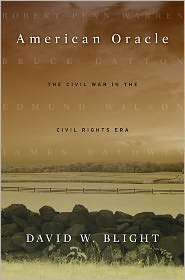
The Chronicle of Higher Education has an interview with David W. Blight on his new book American Oracle: The Civil War in the Civil Rights Era (Harvard University Press). Here's a snippet of the conversation:
Blight: I wrote this book, in great part, as a way of doing some good, serious history of the Civil War Centennial/Civil Rights eras and beginning to reflect on where we are now as a national culture in remembering and explaining the Civil War and Reconstruction. Looking back is almost always the best way of looking at ourselves.
In this week's edition of the New Republic: The Book, you'll find coverage of The Eichmann Trial (Schocken), by historian Deborah Lipstadt. Here's why the book is special, according to the review:
Lipstadt’s book combines a familiar genre of historical summation with a more unusual species of personal and historical reflection. It is a serviceable summary of the events and the major themes of the trial itself. But readers already familiar with this story will not find much to surprise them . . . . [W]hat will grab the reader’s attention most of all is the unusual way Lipstadt interweaves the narrative of the Eichmann trial with more speculative remarks on its significance in relation to revisionism.
Also reviewed: House of Exile: The Lives and Times of Heinrich Mann and Nelly Kroeger-Mann (Farrar Straus Giroux), by Evelyn Juers (here). In a format that is neither fiction nor non-fiction, the book "aim[s] . . . to capture . . . the experience of the European intellectual community in the period before, during, and immediately after World War II."

The New York Times Sunday Book Review is heavy on politics this week. Reviews include Ron Suskind's Confidence Men (here) (mentioned in last week's round-up) and journalist Joe McGinniss's account of his "search[] for the real Sarah Palin" (here).

But there is much for the historically minded, as well. The NYT covers The Swerve: How the World Became Modern (W. W. Norton and Co.), by literary historian Stephen Greenblatt (here); a bestselling biography of Gustav Mahler, now translated into English (here); and Destiny of the Republic: A Tale of Madness, Medicine, and the Murder of a President (Doubleday), by Candice Millard (here) ("Though [James A.] Garfield’s death had little historical significance, Millard has written us a penetrating human tragedy.").


A new issue of the London Review of Books is out.  Non-subscribers may read Daniel Soar's review of The Googlisation of Everything (and Why We Should Worry) (University of California Press), by Siva Vaidhyanathan; In the Plex: How Google Thinks, Works and Shapes Our Lives (Simon and Schuster), by Steven Levy; and I’m Feeling Lucky: The Confessions of Google Employee Number 59 (Houghton Mifflin Harcourt), by Douglas Edwards.

Subscribers will want to check out Neal Ascherson's review of To the Ends of the Earth: Scotland’s Global Diaspora, 1750-2010 (Allen Lane) by T.M. Devine, and The Inner Life of Empires: An 18th-Century History (Princeton University Press), by Emma Rothschild.

Also available to subscribers: Mark Mazower's review of Sarajevo, 1941-1945: Muslims, Christians and Jews in Hitler’s Europe (Cornell University Press), by Emily Greble, and Susan Pederson's review of three British social history festschrifts, honoring Ross McKibbin, Gareth Stedman Jones and Patrick Joyce.

This week the Nation reviews two books on China's transformation: Deng Xiaoping and the Transformation of China (Belknap Press), by Ezra Vogel, and On China (Penguin Press), by Henry Kissinger.  The reviews mentioned last week are now available to non-subscribers.

Saturday, October 1, 2011

Weekend Round-Up

  •  Around the colloquia (courtesy of Legal Scholarship Blog): On September 26, Mark Tushnet (Harvard Law ) presented "Civil Liberties After 1937 - The Justices and Their Theories” at Columbia Law," and Jonathan Miller (Southwestern Law) presented "Borrowing a Constitution: The U.S. Constitution in Argentina and the Heyday of the Argentine Supreme Court (1853-1930)” at UCLA Law.
  • Eric Yamamoto, Hawai'i Law, delivered the keynote address to a recent meeting of the Hawai'i State Bar Association, in which he noted "disturbing parallels"  between the internment of Japanese Americans during World War II and "post 9/11 national policies and actions."
  •  I was pleasantly surprised to learn this week, while noodling around a bit on Joseph Rucker Lamar, who served on the Supreme Court from 1911-1916, that the University of Georgia has posted scans of its holding of of his and his wife Clarinda's papers.  One folder reproduces popular treatments of the Court in middle-class periodicals, such as World's Work.  I've noted a tendency to deprecate Lamar's decisions, but those in two ICC cases (Union Pacific and Louisville & Nashville) do a much better job setting out a framework for the Court's administrative law jurisprudence than did those of Edward Douglass White, who usually gets the credit.  DRE
  • The Edinburgh Legal History Blog has posted a brief report of the recent meeting of the Société internationale Fernand de Visscher pour l'Histoire des Droits de l'Antiquité here.
  • The Society for Historians of American Foreign Relations (SHAFR) has announced a call for papers for its 2012 conference. The theme is "Revolutionary Aftermaths." More information is here. (Hat tip: H-LAW)
  • Over at the Browser, Dahlia Lithwick recommends 5 books on Supreme Court justices.
    The Weekend Round-Up is a weekly feature compiled by all the Legal History bloggers.

    Friday, September 30, 2011

    Binder on Forty Years of Environmental Law

    Denis Binder, Chapman University School of Law, has posted Perspectives on 40 Years of Environmental Law.  Here is the abstract:
    Environmental Law is 40 years old as a distinct body of law. This article is my historical perspective from 4 decades of teaching Environmental Law, emphasizing the early issues that set the foundations for today's Environmental Law, as well as the background in Administrative Law, Land Use Planning and Natural Resources Law that were the seeds of Environmental Law, the issues that blossomed, the issues that disappeared, and those that remain with us. The article contains kudos to the pioneers in the area. We note the changes in paradigms from resource exploitation to resource conservation and from the Master Builder to the Environmentalist.

    New in Law & Society Review

    The new issue of Law & Society Review (September 2011) contains several articles that may be of interest to blog readers.


    “No Hints, No Forecasts, No Previews”: An Empirical Analysis of Supreme Court Nominee Candor from Harlan to Kagan," by Dion Farganis (Elon University—Political Science) and Justin Wedeking (Kentucky—Political Science), covers the period 1950 through 2010 and challenges conventional wisdom about the confirmation process. The abstract follows and the full article is available to subscribers here.  


    Criticism of Supreme Court confirmation hearings has intensified considerably over the past two decades. In particular, there is a growing sense that nominees are now less forthcoming and that the hearings have suffered as a result. In this article, we challenge that conventional wisdom. Based on a comprehensive content analysis of every question and answer in all of the modern confirmation hearings—nearly 11,000 in total—we find only a mild decline in the candor of recent nominees. Moreover, we find that senators ask more probing questions than in the past, and that nominees are now more explicit about their reasons when they choose not to respond—two factors that may be fueling the perception that evasiveness has increased in recent years. We close with a discussion of the normative implications of our findings as well as an outline for future research into this issue.

    "From Programmatic Reform to Social Science Research: The National Tax Association and the Promise and Perils of Disciplinary Encounters" by Ajay K. Mehrotra (Indiana--Law) and Joseph J. Thorndike (Tax Analysts), may also be of interest. The abstract follows and the article is available here.
     This article uses the history of the National Tax Association (NTA), the leading twentieth-century organization of tax professionals, to strengthen our empirical understanding of the disciplinary encounter between law and the social sciences. Building on existing sociolegal scholarship, this article explores how the NTA embodied tax law's ambivalent historical interaction with public economics. Since its founding in 1907, the NTA has changed dramatically from an eclectic and catholic organization of tax professionals with a high public profile to an insular, scholarly association of mainly academic public finance economists. Using a mix of quantitative and qualitative historical evidence, we contend that the transformation in the NTA's mission and output can be explained by the increasing professionalization and specialization of tax knowledge, and by the dominant role that public economics has played in shaping that knowledge. This increasing specialization allowed the NTA to secure its position as a bastion of scholarly tax research. But that achievement came at a cost to the organization's broader civic mission. This article is thus a historical account of how two competing professional disciplines—tax law and public economics—have interacted within a particular organizational field, namely the research and analysis of tax law and policy.

    Finally, consider the abstract of "Politics, Prisons, and Law Enforcement: An Examination of the Emergence of “Law and Order” Politics in Texas," by Michael C. Campbell (Northern Illinois--Sociology). The article, which pivots on the period 1978-1989, is here.

    This article examines the rise of “law and order” politics in Texas, providing an in-depth archival case study of changes in prison policy in a Southern state during the pivotal period when many U.S. states turned to mass incarceration. It brings attention to the important role an insurgent Republican governor and law enforcement officials played in shaping crime policy. Law enforcement's role is considered within a broader examination of political strategy during a period of intense socioeconomic volatility. The findings suggest that within particular political contexts, especially those with low levels of political participation, law enforcement agents might play a key role in shaping punishment.

    Q & A with Lawrence Friedman: on teaching in history depts. and law schools

    Note to readers: This is a part of a series of questions and answers with Lawrence Friedman.

    Question from David Pye, PhD University of West Georgia:  I am wondering about the difference, if any, between teaching a Legal History survey in a law school and in a history department.

    Answer from Lawrence:
    The question about the difference between teaching a legal history survey in a law school as compared to teaching it in a history department is a very good question.  I wish I knew the answer.  I have always taught in a law school, although my course is cross-listed and I have some history students.  I would imagine there are differences in academic culture-- the things the professor would refer to, the traditions she would invoke, and so on.  Also, teaching mostly law students, one can assume they know certain terms; you don't have to define "tort."  But I imagine what really makes a difference is not the students, or the department, but the individual instructor.  As I said in another response, there really isn't a canon for American legal history.  In my own course, I spend a lot of time on family law, and on criminal justice; and I know that many people who teach legal history  (in law school or not) basically skip these subjects.  On the other hand, I go very lightly on the constitutional convention, the founding fathers, and big Supreme Court cases; and I pay shockingly little attention to the intellectual history of American law (such as it is).  Other people feel very differently and design their courses accordingly.

    CFP: Comparative Legal History

    “Definitions and Challenges,” the second biennial conference of the European Society for Comparative Legal History, will be held July 9-10, 2012, at the Vrije Universitet Amsterdam.  The call for papers explains:
    Vrije Universitet Amsterdam
    Comparative Legal History is a relatively young discipline. It focuses explicitly on the comparison of legal ideas and legal institutions in divergent legal traditions. The European Society for Comparative Legal History (ESCLH) was founded in 2009 in order to promote such comparison. Its Inaugural Conference (Valencia, 5-6 July 2010) showed that it is not always easy to find material which is suitable for serious comparison and to establish the criteria which have to be met in order to come to grips with this material.

    The Second ESCLH Conference, which will take place on 9-10 July 2012 at Amsterdam and will be hosted by the VU University, aims at addressing this fundamental problem. Under the heading “Definitions and Challenges” it will try to delineate the landmarks which fruitful legal historical comparison requires and to trace the specific problems that a comparative-historical approach of the various branches of law may encounter. The keynote address will be delivered by David Ibbetson, Regius Professor of Civil Law at the University of Cambridge.
    More information is here.

    Thursday, September 29, 2011

    Reid, The Devil Comes to Kansas: A Story of Free Love and the Law

    The Devil Comes to Kansas: A Story of Free Love and the Law has been posted by Charles J. Reid Jr., University of St. Thomas School of Law (Minnesota).  Here's the abstract:
    State v. Walker (1887) is an important but hitherto neglected landmark case in the development of the right of privacy. The case involved the "autonomistic" or "free-love" marriage of Edwin C. Walker and Lillian Harman, daughter of Moses Harman, the radical newspaperman.

    Edwin and Lillian, who rejected state control over marriage, proclaimed themselves married in the fall of 1887, although they declared that their union was neither permanent or exclusive. Prosecuted for illegal cohabitation because of their refusal to obtain a marriage license, they and their defenders developed a vocabulary that would profoundly influence the future path of American law.

    Their supporters in the radical press began to speak of the right of women to control their own bodies, woman's right to reproductive autonomy, and a right of sexual privacy. Indeed, it was in the midst of this controversy that the expression "freedom of choice" was used, probably for the first time, in its modern meaning by Lillian Harman writing from prison.

    The Kansas Supreme Court, which ruled on the appeal of their convictions, was, in contrast, a deeply conservative and Christian group of men who were publicly known for their religious fidelity and who brought their religious feelings to bear in the case.

    Thanks to the survival of both a substantial body of newspapers and the personal papers of the three justices who ruled on the appeal, it is possible to reconstruct a vivid account of this first skirmish in the American culture wars.

    Regulating Work in the Antipodes, 1788-2007

    Gordon John Anderson, Victoria University of Wellington, and Michael G. Quinlan, University of New South Wales, have posted The Changing Role of the State: Regulating Work Arrangements in Australia and New Zealand 1788-2007, which originally appeared in Labour History (November 2008).  Here is the abstract:
    The state has played a conspicuous role in the history of labour in Australia and New Zealand both as a focus for struggles and where the labour movement achieved a degree of influence that garnered the interest of progressives in other countries. The state is a complex institution and its relationship to labour has been equally complex especially when the differential impacts on different groups such as women are considered. The principal aim of this paper is to trace state regulation of work arrangements (not only those pertaining to industrial relations) in both countries over the period of European presence. Although there are significant similarities, a number of differences are identified and we also try to indicate how recent research and debate on the historiography of the state can provide new insights.

    Wednesday, September 28, 2011

    Law and the Constitution: Antidote to Declining History Enrollments?

    Credit
    The Cornell Daily Sun discusses steps taken by Cornell's history department to reverse declining enrollment in its courses.  According to the story, one step was to create a minor.  Another was to offer "new 1000- and 2000-level courses intended to appeal specifically to freshman and sophomores."  One of these was “History of Law: Great Trials,” which drew over 100 students in its first offering.  In addition, Richard Polenberg agreed to revive his "American Constitutional Development" course.

    New reviews from the Law & Politics Book Review

    Readers may be interested in the latest batch of reviews from the Law & Politics Book Review.

    Eric B. Easton (University of Baltimore School of Law) reviews The Free Press Crisis of 1800: Thomas Cooper's Trial for Seditious Libel (University of Kansas Press), by Peter Charles Hoffer ("due a prominent place among First Amendment case histories"). [here]

    Stephen M. Feldman (University of Wyoming) reviews The Language of Law and the Foundations of American Constitutionalism (Cambridge University Press), by Gary L. McDowell ("On the one hand, it is a brilliant history, meticulously researched, but on the other hand, it is marred by its blatant political goal."). [here]

    Jeannine Bell (Indiana University Maurer School of Law-Bloomington) reviews Degradation: What the History of Obscenity Tells Us About Hate Speech (New York University Press), by Kevin W. Saunders (aiming "not just to demonstrate the similarities between these two types of speech, but also to suggest how examining the legal treatment of obscenity in the United States can guide the sanctioning of hate speech"). [here]

    Michelle D. Deardorff (Jackson State University) reviews The Myth of American Religious Freedom (Oxford University Press), by David Sehat ("an engaging exploration of the continuous and seemingly irreconcilable debates over the meaning of the free exercise clauses found in the federal Constitution and in numerous state-governing documents"). [here]

    Tuesday, September 27, 2011

    Q & A with Lawrence Friedman: on essential readings in legal history


    Note to readers: This is a part of a series of questions and answers with Lawrence Friedman. If you have a question you've wanted to ask him, please post it in a comment, or email me. 

    Questions from Readers
    :
    Would love some legal reading recommendations from Lawrence Friedman. Any books that he thinks are essential for understanding US legal history? Thanks.

    I second that comment, and would also ask for his recommendations on English legal history, if he has any.

    Answers from Lawrence:   
    It's hard to think of "essential" books for American legal history; and of course I don't dare mention any of mine.  I would say, Willard Hurst's Law and the Conditions of Freedom, his 1956 lectures.  In some ways it's dated; and in some ways so well accepted that a reader thinks, of course, what's the big deal; but I think a careful reading still is very worth while and useful. 
         
    Controversial but terribly important:  Robert Gordon's article, "Critical Legal Histories." 
         
    The field doesn't have many general syntheses-- there's mine, and Kermit Hall's-- but it's really rich in excellent books on various subjects.  I always find Stuart Banner's work intriguing and thought provoking; and his latest book, on property law, is especially good.  I could list books I particularly liked but it would be a long list, and people I left out could feel insulted.  The field is in great shape, in many ways.  But very little is "essential" in the sense that I think the question intends.
          
    British legal history:  here I nominate Douglas Hay, Albion's Fatal Tree.  A model of brilliant and insightful history.  And then there's always Pollock and Maitland.

    Yale Legal History Forum

    Here's the line-up for the year's Legal History Forum at the Yale Law School:

    FALL 2011:

    Thursday, September 22
    Naomi Lamoreaux, Yale University, Department of Economics and History

    Tuesday, October 25
    Mark Weiner, Rutgers School of Law

    Tuesday, November 15
    Melinda Miller, University States Naval Academy

    SPRING 2012

    Tuesday, February 7
    Daniel Hulsebosch, New York University School of Law

    Tuesday, February 28
    James Masschaele, Rutgers University, Department of History

    Tuesday, April 10
    Allison LaCroix, University of Chicago Law School

    Update
     The above simply represents the legal history presented at Yale in the Legal History Forum.  Two historians will be presenting this fall in Yale's Legal Theory Workshop: Clifford Ando (University of Chicago Classics) and Mary Dudziak (USC Law and History). 

    Yablon on Madison's Full Faith and Credit Clause

    Madison's Full Faith and Credit Clause: A Historical Analysis has just been posted by Charles M. Yablon, Yeshiva University, Cardozo School of Law.  It appears in the Cardozo Law Review, Vol. 33, No. 1, p. 125, 2011.  Here's the abstract:
    The Defense of Marriage Act (DOMA) created a new wave of interest in the Full Faith and Credit Clause and its apparent contradictions. Important recent scholarship has shown that American lawyers in the eighteenth century often viewed the term “full faith and credit” as referring to an evidentiary rule. This interpretation ameliorates, but does not actually resolve, the apparent conflict between the first sentence of the Clause, which seems to create a mandatory rule of sister state deference, and the second sentence of the Clause, which seems to give Congress plenary power to abrogate that rule. Rather than seek a chimerical general understanding of the Clause, this Article focuses on James Madison to provide a new and strikingly different historical account of the creation of the Full Faith and Credit Clause. It shows how the Full Faith and Credit Clause was part of a broader plan by Madison and others to curb the ability of states to take acts that were harmful to one another and to the nation, particularly those which, by interfering with vested contract and property rights, jeopardized the country’s economic well-being. Madison purposely sought a Clause that would embody a vague but dynamic deference obligation that could be increased by Congress over time.

    Madison’s actions and writings regarding the Full Faith and Credit Clause strongly suggest that he would have considered congressional actions to weaken or abrogate existing deference obligations not just unwise and unjust, but unconstitutional. Unlike powers which appropriately belonged to the federal legislature irrespective of how they were exercised, Madison’s justification for the powers granted under the second sentence of the Clause was based on how Madison expected those powers to be used, namely, to “provide for the harmony and proper intercourse among the states.” What emerges from this analysis is a picture of the Full Faith and Credit Clause that has significant similarities to the “one way ratchet” interpretation which has been used to argue that the DOMA is unconstitutional, but one in which the presumed constraints on congressional action are the product of national interest, political virtue, and natural law as well as the language of the Full Faith and Credit Clause.

    Monday, September 26, 2011

    Davies on the Generosity of David Dudley Field

    Ross E. Davies, George Mason University School of Law, has published The Judiciary Funded: The Generosity of David Dudley Field in Green Bag 2d, 14 (Summer 2011): 433-452, and on SSRN.  Here is the abstract:

    Library of Congress
    In mid-1894, shortly after the death of David Dudley Field (one of the most powerful and famous, and least-loved, American lawyers of the 19th century), lawyer-journalist Irving Browne published an implausibly laudatory anecdote about Field, based on a letter in which Field claimed to have engaged in a longstanding act of secret philanthropy that was wholly out of character. An experienced observer of public affairs in 1894, or in 2011, surely could be forgiven for doubting the veracity of such a self-serving, out-of-character story, told only posthumously by a friendly journalist, and with no evidence to back it up. The Gilded Age was, after all, a time when politicians and power-mongers like Field could rely on select reporters and editors to serve as virtual publicists – mixing innuendo with truths, half-truths, and non-truths (often supplied by unidentified sources) in news stories that boosted their favorites. Neither Browne nor anyone else seems to have made any effort to verify Field’s story, even though there were seemingly easy ways to do so. It is perhaps for those reasons that Browne’s parable of the secretly saintly David Dudley Field, revealed only post-mortem in all the glory of his selfless kindness and generosity, was largely ignored at the time and has been ever since. But the story is true, or true at least as to Field’s initial generosity. And there is evidence to back it up.

    Justice as a Sign of the Law

    [Here, courtesy of the Yale Law Library Rare Books Blog, is word of a new exhibit.  Five items are now viewable on-line.  This link will bring up all the posted installments at any given moment.]

    How is it that the figure of a woman, draped, holding scales and sword, has been so widely recognized as a symbol of the law for more than 500 years?

    This question is at the heart of the latest exhibit from the Yale Law Library's Rare Book Collection: "The Remarkable Run of a Political Icon: Justice as a Sign of the Law."  Using images from books printed between 1497 and 1788, the exhibit traces the roots of the iconography of Justice, a remnant of the Renaissance, that remains legible today. The exhibit features eleven volumes from the Law Library's Rare Book Collection, along with four emblem books on loan from Yale's Beinecke Rare Book & Manuscript Library.

    The shifting attributes of Justice, displayed in the exhibit, reflect the complex relationships between judgment, sight, knowledge, and wisdom. In the 1400s and 1500s, a blindfold on Justice signified her disability; today the blindfold is commonly understood as a sign of justice's impartiality.

    The exhibit is curated by Judith Resnik (Arthur Liman Professor of Law, Yale Law School), Dennis Curtis (Clinical Professor of Law Emeritus, Yale Law School), Allison Tait (Gender Equity & Policy Postdoctoral Associate, Yale Women Faculty Forum), and Mike Widener (Rare Book Librarian). The exhibit draws heavily on Resnik's & Curtis' new book, Representing Justice: Invention, Controversy and Rights in City-States and Democratic Courtrooms (Yale University Press, 2011).

    The exhibit is on display through December 16, 2011 in the Rare Book Exhibition Gallery, located on Level L2 of the Lillian Goldman Law Library, Yale Law School, 127 Wall Street. It is open to the public, 9am-10pm daily.

    Sunday, September 25, 2011

    Love, Leadership, and Bad Behavior: This Week in the Book Pages


    The one that caught my eye in the New York Times Sunday Book Review was Love and Capital: Karl and Jenny Marx and the Birth of a Revolution (Little, Brown and Co.), by biographer Mary Gabriel.  From the review:
    It gives an entertaining and balanced portrait of Marx, Engels, their colorful milieu of exiles, freaks and revolutionaries, and the little-known Marx family, dominated by Karl’s political obsession. It also details illicit love affairs, the deaths of children and financial struggles, all based on vast research and narrated with empathetic passion. At the same time, it is too long by 200 pages and often undermined by flagrantly purple throbbings, minor mistakes and portentous overegging.
    The NYT gives top billing, however, to Who's Afraid of Post-Blackness? What It Means to Be Black Now (Free Press), by Touré.

    Here's the first paragraph of the review, by Orlando Patterson:
    Much has been written on the benefits that accrued to the generation of African-Americans reaping the rewards of the civil rights revolution. But we have heard surprisingly little from those in the post-civil-rights age about what these benefits have meant to them, and especially how they view themselves as black people in an America now led by a black president. In his new book, Touré’s aim is to provide an account of this “post-black” condition, one that emerged only in the 1980s but by the ’90s had become the “new black.”
    Patterson describes the book as "one of the most acutely observed accounts of what it is like to be young, black and middle-class in contemporary America," and the author's voice as "often humorous, occasionally wary and defensive, but always intensely engaging." For more on the book, listen to the podcast, here.

    Also reviewed: film critic Roger Ebert's memoir (here), and Laurence Bergreen's biography of Christopher Columbus (here).

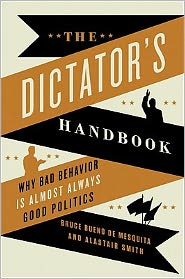
    In the Wall Street Journal book pages, you'll find a review of The Dictator's Handbook: Why Bad Behavior Is Almost Always Good Politics (PublicAffairs), by political scientists Bruce Bueno de Mesquita and Alastair Smith (here). It is "a lucidly written, shrewdly argued meditation on how democrats and dictators preserve political authority." Here's a bit more:
    One might presume that a badly handled natural disaster greatly shortens time in office. It does—but only in democracies. Dictators, the authors argue, should view mass death by natural disaster as good politics. This is a jarring assertion, but consider that the higher the death toll in a democracy, the less likely an incompetent government is to be re-elected. The higher the death toll in an autocracy, however, the more money leaders can extract from foreign governments and aid agencies, money that is then used to strengthen the position of government loyalists.
    Also in the WSJ: reviews of Signing Their Rights Away: The Fame and Misfortune of the Men Who Signed the United States Constitution (Quirk), by Denise Kiernan and Joseph D'Agnese (here); and Hemingway's Boat: Everything He Loved in Life, and Lost, 1934-1961 (Knopf), by Paul Hendrickson (here).

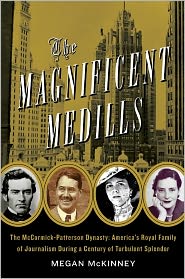
    The Washington Post covers The Magnificent Medills: America's Royal Family of Journalism During a Century of Turbulent Splendor (Harper), by Megan McKinney, and Newspaper Titan: The Infamous Life and Monumental Times of Cissy Patterson (Knopf), by Amanda Smith.  Critic Jonathan Yardley describes the first as a "good book about Joseph Medill and his descendants," "predatory newspaper barons whose influence on American journalism was considerably more malign than salubrious." The second is "a rather less good book about Medill’s granddaughter," who in Yardley's view was hardly the "titan" claimed.

    Also reviewed in the Post:

    Journalist Ron Suskind's Confidence Men: Wall Street, Washington, and the Education of a President (Harper). The review is mixed ("In the end, I wondered if the author himself were the real confidence man, the ultimate untrustworthy narrator.").

    Nassir Ghaemi's "psychological history," A First-Rate Madness: Uncovering the Links Between Leadership and Mental Illness (Penguin Press).  According to the review, Ghaemi uses profiles of eight arguably mentally ill leaders and a control group of "normal" ones to argue that "[i]n times of crisis, we are better off being led" by the former than the latter. 


    This week the New Republic covers Steven Brill's Class Warfare (Simon and Schuster). In reviewer Richard Kahlenberg's estimation:
    Brill’s portrait of school reform in America is highly seductive. It would be very nice to believe that if only unions would get out of the way, we could make enormous strides with fairly simple changes in school governance and human capital policies. But like the film Waiting for Superman before it, Class Warfare is highly misleading and often simplistic.
    For other reviews, see our earlier round-ups, here and here.

    Over at the Los Angeles Times, you'll find coverage of Hughes After Howard (Sea Hills Press), an insider's account of Hughes Aircraft Co. after the departure of its eccentric founder.  According to the review, the book should appeal to historians, scientists, and engineers.

    Also covered: American Dreamers: How the Left Changed a Nation (Knopf), by Michael Kazin (here).

    A new issue of the New York Review of Books is out. Mark Danner's essay "After September 11: Our State of Exception" is open access. Subscribers may also want to check out Russell Baker's "Anarchists and Capitalists," a review of Emma Goldman: Revolution as a Way of Life (Yale University Press), by Vivian Gornick, and The President and the Assassin: McKinley, Terror, and Empire at the Dawn of the American Century (Random House), by Scott Miller. 

    There is some good stuff in the Nation this week. Subscribers may read "The Truth About the Civil War," by Eric Foner ("Too many Americans have fallen prey to narratives that erase the role of slavery in the war’s origins and legacy.") and Aziz Rana's take on Malcolm X, by Manning Marable ("A biographer's flawed attempt to rediscover the politics in the decidedly political life of Malcolm X.").

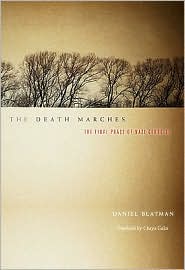
    The UK magazine History Today offers short reviews of The Origins of the English Parliament, 924-1327 (Oxford University Press), by J. R. Maddicott (here); Simon Wiesenthal: The Life and the Legends (Jonathan Cape), by Tom Segev (here); and The Death Marches: The Final Phase of Nazi Genocide (Belknap Press), by Daniel Blatman (trans. Chaya Galai) (here), among others.

    Saturday, September 24, 2011

    Weekend Round-Up

    • An on-line exhibit of the portraits of the judges of the District Court for the District of Columbia is now available here.
    The Weekend Round-Up is a weekly feature compiled by all the Legal History bloggers.