Tuesday, April 11, 2023

Wertheimer's "Race and the Law in South Carolina"

John William Wertheimer, the William R. Kenan, Jr. Professor of History at Davidson College, has published Race and the Law in South Carolina: From Slavery to Jim Crow (Amherst College Press).  It is available open access:

This first title in the “Law, Literature & Culture” series uses six legal disputes from the South Carolina courts to illuminate the complex legal history of race in the U.S. South from slavery through Jim Crow. The first two cases—one criminal, one civil—both illuminate the extreme oppressiveness of slavery. The third explores labor relations between newly emancipated Black agricultural workers and white landowners during Reconstruction. The remaining cases investigate three prominent features of the Jim Crow system: segregated schools, racially biased juries, and lynching, respectively. Throughout the century under consideration, South Carolina’s legal system obsessively drew racial lines, always to the detriment of non-white people, but it occasionally provided a public forum within which racial oppression could be challenged. The book emphasizes how dramatically the degree of legal oppressiveness experienced by Black South Carolinians varied during the century under study, based largely on the degree of Black access to political and legal power.

As Professor Wertheimer writes in the Acknowledgements, “Each of this book’s six chapters began as a class-wide collaborative project in HIS 455: Law and Society in American History, an undergraduate research seminar that I teach in the History Department at Davidson College. In all, eighty students cowrote these pages.”

Here are some endorsements:

“Recent arguments in African American History have emphasized the theme of continuity... Race and Law in South Carolina recovers the theme of change over time by showing just how things have changed, and it does so through patient, thick description.” — H. Robert Baker, Georgia State University

“This book and its concomitant student project is an exciting endeavor...The cases are captivating and accessibly written, making this a possible college classroom read.” —Vanessa Blanck, Rowan University 

--Dan Ernst

AJLH 62:4

American Journal of Legal History 62:4 (December 2022) has been published online:

Articles
 
Those Things Which Are Written in Romance: Language and Law Teaching in Thirteenth-Century England    
Thomas J McSweeney

Charitable Trusts of Cemeteries and Places of Worship in Thailand: A Historical Anomaly
Surutchada Reekie
 
The Tragic Pragmatism of the Wagner Act    
Daniel Judt

O’Connor v Donaldson (1975): Legal Challenges, Psychiatric Authority, and the Dangerousness Problem in Deinstitutionalization    
Laura Hirshbein
 
Book Reviews

 
Kristin A. Olbertson, The Dreadful Word: Speech Crime and Polite Gentlemen in Massachusetts
Jessica Lowe
 
Mary Sarah Bilder, Female Genius: Eliza Harriot and George Washington at the Dawn of the Constitution 
Rosemarie Zagarri

Monday, April 10, 2023

ASLH Student Research Colloquium

[We have the following Call for Applications.  DRE]

The American Society for Legal History will host its tenth annual Student Research Colloquium (SRC) on Wednesday, October 25, and Thursday, October 26, 2023, in Philadelphia, Pennsylvania, USA.  Each year, the SRC brings eight graduate students to the site of the ASLH annual meeting to discuss their in-progress research projects with each other and with ASLH-affiliated scholars.

Target applicants include early-post-coursework Ph.D. students and historically minded law students.  All students whose research touches on legal-historical themes are encouraged to apply, whatever the chronological or geographical focus.  Applicants who have not yet had an opportunity to interact with the ASLH are welcome, as are those who have never received any formal training in legal history.  A student may present a paper at the annual meeting and participate in the SRC in the same year.

The ASLH will at least partially and, in many cases, fully reimburse students' travel, hotel, and conference-registration costs.   To apply, please submit the following three items to John Wertheimer at:  srcproposals@aslh.net:

  • a cover letter that describes, among other things, how far along you are and approximately how many years remain in your present course of study;
  • a cover letter that describes, among other things, how far along you are and approximately how many years remain in your present course of study;
  • an up-to-date CV; and
  • a two-page, single-spaced research statement that contains a working title and describes the in-progress research project that you would like to present at the colloquium.

Application deadline: June 1, 2023.

Ernst Comments on Tushnet's "Hughes Court"

[For the occasion and setting of these remarks, see here.  DRE.]

Professor Ernst's Remarks:

Mark Tushnet is famously prolific.  Back in the 90s, when he was on the faculty here and I was still junior, I had occasion to allude to this trait in explaining why I was taking time before tenure to write a review essay.  Many leading American legal historians had worked out their own approaches to history in such writings, I explained.  Morton Horwitz wrote such a review essay, Dirk Hartog wrote one; Bob Gordon wrote one.  Mark wrote three.

So perhaps you can forgive me for thinking, as I unpacked the very large draft of Mark’s manuscript a few summers ago, “Of course: Ask Mark Tushnet to write a Holmes Devise history of the Hughes Court, and he’ll write two.  

And perhaps the thought was all the more understandable because I was aware of the conflicting challenges that confront authors of volumes in the Holmes Devise series.  The first is to tell a story of change over time, with sufficient narrative tension to keep readers reading.  The second is the expectation that its volumes will tell the whole story of the Supreme Court in the years covered. The author who puts too great a premium on a compelling narrative risks leaving too much out.  The author who puts too great a premium on comprehensiveness risks writing an encyclopedia, not a history. “Of course,” I again said to myself, “like Yogi Berra, when Mark came to a fork in the road, he took it.”  That is, the first of Mark’s two Holmes Devise histories of the Hughes Court, disguised as the 420-page Part I, is a narrative; the second, more comprehensive history is disguised as the 722-page Parts II and III.

But if my initial reaction, that Mark wrote two books on the Hughes Court, deceptively marketed within the same wine-and-green covers, was understandable, it was also unfair, because The Hughes Court: From Progressivism to Pluralism really is a single work, with a single point, albeit one requiring both approaches, the narrative and the comprehensive, to establish.

Let’s start with the narrative.  More than is true for that of any other Chief Justiceship, readers open a history of the Hughes Court anticipating its narrative arc and especially its climax, the Court-packing plan and the “Constitutional Revolution of 1937.”  Mark addresses that expectation right at the outset.  Borrowing from the historian of science Steven Shapin, who made an analogous point about the scientific revolution, he writes, “There was no Constitutional Revolution of 1937, and this is a book about it.”  Revolutions are abrupt fundamental changes, about faces or swappings out of one structure for another.  Mark acknowledges that a dichotomous interpretation of the Hughes Court has “something to back it up” and that “something like dichotomies can indeed be found in the Court’s work”; nonetheless, and to use his word, The Hughes Court “destabilizes” those dichotomies. Yes, as he shows in Part 3, by the end of Charles Evans Hughes’s chief justiceship a new approach legal approach, pluralism, was emerging and partially displacing the older, progressive one.  But in Part 2 he shows many doctrinal continuities across 1937.  Further, whether you attempt to distinguish them in political economic terms between conservatives and liberals or in jurisprudential terms between formalists and realists, “most of the justices moved fluidly across the divides when they thought doing so was appropriate.”

And that is because, with some arguable exceptions, the justices were not invested in developing or instantiating theory.  “It is a mistake to treat the justices' opinions as embodying deep theoretical commitments,” Mark writes.  “Rather, the theories of the administrative state, the public interest, and the judicial process were part of the general atmosphere of thought surrounding the justices.”  Aside from Holmes and possibly Cardozo, the “justices were more or less ordinary lawyers immersed in their daily work.  Some were smarter than others, some had more direct political experience than others, and all these influences shaped their decisions substantially more than their absorption of external theorizing.  Again: “What the justices brought to their decisions was the working–and rather untheorized–jurisprudence of the ordinary judge who learned law in the late nineteenth and early twentieth centuries.”

Well, what were they doing, then?  As Mark writes, borrowing language from one of Hughes’s addresses: they were reaching conclusions by consulting both “particular formulas” and “conceptions of basic needs,” constructs that “supplied the grammar of constitutional discourse rather than determin[ed] its content.” That is, Mark doesn’t deny that political economy or what legal process scholars would later call the principle of institutional settlement pointed the justices in the direction they wanted to go.  Still, the two constructs were the tools they had to get themselves there, and they had to be used in certain ways or else appear to pass–in Mark’s words–”from lawyerly deliberation to sheer willfulness” (to quote Mark’s rendering of Harlan Fiske Stone’s verdict on Colgate v. Harvey).

It did not take Mark that many pages to tell us this much, but showing it to us was another matter.  “Understanding how the tension [between "particular formulas” and “conceptions of basic needs”] played itself out in the Court’s cases,” he writes, “requires attention to rather dry cases far removed from the core constitutional controversies that are typically the focus of attention.” Again, from the preface: “[T]he work of the Supreme Court is, well, work.  The justices’ experience was shaped by everything they did, not only by the cases that got the headlines.  To capture the experience we must look at as much of the Court’s work as feasible.”  And, in case that warning didn’t take, Mark provides another, a description of his method that is somehow both wholly accurate and deceptively understated: “I discuss a rather large number of relatively small cases in some detail.”  (I’ll say.)

Those “core constitutional controversies” dominate the narrative in Part 1; the cases in Parts 2 and 3 are more likely to strike readers as “rather dry”–unless they happen to specialize in the law those cases made, in which case the reading is rather thrilling–and at times astonishing.  Long ago, Mark famously identified the “‘lawyer as astrophysicist’ assumption,” the belief that lawyers’ general training enables them to “read a text on astrophysics over the weekend and launch a rocket on Monday.”  Mark may not have launched any rockets, but he is utterly convincing as he moves across the many topics that found their way to the Court, combining lucid summaries of the often complex records of the cases with equally clear descriptions of the context in which they arose.  If you happen to know a topic pretty well and look down at Mark’s footnote, every time you discover that Mark has read just the right source.  And if you don’t know the topic well, you’re grateful to Mark for explaining it to you.  To take one example: many people have tried to explain to me how holding companies work, but Mark, at page 970, is the only person who has succeeded.  To sum up: if you find yourself needing help with an unfamiliar Supreme Court case, you are generally wise to start with the relevant volume of the Holmes Devise.  If the Hughes Court decided the unfamiliar case, you are a fool not to start with Mark’s.

That’s enough on the first of two questions one should ask every work of scholarship–“What’s new?”  What about the other question, “So what?”  To work toward an answer, I want to take up the irony that Laura has just identified, that Mark’s book would have wowed Felix Frankfurter and Paul Freund when one would have expected them to hate a history of the Court written by so important a figure in a movement that sought to destabilize the school of jurisprudence to which they subscribed.  You could almost imagine Freund opening the book, with his verdict on the judicial biographer Alpheus T. Mason at the ready (“what Mason touches he vulgarizes”) and then closing it deeply impressed how subtly and seriously Mark explained the justices’ decisionmaking.  

I’ve had a similar thought, that Mark has written the book Paul Freund couldn’t, but then I mistrusted it.  Although I have worked in Freund’s papers, I can't claim to know his scholarship well nor did I ever take a course from Freund, as Mark did, but I’m assuming that Freund invested the justices’ reasoned elaboration with a timeless normative significance that I doubt Mark shares.  That’s not to say that Mark’s book is purely descriptive or without normative implications; it’s just that the implications of an emphasis on craft may have been different near the conclusion of Mark’s career in the legal academy than they were near its beginning.  That’s the thing about writing of history being a dialogue between the past and the present: the present keeps changing.  Perhaps when the Legal Process pervaded the legal education of so many Supreme Court justices, the politics of law called for revealing the structures of thought obscured by their display of craft.  Now, when so many seem to be committed to theory in one form or another, the politics of law call for reminding them that, to use Holmes’s famous term, “jobbism” allowed their predecessors to resolve old challenges and meet new ones in calamitous times, notwithstanding their sometimes sharply conflicting political commitments.

At the end of his acknowledgments, Mark writes that he considers The Hughes Court “the capstone of a career in the legal academy that has now ended.”  I can’t disagree: a scholarly lifetime is evident in Mark’s conception of the purpose of his book, in the learning he brought to it, and in the mastery with which he executed his design.  I can imagine that it might leave some scholars discouraged, overwhelmed by the realization that they could never produce a similar work, but it heartens me.  After contributing vitally so many fields of legal scholarship, Mark has chosen to complete his career in the legal academy with a work of legal and constitutional history.  When I reflect on the fact that a scholar as great as Mark is has been so committed to the same enterprise I am I find myself enormously reassured of its value and eager to get back to work.

Kalman Comments on Tushnet's "Hughes Court"

[On Tuesday, April 4, Georgetown Law devoted a session of its faculty workshop to honoring the publication of The Hughes Court: From Progressivism to Pluralism, 1930-1941 (Cambridge University Press, 2022), a volume in the Oliver Wendell Holmes Devise History of the Supreme Court of the United States, by Mark V. Tushnet, the William Nelson Cromwell Professor of Law Emeritus at the Harvard Law School.  The HLS Library hosted a virtual symposium on the book last year, Georgetown Law wanted to celebrate its appearance as well, because Professor Tushnet was a former, longtime member of its faculty.  My colleague Brad Snyder organized the event, at which Laura Kalman, Distinguished Research Professor of History, University of California, Santa Barbara, and I gave remarks.  With her permission, Professor Kalman's appear below.  Mine follow in the next post.  We ask you to keep the setting in mind as you read them.  DRE.]

Professor Kalman's Remarks:

Like some of you, I bet, I have my own very particular vision of Heaven. It includes a fabulous library where those who've died can continue reading what authors have written about them.  When the authors themselves arrive, they sit down with their subjects in the library cafĂ© and consume great amounts of pizza from Frank Pepe's and beer as authors and subjects chew over what the authors wrote.  Given the food, the library's beauty, and the fact that the mantra in my heaven is that reasonable people can disagree, these discussions are usually very cheerful.  

Now when it happens the lunch between Oliver Wendell Holmes, Felix Frankfurter, and Paul Freund after they've read the book, with Mark, who I hope doesn't arrive in Heaven until he's 120, may start out a tad tense.  Holmes is probably thrilled to see Mark.  He's got to be relieved someone has FINALLY finished this volume of the Devise. Frankfurter--not so much.  Frankfurter was obviously the moving force on the Court behind the Devise, having launched it "into high gear” (ha ha) in 1955--while Earl Warren was distracted by Brown II and calls to run for President after Ike's heart attack. Mark is no Frankfurter fan, and he's called Frankfurter "sloppy" about procedural matters dear to the justice's heart. And Frankfurter has got to be bothered by the fact that Mark said in 1976 that the "time has come to blow the whistle on the Holmes Devise History of the Supreme Court"-presumably because the volumes have been taking too long to get out, since Frankfurter and Freund assigned them to the wrong people.  And then there's Freund, general editor of the Devise before he was succeeded by Stan Katz, then Maeva Marcus.  Freund was also supposed to have written the Hughes Court volume, but he didn’t deliver. Frankfurter and Freund can't relish having Mark at Harvard, much less as an author of the sainted Holmes Devise that the justice promoted to provide proof that Harvard was superior in all things.
 
But if our luncheon guests put all these issues aside, as you're supposed to do in my heaven, I bet Frankfurter and Freund are absolutely wowed by Mark's spectacular book. It is a masterpiece right from the early sentence, "There was no Constitutional Revolution of 1937, and this is a book about it." Mark explodes tired old dualities like progressive-conservative, formalist-realist, internalist-externalist and shows how the justices navigated their way between formalism and social reality to shape progressivism into pluralism. And in my favorite sentences on page 1162 (Holmes Devises double as doorstops), Mark identifies a "constitutional revolution" "IN" 1937 in the precise location of Jones & Laughlin's "dismissal of Carter Coal as "not controlling."  Then Mark rightly adds, "And yet, because legal consciousness is never fully consolidated, it is also a mistake to describe a constitutional revolution OF 1937." Absolutely brilliant! To conclude, I revere this book, and Frankfurter and Freund should also!

Saturday, April 8, 2023

Weekend Roundup

  • Congratulations to Karl Shoemaker on his appointment as the Robert F. and Sylvia T. Wagner Distinguished Faculty Chair from the College of Letters and Science at UW-Madison!
  • And to Sally Hadden, Western Michigan University, on her selection as a National Humanities Center Fellow for 2023-24, for what she describes as a work in progress with Maeva Marcus on “a prehistory of the earliest Supreme Court"!
  • Carlos Fernandez Salas, a lawyer currently pursuing a doctorate at Harvard University, will present in the Legal History Roundtable at Boston College Law School on Thursday, April 20 from 4:30pm to 5:45pm.
  • Georgetown Law observes the centennial of United States v. Thind (1923) on Thursday, April 20, at 5:30 PM.  Tejinder Singh, Sparacino PLLC; Sherally Munshi, Georgetown Law; and Sim J. Singh, The Sikh Coalition will “examine the intersections between Thind and race, caste, colonialism, its implications for religion and activism, and what we can learn from this history today.” 
  • The latest Newsletter of the Historical Society of the District of Columbia Circuit is available here.
  • ICYMI: "The Declaration of Breda” is expected to “fetch up to £600,000 ($749,000)” when Sotheby’s auctions it off (CNN).  Penn names first female law school dean in 170-plus year history (Philadelphia Inquirer). 
  • Update: Over at The Jackson List, John Q Barrett notes the passing of Benjamin B. Ferencz.
Weekend Roundup is a weekly feature compiled by all the Legal History bloggers.

Friday, April 7, 2023

CFP: South Asia Legal Studies Workshop

Just released: the Call for Proposals & Commentators for the 17th Annual South Asia Legal Studies Workshop, which will be held in person: October 18, 2023, at the University of Wisconsin Law School, and virtually on December 1-2, 2023.  It invites a short paper or project proposal “relating to any aspect of the study of law and South Asia.”  The organizers write:

We understand “law” in its broadest sense to encompass not only state law, but also norms emanating from non-state sources and actors. We welcome proposals from a diverse array of disciplines and career paths and research on issues of timely interest and concern have been particularly well received at past workshops. Please note that those who presented during the last two years (2021 and 2022) are not eligible to apply.

--Dan Ernst

A History and Inventory of the Records of the New York State Supreme Court

With financial help from the William Nelson Cromwell Foundation, the New York State Court of Appeals and the New York State Archives have published a second edition of "Duely & Constantly Kept:” A History of the New York Supreme Court and an Inventory of Its Records, 1691–1847:
In 1691 the Assembly of New York Colony passed an act establishing a Supreme Court of Judicature and provided that the court should be "Duely & Constantly Kept" at times to be provided. After over 350 years of political revolution and independence from Great Britain, four State constitutions, and four major reorganizations of the judiciary, the Supreme Court continues as the State’s court of “general, original jurisdiction." Extending the meaning of the phrase, a comprehensive collection of New York’s earliest court records, covering the period of 1690 to 1847, are now "duly and constantly kept" at the State Archives.

--Dan Ernst

Thursday, April 6, 2023

Friedlander on the Delaware Companion Case in Brown

Joel Edan Friedlander, Friedlander & Gorris, has posted The Desegregation Decrees of the Delaware Court of Chancery, which is forthcoming in the Delaware Law Review:

It is often said that the United States Supreme Court affirmed Chancellor Collins J. Seitz in Brown v. Board of Education, but the legal history is more complex than that. Chancellor Seitz’s decision in Belton v. Gebhart and Bulah v. Gebhart was simultaneously historic, influential, and disregarded as a model for desegregation. In this essay, I discuss how Chancellor Seitz’s decision and decree can be seen as representing an alternative model for desegregation based on a more traditional form of equity jurisprudence. I examine Chancellor Seitz’s approach to desegregation by examining Belton/Bulah within the context of three other challenges to racial segregation adjudicated by the Delaware Court of Chancery in the decade between 1950 and 1959. The manner by which Chancellor Seitz and Vice Chancellor Marvel discharged their judicial oath in these four cases is worthy of study and honor several decades later.

--Dan Ernst

Bryson's Edition of Chancery Cases, 1660-1673

Just published: W. H. Bryson, ed. Reports of Cases in the Court of Chancery from 1660 to 1673 (Tempe: Arizona Center for Medieval and Renaissance Studies, 2022):

This edition of Chancery cases from the Restoration of Charles II in 1660 to the beginning of the juridical tenure of Lord Nottingham in 1673 includes all of the Chancery reports, both in print and in manuscript, known to date from this period. It also adds to the Chancery canon the law reports included in Lord Nottingham’s prolegomena. These reports come from the judicial tenures of Edward Hyde, Earl of Clarendon, Sir Orlando Bridgman, and the Earl of Shaftesbury, three very different types of equity judges. Yet there is a consistency among them, which shows the continuity of the administration of the court. These consolidated reports are presented chronologically according to the modern method of presenting cases.

--Dan Ernst

Wednesday, April 5, 2023

Raffield's "Shakespeare's Strangers and English Law"

Paul Raffield, University of Warwick, has published Shakespeare's Strangers and English Law (Hart/Bloomsbury):

Through analysis of 5 plays by Shakespeare, Paul Raffield examines what it meant to be a 'stranger' to English law in the late Elizabethan and early Jacobean period. The numbers of strangers increased dramatically in the late sixteenth century, as refugees fled religious persecution in continental Europe and sought sanctuary in Protestant England.

In the context of this book, strangers are not only persons ethnically or racially different from their English counterparts, be they immigrants, refugees, or visitors. The term also includes those who transgress or are simply excluded by their status from established legal norms by virtue of their faith, sexuality, or mode of employment.

Each chapter investigates a particular category of 'stranger'. Topics include the treatment of actors in late Elizabethan England and the punishment of 'counterfeits' (Measure for Measure); the standing of refugees under English law and the reception of these people by the indigenous population (The Comedy of Errors); the establishment of 'Troynovant' as an international trading centre on the banks of the Thames (Troilus and Cressida); the role of law and the state in determining the rights of citizens and aliens (The Merchant of Venice); and the disenfranchised, estranged position of the citizen in a dysfunctional society and an acephalous realm (King Lear).

--Dan Ernst

Sophia Lee to be Dean at Penn Law

We congratulate former LHB Guest Blogger Sophia Z. Lee on her naming as the next dean of the  University of Pennsyl-vania Carey Law School.  Professor Lee is the author of The Workplace Constitution from the New Deal to the New Right (2015).

--Dan Ernst

Tuesday, April 4, 2023

Halliday on English Laws and Global Histories

English Laws, Global Histories; or, What Makes a Court Supreme? the presidential address Paul D. Halliday, University of Virginia, delivered at the North American Conference on British Studies in November 2021, has now been published open access in the Journal of British Studies.  Here is a taste:

I will explore a question I've long puzzled over: how might one produce a global history of English laws? We need this history; a global orientation offers the only way to conceive English laws in all their Englishness. I stress English, for the laws of a British empire were peculiarly English. Yet they were also multiform: so much more than indicated by all the maps of common law countries one might find online. We also need this history because understanding English law's extra-English transformations will help us think through any number of problems that people around the globe confront now in the possession and protection of rights in all their forms: substantive and procedural, civil, constitutional, and human.
–Dan Ernst

Monday, April 3, 2023

Holt's "Very Short Introduction" to the Civil Rights Movement

Thomas C. Holt, the James Westfall Thompson Distinguished Service Professor Emeritus of American and African American History at the University of Chicago, has published The Civil Rights Movement: A Very Short Introduction (Oxford University Press):

The Civil Rights Movement was among the most important historical developments of the twentieth century and one of the most remarkable mass movements in American history. Not only did it decisively change the legal and political status of African Americans, but it prefigured as well the moral premises and methods of struggle for other historically oppressed groups seeking equal standing in American society. And, yet, despite a vague, sometimes begrudging recognition of its immense import, more often than not the movement has been misrepresented and misunderstood. For many, a singular moment, frozen in time at the Lincoln Memorial, sums up much of what Americans and the world know about that remarkable decade of struggle.

In The Civil Rights Movement: A Very Short Introduction, Thomas C. Holt provides an informed and nuanced understanding of the origins, character, and objectives of the mid-twentieth-century freedom struggle, privileging the aspirations and initiatives of the ordinary, grassroots people who made it. Holt conveys a sense of these developments as a social movement, one that shaped its participants even as they shaped it. He emphasizes the conditions of possibility that enabled the heroic initiatives of the common folk over those of their more celebrated leaders. This groundbreaking book reinserts the critical concept of "movement" back into our image and understanding of the Civil Rights Movement.

--Dan Ernst

Saturday, April 1, 2023

Weekend Roundup

  • Philippa Strum will receive the Spitzer Lifetime Achievement Award at the Bill of Rights Celebration of the District of Columbia Chapter of the ACLU on May 2.  
  •  “'Legal Knowledge,' a new podcast produced by the Arthur J. Morris Law Library’s Special Collections department, will explore the history of legal education at the University of Virginia."
  • Advocate, the memoir of “DC insider” James Hamilton, is published (ABAJ) .
  • ICYMI: Amanda Frost on birthright citizenship (WaPo). Hardeep Dhillon on how birthright citizenship shaped Asian American families (Smithsonian).  Illinois’s history with slavery and its links to the present (Illinois Public Media).  A modern history of tenants' rights (Investopedia).

Weekend Roundup is a weekly feature compiled by all the Legal History bloggers.

Friday, March 31, 2023

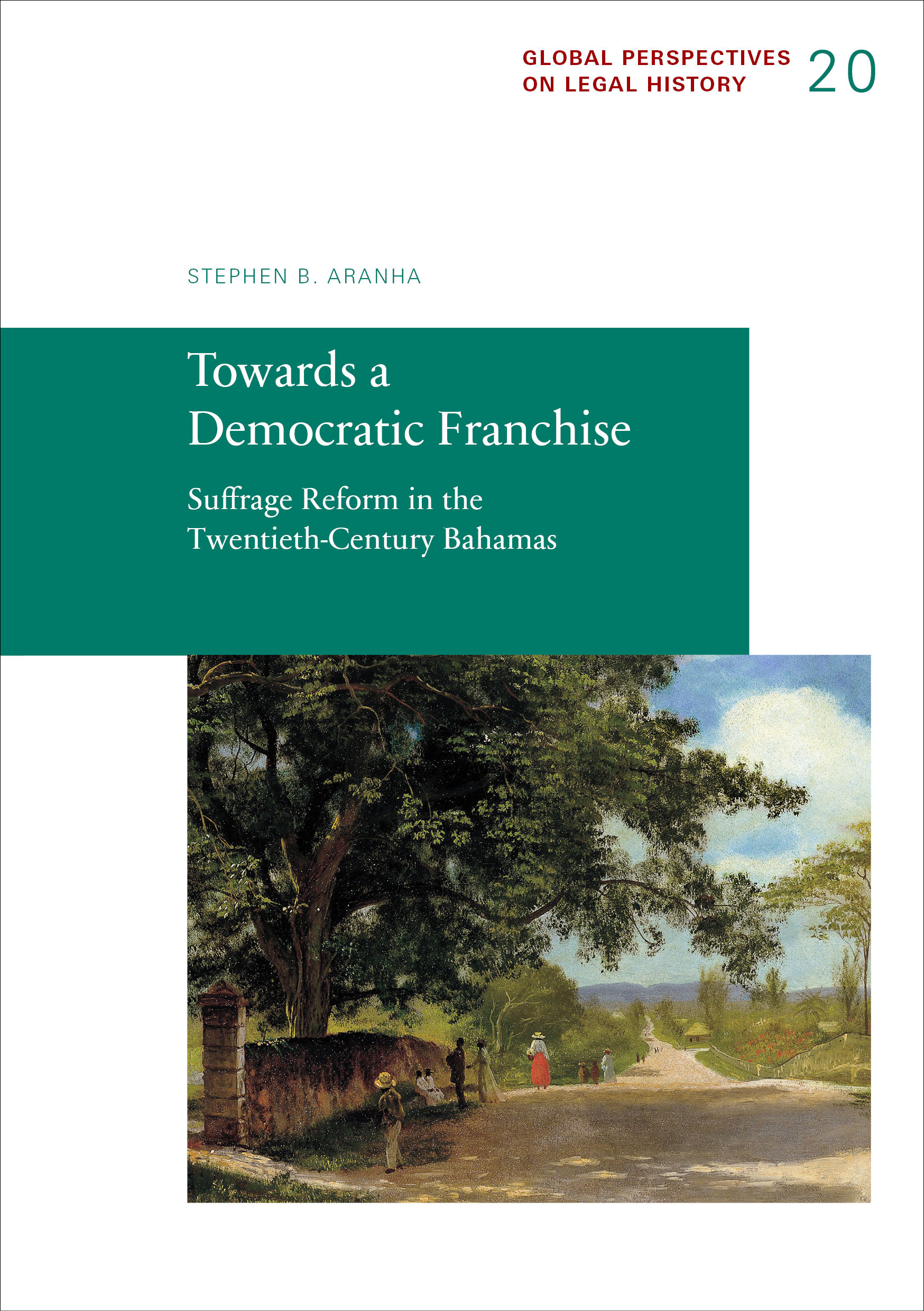
Aranha on Suffrage Reform in the Bahamas

[We have the following announcement.  DRE]

Stephen B. Aranha, Towards a Democratic Franchise. Suffrage Reform in the Twentieth-Century Bahamas (Global Perspectives on Legal History 20), Frankfurt am Main: Max-Planck-Institut fĂĽr Rechtsgeschichte und Rechtstheorie 2022, XII, 323 p., ISBN 978-3-944773-38-4, eISBN 978-3-944773-39-1

The book examines the process of electoral reform in the Bahamas during the twentieth century in the broader context of decolonisation. Beginning with the General Assembly Elections Act of 1919, which reaffirmed a franchise limited to propertied men, milestones include the introduction of voting by secret ballot between 1939 and 1946, universal adult male suffrage in 1959, women's suffrage in 1961, and the incremental abolition of plural voting between 1959 and 1969.

This legal and political historical study draws on a variety of sources from Great Britain and the Bahamas, such as legislation, legal cases, government records, newspapers and blogs. It also analyses the effect that the electoral reforms have had on the state of democracy in the modern-day Bahamas in shaping the relationship between the postcolonial state and its citizens. The author concludes that since independence in 1973 the reform progress has stalled. Civil society, the driving force behind the twentieth-century reforms, has been largely dormant since then.

After graduating from the Free University of Berlin, Stephen B. Aranha worked in the Bahamas where he joined the then College of The Bahamas as an Assistant Professor in History. In 2016, he returned to Germany as a doctoral student at the Max Planck Institute for Legal History and Legal Theory. He earned his doctorate from the Goethe University in Frankfurt am Main in 2021. 

More information about the book and its availability in Open Access and print [here].

Thursday, March 30, 2023

Roberts on Cordell Hull and the Income Tax

Tracey M. Roberts, Cumberland School of Law, Samford University, has posted A Man for His Era and for Ours: Cordell Hull, Father of the Federal Income Tax, which is forthcoming in the Cumberland Law Review:

Cordell Hull (and Spittoon), 1939 (LC)
An 1891 graduate of Cumberland School of Law, Cordell Hull served our country in countless ways. He worked as captain of the Fourth Regiment of the Tennessee Volunteer Infantry in the Spanish-American War, as judge for the fifth judicial circuit of Tennessee, as state representative in the Tennessee House of Representatives, as a member of the United States House of Representatives, as a member of the United States Senate, and as United States Secretary of State. President Franklin D. Roosevelt referred to him as the “Father of the United Nations.” Hull subsequently received the Nobel Peace Prize in 1945 in honor of his work to establish that body. Hull is less well known for his work to establish another important and enduring institution—the modern income tax. In his 1948 memoir, Hull wrote that he probably would not be able to render public service equal to his work in long fight for enactment of the income-tax system, even if he had two lifetimes. This essay explains why Hull regarded the federal income tax as among his chief contributions. First, it outlines Hull’s personal history, his experiences with his mentor—United States Representative Benton McMillin— Hull’s efforts leading up to the adoption and ratification of the Sixteenth Amendment, and the passage of the Revenue Act of 1913. Second, it discusses the historical, economic, and political context that motivated Hull to introduce the tax reform that not only sustained the United States through the two world wars that followed but made possible widespread economic prosperity in the twentieth century. Finally, it discusses the original impetus for reform, comparing the economic conditions from over 100 years ago to those prevailing today, and outlines what it would take to fulfill Hull’s vision and intentions for the federal tax system and the country in the present.
--Dan Ernst

Wednesday, March 29, 2023

Schwartz on Bellia & Clark on Compact Theory of US Federalism

David S. Schwartz, University of Wisconsin Law School, has posted The International Law Origins of Compact Theory: A Critique of Bellia & Clark on Federalism, which is forthcoming in the Journal of American Constitutional History:

Compact theory will not stay dead. Justice Clarence Thomas seems intent on reviving it in some form. Recently, Professors Anthony J. Bellia Jr. and Bradford R. Clark have given a scholarly imprimatur to compact theory by arguing that the word “state” in the Constitution compels us to interpret American federalism doctrine in the manner that Emmerich de Vattel and other European international law theorists would have interpreted the various treaty arrangements that created confederacies of small European states. This international law doctrine holds that express waivers of sovereignty by member states in such leagues must be construed narrowly, and that waivers of sovereignty by implication are disallowed entirely. The authors claim that the doctrines of Vattel were so “well known to the Founders” that the word “state” in the Constitution was widely and tacitly understood to refer to independent, sovereign Vattelian nation-states.

This article argues that Bellia & Clark’s thesis is mistaken. The Framers consistently and systematically rejected this conception of American states as sovereign nation-states in creating the Constitution. To the extent that the Framers showed any awareness of Vattel’s international law understanding of confederacies, they associated it firmly with the central failing of the Articles of Confederation. The ratifying public was well aware that a Constitution established by the people and empowered to regulate the people directly was a fundamental departure from European-style confederacies. Vattelian international law theory as described by Bellia & Clark in essence became “compact theory” in the United States, where it served as the theoretical foundation for ultra-strict construction of implied powers, and later for nullification and secession. It was rejected repeatedly in U.S. constitutional history. Thus, while Bellia & Clark’s account could offer a serviceable origin story for compact theory, it fails as an origin story for American federalism.
--Dan Ernst

Tuesday, March 28, 2023

Thai to Speak on A Chinese Lawyer in Cold War Hong Kong

Tomorrow, Philip Thai, History and Asian Studies, Northeastern University, will be giving via Zoom an ABF Research Seminar, Fighting Containment with Colonial Law: The Strange Career of Percy Chen in Cold War Hong Kong;

Shortly after intervening in the Korean War (1950–53), the People’s Republic of China faced an array of economic sanctions by the United States and the United Nations. The nascent regime vowed to “oppose the American imperialist policy of economic blockade against our country,” and it sought to break what it denounced as an illegal and illegitimate embargo by any means necessary. One front in this campaign was the British colony of Hong Kong, where the People’s Republic hired a lawyer by the name of Percy Chen to work with its many front companies and file lawsuit after lawsuit challenging the U.S. embargo. At first glance, Chen seemed an unlikely figure to serve as legal counsel for Communist China. An Afro-Asian anglophile and a thoroughly bourgeois barrister who lived on the margins of the British empire, Chen found himself at the center of China’s legal offensive during a critical moment in the Cold War. This talk looks at Chen’s life and legal work during the early 1950s, retracing how he wielded colonial law as a weapon to chip away at the U.S. embargo and thereby circumscribe its reach. More broadly, it situates Chen’s role within the vast shadow economies of Greater China during the Cold War and explores the creative ways assorted actors leveraged the legacies of empire for survival and profit. The presentation is based on a draft chapter of Professor Thai’s forthcoming book, In the Shadows of the Bamboo Curtain.
To register, contact Sophie Kofman at skofman@abfn.org

The Docket 5:4

Issue 5:4 of The Docket, the online publication of Law and History Review, is now live, with an essay by David Tanenhaus, Christopher Tomlins's remembrance of David Lieberman (1953-2022), a review symposium on Christine Desan's Making Money and more.

Monday, March 27, 2023

LHR 40:4

Law and History Review  40:4 has now been published on Cambridge Core.

Original Articles

The Probate Regime: Enchanted Bureaucracy, Islamic Law, and the Capital of Orphans in Nineteenth-Century Egypt
Adam Mestyan, Rezk Nori

“To Save the Benefit of the Act of Parliamt”: Mapping an Early American Copyright
Nora Slonimsky

Protecting the Colony from its People: Bushranging, Vagrancy, and Social Control in Colonial New South Wales
Meg Foster

Before Equal Protection: The Fall of Cross-Dressing Bans and the Transgender Legal Movement, 1963–86
Kate Redburn

“They Call it Schaec in Flemish”: The Language of Abduction with Marital Intent in the Late Medieval Low Countries
Chanelle Delameillieure

Wool Smuggling and the Royal Government in England, c.1337–63: Law Enforcement and the Moral Economy in the Late Middle Ages
Matt Raven

From Slaves to ĂŤndios: Empire, Slavery, and Race (MaranhĂŁo, Brazil, c.1740–90)
Alexandre Pelegrino

Forum: Anna Lvovsky's Vice Patrol: Cops, Courts, and the Struggle over Urban Gay Life Before Stonewall

Introduction: Rethinking the Policing of Homosexuality in Modern America
Angela Fernandez, Gautham Rao

Complicating Conformity
Marie-Amélie George

Meet Me in Pervert Park: Epistemology, Positionality, and Praxis in the Queer History of Policing and the Law
Steven Maynard

Into Law's Artifice: Postwar Policing, Sexual Difference, and the Epistemic Gap
Yvonne Pitts

Response
Anna Lvovsky

Review Essay

Seeing Like an Anti-Fraud State
Susanna L. Blumenthal

Book Reviews

Adriana Chira, Patchwork Freedoms: Law, Slavery, and Race Beyond Cuba's Plantations Cambridge: Cambridge University Press, 2022.
Mariana Dias Paes

Sascha Auerbach, Armed with Sword and Scales: Law, Culture, and Local Courtrooms in London, 1860–1913 Cambridge: Cambridge University Press, 2021
Allyson N. May

Michael Lobban, Imperial Incarceration: Detention without Trial in the Making of British Colonial Africa Cambridge: Cambridge University Press, 2021
Erin Braatz

Lisa Ford, The King's Peace: Law and Order in the British Empire. Cambridge, MA: Harvard University Press, 2021
Christopher Roberts

Henrietta Harrison, The Perils of Interpreting. The Extraordinary Lives of Two Interpreters between Qing China and the British Empire Princeton: Princeton University Press, 2021
Guido Abbattista

Corrigendum

Rebellion, Sovereignty, and Islamic Law in the Ottoman Age of Revolutions
Will Smiley

Saturday, March 25, 2023

Weekend Roundup

  • From Environment, Law, and History: the final installment of David Schorr's series on "Nature versus the Common Law."
  • Now online: The Center for the Study of Slavery and Its Legacies at Georgetown University. “The Center supports rigorous new scholarship and innovation in disseminating knowledge about the history of enslavement and its past and current legacies.  The history of Georgetown, the Jesuits, and enslavement is one area of focus, as well as the history of slavery and its legacies in the Washington, D.C. area, and in Catholic America.”
  • ICYMI: Illinois law, 200 years ago: Inside the quest to digitize state's legal history (Pantagraph.
Weekend Roundup is a weekly feature compiled by all the Legal History bloggers.


Friday, March 24, 2023

Crum on the Fifteenth Amendment

Travis Crum, Washington University in St. Louis School of Law, has posted The Unabridged Fifteenth Amendment, which is forthcoming in the Yale Law Journal:

In the legal histories of Reconstruction, the Fifteenth Amendment’s drafting and ratification is an afterthought compared to the Fourteenth Amendment. This oversight is perplexing given that the Fifteenth Amendment ushered in a brief period of multi-racial democracy and laid the constitutional foundation for the Voting Rights Act of 1965. This Article helps to complete the historical record and provides a thorough accounting of the Fifteenth Amendment’s text, history, and purpose.

This Article situates the Fifteenth Amendment within the broad array of constitutional provisions, federal statutes, fundamental conditions, and state laws that enfranchised—and disenfranchised—Black men during Reconstruction. This Article then performs a deep dive into the congressional debate, cataloguing every version of the Amendment that was voted on. It next turns to the ratification debate, an intense partisan affair that culminated in Congress compelling four Southern States’ ratification as part of their re-admission to the Union.

Rather than answer today’s doctrinal questions, this Article’s focus is on the issues debated by the ratifying generation. The Reconstruction Framers were united in their goal of enfranchising Black men nationwide, but they were deeply divided over how best to achieve that goal and whether other disenfranchised groups—such as women, Irish Americans, and Chinese immigrants—should be covered by the Amendment as well. In addition, the Reconstruction Framers debated whether and how the Amendment could be circumvented and whether officeholding should be explicitly protected.

This Article argues that the Fifteenth Amendment’s original understanding went beyond forbidding facially discriminatory voting qualifications; it also prohibited the use of racial proxies and, albeit less clearly, protected the right to hold office. But more fundamentally, the Fifteenth Amendment rejected the original Constitution’s theory of democracy, which delegated to States the authority to decide who deserved the franchise based on whether they had a sufficient stake in the community or their interests were virtually represented. In short, the Fifteenth Amendment is the first constitutional provision that embraced the idea that the right to vote is preservative of all other rights.
--Dan Ernst

Thursday, March 23, 2023

Owens on "Barbara Jordan and the Politics of Scripture"

Georgetown University Press has published "My Faith in the Constitution Is Whole": Barbara Jordan and the Politics of Scripture (2022), by Robin L. Owens (Mount Saint Mary’s University). A description from the Press:

US Congresswoman Barbara Jordan is well-known as an interpreter and defender of the Constitution, particularly through her landmark speech during Richard Nixon’s 1974 impeachment hearings. However, before she developed faith in the Constitution, Jordan had faith in Christianity. In “My Faith in the Constitution is Whole”: Barbara Jordan and the Politics of Scripture, Robin L. Owens shows how Jordan turned her religious faith and her faith in the Constitution into a powerful civil religious expression of her social activism.

Owens begins by examining the lives and work of the nineteenth-century Black female orator-activists Maria W. Stewart and Anna Julia Cooper. Stewart and Cooper fought for emancipation and women’s rights by “scripturalizing,” or using religious scriptures to engage in political debate. Owens then demonstrates how Jordan built upon this tradition by treating the Constitution as an American “scripture” to advocate for racial justice and gender equality. Case studies of key speeches throughout Jordan’s career show how she quoted the Constitution and other founding documents as sacred texts, used them as sociolinguistic resources, and employed a discursive rhetorical strategy of indirection known as “signifying on scriptures.”

Jordan’s particular use of the Constitution—deeply connected with her background and religious, racial, and gender identity—represents the agency and power reflected in her speeches. Jordan’s strategies also illustrate a broader phenomenon of scripturalization outside of institutional religion and its rhetorical and interpretive possibilities.

More information is available here. An interview with Professor Owens is available here, at New Books Network.

-- Karen Tani

Schmidt on Legal Realism, Free Law, and Hermann Kantorowicz

Katharina Isabel Schmidt’s article How Hermann Kantorowicz Changed His Mind About America and Its Law, 1927–34, is now available open access from  Law and History Review.  Highly recommended!

Hermann Kantorowicz crossed the Atlantic twice: to take up a visiting professorship at Columbia Law School in the summer of 1927, and to find refuge at New York's University in Exile in 1933/1934. Between his first and second stay, the German-Jewish Ă©migrĂ© changed his mind about America and its law fundamentally. While he had—patronizingly—praised his US colleagues for “catch[ing] up… intellectually” in 1927, he accused them of “destroy[ing] the Law itself” in 1934. Reconstructing Kantorowicz's change of heart, my article uncovers just how open the transatlantic 1930s still were in jurisprudential matters. As leader of the so-called “free law” movement, Kantorowicz had sparked a turn to “life” in German legal science in the years before World War I. Throughout the 1920s, he had then watched contentedly, as American “realist” scholars drew on free law ideas for their own critical projects. By 1934, however, Kantorowicz could not help but notice parallels between New Deal and Nazi law. To his mind, both Roosevelt's and Hitler's jurists had started turning his moderate free law ideas into a radical—and dangerous—legal nihilism: in designating law as life's only source, they shunned scientific legal methods. In light of these concerns, my article excavates life-law's delicate suspension between peril and potential. My sources reveal a striking, triangular relationship between German free law, American legal realism, and Nazi life-jurisprudence.
–Dan Ernst

Wednesday, March 22, 2023

Yeager on the Exclusionary Rule

Daniel B. Yeager, California Western School of Law, has posted A History of Fruit of the Poisonous Tree (1916-1942):

Learned Hand (LC)
This is a history of a little-known stage within an otherwise well-known area of criminal procedure. The subject, “fruit of the poisonous tree,” explains the exclusion from trial of evidence (the fruit) derived from unconstitutional police practices (the tree). The Supreme Court first deployed the metaphor in 1939; exclusion of fruits by any other name, however, dates to before the Court began reviewing state convictions. While academic interest in the 1963-to-present phase of fruits is keen, the first quarter of what is now a century of history is taken as given, described in only the most conclusory terms. The 1916-1942 era began with a recently expanded federal criminal law, followed by an expanded review of convictions in the Supreme Court, whose energies Prohibition would divert to other issues of enforcement. As a result, development of fruits doctrine was taken up by the lower federal courts, led by the Second Circuit, which in turn was led by Judge Learned Hand. As the first to articulate the admissibility of so-called derivative evidence (as in copies of illegally seized papers), Hand & Co. were ahead of their time, extending their insights to related matters (harmless error, standing), some of which remain undeveloped to this day (as in evidence derived from coerced confessions). Mostly, the Second Circuit manifested a sensibility toward fruits that is distinct from the wooden, causal, torts-based angle the Supreme Court would come to adopt.
--Dan Ernst

Tuesday, March 21, 2023

Merges's "American Patent Law"

Robert P. Merges, University of California, Berkeley, has published American Patent Law: A Business and Economic History (Cambridge University Press):

Students and established scholars of intellectual property law often look for historical context when trying to understand the development and present-day contours of IP rules and systems. American Patent Law supplies this context, offering readers a comprehensive account of the evolution of the US patent system and patent doctrine beginning in 1790. From the technologies for harvesting wood and shoemaking in the earliest periods to computer software and biotechnology of the present, each chapter of the book covers the characteristic technologies of each historical era. The book also describes how businesspeople in each era acquired and enforced patents and used patents as the foundation of various business arrangements. This book is a landmark in the history of technologies, the US patent system, and the way private actors have deployed patents across American history.
Here is an endorsement:
"The product of Merges's decades of research on the patent system, this masterful study transcends the simple debate over patents as a stimulus to technological discovery and documents their role in helping ensure that inventions are put to productive use. Whatever your view of patents, you will find much that is new and intriguing in Merges's analysis of how patents have been used to obtain financing and organize enterprises to exploit promising new technologies."

Naomi R. Lamoreaux - Stanley B. Resor Professor of Economics and History, Yale University
–Dan Ernst

Monday, March 20, 2023

Gordon on Slavery in California

Sarah Barringer Gordon, University of Pennsylvania, has posted Unlikely Freedom: Slavery, Race, and Law in Antebellum California:

Slavery in a free state, such as California, was far more common than we have recognized -- its place in history has long been underestimated.

This article tells the story of a key freedom suit in Los Angeles in 1856. Fourteen women and children were freed at the conclusion of the case -- but by default, rather than a formal decision. Their slaveholder fled, abandoning his claim. Yet this case changed lives, especially those whose freedom was achieved. Others also took their freedom when they learned of the outcome in this case.

But the law of slavery in California supported white slaveholders, and the emancipation of all those held in slavery by the state's largest slaveholder was unpopular among southern California's proslavery Democrats. The women and children involved in the case included a remarkable midwife, healer, and philanthropist -- Biddy Mason, whose life and achievements were essential to the growth of Los Angeles, especially its free Black community. At her death in 1891, Mason was renowned and beloved, her capacity to give matched by her own success.

Recovering this story of freedom in California highlights the slaveholding of white migrants, particularly in San Bernardino, the Latter-day Saints' colony , where Biddy, her family, and many others labored in slavery. California's Supreme Court established a strong proslavery jurisprudence -- but a local judge in Los Angeles had presided over a case that ended in emancipation. The judge was widely criticized, and his work in the case has not been studied. Yet the result changed Los Angeles and undermined slavery in its most prosperous farm community, San Bernardino.
--Dan Ernst

Sunday, March 19, 2023

A Celebration for Bill Casto

William R. Casto (TTU)
[We are moving up this post on “A Celebration for Bill Casto"--that is, for William R. Casto, the Paul Whitfield Horn Distinguished Professor at the Texas Tech University School of Law, as it will take place this Friday, March 24.  DRE]

The year 2023 will mark Bill Casto’s 40th year of teaching and 50th year of scholarly publications.  We invite you to help mark that milestone by participating in a celebration of his wide-ranging scholarship.  It’s also an opportunity to have some fun talking about an eclectic variety of his favorite subjects.  You can find his wide-ranging bibliography on his faculty webpage.  Judicial reliance on his scholarship is best seen in Sosa v. Alvarez-Machainv, 542 U.S. 692 (2004).

The Celebration will be on Friday, March 24, 2023.  It will be a Zoom event.  The Celebration will consist of 4 panels, as follows (all times are Central Time since Lubbock is in flyover country):

Panel 1 (9:00 -10:15): History of the Early Supreme Court and, more generally, the role of courts in the Founding Era.

Panel 2 (10:30 -11:45): History of the Alien Tort Claims Act and, more generally, of legal issues in conducting foreign affairs in the Founding Era.

Panel 3 (1:30 - 2:45): History of Justice Jackson’s role in the Roosevelt administration and, more generally, the role of a President’s legal counselor.

Panel 4 (3:00 – 4:15): A Historiography panel on techniques and approaches to source materials.

If any of this interest you, please register using this link.

Saturday, March 18, 2023

Weekend Roundup

  • The Center for the Southwest at The University of New Mexico announces that Katrina Jagodinsky, University of Nebraska-Lincoln, will deliver the 2023 C. Ruth and Calvin P. Horn Lecture in Western History and Culture, on Monday, March 20, from 5 to 6:30 p.m.  She will lecture on “The Many Faces of Habeas: Challenging Coercion and Confinement in the American West.”

  • Johns Hopkins's notice on Martha S. Jones's appointment to the Permanent Committee for the Oliver Wendell Holmes Devise (Hub).
  • Former ASLH President Bruce Mann et uxor will each receive the Doctor of Laws, honoris causa, from the Elisabeth Haub School of Law at Pace University on May 15, 2023.
  • In James Bradley Thayer, Legal Realist? Mathew J. Franck reviews The Prophet of Harvard Law: James Bradley Thayer and His Legal Legacy, by Andrew Porwancher and his three recently graduated students (Jake Mazeitis, Taylor Jipp, and Austin Coffey) in Public Discourse, the journal of the Witherspoon Institute.
  • "The Laws of Yesterday’s Wars," a book series with Brill Nijhoff, “highlights the wider customs and norms that regulate warfare to offer alternate models of conflict regulation and resolution” (Articles of War).
  • Martin Riker's The Guest Lecture is just terrific.  DRE
  • ICYMI:  Judge Cites 1849 Slavery Law in Ruling Embryos Can Be Considered Property (NYT).  Clare Sears on Cross-Dressing Bans in US History (Jacobin). Joshua Shanes, College of Charleston, on What is a Progrom? (Akron Legal News).

Weekend Roundup is a weekly feature compiled by all the Legal History bloggers.

Friday, March 17, 2023

Kathryn T. Preyer Scholars Program

[We have the following announcement from the American Society for Legal History.  DRE.]

Kathryn T. Preyer Scholars Program.  The American Society for Legal History invites submissions for the annual Kathryn T. Preyer Award. Submissions are welcome on any topic in legal, institutional, and/or constitutional history. Early career scholars, including those pursuing graduate or law degrees, those who have completed their terminal degree within the previous year, and those independent scholars at a comparable stage, are eligible to apply.

At the annual meeting of the Society, two early career legal historians designated Kathryn T. Preyer Scholars will present what would normally be their first papers. In addition to presenting their work at this specially-designated Preyer Panel, recipients receive a small honorarium to reimburse, in some measure or entirely, their costs of attending the conference.
 
This year's deadline is April 1, 2023. More information is available here.

Thursday, March 16, 2023

Wallace Johnson Program for First Book Authors

[We have the following announcement from the American Society for Legal History.  DRE]

The biennial Wallace Johnson Program for First Book Authors provides advice and support to scholars working toward the publication of first books in legal history, broadly defined. In conversation with peers and with the advice of senior scholars, participants develop and revise book proposals and sample chapters, as well as meeting with guest editors to learn about approaching and working with publishers.

The Johnson Program is open to early career, pre-tenure scholars, publishing in English, who have completed PhDs, JDs, or equivalent degrees. Scholars with expertise in all chronological periods and geographical fields are encouraged to apply, as are applicants who may not (yet) identify as legal historians. The Program provides substantial travel and accommodation funding to support attendance at Program meetings.

[More.]

Fritz's "Monitoring American Federalism"

Christian G.  Fritz, Professor Emeritus of Law, University of New Mexico School of Law, has published Monitoring American Federalism: The History of State Legislative Resistance (Cambridge University of Press).  It appears in Studies in Legal History, the book series of the American Society for Legal History:

Monitoring American Federalism examines some of the nation's most significant controversies in which state legislatures have attempted to be active partners in the process of constitutional decision-making. Christian G. Fritz looks at interposition, which is the practice of states opposing federal government decisions that were deemed unconstitutional. Interposition became a much-used constitutional tool to monitor the federal government and organize resistance, beginning with the Constitution's ratification and continuing through the present affecting issues including gun control, immigration and health care. Though the use of interposition was largely abandoned because of its association with nullification and the Civil War, recent interest reminds us that the federal government cannot run roughshod over states, and that states lack any legitimate power to nullify federal laws. Insightful and comprehensive, this appraisal of interposition breaks new ground in American political and constitutional history, and can help us preserve our constitutional system and democracy.

 Here are some quite impressive endorsements:

"Fritz’s meticulously researched and timely book reframes our understanding of interposition and shows that it was distinct in important ways from nullification. This book fills a gap in our knowledge of the states’ role in early national federalism, placing the founders’ ideas in context and showing how those ideas were reshaped in the early nineteenth century." Alison L. LaCroix, University of Chicago, author of The Interbellum Constitution: Union, Commerce and Slavery in the Age of Federalisms

"Christian Fritz is one of the most illuminating students of American constitutional development. His latest book, on the theory and practice of state interposition, casts dazzling new light on the complexities of unified constitutional meaning in a fractious federal system." Sanford Levinson, University of Texas, author of Framed: America's 51 Constitutions and the Crisis of Governance

"With perfect timing, Fritz’s book on the history of state legislative resistance hits the market, just as debate about the theory of the independent state legislature heats up, and the Supreme Court considers it. Reading Fritz’s fascinating examination of state legislative actions should fill the need for accurate history absent from the debate thus far." Maeva Marcus, Research Professor of Law, The George Washington University

"In this deftly argued book, Christian Fritz traces the complex ways in which the American states attempted to 'interpose' their authority to challenge federal acts. He explains what the idea of interposition meant to its main author, James Madison, but also why Madison's concept proved so ambiguous and controversial to its interpreters." Jack Rakove, Stanford University, author of Original Meanings: Politics and Ideas in the Making of the Constitution

--Dan Ernst

Wednesday, March 15, 2023

Fletcher on the History of Tribal Courts

Matthew L. M. Fletcher, University of Michigan Law School, has posted The Three Lives of Mamengwaa: Toward an Indigenous Canon of Construction:

This paper will survey the history of tribal courts, which allows for an explanation for the reasons behind the relatively minimal impact tribal courts have had on Indian country governance, drawing on the work of Rob Porter. The paper will then turn to the monumental changes in tribal judiciaries and in tribal legal practice of the last few decades, which in turn allows for a discussion about several recent tribal court decisions that could signal a future where tribal courts play a far greater role in regulating Indian country governance through the application of customary law, drawing on the work of Wenona Singel. Finally, the paper offers preliminary thoughts on whether adding robust tribal judicial regulation to an already crowded field of Indian country governance is normatively beneficial. Short answer? Yes. Many of the intractable political disputes that plague tribal governance can be traced to the reliance by tribal governments on state and federal legal principles that are deeply flawed and have limited value in Indigenous contexts. I suggest the acknowledgment of an Indigenous Canon of Construction of tribal laws by tribal judiciaries that limit the impact of colonization on tribal nations.
--Dan Ernst

Legal History as Business History (and vice versa)

The Business History Conference starts on Thursday in Detroit.  The program is here.  One session is of particular interest for legal historians in the 5:00pm - 6:15pm on Friday: "Legal History as Business History (and Business History as Legal History)."  Joanna Grisinger, Northwestern University, chairs and is a panelist.  The other panelists are Justin Simard, Michigan State University; Evelyn Atkinson, University of Chicago; and Geneva Smith, Princeton University>

Tuesday, March 14, 2023

Mezey Dissertation Prize

[We have the following announcement.  DRE.]

LCH Julien Mezey Dissertation Award 2023.  The Association for the Study of Law, Culture and the Humanities invites submissions for the Julien Mezey Dissertation Award. This annual prize is awarded to the dissertation that most promises to enrich and advance interdisciplinary scholarship at the intersection of law, culture and the humanities.

Applicants eligible for the 2023 award must have defended their dissertations successfully between March 2022 and March 2023.  The Association will cover the Mezey Prize winner’s travel and lodging costs to the annual meeting.  Nominations for the 2023 award must be received on or before April 14, 2023.

Each applicant must submit the following: (1) a letter by the nominee detailing the genesis, goal, and contribution of the dissertation; (2) a letter of support from a faculty member familiar with the work; an abstract, outline, and selected chapter of the dissertation; and (3)  contact information for the nominee.

Please submit these materials to lch@lawculturehumanities.com.  More information about this award is available on our website.
--
Martha M. Umphrey
President, Association for the Study of Law, Culture and the Humanities