--Dan Ernst
--Dan Ernst


Stanford Law Review has published "Imperialism and Black Dissent," by Nina Farnia (Albany Law School). The abstract:
As U.S. imperialism expanded during the twentieth
century, the modern national security state came into being and became a
major force in the suppression of Black dissent. This Article
reexamines the modern history of civil liberties law and policy and
contends that Black Americans have historically had uneven access to the
right to freedom of speech in the United States. Through archival
research and legal analysis, I conduct four case studies that are
representative of key trends in Black dissent after World War II: Black
Communism, the Civil Rights Movement, the Black Power movement, and the
Movement for Black Lives. These case studies illustrate how the modern
national security state has affected the First Amendment right to
freedom of speech and managed Black dissent in the United States,
particularly when such speech is anti-imperialist or anticapitalist.
I argue that the modern national security state is one of the power structures undergirding free-speech jurisprudence. It operates in concert with free-speech colorblindness, a phenomenon I track in the final Part of this Article, to suppress domestic dissent by subordinated racial groups. The case studies suggest that the practical consequence of free-speech colorblindness is the narrowing of speech rights for Black dissenters and the overall containment of Black dissent.
Read on here.
Readers interested in this topic may also wish to read Farnia's "Imperialism in the Making of U.S. Law," which we missed when it came out in 2022.
-- Karen Tani
We noted with interest an author's query in the May 11 issue of the New York Review of Books:
Prof. Corbin's grandson has unpublished autobiography & recordings, including pivotal role at Yale Law; seeks agent, benefactor, biographer, or publisher. philip.corbin@aol.com
--Dan Ernst
This post, by Karen Tani (University of Pennsylvania), is the third in a series of posts in which legal historians reflect on Outside In: The Oral History of Guido Calabresi (Oxford University Press), by Norman I. Silber.
In an earlier post in this series, I suggested the fruitfulness of placing Guido Calabresi's career alongside the rise of what sociologist Elizabeth Popp Berman has called “the economic style of reasoning”—an approach to governance that flourished in the later decades of the twentieth century and remains prominent. [All the Berman quotes in what follows are from Thinking Like an Economist: How Efficiency Replaced Equality in U.S. Public Policy (Princeton University Press, 2022) ("TLE").] That first post described Calabresi’s education in economics and in law, as recounted in Outside In. This post turns to his scholarship and asks about how it fits (or doesn't) with “the economic style.” This question holds interest because the spread of “the economic style” had consequences—which I’ll address in more depth in a subsequent post.
As I noted in my last post, “the economic style of reasoning” is Berman’s term for “a distinctive way of thinking about policy” that became visible in Washington “as early as the 1950s, but really spread in policymaking between about 1965 and 1985” (TLE 3, 5). Berman’s account is nuanced, emphasizing that “the economic style” had multiple points of origin*, that various factors contributed to its spread within government, and that the economists at the core of her account “were neither monolithic nor monomaniacally committed to efficiency” (TLE 16). Nonetheless, she does identity two “stances” that are at the “core” of the “the economic style” (TLE 6). The first is “a deep appreciation of markets as efficient allocators of resources” (TLE 6). Importantly, this does not translate into a consistent preference for deregulation or minimal government, but it does mean the application of “a market lens” to all sorts of problems and “an affinity for introducing market-like elements . . . into areas, such as education or healthcare, that are not governed primarily or solely as markets” (TLE 6). The second is a tendency to “place[] a very high value on efficiency as the measure of good policy” (TLE 6). This value might come into play when deciding the best way to achieve a democratically chosen objective. It might also come into play earlier in the process, when deciding which objectives should be pursued. (For more on this argument, without reading the full book, check out Berman's September 2022 LPE blog post.)
To what extent are these “core stances” apparent in Calabresi’s work? As a dilettante in the world of Law & Economics, I am not the best positioned to answer this question, but I can convey what Outside In suggests and hope to generate further conversation. (I can also point readers to more expert discussions of Calabresi's scholarly legacy, such as the contributions to this 2014 special issue of Law & Contemporary Problems.)
There is no doubt that Calabresi’s writings, alongside those of Ronald Coase and others, brought economics precepts and insights into legal domains where they had not previously had much purchase. Here is Calabresi** in Outside In discussing the influence of Coase’s “The Problem of Social Cost” and his “Some Thoughts on Risk Distribution and the Law of Torts”:
Of course, the interplay of law and economics was there before; but the relationship had focused on particular areas of law where economics had been directly relevant, like antitrust. What Coase’s article and mine did was to invite—indeed to require—people to look at areas of law that were not expressly focused on economics, like torts. In fact, to look at the legal system generally.”
(OI, v.1, 228) (emphasis added). At this early stage of his career, Calabresi also encountered critics who seemed appalled by what he was doing—to which his general response was to concede that economic theory could not always supply an answer, but to insist that this “most dismal of theories” (as he jokingly put it in “Some Thoughts”) might still yield important insights.
Rohit De and Ornit Shani have published, open access, Assembling India’s Constitution: Towards a New History, in Past & Present:
The framing of India’s constitution was a critical event in the global history of both constitution-making and democracy. Conventionally it has been analysed as a founding moment. Its success against multiple odds has been explained as resulting from a vision and consensus among the elite over what would become a pedagogical text for an ‘ignorant’ and undemocratic public. This focus among academics on political elites, and an underlying assumption that constitutional details were beyond the public’s imagination, limited the scope of investigations largely to the Constituent Assembly debates. By directing the inquiry away from these debates towards hitherto unstudied documents, this article offers a paradigm shift in the method of research and understanding of India’s constitution-making. It explores the constitution as it emerged from beyond the Constituent Assembly through engagement with its making among diverse publics. In doing so, it shows that the Indian constitution was not simply founded and granted from above, but came about through many smaller acts of assembly away from the Constitution Hall. It was the public who set normative expectations and tried to educate the members of the Constituent Assembly, and this was critical for the constitution’s future reception and endurance.
–Dan Ernst
This post, by Karen Tani (University of Pennsylvania), is the second in a series of posts in which legal historians reflect on Outside In: The Oral History of Guido Calabresi (Oxford University Press), by Norman I. Silber.
When I first met Guido Calabresi, it was in an interview for a clerkship. As an outsider to the world of Yale Law School, I knew him only by reputation and had little sense of how he had achieved his stature. Prior to the interview, I tried to familiarize myself with his legal scholarship, but I lacked the intellectual grounding to really understand the importance of his interventions. The interview went just as I feared, at least from my perspective. We had a moment of connection when we talked about the infamous Korematsu case and my Japanese American grandparents’ experience at that time (the early chapters of Outside In nicely capture why this would resonate with him), but besides that, I remember feeling unsophisticated and uninteresting. I was genuinely surprised when he offered me a job.
One of the delights in reading Outside In has been to realize, belatedly, how deeply my research interests intersect with Calabresi’s life. In part, this is because his adulthood covers the period that most interests me as a historian, and because his personal and professional journeys brought him into contact with so many influential people in law and politics. To take one example, my first article was about the revocation of government benefits and privileges as a tool of anti-communist persecution and how this influenced Charles Reich as Reich formulated what became “The New Property.” Calabresi not only knew Reich well, but, like Reich, had clerked for Justice Black during a period when the Supreme Court grappled with loyalty/security cases. All this comes up in Outside In.  I also now see another intersection. This post (one of several) discusses Calabresi as a complex vector of what sociologist Elizabeth Popp Berman has called “the economic style of reasoning”—an approach to governance that rose to prominence in the later decades of the twentieth century and that is central to my current work on disability and law in this period. [All the Berman quotes in what follows are from Thinking Like an Economist: How Efficiency Replaced Equality in U.S. Public Policy (Princeton University Press, 2022). I use the abbreviation “TLE” for citations.]*
“The economic style of reasoning” is Berman’s term for “a distinctive way of thinking about policy” that became visible in Washington “as early as the 1950s, but really spread in policymaking between about 1965 and 1985” (TLE 3, 5). Less a coherent theory than a “loose approach to policy problems,” the “economic style” emphasizes the use of “basic microeconomics concepts, like incentives, various forms of efficiency, and externalities” (TLE 3, 5). Translated into policymaking (by liberals as well as conservatives), this has often meant quantification, the use of models to simplify, cost-benefit analysis, and “thinking at the margin” (TLE 5). And, compellingly, it has led to results that appear politically neutral. “[N]evertheless,” Berman cautions, the “economic style” “contains values of its own,” such as “choice, competition, and, especially, efficiency” (TLE 4).
Berman’s Thinking Like an Economist carefully documents “where the economic style of reasoning came from” and “how it spread and was institutionalized in Washington” (TLE 4). (She also explores and critiques the political consequences, to which I’ll return in later posts.) One facet of the “spread,” she argues, was through the field of Law & Economics. Here, Berman places most emphasis on Harvard and University of Chicago industrial organization economists (those interested in "the relationship between firms, industries, and markets”) and their influential converts in law (e.g., Chicago’s Richard Posner) (TLE 72). But Calabresi’s work receives mention, too, as “a separate, fruitful line of intellectual exploration” (TLE 84). In other words, Calabresi was there at the beginning and he mattered, but Berman appears to attribute the rise of economics in law schools (and beyond) largely to other figures.
Outside In brings additional nuance to this important account, by (1) describing Calabresi’s Chicago-skeptical training in economics, (2) documenting Calabresi’s somewhat different “economic style” (apparent in both his academic writings and his judicial opinions), and (3) suggesting that he may, in fact, have played a crucial (if complex) role in the “spread” phenomenon that Berman has rightly brought to scholars' attention.
This post discusses the first: the Law & Economics education—or rather the economics, then law, education—of Guido Calabresi.**
Weekend Roundup is a weekly feature compiled by all the Legal History bloggers.
This post, by Alex Zhang, is the first in a series of posts in which legal historians reflect on Outside In: The Oral History of Guido Calabresi (Oxford University Press), by Norman I. Silber.
Aristotle wrote that poetry is more scientific than history, for poetry speaks of universals, and history narrates in particulars. Two millennia later, Guido Calabresi, now a senior Second Circuit judge, told his law clerks at lunch: “It is in the nature of the law to generalize on an inadequate basis.” Behind Guido’s memorable quip is an Aristotelian aspiration. Judging requires—and some might say, should only reach—a resolution of the dispute before the court, bearing in mind the facts and the parties’ contentions that have already been made. Historiē, as ancient Greek historians recognized, centers on an investigation of the particulars of the past. But every judicial opinion also grasps at something more: the structure of doctrine, the demands of policy—the universals and the poetry of the law.
In Outside In: The Oral History of Guido Calabresi, Guido tells the story of his fascinating life, with extensive context provided by Norman Silber’s helpful commentaries. The first volume of this magisterial work starts with Guido’s family history, upbringing, and education. It ends with Guido’s clerkship with Justice Black, his academic path, and reflections on his paradigm-shifting scholarship. The second volume is a bipartite narrative of Guido’s tenure as the Dean of the Yale Law School and his time on the bench as a Second Circuit judge. It includes remarkable stories about how Guido re-invigorated Yale Law School’s faculty, and negotiated its financial independence from the University with Benno Schmidt and William Nordhaus, then Yale’s President and Provost, respectively.
Of particular interest to scholars and historians of federal courts—and judicial decisionmaking—are Volume II’s in-depth discussions of Guido as a federal appellate judge. Guido’s transition to the bench, the adjudicative culture of the Second Circuit, and stories about specific cases in torts, immigration, and antidiscrimination all yield insights that help scholars read opinions and decipher doctrinal developments. As Guido recounts, judges are historians: They care deeply about the particulars. Their focus is on the specific arguments made by the parties, as well as the facts that make up the case. Their respect for the law of the past—and the institution that produced it—make them cautious and incremental in judging. Volume II, 182. They “decide cases,” they “explain how [they] get to the result, and that’s what the Law requires.” Volume II, 202. For example, Jon Newman, a former chief judge, “writes for the ‘law.’” Id. He once advised Guido: “You’re a judge. Decide this case.” Id.
But even in the heyday of judicial minimalism, judges are also poets—some quite literally. Dennis Jacobs, a former chief judge, “taught literature before he went on the court,” talked Dante with Guido, and in judging, tried to “weigh words, to hear their resonance, and to pay attention to sound and rhythm.” Volume II, 177, 187. Especially memorable is a limerick Judge Jacobs composed in response to Zarda, the case that recognized sexual orientation as a protected trait for antidiscrimination:
The Statute’s Delight
A Statute that Guido “construed”
Was happy to be so renewed. “I had thought that the text
Explained I was sexed;
Now I’m LG-BTQ’d.”
Volume II, 252. Guido is also a poet. He comes from the world of universals, and spent decades in academia pondering “the structure of the Law.” Volume II, 202. As Guido transitioned to the bench, he mastered the judicial craft while still—as he had done as a scholar—uncovering, and illuminating, the invisible patterns behind murky caselaw. His poetic inclination is perhaps the most prominent in tort cases: As Guido reflects on one of his first opinions, Taber v. Maine, the “length and the style may be a mite too academic,” though “it helps everyone understand the recurring issues” about the Federal Tort Claims Act. Volume II, 201. But Guido also recognized that his judicial role means that he must be more of a historian at times—that is, to “restrain[] the inclination that [he] certainly then had to write opinions as though they are law review articles.” Volume II, 202.
An insight from this part of Guido’s oral history is that we must not only grasp the “history” of cases, but also read their poetry. Guido explains that every judge writes for a constituency: “[A]ll judges write for the Law,” but “each of us has, also, a special audience located back in the places from which we come, that we feel we have to answer to, whether consciously or subconsciously.” Volume II, 202. While judges “can and should” write for their own “particular constituency,” they cannot do so “to the extent that it makes it difficult for other legal constituencies.” Id. This self-consciousness and self-restraint, for Guido, constitute the art of judging. The law aspires to the universals of poetry, but understands the institutional constraints that ground it in the particulars of history.
What Guido taught me—as his law clerk and as a scholar—is this courage to read the poetry of the law. In advocacy, we rely on the particulars of caselaw, because doctrine persuades lawyers, or at least is their vocabulary of persuasion. One of my recent articles, Antidiscrimination and Tax Exemption (107 Cornell Law Review 1381), focused on the Bob Jones University case from 1983. I followed my lawyerly instinct, and argued that the doctrinal logic clearly meant that the IRS should deny tax exemption to 501(c)(3) organizations that discriminate on the basis of any protected trait (i.e., not only race). Such a result, I had thought, countered Robert Cover’s famous critique of the case in Nomos and Narrative—that the Court failed to articulate a public commitment against subsidies for discrimination, in view of the insularity and autonomy asserted by the tax-exempt groups. In retrospect, mine was a historian’s project, in the Aristotelian sense. Cover saw something different—beyond the issue of tax exemption and charitable deductions—a battle between antidiscrimination and insular autonomy. Perhaps he read more the poetry of the law, and as Guido instructs, all of us can too.
-- Alex Zhang
As we noted earlier this year, Oxford University Press recently published a two-volume oral history (titled Outside In) of the well-known legal scholar, former law school dean, and federal judge Guido Calabresi. Author Norman I. Silber (Hofstra University) conducted many interviews with Calabresi over a period of years, then arranged the contents of the interviews into chapters, which he supplemented with commentary (his own original research on the topics and figures in each chapter). (The TOC is available here.)
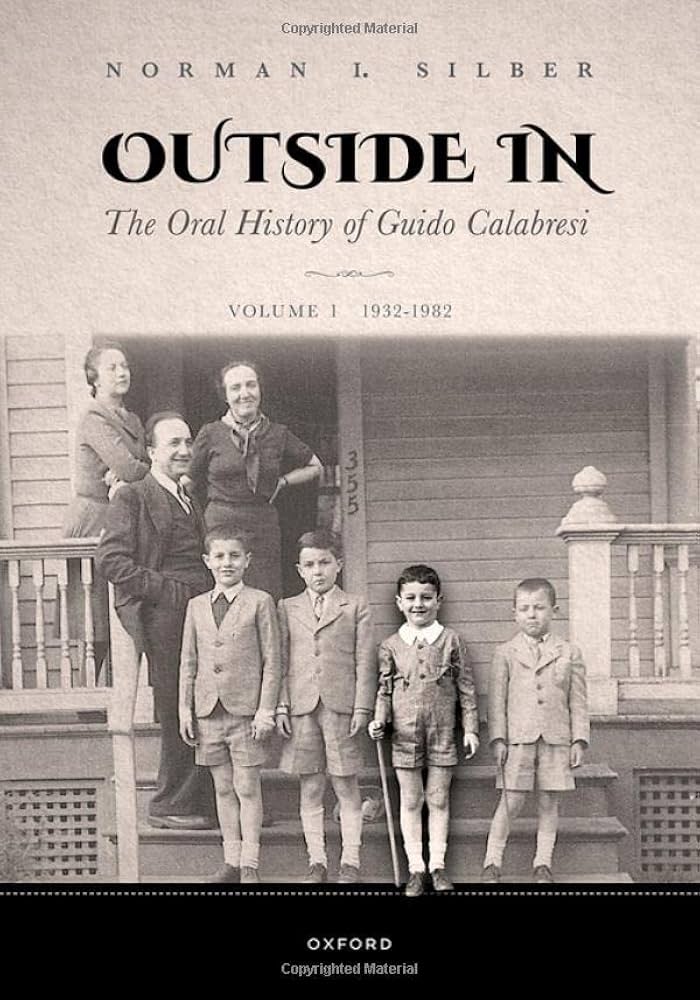 The oral histories will be a fascinating read for the many people who have encountered Calabresi over the course of his life, including his many former students and colleagues, his scholarly interlocutors, and the lawyers and litigants who have appeared before him as a judge on the U.S. Court of Appeals for the Second Circuit.
But the oral histories are also a treasure trove for legal historians, as our forthcoming series of posts will show. Over the coming weeks, we will post reflections from scholars who were once law clerks for Calabresi and who have since made careers out of the study of legal history. Stay tuned!
-- Karen Tani
Allan C Hutchinson, Osgoode Hall Law School, has published Hart, Fuller, and Everything After: The Politics of Legal Theory (Bloomsbury):
--Dan ErnstMore has been said about the Hart-Fuller debate than can be considered healthy or productive even within the precious world of jurisprudential scholarship – too much philosophising about how law has revelled in its own abstractness and narrowness. But the mission of this book is distinctly and determinedly different – it is not to rework these already-rehashed ideas, but to reject them entirely.
Rather than add to the massive jurisprudential literature that has been generated by all and sundry, the book criticises and abandons the project that Hart and Fuller set in motion. It contends that the turn that was taken in 1957 has led down a series of cul-de-sacs, blind alleys, and dead-ends to nowhere useful or illuminating. It is more than past time to leave their debate behind and strike out in an entirely new and more promising direction. The book insists that not only law, but also all theorising about law, is political in all its derivations, dimensions, and directions.
The American Law Institute: A Centennial History, edited by Andrew S. Gold and Robert W. Gordon, has been published by Oxford University Press:
This book collects together a series of original essays in honor of the American Law Institute’s (ALI’s) Centennial. The essays are authored by leading experts in their fields, often including current and former Restatement Reporters. The essays also provide a wide range of perspectives on both methodology and the law. The volume coverage focuses on specific ALI undertakings, including some of the more important Restatements and Codes; several leading Principles projects; statutory projects such as the Model Penal Code and the Uniform Commercial Code; themes that cut across substantive fields of law (such as Restatements and codification or Restatements and the common law); and the ALI’s institutional history over the past century. The resulting book is a unique and compelling contribution to its fields of study.
TOC here, but but note that many of the chapters are open access, including Robert W. Gordon's Restatements and Realists.
--Dan Ernst
[We have the following announcement of the CFP for the 26th British Legal History Conference, which will take July 3-6, 2024, at the University of Bristol Law School. The full call is here. DRE]

[We have the following announcement. DRE]
The Early English Laws project publishes online and in print new editions and translations of all English legal codes, edicts, and treatises produced up to the time of Magna Carta 1215.
The project was supported by a collaboration between the Institute of Historical Research at the University of London and the Department of Digital Humanities at King's College London. The AHRC provided initial funding for the first three years of the project (2009–2011). We wish to thank the Selden Society for their support.
The online resource was transferred to the University of St Andrews in 2023; the website is being updated but access to material is now restored.
Duke University Press has published Since Time Immemorial: Native Custom and Law in Colonial Mexico (2023), by Yanna Yannakakis (Emory University). A description from the Press:
Advance praise:In Since Time Immemorial Yanna Yannakakis traces the invention of Native custom, a legal category that Indigenous litigants used in disputes over marriage, self-governance, land, and labor in colonial Mexico. She outlines how, in the hands of Native litigants, the European category of custom—social practice that through time takes on the normative power of law—acquired local meaning and changed over time. Yannakakis analyzes sources ranging from missionary and Inquisition records to Native pictorial histories, royal surveys, and Spanish and Native-language court and notarial documents. By encompassing historical actors who have been traditionally marginalized from legal histories and highlighting spaces outside the courts like Native communities, parishes, and missionary schools, she shows how imperial legal orders were not just imposed from above but also built on the ground through translation and implementation of legal concepts and procedures. Yannakakis argues that, ultimately, Indigenous claims to custom, which on the surface aimed to conserve the past, provided a means to contend with historical change and produce new rights for the future.
“Rejecting an older bibliography that romanticized Native customs as ancient and autochthonous, Yanna Yannakakis studies how customs were formulated, how they changed, and how they became central to both law and politics during the colonial period. Rather than conserving a past, she astutely points out that customs enabled a host of different actors to adjust to a present and dream of a better future.” — Tamar Herzog
“Since Time Immemorial is a compelling study of how Indigenous communities in colonial Mexico adapted European concepts of custom to their own communal lifeways. It shows how they advanced those reformulated versions in Spanish courts of law, responding strategically to global changes and challenges in the name of local custom, ironically. As with her first book, The Art of Being In-between, Yanna Yannakakis has written a classic in the field of Latin American history.” — Kevin Terraciano
More information, including free access to the Introduction, is available here.
-- Karen Tani
 |
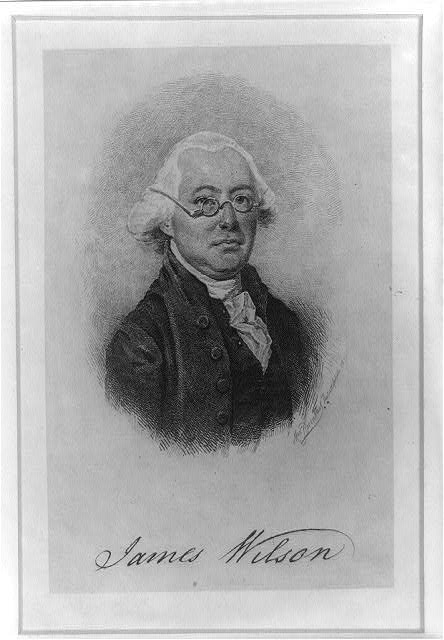
| James Wilosn: (LC) |
[We have the following announcement from the American Society for Legal History. DRE]


Application Deadline: July 1, 2023
[We have the following announcement from the Supreme Court Historical Society. DRE]
The [Supreme Court Historical] Society is pleased to announce that we have a new feature on our website and YouTube Channel highlighting the groundbreaking scholarship published in the Journal of Supreme Court History. On our website ... you will find New Scholarship: Breaking History, that includes short video interviews with scholars spotlighting new work in Supreme Court history. These video interviews will further amplify the written word by allowing scholars to discuss what is new and interesting about their articles. Interviews are conducted by the Editor of the Journal, Timothy S. Huebner, who is the Irma O. Sternberg Professor of History at Rhodes College.
[Already posted are interviews with Craig Alan Smith, Christopher Brooks, John G. Browning, James Feldman, and Rachel A. Shelden.]
Alex Zhang, Emory University School of Law, has posted Separation of Structures, which is forthcoming in the Virginia Law Review:
In a series of decisions, Free Enterprise Fund, Seila Law, and Collins v. Yellen, the Supreme Court struck down for-cause removal restrictions over agency heads. These rulings fault structural elements of the respective agency—double-layer protections or single directorships—for violating separation of powers because they insulate the agency from presidential review and oversight. But while the Court increasingly relies on agency structures to adjudicate constitutionality, separation-of-powers scholarship has focused on the division of powers into legislative, executive, and judicial functions.--Dan Ernst
This Article supplies the missing account of separation of structures, in the process defending the legitimacy of the administrative state against its critics. It argues that institutional structure is integral to separation of powers and deeply rooted in the Founders’ reception of ancient Greek and Roman political philosophy. By introducing the link between institutional design and the Constitution, separation of structures sketches a doctrinal terrain of how judicial adjudications of agency structure could proceed beyond the formalist approach latent in the Court’s recent decisions. By shifting the doctrinal focus from the nature of political functions to the design of accountability mechanism in governance structures, this Article provides strong support for the constitutionality of congressional delegation of legislative powers to agencies. This more capacious understanding of structural separation of powers accords with constitutional design and better accommodates the dynamic needs of modern regulation.

--Dan Ernst
James E. Pfander, Northwestern University School of Law, has posted Public Law Litigation in Eighteenth Century America: Diffuse Law Enforcement for a Partisan World, which is forthcoming in the Fordham Law Review:
For some time, the Supreme Court has used standing doctrine to limit the authority of federal courts to entertain private suits aimed at enforcing public norms. In its most recent iteration, TransUnion LLC v. Ramirez, the Court invalidated a federal consumer protection statute on the theory that it wrongly empowered suit by individuals who lacked the requisite injury in fact. Shutting down private litigation was said to advance separation of powers values and to protect the enforcement discretion of a unitary executive branch. The Court characterized private enforcement as a novel feature of the 1970s, a time the Court viewed with evident suspicion as one that inaugurated interest group litigation.--Dan Ernst
In truth, the tradition of interest group enforcement of public norms extends to the earliest days of the Republic. During the 1790s, Quakers and other anti-slavery activists secured federal legislation prohibiting American involvement in the international trade in enslaved people. Like other legislation of that period, the 1794 statute empowered both the federal government and private informers to enforce the law. The ensuing litigation, brought by private informers associated with such groups as the Providence Abolition Society, led to the forfeiture and sale of the offending vessels in the admiralty courts of Rhode Island and elsewhere. Drawing on federal archives, this Article recounts a history in which all three branches of the federal government – Congress, courts, and executive branch officials – viewed private litigation through what were called “popular” actions as an uncontroversial tool for enforcing public norms. One finds no objections based on Article II or III of the Constitution.

--Dan Ernst
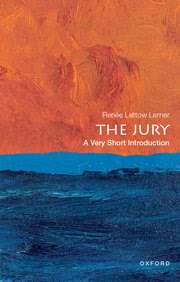
Renée Lettow Lerner, George Washington Law, has published The Jury: A Very Short Introduction (Oxford University Press):
From ancient Athens to modern Asia, cultures have wanted ordinary people involved in making legal decisions. This Very Short Introduction charts juries from antiquity through the English-speaking world and beyond to Europe, Latin America, Africa, and Asia. Today, juries have become a symbol of democracy and popular legitimacy.
But in English-speaking countries, jury trials are declining. Civil juries have been virtually abolished everywhere except the United States, and plea bargaining is taking the place of criminal jury trials. In this book, Renée Lettow Lerner describes the benefits and challenges of using juries, including jury nullification. She considers how innovations from non-English-speaking countries may be key to the survival of citizen participation in the legal system.
Along the way, the book tells how a small German state invented a way of using jurors that is now found around the world. And it reveals why some defendants preferred to be crushed to death by weights rather than convicted by a jury.
--Dan Ernst

The Historical Society of the District of Columbia Circuit presents the second program in its series of Judge Patricia M. Wald Programs on Life and Law in the Courts of the D.C. Circuit, United States v. Microsoft Corp., 253 F.3d 34 (D.C. Cir. 2001).
We have the following Call for Papers:
Call for Papers for the Massachusetts Historical Society’s 2024
Conrad E. Wright Research Conference on Citizenship
July 11-13, 2024
Massachusetts Historical SocietyThe centennial of both the Indian Citizenship Act of 1924 and Immigration Act of 1924 offers an opportunity to explore the intersection of two subjects that have not always been considered alongside each other. However, as both scholars of Native American and U.S. immigration history grapple with the legacies of settler colonialism in their respective fields, the links between the aforementioned pieces of legislation come into clearer focus. Recent scholarship points out that the “peopling” of the United States not only occurred through the forces of international migration, but also reflects the incorporation of Indigenous peoples, forced or enslaved migrants from Africa and elsewhere, and the movement of borders that turned people into newcomers regardless of whether or not they actually moved. The degree to which those groups were included or excluded from citizenship, cultural “membership,” or even the right to remain in the nation has however varied widely.
The conference committee invites proposals of papers and/or panels that explore themes associated with citizenship and other variations of national belonging reflected in both the pieces of landmark legislation featured here. Possible topics might include but are not limited to Native American engagement with or responses to the Indian Citizenship Act of 1924; immigrant and ethnic group responses to the Immigration Act of 1924, historical articulations of citizenship and their repercussions; examinations of “belonging” for various groups; changes to immigration, naturalization, and citizenship policies, investigations of Native sovereignty and tribal citizenship, explorations of removal and expulsion; transnational Native presences/movements/communities, and other related topics.
As an organization that operates within academia and the public history arena, the Massachusetts Historical Society both champions important scholarship and supports vital public history initiatives like professional development for K-12 instruction. This conference will serve both constituencies—scholars and K-12 educators—by providing a platform to consider how the classroom serves as a key site of historical representation. Teachers will be invited to attend the traditional academic sessions, and scholars in turn will be invited to participate in a concluding teacher workshop at the end of the conference. We encourage participation from scholars who are eager to engage with and learn from K-12 educators, as well as teachers who are looking to incorporate the latest scholarship into the classroom.
-- Karen TaniThe conference and workshop will take place at the Massachusetts Historical Society and Suffolk University in Boston on 11-13 July 2024. The panels and presentations will take place on 11-12 July with the teacher workshop on 13 July. Note that all papers for presentation must be ready for pre-circulation to commenters and conference registrants four weeks prior to the conference
date.Interested parties are encouraged to submit either individual paper presentations or full panels (with or without commenters) by 15 June 2023. Application materials must include a paper description and CV for individual submissions and paper descriptions and individual CVs along with a panel proposal for full panels. Paper proposals should not exceed one page and accompanying CVs should not exceed three pages in length. Please submit application materials and questions to ccloutier@masshist.org.

The ASLH awards a number of annual prizes that celebrate legal history research published or defended in the previous calendar year. Please see the following award descriptions [here], and visit specific prize pages on our website for complete information. Note that each prize that requires nomination has a June 1, 2022 deadline.

The 2023 issue of Federal History has been published on-line. Here’s the TOC:
Roger R. Trask Lecture: What Federal Historians Do
Edward C. Keefer
The Policy Which Put Down the War Shall Settle the Result”: Loyalty, Race, and the Reconstruction of Missouri
Jeremy Neely
The Budget Bureau’s Administrative Doctrine and the Creation of an Independent NASA, 1958
William F. Finan III
The HBCU Revolution: Desegregation, Disintegration, Collaboration, and Jimmy Carter’s 1980 Decision to Give Black Colleges Their Own White House Office
Cheryl E. Mango
Robert Byrd and the Iraq War: A Case Study of Senatorial Power
Lori Maguire
An Interview with Michael A. Olivas
Benjamin Guterman
Roundtable: The Deportation Machine: America’s Long History of Expelling Immigrants
Introduction by Maddalena Marinari. Reviews by Eladio B. Bobadilla, Amanda Frost, Deborah Kang, and Yael Schacher. Author’s Response by Adam Goodman
Reviews in Legal History
--Dan Ernst
On Monday, April 24, 17:00 - 18:30 (GMT), Lorren Eldridge, an Early Career Fellow in Legal History at the University of Edinburgh, will present, via Zoom, some of the findings from her forthcoming book, Law and the Medieval Village Community: Reinvigorating Historical Jurisprudence (Routledge 2023). Register here.
--Dan ErnstHistorical jurisprudence was initially developed into a methodology by late Victorian scholars who were particularly interested in medieval English law. This paper will consider some of the ways they used historical jurisprudence, in which they combined influences from the German Historical School, the Scottish Enlightenment, and English political preoccupations. The approach to the village community in the work of Sir Henry Maine, Frederick W Maitland, and Sir Paul Vinogradoff used this novel method to generate new questions in medieval English law, and in the theoretical understanding of legal personality, individualism, and communalism. This paper will explore some of the research questions they pursued which have enduring interest in modern scholarship.
The Libri Feudorum (the ‘Books of Fiefs’): An Annotated English Translation of the Vulgata recension with Latin Text, by Attilio Stella, has been published, open access, with Brill:
The I (the ‘books of fiefs’) are the earliest written body of feudal customs in Europe, codified in northern Italy c.1100-1250, which gave rise to feudal law as a branch of civil law. Their role in shaping modern ideas of feudalism has aroused an intense debate among medievalists, leading to deep re-thinking of the ‘feudal’ vocabulary and categories. This book offers an up-to-date English translation with a working Latin text introduced by a historical and historiographical overview of the Libri, thereby providing a valuable tool to understanding the long-standing importance of this collection over nine centuries of European history.
--Dan Ernst
I'm saddened to learn of the passing of Robert C. Palmer, the Cullen Professor of History and Law Emeritus at the University of Houston Law Center. The most learned of the medieval legal historians I've met over the years have also been the least pretentious. That certainly was my experience with Professor Palmer. I first saw him when he presented a paper at a workshop at the University of Chicago Law School when I was a student there in the early 1980s. The paper developed the distinction between two-handed and three-handed writs. (Or at least I think that's what it did--how would I have known?) After he finished, there was an awkward pause as the attendees waited to see who would be first to reveal how far behind Professor Palmer had left us. Finally, then-Professor Frank Easterbrook ventured a question, Professor Palmer answered, and Professor Easterbrook replied, "So the Coase theorem did not apply in medieval England?" I don't recall that anyone else had anything better.
As Professor Liz Papp Kamali writes, Professor Palmer has “left an immeasurable legacy to the world of English legal history: a website with about ten million images of materials from the 12th through 19th centuries in the British National Archives!" -- Anglo-American Legal Tradition (AALT).
--Dan Ernst