Showing posts with label Health law. Show all posts

Monday, November 10, 2025

Ahmed, "Risk and Resistance: How Feminists Transformed the Law and Science of AIDS"

Cambridge University Press has published Risk and Resistance: How Feminists Transformed the Law and Science of AIDS, by Aziza Ahmed (Boston University School of Law). A description from the Press:

How did women come to be seen as 'at-risk' for HIV? In the early years of the AIDS crisis, scientific and public health experts questioned whether women were likely to contract HIV in significant numbers and rolled out a response that effectively excluded women. Against a linear narrative of scientific discovery and progress, Risk and Resistance shows that it was the work of feminist lawyers and activists who altered the legal and public health response to the AIDS epidemic. Feminist AIDS activists and their allies took to the streets, legislatures, administrative agencies, and courts to demand the recognition of women in the HIV response. Risk and Resistance recovers a key story in feminist legal history – one of strategy, struggle, and competing feminist visions for a just and healthy society. It offers a clear and compelling vision of how social movements have the capacity to transform science in the service of legal change. 

Praise from reviewers:

"Risk and Resistance: How Feminists Transformed the Law and Science of AIDS is a moving and meticulous study about the grass-roots activists who made visible women’s plight during a time when AIDS treatment and funding were entirely focused on men. The initial definition of AIDS as ‘a gay men’s disease’ led to long-term distributional injustices: the exclusion of women from clinical trials, from disability benefits, and even from being counted in the statistics of its devastation. Aziza Ahmed has crafted a magnificent genealogy of specific organizational strategies that linked individual women into powerful communities of patients, medical researchers, service providers, and litigators. Their advocacy reframed not merely responses to the AIDS crisis but to all subsequent epidemics including COVID. This book is the chronicle of hard-fought interventions that redirected the course of legal and medical history and that transformed social outcomes to the betterment of all." -- Patricia Williams 

"Risk and Resistance is a tour de force. It is the book that was missing from the catalogue about HIV/AIDS and the catastrophic health, legal, and political crises in its wake. In beautiful prose and rich story-telling, Aziza Ahmed corrects the historical record, rewriting women and crucial, feminist activism into the folds of a devastating era in global history. With this book, Professor Ahmed has penned a pathbreaking contribution to law and feminist theory." -- Michele Bratcher Goodwin

More information is available here.

-- Karen Tani  

Thursday, March 10, 2022

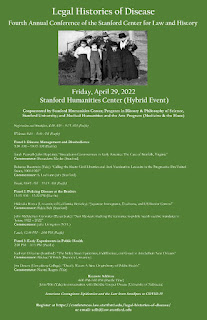
Legal Histories of Disease: The Stanford Legal History Conference

[We have the following announcement.  DRE]

The Stanford Center for Law and History is delighted to share the full information for our Center's fourth annual conference, which will be held on April 29, 2022 as a hybrid event in-person at the Stanford Humanities Center and online via Zoom. The conference theme is Legal Histories of Disease.

The conference will explore how the law has historically responded to health crises and what contemporary insights can be drawn from this history. The one-day conference will be held on Friday, April 29, 2022, and is cosponsored by the Stanford Humanities Center; Program in History & Philosophy of Science, Stanford University; and Medical Humanities and the Arts Program (Medicine & the Muse).

The conference will include three panels followed by a keynote session featuring Professor John Witt of Yale Law School who will take part in a discussion of his recently published book, American Contagions: Epidemics and the Law from Smallpox to COVID-19 with Professor Deirdre Cooper Owens of the University of Nebraska.

The complete schedule and panel abstracts are available here.

Register here to reserve your in-person space at the Stanford Humanities Center or to receive the Zoom link details which will be sent about a week before the event.  All are welcome to attend every session or particular sessions of interest. Breakfast, lunch, and snacks will be served for those who attend in-person. Note: in-person registration is on a first-come, first-served basis and seating is limited.

We also ask all those who attend in-person to comply with current Stanford event guidelines regarding COVID which can be found here.

This event is open to the general public, as well as the Stanford community, both in-person and online. If you have any questions, please contact sclh@law.stanford.edu

Friday, February 11, 2022

JPH 34:1

The Journal of Policy History 34:1 (January 2022) is available online.

New Policy Elites and the Affordable Care Act: The Making of Long-Term Insiders
William Genieys, Mohammad-Said Darviche, Brent Epperson
 
Race, Post-Reconstruction Politics, and the Birth of Federal Support for Black Colleges
Deondra Rose

Clandestine Networks and Closeted Bureaucrats: AIDS and the Forming of a Gay Policy Network in California
Stephen Colbrook

The Politics of Clemency in the Early American Presidency: Power Inherited, Power Refashioned
Bradley D. Hays

Critical Perspective

Understanding the Controversy: The Kerner Commission, The Harvest of American Racism, and the Dynamics of Incorporating Social Science with Public Policy
Rick Loessberg

--Dan Ernst

Friday, April 10, 2020

A Query on the Legal History of Epidemics

[We have received the following request.  DRE.]

The David Berg Foundation Institute for Law and History at Tel Aviv University is putting together a web page with links to sources – primary and secondary – on the legal history of epidemics, their consequences, and responses to them. Please send any sources and resources to David Schorr at dschorr@tauex.tau.ac.il.

Monday, May 6, 2019

Newman on Meat Inspection and Public Choice

Patrick Newman, Florida Southern College, has posted another installment of his research on the politics of meat inspection, Public Interest or Public Choice? The Beef Trust and the 1906 Meat Inspection Act:
The Meat Market, 1906 (LC)
This paper challenges the recent research of public interest historians and argues the evidence supports a public choice interpretation of the 1906 Meat Inspection Act. First, the Beef Trust’s slaughter of diseased meat was due to the uncertainty over the science of disease transmission and using it was the only way at the time to make meat affordable to consumers. Second, critics of the Beef Trust’s sanitary practices were often biased and they exaggerated the problem. Third, the evidence is consistent with the argument that the Beef Trust captured the regulation because the law was associated with an increase in their market share, less product choice, and higher meat prices, all of which hurt consumers.
Dan Ernst

Friday, April 27, 2018

Price on Quarantines and Federalism

Polly J. Price, Emory University School of Law, has posted Do State Lines Make Public Health Emergencies Worse? Federal Versus State Control of Quarantine, which appears in the Emory Law Journal 67 (2018): 491-543:
This Article explores the origins and limits of the federal government’s interstate quarantine power. In the event of a public health emergency, state and local political boundaries may generate self-interested measures that risk substantial harm to neighboring states. To more effectively stem a national epidemic and to better protect the interests of regional populations, should the federal government step in to override a state’s protective quarantine? Neither current statutory authority nor how we have thought about it in the past prevents a greater national role. This Article shows how to expand our view of the federal government’s interstate quarantine authority as an important tool to respond to public health threats affecting more than one state.

Friday, December 16, 2016

Maehle on Medical Confidentiality

Out now with the University of Chicago Press is Contesting Medical Confidentiality: Origins of the Debate in the United States, Britain, and Germany by Andreas Holger Maehle, Durham University. From the publisher:
Medical confidentiality is an essential cornerstone of effective public health systems, for centuries societies have struggled to maintain the illusion of absolute privacy. In this age of health databases and increasing connectedness, however, the confidentiality of patient information is rapidly becoming a concern at the forefront of worldwide ethical and political debate. 
In Contesting Medical Confidentiality, Andreas-Holger Maehle travels back to the origins of this increasingly relevant issue. He offers the first comparative analysis of professional and public debates on medical confidentiality in the United States, Britain, and Germany during the late nineteenth and early twentieth centuries, when traditional medical secrecy first came under pressure from demands of disclosure in the name of public health. Maehle structures his study around three representative questions of the time that remain salient today: Do physicians have a privilege to refuse court orders to reveal confidential patient details? Is there a medical duty to report illegal procedures to the authorities? Should doctors breach confidentiality in order to prevent the spread of disease? Considering these debates through a unique historical perspective, Contesting Medical Confidentiality illuminates the ethical issues and potentially grave consequences that continue to stir up public debate.
 More information is available here.

Thursday, August 25, 2016

Legal history meets the History of Science+

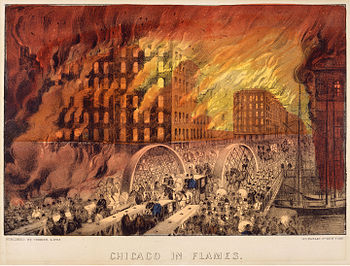
The Great Chicago Fire of 1871 (credit)
Are you working on the legal history of disasters, poisoning, animals, inventions, travel, hospitals, or forensic science? If so, your research probably sits at the intersection of legal history and the history of science, medicine, or technology.

This summer, we got in touch with scholars working in science-related historical fields that overlap with legal history. Our question was: what are your favorite websites in your own sub-field that could be of use to legal historians? Here's what people said--after the jump  
(* indicates special favorites).

Saturday, July 30, 2016

Weekend Roundup

  • St. Andrews University has acquired the Marchmont Manuscript, a 450-year-old manuscript that “contains Regiam Majestatem, the earliest surviving text giving a comprehensive overview of Scots law.”  It was once owned by the Scots poet Alexander Hume. 
  • The Kluge Center at the Library of Congress announces its 2016 fellows
  •  “10 facts about the most famous scene in legal history,” from Constitution Daily, the blog of the National Constitution Center.
  • "The National History Center of the American Historical Association will hold a Congressional briefing on the Zika virus: historic parallels, and policy responses.  J.R. McNeill of Georgetown University and Margaret Humphreys of Duke University will discuss  the history of Zika’s mosquito vectors and the complexity of planning public health programs to counter disease-bearing mosquitoes.  Alan Kraut of American University will moderate." More.
  • Now through August 14: Oxford University Press's summer sale.
Weekend Roundup is a weekly feature compiled by all the Legal History bloggers.

Tuesday, June 21, 2016

Swanson on Assisted Reproduction & Abortion

Back in 2015, Kara Swanson, Northeastern University School of Law, published "The Doctor's Dilemma: Paternalisms in the Medicolegal History of Assisted Reproduction and Abortion" in the Journal of Law, Medicine and Ethics 43:2 (312-25): 
This article analyzes the comparative history of the law and practice of abortion and assisted reproduction in the United States to consider the interplay between medical paternalism and legal paternalism. It supplements existing critiques of paternalism as harmful to women’s equality with the medical perspective, as revealed through the writings of Alan F. Guttmacher, to consider when legal regulation might be warranted.

Tuesday, June 14, 2016

Lux on Canada's "Indian Hospitals"

Maureen K. Lux (Brock University) has published Separate Beds: A History of Indian Hospitals in Canada, 1920s-1980s (University of Toronto Press). From the publisher:
Separate Beds: A History of Indian Hospitals in Canada, 1920s-1980sSeparate Beds is the shocking story of Canada’s system of segregated health care. Operated by the same bureaucracy that was expanding health care opportunities for most Canadians, the “Indian Hospitals” were underfunded, understaffed, overcrowded, and rife with coercion and medical experimentation. Established to keep the Aboriginal tuberculosis population isolated, they became a means of ensuring that other Canadians need not share access to modern hospitals with Aboriginal patients.
Tracing the history of the system from its fragmentary origins to its gradual collapse, Maureen K. Lux describes the arbitrary and contradictory policies that governed the “Indian Hospitals,” the experiences of patients and staff, and the vital grassroots activism that pressed the federal government to acknowledge its treaty obligations. A disturbing look at the dark side of the liberal welfare state, Separate Beds reveals a history of racism and negligence in health care for Canada’s First Nations that should never be forgotten.
 Some blurbs: 
"Canada has a painful history of racially segregated hospitals that were intended to isolate and institutionalize Aboriginal people seen as a menace and danger to the nation. Separate Beds is a sophisticated, analytical, and lucid history of this neglected chapter of Canada's history and of the strength and resolve of Aboriginal communities to return to the management of their health care." -Sarah Carter
"Lux's monumental work helps us understand more about the historical roots of the health care system we have inherited, one which is still influenced by racism, inequality and exclusion, but one that has changed over time and can thus change again." -Mary Jane McCallum 
"In painstaking research and matter-of-fact reportage, Associate Professor Lux of Brock University documents Canadian apartheid. Separate Beds: A History of Indian Hospitals In Canada is a riveting and extraordinary account of mistreatment of citizens." -Tom Korski
More information is available here

Tuesday, March 1, 2016

Grossman on AIDS Activists, the FDA, and the "Drug Constitution"

Lewis A. Grossman, American University, Washington College of Law, has posted AIDS Activists, FDA Regulation, and the Amendment of America's Drug Constitution:
This Article explores how AIDS activists, desperate for access to potentially life-saving pharmaceuticals, permanently transformed America’s “drug constitution.” Their advocacy altered the FDA’s interpretation and application of the federal Food, Drug, and Cosmetic Act (FDCA) so as to expedite the availability of new, unproven drugs for critical illnesses, thus enhancing individual patients’ autonomy to make therapeutic choices without government interference.

The FDCA is more than simple set of instructions to a federal agency — it is a source of vitally important and deeply entrenched institutional and normative frameworks. Like major civil rights, antitrust, and environmental statutes, the FDCA should be viewed as a quasi-constitutional “superstatute.” Therefore, the AIDS activists’ FDA reform campaign of the late 1980s and early 1990s should be understood as a “constitutional” movement, even though it rarely invoked the United States Constitution and pursued its goals entirely outside of court. As a result of the AIDS movement’s efforts, federal drug regulation today reflects not only the FDCA’s original foundational principle of protecting consumers from hazardous protects, but also the (often contrary) fundamental goal of promoting the expeditious release of potentially effective treatments for severe illnesses. The AIDS activists’ successful advocacy regarding drug access permanently shifted decision-making power previously exercised by the FDA to individual patients and their physicians.

Monday, November 30, 2015

Grossman on Medical Licensing in Gilded-Age America

Lewis A. Grossman, American University, Washington College of Law, visiting at Cornell Law School, has posted Orthodoxy and "The Other Man's Doxy": Medical Licensing and Medical Freedom in the Gilded Age.
This is a draft of Chapter Two of my book-in-progress under contract with Oxford University Press titled You Can Choose Your Medicine: Freedom of Therapeutic Choice in American History and Law. This chapter shows how freedom of therapeutic choice remained an influential theme in American policy and thought in the Gilded Age. Despite the almost universal restoration of medical licensing after the Civil War, the new licensing regimes were drafted and enforced in ways that protected the rights of practitioners and patients of nonorthodox schools of medicine.

This chapter starts by briefly describing the main alternative medical sects during the Gilded Age, including Homeopathy, Eclectic medicine, Christian Science, and Mind Cure. It then examines the resurgence of medical licensing and shows how the continuing popular preference for freedom of therapeutic choice was reflected in the medical licensing statutes as written and implemented. The chapter considers the meaning and impact of Dent v. West Virginia, the 1889 Supreme Court case upholding medical licensing, and it explains how courts, largely as a result of this decision, played little role in guaranteeing freedom of therapeutic choice during this period.

Chapter Two then explores the content of the arguments directed against discriminatory medical licensing in the Gilded Age. It discusses how these arguments were “constitutional,” even though they occurred almost entirely outside of court. The chapter considers the persistence of four strains of medical freedom rhetoric from the antebellum years (bodily freedom, economic freedom, freedom of belief, and freedom of inquiry), and it also identifies some important differences between the anti-licensing literature of the two eras. Chapter Two concludes by examining the overall political philosophy of medical freedom activists during this period, in particular the extent of their libertarianism.

Thursday, November 5, 2015

ASLH Panel Recap: The Administrative State at the Grassroots

[Smita Ghosh, JD, Class of 2014, and PhD Candidate, American Legal History, at the University of Pennsylvania, has provided us with a recap of a second ASLH panel, "The Administrative State at the Grassroots."  The panelists were (1) Eric L. Muller, the Dan K. Moore Distinguished Professor in Jurisprudence at the University of North Carolina School of Law; (2) Sarah Milov, an assistant professor in the Corcoran Department of History at the University of Virginia; and (3) Joanna Grisinger, Associate Professor of Instruction and Director of Undergraduate Studies in the Center for Legal Studies at Northwestern University.  I chaired and commented.  Here is Ms. Ghosh’s report.  The text of my comment and an addendum follow after the jump.]

Eric Muller’s “Looking at Japanese American Imprisonment through a Law Office Window” is a microhistory of legal contests at a Japanese internment site in Wyoming.  Project Attorneys for the War Relocation Agency (WRA), who acted as all-purpose lawyers in Japanese internment camps.  They served as representatives for camp directors and internee organizations, and also gave legal aid to particular detainees in low-level disputes.  While historians have seen these officers as embodiments of the government’s exclusionary impulse--”assimilationists” at best, abusive racists at worst--this paper found more nuanced story.  Project Attorneys often ignored explicit directives from Washington in order to accommodate the desires of detainees.  At one point, a cuckolded man assaulted another detainee who had been sleeping with his wife.  Officials in Washington, who monitored the attorneys in weekly correspondence, urged the Project Attorney to contact state officials to press charges.  But the attorney pushed back, convinced by the perception among the detainee “community” that the assault was justified.  In the end, the lawyer handled the case in house,  suggesting the negotiability of legal practices on the ground. 

In Sarah Milov’s paper, “Clearing the Air: Shimp v. New Jersey Bell and the Strange Politics of Workplace Smoking,” the original sin is not imprisonment but a little secondhand smoke.  The protagonist is an aggrieved plaintiff, rather than a government lawyer, but processes are similarly negotiable (we are, after all, in the grassroots).  The paper focuses on Donna Shimp, an employee of Bell Telephone who developed serious health problems after working in a smoke-filled office in the early 1970s. When Bell was unresponsive to her complaints--instead putting her on unpaid leave--Shemp became an anti-smoking activist.  She drew from a set of newly available resources to develop her complaints: agencies like the EPA and OSHA and their state counterparts, as well as newly formed anti-smoking advocacy groups.  Eventually, she sued the company in state court with the help of a Rutgers Law professor and his employment law clinic.  The suit pitted Shimp against her union, which had only ten years before earned its members the right to smoke at work.  After winning an injunction against Bell, Shimp developed a non-profit consulting company to help non-smokers advocate for similar changes on the job.  Despite the success of the suit, Shimp’s work focused on the bottom-line (and, as someone mentioned in Q&A, a gendered language about protection).  Employers of tobacco-toting TAs should take note: Smokers waste 2-10% of the workday on cigarette breaks. 

Joanna Grisinger’s paper, “‘The self-containment of the bureaucracy’: The Civil Aeronautics Board and the Right to Participate,” offered a grassroots-level view of public participation in agency processes.  The agency in question is the Civil Aeronautics Board, which was empowered to both regulate and promote the American airline industry.  This dual mandate made the liberal public participation provisions of the CAB’s statutory mandate fairly hollow. The agency rarely took the public’s input very seriously.  Instead, it was overwhelmed by public complaints, captured by greedy airlines and distracted by their orders to boost the industry.  But activists were still moved by the power of participation.  Activists interested in civil rights, environmentalism and dismantling Apartheid all complained to the Board in one way or another.  In this way, as Dan Ernst noted in his comments, Grisinger showed the optimistic tone of the early participation movement.

In his comments, Ernst reflected on his own work on the NRA in the 1930s and ’40s.  From this vantage point, he was able to assess the changing nature of administration  over the years.  In Ernst’s era, it was agencies that made the more “adventurous” legal arguments towards hostile and conservative courts. But by the 1970s things were different: Courts--like the NJ Superior Court in Shimp--were at the forefront of legal change, while agencies were slow to act, perhaps desiring political cover.  It was an apt time for Ernst's New Deal era film reference: We weren't in Kansas anymore.

[My comment and an addendum prompted by the Q&A appear after the jump.]

Tuesday, September 15, 2015

Troesken on "How the Constitution Left Americans Rich, Free, and Prone to Infection"

New from the University of Chicago Press: The Pox of Liberty: How the Constitution Left Americans Rich, Free, and Prone to Infection (June 2015), by Werner Troesken (University of Pittsburgh). From the Press's overview:
Werner Troesken looks at the history of the United States with a focus on three diseases—smallpox, typhoid fever, and yellow fever—to show how constitutional rules and provisions that promoted individual liberty and economic prosperity also influenced, for good and for bad, the country’s ability to eradicate infectious disease. Ranging from federalism under the Commerce Clause to the Contract Clause and the Fourteenth Amendment, Troesken argues persuasively that many institutions intended to promote desirable political or economic outcomes also hindered the provision of public health. We are unhealthy, in other words, at least in part because our political and legal institutions function well. Offering a compelling new perspective, The Pox of Liberty challenges many traditional claims that infectious diseases are inexorable forces in human history, beyond the control of individual actors or the state, revealing them instead to be the result of public and private choices.
More information is available here.

Friday, August 28, 2015

Price on "Health Security" and Mentally Ill Immmigrants

Polly J. Price, Emory University School of Law, has posted Infecting the Body Politic: Observations on Health Security and the 'Undesirable' Immigrant, which will appear in the Kansas Law Review 63 (2015): 917-52:
Sovereign nations may refuse admission to migrants who are either physically or mentally ill or disabled. Nations have commonly preferred an ideal class — the physically and mentally healthy — to the “undesirable” migrant who is unhealthy or disabled. Both exclusions are traditionally justified as a nation’s prerogative to choose its membership. Nations defend exclusionary safeguards by the need to protect their citizens against contagions from the outside world. Immigrants who are physically or mentally disabled do not pose the same threat, but they may require state services and support, what U.S. immigration law terms a “public charge.” Mental illness is a different category altogether, in that public safety may be an issue, in addition to the need for state welfare expenditures.

Mental disorder as a disqualification for entering the U.S., and accordingly disqualification for U.S. citizenship, has a long history. On two notable occasions in the past, Congress has focused specifically on mental health of would-be immigrants — the first decade of twentieth century, and again in the early 1950s. At the same time, state officials desired to rid themselves of “undesirable” non-citizens housed in state institutions. The solution was to collaborate with the federal government to deport them on mental health grounds. In 1926, for example, 796 persons were deported for “insanity” or “epilepsy,” 257 for “other mental conditions,” and 887 as “likely to become a public charge,” out of nearly 11,000 total deportations that year.

With established interests to protect, the United States along with every other nation imposes constraints on citizenship and migration by self-selection. The screen of “health security” is used to cover policy choices — whether to assume the risk of successfully managing contagious disease; whether to assume the burden of managing mental illness — that have shaped immigration policy for more than a century. The foremost difference is that contagious disease presents a verifiable condition, where mental illness has been defined in such hazy terms as to be applicable to just about anyone — or at least, as Justice Douglas argued, anyone “unpopular.”

Friday, August 7, 2015

Price on the Legislative History of Yellow Fever Quarantines

Polly J. Price, Emory University School of Law, has posted A Legislative History of the Shotgun Quarantine
The recent Ebola threat from western Africa raised unanswered questions about the scope of the U.S. federal government’s quarantine authority. For decades, a widespread assumption has existed that states have absolute control over quarantines imposed within their boundaries. This article suggests that the presumption of limited federal authority is overly restrictive and not constitutionally mandated. The history of the “shotgun quarantines” imposed during the yellow fever epidemics of the late 19th and early 20th centuries offers an alternative constitutional interpretation. This fascinating but previously untold account reveals that leading politicians of the day believed the federal government had a broad constitutional authority. The human suffering and disruption to commerce caused by the local shotgun quarantine led the South to implore Congress for legislation to remedy it – the only significant instance in which the post-Civil War South united in favor of ceding state’s rights to the federal government. The controversy faded as effective measures against yellow fever were found, only to emerge again when Ebola confronted public health policy makers a century later. Because Congress never acted, we have largely forgotten the history of these legal debates over interstate quarantine authority. In recovering that history, this Article offers a new perspective on how to manage public health crises in our federal system. The need for regulatory standards that could preempt an unnecessary, parochial local quarantine requires Congress to act.

Sunday, May 31, 2015

Sunday Book Roundup

Hello from Seattle and the Law & Society Association Conference! Here's a list of reviews for this Sunday's reading:

H-Net has posted the following--
The New Republic reviews Perry Anderson's American Foreign Policy and Its Thinkers (Verso).

The Washington Independent Review of Books has a review of Caroline Fredrickson's Under the Bus: How Working Women Are Being Run Over (The New Press).

The New Books series has posted these interviews--


In another interview, Steve Instep discusses his new book, Jacksonland: President Andrew Jackson, Cherokee Chief John Ross, and a Great American Land Grab (Penguin) with Politics & Prose, here.

The Times Literary Supplement reviews Jeffrey J. Williams's How to Be An Intellectual (Fordham University Press).

The Los Angeles Times has a summer reading guide for those of you done with grading, here.

Sunday, April 12, 2015

Sunday Book Roundup

H-Net has a review of Brendan C. Lindsay's Murder State: California's Native American Genocide 1846-1873 (University of Nebraska Press).

Salon has an excerpt from Dream Chasers: Immigration and the American Backlash by John Tirman (MIT Press).

New Books has an interview with the editors of Democratizing Inequalities: Dilemma of the New Public Participation (NYU Press)--Caroline Lee, Michael McQuarrie, and Edward Walker.

Kevin Kruse has an excerpt of his new book, One Nation Under God: How Corporate America Invented Christian America (Basic), published in Salon.

In The Washington Post, Frank Bruni's Where You Go is Not Who You'll Be: An Antidote to the College Admissions Mania (Grand Central) is reviewed.

Steven Brill's America's Bitter Pill: Money, Politics, Backroom Deals, and the Fight to Fix Our Broken Healthcare System (Random House), is reviewed in The New York Review of Books.

On Slate Gregory P. Downs's After Appomattox: Military Occupation and the Ends of War (Harvard University Press) is reviewed.

Also from New Books is an interview of Leigh Ann Wheeler, discussing her book, How Sex Became a Civil Liberty (Oxford University).

Wednesday, January 28, 2015

New Release: Bohme, "Toxic Injustice"

New from the University of California Press: Toxic Injustice: A Transnational History of Exposure and Struggle (Dec. 2014), by Susanna Rankin Bohme (Harvard University). A description from the Press:

The pesticide dibromochloropropane, known as DBCP, was developed by the chemical companies Dow and Shell in the 1950s to target wormlike, soil-dwelling creatures called nematodes. Despite signs that the chemical was dangerous, it was widely used in U.S. agriculture and on Chiquita and Dole banana plantations in Central America. In the late 1970s, DBCP was linked to male sterility, but an uneven regulatory process left many workers—especially on Dole’s banana farms—exposed for years after health risks were known.

Susanna Rankin Bohme tells an intriguing, multilayered history that spans fifty years, highlighting the transnational reach of corporations and social justice movements. Toxic Injustice links health inequalities and worker struggles as it charts how people excluded from workplace and legal protections have found ways to challenge power structures and seek justice from states and transnational corporations alike.
More information is available here.