Showing posts with label Voting Rights. Show all posts

Wednesday, May 13, 2020

The Nineteenth Amendment at 100: Essays by Siegel, Asanloo, Mayeri

The Yale Law Journal Forum recently published a collection of essays on The Nineteenth Amendment at 100. We've mentioned Reva Siegel's contribution, but missed two others. Arzoo Asanloo (University of Washington, Seattle) wrote about "Lessons from the Suffrage Movement in Iran":
The suffrage movement in Iran achieved its goal of formally enfranchising women in 1963, through a referendum in which women voted. This Essay explores the movement for Iranian women’s suffrage in three phases. First, it examines ’the mid-nineteenth-century pre-suffrage political climate that created the conditions for some to call for women’s enfranchisement and the founding of a women’s movement during a period of modernization in the mid-twentieth century alongside debates about Iranian women’s roles. Second, this Essay considers the success of the women’s suffrage movement as part of a broader package of reforms that transferred power from the aristocracy and clerical leaders to the monarchy, despite political resistance. Third, it explores the challenges to Iranian women’s rights after the 1979 revolution, which maintained women’s right to vote, but initially suspended other hard-fought rights in the domain of family law, as part of an effort by the new Islamic republic to redefine women’s roles as a technique of branding the new state.
The lessons from the Iranian women’s suffrage movement show that voting alone is not a cure for women’s equal enfranchisement in all sectors of society. Women’s entry into the political sphere, however, raises and maintains demands for women’s rights in society as a key legitimating factor for the state. The Iranian women’s movement was a multi-dimensional effort with different factions sometimes sparring over the goals of the mission. Debates about women’s rights in Iran and elsewhere reveal that women’s societal roles still serve as important cultural tropes whose meaning powerful actors fight to define and control.
Serena Mayeri (University of Pennsylvania) contributed a piece titled "After Suffrage: The Unfinished Business of Feminist Legal Advocacy":
This Essay considers post-suffrage women’s citizenship through the eyes of Pauli Murray, a key figure at the intersection of the twentieth-century movements for racial justice and feminism. Murray drew critical lessons from the woman suffrage movement and the Reconstruction-era disintegration of an abolitionist-feminist alliance to craft legal and constitutional strategies that continue to shape equality law and advocacy today. Murray placed African American women at the center of a vision of universal human rights that relied upon interracial and intergenerational alliances and anticipated what scholars later named intersectionality. As Murray foresaw, women of color formed a feminist vanguard in the second half of the twentieth century, pioneering social movements and legal claims that enjoyed significant success. But Murray’s hope that women’s solidarity could overcome ideological divides and the legacy of white supremacy went unfulfilled. As a result, the more expansive visions of racial, sexual, economic, and reproductive justice that intersectional advocacy produced remain the most pressing unfinished business of sex equality today, at the Nineteenth Amendment’s centennial.
The whole collection is available here.

-- Karen Tani

Saturday, February 15, 2020

Weekend Roundup

  • Via our friends at Iowa Law, word of a faculty fellowship position, appointed at the rank of Visiting Assistant Professor of Law. The fellowship "prioritizes applicants who seek to conduct interdisciplinary research that connects with other fields of study at the University of Iowa." 
  • Dire financial exigency is forcing the Historical Society of Pennsylvania to sell some of its holdings, including "the Freedom Box" citizens of New York gave Andrew Hamilton after his defense of John Peter Zenger.
Weekend Roundup is a weekly feature compiled by all the Legal History bloggers. 

Tuesday, December 10, 2019

Siegel on the 19th Amendment and the Family

Reva Siegel, Yale Law School, has posted The Nineteenth Amendment and the Democratization of the Family, which is forthcoming in the Yale Law Journal Forum:
This Essay recovers debates over the family connecting the Reconstruction Amendments and the Nineteenth Amendment, and considers how this lost history can guide the Constitution’s interpretation, in courts and in politics.

A woman’s claim to vote contested a man’s prerogative to represent his wife and daughters, and so was a claim for democratization of the family. Suffragists raised other, more far-reaching challenges to the family. Suffragists advocated reforming the law to recognize women’s right to voluntary motherhood and to be remunerated equally with men for work outside and inside the household. They sought to create a world in which adult members of the household could be recognized and participate in democratic life as equals. And they debated how to realize these goals when women faced different and intersectional forms of discrimination.

Courts can interpret the Amendments synthetically and so, for example, integrate the history of suffrage struggle into the equal-protection framework of United States v. Virginia. I show how an historical and intersectional analysis could change the way that courts approach cases concerning of the regulation of pregnancy, contraception, sexual violence, and federalism. I close, looking beyond the courts, to persisting claims for democratization of the family in politics. How would we understand these claims if we recognized they began in the decades before the Civil War, and we recognized the disenfranchised Americans who voiced them among our Constitution’s esteemed Framers?
--Dan Ernst

Thursday, September 12, 2019

CFP: The 15th and 19th Amendments

[We have the following announcement.]

Massachusetts Historical Society
.  Call for Papers for the 2020 Conrad E. Wright Research Conference.  “Shall Not Be Denied”: The 15th and 19th Amendments at the Sesquicentennial and Centennial of their Ratifications, October 16-17, 2020.  Deadline: November 1, 2019.

The year 2020 marks the anniversaries of two critical amendments to the United States Constitution. Spaced fifty years apart, the Fifteenth and Nineteenth Amendments, ratified in 1870 and 1920, respectively, prohibited the use of race or sex to deny American citizens the franchise. However, the amendments did not prevent states from adopting other methods of discrimination. Viewed as the product of two different movements—abolitionism and the Civil War on the one hand and the Progressive campaigns and the First World War on the other—these two periods and amendments are not often considered together. This conference revisits the long journey to secure voting rights for African Americans and women in United States history. It considers the legal precedents and hurdles that each amendment faced, the meaning and uneven outcomes of each, the social context that allowed for ultimate ratification, the role of key individuals and groups in these respective contexts, and how each amendment has been remembered over time.

This conference invites scholars from various disciplines to discuss common themes and challenges surrounding the amendments and papers can cover any topic relating to them. We welcome submissions from all historical, political science, and legal fields.

A keynote panel and reception will take place on Friday, 16 October. The panel features Profs. Alison M. Parker (University of Delaware) and Lisa Tetrault (Carnegie Mellon University) and will be moderated by Prof. Alex Keyssar (Harvard). The full conference day will take place on Saturday, 17 October.

Interested parties are encouraged to submit either individual paper presentations or full panels (with or without commenters) by November 1, 2019. Application materials must include a paper description and CV for individual submissions. Full panel proposals must include paper descriptions and individual CVs along with a description of the panel itself. Paper proposals should not exceed one page and accompanying CVs should not exceed ten pages in length. Please submit applications materials and/or questions to research@masshist.org.

[--Dan Ernst.  H/t: LES]

Thursday, August 29, 2019

Faulkenbury, "Poll Power: The Voter Education Project and the Movement for the Ballot in the American South"

Recently released by the University of North Carolina Press: Poll Power: The Voter Education Project and the Movement for the Ballot in the American South (April 2019), by Evan Faulkenbury (State University of New York, Cortland). A description from the Press:
The civil rights movement required money. In the early 1960s, after years of grassroots organizing, civil rights activists convinced nonprofit foundations to donate in support of voter education and registration efforts. One result was the Voter Education Project (VEP), which, starting in 1962, showed far-reaching results almost immediately and organized the groundwork that eventually led to the Voting Rights Act of 1965. In African American communities across the South, the VEP catalyzed existing campaigns; it paid for fuel, booked rallies, bought food for volunteers, and paid people to canvass neighborhoods. Despite this progress, powerful conservatives in Congress weaponized the federal tax code to undercut the important work of the VEP.

Though local power had long existed in the hundreds of southern towns and cities that saw organized civil rights action, the VEP was vital to converting that power into political motion. Evan Faulkenbury offers a much-needed explanation of how philanthropic foundations, outside funding, and tax policy shaped the southern black freedom movement.
A few blurbs:
"In this innovative study, Faulkenbury goes behind the scenes to elucidate the relationship between the civil rights movement and philanthropic foundations. An organizational history of the Voter Education Project and its funders, Poll Power demonstrates that as civil rights activists in countless communities across the South began to institutionalize their hard-won access to the ballot, their opponents answered with federal legislation that severely curtailed the chances of their success. This work is essential for understanding the intricacies of voter suppression efforts, both past and present."--Katherine Mellen Charron 
"This important contribution focuses on a neglected yet critical episode in the civil rights movement, explaining well how an unexpected alliance of politicians, philanthropists, and civil rights activists launched voter registration projects and achieved important victories despite segregationists in Congress and state and local governments."--Olivier Zunz
More information is available here.

-- Karen Tani

Saturday, August 17, 2019

Weekend Roundup

  • Congratulations to Sarah Barringer Gordon and Kevin Waite, both of the University of Pennsylvania, on their award of a $242,000 collaborative research grant from the National Endowment for the Humanities. The grant will support a project titled "The Long Road to Freedom: Biddy Mason (1818–1891) and the Making of Black Los Angeles."
  • Writing for JOTWELLs Constitutional Law section, Ilya Somin has posted an admiring review of Maureen E. Brady's recent article on damagings clauses.
  • Harvard Law Today has a story on how students in Elizabeth Papp Kamali’s seminar, "Mind and Criminal Responsibility in the Anglo-American Tradition," use crime broadsides and other original sources in the Harvard Law School Library's Historical & Special Collections.
  • The Supreme Court Historical Society and production company Article III Films have announced the launch of the web documentary FDR and the Courtpacking Controversy.  “In late August the documentary will be sent to U.S. History teachers across the nation, accompanied by specially designed lesson plans to help students learn about the Courtpacking episode, which highlights important issues about separation of powers.”
  • 1619: The 400th anniversary of the start of African American slavery in what is now the United States of America is the subject of the 1619 Project of the New York Times Magazine and this timeline in The Guardian.  But the History Channel says it started earlier.
  • ICYMI: Immigration edition.  Erika Lee on the legal history of the new "public charge" regulation.  Also Kunal Parker, on NPRMother Jones thinks Acting Director of US Citizenship and Immigration Services Ken Cuccinelli’s ancestor might have been excluded under it.
  • Margaret O'Mara, the Howard & Frances Keller Professor of History at the University of Washington, will be delivering the keynote at the Policy History Conference in June 2020.  The PHC is currently accepting submissions of panels and papers.
  • Update: LHB blogger Mitra Sharafi's post for India's Independence Day (Aug.15) on how one law journal survived the partition of British India
Weekend Roundup is a weekly feature compiled by all the Legal History bloggers.

Wednesday, May 29, 2019

AALS CFP: Century of Woman Suffrage

[We have the following CFP.]

The AALS Section on Legal History is pleased to announce a call for papers for its section program, which will be held during the 2020 AALS Annual Meeting in Washington, DC. The program is entitled “A Century of Women’s Suffrage.”

2020 marks one hundred years since the 19th Amendment was ratified, ushering in the last century of women’s suffrage in the United States. This program will bring together scholars writing on the history of women’s suffrage, broadly construed. Submissions should relate to any aspect of women’s suffrage, including exploring the suffrage movement that culminated in the 19th Amendment, addressing how the 19th Amendment affected political parties or politics in the subsequent century, and comparing the women’s suffrage movement to analogous social movements.

Eligibility and Submission Requirements: This Call for Papers is open to all faculty members from AALS member schools. Submissions should not exceed 30,000 words, including footnotes. You may submit a CV as well, but are not required to do so.

Submission Process: To be considered for participation as a panelist, please email a copy of your submission to Evan Zoldan at evan.zoldan@utoledo.edu by July 31, 2019. Participants will be selected by the Legal History section executive committee and will be notified by September 1, 2019.

Questions: If you have any questions about the panel, please contact Evan Zoldan at evan.zoldan@utoledo.edu.  A link to the CFP can be found on the AALS website, here.

---Dan Ernst

Thursday, January 24, 2019

Maltz on the Fifteenth Amendment

Earl Maltz, Rutgers Law School, has posted The Coming of the Fifteenth Amendment: the Republican Party and the Right to Vote in the Early Reconstruction Era:
The year 2019 marks the one hundred fiftieth anniversary of one of the most significant moments in American constitutional history. On February, 25, 1869, more than two-thirds of the members of the House of Representatives approved the proposed Fifteenth Amendment. The next day, the Senate followed suit, and the proposed amendment was sent to the state legislatures for ratification. After being ratified by the requisite number of states, the Fifteenth Amendment became the last of the three Reconstruction amendments that fundamentally transformed both the structure of the Constitution and the nature of American federalism.

The Fifteenth Amendment (LC)
The Fifteenth Amendment differed from its predecessors in a number of important ways. First, it was the only one of the Reconstruction amendments and remains the only part of the entire Constitution to focus explicitly on race. In addition, the amendment became the first provision of the Constitution to limit the power of the state governments to establish the qualifications for voters in elections for state office, providing that “[t]he right of citizens…to vote…shall not be denied or abridged…on account of race, color, or previous condition of servitude” and also vesting Congress with the authority to enforce this command by adopting “appropriate legislation.” Thus, among other things, the Fifteenth Amendment provided the most plausible source of congressional authority for the passage of the Voting Rights Act of 1965—a statute which was and continues to be, by any standard, one of the most important civil rights measures ever adopted by Congress.

Nonetheless, unlike the Thirteenth and Fourteenth Amendments, legal scholars have shown little or no interest in exploring the background of the Fifteenth Amendment. This article is the first to describe both the sequence of events that led to the passage and ratification of the Fifteenth Amendment and the forces that shaped the amendment itself.

Wednesday, October 3, 2018

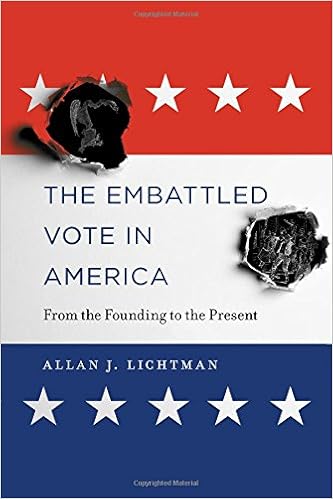
Lichtman, "The Embattled Vote"

New from Harvard University Press: Allan J. Lichtman (American University), The Embattled Vote in America: From the Founding to the Present (September 2018). A description from the Press:
Americans have fought and died for the right to vote. Yet the world’s oldest continuously operating democracy guarantees no one, not even its citizens, the right to elect its leaders. 
For most of U.S. history, suffrage has been a privilege restricted by wealth, sex, race, residence, literacy, criminal conviction, and citizenship. Economic qualifications were finally eliminated in the nineteenth century, but the ideal of a white man’s republic persisted long after that. Today, voter identification laws, registration requirements, felon disenfranchisement, and voter purges deny many millions of American citizens the opportunity to express their views at the ballot box. 
An award-winning historian who has testified in more than ninety voting rights cases, Allan Lichtman gives us the deep history behind today’s headlines and shows that calls of voter fraud, political gerrymandering and outrageous attempts at voter suppression are nothing new. The players and the tactics have changed—we don’t outright ban people from voting anymore—but the battle and the stakes remain just as high.
More information is available here.

Saturday, June 23, 2018

Weekend Roundup

  • From the Los Angeles Times: an op-ed by Kristin Collins (Boston University Law), Serena Mayeri (Penn Law), and Hiroshi Motomura (UCLA Law). They bring a historical perspective to bear on current immigration policy and the family separations occurring at the U.S.-Mexico border.
  • Aaron T. Knapp reviews former LHB Guest Blogger Gautham Rao’s National Duties in the latest issue of Law and Social Inquiry.
  • From the newsletter of the SEC Historical Society: “Maybe you've heard of the Buttonwood Agreement, an effort to organize securities trading in 1792 and preceding the formation of the New York Stock and Exchange Board...but have you ever seen it?”
  • Coming up: a workshop on "Cultural Expertise in Ancient and Modern History," convened by Livia Holden at Oxford's Centre for Socio-Legal Studies, July 4-5, 2018. Participants will explore dispute resolution and cultural expertise in legal history, while also tracing the historical development of recent trends in cultural expertise. More here.
  • And later this summer: a 900-year commemoration of the first Icelandic laws, the Hafliðaskrá, at the 17th International Saga Conference in Reykjavik and Reykhold (Aug.12-17, 2018). Otto Vervaart has a handy overview at his Rechtsgeschiedenis Blog.
Weekend Roundup is a weekly feature compiled by all the Legal History bloggers.

Saturday, March 3, 2018

Weekend Roundup

  • ChinaFile has posted an interview with recent guest blogger Taisu Zhang (Yale Law School), on his book The Laws and Economics of Confucianism: Kinship and Property in Pre-Industrial China and England.  UPDATE: Here's one more, from the New Books Network.
Weekend Roundup is a weekly feature compiled by all the Legal History bloggers.

Saturday, June 10, 2017

Weekend Roundup

  • Congratulations to Penn Law's Sarah Barringer Gordon on being appointed the Cary and Ann Maguire Chair in Ethics and American History at the John W. Kluge Center of the Library of Congress for the fall semester of 2017.
  • Over at Balkinization, Mark Tushnet (Harvard Law School) urges someone to write a history of "'working the refs,' meaning the Supreme Court, by framing issues before the Court not as raising contestable legal questions on which the author is taking a side, but as presenting the Court with an opportunity to take a stance on some collateral issue."
  • ICYMI:  David Bernstein and Calvin TerBeek continue their exchanges on the intellectual history of originalism on The Faculty Lounge.  And, on the subject of the intellectual (and political) history of originalism, Logan E. Sawyer’s Principle and Politics in the New History of Originalism, is available now as an advance article on the website of the American Journal of Legal History and is forthcoming in the AJLH’s next volume.  Another AJLH advance article: The Poll Tax before Jim Crow, by Brian Sawers.
Weekend Roundup is a weekly feature compiled by all the Legal History bloggers.

Monday, November 7, 2016

Curtis on Redemption and Redistricting in North Carolina

Michael Kent Curtis, Wake Forest University School of Law, has posted Race As a Tool in the Struggle for Political Mastery: North Carolina's "Redemption" Revisited 1870–1905 and 2011–2013, which appeared in Law and Inequality 33 (2015): 53-142:
This article looks at two episodes in North Carolina history:  (1) the overthrow and destruction of the Republican white-black political coalition in the years between 1876 and 1900 and the techniques for overthrow used in those years; and (2) the attack on the Democratic multi-racial coalition in North Carolina’s 2010 election and 2011 redistricting.

While, thankfully, there are differences in the episodes, in both race was as a tool in the search for political mastery. In the second, 2011 redistricting, the legislature sought to justify two racial quotas and packing more black voters into black districts under the Voting Rights Act—undermining overall black political power, wasting black votes, and increasing racial polarization. The article argues that the Voting Rights Act rationale used by the legislature was deeply flawed even on its own purported terms. The article was the first of two on the subject.
H/t: Legal Theory Blog

Monday, December 28, 2015

Free's "Suffrage Reconstructed"

Laura E. Free, Hobart and William Smith Colleges, has published Suffrage Reconstructed: Gender, Race, and Voting Rights in the Civil War Era, with Cornell University Press:
The Fourteenth Amendment, ratified on July 9, 1868, identified all legitimate voters as "male." In so doing, it added gender-specific language to the U.S. Constitution for the first time. Suffrage Reconstructed is the first book to consider how and why the amendment's authors made this decision. Vividly detailing congressional floor bickering and activist campaigning, Laura E. Free takes readers into the pre- and postwar fights over precisely who should have the right to vote. Free demonstrates that all men, black and white, were the ultimate victors of these fights, as gender became the single most important marker of voting rights during Reconstruction.

Free argues that the Fourteenth Amendment's language was shaped by three key groups: African American activists who used ideas about manhood to claim black men's right to the ballot, postwar congressmen who sought to justify enfranchising southern black men, and women’s rights advocates who began to petition Congress for the ballot for the first time as the Amendment was being drafted. To prevent women’s inadvertent enfranchisement, and to incorporate formerly disfranchised black men into the voting polity, the Fourteenth Amendment’s congressional authors turned to gender to define the new American voter. Faced with this exclusion some woman suffragists, most notably Elizabeth Cady Stanton, turned to rhetorical racism in order to mount a campaign against sex as a determinant of one’s capacity to vote. Stanton’s actions caused a rift with Frederick Douglass and a schism in the fledgling woman suffrage movement. By integrating gender analysis and political history, Suffrage Reconstructed offers a new interpretation of the Civil War–era remaking of American democracy, placing African American activists and women’s rights advocates at the heart of nineteenth-century American conversations about public policy, civil rights, and the franchise.

Sunday, December 13, 2015

Sunday Book Roundup

Laura Weinrib reviews After Roe: The Lost History of the Abortion Debate by Mary Ziegler (Harvard University Press) for The New Rambler.
"Drawing on more than one hundred oral histories and a vast array of archival materials, Ziegler offers a more complete account of abortion rights advocacy in the decade after Roe.  She links social movement strategies to the broader political and cultural shifts of the 1970s and early 1980s, including the realignment of the Republican and Democratic parties, the rise of the Religious Right and the New Right, changing perceptions of population control and civil rights, and Ronald Reagan’s embrace of neoliberalism. The book is framed around a series of six “major historical questions that preoccupy commentators across the ideological spectrum” (xix).  Chapter by chapter, Ziegler identifies the “core scholarly conclusions” that have emerged in the literature (xii) and exposes each as an oversimplification or outright fiction."
The Federal Lawyer has a review of Damon Root's Overruled: The Long War for Control of the US Supreme Court (Palsgrave Macmillan).

Jennifer Mittelstadt is interviewed by New Books about her new book, The Rise of the Military Welfare State (Harvard University Press).

Eric Foner reviews Ari Berman's Give Us the Ballot (Farrar, Straus, and Giroux) for The Nation.
"Berman makes clear that, today, voter suppression is a national problem, not confined to the Old South, that affects numerous groups thought to favor the Democrats—not only blacks but also Hispanics, college students, and the poor more generally. Citing a nonexistent wave of voter fraud, a majority of the states, nearly all of them under Republican control, have passed laws in the past few years making it more difficult to vote."
The Guardian has collected "The best history books of 2015."

If you're looking for last minute gift recommendations, the Los Angeles Times has "31 nonfiction picks" with a healthy history section.

Wednesday, December 2, 2015

Zelizer and Burton to Brief Congress on the History of the Voting Rights Act of 1965

[We have the following announcement from the National History Center.]

Congressional Briefing: History of the Voting Rights Act of 1965

The National History Center of the American Historical Association is pleased to announce our upcoming Congressional briefing. Julian Zelizer of Princeton University and Vernon Burton of Clemson University will discuss the history of the Voting Rights Act in commemoration of its 50th anniversary. Professor Dane Kennedy, Director of the National History Center, will moderate the discussion.

The briefing will examine the intended and unintended historical consequences of the Voting Rights Act of 1965.  [It] will be held on Friday, December 4th, at 1 PM in the Cannon House Office Building Room 121.

Sunday, November 15, 2015

Sunday Book Roundup

This week The New Rambler has a review of Ari Berman's Give Us the Ballot (Farrar, Straus, and Giroux).
"In his new book, Give Us the Ballot, journalist Ari Berman tells the story of these stirring moments, and tells it well. But unlike many civil rights chronicles, his account begins rather than ends in the 1960s. Via a series of vivid anecdotes, he describes the tumultuous history of the Voting Rights Act (VRA) from its enactment all the way to the present day. It’s an important and absorbing tale—though one that could have been narrated with a bit less certainty and a bit more nuance."
There's lots on H-Net, including a review of Lynched: The Victims of Southern Mob Violence by Amy Kate Bailey and Stewart E. Tolnay (UNC Press).

There's also a review of Origins of the National Security State and the Legacy of Harry S. Truman edited by Mary Ann Heiss and Michael J. Hogan (Truman State University).

Indian Ocean Slavery in the Age of Abolition edited by Robert Harms, Bernard K. Freeman, and David W. Blight (Yale University Press) is reviewed on H-Net too.

The New Republic has a review of The Con Men: Hustling in New York City by Terry Williams and Trevor B. Milton (Columbia University Press).
"Terry Williams and Trevor B. Milton don’t bother to pretend not to be enchanted by their subjects. Con Men is a present-day investigation into some people who make a living against or around the law. It’s a PG-13 version that excludes crimes of violence, which are against the code, and only touches briefly on sex work. What’s left are hustles: Selling fake or stolen goods, dice and numbers games, quick confidence tricks, hawking water bottles and candy. Most of these play on the mark or customer’s combination of greed and their desire to be entertained. Unlike a mugging, they require some participation."
And, New Books has a couple new interviews too. There is an interview with Michael L. Berg discussing his Peacemakers: The Iroquois, the United States, and the Treaty of Canandaigua, 1794 (Oxford University Press). Mario T. Garcia is also interviewed about his book, The Chicano Generation: Testimonies of the Movement (University of California Press).

Sunday, November 8, 2015

Sunday Book Roundup

We're back with a full book roundup this weekend. Here's the run-down of legal history related book reviews:

The New York Review of Books has a review by Jed Rakoff about John C. Coffee Jr.'s Entrepreneurial Litigation: Its Rise, Fall, and Future (Harvard University Press).
"Rather, it covers the full spectrum of class actions, including mass tort class actions, employment discrimination class actions, antitrust class actions, consumer class actions, merger and acquisition class actions, and much more. Not only is the book more comprehensive than prior studies of class actions, it also probes more deeply, placing today’s class actions firmly within the setting of the modern trend toward turning the practice of law ever more into a business. Perhaps most impressively, Coffee’s book offers specific prescriptions (the most original of which is discussed below) for reducing the weaknesses of modern class action litigation while enhancing its strengths."
In the LA Times is a review of Ari Berman's Give Us the Ballot: The Modern Struggle for Voting Rights in America (Farrar, Straus, and Giroux).

A complementary review in The New Rambler is that of Bending Toward Justice: The Voting Rights Act and the Transformation of American Democracy by Gary May (Basic).

Slate has a lengthy review of Glenda Gilmore and Thomas Sugrue's new These United States: A Nation in the Making, 1890 to the Present (Norton).
"In their timely, remarkable new survey of America since 1890, These United States, they argue that in many ways we are back to where we started. They begin in the 1890s, when Gilded Age tycoons like Andrew Carnegie and John Rockefeller controlled much of the nation’s wealth and an enfeebled federal government seemed incapable if not unwilling to stop them. And despite the tremendous strides made during the New Deal and Great Society era, in many ways we find the U.S. facing those exact same problems. Provocatively, Gilmore and Sugrue ask whether the greater equalities of the immediate postwar years, when seen in light of the “long” 20th century, seems less like an inevitability and more like an “historical accident.” That they make a compelling case that they do makes this book required reading."
Tom Lewis's Washington: A History of Our National City (Basic) is reviewed in The Washington Post.

Lafayette in the Somewhat United States by Sarah Vowell (Riverhead Books) is reviewed in several places. The review in the New Republic is here, and the review from the Washington Independent Review of Books can be found here. NPR says:
"Be careful about calling Sarah Vowell's latest a history book. The term fits in the broadest sense, sure — but for many, that phrase may also drum up visions of appendices and ponderous chapter titles, obscure maps and pop quizzes. Knee-deep as it may be in the history of the American Revolution, Lafayette in the Somewhat United States doesn't look or act much like its textbook brethren. 
Gilded with snark, buoyant on charm, Vowell's brand of history categorically refuses to take itself — or any of its subjects — too seriously."
The Los Angeles Review of Books has a review of Melvin Urofsky's Dissent and the Supreme Court (Pantheon).

An excerpt from Nut Country: Right-wing Dallas and the Birth of the Southern Strategy (University of Chicago Press) by Edward Miller can be found on Salon.

From the New Statesman comes a two-book review of Charles Moore's Margaret Thatcher: the Authorized Biography, Volume Two--Everything She Wants (Allen Lane) and Kwasi Kwarteng's Thatcher's Trial: Six Months That Defined a Leader (Bloomsbury).

Martha Minow reviews Michal Schudson's The Rise of the Right to Know: Politics and the Culture of Transparency, 1945-1975 (Harvard University Press) for The New Rambler.
"Neither the founders of the nation nor their lawmaker heirs called for a citizens’ right to information during the 19th century or the first half of the 20th. Sociologist Michael Schudson whets the reader’s appetite with this arresting observation, and then offers satisfying case studies with explanations for changes since the 1950s. The book portrays political and social contexts that helped establish unprecedented demands for, and practices of, transparency in government processes and in the lives of public officials, as well as transparency about risks to health, safety, and the environment from economic developments."
H-Net, of course, has added several reviews in the two weeks since our last round-up. A review of Jori Diez's The Politics of Gay Marriage in Latin America: Argentina Chile, and Mexico (Cambridge University Press) is now available.

So too is a review of Louis Masur's Lincoln's Last Speech: Wartime Reconstruction and the Crisis of Reunion (Oxford University Press).

More Civil War history is found in the review of collected volume The Blue, the Gray, and the Green: Toward an Environmental History of the Civil War (University of Georgia Press), edited by Brian Allen Drake.

Also on H-Net is a review of A Few Lawless Vagabonds: Ethan Allen, the Republic of Vermont, and the American Revolution (Casemate) by David Bennett.

Continuing to move back in time, H-Net has a review of Pirates, Merchants, Settlers, and Slaves: Colonial America and the Indo-Atlantic World (University of California Press) by Kevin McDonald.

If that's too much reading for you, you can listen to an interview with Azizah al-Hibri, in which she discusses her new book The Islamic Worldview: Islamic Jurisprudence--An American Muslim Perspective, Volume One (ABA Books).

New Books in American Studies also offers an interview with Daniel Schlozman, who discusses his work in When Movements Anchor Parties: Electoral Alignments in American History (Princeton University Press).

Daniel Geary discusses with New Books his work, Beyond Civil Rights: The Moynihan Report and Its Legacy (University of Pennsylvania Press).

And a last interview from New Books is one with Sam Mitrani, whose most recent book is The Rise of the Chicago Police Department: Class and Conflict, 1850-1894 (University of Illinois Press).

Finally, I heard talk at ASLH of projects in the works for legal history writing for children and youth. So, here is an interesting multi-book review of children's history books in the New York Times, that includes a review of Aaron and Alexander by Don Brown (Roaring Brook Press). Also in this issue of NYT is a review of Most Dangerous: Daniel Ellsberg and the Secret History of the Vietnam War by Steve Sheinkin (Roaring Brook Press), also for young readers.

Sunday, September 6, 2015

Sunday Book Roundup

The Federal Lawyer has a new issue, with several book reviews of note. Benjamin H. Barton's Glass Half Full: The Decline and Rebirth of the Legal Profession (Oxford University Press) is reviewed. More legal history is found in a review of Licensed to Practice: The Supreme Court Defines the American Medical Profession by James C. Mohr (Johns Hopkins University). There's also a review of James M. Denham's Fifty Years of Justice: A History of the U.S. District Court for the Middle District of Florida (University Press of Florida). All reviews from the September issue can be found here.

New Books has an interview with George H. Nash about his book The Crusade Years, 1933-1955: Herbert Hoover's Lost Memoir of the New Deal Era and Its Aftermath (Hoover Institution Press). And, Natalia Molina discusses her book, How Race is Made in America: Immigration, Citizenship, and the Historical Power of Racial Scripts (University of California Press).
"In her fascinating new study ...  Professor of History and Urban Studies at UC San Diego Natalia Molina advances the study of U.S. immigration history and race relations by connecting the themes of race and citizenship in the construction of American racial categories. Using archival records held by the Immigration and Naturalization Service (INS), the U.S. Congress, local governments, and immigrant rights groups, Dr. Molina examines the period of Mexican immigration to the U.S. from 1924-1965. Employing a relational lens to her study, Professor Molina advances the theory of racial scripts to describe how ideas about Mexicans and Mexican immigration have been fashioned out of preexisting racial projects that sought to exclude African Americans and Asian immigrants from acquiring the full benefits of American citizenship."
Ari Berman talks about his Give Us the Ballot: The Modern Struggle for Voting Rights in America (Farrar Straus Giroux) on Politics & Prose.

H-Net adds several more reviews to the mix, including one of Charity and Sylvia: A Same-Sex Marriage in Early America by Rachel Hope Cleves (Oxford University Press).

The Myth of Seneca Falls: Memory and the Women's Suffrage Movement, 1848-1989 by Lisa Tetrault (UNC Press) is reviewed on H-Net.
"Tetrault examines the myth that the 1848 meeting in Seneca Falls, New York, launched the woman suffrage movement. She does not argue that the Seneca Falls meeting was unimportant. Instead, she states that it has become a “venerated and celebrated story” that requires further scrutiny (p. 5). Tetrault demonstrates that Stanton and Anthony crafted this historical narrative during the late nineteenth century to ensure that their contemporaries and later generations recognized them as the movement’s leaders. By dating the movement to this meeting, Stanton, who helped organize the event and drafted the Declaration of Sentiments, became a founding mother. Inaccurate accounts placed Anthony at the meeting as well."
Lowell J. Soike's Busy in the Cause  Iowa, the Free-State Struggle in the West, and the Prelude to the Civil War (University of Nebraska Press) is reviewed as well on H-Net.

Sunday, August 23, 2015

Sunday Book Roundup

Give Us the Ballot: The Modern Struggle for Voting Rights in America by Ari Berman (Farrar, Straus, and Giroux) is reviewed on The Daily Beast.
"Berman relates the story of the Voting Rights Act (VRA) from its making in 1965 to its mauling in 2013. In chapters bearing titles such as “The Second Emancipation,” “The Second Reconstruction,” “The Southern Strategy,” and “The Counterrevolution,” he recalls the 1965 marches that propelled the history-making passage of the VRA in Congress; the extraordinary transformations wrought by the federal government’s implementation of the Act in the former states of the Confederacy; the concurrent campaigns and diverse machinations through the course of five decades by reactionaries, conservatives, and neoconservatives to block, undermine, or do in the Act piece by piece; and finally, the Roberts Court’s devastating decision in Shelby."
H-Net has a double review of Charles E. Cobb Jr.'s This Nonviolent Stuff'll Get You Killed: How Guns Made the Civil Rights Movement Possible (Basic Books) and Akinyele Omowale Umoja's We Will Shoot Back: Armed Resistance in the Mississippi Freedom Movement (New York University Press).

There's also a review of Laura Edward's A Legal History of the Civil War and Reconstruction: A Nation of Rights (Cambridge University Press).
"Edwards has provided a relatively brief but incisive synthesis of the recent historical literature on the Civil War and Reconstruction that focuses on the legal consequences of emancipation. In doing so, she also puts forward her own original—and ultimately persuasive—argument. Oddly, the subtitle probably gives a better indication of the book’s subject matter and contents than does the title (and one wonders if perhaps the title and subtitle ought to have been reversed). Moreover, the book’s chronological framework, the title notwithstanding, transcends the era of the Civil War and Reconstruction, extending into the early years of the twentieth century. Edwards has written a volume that will benefit scholars of the Civil War era, broadly construed, the Gilded Age and late nineteenth century, and legal and constitutional history."
New Books in History interviews Brian Murphy about his new book, Building the Empire State: Political Economy in the Early Republic (University of Pennsylvania Press).

And from Slate there is a review of The Boundaries of Desire: A Century of Good Sex, Bad Laws, and Changing Identities by Eric Berkowitz (Counterpoint).

Contraband: Smuggling and the Birth of the American Century by Andrew Wender Cohen (WW Norton) is reviewed in The Washington Post.

Bernard Bailyn reviews Revolutions Without Borders: The Call to Liberty in the Atlantic World by Janet Polasky (Yale University Press) in The New York Review of Books.