Showing posts with label Islamic Law. Show all posts

Thursday, May 29, 2025

Law & Society Dissertation Prize to Fei

At the recent meeting of the Law and Society Association, the winner of the annual Dissertation Prize was announced. The award went to Du Fei (University of Oklahoma), for a dissertation titled "Local Women, Global Histories? Gendering Economic Life, Law, and Islam in Early Modern Transregional India." The citation:

Du Fei, Assistant Professor at the University of Oklahoma, who earned his PhD from Cornell University, has been selected as the winner of this year’s Dissertation Prize. His dissertation, “Local Women, Global Histories? Gendering Economic Life, Law, and Islam in Early Modern Transregional India,” challenges gendered constructions of Islamic law and reveals how gender-insensitive narratives have shaped dominant histories of trade and travel in global Islam. 

Historians have long traced the movements of merchants, colonizers, and legal professionals across transregional India, often casting men as global actors and non-European women as local, domestic subjects. But what was it precisely that made some of these histories “global” and others “local”? What roles did women actually play in the economic life of the time, and how did they engage with legal systems, while navigating financial and social networks? Drawing on extraordinarily rich archival research and sharp theoretical analysis, Fei’s dissertation uncovers a fascinating inversion of mainstream assumptions about the histories of gender in Islam. 

While Muslim women in transregional India are often portrayed as passive or economically marginalized, Fei shows that some acted as strategic negotiators—engaging with jurists, judges, and male kin to assert claims through Islamic law on property and inheritance. Rather than being confined to the private sphere, these women regularly negotiated with male kin, jurists, judges, and officials in multiple courts. Taking readers across the lands and seas of South Asia, the Middle East, and Southeast Asia, Fei effectively constructs a new archive for the legal history of South Asia, drawing on sources in Persian, Arabic, English, and Dutch.  

By positioning the household as a critical site of economic activity, the dissertation also unsettles simplistic accounts of patriarchy and offers a major methodological and substantive contribution to the economic and legal history of global early modernity. It advances scholarship on legal pluralism by demonstrating how women navigated overlapping legal traditions as they engaged in debates among Muslim jurists, colonial officials, and Orientalists. In short, Fei’s dissertation represents the epitome of law and society scholarship. 

The committee unanimously praised the exceptional reach of the dissertation, spanning gender studies, legal history, and Islamic studies, and its potential to mark a leap forward in socio-legal scholarship that employs historical analysis. Beautifully written and meticulously researched, the dissertation lays the groundwork for an important interdisciplinary intervention. In a period marked by opportunistic originalism, it offers socio-legal scholars a compelling example of how careful archival rereading can serve as a powerful counterpoint in legal argumentation about global histories. 

Congratulations to Professor Fei!

Monday, February 24, 2025

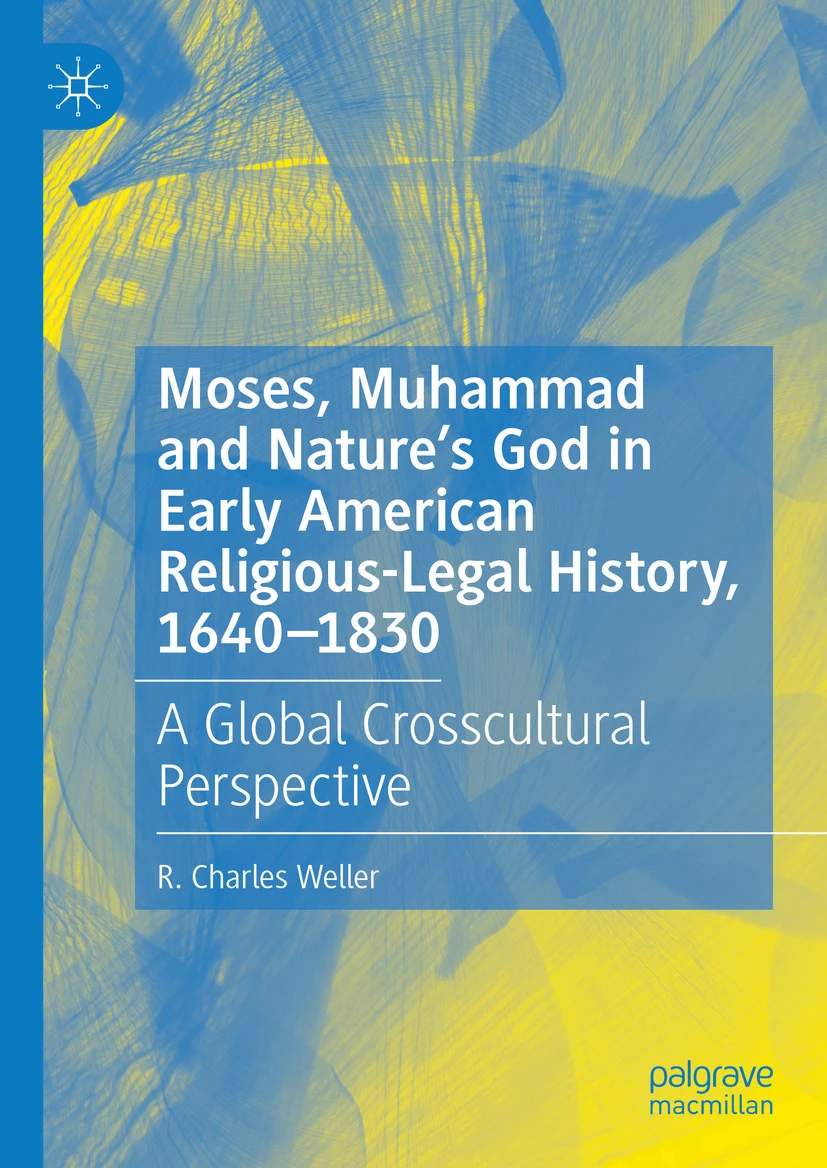
Weller, "Moses, Muhammad and Nature’s God in Early American Religious-Legal History, 1640-1830"

Palgrave Macmillan Cham has published Moses, Muhammad and Nature’s God in Early American Religious-Legal History, 1640-1830 (Sept. 2024), by R. Charles Weller (Washington State University). A description from the publisher:

This is the first comparative study of Mosaic and Islamic law in American history to be published. Constructing a complex picture in trans-Atlantic, trans-European and world historical perspectives, this book elucidates the intersections that lie beneath and behind the rise of the debates in the 1990s and 2000s over the promotion of the Ten Commandments and Mosaic Law as alleged sources of American Constitutional law and symbols of American national identity. These debates have taken shape in close connection with resurgent anti-Semitism, anti-Sharia protests and anti-Sharia legislation throughout the United States and other Western societies.

More information is available here.

-- Karen Tani

Wednesday, December 13, 2023

Soufi, "The Rise of Critical Islam: 10th-13th Century Legal Debate"

Oxford University Press has published The Rise of Critical Islam: 10th-13th Century Legal Debate (2023), by Youcef L. Soufi (University of Toronto). A description from the Press:

In a richly narrated historical study, Youcef Soufi excavates an Islamic legal culture of critique from the 10th to 13th centuries. Focusing on the practice of munāẓara (disputation), Soufi explores how and why oral debates became a pervasive and revered part of the intellectual legal landscape of Iraq and Persia. Using the life and career of celebrated Iraqi jurist Abū Isḥāq al-Shīrāzī, he traces the formalization of debate gatherings at the dawn of the classical legal schools (al-madhāhib) in the early 10th century and analyzes the wider institutional, social, and discursive conditions that made debate an important feature of any jurist's practice.

Pushing back against claims that classical Muslim jurists sought to weed out differences of opinion, The Rise of Critical Islam presents a community committed to the openness, fluidity, and continued exploration of the law. Challenging the view of debate gatherings simply as mechanisms of doctrinal resolution before codification, the study reveals a classical culture where critical debates were part of a continual and personal quest to discover God's law. In uncovering this classical legal culture, Soufi invites readers to question claims about the promise of secular critique in disciplining religious passions and forging human solidarity.

More information is available here. An interview with Professor Soufi is available here, at New Books Network.

-- Karen Tani

Thursday, November 16, 2023

AJLH 63:2

The American Journal of Legal History has published its 63:2 (June 2023) issue.  It is devoted to the symposium "Status in Ancient and Medieval Law."

Status in Ancient and Medieval Law: Introduction
Timothy Lubin

Empire, Status, and the Law
Clifford Ando

Metics and Freedmen: Conflicts of Social and Juridical Status in the Classical and Hellenistic Greek World
Elizabeth A Meyer

Religious Endowments in Ancient India and the Institutionalization of Brahmin Caste Status
Timothy Lubin

Belief as Status: Premodern Islamic Law, Duties, and the Martyr Conundrum
Adnan A Zulfiqar

The Matter of Personae in Medieval Italy
Melissa Vise

‘Our Practice Has a Superiority:’ Debt Enforcement, Bills of Exchange, and Credit in Eighteenth-Century Glasgow
Hunter Harris

Book Reviews

Eric L Muller, Lawyer, Jailer, Ally, Foe: Complicity and Conscience in America’s World War II Concentration Camps
Gabriel J Chin

Brent Salter, Negotiating Copyright in the American Theatre: 1856–1951
Oren Bracha

 --Dan Ernst

Monday, September 4, 2023

CFP: Symposium on Copyright in Islamic Legal Tradition

 Via H-Law, we have the following Call for Papers:

Symposium on Copyright in Islamic Legal Tradition
“Copyright in Islamic Law” Research Project | ISAR Research Center
June 28-29, 2024 | Istanbul

In today’s contemporary landscape, the intricacies surrounding copyright and intellectual property rights have gained significant prominence. The rapid advancement and diversification of digital technologies have given rise to a multitude of copyright-related challenges. Although numerous legal systems address copyright through various theoretical frameworks, such as personality, labor, and utilitarian theories, the comprehensive examination of this subject from the perspective of Islamic law remains relatively unexplored.
 
The “Copyright in Islamic Law” project, under the auspices of ISAR Research Center, has been exploring the potential of this perspective through a reading group on the Western foundations of copyright, a workshop on scholarly approaches within Islamic legal tradition, and a lecture series called “Copyright Talks” featuring renowned researchers. Taking our contribution a step further, the project's fourth step is the “Symposium on Copyright in Islamic Legal Tradition” which will critically examine the intersection between copyright and Islamic legal tradition, uniting diverse researchers from various
disciplines.

The symposium aims to address a range of key inquiries that lie at the heart of the discussion on copyright within the Islamic legal context. These questions include, but are not limited to, the following:
- The principal factors influencing ongoing debates surrounding copyright,
- The role of the madhhab tradition in shaping contemporary discourses on copyright,
- The reasons, obstacles, and potential consequences associated with endeavors aimed at justifying copyright,
- The strengths and weaknesses inherent in attempts to provide a perspective on this issue,
- The relationship between modern legislative frameworks in Muslim societies and the Islamic legal tradition,
- Insights from pre-modern legal legacies,
- Other problems, issues, and challenges relating to the broader questions at the intersection of Islamic law and copyright.

We seek original scholarly contributions that delve into the intricate connection between copyright law and the Islamic legal tradition. We also welcome submissions exploring various dimensions of intellectual property, but priority will be given to submissions that center around copyright-related themes.

More information about submissions, funding, deadlines, contact information, and the ISAR is available here
 
The deadline for abstract submissions is October 15, 2023.
 
-- Karen Tani

Thursday, March 2, 2023

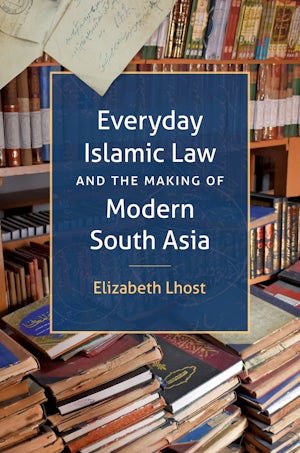
Lhost, "Everyday Islamic Law and the Making of Modern South Asia"

The University of North Carolina Press has published Everyday Islamic Law and the Making of Modern South Asia (2022) by Elizabeth Lhost (Dartmouth College). A description from the Press:

Beginning in the late eighteenth century, British rule transformed the relationship between law, society, and the state in South Asia. But qazis and muftis, alongside ordinary people without formal training in law, fought back as the colonial system in India sidelined Islamic legal experts. They petitioned the East India Company for employment, lobbied imperial legislators for recognition, and built robust institutions to serve their communities. By bringing legal debates into the public sphere, they resisted the colonial state’s authority over personal law and rejected legal codification by embracing flexibility and possibility. With postcards, letters, and telegrams, they made everyday Islamic law vibrant and resilient and challenged the hegemony of the Anglo-Indian legal system.

Following these developments from the beginning of the Raj through independence, Elizabeth Lhost rejects narratives of stagnation and decline to show how an unexpected coterie of scholars, practitioners, and ordinary individuals negotiated the contests and challenges of colonial legal change. The rich archive of unpublished fatwa files, qazi notebooks, and legal documents they left behind chronicles their efforts to make Islamic law relevant for everyday life, even beyond colonial courtrooms and the confines of family law. Lhost shows how ordinary Muslims shaped colonial legal life and how their diversity and difference have contributed to contemporary debates about religion, law, pluralism, and democracy in South Asia and beyond.

Advance praise:

“Opening a window on a virtually unexplored domain, Elizabeth Lhost foregrounds lawmaking in South Asian Islam as a process, providing a diachronic view of how the relationship between Muslim judges and the British state developed throughout the colonial period. Lhost also gives readers an unprecedented glimpse into the everyday lives of litigants, especially women, who attempted to use the law to better their lives. A landmark study of Islamic law in any time or period.”—Brannon Ingram

“Elizabeth Lhost draws on a remarkable and largely unexplored collection of archives, many of which require rare skill sets to interpret. The result is a lively, bottom-up perspective on everyday legal encounters. For historians and legal scholars alike, this book enriches our understanding of the ongoing importance of non-state legal forums and their complex interfaces with state courts and legislation.”—Julia Stephens

More information about the book is available here. An interview with Professor Lhost is available here, at New Books Network.

-- Karen Tani

Wednesday, August 17, 2022

Rabb on Punishment in Medieval Islamic Law

Intisar A. Rabb, Harvard Law School, has posted Enforcement and Punishment in Medieval Islamic Law, which is forthcoming in Cultural History of Crime and Punishment in the Medieval Age, ed. Sarah McDougall and Karl Shoemaker (Bloomsbury 2022):

The striking thing about medieval Islamic criminal law is that it featured a jurisprudence of doubt and lenity facing off against political practices of control and severity. Principles of Islamic criminal law placed interpretive authority in the group of scholar-jurists who gained expertise to read divine texts to say what the Law is (sharīʿa). Practices of Islamic criminal law authorized executive authorities—caliphs, sultans, and their agents—power over law enforcement (siyāsa). Principles informed the task of expert jurists and state-appointed judges in defining legitimate punishment derived from Islam’s foundational texts. Practices informed the wide array of severe punishment that law enforcement officials meted out regularly, with a justification that it was “in the public interest” (maṣlaḥa). Principles often justified limited punishment by means of “deterrence” (zajr) and “spiritual rehabilitation” (kaffāra). Practices often justified unrestrained punishment as a means of maintaining law and order, social control, or might as right. The principles of punishment, practices of punishment, and justifications for punishment typically operated in siloes separated by a wide plain. This chapter explores the ground where they met.

Examining both principles and practices of medieval Islamic criminal law can shed light on some of the most pressing questions of old criminal law (Islamic and otherwise): What is the extent of convergence or divergence between Islam’s principles and practices? How, from juristic or social-political accounts of criminal justice, can we explain the types of punishments we see on the books and in the world as we know it?

To answer these questions, I will explore the principles-practices divergence by first examining the legal sources. Then I will review them alongside narratives of social-political practices. For the legal principles, I draw on previous work outlining medieval Islamic criminal law and the expansive role of doubt in substantive law and in criminal procedure. To explore the practices, I canvas Maḥmūd Shaljī’s seven-volume Encyclopedia of Punishment (MMawsūʿat al-ʿadhāb), in which he collects all mentions of “punishment” from a well-known set of historical chronicles and other literary sources from the eighth century onward. I supplement his sources with the less-covered Seljuq, Mamlūk, and Ottoman-era accounts of punishment that Christian Lange (2012), Carl Petry (2008), and others have collected in their studies. By combining views of criminal law from the pens of medieval jurists together with accounts of contemporaneous acts reporting on their less verbose executive counterparts, I offer depictions of how each side tended to approach crime and punishment.
--Dan Ernst

Wednesday, June 22, 2022

LHR 40:2

Law and History Review 40:2 (May 2022) is now available online:

Using Topic-Modeling in Legal History, with an Application to Pre-Industrial English Case Law on Finance
Peter Grajzl, Peter Murrell

Rebellion, Sovereignty, and Islamic Law in the Ottoman Age of Revolutions
Will Smiley

The Surveillance State and the Surveillance Private Sector: Pathways to Undercover Policing in France and the United States
Jacqueline E. Ross

Religion, Law, and the Dynamics of Intellectual Transmission: Weimar Jurisprudence among Religious Socialists in Israel
Alexander Kaye

Heart Transplants, Legislating Death, and Disruptive Anti-Apartheid Advocacy
Meredith Terretta

Book Reviews


Sara M. Butler, Pain, Penance, and Protest: Peine Forte et Dure in Medieval England. Cambridge: Cambridge University Press, 2022. Pp. xiv, 474. $135.00 hardcover (ISBN 9781316512388)
Henry Summerson

Tom Johnson, Law in Common: Legal Cultures in Late-Medieval England. Oxford: Oxford University Press, 2020. Pp. xii, 324. $105.00 hardcover (ISBN 9780198785613)
Anthony Musson

Catherine L. Evans, Unsound Empire: Civilization & Madness in Late-Victorian Law. New Haven and London: Yale University Press, 2021. Pp. 304. $65.00 hardcover (ISBN 9780300242744)
Katherine D. Watson

Christopher W. Schmidt, Civil Rights in America: A History. Cambridge: Cambridge University Press, 2020. Pp.250. $114.95 hardcover (ISBN 9781108426251); $39.95 paperback (ISBN 9781108444972)
Sophia Z. Lee

--Dan Ernst

Wednesday, April 14, 2021

Quadri on Islamic Law in Colonial Modernity

Oxford University Press has published Transformations of Tradition: Islamic Law in Colonial Modernity (Mar. 2021), by Junaid Quadri (University of Illinois at Chicago). A description from the Press: 

Transformations of Tradition probes how the encounter with colonial modernity conditioned Islamic jurists' conceptualizations of the shari'a. Departing from the tendency to focus on reformist-minded thinkers and politically charged issues, Junaid Quadri directs his attention towards the overlooked jurisprudential writings of Muhammad Bakhit al-Muti-i (1854-1935), Mufti of Egypt and a frequent critic of the famed reformists Muhammad 'Abduh and Rashid Rida. There, he locates a remarkable series of foundational intellectual shifts. Offering a fresh perspective on a pivotal period in the history of Islamic thought, Quadri tracks how Bakhit reworks the relationship of the shari'a to categories of understanding as fundamental as history and authority, science and technology, and religion and the secular, thereby upending the very ground upon which Islamic law had until then functioned. Through close readings of complex legal texts and mining of oft-neglected archives, this carefully researched study situates its argument in both the contested scholarly world of a quickly-changing Cairo, and the transregional school of Hanafi law as represented by jurists writing in Kazan, Lucknow, and Baghdad. Examining Islamic jurisprudential discourse in the colonial moment, Transformations of Tradition uncovers a shari'a that is neither a medieval holdover nor merely a pragmatic concession to the demands of a new world, but rather deeply entangled with the epistemological commitments of colonial modernity.

More information is available here. You can listen to an interview with the author here, at New Books Network.

-- Karen Tani

Saturday, September 5, 2020

Ceci n'est pas un chameau

In writing my book Fluid Jurisdictions: Arabs and Colonial Law in Southeast Asia (Ithaca: Cornell University Press, 2020), I approach legal history as a series of ‘portals.’ Each legal system and each legal device opened up a world of possibilities. The more a legal system is used, the deeper the sovereign ruler’s jurisdictions and vice versa. Likewise, each legal device such as a power of attorney echoes other similar or commensurable devices such as a wakala across legal systems and cultures further extending its utility across different jurisdictions. A series of portals connected the western end of the Indian Ocean to the eastern end allowing users to jump across huge spaces to enact various actions ranging from transferring economic power to granting a divorce. By generating links tied to institutional legal bureaucracies between otherwise disjointed points, they broadened the orbits of economic production and family responsibility. The use of colonial legal portals in particular came at high cost for most people because colonial legal systems tend to hold people captive. Before going through a portal, one had options, but once one passed through a door to colonial jurisdictions, it was hard to leave for myriad reasons.


I marvel at how little was opaque when it came to law in the eyes of my historical actors - the diasporic Arabs who originated from Hadhramaut in Yemen who seemed to adeptly navigate English common law, Dutch civil law and colonial reformulations of Islamic law in Southeast Asia. They created a scattered accumulation of legal documentation which we inherit today that reveal new-fangled colonial legal systems at every turn that because laws differed from island to island even as they came under a single jurisdiction at times in the vast archipelago in Southeast Asia. Colonial subjects legal practitioners were creating and discovering their own legal systems in ‘real time.’ Just like how I dwell on laws, legal classifications, legal documents, these people in the past also took time to dwell on the same things in multiple languages and idioms with higher stakes of course. To dwell is the first step towards a commitment, a willingness to engage with something strange.


Although I eventually turned to legal history as the main framework for my book, my original question focuses on the spaces in Southeast Asia to illuminate what truly happened in specific locations with particular jurisdictions. My starting question a decade ago was “why did Southeast Asian port-cities whose histories are often exalted for being mixed remain ethnically and socio-economically so divisive?” For example, Muslim subjects (later citizens) were divided ethnically even when classified as one community by colonial and national bureaucracies. It is tempting perhaps to merely blame European colonialism for deepening societal rifts in many ways but this is inadequate. I became intent on discovering the exact contours of the relationship amongst colonial subjects within the new colonial environments in the nineteenth century. As I dug further in the archives, I found that the diasporic peoples I was tracing were rooting themselves in Southeast Asia, intertwining their roots with that of colonial jurisdictions which deepened over time with the added weight of subjects’ expectations. Territorial jurisdictions within maritime Southeast Asia became paramount in the stories I tell although personal jurisdictions tied to older forms of sovereignty still traveled within individuals who continued to make unexpected connections across vast geographical expanses under oppressive rule.


To open a door, to dwell, to take root – that is the history of law in the colonies.


In the photograph on the cover of my book is a life-sized camel with a jubilant expression made out of wood, cloth and possibly metal on wheels accompanying a procession of Arabs in Surabaya located in Java who were commemorating the inauguration of Dutch Queen Wilhelmina in 1898 whose portrait is on the left. The Arabs in the foreground had their swords drawn as was customary at parades, weddings and special occasions. Amongst them, I spotted one of my main historical actors, the Kapitan Arab (head of the Arabs) of the Surabaya Arab community from the Bobsaid clan, a name I have encountered only in Surabaya. Sech Hasan bin Abdulla Bobsaid stood apart from his community slightly in front of them with his face to the camera. Clearly, he was the one who led the Arab delegation at this parade, flanked by members of his community, and the ecstatic camel and more subdued elephant replicas. The camel embodies this new creature in town – colonial legal forms which were mobile, tractable, reimagined versions of older laws moving forward into the twentieth century. My blog posts this month will focus on other aspects of this phenomenon.

 --Nurfadzilah Yahaya

Saturday, July 11, 2020

Weekend Roundup

Charles Sumner (LC)
  • Lucy Salyer (University of New Hampshire) posted "'It Has Not Been My Habit to Yield': Charles Sumner and the Fight for Equal Naturalization Rights" (HNN).
  • Mary Ziegler (Florida State Law) on June Medical Service on NPR and in The Atlantic.
  • Caroline Fredrickson reviews Sara Mayeux’s Free Justice: A History of the Public Defender in Twentieth-Century America (Washington Monthly). 
  • The US Supreme Court's engrossed dockets from 1791 to 1995 are available here.  H/t: @SCOTUSPlaces.
  • Larry Tye discusses Demagogue: The Life and Long Shadow of Senator Joe McCarthy with Terry Gross on Fresh Air (WAMU). 
  • Law Book Exchange has circulated a catalogue on Legal Education. 
  • Harvard Law School has launched the new Journal of Islamic Law. It's a peer-reviewed, online journal with a special interest in data science tools and primary sources.
  • The Historical Society of the New York Courts has posted a new podcast, a discussion about Chancellor James Kent with the Hon. Robert S. Smith.
  • Jed Handelsman Shugerman (Fordham Law) on "The Imaginary Unitary Executive" (Lawfare)Josh Blackman (South Texas College of Law Houston) takes issue with Chief Justice Roberts's references to Aaron Burr’s treason trials in Trump v. Vance  (SCOTUSBlog).  Kristin E. Tremper, a Ph.D. Candidate at Lehigh, offers a brief history of the Founders and public health (Salon).  Stephen B. Presser asks whether George Washington would have worn a mask (Newsmax).  And apparently Stone Mountain isn't going anywhere.  Ugh.
 Weekend Roundup is a weekly feature compiled by all the Legal History bloggers.

Tuesday, April 14, 2020

Chatterjee on Mughal Law

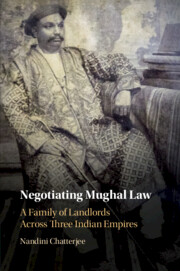
Nandini Chatterjee, University of Exeter, has published Negotiating Mughal Law: A Family of Landlords across Three Indian Empires with Cambridge University Press. The book is available on an Open Access basis. From the publisher: 
Negotiating Mughal LawBased on a completely reconstructed archive of Persian, Hindi and Marathi documents, Nandini Chatterjee provides a unique micro-history of a family of landlords in Malwa, central India, who flourished in the region from at least the sixteenth until the twentieth century. By exploring their daily interactions with imperial elites as well as villagers and marauders, Chatterjee offers a new history from below of the Mughal Empire, far from the glittering courts of the emperors and nobles, but still dramatic and filled with colourful personalities. From this perspective, we see war, violence, betrayal, enterprise, romance and disappointment, but we also see a quest for law, justice, rights and righteousness. A rare story of Islamic law in a predominantly non-Muslim society, this is also an exploration of the peripheral regions of the Maratha empire and a neglected princely state under British colonial rule. 
Praise for the book:

 "This book is an important work that enriches our understanding of family, empire and estate in South Asia. The analysis moves away from state policy and image-building to the micro-processes that actually reproduce state power. It achieves this through the mastery of difficult sources presented in a wide comparative frame.'"- Sumit Guha 

"In tracking a single family's legal documents over three centuries, Nandini Chatterjee has written an extraordinary book, upturning our understanding of how Mughal law worked and how it was experienced by its subjects. It will be revelatory for anyone interested in Islamic, South Asian, or Mughal history." - Samira Sheikh

Further information is available here.

--Mitra Sharafi

Thursday, March 5, 2020

Siddiqui on Abbasid Law and Politics

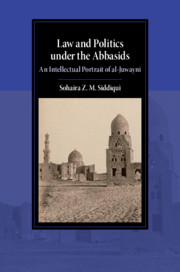
Sohaira Z. M. Siddiqui (Georgetown University, Qatar) published Law and Politics under the Abbasids: An Intellectual Portrait of al-Juwayni in 2019 with Cambridge University Press. From the publisher: 
Law and Politics under the AbbasidsAbu Ma'ali al-Juwayni (d.478/1085) lived in a politically tumultuous period. The rise of powerful dynastic families forced the Abbasid Caliph into a position of titular power, and created instability. He also witnessed intellectual upheavals living amidst great theological and legal diversity. Collectively, these experiences led him to consider questions of religious certainty and social and political continuity. He noted that if political elites are constantly changing, paralleled with shifting intellectual allegiances, what ensures the continuity of religion? He concluded that continuity of society is contingent upon knowledge and practice of the Shari'a. Here, Sohaira Siddiqui explores how scholars grappled with questions of human reason and knowledge, and how their answers to these questions often led them to challenge dominant ideas of what the Shari'a is. By doing this, she highlights the interconnections between al-Juwayni's discussions on theology, law and politics, and the socio-political intellectual landscapes that forged them.
 Table of Contents after the jump:

Thursday, January 16, 2020

Halevi on "Islam’s Global and Material Reformation in the Age of Rida, 1865–1935"

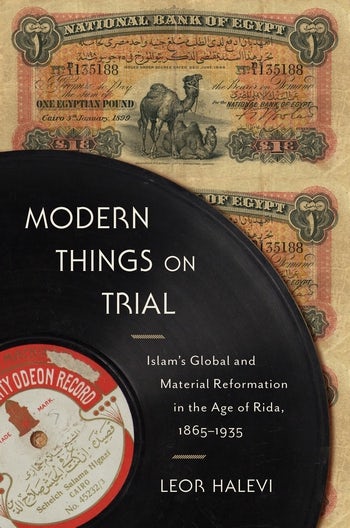
Via the New Books Network (New Books in Law), we have word of the publication of Modern Things on Trial: Islam’s Global and Material Reformation in the Age of Rida, 1865–1935 (Columbia University Press, 2019), by Leor Halevi (Vanderbilt University). A description from the press:
In cities awakening to global exchange under European imperial rule, Muslims encountered all sorts of strange and wonderful new things—synthetic toothbrushes, toilet paper, telegraphs, railways, gramophones, brimmed hats, tailored pants, and lottery tickets. The passage of these goods across cultural frontiers spurred passionate debates. Realizing that these goods were changing religious practices and values, proponents and critics wondered what to outlaw and what to permit.

In this book, Leor Halevi tells the story of the Islamic trials of technological and commercial innovations of the late nineteenth and early twentieth centuries. He focuses on the communications of an entrepreneurial Syrian interpreter of the shariʿa named Rashid Rida, who became a renowned reformer by responding to the demand for authoritative and authentic religious advice. Upon migrating to Egypt, Rida founded an Islamic magazine, The Lighthouse, which cultivated an educated, prosperous readership within and beyond the British Empire. To an audience eager to know if their scriptures sanctioned particular interactions with particular objects, he preached the message that by rediscovering Islam’s foundational spirit, the global community of Muslims would thrive and realize modernity’s religious and secular promises.

Through analysis of Rida’s international correspondence, Halevi argues that religious entanglements with new commodities and technologies were the driving forces behind local and global projects to reform the Islamic legal tradition. Shedding light on culture, commerce, and consumption in Cairo and other colonial cities, Modern Things on Trial is a groundbreaking account of Islam’s material transformation in a globalizing era.
A few blurbs:
Leor Halevi's original study offers important perspectives on turn of the twentieth-century Islamic reformist thought in the context of changing relations between law and material history. He matches up instructive readings in legal opinions delivered in Cairo by Rashid Rida with innovative background research on the new products and technologies that prompted questions to him from around the Muslim world. Brinkley Messick
This nuanced, meticulously researched, yet accessible study illuminates how significant early-twentieth-century debates on Islamic law often revolved around some surprisingly ordinary objects and how local anxieties and input shaped a reformist Islam with transregional appeal. Halevi's focus on the material dimensions of modern Islamic thought adds a very welcome and promising dimension to the scholarship in this field. Muhammad Qasim Zaman
More information is available here.

-- Karen Tani

Wednesday, October 30, 2019

Farahat on Islamic Jurisprudence

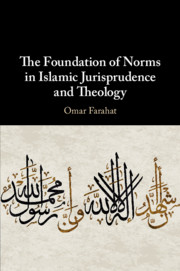
Omar Farahat, McGill University has published The Foundation of Norms in Islamic Jurisprudence and Theology with Cambridge University Press. From the publisher:
The Foundation of Norms in Islamic Jurisprudence and TheologyIn this book, Omar Farahat presents a new way of understanding the work of classical Islamic theologians and legal theorists who maintained that divine revelation is necessary for the knowledge of the norms and values of human actions. Through a reconstruction of classical Ashʿarī-Muʿtazilī debates on the nature and implications of divine speech, Farahat argues that the Ashʿarī attachment to revelation was not a purely traditionalist position. Rather, it was a rational philosophical commitment emerging from debates in epistemology and theology. He further argues that the particularity of this model makes its distinctive features helpful for contemporary scholars who defend a form of divine command theory. Farahat's volume thus constitutes a new reading of the issue of reason and revelation in Islam and breaks new ground in Islamic theology, law and ethics.
Further information is available here.

--Mitra Sharafi

Friday, October 18, 2019

Stephens' Governing Islam

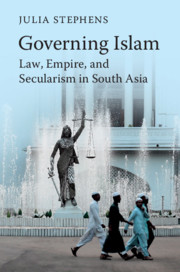
In 2018, Julia Stephens (Rutgers University) published Governing Islam: Law, Empire, and Secularism in Modern South Asia with Cambridge University Press. From the publisher: 
Governing IslamGoverning Islam traces the colonial roots of contemporary struggles between 
Islam and secularism in India, Pakistan, and Bangladesh. The book uncovers the paradoxical workings of colonial laws that promised to separate secular and religious spheres, but instead fostered their vexed entanglement. It shows how religious laws governing families became embroiled with secular laws governing markets, and how calls to protect religious liberties clashed with freedom of the press. By following these interactions, Stephens asks us to reconsider where law is and what it is. Her narrative weaves between state courts, Islamic fatwas on ritual performance, and intimate marital disputes to reveal how deeply law penetrates everyday life. In her hands, law also serves many masters - from British officials to Islamic jurists to aggrieved Muslim wives. The resulting study shows how the neglected field of Muslim law in South Asia is essential to understanding current crises in global secularism.
Praise for the book:
 "This book is nothing less than a landmark in its lucid, subtle, and persuasive arguments about the transformation of Islamic law in its encounter with colonial legal discourses and institutions. Basing herself on an archive of extraordinary breadth, Stephens revises old assumptions about Muslim law and about the consequences of colonial governance at every turn. This analysis of the past illuminates a present in urgent need of fresh understanding." -Barbara D. Metcalf
"Governing Islam is a masterful and compelling book that explores modern South Asia's Muslim legal history through ideas about religion, economy, gender, custom, colonialism, and socialism. Using primary sources in multiple languages, Julia Stephens reveals the many layers of law for Muslims. The result is simply superb - a fascinating portrait of vernacular, colonial, and post-colonial legal cultures, all intertwined and with plenty of intriguing twists." -Mitra Sharafi 

"A major work of scholarship that brings together the history of law, religion and family in British India to tell the story of South Asian secularism. Erudite and sophisticated in tone this is a much-needed monograph at a time when the idea of secular India faces its gravest threat." -Seema Alavi
Watch Prof. Stephens' 2015 interview on the book project on Yale's The MacMillan Report. 

Further information about the book is available here.

--posted by Mitra Sharafi

Thursday, October 17, 2019

Echevarria, Monferrer-Sala, Tolan and friends on law and religious minorities

We missed this one back in 2017: A. Echevarria (Universidad Nacional de Educación a Distancia, Madrid), J. P. Monferrer-Sala (Universidad de Córdoba), and J. V. Tolan (Université de Nantes) have co-edited Law and Religious Minorities in Medieval Societies: Between Theory and Praxis with Brepols Publishers. From the press:

This volume shows through the use of legal sources that law was used to try to erect boundaries between communities in order to regulate or restrict interaction between the faithful and the non-faithful; and at the same time shows how these boundaries were repeatedly transgressed and negotiated.
Muslim law developed a clear legal cadre for dhimmīs, inferior but protected non-Muslim communities (in particular Jews and Christians) and Roman Canon law decreed a similar status for Jewish and Muslim communities in Europe. Yet the theoretical hierarchies between faithful and infidel were constantly brought into question in the daily interactions between men and women of different faiths in streets, markets, bath-houses, law courts, etc. The twelve essays in this volume explore these tensions and attempts to resolve them. These contributions show that law was used to try to erect boundaries between communities in order to regulate or restrict interaction between the faithful and the non-faithful — and at the same time how these boundaries were repeatedly transgressed and negotiated.
Table of Contents after the jump:

Tuesday, October 1, 2019

Welcome, Fahad Bishara!

BisharaIn October 2019, Fahad Bishara, Assistant Professor of History at the University of Virginia will be guest blogging here. 

Prof. Bishara specializes in the economic and legal history of the Indian Ocean and Islamic world. His  book, A Sea of Debt: Law and Economic Life in the Western Indian Ocean, 1780-1950 (Cambridge University Press, 2017) is a legal history of economic life in the Western Indian Ocean, told through the story of the Arab and Indian settlement and commercialization of East Africa during the nineteenth century. It won the J. Willard Hurst Prize (awarded by the Law and Society Association), the Jerry Bentley prize (awarded by the World History Association), and the Peter Gonville Stein book award (given by the American Society for Legal History). 

Prof. Bishara is currently working on two projects. The first narrates 500 years of world history from the deck of an Indian Ocean dhow, and takes on issues of global capitalism, international law, empire, mobility, and scale in historical writing. The second explores the Indian Ocean trade in dates and uses it as a platform for examining the dynamics of a transregional bazaar economy in the 19th and early 20th centuries, but also sets that story against the backdrop of a longer connected history of the Gulf and Indian Ocean.

Welcome, Fahad Bishara!

--Mitra Sharafi

Thursday, August 15, 2019

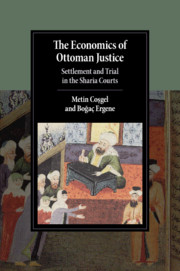
Coşgel and Ergene on Ottoman justice

We missed this one earlier, so here it is now: Metin CoşgelUniversity of Connecticut and Boğaç ErgeneUniversity of Vermont published The Economics of Ottoman Justice: Settlement and Trial in the Sharia Courts with Cambridge University Press in 2016. From the publisher: 
The Economics of Ottoman JusticeDuring the seventeenth and eighteenth centuries, the Ottoman Empire endured long periods of warfare, facing intense financial pressures and new international mercantile and monetary trends. The Empire also experienced major political-administrative restructuring and socioeconomic transformations. In the context of this tumultuous change, The Economics of Ottoman Justice examines Ottoman legal practices and the sharia court's operations to reflect on the judicial system and provincial relationships. Metin Coşgel and Boğaç Ergene provide a systematic depiction of socio-legal interactions, identifying how different social, economic, gender and religious groups used the court, how they settled their disputes, and which factors contributed to their success at trial. Using an economic approach, Coşgel and Ergene offer rare insights into the role of power differences in judicial interactions, and into the reproduction of communal hierarchies in court, and demonstrate how court use patterns changed over time.
Praise for the book: 

"Metin Coşgel and Boğaç Ergene have written a well-researched book that pushes the boundary of interdisciplinary scholarship. Their history is informed by economics, and their economics is generalized via history. It is an impressive and difficult methodology to pull off, yet Coşgel and Ergene have done just this." -Jared Rubin 


Further information is available here.


-posted by Mitra Sharafi

Tuesday, July 9, 2019

Siddiqui and friends on locating the Sharīʿa

Sohaira Siddiqui, Georgetown University Qatar has edited Locating the Sharīʿa: Legal Fluidity in Theory, History and Practice. Out with Brill earlier in 2019, it includes a number of chapters that take a historical approach. The book is vol.48 in the "Studies in Islamic Law and Society" series. From the press: 
Cover Locating the Sharīʿa
The study of the sharīʿa has enjoyed a renaissance in the last two decades and it will continue to attract interdisciplinary attention given the ongoing social, political and religious developments throughout the Muslim world. With such a variety of debates, and a corresponding multitude of theoretical methods, students and non-scholars are often overwhelmed by the complexity of the field. Even experts will often need to consult multiple sources to understand these new voices and provide accessible answers to specialist and non-specialist audiences alike. This volume is intended for both the novice and expert as a companion to understanding the evolution of the field of Islamic law, the current work that is shaping this field, and the new directions the sharīʿa will take in the twenty-first/fifteenth century. 
Contributors are Khaled Abou El Fadl, Asma Afsaruddin Ahmad Ahmad, Sarah Albrecht, Ovamir Anjum, Dale Correa, Robert Gleave, Sohail Hanif, Rami Koujah, Marion Katz, Asifa Quraishi-Landes, David Warren and Salman Younas.
Further information is available here.

--Mitra Sharafi