Showing posts with label trade. Show all posts

Tuesday, May 5, 2026

Claussen and Meyer on the Foreign Commerce Power

Kathleen Claussen, Georgetown Law, and Timothy Meyer, Duke Law, have published The Foreign Commerce Power in the California Law Review:

This Article is the first to scrutinize presidential trade authority under the Constitution. The Constitution grants the President no independent power to regulate foreign commerce. That conclusion, while apparent from a straightforward reading of Articles I and II, stands in stark contrast to executive conduct of U.S. trade policy in recent years. This Article traces the roots of this constitutional distortion to a confluence of doctrinal drift and academic oversight. Courts and commentators have increasingly relied on an expansive conception of executive power grounded in a perceived general foreign affairs authority. In doing so, they have blurred the line between diplomacy and commerce and used this confluence to justify unilateral economic actions by a “trader in chief” that circumvent the Constitution’s allocation of power. These matters have reached a tipping point over the last decade, prompting a series of high-profile cases in which the government has argued that this general foreign affairs power includes some portion of the foreign commerce power. To correct this misapprehension, this Article undertakes a novel examination of Founding-era materials, including the distribution of commercial authority between the king and parliament in eighteenth-century Britain, the correspondence and deliberations of the Framers, and the Founding Generation’s implementation of the commerce power in matters of national security during the early years of the Republic. These sources reveal a consistent and deliberate understanding both that Congress’s control over foreign commerce is exclusive and that Congress’s control over commerce trumps the President’s general foreign affairs powers when the two intersect. This Article further argues that this allocation was not accidental or ancillary but central to the constitutional design.

--Dan Ernst 

Tuesday, June 3, 2025

AHA Congressional Briefing on Tariffs

 [We have the following announcement.  DRE]

The American Historical Association invites you to attend a Congressional Briefing offering historical perspectives on tariffs. The briefing will take place on Wednesday, June 11, at 9:00 a.m. ET in Rayburn House Office Building Room 2075.

Panelists Douglas A. Irwin (Dartmouth Coll.), Sharon Ann Murphy (Providence Coll.), and Eric Rauchway (Univ. of California, Davis) will discuss how the government has implemented tariffs in the past, and how they have impacted the domestic and global economies. The AHA’s Alexandra Levy will moderate.

The event is open to the public; no registration is required. A breakfast spread and coffee will be served. If you have any questions, please email brosenbaum@historians.org .

The AHA’s Congressional Briefings series seeks to provide Congressional staff members, journalists, and other members of the policy community with the historical context essential to understanding contemporary issues. The sessions are strictly nonpartisan and avoid advancing particular policy prescriptions or legislative agendas. Recordings of our recent briefings providing historical perspectives are available on the AHA’s website.

Thursday, December 19, 2024

Powers's "Arbitrating Empire"

Allison Powers, University of Wisconsin-Madison, has published Arbitrating Empire: United States Expansion and the Transformation of International Law (Oxford University Press):

Arbitrating Empire offers a new history of the emergence of the United States as a global power-one shaped as much by attempts to insulate the US government from international legal scrutiny as it was by efforts to project influence across the globe. Drawing on extensive archival research in the United States, Mexico, Panama, and the United Kingdom, the book traces how thousands of dispossessed residents of US-annexed territories petitioned international Claims Commissions between the 1870s and the 1930s to charge the United States with violating international legal protections for life and property.

Through attention to the consequences of their unexpected claims, Allison Powers demonstrates how colonized subjects, refugees from slavery, and migrant workers transformed a series of tribunals designed to establish the legality of US imperial interventions into sites through which to challenge the legitimacy of US colonial governance. One of the first social histories of international law, the book argues that contests over meanings of sovereignty and state responsibility that would reshape the mid-twentieth-century international order were waged not only at diplomatic conferences, but also in Arizona copper mines, Texas cotton fields, Samoan port cities, Cuban sugar plantations, and the locks and stops of the Panama Canal.

Arbitrating Empire uncovers how ordinary people used international law to hold the United States accountable for state-sanctioned violence during the decades when the nation was first becoming a global empire-and demonstrates why State Department attempts to erase their claims transformed international law in ways that continue to shield the US government from liability to this day.
--Dan Ernst

Thursday, March 30, 2023

Roberts on Cordell Hull and the Income Tax

Tracey M. Roberts, Cumberland School of Law, Samford University, has posted A Man for His Era and for Ours: Cordell Hull, Father of the Federal Income Tax, which is forthcoming in the Cumberland Law Review:

Cordell Hull (and Spittoon), 1939 (LC)
An 1891 graduate of Cumberland School of Law, Cordell Hull served our country in countless ways. He worked as captain of the Fourth Regiment of the Tennessee Volunteer Infantry in the Spanish-American War, as judge for the fifth judicial circuit of Tennessee, as state representative in the Tennessee House of Representatives, as a member of the United States House of Representatives, as a member of the United States Senate, and as United States Secretary of State. President Franklin D. Roosevelt referred to him as the “Father of the United Nations.” Hull subsequently received the Nobel Peace Prize in 1945 in honor of his work to establish that body. Hull is less well known for his work to establish another important and enduring institution—the modern income tax. In his 1948 memoir, Hull wrote that he probably would not be able to render public service equal to his work in long fight for enactment of the income-tax system, even if he had two lifetimes. This essay explains why Hull regarded the federal income tax as among his chief contributions. First, it outlines Hull’s personal history, his experiences with his mentor—United States Representative Benton McMillin— Hull’s efforts leading up to the adoption and ratification of the Sixteenth Amendment, and the passage of the Revenue Act of 1913. Second, it discusses the historical, economic, and political context that motivated Hull to introduce the tax reform that not only sustained the United States through the two world wars that followed but made possible widespread economic prosperity in the twentieth century. Finally, it discusses the original impetus for reform, comparing the economic conditions from over 100 years ago to those prevailing today, and outlines what it would take to fulfill Hull’s vision and intentions for the federal tax system and the country in the present.
--Dan Ernst

Monday, January 2, 2023

Manucha's "Booze, Cigarettes, and Constitutional Dust-Ups"

The Toronto lawyer Ryan Manucha has published Booze, Cigarettes, and Constitutional Dust-Ups: Canada's Quest for Interprovincial Free Trade (McGill-Queen's University Press):

Gerard Comeau, a retiree living in rural New Brunswick, never thought his booze run would turn him into a Canadian hero. In 2012, after Comeau had driven to Quebec to purchase cheaper beer and crossed back into his home province, police officers participating in a low-stakes sting operation tailed and detained him, confiscated his haul, and levied a fine of less than $300.

Countries routinely engage in trade wars and erect barriers to protect domestic industries from foreign competition. Comeau, however, was detained by the full force of the law for engaging in commerce with a Canadian business on the other side of a domestic border. With Comeau’s story as its starting point, Booze, Cigarettes, and Constitutional Dust-Ups tells the fascinating tale of Canadian interprovincial trade. Ryan Manucha examines the historical, political, and legal forces that gave rise to the regulation of interprovincial commerce in Canada, the trade-offs that come with liberalized domestic free trade, and Canada’s enduring pursuit of economic union.
The book is reviewed here.

--Dan Ernst

Wednesday, December 21, 2022

CFP: Global Correspondent Banking 1870–2000

[We have the following announcement.   DRE]

The global payments system represents the underlying plumbing of globalisation, determining the efficiency and security of cross-border payments for goods and services. Despite its fundamental importance surprisingly little is known about the evolution of this system, especially the dynamics of the network of bilateral bank relationships used for cross-border settlements across the past 150 years.

The European Research Council funded "Global Correspondent Banking 1870–2000" project would like to invite proposals from researchers at all levels for a conference on the evolution of the global payments system during the 19th and 20th centuries. Topics may include, but are not limited to:

  • Correspondent banking, international banking networks and the development of the global payments system
  • The changing shape, patterns and dynamics of international banking networks, and the impact of financial crises, world events and regulatory changes
  • Banking technologies and the 'plumbing' of the international payments system, e.g. bills of exchange, ICT innovation
  • Bank internationalisation strategies

The conference will be held at St Hilda's College, Oxford University on Thursday 23rd and Friday 24th March 2023.

Submission details: Proposed titles and paper abstracts of c. 300 words, along with a short biography of the author, should be submitted to glocobank@history.ox.ac.uk by Monday 2 January 2023. Participants will be notified in early January if their proposal has been accepted.

Conference organisers: Professor Catherine R. Schenk; Dr Marco Molteni; Dr Alena Pivavarava | GloCoBank Project

About GloCoBank: "Global Correspondent Banking 1870–2000" (GloCoBank) is a 5-year research project funded by the European Research Council (ERC) which seeks to identify and analyse the international network of correspondent banking relationships across the 20th century.

Tuesday, October 1, 2019

Welcome, Fahad Bishara!

BisharaIn October 2019, Fahad Bishara, Assistant Professor of History at the University of Virginia will be guest blogging here. 

Prof. Bishara specializes in the economic and legal history of the Indian Ocean and Islamic world. His  book, A Sea of Debt: Law and Economic Life in the Western Indian Ocean, 1780-1950 (Cambridge University Press, 2017) is a legal history of economic life in the Western Indian Ocean, told through the story of the Arab and Indian settlement and commercialization of East Africa during the nineteenth century. It won the J. Willard Hurst Prize (awarded by the Law and Society Association), the Jerry Bentley prize (awarded by the World History Association), and the Peter Gonville Stein book award (given by the American Society for Legal History). 

Prof. Bishara is currently working on two projects. The first narrates 500 years of world history from the deck of an Indian Ocean dhow, and takes on issues of global capitalism, international law, empire, mobility, and scale in historical writing. The second explores the Indian Ocean trade in dates and uses it as a platform for examining the dynamics of a transregional bazaar economy in the 19th and early 20th centuries, but also sets that story against the backdrop of a longer connected history of the Gulf and Indian Ocean.

Welcome, Fahad Bishara!

--Mitra Sharafi

Thursday, October 4, 2018

Special Issue: Indian Ocean of Law

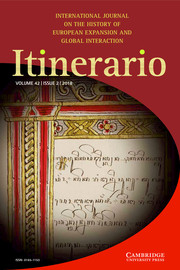
Itinerario Volume 42 - Special Issue2 -  The Indian Ocean of Law: Hybridity and SpaceItinerario's new special issue on "The Indian Ocean of Law: Hybridity and Space" is now out. Here is the table of contents for the journal, 42:2 (August 2018):

Introduction: 
  • Mahmood Koorie and Sanne Ravensbergen, "The Indian Ocean of Law: Hybridity and Space"
Articles: 
  • Fahad Ahmad Bishara, “Imagining Oceans of Law: Oman and East Africa, circa 1910”
  • Nathan Perl-Rosenthal, “On Mobile Legal Spaces and Maritime Empires: The Pillage of the East Indiaman Osterley (1779)”
  • Mahmood Kooria, “The Dutch Mogharaer, Arabic Muḥarrar, and Javanese Law Books: A VOC Experiment with Muslim Law in Java, 1747–1767″
  • Nadeera Rupesinghe, “Navigating Pluralities Reluctantly: The Marriage Contract in Dutch Galle”
  • Sanne Ravensbergen, “Anchors of Colonial Rule: Pluralistic Courts in Java, ca. 1803–1848”
  • Elizabeth Lhost, "Writing Law at the Edge of Empire: Evidence from the Qazis of Bharuch (1799-1864)"
  • Byapti Sur, “Individual Interests Behind the Institutional Façade: The Dutch East India Company’s Legal Presence in Seventeenth-Century Mughal Bengal”
Further information is available here.

(H/t: Elizabeth Lhost's Law, Religion, History)

Friday, August 3, 2018

Pihlajamäki and friends on the history of commercial law

Heikki Pihlajamäki (University of Helsinki), Albrecht Cordes (Goethe University Frankfurt am Main),Serge Dauchy (CNRS Lille-France, University of Saint-Louis in Brussels), and Dave De ruysscher (Tilburg University, Vrije Universiteit Brussels) have co-edited Understanding the Sources of Early Modern and Modern Commercial Law published by Brill. From the press:
Understanding the Sources of Early Modern and Modern Commercial LawThe contributions of Understanding the Sources of Early Modern and Modern Commercial Law: Courts, Statutes, Contracts, and Legal Scholarship show the wealth of sources which historians of commercial law use to approach their subject. Depending on the subject, historical research on mercantile law must be ready to open up to different approaches and sources in a truly imaginative and interdisciplinary way. This, more than many other branches of law, has always been largely non-state law. Normative, "official," sources are important in commercial law as well, but other sources are often needed to complement them. The articles of the volume present an excellent assemblage of those sources. 
 Contents after the break:

1 Introduction
  Heikki Pihlajamäki, Albrecht Cordes, Serge Dauchy and Dave De ruysscher

2 Mercantile Conflict Resolution in Practice: Connecting Legal and Diplomatic Sources from Danzig c. 1460–1580
  Justyna Wubs-Mrozewicz

3 Justitia in Commerciis: Public Governance and Commercial Litigation before the Great Council of Mechlin in the Late Fifteenth and Early Sixteenth Century
  Alain Wijffels

4 Honore et utile: The Approaches and Practice of Sixteenth-century Genoese Merchant Custom
  Ricardo Galliano Court

5 The Abandonment to the Insurers in Sixteenth-century Insurance Practice: Comparative Remarks and (A Few) Methodological Notes
  Guido Rossi

6 Historiographical Opportunities of Notarized Partnership Agreements Recorded in the Early Modern Low Countries
  Bram Van Hofstraeten

7 How Normative were Merchant Guidebooks? Of Customs, Practices, and … Good Advice (Antwerp, Sixteenth Century)
  Dave De ruysscher

8 Sources of Commercial Law in the Dutch Republic and Kingdom
  Boudewijn Sirks

9 The Files and Exhibits of the Imperial Chamber Court and Aulic Council as Sources of Commercial Law
  Anja Amend-Traut

10 Legal, Moral-Theological, and Genuinely Economic Opinions on Questions of Trade and Economy in Fifteenth- and Early Sixteenth-century Germany
  Eberhard Isenmann

11 The Birth of Commercial Law in Early Modern Sweden: Sources and Historiography
  Heikki Pihlajamäki

12 Svea Court of Appeal Records as a Source of Commercial Law: The Founding Year of 1614
  Mia Korpiola

13 Tracing the Speculation Bubble of 1799 in Newspapers, Court Records, and Other Sources
  Margrit Schulte Beerbühl

14 The Rise of Usages in French Commercial Law and Jurisprudence (Seventeenth-Nineteenth Centuries): Some Examples
  Edouard Richard

15 On the Origins of the French Commercial Code: Vicissitudes of the Gorneau Draft
  Olivier Descamps

16 Court Records as Sources for the History of Commercial Law: The Oberappellationsgericht Lübeck as a Commercial Court (1820–1879)
  Peter Oestmann

Further information is available here.

Saturday, July 28, 2018

Weekend Roundup

  • Greg Taylor, University of Adelaide School of Law, has posted The Grand Jury of New Zealand, which appeared in LAWTALK 919 (July 2018): “Little is remembered of the grand jury of New Zealand nowadays, but it existed within living memory – after 118 years of operation starting in 1844, the last grand jury sat in Gisborne on 28 November 1961. As late as July 1961 a grand jury in Hamilton refused to permit a prosecution against an electricity worker for failing to provide the necessary safety equipment and thereby causing the death of a worker.”
  • From "Talking Points Memo": Gregory Downs (UC Davis) on the 150-year history of today's voter suppression tactics.
Weekend Roundup is a weekly feature compiled by all the Legal History bloggers.

Friday, June 15, 2018

Thai on China's war on smuggling

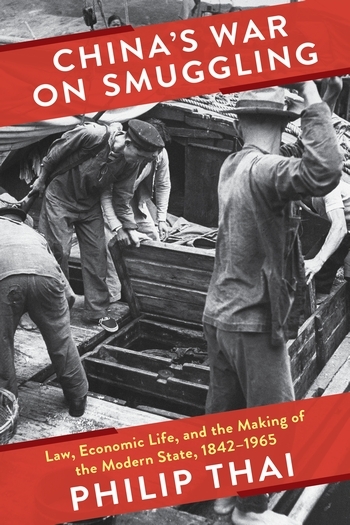
Philip Thai, Northeastern University, has published China's War on Smuggling: Law, Economic Life, and the Making of the Modern State, 1842-1965 with Columbia University Press. From the publisher:
China's War on SmugglingSmuggling along the Chinese coast has been a thorn in the side of many regimes. From opium and weapons concealed aboard foreign steamships in the Qing dynasty to nylon stockings and wristwatches trafficked in the People’s Republic, contests between state and smuggler have exerted a surprising but crucial influence on the political economy of modern China. Seeking to consolidate domestic authority and confront foreign challenges, states introduced tighter regulations, higher taxes, and harsher enforcement. These interventions sparked widespread defiance, triggering further coercive measures. Smuggling simultaneously threatened the state’s power while inviting repression that strengthened its authority.
Philip Thai chronicles the vicissitudes of smuggling in modern China—its practice, suppression, and significance—to demonstrate the intimate link between illicit coastal trade and the amplification of state power. China’s War on Smuggling shows that the fight against smuggling was not a simple law enforcement problem but rather an impetus to centralize authority and expand economic controls. The smuggling epidemic gave Chinese states pretext to define legal and illegal behavior, and the resulting constraints on consumption and movement remade everyday life for individuals, merchants, and communities. Drawing from varied sources such as legal cases, customs records, and popular press reports and including diverse perspectives from political leaders, frontline enforcers, organized traffickers, and petty runners, Thai uncovers how different regimes policed maritime trade and the unintended consequences their campaigns unleashed. China’s War on Smuggling traces how defiance and repression redefined state power, offering new insights into modern Chinese social, legal, and economic history.
Praise for the book:

"Philip Thai skillfully explores how smuggling remade the Chinese state by enabling it to establish better protection of its borders and its revenues and by standardizing regulations; he also examines the ways that political and economic disruptions constantly challenged this process. Thai weaves together a creative combination of social, political, economic, and legal history, ranging from a sophisticated technical discussion of tariff autonomy to a clever explication of the visual representation of smuggling in the public imagination of 1930s China. The combination of a broad theme—illicit economic activities interacting with state power—with many smaller case studies of smuggling incidents brings the story alive." -Elisabeth Köll

"Breaking chronological and geographic conventions, this important book places Nationalist-period state-building and the struggle for sovereignty in a framework of the long-term growth of infrastructural state power in China. By linking the rise of policing, legal regulation of production and consumption, and government intrusion in the economy with the operation of markets and economic life, Philip Thai accomplishes the remarkable feat of a fresh perspective on China from the bottom to top." -Brett Sheehan

Further information is available here.

Tuesday, March 6, 2018

Davis on Commercial Law in Medieval India

Donald R. Davis, University of Texas at Austin, has published The Dharma of Business: Commercial Law in Medieval India with Penguin. From the press:
The Dharma of BusinessBusiness law in medieval and early modern India developed within the voluminous and multifaceted texts called the Dharmashastras. These texts laid down rules for merchants, traders, guilds, farmers, and individuals in terms of the complex religious, legal, and moral ideal of dharma. This exciting book provides a new perspective on commercial law in this period. In addition to a description of the substantive rules for business, the book reinterprets the role of business and commerce within the law generally and demonstrates that modern assumptions about good business practice could benefit from the insights of this ancient tradition. It thus makes a compelling case for the relevance of the dharma of business to our own time.
 Here's the Table of Contents:
  • 1: How to Read a Dharmasastra
  • 2: Business Law in Context
  • 3: Relationships as the Foundation of Commerce
  • 4: Why Government is Necessary for Business
  • 5. Virtue in Business
Further information is available here.

Friday, November 3, 2017

Chatterjee on women, monks, and coverture

In 2016, Indrani Chatterjee, University of Texas at Austin, published "Women, Monastic Commerce, and Coverture in Eastern India circa 1600-1800 CE" in Modern Asian Studies 50:1, 175-2016. Here's the abstract:
This article argues that economic histories of the transition to colonial economics
in the eighteenth century have overlooked the infrastructural investments that
wives and widows made in networks of monastic commerce. Illustrative examples
from late eighteenth-century records suggest that these networks competed with
the commercial networks operated by private traders serving the English East
India Company at the end of the eighteenth century. The latter prevailed. The
results were the establishment of coverture and wardship laws interpellated
from British common law courts into Company revenue policies, the demolition
of buildings. and the relocation of the markets that were attached to many of
the buildings women had sponsored. Together, these historical processes made
women’s commercial presence invisible to future scholars.

Monday, March 27, 2017

Bishara on Debt in the Indian Ocean

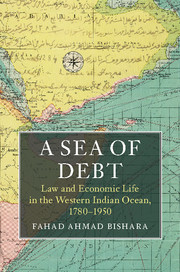
Out this month with Cambridge University Press is A Sea of Debt: Law and Economic Life in the Western Indian Ocean, 1780-1950 by Fahad Bishara, University of Virginia. From the press:

A Sea of DebtIn this innovative legal history of economic life in the Western Indian Ocean, Bishara examines the transformations of Islamic law and Islamicate commercial practices during the emergence of modern capitalism in the region. In this time of expanding commercial activity, a mélange of Arab, Indian, Swahili and Baloch merchants, planters, jurists, judges, soldiers and seamen forged the frontiers of a shared world. The interlinked worlds of trade and politics that these actors created, the shared commercial grammars and institutions that they developed and the spatial and socio-economic mobilities they engaged in endured until at least the middle of the twentieth century. This major study examines the Indian Ocean from Oman to India and East Africa over an extended period of time, drawing together the histories of commerce, law and empire in a sophisticated, original and richly textured history of capitalism in the Islamic world.

Here is the Table of Contents:
Prologue 
1. Life and debt 
2. Inscribing obligation 
3. Paper routes 
Interlude 
4. Translating transactions 
5. Making Africa Indian 
6. Muslim mortgages 
7. Capital moves 
8. Unravelling obligation 
Epilogue

Full information is available here.