Showing posts with label maritime history. Show all posts

Tuesday, September 16, 2025

Arlyck's "Nation at Sea"

My Georgetown Law colleague Kevin Arlyck has published The Nation at Sea: The Federal Courts and American Sovereignty, 1789–1825 (Cambridge University Press).  It appears in the series Studies in Legal History, sponsored by the American Society for Legal History.

The Nation at Sea tells a new story about the federal judiciary, and about the early United States itself.  Most accounts of the nation's transformation from infant republic to world power ignore the courts. Their importance, if any, was limited to domestic politics. But the truth is that, in the critical decades following the Constitution's ratification, federal judges decided thousands of maritime cases that profoundly shaped the United States' relations with foreign nations. Judges ruled on the legality of naval captures made by European powers, regulated the conduct of American merchants, and tried pirates and slave traders who sought profit amid the turmoil of transatlantic war. Kevin Arlyck's vivid reconstruction of this forgotten history reveals how, over time, the federal courts helped realize an increasingly bold conception of American sovereignty, one that vindicated the Declaration of Independence's claim to the United States' place 'among the powers of the earth.'

Here are some endorsements:

‘In The Nation at Sea, Kevin Arlyck expertly bridges two significant but often detached areas of scholarship: the early history of the federal courts, a topic typically treated as ‘domestic,’ and the international struggles of the United States in the early national period. The intersection of these topics is of pressing interest to lawyers, judges, legal scholars, and historians, especially given the current prominence of originalist methods of legal interpretation.’
Alison LaCroix - Robert Newton Reid Professor of Law, University of Chicago Law School and author of The Interbellum Constitution: Union, Commerce, and Slavery in the Age of Federalisms
‘In the first 40 years after the Constitution was ratified, much of the business of the federal courts consisted of maritime disputes with international dimensions. These disputes made judges central to U.S. foreign relations in ways that are scarcely imaginable today. Arlyck’s compelling and important study is the first major treatment of how federal judges took up this international role and with what consequences.’

Nicholas R. Parrillo - Townsend Professor of Law, Yale Law School and author of Against the Profit Motive: The Salary Revolution in American Government, 1780–1940
  
A Nation at Sea argues persuasively that America’s high courts negotiated international conflicts at a crucial period after the founding when the United States needed to establish credibility and assert neutrality in the midst of dangerous conflicts between powerful empires. Arlyck also demonstrates that Supreme Court justices failed to uphold American restrictions on the slave trade after 1808, even though they could have done so through extension of legal doctrines of their own maritime decisions.’
Holly Brewer - Burke Chair of American Cultural and Intellectual History, University of Maryland and author of By Birth or Consent: Children, Law, and the Anglo-American Revolution in Authority

--Dan Ernst 

Friday, November 1, 2024

P&P Special Issue: Ordering the Oceans

Past & Present has published a supplemental issue, Ordering the Oceans, Ordering the World: Law, Violence, and European Empires, edited by Jeppe Mulich and Renaud Morieux:

Once the primary domain of naval and social historians, the field of maritime and oceanic history has become in the last decade part of larger and ongoing conversations in the historical discipline. Rather than simply riding the wave of global and transnational history, maritime and oceanic history has been contributing decisively to the recent inflexions of these fields. It has brought attention to issues of disconnection, power asymmetry, frictions, and material and environmental factors. It has questioned the capacity of European empires to control distant spaces, by focusing on legal geography and zones of blurred sovereignty, and by foregrounding the experience of non-European people. It has offered new methods, reflecting critically on how to combine scales of analysis and challenge inherited framings. What all these approaches share is a concern with the relationship between global processes and issues of governance.

Oceanic history is a particularly good laboratory in which to think about order-making in a global context. Many oceanic histories now share the premise that the oceans were governed and not lawless spaces. Yet many authors still focus, on the one hand, on governance and regulatory frameworks, and on the other, on forms of resistance. The concept of ‘ordering’ enables historians to bypass a dichotomy that is, in many ways, unsatisfactory. Focusing on oceans allows us to explore the unstable nature of any order in a more dynamic way than would be possible if confined only to studying the land. The processes taking place on and around the oceans were not always distinct from those on land — but they were often heightened, more experimental and in some cases pre-dated their terrestrial counterparts. Oceans rarely feature in classic accounts of the emergence of the modern state and international order, tied as these are to notions of territorialization and centralization. Focusing on oceans and oceanic contact zones underlines that the structural changes that took place between the seventeenth and the nineteenth centuries, with respect to state formation, empires, global trade and migrations, were inherently the product of inter-imperial and interpolitical dynamics. Furthermore, a focus on the water margins and the polyglot peoples inhabiting them shows how much these changes were shaped from below and from the peripheries. State and social transformation was caused as much by actions at the margin of empires as it was by policies coming from their centres.

 --Dan Ernst.  H/t: KR

Monday, June 3, 2024

Brinkman on "Sea Power, Neutrality, and Prize Law in the Seven Years' War"

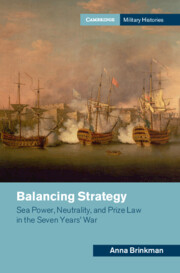
Cambridge University Press has published Balancing Strategy: Sea Power, Neutrality, and Prize Law in the Seven Years' War (2024), by Anna Brinkman (King's College London). A description from the press:


What is the relationship between seapower, law, and strategy? Anna Brinkman uses in-depth analysis of cases brought before the Court of Prize Appeal during the Seven Years' War to explore how Britain worked to shape maritime international law to its strategic advantage. Within the court, government officials and naval and legal minds came together to shape legal decisions from the perspectives of both legal philosophy and maritime strategic aims. As a result, neutrality and the negotiation of rights became critical to maritime warfare. Balancing Strategy unpicks a complex web of competing priorities: deals struck with the Dutch Republic and Spain; imperial rivalry; mercantilism; colonial trade; and the relationships between metropoles and colonies, trade, and the navy. Ultimately, influencing and shaping international law of the sea allows a nation to create the norms and rules that constrain or enable the use of seapower during war.

Praise from reviewers:

'This is imperial, military, legal and maritime history at its scrupulous and creative best, at once both micro- and macro-historical. Through a detailed reconstruction of four cases coming before Britain's Court of Prize Appeal and concerning two Dutch and two Spanish vessels captured during the Seven Years War, Anna Brinkman convincingly reveals for the first time the overarching strategic role that the court played in balancing domestic and international law to keep the Dutch Republic and Spain neutral during the global conflict. Particularly nuanced - and wholly unique in prize history - is her attention to the human dimension of legal process: the myriad of people, personalities, ties, interests, and environments that destabilized or undergirded neutrality. A triumph of insight and scholarship.' -- David Hancock

'Balancing Strategy opens a window into the complex interplay of law, empire, seapower, and strategy. Through meticulous and well-documented case studies that incorporate legal records, private political accounts, and the popular press, Brinkman offers new insight into how Britain sought legitimacy for its increasing projection of power on the global stage.' -- Sarah Kinkel

An interview with Brinkman is available here, at New Books Network.

-- Karen Tani

Tuesday, December 26, 2023

Simon, "The Pirates' Code: Laws and Life Aboard Ship"

Reaktion Press has published The Pirates' Code: Laws and Life Aboard Ship, by Rebecca Simon (Santa Monica College). A description from the Press:

Pirates have long captured the imagination with images of cutlass-wielding swashbucklers, eye patches and buried treasure. But what was life really like on a pirate ship? Piracy was a risky, sometimes deadly occupation, and strict orders were essential for everyone’s survival. These ‘Laws’ were sets of rules that determined everything from how much each pirate earned from their plunder to compensation for injuries, punishments and even the entertainment allowed on ships. These rules became known as the ‘Pirates’ Code’, which all pirates had to publicly swear by.
Using primary sources such as eyewitness accounts, trial proceedings and maritime logs, this book explains how these codes were the key to pirates’ success in battle, both on sea and on land.

A sample of advance praise:

"A comprehensive and highly engaging study of the operations and everyday life at sea on pirate ships in the "Golden Age" of piracy. Using a wide range of archival material, Rebecca Simon has produced a meticulous examination of how pirate crews used "articles" to organise their ships and lives. An in-depth exploration of not only the most notorious pirates and their lesser-known brethren, but every aspect of pirate life from the motivations of men to turn to piracy, to how they shared out plunder and food, to discipline and health care for injured pirates. The Pirates' Code is a pleasure to read." -- Elaine Murphy

More information is available here. An interview with the author is available here, at New Books Network.

-- Karen Tani

Tuesday, October 24, 2023

Congress Investigates the Titanic

The Carl Levin Center for Oversight and Democracy at the Wayne State University Law School, in collaboration with the U.S. Capitol Historical Society, has released its latest Portrait in Oversight.  It is devoted to Congressional hearings in 1912 on the sinking of the Titanic, which led to such reforms as the International Convention for the Safety of Life at Sea and the International Ice Patrol. 

--Dan Ernst

Tuesday, September 22, 2020

Reclamation

One thing peculiar about land is that we are predisposed to encounter it as if it was always there, seemingly naturalized from the outset without a beginning. Because histories are built upon land, its own history is obscured by later infrastructure, quickly escalating the complexity of the territory. My current book project tentatively titled Overflow - History of Land Reclamation in the British Empire focuses on the history of seaward land reclamation which entails the formation of artificial land surfaces that extend outwards over the sea using advanced geo-engineering techniques. I was motivated by the avid land reclamation that occurred in Singapore which increased in land size by 23% from 587 square kilometers in 1974 to 725 square kilometers today (slightly larger than DC metropolitan area). 

Intensive land reclamation transformed coastal areas from the late nineteenth century. Colonial governments were initially drawn to the supposed lack of ambiguity concerning the status of reclaimed land - there was little possibility of indigenous inhabitants or prior landowners of reclaimed territory so authorities were theoretically free to plan without any resistance. A territorial blank slate was the ultimate goal of colonial officials after all. But the prohibitive costs of land reclamation projects make it a last resort in expanding territory. While local colonial governments eagerly embarked on such projects, higher authorities within the imperial hierarchy based in London often asked “Is this really necessary? and “could something else be done instead?” to ensure that cheaper options were explored first. Land reclamation efforts were extremely expensive, and often completely debt-financed and thus formed risky undertakings involving huge volumes of sand, specialized equipment and vehicles, costly research into the suitability of soil and sand with its particular characteristics, labour, logistical coordination, and resettlement of people who lived in areas adjacent to reclamation sites. In Hong Kong, private enterprise was historically powerful and initiated reclamation projects. Armenian businessman Catchick Paul Chater founded property developer company Hong Kong Land which reclaimed 59 acres of land in the colony between 1889 and 1903 for example. The interests of long-established dock companies such as Butterfield and Swire, and Jardine and Matheson were aligned with that of the colonial government in the late nineteenth century although they drifted apart in the first half of the twentieth century. While businesses entrenched themselves in the area of the port, successive government administrations sometimes differed greatly from their predecessors to the extent of breaking ranks with previous policies. In addition, while the cost of reclamation was relatively low during the early years since landfill was made up of rock and soil found in abundance near sites, it became progressively expensive because fills are not easily available anymore and the sea to be reclaimed was deeper. The Admiralty too weighed in, anxious about encroachment to existing dockyard facilities. 

As land reclamation became popular throughout Empire, the coastal feature known as the foreshore which is neither wet nor always dry due to the ebb and flow of the incoming tide gained prominence. As a buffer zone, the foreshore was valuable because it provided entry to the sea. From 1830s onwards, the British government granted ownership rights to foreshores in parts of the British Isles opening them up further to construction and development but these rights were suspended in Empire. Historically, denizens of undeveloped waterfronts had survived and thrived on it because they occupied cheap land. Increasingly from the late nineteenth century onwards, the foreshore became more prized throughout Empire as a gateway to land reclamation which brought a new enemy on the horizon for residents in coastal regions - coastal development. Even when they were compensated by government authorities, rising land prices post-reclamation meant that they were unable to buy their own property back in order to live there again. Something about control over watery spaces, a relatively new form of domination, resists risk assessment necessary for compensation requests. This “hydroborder,” to borrow Isabel Hofmeyr’s term, “where the ‘normal’ anxieties of the boundary were exacerbated by ecological uncertainty” serves as the fulcrum for change.


Hofmeyr, Isabel. “Provisional Notes on Hydrocolonialism.” English Language Notes. 57, 1 (April 2019): 11-20.

--Nurfadzilah Yahaya

Tuesday, October 1, 2019

Welcome, Fahad Bishara!

BisharaIn October 2019, Fahad Bishara, Assistant Professor of History at the University of Virginia will be guest blogging here. 

Prof. Bishara specializes in the economic and legal history of the Indian Ocean and Islamic world. His  book, A Sea of Debt: Law and Economic Life in the Western Indian Ocean, 1780-1950 (Cambridge University Press, 2017) is a legal history of economic life in the Western Indian Ocean, told through the story of the Arab and Indian settlement and commercialization of East Africa during the nineteenth century. It won the J. Willard Hurst Prize (awarded by the Law and Society Association), the Jerry Bentley prize (awarded by the World History Association), and the Peter Gonville Stein book award (given by the American Society for Legal History). 

Prof. Bishara is currently working on two projects. The first narrates 500 years of world history from the deck of an Indian Ocean dhow, and takes on issues of global capitalism, international law, empire, mobility, and scale in historical writing. The second explores the Indian Ocean trade in dates and uses it as a platform for examining the dynamics of a transregional bazaar economy in the 19th and early 20th centuries, but also sets that story against the backdrop of a longer connected history of the Gulf and Indian Ocean.

Welcome, Fahad Bishara!

--Mitra Sharafi