Showing posts with label legislation. Show all posts

Thursday, August 27, 2026

Bruhl on Legislative Interpretive Directives

Aaron-Andrew P. Bruhl, William & Mary Law School, has posted The Forgotten History of Legislative Interpretive Directives, which is forthcoming in the Texas Law Review:

This Article addresses an overlooked aspect of the history of legal interpretation: the early emergence of "legislative interpretive directives," enactments in which legislatures instruct courts on the rules for interpreting statutes. Although some modern courts and commentators treat such directives as constitutionally suspect, it is the objection to legislative directives that is new, not the directives themselves. As far back as the early republic, and with increasing frequency in the nineteenth-century age of codification, state legislatures enacted interpretive directives that changed the judicially developed rules. And courts applied those instructions without suggesting that they violated separation-of-powers principles. Early treatise writers sometimes raised pragmatic concerns about the directives' usefulness, concerns that originated in English decisions, but the commentators did not raise constitutional objections. 

This Article reconstructs the long tradition of legislative interpretive directives and chronicles the slow emergence, in the twentieth century, of constitutional doubts about legislative authority to guide statutory interpretation. By recovering the forgotten past of interpretive directives, the Article presents an alternative vision of the division of authority over interpretation. It also provides resources for state courts that want to understand their own constitutional histories. And by tracing the intellectual history of how early receptivity to legislative involvement turned into skepticism, the project contributes to the literature on the rise of judicial power. 

--Dan Ernst 

Monday, August 10, 2026

Yeargain on State Constitutional Checks on McCarthy-Era Investigations

Quinn Yeargain, Michigan State University College of Law, has published “Anti-McCarthyism and the Right to ‘Fair and Just Treatment’ in State Constitutions” in the Kansas Law Review 74 (April 2026): 611-653.  From the introduction:

In two states . . . McCarthy-era concerns about abuses of power by executive branch agencies and legislative committees alike prompted constitutional responses. In Alaska's constitution, which was ratified in 1956 and came into effect in 1959, delegates adopted a Fourteenth Amendment-style due process guarantee, but added onto it another sentence: "The right of all persons to fair and just treatment in the course of legislative and executive investigations shall not be infringed."  . . .  Less than a decade later, at the 1961-62 Michigan constitutional convention, delegates proposed a new constitution with a nearly identical provision, which voters ratified. . . . 

In this Article, I situate these rights in the broader historical context of the Second Red Scare and state constitutional responses to it, lay out the processes by which the right to "fair and just treatment" were adopted, and argue that their reach has been improperly limited by cramped judicial interpretations. I begin in Section II by exploring the extent to which state constitutions incorporated the tactics and approaches used in the Second Red Scare, focusing specifically on the adoption of disqualification and loyalty oaths, as well as efforts to constitutionalize criminal prohibitions of "subversion."

Then, in Section III, I analyze the proposal and adoption of the right to "fair and just treatment." Relying on constitutional convention records from Alaska and Michigan, both of which include verbatim transcripts and detailed committee reports, I synthesize the debates surrounding these provisions. While the right was not successfully incorporated into any other state or territorial constitution, I discuss the efforts in Guam and Maryland to include such a right in their failed constitutions, as well as other (and more successful) efforts to constitutionalize more limited responses to McCarthy-esque abuses. Finally, in Section IV, I summarize the caselaw from Alaska and Michigan interpreting and applying these rights. While neither state has seen many published opinions from their supreme courts that lay out the right's ambit, the opinions that do exist--often unpublished, nonprecedential opinions from intermediate appellate courts--illustrate the conservative response by the judiciary to this protection. I then argue that these interpretations are unnecessarily limited, and cabin both the text and available historical evidence to avoid the potentially far-reaching implications of these rights.

--Dan Ernst 

Saturday, July 4, 2026

Weekend Roundup

  • Rosa Goluboff and G. Edward White reflect on the enduring legacy of the Declaration of Independence (Virginia Law). 
  • William Novak reflects on Polan Fellowship and the Future of Democracy (Michigan Law).  
  • Legal historian Jennifer Mnookin is now president of Columbia University (NYT). 
  •  For Most of Its History, the Supreme Court Didn’t Pretend to Be Apolitical: a preview of Rachel Shelden's forthcoming The Political Supreme Court: A Forgotten History (TPM).
  • The Max Planck Institute for Legal History and Legal Theory is expanding its collaboration with India through the launch of the Centre for Legal History of India, in cooperation with the National Law School of India University in Bangalore and the NALSAR University of Law in Hyderabad. 

  • The July newsletter of the Historical Society of the District of Columbia Circuit is here.  It includes a report of the Society's recent panel on U.S. v. Lewis “Scooter” Libby.
  • From the Touro Law Review: a podcast episode featuring David S. Reynolds, interviewed by Rodger Citron, on Reynolds's recent book The Two Ships That Shaped America: The Mayflower, the White Lion, and the History of the Nation.  

Weekend Roundup is a weekly feature compiled by all the Legal History bloggers. 

Friday, May 8, 2026

Zhang on Statutory Interpretation and the Constitution

Alexander Zhang, University of Texas School of Law, has posted Directly Constitutional Statutory Interpretation, which is forthcoming in the NYU Law Review:

The last half century of American statutory interpretation theory grew out of a U.S. Constitution that never prescribes how to read statutes. This has compelled the mistaken conclusion that constitutional law can have little to say about two of the most fundamental questions in statutory interpretation: whether courts should be able to treat interpretive methods as binding precedents, and whether interpretive methods need to reflect the customs and beliefs of “the people” to be democratically legitimate. But while the U.S. Constitution never directly prescribes how to read statutes, astoundingly twelve state constitutions do. Those state constitutions contain what I call “directly interpretive constitutional provisions”—constitutional provisions that on their own terms supply a mandatory method of statutory interpretation.

In this Article, I gather these overlooked and under-theorized provisions together for the first time, present original historical case studies on the surprising reasons they came into being, and offer the first sustained analysis of how they have been used in practice. In uncovering this neglected category of statutory interpretation law, this Article demonstrates how two critical assumptions of existing statutory interpretation theories derived from the U.S. Constitution—that interpretive methods are justifiable on democratic grounds merely if they reflect a proper balance of power between government institutions, and that only weak and sub-constitutional sources of law are available to ground interpretive methodology as binding precedent—are poor fits for state-level statutory interpretation. By developing an alternative account of a directly democratic and constitutional foundation at the state level, this Article both introduces a new framework for understanding state statutory interpretation on its own terms and provides a counterpoint against which we can measure the relative democratic legitimacy and legality of federal statutory interpretation methodology.

Most fundamentally, this Article contends that in most states the democratic and constitutional bases of statutory interpretation methods ultimately rest not on the institutional dialogue among courts, legislatures, and executives (as may be the case with federal constitutional law), but instead on popular sovereignty—on the public’s ongoing formal participation through elections in directly approving, disapproving, or deferring to government on those methods. As this Article further argues, people have exercised their sovereignty in limited yet surprising ways that reveal what I call a “democratic division of interpretive labor”—a formally legitimized allocation of statutory interpretation functions between government and civil society.

These insights lend themselves to three practical upshots. First, state constitutions’ distinctive commitments to popular sovereignty and to limiting legislative plenary power provide new grounds for why statutory interpretation methodology should differ between the state and federal levels; meanwhile, the fact that only some states allow citizens to unilaterally amend their constitutions provides a new reason why statutory interpretation methodology should differ from state to state. Second, courts applying these constitutional provisions should not treat the required methods as if they obeyed the same rules as judge-made canons of interpretation. Finally, the political infeasibility of constitutionally overriding a given interpretive method should be a factor against judicial entrenchment of that method as precedent.

--Dan Ernst 

Thursday, March 12, 2026

The Decline of Congress: An ICH Seminar

US Capitol (NYPL)
The New York Historical’s Bonnie and Richard Reiss Graduate Institute for Constitutional History has announced its spring seminar, “The Decline of Congress in American Politics and Law.”  The instructors are K.C. Johnson, professor of history at Brooklyn College and the CUNY Graduate Center, and Kevin J. McMahon, the John R. Reitemeyer Professor of Political Science at Trinity College. The seminar be conducted in person at The New York Historical, 170 Central Park West, New York, NY 10024, on Fridays, May 1, 8, 15, and 29, 2026, from 2 to 5 pm ET.  Although in-person attendance is encouraged, “livestream participation will be offered to admitted students who do not live in the New York Metropolitan Area or who are unable to attend a class in person.”  The deadline for applying is April 10, 2026.  

The ICH seminar is convened twice yearly and is designed for “graduate students, junior faculty, and other educators, in history, political science, law, and related disciplines.” There is no tuition. More information about the seminar and how to apply is here.

[A disambiguation note: The Institute for Constitutional History at the New York Historical ought not to be confused with the Institute for Constitutional Studies at GW Law, directed by Maeva Marcus.]

--Dan Ernst

Friday, January 23, 2026

Burset on the Origins of Statutory Stare Decisis

Christian R. Burset, Notre Dame Law School, has posted The Origins of Statutory Stare Decisis:

Federal courts apply stare decisis with extra force to decisions that interpret statutes. Critics contend that this “supercharged” deference to statutory precedents lacks a legitimate pedigree. But that charge rests on conjecture, since scholars have paid little attention to how English courts historically handled such cases. This Article responds with a new history of statutory stare decisis. For much of the seventeenth and eighteenth centuries, it argues, common lawyers endorsed the maxim communis error facit ius—common error makes law. That maxim counseled against overturning a course of decisions merely because they had interpreted a statute erroneously. Indeed, as one leading judge remarked, “A series of precedents against the plain words of an act of Parliament have made a law.” Starting in the 1760s, however, several factors—better legislative drafting, partisan conflict over jurisprudence, and high-profile treason trials—led some lawyers, but not all, to reject communis error when it came to statutes. The result: By the 1790s, English law contained two rival approaches to statutory precedent—a classical paradigm, which effectively allowed a course of precedent to amend a statute; and a revisionist alternative, which held that precedent could clarify but not alter a statute’s meaning. Americans inherited that conflict, which endured well into the nineteenth century. This history offers a new perspective on statutory stare decisis today. It also suggests a further question: If some early Americans thought precedent could reshape legislation, what did that mean for erroneous constitutional precedents?

--Dan Ernst 

Wednesday, October 8, 2025

Novak on Legislation, Regulation, and Administration in the American Revolution

William J. Novak, University of Michigan Law School, has published Legislation, Regulation, and Administration in the American Revolution online and open-access in Law and History Review:

This article continues a long-term investigation into the nature of legislation, regulation, and administration across United States history. In contrast to persistent myths about an original American legal and political inheritance dedicated primarily to private rights, limited government, and laissez-faire economics, this article explores the earliest roots of American public rights, popular lawmaking, and regulatory policymaking. In the very first activities of revolutionary Provincial Congresses and Committees of Safety, this article locates a surprisingly robust template for the future development of American state police power, public provisioning, general-welfare legislation, and socio-economic regulation.

--Dan Ernst

Friday, May 30, 2025

Keyes on the Evolution of Legislative Drafting

John Mark Keyes, University of Ottawa, has posted Evolution of Legislative Drafting Style in English:

This paper reviews the evolution of legislative drafting style in English beginning in the Middle Ages in England through to modern reforms adopted by the national drafting offices of Canada, the UK, Australia and New Zealand. It concludes there is remarkable similarity in the styles adopted by these offices with the exception of some of the more debatable techniques proposed to enhance the readability of legislation.
--Dan Ernst

Monday, August 26, 2024

Steilen on Magna Carta and Legislative Power

Matthew J. Steilen, SUNY at Buffalo Law School, has posted Magna Carta and the Origins of Legislative Power:

This article argues that Magna Carta has a central place in the development of debate and deliberative politics in parliament. Its focus is chapter 12 of the Magna Carta of 1215, in which the king promised not to levy certain taxes “unless by the common counsel of our realm.” Conventionally these words are interpreted to require consent before levying a tax. Against this view, the article argues that “common counsel” meant public deliberation or debate. The source of these ideas was the cathedral schools, the forerunners of the first European universities. Evidence for this “school theory” of common counsel is presented in two parts. First is a study of the career of Stephen Langton, who taught theology in the cathedral schools of Paris. Langton came to England in 1213 to serve as archbishop of Canterbury, and period sources suggest he played a central role in encouraging dissident barons and negotiating Magna Carta. The article addresses scholarly questions about the reliability of these sources. The second part is a study of London, its government, and political culture. The article argues that London’s political traditions provided a fertile environment for Langton’s advice to the dissident barons about how to pursue their grievances against King John. Finally, the article presents an argument against the conventional interpretation of “common counsel” as a requirement of consent, addressing the meaning of the relevant Latin terms, usage in Magna Carta and related documents, law and practice relating to taxation, theories of kingship, and the meaning of “parliament.”

--Dan Ernst

Saturday, August 3, 2024

Weekend Roundup

  • Noah Rosenblum, NYU Law, discusses Securities and Exchange Commission v. Jarkesy in WilmerHale's podcast series. "Leveraging his background as a legal historian, Rosenblum provides historical context and explains how applying a traditional Constitutional interpretation to the case increases its complexity."
  • The Securities and Exchange Commission held a 90th Anniversary Celebration, including remarks by Michael Beschloss and Joel Seligman.  The recording is here.
  • George Garnett asks why constitutional history is coming back in fashion in university history departments in Britain (History Today).
  • Learning to teach Milliken v. Bradley at “a two-week institute, 'Democracy in Education: A View from Detroit,' at the Walter P. Reuther Library” at Wayne State University (Chalkbeat).
  • The Comfort Fund of the University of Sydney’s law school, founded in July 1940 “to keep legal men and students in the Services in touch with the school and the legal professions, but the main object of the fund was to provide reading matter to those whose name was on the roll.”
  • George Yin, UVA Law, on what Stanley Surrey would have made of the New Textualism (UVA Law).
  • ICYMI: “Explore the history of politics and the Constitution in ‘A More or Less Perfect Union’” with Judge Douglas H. Ginsburg (NBC Montana).

  Weekend Roundup is a weekly feature compiled by all the Legal History bloggers.

Monday, July 1, 2024

Zhang on the History of Statutory Interpretation

Alexander Zhang, the Legal History Fellow at the Yale Law School, has posted two papers on the history of statutory interpretation.  Legislative Statutory Interpretation appears in 99 N.Y.U. L. Rev. 950 (2024):

We like to think that courts are, and have always been, the primary and final interpreters of statutes. As the conventional separation-of-powers wisdom goes, legislatures “make” statutes while judges “interpret” them. In fact, however, legislatures across centuries of American history have thought of themselves as the primary interpreters. They blurred the line between “making” and “interpreting” by embracing a type of legislation that remains overlooked and little understood: “expository” legislation—enactments that specifically interpreted or construed previous enactments.

In the most exhaustive historical study of the subject to date, this Article—the first in a series of Articles—unearths and explains that lost tradition of legislative statutory interpretation from an institutional perspective. To do so, it draws on an original dataset of 2,497 pieces of expository legislation passed from 1665 to 2020 at the colonial, territorial, state, and federal levels—the first effort of its kind. It shows how expository legislation originated as a colonial-era British import that Americans came to rely on beyond the creation of new constitutions. Lawmakers used expository statutes to supervise administrative statutory interpretation and to negotiate interpretation in the shadows of courts. Judges accepted and even encouraged legislative statutory interpretation. In the mid-nineteenth century, judges increasingly fought back, emboldened by growing calls for judicial independence. Yet even as the backlash entered into treatises, and even as some lawmakers began to balk, legislatures and judges continued to accept and use legislative interpretations of statutes well into the nineteenth century.

The early history of expository legislation offers an alternative constitutional vision to the oft-repeated notion that statutory interpretation is necessarily and has always been an intrinsically and exclusively “judicial” power. As the Article ultimately argues, strict and formalist conceptions of separation of powers in statutory interpretation are misguided, for the extent to which statutory interpretation was considered a judicial power has fluctuated in ways that were intertwined with broader transformations in American society. This history teaches us to think of statutory interpretation as a shared task among branches but exercised in different contexts and domains.

It also illuminates the historically contingent nature of legislation, revealing new ways that statutes can contain an inherent interpretive openness. These particular forms of openness raise new questions about the validity of subsequent legislative history. They also reveal how legislatures have embraced a paradoxical concept of original intent and meaning—one that legislatures recognized was rarely a “pure” kind but more often a fictional, dynamic kind intertwined with the changing views of post-enactment interpreters.
Externalist Statutory Interpretation is forthcoming in the Yale Law Journal:

The dominant paradigm of statutory-interpretation scholarship is an “internalist” one. It treats statutory interpretation as a self-contained set of tools divorced from society and primarily deployed by lawyers and judges within the closed universe of courts. But as judges increasingly justify textualist statutory interpretation by invoking a populist fidelity to “the people,” the internalist paradigm has proven too narrow to support a robust democratic theory of statutory interpretation. Urgent, foundational questions such as “How should laypeople engage with statutes in the first place?” and “What is the relationship between statutory interpretation and power?” are entirely illegible within an internalist, juricentric paradigm. The concept of “ordinary meaning” has in turn developed with little attention paid to laypeople’s actual participation in political processes.

In response, this Article—the second in a series—begins a new conversation in the field of legislation by developing a broader, critically “externalist” perspective. The Article lays the foundations for a social and political theory of statutory interpretation that is more inclusive of diverse and historically marginalized peoples, grounded in the realities of lay politics, and capable of reflecting the social nature of statutory interpretation. An externalist perspective reveals the lived experience of statutory interpretation beyond traditional governmental actors. It sees statutory interpretation and society as mutually constitutive. It pays attention to on-the-ground manifestations of abstract values like “the rule of law.” And it situates statutory interpretation as a component of political culture, political economy, grassroots participation, and racial politics. This perspective reveals the potential role that statutory interpretation can play in framing how people imagine the possibilities of societal change. And it enables us to ask subversively: Does statutory interpretation counterintuitively make social change more difficult?

To begin the work of articulating this externalist paradigm, the Article chiefly recovers a new history of expository legislation—statutes that purported to interpret previous legislative enactments—and uses that history to articulate three new frameworks.

The first framework—“participatory statutory interpretation”—shows how statutory interpretation has been a profoundly democratic practice done by “ordinary” people. Many laypeople—including unenfranchised, poor, and historically marginalized people—once had a direct, personal, and intimate connection to statutory interpretation that they channeled into petitions for expository legislation. Through expository legislation, they were able to access an alternative to judicial remedies and to check administrative officials’ interpretations of statutes. However, this mechanism of participation was fragile and imperfect, as corporations also could exploit it to secure their own interests.

The second framework—“sociopolitical statutory interpretation”—shows how statutory interpretation was inseparable from mass politics. It challenges the idea that statutory interpretation is relatively apolitical. It highlights how statutory interpretation can be a part of grassroots, nationwide political struggles—not just individualized legal conflicts in courts. Yet it raises questions about the limitations of statutory interpretation as a tool of political struggle.

These two frameworks lead to a third framework: “legislative intent as ordinary meaning.” Whereas scholars and judges have presumed that the “ordinary meaning” of statutes must ultimately be about textual meaning, this framework demonstrates the historical basis of an “ordinary meaning” that decenters statutory text. As the Article shows, laypeople cared deeply about legislative “intentions,” and many saw text as merely evidence of law rather than law itself. Meanwhile, as expository legislation increasingly modified statutory text as time went on, the idea that “text is law” came under peril in new ways.

--Dan Ernst

Wednesday, January 10, 2024

Markiewicz on the Panama Canal Purchase Act

Graham Markiewicz has published Pirates, Rogues, Revolutionaries, and Lobbyists: A Legislative History of the Panama Canal Purchase Act of 1902 in the Journal of Legislation:

TR & Steam Shovel in Panama (LC)
Just three pages of legislative text was enough for the United States to embark on the one of  the grandest engineering feats of all time. This Article examines the history, policies, and processes that led to the passage of the Panama Canal Purchase Act of 1902. Beginning and ending with civil wars in Latin America, this Article tells the story of how foreign affairs influence Washington, D.C., and vice versa. It follows closely a rotating cast of characters seeking fame and fortune who resorted to any lengths to achieve them. It winds through stories of revolutions, corruption, pirates, and cutthroat politics. In some ways, the passage of that law was as difficult as the engineering challenges faced by those tasked with constructing the canal. The Act itself faced a multitude of setbacks, referrals to committees, and calls for further study. Despite the intervening century, the final passage of this Act teaches us modern lessons for legislative design and advocacy.

--Dan Ernst

Tuesday, October 24, 2023

Congress Investigates the Titanic

The Carl Levin Center for Oversight and Democracy at the Wayne State University Law School, in collaboration with the U.S. Capitol Historical Society, has released its latest Portrait in Oversight.  It is devoted to Congressional hearings in 1912 on the sinking of the Titanic, which led to such reforms as the International Convention for the Safety of Life at Sea and the International Ice Patrol. 

--Dan Ernst

Wednesday, June 21, 2023

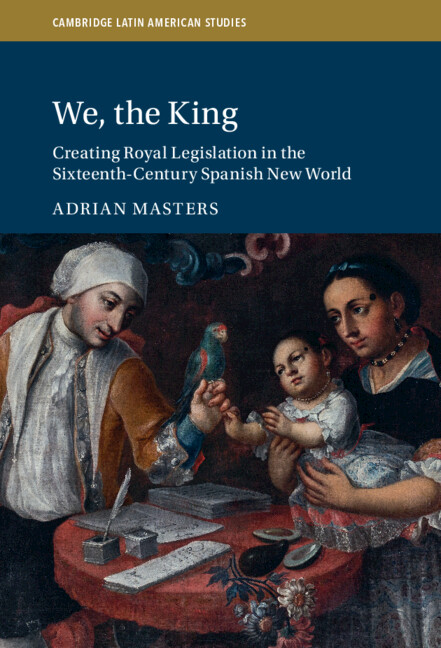
Masters, "We, the King: Creating Royal Legislation in the Sixteenth-Century Spanish New World"

Cambridge University Press has published We, the King: Creating Royal Legislation in the Sixteenth-Century Spanish New World (2023), by Adrian Masters (Universität Trier, Germany). A description from the Press:

We, the King challenges the dominant top-down interpretation of the Spanish Empire and its monarchs' decrees in the New World, revealing how ordinary subjects had much more say in government and law-making than previously acknowledged. During the viceregal period spanning the post-1492 conquest until 1598, the King signed more than 110,000 pages of decrees concerning state policies, minutiae, and everything in between. Through careful analysis of these decrees, Adrian Masters illustrates how law-making was aided and abetted by subjects from various backgrounds, including powerful court women, indigenous commoners, Afro-descendant raftsmen, secret saboteurs, pirates, sovereign Chiriguano Indians, and secretaries' wives. Subjects' innumerable petitions and labor prompted – and even phrased - a complex body of legislation and legal categories demonstrating the degree to which this empire was created from the “bottom up”. Innovative and unique, We, the King reimagines our understandings of kingship, imperial rule, colonialism, and the origins of racial categories.

A sample of praise from reviewers:

‘Meticulously researched and beautifully written, We, the King unveils the labyrinthine petitioning process involved in enacting thousands of legislative decrees and reveals how diligent vassals shaped colonial policies and categories of difference. It dismantles the standard view of the Spanish colonial state as the architect of legal rule that was all-seeing and all-pervasive. This outstanding work should be required reading for all colonial Latin Americanists.’ -- Nancy E. van Deusen

‘Adrian Masters has produced an ambitious study of early modern bureaucracy, law-making, and subaltern agency. Deeply researched and carefully written, We, the King is an indispensable resource for scholars of the Iberian empire.’ -- Michelle McKinley

More information is available here. An interview with Professor Masters is available here, at New Books Network.

-- Karen Tani

Thursday, June 1, 2023

Green on English Statutory Interpretation

Jonathan Green, a Harry A. Bigelow Fellow and Lecturer in Law at the University of Chicago Law School, has posted Interpretation in England:

American purposivists and textualists have both invoked the authority of the English statutory interpretation tradition to give their respective approaches pedigree and credibility. But both sides have misunderstood this history. The search for the purpose of the statute’s authors does not date to the sixteenth century, as Hart and Sacks suggested. Neither did the English courts categorically ban “legislative history” as an aid to interpretation in the 1760s, as Scalia claimed. The seminal case of Pepper v. Hart (1992), finally, did not mark the death knell of English textualism or the return of purposivism—at least as that term is usually understood.

This Article offers the first intellectual history of statutory interpretation in modern England. It begins in the early-nineteenth century, with the appearance of new evidentiary sources that made it possible, for the first time, to try to peer into the mind of Parliament. This triggered decades-long disagreement about whether the intentions of past legislators were relevant to statutes’ meaning—and whether, in turn, evidence of those intentions should be admissible in court. Late-Victorian judges ultimately rejected intentionalism for an approach centered on the “plain meaning” of the statute’s text. That formalistic method aimed to discipline construction and cabin judicial discretion, but its failure to do so led to its collapse in the late twentieth century. What emerged in its wake—the approach dominant in England today—was a novel kind of purposivism, one that centers the objective purpose of the statute and generally ignores evidence of the subjective intentions of its authors. The English courts’ contemporary approach, in other words, presents an alternative to the congressional-intent purposivism dominant on the federal courts today.

Retrieving this history, in turn, opens up new ways of thinking in the present. The history of interpretation in England suggests that textualists have been too quick to rule out evidence of the statute’s historical context; that purposivists have conflated the purpose of the statute and the purpose of its authors; and that today, when federal judges debate congressional intent, they are often talking past each other. The English tradition has much to offer us—just not what we think it does.
–Dan Ernst H/t: CB

Thursday, November 10, 2022

Grove on the History of Textualism as Statutory Interpretation

Tara Leigh Grove, University of Texas School of Law, has posted The Misunderstood History of Textualism, which is forthcoming in the Northwestern University Law Review:

This Article challenges widespread assumptions about the history of textualism. Jurists and scholars have sought for decades to distinguish “modern textualism” from the so-called “plain meaning school” of the late nineteenth and early twentieth centuries—an approach that both textualists and non-textualists alike have long viewed as improperly “literal” and “wooden.” This Article shows that this conventional historical account is incorrect. Based on a study of statutory cases from 1789 to 1945 that use the term “plain meaning” or similar terms, this Article reveals that, under the actual plain meaning approach, the Supreme Court did not ignore context but looked to surrounding text and structure to determine if an operative text was clear. The Article also offers an intellectual history, showing how in the early twentieth century, legal realists and legal process theorists created the myth of a “literal” and “wooden” “plain meaning school.” More surprisingly, modern textualists later accepted this account—a decision that, this Article suggests, had an important impact on the development of textualism. To distinguish their brand from (what they saw as) the “literal” old plain meaning school, modern textualists defined “textualism” so capaciously as to create the conditions for divisions within textualism that we see today. This Article not only clears up a historical misunderstanding but also has two broader lessons. First, the account here offers a cautionary tale about reliance on “conventional wisdom.” Second, the analysis suggests that theorists should set aside debates over “literalism” in statutory interpretation. The question is not—and has never been—whether interpreters should look to context but rather which context they should consider.
--Dan Ernst

Wednesday, January 26, 2022

CFP: Early Modern Colonial Laws and Legal Literature

[We have the following Call for Papers.  DRE.]

The Dynamics of Early Modern Colonial Laws and Legal Literature, 26-28 October 2022, Faculty of Law, University of Helsinki, Finland

The conference organizers invite papers exploring how legislative strategies of early modern colonial empires affected each other, what they had in common, and how colonial laws emanating both from Europe and the colonies themselves developed into different directions. Conference papers will look at early modern colonial legislation of the empires in multiple contexts:  medieval inheritance of ius commune and legal pluralism; early modern transformations of legal orders, such as the growth of police regulation; and not the least, the local colonial realities and normativities.

Connected to the last point, contributions investigating local readings of "foreign" legal literature will also be welcome. One may ask what role legal literature had in the circulation of legal rules and concepts, and in confronting societal challenges. Examples from court practice and legislative bodies highlight these complex processes. "Legal literature" will not be understood in the sense of being strictly dogmatic or methodological, but in the broad sense of personally constructed texts on law, written for legal practitioners, both academically trained lawyers and laymen.  

This conference will bring together legal scholars, historians, and social scientists to explore the complex entanglements of early modern colonial laws.

Confirmed keynote speakers are professors Thomas Duve (Max Planck Institute for Legal History and Legal Theory, Frankfurt) and Andréa Slemian (University of São Paulo). 

The conference is organized jointly by two projects, Comparing Early Modern Colonial Laws: England, the Netherlands, Portugal, and Spain (Academy of Finland, University of Helsinki) and Reading Law Glocally: Local Readings of Foreign Legal Literature in a Globalized World (Seventeenth to Early Twentieth Centuries) (Centre National de la Recherche Scientifique / France, Ghent University, University of Helsinki, Universidad Autónoma de Madrid). The conference committee consists of professors Laura Beck (Universidad Autónoma de Madrid), Serge Dauchy (Centre National de la Recherche Scientifique), Georges Martyn (Ghent University) and Heikki Pihlajamäki (University of Helsinki).

Please send, in one file, your abstract (max. 300 words) and short CV to the address: 

heikki.pihlajamaki@helsinki.fi. 

The language of the conference is English. There is no registration fee. The organizers will consider applications for reimbursement of travel costs and/or accommodation for junior researchers presenting papers. Participation online will be possible, and publication of the conference papers is foreseen.  The deadline for submissions is March 31, 2022

Tuesday, January 25, 2022

CFP: A Conference on Coverture

 [We have the following announcement.  DRE.]

Married Women and the Law in Britain, North America, and the Common Law World, Gainesville, Florida, May 5-8, 2022

The University of Florida, Levin College of Law is hosting a conference on all aspects of coverture, broadly defined.  This intimate conference will enable the participants to consider issues of marriage and married women's legal disabilities through multiple lenses, including by time period, legal system, as a colonial export, its economic and social impacts, as literary representations, and many others.  If you are working on aspects of married women's legal incapacities in the common-law world, please consider submitting a paper.  Accommodations for panelists during the conference will be covered. Publication opportunity may be available.

Please submit a 200 word abstract of your paper to Danaya Wright at wrightdc@law.ufl.edu by March 1, 2022 for consideration, or if you have any questions.

Wednesday, August 18, 2021

Emerson on the "Politics of Care"

Blake Emerson, UCLA School of Law, has posted Public Care in Public Law: Structure, Procedure, and Purpose, which is forthcoming in the Harvard Law & Policy Review:

This Article responds to recent mobilization around the “politics of care” by articulating a legal principle of public care within U.S. constitutional, statutory, and administrative law. Public care requires executive officials to attend to and advance the needs and values of those the law binds and benefits. This principle has three components. The regulatory purpose of public care, which is recognized in various statutory authorities of the welfare state, re-quires government to provide those goods and services that are necessary for people to exercise moral and political agency. The administrative procedure of public care, which is recognized by the Administrative Procedure Act of 1946, requires that federal agencies act with due regard for the interests and input of affected parties. The constitutional structure of public care, recognized by the Take Care Clause, requires that the President listen to subordinate officials who have specific legal, professional, and expert authority. These three dimensions together offer an attractive picture of what the administrative state ought to do and how it ought to do it. Public care offers an approach to administrative regulation that differs from other now dominant approaches, such as presidential administration and economic cost-benefit analysis. The practice of public care, which is informed by Progressive political thought and feminist social theory, emphasizes social solidarity, deliberative policymaking, and official collaboration, rather than executive unilateralism, instrumental reasoning, and isolated individualism.

--Dan Ernst

Wednesday, February 24, 2021

Land on the Origination Clause

Chris Land, Northwestern University Pritzker School of Law, has posted The Origination Clause’s Missing Piece, which is forthcoming in the Tennessee Law Review 87 (2021):

The Origination Clause is nearly constitutional surplusage today. The scope of the Clause has been limited by the U.S. Supreme Court to a very narrow class of revenue legislation that emerges from the U.S. House of Representatives.

This Article, for the first time, analyzes historical evidence that the U.S. Supreme Court has defined the constitutional scope of “Bills for raising Revenue”—and the concomitant reach of the Clause—in a manner that fails to account for Revolutionary-era British revenue legislation. Four of the five bills passed by the British Parliament which contributed to the outbreak of the Revolutionary War, i.e., the Sugar Act 1764, Stamp Act 1765, American Colonies Act/Declaratory Act 1766, Revenue Act 1767 and the Tea Act 1773, were considered by the Revolutionary-era generation to be “Bills for raising Revenue.” These measures were largely the genesis of the slogan “taxation without representation.

Under U.S. Supreme Court precedent today, none of these Revolutionary-era measures would likely be subject to the Origination Clause because each bill raised revenue for a specific governmental purpose, e.g., the defense of the American colonies, the enforcement of anti-smuggling laws and other specific, directed purposes. Though Origination Clause precedent has supposedly been rooted by the Court in “the history of the origin of the power,” Origination Clause cases make it clear that only those bills that raise “revenue to support government generally,” i.e., undesignated revenue-raisers, are subject to the Origination Clause’s requirements.

This Article contends that this approach is largely unsupported by the historical record and that our modern application of the Origination Clause is missing an important piece—the Revolutionary-era generation’s view of the legislation which truly constitutes “Bills for raising Revenue.”
–Dan Ernst