Showing posts with label revolution. Show all posts

Monday, June 22, 2026

Cambridge History of the American Revolution

The three-volume Cambridge History of the American Revolution, edited Marjoleine Kars, Michael A. McDonnell, Andrew M. Schocket, was published online on February 3 and has a print publication date of October 30. 

Volume 1: Revolutionary Contexts

The first volume delves into how the context of the American Revolution was set, taking readers across North America and the world to reveal the far-flung people, events, institutions, cultures, and ideas that led to its inception. Through a global lens, the volume shows how empires struggled with political and economic reforms, as well as popular protest, while competing and warring with each other. On a continental scale, long-term environmental and economic structures, native peoples, colonial settlers, and their interactions set the parameters for revolutionary conflict. Focusing on the thirteen colonies, -particularly groups who are traditionally overlooked- the essays shed light on the specific milieus in which the Revolution took place, examining and reinterpreting the iconic events leading up to independence and war. A mixture of broad topical essays and short innovative “viewpoints”, together the essays question notions of American exceptionalism while emphasizing both change and continuity.
Volume 2: Revolution
The second volume focuses on the years of upheaval during the American Revolution between 1775 and 1789. It breaks new ground by surveying a wide range of internal conflicts in the thirteen colonies, the trauma of a bloody war and its consequences, as well as the continental, hemispheric, and global forces shaping warfare and politics in this era. Together, the essays expand our understanding of how various people navigated military occupation, community conflict, governmental paralysis, interpersonal relationships, institutional collapse, and the slipperiness of allegiances. Through sweeping interpretative essays and micro-history viewpoints, the volume highlights the interplay of class, race, and gender in a wartime context and how these dynamics played out and were influenced by broader geopolitical developments. The depths of division and grand possibilities are explored – and interrupt our long-standing notions of traditional linear narratives of nation-making in this era.
Volume 3: Continuities, Changes, and Legacies
The third and final volume examines the American Revolution and its consequences, continuities, and legacies. Across thirty essays, ranging from broad, topical chapters to innovative, shorter 'viewpoints', the volume sheds light on how the American Revolution reverberated worldwide from the Constitution's ratification to twenty-first century cultural battles over the Revolution's meanings. Americans of all stripes adapted old rituals and structures to national independence, new rights, and republican politics, while enslaved and Indigenous peoples contended with the nation's intensification of the exploitation of humans and land. The Revolution's global shockwaves buffeted empires and the people who resisted them. From the eighteenth century to today, Americans and people across the world have contested how we remember the American Revolution. 
Richard J. Ross, University of Illinois, and Steven Wilf, University of Connecticut School of Law, have posted their contribution to volume 1, Legal Orders:
This chapter explores how the Patriots deployed law in order to mobilize fellow citizens towards rebellion.  In the decade before the Revolution, Patriots fashioned law in innovative ways as a language that could cross geographical and social borders in order to rally citizens to a cause.  What made their appeals effective?  First, the chapter asks how the settlers’ growing competence in formulating constitutional argument favored the Whigs.  Second, a look at early nineteenth-century Spanish American independence movements helps explain how and why the Whigs could plausibly believe one of their core ideas—that a colony was a polity representing the rights of an underlying people.  Finally, attention to the vernacular legal culture of the streets and taverns shows how Patriot legal appeals could be appropriated by ordinary people.  The remarkable capacity of Whig law to bridge social and geographical distances helped make it a powerful instrument of revolutionary mobilization.

--Dan Ernst 

Tuesday, June 16, 2026

Parkinson's "Tyrants and Rogues"

Robert G. Parkinson, Binghamton University, has published Tyrants and Rogues: Understanding the Declaration of Independence (Norton):

We think of the Declaration of Independence as timeless. We know the sacred phrases: “all men are created equal,” “life, liberty, and the pursuit of happiness,” “self-evident truths,” “certain inalienable rights.” These are some of the most important words human beings have ever written. And they are all from the Declaration’s preamble, which has inspired people for centuries, including generations of revolutionaries all over the world.

But as historian Robert G. Parkinson points out, the Declaration was not written as a timeless statement of political philosophy. It was, rather, produced in the heat of a confusing, bloody, and desperate war. And in that moment, it wasn’t high ideals alone that drove the patriots forward. Parkinson’s great innovation is to allow us, 250 years on, to see the Declaration as its authors did. For them, the opening paragraphs were not the main event. It was the body of the Declaration—the twenty-seven grievances against King George—that formed the essential part. Even Thomas Jefferson would have been puzzled by history’s fixation on his opening sentences.

Parkinson takes us into the grievances, giving us stories of the Revolutionary era that are little known today but loomed large for the patriots. As the leaders of the Revolution saw it, they had been pushed to the breaking point by British officials who undermined colonial legislatures and courts, corrupted the judiciary, turned military power against civilians, inflamed slave revolts, forced colonists to fight one another—ultimately, waging war on their own people.

In his brilliantly original reading of the Declaration, Parkinson asks fundamental questions that have too often been overlooked: Why did the colonies declare independence when they did? What were their nonnegotiable demands? Who were the individuals whose actions made reconciliation impossible? By recovering the people and conflicts behind the Declaration’s grievances, Parkinson offers a strikingly new account of the American Revolution—and shows that the issues that most alarmed colonists in 1776 are urgent once again today.
--Dan Ernst

Tuesday, December 9, 2025

Johnson on Legality in the American Revolution

Donald F. Johnson, North Dakota State University, has published Popular Government and the Limits of the Law at the Outset of the American Revolution online in Law and History Review, we assume as an initial installment of a forthcoming, joint special issue with the William and Mary Quarterly, "New Legal Histories of the American Revolution."  here is the abstract to Professor Johnson's article:

The outbreak of the American Revolution thrust would-be revolutionaries into a paradoxical relationship with the law. As they overthrew colonial governments from New Hampshire to Georgia during the summer and fall of 1775, leaders of the resistance to Great Britain found themselves in the awkward position of having to justify rebellion against British authority while still professing to be law-abiding Britons. The revolutionaries’ mandate to govern rested on protecting rights to property and representation that many colonists believed had been violated by agents of the Empire, but the practicalities of war demanded extra-legal measures. The popular governments that replaced colonial administrations had to find a way to balance upholding many of the laws of the old regime while simultaneously organizing an armed insurrection against it. Much of this burden fell on revolutionary committees at the town and local level. As the Continental Congress and provincial elites vacillated between rebellion and reconciliation and struggled to assert control over the fast-growing revolutionary coalition, ad hoc governments comprised of ordinary citizens took on the tasks of governing their regions and organizing for armed struggle. For much of 1775 and early 1776, these popular regimes precariously balanced the need for extra-legal expediencies with the need to maintain at least a semblance of law to maintain their legitimacy.

--Dan Ernst 

Thursday, December 4, 2025

Cambridge History of the American Revolution

Ken Burns isn't the only person who has been trying to get out ahead of the 250th anniversary of the American Revolution.  Just out is the three-volume Cambridge History of the American Revolution, edited by  Marjoleine Kars, Michael A. McDonnell, and Andrew M. Schocket (Cambridge University Press, 2026). Contributions that particularly address legal and constitutional history include:

Volume 1: Revolutionary Currents 

Richard J. Ross and Steven Wilf, “Legal Orders”
Geneva Smith, “Viewpoint: Slave Courts in Pre-Revolutionary Maryland”

Volume 2: Revolution 

Terry Bouton, “Constitutions”
Lindsay M. Chervinsky, “Confederation”
Lorri Glover, “Constitutional Convention”
Michael J. Klarman, “Ratification”

Volume 3: Continuities, Changes, and Legacies

Nora Slonimsky, “Law and Property”

--Dan Ernst.  H/t: RJR

Friday, November 21, 2025

CFP: American Revolution International

[We have the following CFP from the USC-Huntington Early Modern Studies Institute (EMSI) for its next annual conference, American Revolution International.  DRE]

The American Revolution was an international event. Its causes, origins, consequences, and trajectory all had roots in places beyond the thirteen colonies, from neighboring Indigenous nations to Asian cities thousands of miles away. Over the last few decades, there has been increasing scholarly attention to the United States in the world and an enlarged geography for early America. Yet, beyond works specifically on international diplomacy and war, the American Revolution has been largely resistant to such treatment, remaining sturdily provincial especially in popular understandings.

This conference will consider the challenges and advantages of making the American Revolution international in ways that move beyond simply European high politics and diplomacy. The Revolution was at the center of a number of global processes, from colonialism to Enlightenment. The interplay of these dynamics and the specific American trajectory furnishes an excellent avenue of approach to re-invigorate and widen perspectives on older stories about colonial resistance, unity, and war.

This EMSI Annual Conference, marking the 250th anniversary of the Declaration of Independence, will take place at the Huntington Library on November 6-7, 2026; publication of a special issue may follow. Travel and accommodation for participants will be covered by EMSI. The conference will include a range of panels devoted to various aspects of the American Revolution International.

Themes include but are not limited to:

  • The relations between the international and the national (international systems and processes and their effects on local contexts, and vice-versa);
  • Slavery, diaspora, and rebellion;
  • Anti-colonial movements, imperialism, and Indigenous resistances;
  • Atlantic and global networks (including commercial, communication, and ecological);
  • Gender, family, and household authority;
  • Sovereignty and independence; and
  • The challenges of war and peace

The conference will include both shorter presentations and pre-circulated longer pieces (~5000 words). We solicit expressions of interest by January 10, 2026. Please email a short proposal (no more than 500 words) and brief CV to amrevinternational@gmail.com.

Organizing committee:
Nathan Perl-Rosenthal (USC)
Christopher L. Brown (Columbia)
Brian DeLay (UC Berkeley)
Elizabeth Ellis (Princeton)
Sarah Pearsall (Johns Hopkins)

Wednesday, October 8, 2025

Novak on Legislation, Regulation, and Administration in the American Revolution

William J. Novak, University of Michigan Law School, has published Legislation, Regulation, and Administration in the American Revolution online and open-access in Law and History Review:

This article continues a long-term investigation into the nature of legislation, regulation, and administration across United States history. In contrast to persistent myths about an original American legal and political inheritance dedicated primarily to private rights, limited government, and laissez-faire economics, this article explores the earliest roots of American public rights, popular lawmaking, and regulatory policymaking. In the very first activities of revolutionary Provincial Congresses and Committees of Safety, this article locates a surprisingly robust template for the future development of American state police power, public provisioning, general-welfare legislation, and socio-economic regulation.

--Dan Ernst

Wednesday, July 6, 2022

Speech, Law, & Power in the American Revolution

         In my first blog post discussing my recent publication, The Dreadful Word, I described how the criminal law in eighteenth-century Massachusetts became attuned not only to ungodly speech but also to language deemed vulgar and impolite. I also discussed how the criminalization and punishment of impolite speech helped construct new hierarchies of social and political power more strongly oriented to empire. In this post I'll address the last few chapters of the book, where I explore what happened when resistance to imperial policies made those hierarchies unsustainable.

    The regime of polite speech that had been established through the prosecution and punishment of vulgar language began to falter under the repeated hammer blows of loud public protest in the 1760s and 1770s. Popular resistance to British imperial policies leveraged traditional politics out-of-doors to a hitherto unprecedented extent. As previous hierarchies of speech premised upon gentility began to disintegrate, new distinctions based upon loyalty to country began to emerge. 

    Even in this fluid and contested environment, however, language retained its power to announce identity and negotiate relationships. Amid the disruptions and dislocations of the Revolutionary War, Massachusetts legislators found occasion to either renew or reconsider some of their previous statutes defining the criminal import of speech--and to craft new legislation about the significance of oaths. Meanwhile, county courts (when circumstances permitted their sitting) cocked their ears towards words from different mouths, even gentlemanly ones--a marked departure from their practices of previous decades.

    None of this is meant to suggest a radical democratization of the speech ethos in Revolutionary-era Massachusetts. Rather, the changes in how authorities defined and punished criminal speech, I would suggest, reflected and promoted contemporary feelings about the associations between language, power, politics, and law. These changes, of course, were occurring in the context of Enlightenment-era conversations about race, gender, reason, and the very construction of identity--and speech was at the center of many of these conversations. Other historians have written brilliantly on some of these ideas, and others remain to be explored. I only hope that The Dreadful Word can provide a useful starting point for future research and conversations about speech, power, and law.

--Kristin A. Olbertson

Thursday, June 9, 2022

CFP: "Somerset v. Steuart @ 250"

We have the following Call for Papers:
Somerset v. Steuart @ 250: Facts, Interpretations, and Legacies

In recent years, the Somerset v. Steuart trial of 1772 has emerged as an event of much discussion in the history of transatlantic antislavery. Scholars have debated the decision’s importance and centrality to the emancipatory impulses in the British Atlantic, and, more recently, its role in the outbreak of the American Revolution. Some have argued that Lord Mansfield’s decision in James Somerset’s favor was a central, even epochal event, while others maintain that North Americans scarcely noticed the decision. With the two hundred and fiftieth anniversary of the trial upon us, the David Center is convening a scholarly symposium to continue this conversation and offer fresh appraisals of the causes, nature, and consequences of the decision.

The program committee seeks paper proposals from scholars in all fields to assess what we have learned and how we might interpret events before, during, and after the 1772 decision. We seek to evaluate the origins of the trial and to examine the question of how important the trial was to the momentous changes of the period,

Potential topics and themes include but are not limited to:

· New analysis on the causes and nature of the Somerset decision in 1772.

· Exploration of the impact and reception of the Somerset decision.

· The direct and indirect effects of the decision on the lives of the enslaved and enslavers.

· The influence of the decision on the law, the empire, the politics, and the African diaspora within the British Empire and beyond it.

· The importance or unimportance of ideas, of law, and of courts.

· The historiography of the Somerset case.

· Memory and public commemoration of the decision, both historically and contemporaneously.

· The current use and depiction of the case in educational materials, public debates, the media, and sites of public history.

· The role of James Somerset himself and other African actors.

We will meet on Thursday and Friday, December 1-2, 2022, for online and in-person sessions, all of which will be open to the public. Papers will be distributed in advance. Participants should be committed to read all the papers and to serve as a discussion leader for another session. We expect to produce a book of revised essays from the conference to be published in a new book series of the David Center for the American Revolution with University of Pennsylvania Press.

To propose a paper, please send an abstract of 250 words, a one-page cv, and a brief cover letter about how this topic fits into your past, present, and/or developing research, by June 15, 2022, to Interfolio.

-- Karen Tani

Monday, December 28, 2020

Roberts on British "Repressive Legality" in the Age of Revolutions

Christopher M. Roberts, Chinese University of Hong Kong Faculty of Law, has published Experiments with Suppression: The Evolution of Repressive Legality in Britain in the Revolutionary Period, in the Loyola of Los Angeles International and Comparative Law Review 43 (2020): 125-181:

This article is concerned with the structure of repressive governance, and how it has evolved historically. It examines this theme through an exploration of the manner which repressive laws and institutions evolved in Britain over the course of the late eighteenth century. In particular, it reviews the various measures that British authorities utilized and relied upon in order to confront a growing wave of calls for social and political reforms. These included a policy of aggressive prosecutions of dissidents; the creation of new institutions such as the Home Office designed to enhance the powers of the central authorities; extra-legal measures such as the creation of loyalist associations, which attempted to intimidate and attack revolutionaries; and the passage of a series of new laws aimed at closing off the space for freedom of association, assembly and expression. There was much opposition to the implementation of these measures; among other things, the period was marked by the evolution of a powerful tradition of defense lawyering, thanks to the efforts of the gifted Thomas Erskine in particular. Ultimately, however, when these four different sets of repressive measures were woven together, they proved too much for progressives to handle, choking off and driving the reform movement underground for a period of time. Along the way, the government implemented a legal and institutional template for repression, the effects of which continue to be felt to the present day.

--Dan Ernst

Tuesday, October 6, 2020

Gaffield on international law after the Haitian Revolution

 Julia Gaffield (Georgia State University) has published "The Racialization of International Law after the Haitian Revolution: The Holy See and National Sovereignty" in the American Historical Review, 125:3 (June 2020), 841-68. Here's the abstract: 

The Haitian state shaped international definitions of sovereignty and national legitimacy after the Declaration of Independence in 1804. Haiti’s nineteenth century was not a period of isolation and decline; its first six decades were globally connected because the country’s leaders challenged their postcolonial inequality with diplomacy and state formation. This strategy aimed to establish Haiti’s membership in the “family of nations,” a central metaphor in European and American diplomatic, legal, and religious decision-making. In doing so, the Haitian state forced the Atlantic powers to redefine the boundaries of international relations. Haiti’s decades-long negotiations with the Catholic Church were tied to the racialization of the global hierarchy. After its Declaration of Independence, the Haitian state began clearing a theoretical path toward recognized sovereignty based on the dominant narrative that a society must be considered “civilized” on the world stage. But, as it cultivated internal policies and practices that rejected the dominant racist assumptions, these discriminatory ideologies became increasingly more explicit in international law.

Further information is available here

--Mitra Sharafi

Friday, January 3, 2020

Scott and Venegas Fornias on slavery and salvation

Rebecca Scott (University of Michigan) and Carlos Venegas Fornias (Instituto Cubano de Investigación Cultural Juan Marinello, La Habana, Cuba) have published the following article: "María Coleta and the Capuchin Friar: Slavery, Salvation, and the Adjudication of Status," William and Mary Quarterly 3d ser., 76:4 (October 2019), 727-62. Here is the abstract:
This article explores the dynamics of the enslavement of free persons of African descent, tracing the process by which acts of force were clothed in robes of law. Freed by the abolition of slavery in Saint Domingue/Haiti, could a young woman called María Coleta maintain her freedom once she left the island of Hispaniola to seek out the father of her unborn child? The answer seemed to be no. In the years that followed her arrival in Havana in 1796, Coleta was claimed and held as a slave by Francisca Lorignac, who had advanced payment for Coleta's passage to Cuba. Each child subsequently born to Coleta was baptized into slavery. In December 1816, Coleta became deathly ill, and a Capuchin friar was called to administer last rites. But Coleta insisted that she would accept absolution only if the friar made a written record of her narrative and submitted it to a judge to initiate a suit for freedom for her daughters. The lawsuit that followed—whose case file opens with a transcript of Coleta's confesiones—reveals both a deep indeterminacy of status emerging from the Haitian Revolution and the uncertain path toward legal redress in a neighboring slaveholding society.
Further information is available here.

--Mitra Sharafi

Monday, September 3, 2018

Jus Gentium 3:1

Vol.3, issue 2 of Jus Gentium: Journal of International Legal History (July 2018) is out. Here is the Table of Contents:

ARTICLES

  • "Arbitration at Vienna: Recasting the History of International Dispute Resolution" by S. Harris
  • "The Rising Generation of International Lawyers at St. Petersburg University: Zaremba and Spasovich" by V. I. Ivanenko
  • "The Baltimore Incident and American Naval Expansion" by Mark W. Podvia    
  • "The 1917 Russian Revolution and International Law" by O. O. Merezhko  
  • "The Development of the Science of International Law at the Koretsky Institute of State and Law" by K. O. Savchuk and I. M.Protsenko
  • "Currency Control, Exchange Contracts, and War: Boissevain v. Weil" by J. Anderson
  • "Brown v. United States and Confiscation of Enemy Property" by IsaacSchaphorst

NOTES AND COMMENTS

  • "Kronid Malyshev and the Renaissance of Private International Law" by V. I. Ivanenko
  • "On Teaching the History of International Law" by W. E. Butler
  • "The People as a Subject of International Law"by I. O. Kresina and O. V. Kresin

DOCUMENTS AND OTHER EVIDENCE OF STATE PRACTICE

  • "Brief Calendar of International Practice for Spain and Portugal 1641 to 1818" by P. Macalister-Smith and J. Schwietzke

BOOK REVIEW

  •  Philippe Sands, Східно-західна вулция. Повернення до Львова 671 [East West Street: Return to Lviv] (2017) by T. R.Korotkyĭ and N. Pashkovskyĭ

Further information is available here.

Friday, December 22, 2017

Hasegawa on Crime & Punishment in the Russian Revolution

Tsuyoshi Hasegawa, UC Santa Barbara, has published Crime and Punishment in the Russian Revolution: Mob Justice and Police in Petrograd with Harvard University Press. From the publisher: 
Cover: Crime and Punishment in the Russian Revolution in HARDCOVERRussians from all walks of life poured into the streets of the imperial capital after the February Revolution of 1917, joyously celebrating the end of Tsar Nicholas II’s monarchy. One year later, with Lenin’s Bolsheviks now in power, Petrograd’s deserted streets presented a very different scene. No celebrations marked the Revolution’s anniversary. Amid widespread civil strife and lawlessness, a fearful citizenry stayed out of sight.
In Crime and Punishment in the Russian Revolution, Tsuyoshi Hasegawa offers a new perspective on Russia’s revolutionary year through the lens of violent crime and its devastating effect on ordinary people. When the Provisional Government assumed power after Nicholas II’s abdication, it set about instituting liberal reforms, including eliminating the tsar’s regular police. But dissolving this much-hated yet efficient police force and replacing it with a new municipal police led rapidly to the breakdown of order and services. Amid the chaos, crime flourished. Gangs of criminals, deserters, and hooligans brazenly roamed the streets. Mass prison escapes became common. And vigilantism spread widely as ordinary citizens felt compelled to take the law into their own hands, often meting out mob justice on suspected wrongdoers.
The Bolsheviks swept into power in the October Revolution but had no practical plans to reestablish order. As crime continued to escalate and violent alcohol riots almost drowned the revolutionary regime, they redefined it as “counterrevolutionary activity,” to be dealt with by the secret police, whose harshly repressive, extralegal means of enforcement helped pave the way for a Communist dictatorship.
Praise for the book:

Hasegawa is one of our leading historians of the February Revolution… [He] makes a strong case that the catastrophic social breakdown, most especially the violent crime that pervaded life in Petrograd after the collapse of the monarchy, ‘served as a stepping-stone toward the creation of the pervasive instrument of terror that became an integral part of the Communist dictatorship.’ -Joshua Rubenstein
This book makes a fundamental contribution to our understanding of the Russian Revolution by revealing the violent, chaotic lived experience of the revolution in the capital city. In a narrative full of colorful characters and stories, Hasegawa gives us a street-level view of the collapse of state authority that cleared the way for the Bolshevik seizure of power. -Eric Lohr
Hasegawa addresses the very important, largely ignored thus far, role of crime and the breakdown of social order and public safety. In doing so he changes the way we think and write about the Russian Revolution, making this one of the more original things I have seen in a very long time. -Rex Wade
Further information is available here.  

Wednesday, September 27, 2017

Cutterham's "Gentlemen Revolutionaries"

We note the publication of Gentlemen Revolutionaries Power and Justice in the New American Republic (Princeton University Press), by Tom Cutterham, Lecturer in United States History at the University of Birmingham.
In the years between the Revolutionary War and the drafting of the Constitution, American gentlemen—the merchants, lawyers, planters, and landowners who comprised the independent republic's elite—worked hard to maintain their positions of power. Gentlemen Revolutionaries shows how their struggles over status, hierarchy, property, and control shaped the ideologies and institutions of the fledgling nation.

Tom Cutterham examines how, facing pressure from populist movements as well as the threat of foreign empires, these gentlemen argued among themselves to find new ways of justifying economic and political inequality in a republican society. At the heart of their ideology was a regime of property and contract rights derived from the norms of international commerce and eighteenth-century jurisprudence. But these gentlemen were not concerned with property alone. They also sought personal prestige and cultural preeminence. Cutterham describes how, painting the egalitarian freedom of the republic's "lower sort" as dangerous licentiousness, they constructed a vision of proper social order around their own fantasies of power and justice. In pamphlets, speeches, letters, and poetry, they argued that the survival of the republican experiment in the United States depended on the leadership of worthy gentlemen and the obedience of everyone else.

Lively and elegantly written, Gentlemen Revolutionaries demonstrates how these elites, far from giving up their attachment to gentility and privilege, recast the new republic in their own image.

Thursday, March 9, 2017

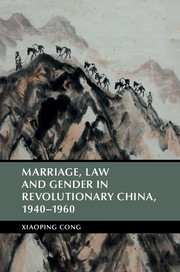
Cong on Marriage & Gender in Revolutionary China

Xiaoping Cong, University of Houston, has published Marriage, Law and Gender in Revolutionary China, 1940-1960 with Cambridge University Press (2016). From the publisher:
Marriage, Law and Gender in Revolutionary China, 1940–1960
Xiaoping Cong examines the social and cultural significance of Chinese revolutionary legal practice in the construction of marriage and gender relations. Her book is an empirically rich investigation of the ways in which a 1943 legal dispute over an arranged marriage in a Chinese village became a legal, political and cultural exemplar on the national stage. This conceptually groundbreaking study revisits the Chinese Revolution and its impact on women and society by presenting a Chinese experience that cannot and should not be theorized in the framework of Western discourse. Taking a cultural historical perspective, Cong shows how the Chinese Revolution and its legal practices produced new discourses, neologisms and cultural symbols that contained China's experience in twentieth-century social movements, and how revolutionary practice was sublimated into the concept of 'self-determination', an idea that bridged local experiences with the tendency of the twentieth-century world, and that is a revolutionary legacy for China today.
Table of Contents after the jump.