Showing posts with label American legal history. Show all posts

Wednesday, July 6, 2022

Speech, Law, & Power in the American Revolution

         In my first blog post discussing my recent publication, The Dreadful Word, I described how the criminal law in eighteenth-century Massachusetts became attuned not only to ungodly speech but also to language deemed vulgar and impolite. I also discussed how the criminalization and punishment of impolite speech helped construct new hierarchies of social and political power more strongly oriented to empire. In this post I'll address the last few chapters of the book, where I explore what happened when resistance to imperial policies made those hierarchies unsustainable.

    The regime of polite speech that had been established through the prosecution and punishment of vulgar language began to falter under the repeated hammer blows of loud public protest in the 1760s and 1770s. Popular resistance to British imperial policies leveraged traditional politics out-of-doors to a hitherto unprecedented extent. As previous hierarchies of speech premised upon gentility began to disintegrate, new distinctions based upon loyalty to country began to emerge. 

    Even in this fluid and contested environment, however, language retained its power to announce identity and negotiate relationships. Amid the disruptions and dislocations of the Revolutionary War, Massachusetts legislators found occasion to either renew or reconsider some of their previous statutes defining the criminal import of speech--and to craft new legislation about the significance of oaths. Meanwhile, county courts (when circumstances permitted their sitting) cocked their ears towards words from different mouths, even gentlemanly ones--a marked departure from their practices of previous decades.

    None of this is meant to suggest a radical democratization of the speech ethos in Revolutionary-era Massachusetts. Rather, the changes in how authorities defined and punished criminal speech, I would suggest, reflected and promoted contemporary feelings about the associations between language, power, politics, and law. These changes, of course, were occurring in the context of Enlightenment-era conversations about race, gender, reason, and the very construction of identity--and speech was at the center of many of these conversations. Other historians have written brilliantly on some of these ideas, and others remain to be explored. I only hope that The Dreadful Word can provide a useful starting point for future research and conversations about speech, power, and law.

--Kristin A. Olbertson

Saturday, July 2, 2022

Barbarians in the Dock: How Vulgar Speech Become a Crime in 18th-Century Massachusetts

     I'd like to thank Dan Ernst and LHB for the opportunity to be a guest blogger this month. I'm excited to participate in this community of scholars. As Dan mentioned in his introduction, I recently published my first book, The Dreadful Word:  Speech Crime and Polite Gentlemen in Massachusetts, 1690-1776, with the Studies in Legal History at CUP.                                   

    For the book, I looked at provincial statutes and General Sessions of the Peace (local courts) records to determine what kinds of verbal offenses were criminalized, prosecuted, and punished in eighteenth-century Massachusetts. I considered how contemporaries described these crimes and the offenders, and tracked who was most likely to be prosecuted and receive the harshest punishments. 
    Unlike the previous century, when colonists criminalized speech they deemed ungodly, now colonists criminalized speech they considered impolite. In many ways, the statutory scheme and enforcement practices of the 1700s regarding criminal speech reflected the ethos of conduct and courtesy literature.
    Surprising patterns emerged. Even as Puritan influence waned, Massachusetts colonists remained deeply interested in criminalizing and punishing speech as part of preserving the King's peace. They enacted and renewed numerous statutes throughout the century outlawing acts such as profane cursing and swearing, defamation, lying, sedition, spreading false news (not yet a political catchphrase), threats, contempt, false swearing and perjury, and mumping (the eighteenth-century version of a confidence man). Additional common law crimes were also avidly prosecuted: noise, abuse, rudeness, and "ill manners."
    Moreover, these crimes were not generally applicable, but were associated in legal records with particular sorts of people--the lower orders. Explicit references to soldiers, sailors, and servants, and language that bent the law's ear toward speech occurring in the work and social spaces of the meaner sort make clear whose speech provincial legislators believed was most threatening to good social order.
    Meanwhile, patterns of prosecution and punishment also reveal strong associations between "vulgar" speech and "the vulgar." Notably, the participatory and highly discretionary nature of the General Sessions Courts meant that the law could not be employed as a blunt cudgel of power by the elite; the system had to look legitimate. Although historians usually stress the shift to property-related offenses in the caseload of eighteenth-century Massachusetts courts, the more than 1600 cases of speech crime that I uncovered suggest a broad community consensus that these crimes, too, posed significant threat to the King's peace.
    In my next post, I'll discuss how the turmoil and chaos of protest and revolution splintered a speech economy premised upon politeness, and created opportunities to recalibrate the relationship between language and power.

--Kristin A. Olbertson

Tuesday, April 6, 2021

Global Forensic Histories Workshop

A group of historians of law, medicine, and science came together for a virtual workshop in March 2021. The Global Forensic Histories Workshop was co-organized by Binyamin Blum (UC Hastings Law) and our blogger Mitra Sharafi (University of Wisconsin Law School). It was co-sponsored by UC Hastings Law, UW Law School, and the American Society for Legal History. 

Here is the line-up of papers:

Day 1 (Chair: Binyamin Blum)

• Khaled Fahmy (University of Cambridge), “Forensic Medicine in nineteenth- century Egypt”

  • Mina Khalili (New York University), “Redefining Criminal Evidence”

• Susanna Blumenthal (University of Minnesota), “Toward a Genealogy of the Pathological Liar”

• Mitra Sharafi (University of Wisconsin–Madison), “Planted Poison and Wrongful Convictions”

• Ian Burney (Manchester University), “A History of Innocence: Erle Stanley Gardner, the Court of Last Resort, and the Pursuit of Wrongful Conviction in Post-war America”

Day 2 (Chair: Mitra Sharafi)

• Projit Mukharji (University of Pennsylvania), “Psychic Detectives: Occult technologies and braided forensics in the British Raj”

• Keren Weitzberg (University College London), “White Backlash”

• Claire Cage (University of South Alabama), “Reproductive Bodies and Forensic Medicine in Modern France”

• Catherine Evans (University of Toronto), “Burning Bodies and Medico- Legal Expertise in Nineteenth-Century Britain”

• Binyamin Blum (University of California, Hastings), “Forensic Culture in the Age of Empire: How Colonialism Shaped the Forensic Sciences”

• Chris Hamlin (University of Notre Dame), “The severing of forensic medicine from public health”

The group shared meals at the end of each day using Uber Eats and SpatialChat.

--Mitra Sharafi

Wednesday, September 9, 2020

Burset on advisory opinions

 Christian Burset (Notre Dame Law School) has an article coming out in vol. 74 of the Vanderbilt Law Review, forthcoming in 2021. Here's the abstract posted on SSRN for "Advisory Opinions and the Founders' Crisis of Legal Authority" (Notre Dame Legal Studies Paper No.200826):

The prohibition against advisory opinions is fundamental to our understanding of federal judicial power, but we’ve misunderstood its origins. Discussions of the doctrine begin not with a constitutional text or even a court case, but a letter in which the Jay Court rejected President Washington’s request for legal advice. Courts and scholars have offered a variety of explanations for the Jay Court’s behavior. But they all depict the earliest Justices as responding to uniquely American concerns about advisory opinions.

This Article offers a different explanation. Drawing on previously untapped archival sources, it shows that judges throughout the anglophone world—not only in the United States, but also in England and British India—became opposed to advisory opinions in the second half of the eighteenth century. The death of advisory opinions was a global phenomenon, rooted in a crisis of common-law authority.

Early modern English judges had routinely advised the Crown. This advisory role was politically fraught but doctrinally unproblematic thanks to a jurisprudential orthodoxy that treated judges’ opinions as evidence of a preexisting common law. Although this declaratory theory survived into the nineteenth century (and beyond), it began to fragment after 1750, as lawyers began to disagree about the nature of precedent. Those disagreements generated new pressure to clarify the weight of different kinds of legal authority. Most lawyers intuited that advisory opinions were less authoritative than decisions arising from litigation. But because bench and bar lacked a common theory of legal authority, they were unable to articulate a shared understanding of what respect was due to judges’ extrajudicial pronouncements. As a result, advisory opinions became dangerous, because the judges who issued them could not control how future readers might treat them. In response, judges sought to limit their advisory activity—first in England, then in British-controlled Bengal, and finally in the United States, whose judges inherited Britain’s contested and dynamic understanding of judicial power.

Further information is available here.

--Mitra Sharafi 

Wednesday, July 1, 2020

Holdren’s First Post -- My book and my plans for future posts

I want to thank the editors of the Legal History Blog for having me as a guest blogger. It’s an honor and I’m delighted to have my words on here. As Professor Tani mentioned in her introduction, I recently published a book and I want to tell you about it.

My book is called Injury Impoverished: Workplace Accidents, Capitalism, and Law in the Progressive Era. It's my first book and is based on my dissertation. I think of the book as a study in the intellectual life of governance - how power relationships are conceptualized, mostly by powerful people, and what concepts are implied within power relationships, whether or not anyone actually thought them explicitly. In my view, inquiry is enriched by emphasis on both of these facets, the actual thoughts of people and the implicit logics enacted within institutional practices. I’m aware that this all sounds pretty abstract. In addition to talking about abstract matters, I also tried to foreground the real human beings who died, suffered, and lived despite all the harms to which working-class people are subjected. In my view, that dying and suffering was (and still is) largely organized by the kinds of abstractions I talk about in the book.

Friday, April 3, 2020

Today: An Online Class with Ken Burns on the Constitution in Crisis Times

Documentary filmmaker Ken Burns will be teaching an online class for students, entitled “The Constitution in Times of Crisis,”  April 3, with the National Constitution Center on the role of the U.S. Constitution during crises at 1pm today, EST, via Zoom.   More.

--Dan Ernst

Tuesday, July 16, 2019

File on the Telegraph and Libel in the Progressive era

Patrick C. File, University of Nevada, Reno has published Bad News Travels Fast: The Telegraph, Libel, and Press Freedom in the Progressive Era with the University of Massachusetts Press. From the publisher: 
At the turn of the twentieth century, American journalists transmitted news across the country by telegraph. But what happened when these stories weren’t true? In Bad News Travels Fast, Patrick C. File examines a series of libel cases by a handful of plaintiffs—including socialites, businessmen, and Annie Oakley—who sued newspapers across the country for republishing false newswire reports. Through these cases, File demonstrates how law and technology intertwined to influence debates about reputation, privacy, and the acceptable limits of journalism.
This largely forgotten era in the development of American libel law provides crucial historical context for contemporary debates about the news media, public discourse, and the role of a free press. File argues that the legal thinking surrounding these cases laid the groundwork for the more friendly libel standards the press now enjoys and helped to establish today’s regulations of press freedom amid the promise and peril of high-speed communication technology.
Praise for the book:

"File’s research is impressive, and Bad News Travels Fast makes an important contribution to understanding this ‘forgotten period’ of libel law." - Samantha Barbas

"An important contribution to our understanding of the development of First Amendment law, with particular relevance to current debates about the role of journalism and legal protections for the press." - Tim Gleason

Further information is available here.

--Mitra Sharafi

Tuesday, July 2, 2019

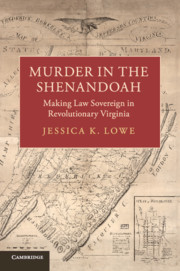
Lowe on law and murder in revolutionary Virginia

Jessica K. Lowe, University of Virginia, published Murder in the Shenandoah: Making Law Sovereign in Revolutionary Virginia with Cambridge University Press earlier in 2019. From the publisher: 
Murder in the Shenandoah
On July 4, 1791, the fifteenth anniversary of American Independence, John Crane, a descendant of prominent Virginian families, killed his neighbor's harvest worker. Murder in the Shenandoah traces the story of this early murder case as it entangled powerful Virginians and addressed the question that everyone in the state was heatedly debating: what would it mean to have equality before the law - and a world where 'law is king'? By retelling the story of the case, called Commonwealth v. Crane, through the eyes of its witnesses, families, fighters, victims, judges, and juries, Jessica K. Lowe reveals how revolutionary debates about justice gripped the new nation, transforming ideas about law, punishment, and popular government.
Praise for the book: 

 "Elegantly written and copiously sourced, Jessica K. Lowe’s book is a must-read for specialists and students alike. Lowe upends the accepted notion that southerners went outside the law to resolve conflicts because of the culture of honor that was inextricably embedded in slavery. She uses criminal law to open a window into social change in postrevolutionary Virginia and to set the stage for antebellum-era conflicts in imaginative and unexpected ways." -Victoria Saker Woeste

"Jessica K. Lowe's beautifully crafted account of murder and justice powerfully illuminates the reconstruction of criminal law in the early American republic. Lowe skillfully turns the story of a single Virginia killing into a compelling meditation on how people, high and low, struggled over the meaning of equality and the rule of law in the aftermath of revolution. A formidable piece of scholarship, Murder in the Shenandoah is also a gem of historical narration and analysis, at once tough-minded and humane." -Sean Wilentz 

"Professor Lowe has produced a volume that is both a murder mystery and a mini-treatise on the history of criminal law in colonial Virginia. Hard-nosed legal history has seldom been presented in such fascinating, readable form. Behind the legal story is an equally important story of social change in early Virginia. Lowe knows her Virginia law, and applies to it the questions of a modern historical sensibility. Readers will be surprised and intrigued by this admirable volume." -Stanley Katz

"In Jessica K. Lowe’s poetic telling of a murder trial in the Shenandoah Valley on Independence Day in 1791, we see how issues of class, violence, and the rule of law came together to lead to the execution of a Virginia patrician. Lowe’s beautifully written book shows the law in motion. Wage workers, slaves, jurors, and the legal and planter elite all cross her stage as the values of democracy made a new American law." -Alfred L. Brophy

Further information is available here.

--Mitra Sharafi

Monday, May 6, 2019

A Book Greater than the Sum of its Chapters

When I learned that the academic book market had changed, my goals shifted too. Of course, the essence of the project remained the same. Policing the Open Road is about how the introduction of a technological shock in American society—the mass adoption of cars—transformed American governance, policing, criminal procedure, and the relationship between individual citizens and the state. The overarching argument posits that all of these changes responded to the necessity of disciplining “law-abiding” citizen-drivers, which raised a profound and troubling question: What did freedom mean in a modern, automotive society that policed all its citizens? Ultimately, the law’s solution to the potential arbitrary policing of “Everyman,” I argue, led directly to the systematic discriminatory policing of racial minorities.

To figure out how to tell this story, I had to think about the book as a whole. In light of the realities of academic teaching today, I also crafted each chapter to stand alone, each with its own narrative, cast of characters, and argument. Here’s a short breakdown:

  • Chapter 1, “A Mystery of Traffic” gives an account of how the mass adoption of the automobile led to the shift from nineteenth-century governance based on common law and voluntarism to twentieth-century governance based on discretionary policing.
  • Chapter 2, “From Lumbering Foot Patrolmen to Motor-Mounted Policemen” traces the emergence of twentieth-century professionalized police to the need to manage traffic and “law-abiding” traffic violators.
  • Chapter 3, “The Automotive Fourth Amendment” examines the technology-driven demise of classical legal thought in criminal procedure and the resulting expansion of police discretion. Or, for crim pro folks, this chapter tells the story about how the Carroll automobile exception in 1925 culminated with the Terry stop-and-frisk in 1968.
  • Chapter 4, “It Could Happen to You” offers an alternative account of the Warren Court’s due process revolution by juxtaposing the Court’s landmark cases with its car cases.
  • Chapter 5, “The Right to Privacy in Public” integrates the histories of policing and the twentieth-century administrative state to explain why the major legal theories of the twentieth century—classical legal thought, legal realism, and legal process theory—failed to offer a principled method to both justify and constrain police discretion.
  • Chapter 6, “The Fourth Amendment Tool in Criminal Patrol” is a legal history of driving while black that shows that underlying proceduralism was a fundamental acceptance of discretionary policing—to the point of countenancing racialized policing.

One could easily pick up Policing the Open Road and start with any chapter. But, as with any book, readers would miss important narrative and thematic through lines without reading from beginning to end. One is the sense of dramatic change in state power and discretionary policing from the beginning of the twentieth century to the present.

Second, although it’s hard to miss my argument about causation, readers of select chapters may not catch my periodization. I argue that the turn to procedure in American law was an outgrowth of events in American society that took place in the 1920s and 30s.

Let me give an example that will be familiar to those who have read my essay, “The New Public,” which appears, significantly modified, as Chapter 5 (more on this in a future post). One of the main characters in this chapter is Charles Reich, who wrote the 1970 bestseller The Greening of America. In 1966 as a Yale law professor, he also wrote about his numerous encounters with the police in his car. These stops were about more than the annoyances of getting pulled over too many times. They were also about the invasion of his privacy. As a closeted gay man at a time when sodomy was a crime in all states but one, Reich went for long drives to escape the burdens of keeping his secret. So when the police questioned his whereabouts in his car, they were prying into the most intimate parts of his personal life.

Readers who read Chapter 5 will come away understanding the struggles of a legal progressive and realist who, in his attempts to delineate some limits on the police, flirted with classical legal thought but settled on an entirely different solution that ultimately expanded the police’s power even more. There is a sense that Reich conceded too much; a contemporary wrote in Playboy that Reich’s proposals for police reform were “well-meaning” but not enough.

But readers who have also read Chapter 1 will find it difficult to judge Reich’s concession to discretionary policing. Further confirming that larger social forces were at play, Reich’s proposals essentially mirrored policy choices and legal changes from the 1920s and 30s that accommodated police discretion, which are detailed in Chapters 2 and 3. Readers of Chapters 3 and 4 will also appreciate the constraints that the public/private dichotomy imposed on Reich’s thinking about the police problem and American legal thought more generally. And while Chapter 5 mentions the implications of Reich’s reforms, it is in Chapter 6 where readers learn about the devastating consequences of proceduralism in Fourth Amendment jurisprudence.

Like any author, I’m thrilled and honored whenever anyone reads something I’ve written. I know I’ll still be thrilled and honored if someone decides to pick and choose a chapter from Policing the Open Road rather than read the whole thing. I understand that authors have to earn their readers. I’ll pick up on this and narrative strategies in the next post.

Sarah Seo

Tuesday, April 16, 2019

A Better Book: The Home Institution


              A choice I did not make that profoundly shaped Almost Citizens was that of USC Gould School of Law to hire me. Here, I lucked out. Writing the book I wanted required time, money, inspiration, guidance, autonomy, infrastructure, and publicity. Fortunately, my home institution was well stocked with all seven. (If your school takes a different approach to these questions or your recipe for success calls for different ingredients, please share in the comments.)
              Time was what I needed most. But it was easy to overinvest in teaching and service. I wanted to serve students and please senior colleagues, and there were so many new, interesting ways to contribute. Gould protected me against myself.  The dean assigned junior professors light service obligations and never asked them to develop new courses beyond their original three (we have a 2-1 load). Senior faculty protested any perceived erosion of the norm. And I got a semester-long sabbatical halfway through.
              I also found that my research, writing, and physical book all benefited from money.  Paid research assistants facilitated broader searches and more thorough reviews. Money for travel bought archival trips and conference presentations. It took funds to hire development editors and improve the book through subventions.  While I couldn’t spend my way to a good book, I could have been starved into a weaker one. Fortunately, I had a dean and institution that invested in scholarship. I never had a prepublication request denied. That support let me put my best foot forward, plan with confidence, and avoid the stress of committing personal funds to professional advancement.
              My book was also shaped by the scholarly cultures and institutionalized intellectuals spaces of the institutions where I researched and wrote. It was while taking part in Gould’s healthy culture of office, hallway, and faculty lounge chats that I had many important epiphanies. I gained key interlocutors and inspiration through my participation in USC’s Center for Law, History and Culture and the multi-institution Law and Humanities Junior Scholars Workshop that the center cosponsors. Gould also gave me the chance to present in an internal workshop each year. And every year the school’s senior faculty read and responded to all my works in progress.  As a result, I received an additional mountain of helpful tips and questions.
One of the  challenges of taking full advantage of opportunities for feedback at Gould was the knowledge that I was inviting criticism from the same people who would vote on my tenure case. Fortunately, engagement with my colleagues turned out to be a way to elevate my work while pleasing my electorate. Gould’s senior faculty stressed that I should ignore any advice that proved unhelpful.  The dean repeatedly insisted that it was the scholar’s job to bring critical judgment to the array of conflicting suggestions received. Never did I hear a complaint that I had ignored someone’s suggestion.
              Gould’s service-oriented library multiplied my research productivity. Its librarians acquired obscure sources, secured high-resolution scans of illustrations, undertook foreign-language correspondence with overseas repositories, and filed Freedom of Information Act requests. Whenever I asked them to compile reading lists, find statistics, create maps, or undertake targeted research, I could trust that it would be done and done well. In fact, Gould’s librarians were often better than me at finding sources and digging up facts. Having such skill on staff was the result of a decision to prioritize personnel above collection size. But Gould’s smaller collection never hampered me. Interlibrary loan, mass digitization, and the school’s willingness to buy otherwise inaccessible materials always did the trick. The end result was that I saved considerable time and mental energy. 
              When I was on the entry-level market, it never occurred to me to evaluate law schools in terms of their public-relations teams.  My mistake! After years of obscurity as a grad student, law clerk, and post-doc, my arrival as a professor brought ready access to the public sphere.  As I soon learned, I could give interviews, discuss topics on background, write op-eds and articles, post to blogs, secure press coverage and book reviews, do public events, send out promotional materials, and much more. (I invite those of you more media-savvy than me to take up the possibilities in the comments.)  I was enthusiastic to raise my profile and spread my ideas. But I worried about PR becoming a time sink, or worse, about making a fool of myself before a large audience.
Gould’s PR team helped me enter the public eye efficiently and on my own terms. They took care of logistics, safeguarded my time, and focused on how I could have an impact. They initially held my hand, practicing with me what I would say and helping me set expectations with reporters. As my confidence grew, my scholarship progressed, and world events unfolded, they had endless ideas about how to give me and my work a broader platform. With their help, I gravitated toward interviews and op-eds (a subject of an upcoming post). I eschewed forums that treated intellectual exchanges as battles, and sought out those favored conversational interactions. They even helped me be heard despite my general absence from most social media (LHB notably excepted!).
              --Sam Erman

Monday, April 15, 2019

A Better Book: The First Book Workshop


              Several years ago, LHB’s own Karen Tani and Mitra Sharafi wrote wonderful posts on their first book workshops (Karen’s is here; Mitra’s is here).  For those who missed them, a first book workshop is a manuscript workshop for a first-time author. Such sessios have grown increasingly common in legal history. Participants typically include a mix of home-school colleagues and outside commenters. Mine was incredibly valuable. This post uses that experience to build on Karen’s and Mitra’s insights. (If your experience as an author or participant was similar or to the contrary, please share it in the comments below.)
              An immediate benefit of staging a first book workshop is the deadline. Karen Tani declared it “a source of stress -- but also a source of motivation.” I would write “and” where she wrote “but.” The interim deadline improved my mood, productivity, and work product. It distracted me from the truly looming deadline: closure of my tenure file. I thus traded exhausting long-term stress for more energizing and motivating short-term stress. After all, getting a manuscript done sooner would mean more time to improve it later.
              The structure of the workshop can vary with the author’s goals. Mitra Sharafi described gathering 4-6 readers for an afternoon of conversation about the book. Karen Tani’s workshop had more than a dozen participants who presented on different parts of the book in panels across an entire day.  My workshop split the difference.  I gathered just shy of a dozen people for a single three-hour book conversation in the morning. There were opportunities to follow up and revisit matters during the lunch that followed and the dinner that I had with the out-of-town guests.
              My goal for the workshop was to come away with a plan for pulling the manuscript’s disjointed pieces together. I already had a clear vision of the characters, narrative, and argument of the book. I knew what I wanted to accomplish in each chapter and overall.  Plus, my tenure file would close in a year and a half, so I had to stay firmly in finish-the-book mode. Any deep exploration of new literatures or events would have to wait for follow-on projects. Instead, I hoped that my readers and I would put on the table competing visions for integrating what I already had. To keep the focus on the book as a whole, I decided against asking each reader to take primary responsibility for one or another chapter.
              Inevitably, I received conflicting advice and concerns. Here, it was crucial to have a trusted mentor present who could direct conversation toward achieving consensus on a concrete plan.  Ariela Gross served that role for me, and did a fantastic job.  Had she been unavailable, I’m confident that either of the ASLH series editors involved in the book – Sally Gordon and Reuel Schiller – could have stepped in.
              I would also recommend having someone in the room take notes. If (unlike me) you would listen to a recording later, consider following Karen Tani’s lead and asking participants’ permission to record the session. I also found it helpful to ask those who spoke to send me any notes they had afterward. I worried that asking people to pre-circulate notes as Karen Tani had might stifle free-flowing discussion.
              I aimed to be instrumental and substantive when inviting participants. My primary goal was to choose readers who would provide helpful feedback on the project. But the workshop was also an opportunity to secure buy-in and buzz for the book and to strengthen my relationships with others in the field. My ideal outside reader was someone who would value the project, become an interlocutor, and potentially write a tenure letter. I wanted inside readers to hear from outsiders why the project mattered and to be drawn more into the work. I also hoped that the discussion would cause all the participants to discuss the book with colleagues once the workshop ended.
              For my workshop, I chose equal numbers of external and internal readers.  Bob Gordon and Sophia Lee agreed to fly in for the event, as did Reuel Schiller in his capacity as the editor for the ASLH series that was publishing my book. Clyde Spillenger made the trek from UCLA, and my USC colleague from American Studies and Ethnicity, Nayan Shah, came as well.  At my home institution, the Gould School of Law, I invited senior colleagues in legal history and constitutional law.
All of this cost money. Mitra Sharafi and Karen Tani turned to grants to fund their workshops. I was fortunate to work at a law school willing to foot the bill. (Thanks, Dean!).
               In my case, the workshop was time and money and well spent. I came out of it with better key terms, a clearer sense of argument, and plans for streamlining the prose. I strengthened my relationships with scholars I admire and placed my book project on their radar.  Crucially, I also gained a renewed sense of the potential of the project.
              Though manuscript workshops are beneficial for junior scholars, they are not equally accessible. Certain educational trajectories and institutional homes make it easier to secure funds and participants – if one knows to seek them in the first place. It is that last barrier that made Mitra Sharafi’s post so valuable. It publicized the first book workshop when it was an emerging practice and possibility.


--Sam Erman

Tuesday, April 9, 2019

A Better Book: Living Descendants


              Three and a half years ago, I had the good fortune to join Barbara Welke, Mitra Sharafi, and Daniel Sharfstein at the 2015 Annual Meeting of the American Society for Legal History for a roundtable on working with the living descendants of historical actors.  As we explained:
Online databases and communication technologies, the transnational turn, the study of memory and agency, and genealogy all lead legal historians to work with descendants of subjects. . . . Scholar-descendant exchanges shape and enrich legal history, making the past recoverable and vivid.  Joint projects that broaden arguments and audiences can result. . . . The scholar offers new strands in family or community histories.  Descendants’ experiences and understandings reveal impacts, limits, and reverberations of legal dynamics or push scholars to move beyond legal frames in productive and unfamiliar ways.
I joined the panel to discuss the topic of today’s post, my experience working with a descendant of a central character in Almost Citizens. The story began around eight years ago.
Just weeks after receiving final approval of my dissertation, which centered on a 1904 Supreme Court litigant names Isabel Gonzalez, I received an email from Belinda Torres-Mary.  She was also researching Isabel Gonzalez and had been for years.  I held my breath.  She was fascinated to learn new details about Gonzalez’s unsuccessful experience as the first Puerto Rican person to demandU.S. citizenship from the Supreme Court.  She was not an academic historian.  Gonzalez was her great-grandmother. Belinda was a passionate genealogist. Exhale.
Soon, Belinda and I were trading research leads.  She told me anecdotes.  Tacking back and forth, we discovered many more records. A long-passed woman I had spent years getting to know came to life once again, now in a new way.  As a result, the book’s account of Gonzalez is much richer than the dissertation’s.
As our collaboration deepened, we discussed how we each understood Isabel Gonzalez.  I saw her as a tragic hero of sorts. When she sought to migrate from San Juan to a better life in New York, Ellis Island inspectors discovered that she was an unmarried mother who was also pregnant and ordered her to be deported as an undesirable alien. Gonzalez filed a suit that eventually reached the Supreme Court. She argued that Puerto Ricans could not be deported because they had become U.S. citizens after the annexation of Puerto Rico in 1899. The claim tapped into longstanding interpretations of the Fourteenth Amendment as making citizens of all Americans other than American Indians. But the justices ruled more narrowly: Puerto Ricans were not aliens, hence not subject to deportation. Nothing needed to be said regarding citizenship. The tentativeness was typical of the early-twentieth-century Insular Cases, through which the Court contributed to a sea change in constitutional law alongside lawmakers, bureaucrats, presidents, and private actors. But the sum result was momentous, a turn away from the Reconstruction Amendments, rights, citizenship, and statehood and toward colonialism.
Belinda declared Gonzalez to be the Puerto Rican Rosa Parks. Initially, the comparison typified for me the difference between our projects.  Belinda saw her ancestor as a heroic figure in a long U.S. march toward inclusion and liberty.  If asked, I probably would have said that even Rosa Parks was no Rosa Parks.  Certainly, the professional historian in me felt compelled to emphasize differences between the women.  Gonzalez’s activism had not made her famous.  It had not arisen out of a commitment to a mass social movement or come to be supported by one.  She had engaged in legal maneuvers rather than direct action.  She did not prevail.  The unmarried and pregnant Gonzalez was not a model of respectability.  She was from a different community and drew on a heritage of Spanish rather than U.S. rule.  It was not clear that she had African ancestry; she seemingly never identified as of color.
              But the deeper I have delved, the more wisdom I have found in Belinda’s analogy.  However Gonzalez self-identified, racial prejudice lay behind the effort to deny her U.S. citizenship and behind the Court’s tepid response to her challenge.  Both controversies were profoundly shaped by being launched by women.  Law played crucial roles in both cases, in part because its future shape was uncertain.  Although neither dispute resulted in a constitutional ruling, both quickly came to be understood as signal events in processes of major constitutional change.  Both cases asked federal courts to reinvigorate legal legacies of Reconstruction.  Gonzalez and her allies deployed honor in ways that prefigured later uses of respectability.  They argued that Puerto Ricans’ honor made them worthy of equal treatment, and that denial of such treatment unjustly dishonored them.  In both cases, a modestly situated actor meaningfully influenced constitutional change.  Both disputes were key events in iterative processes of legal transformation involving a diverse array of officials.  And as recent events sharply remind us, the constitutional revolutions that resulted in both cases were incomplete and unstable.
              Working with Belinda also made my process of researching Almost Citizens feel similar to my experience of reading good fiction.  The book’s characters, themes, insights, and events kept overrunning the interpretive bounds within which I sought to contain them.  I found the world that emerged from the archives to be immersive and consuming.  I aimed to capture these novelistic sensations with a character-driven approach that attended to narrative and people as much as it did to analysis and argument.  Of course, I did not have the luxury of inventing plot turns and characters at will.  But I did have characters who were real and compelling.  Their struggles helped form the world we now inhabit.  For Belinda, that was doubly true.  Isabel Gonzalez’s decisions brought Belinda’s ancestors into existence.  Unsurprisingly, strongly felt familial ties linked great-granddaughter to great-grandmother.  Perceiving Belinda’s passion for Gonzalez’s story inspired me to deepen my depictions of Gonzalez, her choices, and their consequences – all to the book’s benefit.
That Belinda and I even met reflects a sea change in the practice of history.  Since I began graduate school, innumerable primary documents have become text-searchable online.  Books, census manuscripts, passenger manifests, judicial documents, legislative hearings, and newspaper articles that required research trips, microfilm readers, hours of painstaking review, and no small amount of luck now spit up information on a person or theme of concern with little more than an entry in a search box.  In many cases, the impetus behind this mass digitization and metadata creation has not been the needs of academic historians, but the demands of genealogists and the growing sophistication of character recognition software.  Increasingly, scholars seeking to learn about particular historical figures find themselves working in tandem or collaboration with genealogists investigating their roots.  One additional reason is that the digitization revolution has made scholars' output ever more accessible, as Belinda discovered when she began searching mentions of her great-grandmother.
              The rise of genealogy and new research technologies has transformed the ethics of researching and telling history. I am lucky not to have encountered the more acute conflicts that can arise. Belinda encouraged me to make my own decisions about what to include in the book and how. Here, it helped that Belinda had developed her own writerly voice.  She expressed aspirations soon after we met to write a young adult biography of Isabel Gonzalez.  I think it’s a great idea. With any luck, I’ll interest her in letting me assist while she takes her turn in the author’s chair.
Even in functional partnerships, working together involves give, take, and the question of whether each person is doing their share of both. Early on, I worried that I was more of a taker. Belinda offered up family history that I had no other way to access.  To my delight, I came to realize that the scarce commodity that I could contribute was undigitized archival material and historical methods with which to make better use of what was online. I was pulling my own weight because history had something unique to contribute.
If I stumbled, it was in over-skepticism. When Belinda recounted the family lore that Gonzalez had married a gentleman before migrating to New York, my first thought was that many more families claim ancestral earls than actually have them. Silly me. As our research continued, Belinda remembered that the story was told in Spanish. Gonzalez had married a “caballero.” Perhaps that was a last name, not an adjective? Some searches in digitized church and county records confirmed it. Gonzalez’s first husband, Juan Caballero, died of tuberculosis in his early 30s, shortly after Gonzalez became pregnant with his second child.

              Working with Belinda was also a reminder that Gonzalez has many other living descendants. Some knew her well. All share in her history. Few would accept every interpretive choice that I made. Yet I am obliged to them, especially Belinda. I hope they recognized Isabel Gonzalez in what I wrote, even as they also saw her in a new light.

--Sam Erman

Saturday, April 6, 2019

A Better Book: The ASLH Book Series


              Perhaps the most important decisions of my transition from dissertation to book was mine to publish with the American Society of Legal History’s book series at Cambridge University Press and theirs to have me.  In a word, the reason was: editing.  In a person, it was: Sally Gordon.  More specifically, I gained a mentor, a booster, a reader, a quarterback, and a promoter.
              From the outset, Sally shared and shaped my vision for the project. I first reached out to her about the book on the suggestion and introduction of my mentor Dan Ernst, himself a former editor of the series.  To my amazement, she read my entire dissertation with her discerning and constructive eye. She saw the same promise in the dissertation that I did. It already had characters, a narrative, and evidence that constitutional change sometimes occurred outside of courts. The promising strands it had left dangling included the place of Reconstruction in U.S. empire, mechanics and details of who drove what legal change how, the relationship between Puerto Ricans and both American Indians and mainland women and minorities, and the shadow that U.S. colonial rule in the Philippines cast over everything.
              An unexpected (but not surprising) benefit of publishing with the ASLH series is that it brings instant credibility with society members. At the annual meeting of the American Society for Legal History, Sally also introduced me as an up-and-coming scholar with plans to publish in the series.  Anyone who’s seen Sally in action knows that means meeting a lot of society members. I’ve always felt welcome at the annual meetings, but since then the meetings have been a sea of friendly faces.
               Joining the series also meant receiving a level of editing and mentorship that I associate with literary presses of yore, not the tight margins of modern academic publishing.  Almost Citizens was my first book, so I had no experiences identifying – much less making – many of the decisions that book writing  requires. Fortunately, as I wrote (and rewrote), Sally read (and re-read)–the book proposal, an annotated table of contents, individual chapters, and finally the full manuscript.  Every major element of the book bears her mark. Through emails, phone calls, and coffees, she pressed me to specify and “surface” my biggest claims and to open my geographic and temporal lenses wide enough to bring those claims fully into focus. We discussed what books I liked, how they were structured, what writerly voice the authors had employed, who read those volumes, and who might read mine.
Equally important, Sally was an enduring source of encouragement. She kept me optimistic and energized throughout the long and lonely endeavor that is book writing. Our conversations spanned years. During each she reminded me what I had accomplished, then identified the further progress now within reach.
As my draft chapters accumulated, Reuel Schiller joined Sally as a co-editor of the series, to its and my good fortune. Sally and Reuel were a crack pair of text massagers and arrangers. They also knew how to leverage their insights. When they saw room for improvement but lacked the time to provide detailed feedback (the series had other authors; they had day jobs–and lives), they recommended that I use development editors (a subject of an upcoming post).
Working with the series also meant that I had experienced editors in my corner as I navigated the unfamiliar, far-from-intuitive publishing process.  When I negotiated my contract, Sally knew which details mattered: commit to a number of images and ask for preapproval; ensure that the series can choose the copy editor and indexer; choose a publication deadline that can slip a month or two without endangering your tenure case.  Someone had to pay for editing, indexing, and the like. The series helped me ask my home institution for the funds by providing me evidence that peer institutions were already providing such funds to their junior faculty. When I became concerned with one or another of the press’s decisions, Sally and Reuel helped me sort out which items were worth raising in what ways. They were always willing to speak on my behalf to Cambridge, with whom they maintained a strong and cooperative relationship.
Mostly, the series steered me away from pitfalls. I never had to contemplate the disadvantages of a machine-made index because my contract let me hire the wonderful Derek Gottlieb. Where some authors tell horror stories of overseas copy editors who insert more typos than they correct, the series snagged for me the excellent Julie Hagen.
              With my book now out under the series imprint, I can add that I am happy being judged by the company I keep. Cambridge University Press’s august imprimatur makes it more likely that readers will pick up the book. The American Society for Legal History is my foremost academic home. It has also published many of the legal historians that I most admire, including the first books of several of the best up-and-coming scholars in the field.

--Sam Erman

Monday, April 1, 2019

A Better Book


I want to thank LHB for having me as a guest blogger.  Thank you, Karen Tani, for the kind introduction. As Karen mentioned, the occasion of my turn on LHB is Cambridge University Press’s release of my book, Almost Citizens: Puerto Rico, the U.S. Constitution, and Empire.  If you want to learn more about it, reviews are available at the New Republic and Jotwell.

A big surprise for me was that the book turned out much better than I had hoped, much less expected.  That’s not to say that the book is perfect – far from it. But as compared to what I thought possible when I began, the writing was stronger, the arguments clearer and more consequential, and the characters and narrative more vivid. In several posts this month, I aim to explain why. As a teaser, my next entry will concern mentorship.

In other posts, I will reflect on other aspects of being a legal historian. Part of the joy of my job is that it connects me to students, courts, the public sphere, and the institutions that sustain the study of law and history. I look forward to addressing all of these in the weeks ahead.

I’m thrilled to have this opportunity to share thoughts with a community from which I have gained so much. I hope to hear from you in the comments.

Sunday, January 27, 2019

On the Indigenous Experience in the Americas


One of the issues that habitually frustrates me is the disconnect between historians who work on the colonial period and those who specialize in the indigenous world. Theoretically, both engage with the same period and depend on similar or even (on occasions) identical sources, but their aims and their readings are often diverse, the bibliography they consult is habitually distinct, and they frequently belong to different fields and professional associations. The result is that they are seldom in conversation with one another. Having participated recently in a search for a historian of Indigenous North America made this clear to me, but so have many years working as a scholar of Spanish America.

How could one place colonial and indigenous history in dialogue? To answer this question, I authored two pieces. The first piece was concerned with Indigenous right to land, the other focused on campaigns to resettle natives in new, Spanish-style communities.[i]

Attempting to understand why some historians insisted on Spanish respect to native land rights (mostly historians of the Spanish colonial state) while others criticized Spain for the massive dispossession of natives (mainly historians interested in the native experience of empire), I observed how respect to native rights operated in the colonial period.  I argued that respect did not guarantee continuity. On the contrary, it (often) introduced change. This could happen because Spanish judges, although willing to recognize indigenous right to land, understood land rights not according to Indigenous law but according to European juridical traditions. These judges tied land rights to occupation and described occupation in ways that resonated with the European experience. The result was both the suppression of ancient rights as well as the invention of new entitlements. In other words, examination of how European norms were applied vis-Ă -vis natives enabled to affirm that respect to native rights and native dispossession could operate simultaneously.

With regards to native resettlement, historians of native Spanish America usually denounced resettlement campaigns as a colonial measure aimed at controlling, converting, and exploiting the native population. Yet, as a historian of Spain in both Europe and the Americas I knew that resettlement did not only target natives but also Spaniards and that it operated in both the Old and the New World. Justifying it were contemporary convictions that only people who resided in proper communities (and indigenous communities were not considered “proper”) could be tied to the polity religiously and civically. The question when resettlement was required, against whom, and for which end, thus demanded a larger and a longer vision. As happened in the case of native land rights, just looking at natives, just looking to the Americas, was insufficient.

These remarks are not meant to diminish the plight of native Americans. European colonialism turned the native world upside down. It was a human-made hurricane that touched and upset almost everything. But, regardless of how terrible it had been, if we wish to understand how it operated, we should not separate the study of the native world from the study of the colonial (and by extension European) world, with which it was closely entangled.


[i]  Tamar Herzog. “Colonial law and ‘Native Customs’: Indigenous Land Rights in Colonial Spanish America.” The Americas 63(3) (2013): 303-321 and Tamar Herzog. “Indigenous Reducciones and Spanish Resettlement: Placing Colonial and European History in Dialogue.” Ler HistĂłria 72 (2018): 9-30 (an earlier version of this work was published under the title “Terres et dĂ©serts, sociĂ©tĂ© et sauvagerie. De la communautĂ© en AmĂ©rique et en Castille Ă  l’Ă©poque moderne.” Annales HSS 62 (3) (2007): 507-538)).