Showing posts with label journalism. Show all posts

Wednesday, August 13, 2025

Cushman on "the Erie Scoop"

Arthur Krock (LC)
Barry Cushman, Notre Dame Law School, has posted The Erie Scoop, which is forthcoming in the Green Bag 2d.:

When the Supreme Court decided the case of Erie Railroad Co. v. Tompkins on April 25, 1938, the entire Washington press corps missed the story. The universality of the oversight prompted at least two of the Justices to send word of the decision’s importance out through various channels. This article relates the tale. 

--Dan Ernst 

Tuesday, July 16, 2019

File on the Telegraph and Libel in the Progressive era

Patrick C. File, University of Nevada, Reno has published Bad News Travels Fast: The Telegraph, Libel, and Press Freedom in the Progressive Era with the University of Massachusetts Press. From the publisher: 
At the turn of the twentieth century, American journalists transmitted news across the country by telegraph. But what happened when these stories weren’t true? In Bad News Travels Fast, Patrick C. File examines a series of libel cases by a handful of plaintiffs—including socialites, businessmen, and Annie Oakley—who sued newspapers across the country for republishing false newswire reports. Through these cases, File demonstrates how law and technology intertwined to influence debates about reputation, privacy, and the acceptable limits of journalism.
This largely forgotten era in the development of American libel law provides crucial historical context for contemporary debates about the news media, public discourse, and the role of a free press. File argues that the legal thinking surrounding these cases laid the groundwork for the more friendly libel standards the press now enjoys and helped to establish today’s regulations of press freedom amid the promise and peril of high-speed communication technology.
Praise for the book:

"File’s research is impressive, and Bad News Travels Fast makes an important contribution to understanding this ‘forgotten period’ of libel law." - Samantha Barbas

"An important contribution to our understanding of the development of First Amendment law, with particular relevance to current debates about the role of journalism and legal protections for the press." - Tim Gleason

Further information is available here.

--Mitra Sharafi

Wednesday, January 23, 2019

Slauter on copyright

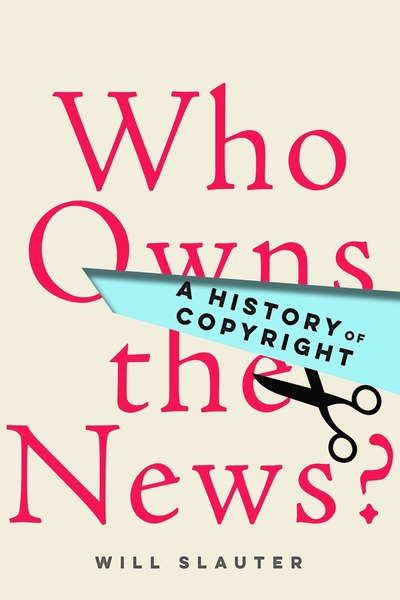
Out this month with Stanford University Press is Who Owns the News? A History of Copyright by Will Slauter, Université Paris Diderot. From the press:
Cover of Who Owns the News? by Will SlauterYou can't copyright facts, but is news a category unto itself? Without legal protection for the "ownership" of news, what incentive does a news organization have to invest in producing quality journalism that serves the public good? This book explores the intertwined histories of journalism and copyright law in the United States and Great Britain, revealing how shifts in technology, government policy, and publishing strategy have shaped the media landscape. 
Publishers have long sought to treat news as exclusive to protect their investments against copying or "free riding." But over the centuries, arguments about the vital role of newspapers and the need for information to circulate have made it difficult to defend property rights in news. Beginning with the earliest printed news publications and ending with the Internet, Will Slauter traces these countervailing trends, offering a fresh perspective on debates about copyright and efforts to control the flow of news.
Praise for the book: 

 "This history of the idea and practice of trying to control news by treating it as intangible property is an important and hugely timely work—brilliantly researched and presented with real sophistication." —Lionel Bently

"Who Owns the News? is a meticulous and fascinating history of attempts over four centuries to copyright news, but it is also much more than that. Will Slauter has given us a commercial history of journalism, which demonstrates that news is a public good that always needs to be embedded in a set of favorable arrangements in order to survive. It is a useful corrective to today's bromides about the promise of new forms of market support for news, at a time when its economic base has severely eroded." —Nicholas Lemann

"A gripping tale, mixing the high principle of Supreme Court opinions with the low subterfuge of editors concocting fake news to expose pilfering rivals. At a moment of peril for both the news industry and the culture that depends on it, there could be no better demonstration of our need for a historical perspective on the most pressing issue of our time." —Adrian Johns

Further details are available here.

Wednesday, June 7, 2017

McNairn on Deliberative Democracy in Upper Canada

Jeffrey L. McNairn, Queen’s University published The Capacity to Judge: Public Opinion and Deliberative Democracy in Upper Canada, 1791-1854 with the University of Toronto Press in 2016. From the publisher:
The Capacity To Judge: Public Opinion and Deliberative Democracy in Upper Canada,1791-1854By the mid-nineteenth-century, "public opinion" emerged as a new form of authority in Upper Canada. Contemporaries came to believe that the best answer to common questions arose from deliberation among private individuals. Older conceptions of government, sociability and the relationship between knowledge and power were jettisoned for a new image of Upper Canada as a deliberative democracy. 
The Capacity to Judge asks what made widespread public debate about common issues possible; why it came to be seen as desirable, even essential; and how it was integrated into Upper Canada's constitutional and social self-image. Drawing on an international body of literature indebted to Jürgen Habermas and based on extensive research in period newspapers, Jeffrey L. McNairn argues that voluntary associations and the press created a reading public capable of reasoning on matters of state, and that the dynamics of political conflict invested that public with final authority. He traces how contemporaries grappled with the consequences as they scrutinized parliamentary, republican and radical options for institutionalizing public opinion. The Capacity to Judge concludes with a case study of deliberative democracy in action that serves as a sustained defense of the type of intellectual history the book as a whole exemplifies.


You can read more about the book here.