Showing posts with label Contract. Show all posts

Thursday, March 26, 2026

AJLH 64:4

We're a bit late in noticing it, but the American Journal of Legal History 64:4 has been published

Mr Locke’s enclosure: the uncommon law of property in the Second Treatise
Hannah Carrese

John Locke, famously, told a property origin story. This article tells a property theory origin story, asking how Locke’s property theory, which omits common rights, emerged from a common law of property that centred them—and showing how this omission influenced the colonial American law that Locke drafted. Locke was silent on or rejected the common law of property, which recognized common rights and defences against privatization of commons through enclosure. Instead, Locke adopted law reform arguments lauding enclosure because it improved waste land. Locke’s property theory therefore attempts to improve the common law of property by orienting it around private rather than common property. He asks a question about the origin of property absent from common law: how do we create private rights to common land? He takes ‘waste’ to have purely negative connotations, avoiding the neutral meanings of that word at common law. And he stipulates that enclosure of English commons requires only tacit consent of commoners, excluding common law defences against enclosure. Locke’s is an equal opportunity enclosure. His spoilage principle and plan to reform Virginia’s land laws sought to benefit the poor by preventing vast enclosures and rural depopulation. However, he theorized a clean chain of title, absent in common law, which could prevent messy disputes over wealthy estates. This article shows the common law background from which Locke departed, thus deepening understanding of both our private property regime, often justified by Locke’s property theory, and a sometimes-overlooked alternative to it, the common law of property.
The laws of ‘an old and settled society’? The law of contract in New South Wales 1815–1850
Warren Swain

The history of contract law in New South Wales in the decades after the closure of the Court of Civil Jurisdiction in 1814 has not received much attention from legal historians. This is an important omission. At the heart of this story is a simple but critical inquiry: the way in which the law of contract in the colony mirrored or diverged from the law of contract that applied back in London. This was rarely a matter that judges addressed explicitly. Piecing together the relationship is an exercise in reconstruction. This can only be done by examining the body of case law. The creation of the Australasian Colonial Legal History Library, combined with readily searchable newspaper reports, has made this easier. The evidence in the mid-nineteenth century is still sometimes sketchy. Context is relevant. The colony moved from a quasi-military penal colony to a significant hub of commercial activity. The period also saw a shift in the legal system as the old informal systems evolved into a much more legalistic one. For the most part, New South Wales contract law was aligned with that in England. Some issues, like the desertion of sailors demanded local solutions. There are other examples in which well-established English contract doctrine did not necessarily fit very well with the conditions of the colony.
Who is a central bank for? The founding and legal design of the Bank of Canada
Dan Rohde

The Bank of Canada is an independent Crown corporation that sees its primary responsibility to be promoting Canada’s economic welfare by maintaining low and stable inflation. When it was first created in 1934, however, the Bank was a radically different institution—a privately owned corporation primarily meant to anchor Canada’s economy globally and manage foreign exchange. Not only was the Bank not tasked with managing inflation, but key policymakers behind its founding thought doing so would be a severe mistake. This article offers the first legal history of the Bank’s founding. It maps the enormous public debate that accompanied the creation of the Bank and the various, often contradictory visions expressed for it. The article labels these five visions: a Bankers’ Bank, a Government Bank, an Imperial Bank, an Economists’ Bank, and a Bank of the People. The article then looks at the original legal design of the Bank and argues that it largely fit the Imperial Bank model. Charting this history helps us better understand this vital organ of Canadian government, and has the potential to upset many of our accepted, contemporary notions of central banking.

--Dan Ernst 

Wednesday, July 9, 2025

Exploring the Foundations of Contract Law

Cause and Consideration: Exploring the Foundations of Contract Law, an anthology edited by Bruno Rodríguez-Rosado, Rocío Caro Gándara, and Antonio Legerén-Molina, has been published by Hart/Bloomsbury.  The publishers tell us that you may order it online here and use the code GLR BD8 to get 20 percent off.

This book provides a comprehensive study of two parallel notions of civil and common law: cause and consideration . . .  in three ways; with historical, comparative, and functional perspectives. Aspects of cause and consideration are hotly contested by contract lawyers and this book will bring clarity by looking at the English and Continental positions. Key areas of focus include: enforceability, questions of legality and morality, contractual justice, and the correction of unjustified property displacements.

Bringing together a team of experts, the book discusses (in some cases for the first time in English) complex questions of both academic and practical importance.
–Dan Ernst. TOC after the jump.

Saturday, November 30, 2024

Weekend Roundup

  • The Institute for Advanced Legal Studies at the University of London has announced the establishment of the Law and the Humanities Hub (LHub), led by Anat Rosenberg.  It “aims to foster academic expertise, creativity, and intellectual leadership in law and the humanities.”  Here are its 2024/25 Visitors.
  • The Illinois Supreme Court Historic Preservation Commission has digitized approximately 3,700 case files from 1819 to 1865.  Its "freely accessible and user-friendly website . . . will be publicly available within the next few months."  More.
  • The University of Chicago Law School will host a book launch for Curtis Bradley’s Historical Gloss and Foreign Affairs: Constitutional Authority in Practice, with comments by Will Baude and David Strauss, on Wednesday, December 3, 12:15pm to 1:10pm, at the Law School.  The event is open to the public.
  • A notice of a conference at Kings College London in support of the Cambridge History of International Law volume on the Pacific from circa 1500 until 1920 (KCL).
  • The next session in the American Society for Legal History series, Making Connections: New Works in Legal History, will occur on Wednesday, December 11, 6-7pm Central Time. Chlöe Kennedy will discuss her Inducing Intimacy: Deception, Consent and the Law (2024) with interlocutor Catherine Evans.  ASLH President Barbara Welke will moderate.  Register here.
  • On Lawfare's "Chatter" podcast, Rachel Shelden, Penn State University, discusses how widespread violence and another civil war were avoided as the nation resolved the disputed presidential election of 1876.
  • Thomas McSweeney's Jot on Ada Maria Kuskowski's, "The Time of Custom and the Medieval Myth of Ancient Customary Law," 99 Speculum 143 (2024).
  • ICYMI: Sandra Day O'Connor was no conservative (HNN).  The price America paid for the Chinese Exclusion Act (NPR).  Open access (for a few more days): The Case of the Slave Ship Zong (History Today).

 Weekend Roundup is a weekly feature compiled by all the Legal History bloggers.

Tuesday, October 15, 2024

Lodz Anglo-American Legal Workshop

[We have the following announcement.  DRE.]

Lodz Anglo-American Legal Workshop

Organized by the Centre for Anglo-American Legal Tradition, University of Lodz, Academic Year 2024/2025

23 October 2024 – Jan Kunicki (University of Warsaw), The Significance of Roman-Dutch Law
in Scope of the Law of Marriages in Contemporary Zimbabwe
.

19 November 2024 – Prof. Cynthia Nicoletti (University of Virginia), The Grant of “Possessory
Title” and the Special Field Orders No. 15.


04 December 2024 – Dr Ashley Hannay (University of Manchester), "Damna Usuum":
Rethinking the Passage of the Statute of Uses (1536)
.

29 January 2025 – Rosalind Ackland (University of Cambridge), Edward Coke’s Classical
Common Law
.

05 February 2025 – Michał Zapała (University of Lodz), Life and Codification Activity of David
Dudley Field.


19 March 2025 – Prof. Jan Halberda (Jagiellonian University), The Introduction of Good Faith
and Fair Dealing into American Contract Law. Between Common Law and Civil Law.

All workshops will take place in hybrid format. In-person par9cipants are invited to
join us at the Centre for Anglo-American Legal Tradi9on (Faculty of Law and Administration building, room 0.09, ground floor). Online viewers must register to aIend each workshop. The registration form will be distributed online via social media approximately one week before the workshop. All workshops start at 5PM (Poland and most European countries) / 4PM (UK and Ireland) / 11AM (US Eastern Coast). In case of any question please don’t hesitate to contact us by emailing Anglo-AmericanLT@wpia.uni.lodz.pl.

Tuesday, September 24, 2024

Swain on Contractual Rectification

Warren Swain, University of Auckland Faculty of Law, has posted Not Worth the Paper it's Written on: Contractual Rectification: An Historical Account, which appeared in the Journal of Equity 17 (2023): 161-180.

Written contracts have been important for millennia. They bring certain evidentiary advantages. Problems may also arise, however, when the written document fails to reflect the intentions of the parties. This is why the equitable doctrine of rectification is so important. In certain limited circumstances, it allows the written words in the contract to be modified. In recent decades, there have been considerable debates about the proper scope of rectification. These questions cannot be understood properly without a proper grasp of the history of the subject. Rectification did not develop in isolation. It was shaped by developments within the law of contract, including the parol evidence rule, the rise in commercial contracting and was impacted by the way that contracts came to rationalised. Set alongside these considerations there is a different tradition of preventing unconscionable behaviour in equity.
--Dan Ernst

Friday, April 5, 2024

Springer on Contracts and Homophile Legal Strategy

Jackson Springer, a 3L at Columbia Law School, has published his note, Contracts and Homophile Legal Strategy, in the Columbia Law Review.

One Magazine (USC)
Law was central to the homophile movement, the main movement for queer rights between World War II and Stonewall. But examinations of this movement’s engagement with law have exclusively focused on public law. Private law has received virtually no attention. This Note corrects that oversight. It unearths instances in which groups advocating for queer rights invoked contract law during the 1950s and 1960s. These moments reveal contract law’s important—and previously overlooked—role in homophile legal strategy.

Homophile groups’ use of contract law changed over the two decades of the movement. During the 1950s, those in the homophile movement used contract law to avoid legal disputes—a sort of “preventative law” that shielded queer people from the outside world’s scrutiny. But after the movement’s militarization in the early 1960s, queer organizations began making affirmative claims based in contract law. These claims served two purposes. On one hand, they were a tool queer people used to protect their public law rights when those rights were under attack. But organizations also saw the assertion of contract law rights as a goal itself—a key part of queer people’s growing rights consciousness.

This Note thus gives contract law its rightful due in the history of homophile legal strategy. Its findings demonstrate that private law should play a larger role in both our study of social movements’ legal strategy and our vision of a future in which marginalized groups have full equality under the law.
The Note draws upon the archives of ONE Magazine, “the United States’ first widely distributed queer publication.”

--Dan Ernst

Tuesday, November 28, 2023

English Law, the Legal Profession, and Colonialism

English Law, the Legal Profession, and Colonialism: Histories, Parallels, and Influences, edited by Cerian Griffiths, Northumbria University, and Lukasz Jan Korporowicz, University of Lodz (Routledge, 2024):

Modern legal history is increasingly interested in exploring the development of legal systems from novel and nuanced approaches. This edited collection harnesses the lesser-researched perspectives of the impact of global and imperial factors on the development of law. It is argued that to better understand these timely discussions, we must understand the process and significance of colonisation itself. The volume brings together experts in the field of law and history to explore the ways in which law and lawyers contributed to the expansion of the British Empire, and the ways in which the Empire influenced the Metropole. The book sheds new light on the role of the law and legal actors during the pivotal centuries that saw the establishment of the Empire. Exploring such topics as Atlantic relations, the impact of British jurists upon Indian law, and the development of the law settler colonies, this collection reveals some of the lesser-known intersections between law, history, and empire. The book will be of interest to students and researchers in legal history, comparative history, equity and trusts, contract law, the legal profession, slavery, and the British Empire.
TOC after the jump.

--Dan Ernst

Monday, June 19, 2023

Kennedy on Walker-Thomas

Duncan Kennedy, Harvard Law School, has posted The Bitter Ironies of Williams v. Walker-Thomas Furniture Co. in the First Year Law School Curriculum, which appears in the Buffalo Law Review:

This article severely criticizes the way first-year law teachers and casebook writers teach the famous case of Williams vs. Walker-Thomas Furniture Co. The court granted relief to a poor Black woman, living on welfare in a poor neighborhood of the District of Columbia in 1965, who had signed a series of one-sided credit sale contracts for household goods. The case has stood, against the intention of the holding, for the conventional wisdom that the regulation of terms in consumer contracts hurts the people it is supposed to help (Part I and II). The second part of the article presents in strictly conventional neo-classical welfare economic terms the better, although still only marginally accepted, position that the consequences are variable depending on the configuration of the market in question (Part III). The third part collects the surprisingly large amount of data available about the market and the specific transaction in Williams. It shows that given the exploitative character of the seller/lender’s sales practices, it is overwhelmingly likely that banning the clause in question benefited Ms. Williams at the expense of Walker-Thomas (Part IV and V). The conclusion argues for the relevance of the analysis to today’s analogous consumer credit abuses. 
--Dan Ernst

Saturday, May 27, 2023

Weekend Roundup

  • The Immigration and Ethnic History Society "is offering two awards, up to $1,500 each, to support graduate students seeking to develop or engage with digital history work connected to migration history and related fields." 
  • The deadline for submissions for the Irish Legal History Society's student-essay competition is Wednesday, May 31 (Law Society Gazette).
  • Medieval Leases and Modern Leases in English Law, a lecture by Dr. Lorren Eldridge, an Early Career Fellow at the University of Edinburgh, presented recently to the Centre for English Legal History at the University of Cambridge, is now available on YouTube.
  • Michael Z. Green, Texas A&M Law, on Dylan C. Penningroth, Race in Contract Law, 170 U. Pa. L. Rev. 1199 (2022) in JOTWELL.
  • Among the recipients of grants to improve public access to historical records from the National Archives is the Chicago Covenants Project, “which draws on volunteers to locate, digitize, and make available racially restrictive covenants in the analog land records from Cook County, through a project sponsored by Virginia Tech University.”
  • The Center for Political Economy at Columbia World Projects has announced the first recipients of its program granting Columbia University faculty “support to engage in interdisciplinary research that promotes new approaches to political economy.”  They include Kellen Funk for “Cities of Bail: Mapping the market of bail bond securities on urban communities” and Richard R. John for “Bad Business: Anti-trust as anti-monopoly.”
  • Charles L. Barzun, University of Virginia School of Law, and John C. P. Goldberg, Harvard Law School, have posted their introduction to the symposium in the Yale Journal of Law and the Humanities honoring the centenary of Benjamin Cardozo’s The Nature of the Judicial Process.
  • David W. Blight reviews James Oakes’s The Crooked Path to Abolition: Abraham Lincoln and the Antislavery Constitution (NYRB).
  • ICYMI:  “What the Constitution Means to” Joanna Grisinger and Kate Masur (Northwestern Now). 

Weekend Roundup is a weekly feature compiled by all the Legal History bloggers.

Tuesday, May 9, 2023

Author's Query: Arthur Corbin

We noted with interest an author's query in the May 11 issue of the New York Review of Books

Prof. Corbin's grandson has unpublished autobiography & recordings, including pivotal role at Yale Law; seeks agent, benefactor, biographer, or publisher.  philip.corbin@aol.com

--Dan Ernst

Wednesday, May 3, 2023

ALI: A Centennial History

The American Law Institute: A Centennial History, edited by Andrew S. Gold and Robert W. Gordon, has been published by Oxford University Press:

This book collects together a series of original essays in honor of the American Law Institute’s (ALI’s) Centennial. The essays are authored by leading experts in their fields, often including current and former Restatement Reporters. The essays also provide a wide range of perspectives on both methodology and the law. The volume coverage focuses on specific ALI undertakings, including some of the more important Restatements and Codes; several leading Principles projects; statutory projects such as the Model Penal Code and the Uniform Commercial Code; themes that cut across substantive fields of law (such as Restatements and codification or Restatements and the common law); and the ALI’s institutional history over the past century. The resulting book is a unique and compelling contribution to its fields of study.

TOC here, but but note that many of the chapters are open access, including Robert W. Gordon's Restatements and Realists.

--Dan Ernst

Friday, March 3, 2023

"Scholars of Contract Law"

New from Hart Publishing/Bloomsbury: Scholars of Contract Law, edited by James Goudkamp and Donal Nolan:

This book provides a counter-balance to the traditional focus on judicial decisions by exploring the contribution of legal scholars to the development of private law.

In the book the work of a selection of leading scholars of contract law from across the common law world, ranging from Sir Jeffrey Gilbert (1674–1726) to Professor Brian Coote (1929–2019), is addressed by legal historians and current scholars in the field. The focus is on the nature of the work produced by the scholars in question, important influences on their work, and the impact which that work in turn had on thinking about contract law. The book also includes an introductory chapter and an afterword by Professor William Twining that explore connections between the scholars and recurrent themes.

The process of subjecting contract law scholarship to sustained analysis provides new insights into the intellectual development of contract law and reveals the central role played by scholars in that process. And by focusing attention on the work of influential contract scholars, the book serves to emphasise the importance of legal scholarship to the development of the common law more generally.

TOC after the jump. I can recommend my colleague Greg Klass's illuminating chapter on Arthur Corbin.

--Dan Ernst

Wednesday, March 1, 2023

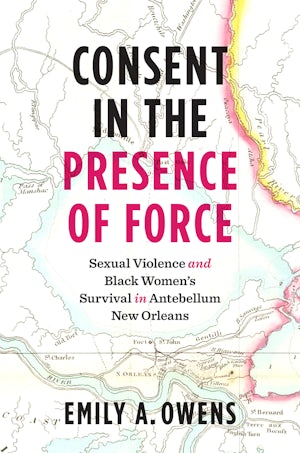
Owens, "Consent in the Presence of Force Sexual Violence and Black Women's Survival in Antebellum New Orleans"

The University of North Carolina press has published Consent in the Presence of Force
Sexual Violence and Black Women's Survival in Antebellum New Orleans
(2022), by Emily A. Owens (Brown University). A description from the Press: 

In histories of enslavement and in Black women's history, coercion looms large in any discussion of sex and sexuality. At a time when sexual violence against Black women was virtually unregulated—even normalized—a vast economy developed specifically to sell the sexual labor of Black women. In this vividly rendered book, Emily A. Owens wrestles with the question of why white men paid notoriously high prices to gain sexual access to the bodies of enslaved women to whom they already had legal and social access.

Owens centers the survival strategies and intellectual labor of Black women enslaved in New Orleans to unravel the culture of violence they endured, in which slaveholders obscured "the presence of force" with arrangements that included gifts and money. Owens's storytelling highlights that the classic formulation of rape law that requires "the presence of force" and "the absence of consent" to denote a crime was in fact a key legal fixture that packaged predation as pleasure and produced, rather than prevented, violence against Black women. Owens dramatically reorients our understanding of enslaved women's lives as well as of the nature of violence in the entire venture of racial slavery in the U.S. South. Unsettling the idea that consent is necessarily incompatible with structural and interpersonal violence, this history shows that when sex is understood as a transaction, women are imagined as responsible for their own violation.

Advance praise:

"In Consent in the Presence of Force, Owens exactingly demonstrates the gaping and lingering question in the historiography of gender and slavery—how do we read sexual relations between enslaved women and white men beyond the failing dichotomy of consent and coercion? This question has been raised, theorized, and analyzed without a satisfying resolution that approximates the actual legal, social, and affective conditions of female-gendered enslavement. Owens offers completely new ways to account for Black women's subtle, but not less violent, vulnerability to sexual danger in the antebellum South."—Marisa J. Fuentes

"A necessary and highly anticipated work that dramatically upends current conceptions of sexual violence. Owens has given us a book that both crucially advances the historical literature and supersedes that historiography with broader scholarly and political reverberations."—Sarah Haley

More information is available here. An interview with Professor Owens about the book is available here, at New Books Network.

-- Karen Tani

Monday, December 19, 2022

Hoeflich and Sheppard's "Lucy and the Judge"

M.H. Hoeflich and Stephen Sheppard have published Lucy and the Judge: Wood v. Lucy, Lady Duff-Gordon (Talbot Publishing):
With this fun collection, Mike Hoeflich and Steve Sheppard invite readers to explore the story behind an iconic American contract law case, Wood v. Lucy, Lady Duff-Gordon. In addition to personal reflections from the authors on the case and its legacy, it includes a brief summary of existing scholarship about the case and the parties, a reprint of the contract and Judge Cardozo's opinion, and selections from Sears's catalogue featuring Lady Duff-Gordon's designs.
--Dan Ernst

Monday, December 12, 2022

Penningroth, "Race in Contract Law"

The University of Pennsylvania Law Review has published "Race in Contract Law," by Dylan Penningroth (University of California, Berkeley). Here's the abstract:

Modern contract law is rife with ideas about race and slavery and cases involving African Americans, but that presence is very hard to see. This Article recovers a hidden history of race in contract law, from its formative era in the 1870s, through the Realist critiques of the early 1900s to the diverse intellectual movements of the 1970s and 80s. Moving beyond recent accounts of “erasure,” and complementing Critical Race Theorists’ insights about law’s role in constructing, naturalizing, and justifying racial inequality, the Article offers a historically rich account of when, where, and why legal professionals have highlighted race in contract law.

The full article is available here.

-- Karen Tani

Tuesday, January 25, 2022

CFP: A Conference on Coverture

 [We have the following announcement.  DRE.]

Married Women and the Law in Britain, North America, and the Common Law World, Gainesville, Florida, May 5-8, 2022

The University of Florida, Levin College of Law is hosting a conference on all aspects of coverture, broadly defined.  This intimate conference will enable the participants to consider issues of marriage and married women's legal disabilities through multiple lenses, including by time period, legal system, as a colonial export, its economic and social impacts, as literary representations, and many others.  If you are working on aspects of married women's legal incapacities in the common-law world, please consider submitting a paper.  Accommodations for panelists during the conference will be covered. Publication opportunity may be available.

Please submit a 200 word abstract of your paper to Danaya Wright at wrightdc@law.ufl.edu by March 1, 2022 for consideration, or if you have any questions.

Friday, January 7, 2022

Swain on Contract in 19th-Century New South Wales

Warren Swain, University of Auckland Faculty of Law, has posted The Laws of "An Old and Settled Society"? The Law of Contract in New South Wales in the Mid-Nineteenth Century:

The history of contract law in New South Wales in the decades after the closure of the Court of Civil Jurisdiction in 1814 hasn’t received much attention from legal historians. This is an important omission. At the heart of this story is a simple but critical inquiry about the way in which the law of contract in the colony mirrored or diverged from the law of contract that applied back in London. This was rarely a matter that judges addressed explicitly. Piecing together the relationship is an exercise in reconstruction. This can only be done by examining the body of case law. The creation of the Australasian Colonial Legal History Library combined with readily searchable newspaper reports has made this task easier. The evidence in the mid-nineteenth century is still sometimes sketchy. Context is relevant. The colony moved from a quasi-military penal colony to a significant hub of commercial activity. The period also saw a shift in the legal system as the old informal systems evolved into a much more legalistic one. Some issues like the desertion of sailors demanded local solutions. In fact there are a range of examples in which well-established English contract doctrine did not necessarily fit very well with the conditions of the colony.
--Dan Ernst

Tuesday, December 21, 2021

DeBrincat on Salvage and Contract in Colonial Connecticut

We recently learned of two articles you might have missed, both by Dominic DeBrincat, Missouri Western State University.  The first is The Spanish Ship Affair: Wreck, Salvage, and Contested Legal Authority in Colonial Connecticut, Early American Studies: An Interdisciplinary Journal 19, no. 4 (Fall 2021): 699-734:

In 1752, a wounded Spanish ship—laden with gold, silver, indigo, and other valuable goods—wrecked along the Connecticut coast. This episode initially appeared to be a tale of Samaritans rescuing the crew and safekeeping their payload. Such hospitality yielded to avarice as the loosely guarded cargo was plundered. This article looks closely at the county court in New London, Connecticut, to examine how judges, jurors, and local legal officials shouldered the burdens of securing some sense of justice for Spanish officials and British colonists ensnared in what became known as “The Spanish Ship Affair.” It highlights the importance of local colonial courts in maintaining peace, not only in their respective communities, but also in greater imperial contexts. This was especially important in the wake of ineffective responses from the governor, colonial assembly, and vice-admiralty court—institutions purportedly designed to handle inter-imperial conflicts. Emphasis on this county court reveals a flexible judiciary creatively punishing unredeemable criminals, merciful jurors willing to forgive repentant neighbors, and the resultant long-term changes in Connecticut’s political landscape and its legal approaches to shipwrecks.
The second is The Long, Salty Arm of the Law: Colonial Connecticut’s Litigated Maritime Economy and the Origins of Modern Contracts, International Journal of Maritime History, 33 , no. 4 (November 2021): 690-706:

This article examines maritime trade litigation tied to a typical New England jurisdiction – New London County, Connecticut – to reveal two important eighteenth-century trends. First, decision-makers prioritized honouring contract promises – a critical shift from earlier Puritan ideals that privileged fairness in agreements. This transition was essential to developing what became the will theory of contract, in which promise and performance replaced equity as the measures of valid agreements. This shift appeared in Connecticut nearly a century before scholars have suggested it did in the United States. The second trend involves litigants’ choice of court. Despite the availability of several tribunals for pursuing maritime-based legal actions, parties regularly chose the county court to resolve their issues. In an expanding and increasingly impersonal Atlantic marketplace, parties preferred the flexible and familiar proceedings of the local court because judges and jurors treated mariners as if they carried Connecticut's legal protections with them on their distant travels.
–Dan Ernst

Wednesday, August 4, 2021

Labuza on Lawyers and Movie Deals after the Studio System

It’s gated but interesting: Peter Labuza has published When a Handshake Meant Something: The Rise of Entertainment Law in Post-Paramount Hollywood in the JCMS: Journal of Cinema and Media Studies 60 (Summer 2021): 61-84:

Following the end of the Hollywood studio system, the entertainment lawyer emerged as a new profession, uniting studios and independent producers through a process of contract negotiation that became central to the industry’s operations. After United States v. Paramount, Inc. (1948), attorneys adapted to the needs of the industry by using dealmaking contracts to align the incentives of cautious financiers and ambitious creatives to work together. This article follows attorney Leon Kaplan and his role in negotiating the paradoxical motivations of corporate finance and radical art that defined New Hollywood.

--Dan Ernst