Showing posts with label monasticism. Show all posts

Friday, November 3, 2017

Chatterjee on women, monks, and coverture

In 2016, Indrani Chatterjee, University of Texas at Austin, published "Women, Monastic Commerce, and Coverture in Eastern India circa 1600-1800 CE" in Modern Asian Studies 50:1, 175-2016. Here's the abstract:
This article argues that economic histories of the transition to colonial economics
in the eighteenth century have overlooked the infrastructural investments that
wives and widows made in networks of monastic commerce. Illustrative examples
from late eighteenth-century records suggest that these networks competed with
the commercial networks operated by private traders serving the English East
India Company at the end of the eighteenth century. The latter prevailed. The
results were the establishment of coverture and wardship laws interpellated
from British common law courts into Company revenue policies, the demolition
of buildings. and the relocation of the markets that were attached to many of
the buildings women had sponsored. Together, these historical processes made
women’s commercial presence invisible to future scholars.

Monday, May 22, 2017

Schonthal on Constitutionalism and Religion in Sri Lanka

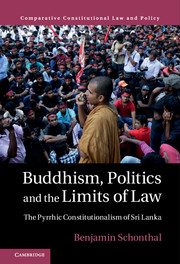
Benjamin Schonthal, University of Otago, published Buddhism, Politics and the Limits of Law: The Pyrrhic Constitutionalism of Sri Lanka with Cambridge University Press in 2016. The book takes a historical approach in Part I, especially. From the publisher:
Buddhism, Politics and the Limits of LawIt is widely assumed that a well-designed and well-implemented constitution can help ensure religious harmony in modern states. Yet how correct is this assumption? Drawing on groundbreaking research from Sri Lanka, this book argues persuasively for another possibility: when it comes to religion, relying on constitutional law may not be helpful, but harmful; constitutional practice may give way to pyrrhic constitutionalism. Written in a lucid and direct style, and aimed at both specialists and non-specialists, Buddhism, Politics and the Limits of Law explains why constitutional law has deepened, rather than diminished, conflicts over religion in Sri Lanka. Examining the roles of Buddhist monks, civil society groups, political coalitions and more, the book provides the first extended study of the legal regulation of religion in Sri Lanka as well as the first book-length analysis of the intersections of Buddhism and contemporary constitutional law.
The book provides the first detailed history of the legal regulation of religion in late and postcolonial Sri Lanka, which will be of interest to scholars of religious and legal history in South Asia. It draws upon previously unexamined sources and original ethnography in Sinhala, Tamil and English, offering new data and insights into Sri Lanka's political, legal and religious history.
A review:

"There is nothing the study of law and religion needs more than deeply informed political and religious histories of postcolonial states and societies. This is exactly what this book offers. In an exhaustively researched legal ethnography of the treatment of religion in Sri Lankan constitutionalism, Benjamin Schonthal explores how Sri Lankans have wrestled with the tensions generated by a legal order that guarantees religious rights while also granting to the majority religion of Buddhism its 'rightful place'. Is it possible for the state to protect a tradition without interfering in it? Who speaks for Buddhism in these debates? This sobering story of the limits of law is a must-read for scholars of religion and politics, Buddhist studies, and comparative constitutional law." -Elizabeth Shakman Hurd

TOC after the break.