Showing posts with label Jewish law. Show all posts

Thursday, October 17, 2019

Echevarria, Monferrer-Sala, Tolan and friends on law and religious minorities

We missed this one back in 2017: A. Echevarria (Universidad Nacional de Educación a Distancia, Madrid), J. P. Monferrer-Sala (Universidad de Córdoba), and J. V. Tolan (Université de Nantes) have co-edited Law and Religious Minorities in Medieval Societies: Between Theory and Praxis with Brepols Publishers. From the press:

This volume shows through the use of legal sources that law was used to try to erect boundaries between communities in order to regulate or restrict interaction between the faithful and the non-faithful; and at the same time shows how these boundaries were repeatedly transgressed and negotiated.
Muslim law developed a clear legal cadre for dhimmīs, inferior but protected non-Muslim communities (in particular Jews and Christians) and Roman Canon law decreed a similar status for Jewish and Muslim communities in Europe. Yet the theoretical hierarchies between faithful and infidel were constantly brought into question in the daily interactions between men and women of different faiths in streets, markets, bath-houses, law courts, etc. The twelve essays in this volume explore these tensions and attempts to resolve them. These contributions show that law was used to try to erect boundaries between communities in order to regulate or restrict interaction between the faithful and the non-faithful — and at the same time how these boundaries were repeatedly transgressed and negotiated.
Table of Contents after the jump:

Monday, March 25, 2019

Two articles on Jewish law in French history

Back in 2017, raldine Gudefin (American University) published two articles on Jewish law in French history. We missed these earlier. Here are some details:

(1) "Creating Legal Difference: The Impossible Divorce of Russian Jews in Early Twentieth-Century France," Nashim: A Journal of Jewish Women's Studies & Gender Issues 31 (2017), 11-36

Abstract: Much of the scholarship on Jewish divorce assumes that civil marital laws are beneficial to Jews. This article complicates that assumption by focusing on a rarely acknowledged aspect of Jewish immigration in France. As France moved towards a stricter understanding of the separation of church and state, civil courts rejected the possibility of applying religious divorce laws to foreigners. Combined with the French practice of applying foreign law in cases involving immigrants, this shift resulted in Russian Jews being denied the right to civil divorce from 1905 to the 1920s. The confessional nature of Russian divorce thus continued to shape the lives of Russian Jews even after their immigration to France. The case of Russian Jewish divorce casts light on the shifting and contradictory understand-ings of the separation of church and state in France during the early years of the twentieth century.

(2) "Reforming Jewish Divorce: French Rabbis and Civil Divorce at the Turn of the Twentieth century (1884-1907" in Martine Gross, Sophie Nizard, and Yann Scioldo-Zurcher, eds., Gender, Families and Transmission in the Contemporary Jewish Context (2017)

Excerpt from introduction: "In the months and years following the passage of the law of 1884 [restoring civil divorce in France], rabbis in France became increasingly aware of the plight of Jewish women who were denied a religious divorce. Over the next two decades, French rabbis designed myriad proposals in an effort to reform Jewish marital laws and  prevent the problem of
agunot; these rabbinical proposals became widely  publicized in the French Jewish press. This article examines the manifold suggestions for reforming Jewish divorce between 1884 and 1907, focusing particularly on the conflicting pressures faced by French rabbis. On the one hand, Jewish communal leaders were extremely influenced by French debates about civil divorce, sharing similar ideas with reformers of civil divorce about the adaptive nature of the law and the need for more  balanced gender relations. On the other hand, owing to the transnational nature of Jewish law and life, the discussion about religious divorce transcended France's national borders, thus complicating attempts at reform."

Further information is available here.

Saturday, August 5, 2017

Weekend Roundup

  • The ASLH’s website has the CFP for Laws Across Codes and Laws Decoded, the ESCLH Conference to be held June 28-30, 2018, at the Ecole Normale Supérieure (Paris).  “The conference will focus on the issue of codes or alternatives to codes as instruments of transforming laws in Europe and in the world.”
  • Barry Friedman, NYU Law, on Fixing Law Reviews.  Among his suggestions: "blind submission, elimination of submitting articles to one’s own school, some form of peer review, and limiting submissions or requiring authors to accept the offer they receive."  He also has suggestions for "the editing process, which—at present—is out of control."  H/t: Legal Theory Blog.  
  • On Monday, September 11, Jeremi Suri, University of Texas, will deliver the W. R. Louis Lecture, on The Impossible Presidency: The Rise and Fall of America’s Highest Office, in the  Washington History Seminar at the Wilson Center, 1300 Pennsylvania Ave NW, Washington, DC
  • On August 19, at 4:00 p.m. at the Franklin D. Roosevelt Library: The New Deal: The Grandchildren Speak, with James Roosevelt, Jr., David Wallace Douglas, June Hopkins and Tomlin Perkins Coggeshall.
  •  ICYMI: Becky Little, on Bakke, on the History Channel’s “History Stories” website; Tom van der Voort, on the creation of Medicare and Medicaid on the Miller Center's website; Bill Moyers recalls JBJ's role in their passage.  Also, Scott Bomboy, of the National Constitution Center, on the Zenger trial as “a huge free press victory by the original Philadelphia lawyer.”
Weekend Roundup is a weekly feature compiled by all the Legal History bloggers.

Friday, July 7, 2017

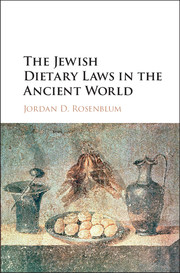
Rosenblum on Jewish Dietary Laws

Jordan D. Rosenblum, University of Wisconsin–Madison has published The Jewish Dietary Laws in the Ancient World with Cambridge University Press. From the publisher:
The Jewish Dietary Laws in the Ancient WorldIn The Jewish Dietary Laws in the Ancient World, Jordan D. Rosenblum explores how cultures critique and defend their religious food practices. In particular he focuses on how ancient Jews defended the kosher laws, or kashrut, and how ancient Greeks, Romans, and early Christians critiqued these practices. As the kosher laws are first encountered in the Hebrew Bible, this study is rooted in ancient biblical interpretation. It explores how commentators in antiquity understood, applied, altered, innovated upon, and contemporized biblical dietary regulations. He shows that these differing interpretations do not exist within a vacuum; rather, they are informed by a variety of motives, including theological, moral, political, social, and financial considerations. In analyzing these ancient conversations about culture and cuisine, he dissects three rhetorical strategies deployed when justifying various interpretations of ancient Jewish dietary regulations: reason, revelation, and allegory. Finally, Rosenblum reflects upon wider, contemporary debates about food ethics.
TOC after the jump.

Wednesday, January 4, 2017

Marglin on Jews and Muslims in Morocco

Out now with Yale University Press is Across Legal Lines: Jews and Muslims in Modern Morocco by Jessica M. Marglin, University of Southern California. From the publisher:
A previously untold story of Jewish-Muslim relations in modern Morocco, showing 
how law facilitated Jews’ integration into the broader Moroccan society in which they lived. 
Morocco went through immense upheaval in the nineteenth and early twentieth centuries. Through the experiences of a single Jewish family, Jessica Marglin charts how the law helped Jews to integrate into Muslim society—until colonial reforms abruptly curtailed their legal mobility. Drawing on a broad range of archival documents, Marglin expands our understanding of contemporary relations between Jews and Muslims and changes the way we think about Jewish history, the Middle East, and the nature of legal pluralism.
Praise for the book:

“Jessica Marglin has achieved nothing less than a complete revision of the way that we view the Moroccan legal system in the late nineteenth century from the viewpoint of its Muslim and Jewish clients.” -Susan Gilson Miller

“This is an important book that deserves a wide readership. Through a vivid portrait of a Jewish family’s entanglement with the law in pre-colonial Morocco, it puts to rest die-hard tales about colonial modernization and the perennial animosity between Muslims and Jews.” -Francesca Trivellato

“With great erudition, insight, and empathy, Marglin dexterously charts a cultural world of precolonial North Africa in which individuals navigate a complex legal landscape. This is an essential book for scholars of North African and Middle Eastern Jewries, Morocco, the cultural history of law, and the legal history of culture.” -Sarah Abrevaya Stein

"Jessica Marglin's pathbreaking book sheds dramatic new light on the social, economic, and legal history of nineteenth century Morocco. Marglin deftly reconstructs the everyday ties by which Muslim and Jewish law and litigants accommodated each other in an unequal but integrated society." -James McDougall


More information is available here.