Showing posts with label jurisprudence. Show all posts

Tuesday, August 15, 2023

CFP: Historicising Jurisprudence: Person, Community, Form

[We have the following CFP.  DRE]

WG Hart Workshop 2024

Historicising Jurisprudence: Person, Community, Form 

Institute for Advanced Legal Studies, London, 26-27 June 2024

We invite abstracts (of 300-500 words) for the 2024 Hart Conference on Historicising Jurisprudence: Person, Community, Formf. Abstracts should be emailed to m.delmar@qmul.ac.uk by Monday 4 December 2023. Further details on the theme are included below. Please note that bursaries are available for PhD and Early Career Scholars as well as scholars from the Global South. There will also be a prize for the best paper from a PhD / Early Career Scholar.

Academic Directors. 
Maksymilian Del Mar (Queen Mary University of London); and Michael Lobban (All Souls College, Oxford)

Conference Keynotes. 
Professor David Armitage, Harvard University; Professor Paul Halliday, University of Virginia; Professor Lorna Hutson, University of Oxford; Professor Lena Salaymeh, Ecole pratique des hautes etudes, Paris, and University of Oxford    

PhD and Early Career Paper Prize. 
A prize will be offered to the best paper submitted by a PhD or Early Career Scholar. To be eligible for the prize, please first submit your abstract in the usual way. When you submit the abstract, please indicate clearly that you are a PhD or Early Career Scholar (within 5 years of your PhD). Once your abstract has been accepted, a further date will be set for the submission of a paper (approx. 6,000-8,000 words, all inclusive). Please note that the requirement to submit a written draft of the paper is only a requirement for those entering the prize (not for presenting at the conference). The prize will be judged by the Academic Directors.

Travel and Accommodation Bursaries.  A limited number of bursaries, contributing to travel and accommodation costs for the conference, is available for two categories of scholars: 1) those who are PhD students and Early Career Scholars (within 5 years of their PhD); and 2) those who live and work in the Global South. To be eligible for these, please indicate clearly you are applying for a bursary when you submit your abstract, and please confirm (e.g., by a statement on letterhead from your Head of School) that you either do not have access to other sources of funding or any funding you have is likely to be insufficient.

General Summary of the Theme.  Jurisprudence, or the philosophy of law, often appears as an abstract and impersonal domain of intellectual practice, and one divorced from the politics and culture of its time. Jurisprudential questions are often treated as timeless, with each jurisprudential text approached as articulating its own autonomous vision of a universal theory of law. The substance of jurisprudential ideas is also typically seen to be independent of the means via which these ideas are expressed, and thus separate from the history of aesthetics and the humanities, including literature and the arts. While recognizing the universal and impersonal aspirations of jurisprudence, this conference seeks to explore its historicization in particular times and places. The conference thus invites participants to take an alternative view of jurisprudence: as a human, all too human, practice, which is deeply personal while also being deeply social, and one that is shot through with historically-situated politics and culture. By digging deeply into its situated ethics, politics, and aesthetics, this conference will explore different ways of historicising jurisprudence. The conference will foreground and pursue the following kinds of questions:

  • How is the production of jurisprudential thought related to the personal, felt, experience of individuals who produce it, as well as to the role those individuals play in the power struggles of their time and place?
  • In what ways is jurisprudential thought a communal enterprise, and thus the result of many hands working together in irreducibly social contexts?
  • What are the forms and genres of jurisprudence, and how are those forms and genres related to the very substance of jurisprudential views?

More after the jump.

Tuesday, June 27, 2023

Likhovski on Jurisprudence and Nationalism in the British Empire

Assaf Likhovski, Tel Aviv University Buchmann Faculty of Law, has posted Jurisprudence and Nationalism in the British Empire in the Early Twentieth Century: India, Egypt, and Palestine Compared, which is forthcoming in the English Historical Review:

Radhabinod Pal (Wiki)
This article discusses works on jurisprudence produced by authors from three British-ruled territories (India, Egypt, and Palestine) in the early decades of the twentieth century. It argues that these works were part of a non-Western jurisprudential wave that appeared in different parts of the British Empire at the time. Legal scholars working in these territories were not passive recipients of legal ideas imported from the metropole: their works were more cosmopolitan than those produced in the United Kingdom, using ideas drawn from English thinkers but also referring to Continental and American historical and sociological theories of law. The use of such theories was combined with an interest in the ideas and values of local religious legal systems (Hindu law, Islamic law, and Jewish law, respectively). These systems were depicted as superior to Western law—not only because local legal scholars saw them as the historical source of Western jurisprudential conceptions but also because they were viewed as a possible source of collectivist values that would replace the individualist values of transplanted Western law. While there were many similarities between the works written in the three territories, the article also highlights certain differences in the way religious legal systems were viewed in the places examined. 
--Dan Ernst

Thursday, May 4, 2023

Hutchinson's "Hart, Fuller, and Everything After"

Allan C Hutchinson, Osgoode Hall Law School, has published Hart, Fuller, and Everything After: The Politics of Legal Theory (Bloomsbury):

More has been said about the Hart-Fuller debate than can be considered healthy or productive even within the precious world of jurisprudential scholarship – too much philosophising about how law has revelled in its own abstractness and narrowness. But the mission of this book is distinctly and determinedly different – it is not to rework these already-rehashed ideas, but to reject them entirely.

Rather than add to the massive jurisprudential literature that has been generated by all and sundry, the book criticises and abandons the project that Hart and Fuller set in motion. It contends that the turn that was taken in 1957 has led down a series of cul-de-sacs, blind alleys, and dead-ends to nowhere useful or illuminating. It is more than past time to leave their debate behind and strike out in an entirely new and more promising direction. The book insists that not only law, but also all theorising about law, is political in all its derivations, dimensions, and directions.
--Dan Ernst

Tuesday, April 18, 2023

Eldridge on Law and the Medieval Village Community

On Monday, April 24, 17:00 - 18:30 (GMT), Lorren Eldridge, an Early Career Fellow in Legal History at the University of Edinburgh, will present, via Zoom, some of the findings from her forthcoming book, Law and the Medieval Village Community: Reinvigorating Historical Jurisprudence (Routledge 2023).  Register here.

Historical jurisprudence was initially developed into a methodology by late Victorian scholars who were particularly interested in medieval English law. This paper will consider some of the ways they used historical jurisprudence, in which they combined influences from the German Historical School, the Scottish Enlightenment, and English political preoccupations. The approach to the village community in the work of Sir Henry Maine, Frederick W Maitland, and Sir Paul Vinogradoff used this novel method to generate new questions in medieval English law, and in the theoretical understanding of legal personality, individualism, and communalism. This paper will explore some of the research questions they pursued which have enduring interest in modern scholarship. 
--Dan Ernst

Wednesday, December 7, 2022

Porwancher and others' "Prophet of Harvard Law"

Andrew Porwancher, Austin Coffey, Taylor Jipp and Jake Mazeitis have published The Prophet of Harvard Law: James Bradley Thayer and His Legal Legacy (University of Kansas Press):

Amid the halls of Harvard Law, a professor of legend, James Bradley Thayer, shaped generations of students from 1874 to 1902. His devoted protégés included future Supreme Court justices, appellate judges, and law school deans. The legal giants of the Progressive Era—Holmes, Brandeis, and Hand, to name only a few—came under Thayer’s tutelage in their formative years.

He imparted to his pupils a novel jurisprudence, attuned to modern realities, that would become known as legal realism. Thayer’s students learned to confront with candor the fallibility of the bench and the uncertainty of the law. Most of all, he instilled in them an abiding faith that appointed judges must entrust elected lawmakers to remedy their own mistakes if America’s experiment in self-government is to survive.

In the eyes of his loyal disciples, Thayer was no mere professor; he was a prophet bequeathing to them sacred truths. His followers eventually came to preside over their own courtrooms and classrooms, and from these privileged perches they remade the law in Thayer’s image. Thanks to their efforts, Thayer’s insights are now commonplace truisms.

The Prophet of Harvard Law
draws from untouched archival sources to reveal the origins of the legal world we inhabit today. It is a story of ideas and people in equal measure. Long before judges don their robes or scholars their gowns, they are mere law students on the cusp of adulthood. At that pivotal phase, a professor can make a mark that endures forever after. Thayer’s life and legacy testify to the profound role of mentorship in shaping the course of legal history.

--Dan Ernst

Friday, November 13, 2020

Helmholz's "Natural Law in Court" at NBN

Over at New Books Network, Jeffrey Bristol talks to R. H. Helmholz, University of Chicago Law School, about Natural Law in Court: A History of Legal Theory in Practice:

R. H. Helmholz's book Natural Law in Court (Harvard UP, 2015) serves as a guide to the uses of natural law in the past. It shows how lawyers, judges and jurists used natural law to reason and argue about all areas of the law, be they procedural or substantive. Far from being a polemic, this book delves into the legal record of multiple countries to compare, contrast and shed light on the role natural law played in actual legal disputes. Due to the renewed interest in natural law today, this book serves as an important counter-point to legal thinkers who too often rely on purely philosophical or theoretical notions of natural law in their arguments to show how natural law was (and potential can be) deployed to make effective legal arguments in actual legal proceedings.

--Dan Ernst

Tuesday, April 7, 2020

Boucai on the Lost Origins of the Right to Marry

Michael Boucai, University at Buffalo Law School, has posted Before Loving: The Lost Origins of the Right to Marry, which is forthcoming in the Utah Law Review 2020: 69-176:
For almost two centuries of this nation’s history, the basic contours of the fundamental right to marry were fairly clear as a matter of natural, not constitutional, law. The right encompassed marriage’s essential characteristics: conjugality and contract, portability and permanence. This Article defines those four dimensions of the natural right to marry and describes their reflections and contradictions in positive law prior to Loving v. Virginia (1967). In that landmark case, the Supreme Court enforced a constitutional “freedom to marry” just when marriage’s definitive attributes were on the brink of legal collapse. Not only did wedlock proceed in Loving’s wake to lose its exclusive claims to licit sex and legitimate procreation, personal autonomy in those very domains gained independent constitutional protection. Drained of its conjugal essence, today’s constitutional right to marry is thus an anachronism, the vestige of a bygone consensus about what, if anything, “marriage” fundamentally is.
–Dan Ernst

Monday, January 13, 2020

Likhovski on the "Colonial Legal Laboratory" in the Jurisprudence of the British Empire

Assaf Likhovski, Tel Aviv University Buchmann Faculty of Law, has posted A Colonial Legal Laboratory? Jurisprudential Innovation in the British Empire, which is forthcoming in the American Journal of Comparative Law:
In this article, I examine jurisprudence textbooks and related works written in the British Empire in the late-19th and early-20th centuries, focusing mostly on British India, but also discussing Mandatory Palestine and British-ruled Egypt. Some of the jurisprudential works from the British Empire were merely summaries of the leading English books. However, there were also more original works, characterized by several unique features. First, some of the works produced in the Empire were more influenced by Continental and American legal theories than the equivalent English textbooks (for example, by early-20th-century French and American sociological approaches to law). Second, the need to mention non-English legal systems in these works sometimes led their authors to question key English notions about the nature and development of law (critiquing, for example, Henry Maine’s description of Hindu law). Finally, some nationalist local legal scholars also created a unique genre of jurisprudential works: texts that used western jurisprudential theories to describe the main features of non-western legal systems, such as Hindu, Jewish and Islamic law.

These unique aspects of colonial jurisprudential works illustrate a broader phenomenon: the fact that legal scholars in imperial peripheries were not always simply passive receivers of ideas produced at the center of empires, but in some cases created works containing interesting jurisprudential insights. The notion that the British Empire was a “legal laboratory” in which legal scholars experimented with new ideas has already been discussed in the literature, largely based on examples taken from the fields of legislation (the codification of English law in 19th-century India), or forensic science. This article explores the extent to which the British Empire was also a site of jurisprudential innovation.
--Dan Ernst

Wednesday, October 30, 2019

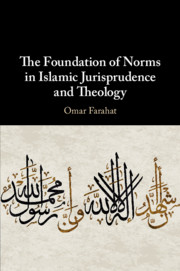
Farahat on Islamic Jurisprudence

Omar Farahat, McGill University has published The Foundation of Norms in Islamic Jurisprudence and Theology with Cambridge University Press. From the publisher:
The Foundation of Norms in Islamic Jurisprudence and TheologyIn this book, Omar Farahat presents a new way of understanding the work of classical Islamic theologians and legal theorists who maintained that divine revelation is necessary for the knowledge of the norms and values of human actions. Through a reconstruction of classical Ashʿarī-Muʿtazilī debates on the nature and implications of divine speech, Farahat argues that the Ashʿarī attachment to revelation was not a purely traditionalist position. Rather, it was a rational philosophical commitment emerging from debates in epistemology and theology. He further argues that the particularity of this model makes its distinctive features helpful for contemporary scholars who defend a form of divine command theory. Farahat's volume thus constitutes a new reading of the issue of reason and revelation in Islam and breaks new ground in Islamic theology, law and ethics.
Further information is available here.

--Mitra Sharafi