Friday, September 11, 2009

Visconsi on The Tempest and the Law of Allegiance

Vinculum Fidei: The Tempest and the Law of Allegiance is a new article by Elliott Visconsi, Yale Department of English & Yale Law School. It appeared in Law and Literature, Vol. 20, No. 1, pp. 1-20, March 2008. Here's the abstract:
In English constitutional law, Calvin's Case (1608) laid down a new, deeply affective basis of individual allegiance; the bond between sovereign and subject was now to be understood in personal, embodied terms as a tie of obligation and love between natural men. This essay argues that Shakespeare's The Tempest is a work of hypothetical constitutional commentary designed to illustrate the fragility and awkwardness of the new norm at home and abroad; the play moreover rebukes the theoretical ambitions of James I. The late Shakespeare, in this account, is not a political quietist but a skeptical constitutional theorist offering a monitory vision of the affective costs of the new model of allegiance and obligation.
Image credit.

Ernst on the New Zealand Arbitration Court

It occurred to me recently that an old and not widely circulated article of mine, "In Short He is a Stupid Man": The Judges and the Arbitration Court, 1891-1928, and such works as David Tanenhaus's study of mother's pensions and the Chicago juvenile court tell a related story about what attracted reformers in the common-law world to the courts and what ultimately led them to look elsewhere for institutions with which to govern certain kinds of social relations. I suppose that I ended up, more or less, where Lon Fuller did in "The Form and Limits of Adjudication," although I hope with a suitable acknowledgment of historical contingency. Here's the abstract:
In the 1890s, New Zealand legislators established the Arbitration Court as an ad hoc system for settling industrial disputes; by the mid-twentieth century the Court had become a pillar of New Zealand's welfare state. This transformation did not proceed smoothly, however, because of a mismatch between the mission and its managers. The judges who presided over the court were more interested in legal principles and forensic debate than the bargains of workers and their employers. They considered their tenure as a purgatory to be endured until they were promoted to full-time service on the New Zealand Supreme Court. This mismatch resulted because the Court evolved into an institution that differed from the founders' intent and because a dearth of other professionals left only the judiciary as a vehicle for putting the resolution of industrial disputes beyond the reach of partisan politics.
The article originally appeared in the Turnbull Library Record 29 (1996): 59-78. It appears now on the web by kind permission of the Friends of the Turnbull Library, Wellington, New Zealand.

The book to read on the mutual influence between American and New Zealand reformers in the early twentieth century is the late Peter J. Coleman's Progressivism and the World of Reform.

Image credit: Justice Frederick R. Chapman (Alexander Turnbull Library)

Thursday, September 10, 2009

Lahav on Portraits of Resistance: Lawyer Responses to Unjust Proceedings

Portraits of Resistance: Lawyer Responses to Unjust Proceedings is a new article by Alexandra D. Lahav, University of Connecticut School of Law and Visiting Professor at Fordham Law School. It is forthcoming in the UCLA Law Review. Here's the abstract:
This Article considers a question rarely addressed: what is the role of the lawyer in a manifestly unjust procedural regime? Many excellent studies have considered the role of the judge in unjust regimes, but the lawyer’s role has been largely ignored. This Article draws on two case studies: that of lawyers representing civil rights leaders during protests in Birmingham, Alabama in 1963 and that of lawyers representing detainees facing military commission proceedings in Guantánamo Bay, Cuba. These portraits illuminate the role of the lawyer in a procedurally unjust tribunal operating within a larger liberal legal regime such as our own.
The purpose of the Article is to paint a landscape of lawyer resistance to procedural injustice that can be used as a basis for further inquiry. The Article considers hard questions about lawyer participation in unjust tribunals such as whether lawyers who participate in unjust tribunals are complicit in injustice and what lawyers can do in the face of an unjust procedural regime. It presents a new way of understanding the forms of lawyer resistance to injustice. The Article demonstrates that complicity and resistance are not on opposite poles of human behavior within organizational systems. Rather, there is a dualistic interplay between complicity and resistance. Acts that appear to be resistance can be perceived as complicit, and acts that appear to be complicit can result in powerful forms of resistance. The Article also explores some questions raised by this analysis, such as what are the lawyer’s responsibilities to society and to his or her client and whether lawyers can know when a tribunal is so unjust as to merit resistance. It concludes by considering avenues for further research.
The photo is of Norman Amaker, whose representation of Dr. Martin Luther King, Jr., is discussed in Lahav's article.

Wells on Langdell on Contract

Catharine P. Wells, Boston College Law School (although on leave at USC Law this semester) has posted the working paper Langdell and the Invention of Legal Doctrine on bepress. Here is the abstract:
This paper addresses two related questions.

The first relates to Langdell and his development of a doctrinal theory of contract law. The substance and method of Langdell’s work has not been well understood and this paper uses a variety of historical materials to remedy this problem. It begins with a review of contract law prior to Langdell. Contract law at this time was in a very primitive state. The available treatises were confusing and the cases themselves offered little guidance for predicting future case outcomes. The paper then proceeds to examine Langdell’s method by describing certain logic texts that describe the Nineteenth Century conception of scientific methodology. This enables us to recreate not only the substance of Langdell’s theory, but also its method. Further, understanding its method allows us to ask crucial questions about justification: What is it that makes Langdell believe that his theory of contract law is correct?

The second question addressed in this paper relates to legal theory and the use of doctrinal theories in legal decision making. As a pragmatist, I reject the idea that there is one form of legal reasoning. Instead I believe that the courts employ a variety of strategies to navigate between the demand for justice in the individual case and the need to develop general theories that can be used to predict future decisions. Doctrinal theories are one of these strategies and, without question, a very important one. In the final section I use what we have learned about Langdell to identify the way in which doctrinal theories work and to explain their success.
Update: The SSRN post is here.

Image credit.

Prizes for What Blood Won't Tell

We've previously noted that Ariela Gross, USC Law, received the James Willard Hurst Prize of the Law and Society Association for What Blood Won’t Tell (Harvard University Press, 2008), which "recounts stories of racial identity trials in American courts, from the early republic well into the 20th century." (LHB's original post on the book is here; a review, here.) Now a USC press release announced that the book has also won the Lillian Smith Book Award and a prize from the Race, Ethnicity, and Politics Section of the American Political Science Association. Congratulations to Professor Gross!

Wednesday, September 9, 2009

Krent on Calabresi and Yoo's Unitary Executive

Harold J. Krent, Chicago-Kent College of Law, has posted The Sometimes Unitary Executive: Presidential Practice Throughout History, a review, also appearing in Constitutional Commentary 25 (2009), of Steven Calabresi and Christopher Yoo's The Unitary Executive: Presidential Power from Washington to Bush. Here is the abstract:
Steven Calabresi and Christopher Yoo's book The Unitary Executive: Presidential Power from Washington to Bush presents an excellent inquiry into the concept of a centralized executive throughout our history. The authors' goal is to persuade the reader that all presidents have viewed the power to supervise and remove subordinates as central to the very meaning of "executive power" in Article II of the Constitution. Without such an ability, presidents would be unable to execute the law effectively and place their stamp on the administration. The authors succeed in attaining that goal in part, for the historical record they portray reveals a long tradition of forceful assertion of presidential rights to control policy through close supervision of officers within the executive branch, especially through the removal power.

The book, however, is both over and underinclusive. The authors include many historical incidents that do not shed light on the unitary executive but rather on executive power more generally. The book is also underinclusive in failing to make a persuasive case for presidential authorities other than the removal power that fall within the unitary executive conception. In particular, the authors' focus on a presidential power to nullify acts of subordinates is misguided. They simply have not made the historical case for any such nullification power, and they have omitted analysis of significant aspects of presidential administration that would illuminate whether presidents consistently have asserted a nullification power. I conclude by examining one of those settings - when the executive branch is defending itself in litigation against suit filed by private entities and individuals - to ascertain how consistent the presidential practice has been. Presidents in a wide variety of cases have not hesitated to rely on a fragmented executive branch to dismiss claims. They have argued that cases should be dismissed because the wrong federal governmental entity was named and due to the fact that insufficient governmental entities were before the court to permit effective redress. They have recognized that federal agencies have distinct legal personalities, and declined to take responsibility for acts committed by subordinates. The historical evidence, in other words, provides a more cabined understanding of the unitary executive than the authors and President Bush's administration would have us believe.

Tuesday, September 8, 2009

Glickman on the Consumer Financial Protection Agency

Lawrence Glickman, University of South Carolina, the author of Buying Power: A History of Consumer Activism in America, has posted a historical intervention into the controversy over the proposed Consumer Financial Protection Agency over at The Baseline Scenario. "The lessons from past consumer battles," he writes, "are not only ideological but organizational." The full post is here.

Costello on The Court of Admiralty of Ireland, 1745-1756

The Court of Admiralty of Ireland, 1745-1756 is a new article by Kevin Costello, University College Dublin School of Law. It is forthcoming in the American Journal of Legal History. Here's the abstract:
In the mid-eighteenth century the Irish Court of Admiralty formed one component in the network of courts of vice-admiralty - extending from Gibraltar to the colonies of America - commissioned by the Lord Admiral of England. Throughout the first part of the eighteenth century the Irish Court of Admiralty operated discretely, its activities confined to processing very modest quantities of instance work. Then unexpectedly, starting about 1745, there commenced a period of turbulence. The cause of this agitation was the appointment as judge of a highly combative and indiscrete Scots civilian émigré, Dr Hugh Baillie. This ‘pushing and somewhat multi-pated personality’ determined on extending the power of the Court: on expanding the Court’s instance jurisdiction past the limits set by the courts of common law; on obtaining prize jurisdiction (which had always been prohibited to it); and on converting the constitutional status of the Court from a mere court of vice-admiralty to an independent court of admiralty for Ireland. In the course of ten years of fighting Dr Baillie managed to provoke virtually every important interest group (the Commissioners of Admiralty in England, Dublin mercantile interests, the justices of the Irish Court of King’s Bench and the English Court of Admiralty) on which his success as judge depended. Eventually, the Admiralty, tired of its contentious and chaotic Irish judge, summoned the Attorney General, William Murray (later Lord Mansfield), to a crisis meeting on the state of the Irish Admiralty Court. In November 1756 judge Baillie was dismissed.

Sharafi on Galanter's Justice in Many Rooms

Justice in Many Rooms Since Galanter: De-Romanticizing Legal Pluralism Through the Cultural Defense has recently been posted by Mitra J Sharafi, University of Wisconsin Law School. It appeared in Law and Contemporary Problems (Spring 2008). Here's the abstract:
Marc Galanter's article, 'Justice in Many Rooms' (1981) was prescient in recognizing that nonstate law was not necessarily kinder and gentler than state law. While many writing in the 1970s and 80s celebrated nonstate law as more egalitarian and less coercive than state law, Galanter held back. Post-1980s critiques of the cultural defense, particularly by Asian American feminist lawyers, have also contributed to a shift in the scholarly perception of nonstate law. In the spirit of Galanter's piece, the cultural defense debate should be read not just as a discussion about multicultural tolerance, but also as an integral part of the legal pluralism literature.

Monday, September 7, 2009

Bowman on The Civil Rights Roots of Tinker's Disruption Tests

The Civil Rights Roots of Tinker’s Disruption Tests is a new article by Kristi L. Bowman, Michigan State University College of Law. It appears in the American University Law Review (2009). Here's the abstract:
This past spring marked the fortieth anniversary of Tinker v. Des Moines Independent Community School District, the landmark student speech case in which the Supreme Court held that three students were protected by the First Amendment when they wore black armbands in their Des Moines, Iowa public schools to protest the Vietnam War. Looking at Supreme Court precedent alone, it would seem as though the Tinker tests were created out of whole cloth: the substantial or material disruption, reasonable anticipation of such disruption, and rights of others tests did not have much of a basis in earlier Supreme Court decisions. But, the district court in Tinker had employed the first two of these tests. For authority, it had looked to the Fifth Circuit’s decisions six weeks prior in two cases involving high school students’ speech about civil rights: Burnside v. Byars and Blackwell v. Issaquena County. Aside from Tinker’s citations to Burnside and Blackwell, those two cases - the roots of Tinker’s disruption tests - have largely been lost to history. Accordingly, this Article scrutinizes Burnside and Blackwell, considers lower courts’ applications of - and retreat from - the Burnside/Blackwell actual disruption test in the student speech context, and analyzes the presence of Burnside and Blackwell in the Tinker district court opinion and in various drafts of the Tinker Supreme Court opinion. Struggles for students’ speech rights and battles waged by the Civil Rights Movement rarely are seen as intertwined strands of history, but this Article demonstrates that the student free speech rights articulated in Tinker are built upon the struggles of the Civil Rights Movement.
Photo: The Tinkers.

Boston College Law School Fall 2009 Legal History Roundtable

In the fall of 2009, the Boston College Law School Legal History Roundtable started its eighth successful year. The Roundtable draws on Boston College Law School’s and Boston College’s strength and interest in legal history. The Roundtable offers an opportunity for Boston College faculty and faculty from other area institutions to meet and discuss a pre-circulated paper in legal history. Meeting several times each semester, the Roundtable seeks to promote an informal, collegial atmosphere of informed discussion. For the 2009-2010 academic year, Professor Mary Sarah Bilder, Professor Daniel R. Coquillette, Professor Frank Herrmann and Professor James S. Rogers are conveners.

Scholars visiting in the greater Boston area who are interested in attending should contact Professor Mary Sarah Bilder (bilder@bc.edu) to be placed on the email list.

Fall 2009:
Thursday, September 17, 2009
Professor Jed Shugerman, Harvard Law School
"Financial Crisis and the Rise of Judicial Elections and Judicial Review"

Thursday, October 22
Professor Marjorie Kornhauser, Sandra Day O'Connor College of Law, Arizona State University
"Tax Politics and the Common Folk: 1932-1936"

Thursday, November 19
Ray Madoff, Professor of Law, Boston College Law School
"Immortality and the Law: The Rising Power of the American Dead"
Additional information available here.

Law, History and Culture at USC

The University of Southern California's Center for Law, History and Culture has posted a Calendar of Events for the academic year ahead. The Center is "devoted to encouraging the study of law as an historical and cultural institution. CLHC brings together faculty members from the College of Letters, Arts, and Sciences and faculty from the Law School, sponsoring a wide range of scholarly and cultural activities, including faculty workshops, book talks, seminars, and conferences, as well as programs designed to support students and emerging scholars. " For more information on the Center and its events, please contact clhc@law.usc.edu.

Fall 2009

(Lunch workshops will be in room 118/120 of the Law School from 12:20 p.m. to 1:30 p.m., unless otherwise stated)

September 2. Kurt Lash (Loyola Law School), Topic: "The Origins of the Privileges and Immunities Clause, Part I: "Privileges and Immunities" as an Antebellum Term of Art."

September 16. Assaf Likhovski (Tel Aviv University Faculty of Law, Visiting Professor at UCLA School of Law, 2009-10), Topic: "Is Tax Law Culturally Specific? Lessons from the History of Income Tax Law in Mandatory Palestine."

October 2. Book Event - Barry Friedman (New York University School of Law), "The Will of the People: How Public Opinion has Influenced the Supreme Court and Shaped the Meaning of the Constitution. " Commentators: Rebecca Brown and Laura Kalman.

October 21. Law and Identities Symposium - Speakers will include: Claudia Moatti (USC-Classics); Susan Lape (USC-Classics); Debra Blumenthal (UCSB-History); Ariela Gross (USC-Law); Camille Gear Rich (USC-Law). Time: 12:00 - 6:00 p.m. Location: Law School Faculty Lounge, Room 433.

Spring 2010

(Lunch workshops will be in room 118/120 of the Law School from 12:20 p.m. to 1:30 p.m., unless otherwise stated)

January 13. West Coast Law & Literature Conference, Speakers: Victoria Kahn (UC Berkeley, English) and Bernadette Meyler (Cornell Law School); Topic "Early Modern/Post-Modern: Hobbes and the Contemporary Moment" Time: 2:00 - 4:30 p.m., Location: tba.

January 27. Melissa Murray (UC Berkeley School of Law), Topic: tba.

February 11. Russell Robinson (UCLA School of Law), Topic: tba.

February 25. The 8th Annual Law and Humanities Distinguished Lecture - Etienne Balibar (University of Paris & UC Irvine), Location: Town & Gown; Time: 4:00 p.m. - 5:30 p.m. Reception to follow.

March 4. Darren Rosenblum (Pace Law School), Topic: tba.

April 7. Susan Schmeiser (University of Connecticut School of Law), Topic: tba.

April 21. Amalia Kessler (Stanford Law School), Topic: tba.

Sunday, September 6, 2009

Stanton's Grave at Woodlawn Cemetery


A newsletter from the good folks at the
Elizabeth Cady Stanton & Susan B. Anthony Papers Project at Rutgers University reminded me that Elizabeth Cady Stanton is buried in Woodlawn Cemetery in the Bronx. If I were to design a 19th century legal history walking tour of New York City, Woodlawn definitely would be on it. Carrie Chapman Catt is buried there, too.

Woodlawn's archives are open by appointment to scholarly researchers (some documentation required; see here).

And speaking of Stanton, I was browsing my local big-chain bookstore and was pleased to see a prominent display of Lori Ginzberg's new book, Elizabeth Cady Stanton: An American Life (published September 1, 2009). I look forward to reading it!

photo credit: Woodlawn Cemetery (here)

Sunday book round-up

For this Sunday's book review round-up, I am borrowing from uber-history-blogger Ralph Luker. Here are recent reviews of interest in the book pages:

Robert B. Reich, "Critical Care," NYT, 1 September, reviews The Heart of Power: Health and Politics in the Oval Office by David Blumenthal and James A. Morone.

Ross Douthat, "Another One for the Gipper," NYT, 1 September, reviews Steven F. Hayward's The Age of Reagan: The Conservative Counterrevolution, 1980-1989.

Thomas Lipscomb, "A Declaration of Inconclusiveness," WSJ, 28 August, reviews William G. Hyland Jr.'s In Defense of Thomas Jefferson.

Gerard DeGroot, "When the Iron Curtain Unraveled," Washington Post, 6 September, reviews Michael Meyer's The Year That Changed the World: The Untold Story Behind The Fall of the Berlin Wall.

Winston Groom, "The Torching of Atlanta," WSJ, 28 August, reviews Marc Wortman's The Bonfire and Russell S. Bonds's War Like the Thunderbolt.

Jay Mathews, "I Pledge Allegiance to Core Knowledge," Washington Post, 30 August, reviews E. D. Hirsch's The Making of Americans: Democracy and Our Schools.

In David T. Beito and Linda Royster Beito, "T.R.M. Howard, an unlikely civil rights hero," LA Times, 28 August, Howard's biographers identify his ties to the movement.
Ralph regularly covers more newspaper reviews than I do, and he can be found every day at Cliopatria.

Saturday, September 5, 2009

Oman on Specific Performance and the Thirteenth Amendment

Nathan B. Oman, William & Mary Law School, draws upon Thirteenth Amendment history in his new article, Specific Performance and the Thirteenth Amendment. It appears in the Minnesota Law Review (2009). Here's the abstract:
Black-letter law declares that a contract to perform personal services cannot be specifically enforced. Many courts, scholars, and commentators have claimed that such enforcement would constitute “involuntary servitude” under the Thirteenth Amendment. This Article, however, rejects that conventional wisdom. A careful reading of the history leading to the ratification of the Thirteenth Amendment reveals that, at the time of its adoption, “involuntary servitude” had a specific legal meaning, one that did not extend to any specific enforcement of a personal service contract. Rather, courts that were forced to draw the line between contract enforcement and “involuntary servitude” looked to coercion in the creation of the contract, the length of its duration, the power of the master over the servant, and the adequacy of the servant’s compensation to determine if enforcement of an agreement would constitute “involuntary servitude.” Since the Thirteenth Amendment’s adoption, the U.S. Supreme Court has never found involuntary servitude in any case except those in which at least one of these factors and arguably all four of them was present. In short, neither the original meaning of “involuntary servitude” nor its subsequent interpretation by the Court justifies a per se prohibition on specific performance of personal service contracts.

Mirow on Coke's Tips for Will Drafting

M. C. Mirow, Florida International University College of Law, has posted Coke's Advice on Executing Wills of Land, which also appears in Relations between the Ius Commune and English Law, ed. R.H. Helmholz and V. Piergiovanni ((Genoa: Rubbettino, 2009), 239-245. Here’s the abstract:
This essay explores the advice Edward Coke provided for testators executing wills of land. Coke listed eight suggested practices at the end of his report of Butler and Baker's Case (1591). This list is examined in light of the Statute of Wills (1540) and the Statute of Frauds (1677). Text in English with Italian abstract.
Image credit.

Knowles on Lysander Spooner

Helen J. Knowles, SUNY at Oswego, has posted "The Pen is Mightier than the Sword": Lysander Spooner’s Constitutional Response to Increasing Abolitionist Violence in the 1850's, a paper she'll deliver at the “John Brown Remembered: 150th Anniversary of the Raid on Harpers Ferry" conference in Harpers Ferry, WV, October 14-17, 2009. Here is the abstract:
Like many other abolitionists, during the 1850's Lysander Spooner (1808-1887) began to infuse the advocacy of violent responses to slavery into his antislavery arguments. However, this Massachusetts native did so by maintaining a decidedly hands-off approach. Instead of oratorical bluster or physical confrontation, Spooner continued to adhere to his lifelong strategy of using written treatises and/or essays of constitutional interpretation and legal logic in order to convey his thoughts. Paying particular attention to his 1858 broadside entitled “A Plan for the Abolition of Slavery (and) to the Non-Slaveholders of the South” (the timing of whose publication John Brown’s supporters considered dangerously inflammatory), this paper asks whether the tendencies towards increased militarism and advocacy of the use of violence changed or weakened the legal bases of the “unconstitutionality of slavery” arguments that Spooner made in the 1840s.

Drawing on Spooner’s works and correspondence, I reach the conclusion that his invitations to violence were just that, invitations. They were, as was the case for so many abolitionists, responses to government actions that had the effect (both perceived and real) of further entrenching Slave Power. They did not in any appreciable manner affect Spooner’s belief that rigid and logical adherence to the rule of natural law and justice could prevail – if only the U.S. Constitution were correctly interpreted.
Image credit.

Friday, September 4, 2009

Laura Edwards, part 2: The Challenge of State-Level Records

From Laura Edwards, discussing work on her new book, The People and Their Peace. Laura's first post is here.

Questioning Organization: The Challenge of State-Level Records

Legal historians write about the law. So do historians in a range of other fields. But what is the law? Many of my students are certain that they have the answer: they identify statutes and appellate decisions at the state and national levels of government as the law. Actually, their favored term for these materials is “the real law.” If you had asked me this question a few years ago, I probably would not have admitted that I, too, was working with the same assumption. But I was.

My research in local records forced me to confront both that assumption and the reasons why I had accepted it so easily. I had been doing research in statutes and appellate cases in North Carolina and South Carolina while I was doing local research. Those two tasks, however, had been on parallel tracks. I had a good sense of the development of state law—both appellate decisions and statutes—on matters relating to cases regarding domestic dependents. I also had a good sense of the legal logic that guided the localized system. But I was utterly unclear about the relationship between these two, obviously distinct, legal arenas. At first, I didn’t understand why it was so hard to see any relationship between state law and localized law. Then I realized that my sources on state law—newspapers, legal treatises, and the papers of prominent legal professionals and state leaders, as well as statutes, appellate decisions, and other state records—were conspiring against me. The professionally trained lawyers and like-minded state leaders who created these sources had an agenda: to promote their own, particular vision of the law and to elevate it over other conceptions, particularly localized legal practice. I was inclined to accept these reformers’ conclusions because their vision of the law duplicated the one that seemed so self-evident to me and my students—and probably many of you as well. The overlap is no coincidence. Legal reformers from that time period worked very hard to promote their vision of the law and to make it seem like the only viable option. The sources they left told a powerful story of progress that became the basis for later academic histories and continues to shape current scholarship. It is only when the reformers’ vision of the law is compared with localized legal practices that the claims to superiority and the carefully constructed trappings of inevitability begin to fall away. That’s when the story got really interesting to me: the law, as we now see it, has a much more interesting history than I ever imagined.

My research on state law became a project of cultural excavation—a matter of slowly and carefully stripping away layers of historical interpretation that had been applied, one on top of the other, over two centuries. Most of these records were created by a core group of professionally trained lawyers who were prominent in state politics, whose networks reached outward to the national level, and who sought to dismantle legal localism. They wished to create rationalized bodies of law that were based in the protection of individual rights, particularly property rights. They wanted to centralize the operations of government at the state level to regularize the creation and dissemination of that body of law. They also recognized the importance of history to their project, compiling documentary sources and crafting narratives that cast localized law as an archaic throwback, which inevitably gave way to progressive change as laws were standardized and rights were uniformly defined and applied. Reformers’ views, infused with objectivity and progress, seemed enlightened and reasonable to later generations. No wonder, then, that their voices acquired resonance over time, as historians relied on their archive, followed their lead, and ignored—even dismissed—legal localism.

The elite’s prominence in the historical record, though, owes as much to their own efforts at self-preservation and aggrandizement as it does to their political importance at the time. Their lives and work are easy to track, because they left such an impressive historical record. Their documentary record not only exaggerates their importance at the time, but also obscures the most profound historical implications of their legal agenda. Their sources—newspapers, appellate decisions, statutes, political pamphlets, legal treatises, and their own collected papers and correspondence—actively promoted the systematization and centralization of law at the state level. The admission of change, however, ends there. These sources wrap the discussion in the rhetoric of progress, with such strong Whiggish undertones of inevitability that it reads as a negation of any human agency in the conception or direction of change: law and government simply assumed the form they were always intended to have, aided by those who had access to the plan. That form, moreover, had been determined long ago, in the distant past. As such, it represented the extension of existing ideas, not anything substantively new or different. That was not the case.

State leaders’ accounts are accurate in the sense that state law became more elaborate, sophisticated, and influential between 1787 and 1840. At the end of the Revolution, there was no coherent body of law at the state level to deal with public matters. But neither was there anything inherent in the decentralized, localized system that precluded the development of such a body of law within state-level institutions. So reformers set about creating a body of state law based in rights. Beginning with the area of property law, they created the necessary institutional structure at the state level. By the end of the 1820s, state leaders had made considerable progress in rationalizing the legal system at the state level, even in the realm of public matters. Then they secured popular support for that project through highly visible political campaigns: the Nullification campaign of 1827-32 in South Carolina and the 1835 state constitutional convention in North Carolina.

As lawmakers extended the reach of state law, they imposed the rubric of individual rights on matters formerly governed by collective conceptions of the peace, as defined in local contexts. The logic behind the developing body of state law turned white men’s patriarchal authority and civic participation into individual rights, akin to their already established property rights. White men’s rights expanded at this level of the legal system, increasing their claims on the legal system and to state protection of their interests. In the political rhetoric of the 1830s, they became “freemen,” legally recognized individuals who were the paradigmatic citizens, at least within the realm of state law. At the same time, dependents’ legal status, particularly their lack of rights, became the rationale for their exclusion from law and government. State law defined them as altogether different categories of legal persons and subordinated them according to the abstract categories of race, class, and/or gender. White women, African Americans, and the poor found it difficult to make themselves heard and their concerns visible within the body of state law, because they were excluded from the category of people with rights that the state was designed to protect.

The denial of rights to the vast majority of southerners and their exclusion from the polity masked even more profound inequalities at the state level. White men were constituted as freemen through their rights over those without rights. In extending this legal framework, state leaders applied the precepts of liberal individualism to the patriarchal structure of localized law. They abstracted the authority white men already exercised in social context, through their obligations to the peace in localized law, and individualized both its privileges and restrictions. By the 1830s white men could claim rights not just in their property and their own labor in state law, but also in the labor and bodies of their dependents and, through the abstractions of gender and race, over the lives of other subordinate people as well. Their authority in this body of law extended over all black persons, slave or free, and no black person fully possessed his or her own body or the product of his or her labor. The rhetoric of party politics construed rights broadly, linking them to freedom, liberty, and equality among white men, whether propertied or not. In practice, though, state leaders’ vision of democracy did not include fundamental changes in the economic or social structure that would put all white men on equal footing. Legislators and jurists defined rights narrowly, so as to affirm existing inequalities among white men and to protect the property interests of the wealthy, particularly slavery. By the 1830s freemen could look to the state to protect their rights, defined in the limited, abstract terms of law at that level of the system. But many of the white men included in this category could not count on those rights as a means to articulate, let alone promote, their interests.

State leaders were less successful in practice than their writings and their influence on later historians suggest. State law took up more institutional space by the 1830s, but it did not triumph over localized law: the legal system, which still included localized legal practices, did not work as state leaders wished and represented, particularly in the broad area of public law. Localized law continued to have considerable influence in the antebellum period and long afterward, because it was embedded in the culture in ways that made it very difficult to eliminate. To further complicate matters, localized law had always accommodated multiple—even conflicting—legal traditions, so it was possible for southerners to embrace rights discourse, as developed at the state level in the 1830s, while still adhering to conflicting tenets of the local system. People might represent their interests in local courts in terms of rights, but the localized system continued to incorporate their claims just as it had always done with other claims on the peace.

The development of state law is, nonetheless, a crucial and historically neglected story. Not only did it operate by a very different logic—the logic of individual rights—than did localized law, it also cast its subjects in a different relationship to law and the government. State law would become more influential over time, as this level of government became more entrenched and more powerful. But it is not so much the relative influence of state law as the timing of its emergence that is the important story. Although scholars usually treat state law as primary, it did not emerge in the broad area of public matters until the 1820s (in appellate law and statutes) and the 1830s (in the discursive realm of politics). This periodization changes our view not only of people’s influence over governance and the development of rights within the nation’s political culture, but also the relationship of slavery and the South to the rest of the nation—and that will be the subject of the next installment.

Lift Every Voice: The Wilson Center Book Launch

The United States Studies Program of the Woodrow Wilson Center is holding a book launch for Lift Every Voice: The NAACP and the Making of the Civil Rights Movement, by Patricia Sullivan, University of South Carolina, in the Center’s 5th Floor Seminar Room, 1300 Pennsylvania Avenue, N.W., Washington, DC., on Thursday, September 17, 3:00 – 5:00 p.m. Commentators are Julian Bond, University of Virginia, and Kenneth Mack, Harvard Law School. Here’s the Wilson Center’s description:

Legal struggles or mass demonstrations--which tactics proved more important in ending racial segregation in the United States? Historians as well as activists have long debated this question. In Lift Every Voice, Patricia Sullivan traces the roots of the civil rights movement of the 1960s back to 1909 and the founding of the NAACP. Chronicling the complex history of the organization and its many prominent leaders, both black and white, she examines debates over tactics and the strategies that led to key court decisions such as Brown v. Board of Education. By shifting the focus from mobilization to litigation, this book challenges reigning paradigms in the field. Join us for a discussion of how interpretations of the history of the civil rights movement are changing, and what that means for activism today.

The event is free and open to the public, but RSVPs are requested to usstudies@wilsoncenter.org.

Update: via an email sent out on September 8, the Wilson Center corrected the previously announced time of 2-4 for this session. It will be held from 3-5.

Thursday, September 3, 2009

New Research Database for Historical Tax Materials

Historians of business, taxation, economics and related topics may be interested in a new database available from HeinOnline: "Taxation & Economic Reform in America: A Historical Archive, 1791-2009." One subset of the collection contains legislative histories and other hard-to-find administrative documents relating to Internal Revenue Acts from 1909 to 1950. The collection has plenty of more modern materials, too. This is a welcome resource for tax scholars and others.

Feminism and Smoking in the 20th Century

On September 16, 2009, Sharon Cook (Education, University of Ottawa) will be speaking at the Ottawa Historical Association meeting at the Library and Archives Canada in Ottawa. Her topic is "Constructing the Modern Canadian Woman Smoker, 1970-1990." Here's a short description of her talk:

In previous eras and coupled with other social forces, smoking had given women an air of authority, even insouciance. In the “Age of Aquarius” it served a similar purpose of offering liberated modern women the visual means to telegraph similar types of authority. The alignment of smoking with the women’s movement became a staple of visual culture. Produced about and by feminists, it took hold so firmly in popular cultural products like women’s magazines, advertisements, television and film representations that the dangers of smoking were masked by the powerful cultural messages culminating in the second wave of feminism. Using many of the same techniques that had been honed by the end of World War Two, advertisers and other cultural architects added to the stock-in-trade approaches by presenting the liberated woman smoker as an iconic image for the modern age. This paper explores ways in which feminism became closely linked with smoking between 1968 and 1990.

Dr. Cook's webpage is here.

I remember clearly the Virginia Slims "You've come a long way, baby" ads. The suggestion that women's progress meant freedom to smoke was hardly subtle. Virginia Slims was one of the early corporate sponsors of women's professional tennis, too. Martina Navratilova's first #1 ranking came in 1978 after she won the Virginia Slims tournament (she won Wimbledon that year, too).


Curating the Legal Landscape in Iceland

With its recent approval of the Icesave deal, the Icelandic Parliament seems to have bought the nation about eight years to get its economic house in order.  The Althingi has agreed to repay $5.5 billion in loans to the UK and the Netherlands, whose citizens were major depositors in Icelandic banks before their collapse, but no payments are due for the next seven years, and repayment obligations cease after 2024.  The agreement sets Iceland on the road to receiving $4.6 billion in IMF bailout funds, which will allow the central bank to ease the capital controls it imposed in the wake of the crisis. 

What does this have to do with public legal memory?  One important source of economic stability in Iceland over the long term lies in the development of its tourist economy, and cultural tourism is bound to play an important part in that growth.  Right now, this country is a destination of choice for nature lovers, but many Icelanders hope that in time its extraordinary history and heritage also will come to play a substantial role within the nation’s tourist profile.  This is to say that as part of its effort to get its economic house in order, Iceland will increasingly sell its past, including its unique legal history, to outsiders.  As this development proceeds, the challenge faced by public educators will be how to present Iceland’s legal past to tourists given that the relation between law and land at the heart of that history, and at the heart of Icelandic identity, is mediated by an illusive and quickly fading folk memory.

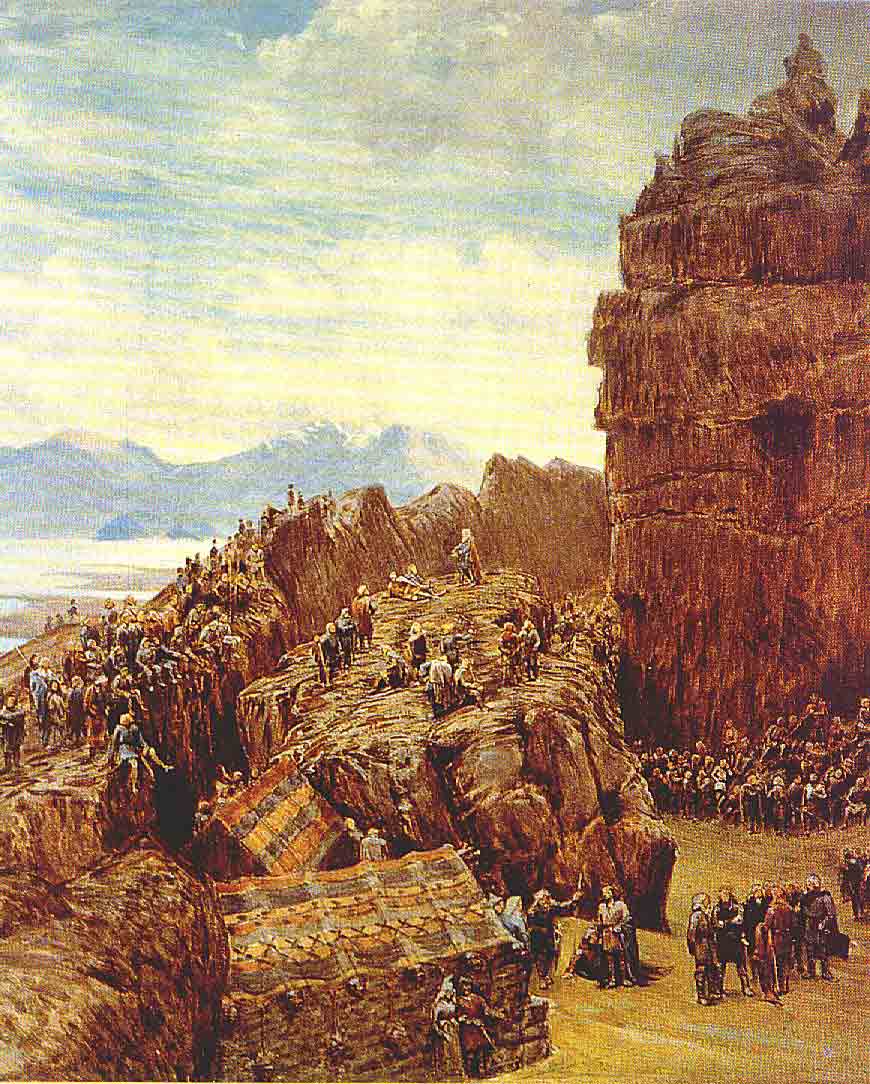
With Thingvellir, the burdens of that challenge will weigh most lightly. Thingvellir is as much a structure as a place.  No artifacts exist as tokens of the chieftain assemblies which took place there a thousand years ago, and which distinguish the legal history of this Germanic nation from that of Anglo-Saxon England, but it’s very easy to imagine what took place.  You don’t need to be William Collingwood to picture the assembly circles, the cloth-covered booths, and the mediation of disputes occurring within the craggy setting of a grand tectonic fissure.  The landscape is architectural in a way that seems positively to invite the visualization of a human presence.


But the sites of Skálholt and Reykholt point to greater, and more common, pedagogical difficulties.  These are places of tremendous symbolic importance to Icelanders, but in both places the landscape offers few tangible clues of that significance.  The church at Skálholt is a modern building, and the landscape itself seems totally empty (at left below, on the road to Skálholt).

An uninformed visitor would never guess that this was once the epicenter of all Icelandic learning, the heart of its intellectual and cultural life, and the administrative hub of the church.  But the place is packed with historical memories actively nurtured and treasured by Icelanders.  Similarly, everyone knows that Reykholt was the seat of the great Snorri Sturluson, and every summer tens of thousands of people visit the bathing pool of the man whose family gave its name to the civil war through which Iceland lost its independence in 1262.  Yet the pool and its environs have a completely mundane air about them—for the outsider, certainly, not sacral but utilitarian.  In both sites, moreover, artifact remains are scant, and any significant pieces seem to be in the possession of the National Museum in Reykjavik.  Finally, the exhibitions at Skálholt and Reykholt have been mounted, almost as a matter of necessity, by the most important institution on the two sites, namely the church, and they are housed in church basements, cut off from view of the land in which the cultural significance of the place is lodged.  The museum at Reykholt, which celebrates the life of Iceland’s single most important author, a man whose work is part of the cultural patrimony of all Europe, is mounted in a room that also is used for funeral receptions.

As Stephanie and I have followed the sight-seeing path marked out by the Iceland Saga Trail Association, we’ve been struck by the various ways in which far-flung curators across Iceland have sought to address the difficulty exemplified by Skálholt and Reykholt: the land is filled with memories, and the land is empty.  Some curators have been remarkably successful in meeting that challenge.  The Settlement Exhibition in Reykjavik surrounds a Viking-age turf longhouse excavated in the center of the city with a 360-degree image of how the land likely appeared in the tenth century, and the excavation itself can be viewed from above ground through a street-level glass enclosure—a beautiful architectural metaphor for the proximity of the medieval past here.  

The exhibition accomplishes through fine curatorship what Thingvellir does naturally, maintain the sense of place that grounds Icelandic history.  Similarly, the Settlement Center in Borgarnes relies on multi-media installations to bring the visitor into the land outside the exhibition hall.  (The center currently is developing an exhibition about the Althing.)  The Saga Center in Hvolsvöllur tells the story of Njal’s Saga through a carefully scripted audio guide before sending visitors, at least theoretically, out to a host of local sites associated with the man known for his forbearance and wise legal council (Njal's farmstead is pictured at right below).  


To bring out the cultural and historical significance of the land, a significance that so often sounds in law and society terms—that’s what the most incisive museums and history centers here seek to do.

These are worthy efforts, but there are worrying signs for those concerned about the future of Icelandic public legal memory.  Throughout the country, one naturally encounters the kitsch which will only proliferate with increasing tourism—the kind of stuff that, in its mass produced quality, seems to define itself against historic and geographic particularity.  But I don’t worry much about this kind of thing, which after all is a presence in any country that attracts a significant number of travelers.  The best response to a plastic Viking helmet, or to the “cultural theme hotel” in Reykholt, with its loftily-named restaurant, is to laugh.  

More troubling, and more revealing, are certain trends within the popular culture consumed by Icelanders themselves, especially tendencies to celebrate hyperviolence or, more pointedly, the subversion of law.  One recent incarnation of that tendency is a controversial music video released by the group Berndsen, which involves a carnivalesque overturning of law, and life, in the symbolically charged setting of the Icelandic countryside.  In the video, a group of young people come upon the scene of a car crash and play bloody and perverted games with the bodies of the victims.  A discussion of the controversy, with a link to the video, can be found here.  The video expresses a deep cultural anxiety about the association of land, law, and community that has defined Iceland for generations.  We are a long way from a land knit together by the common legal identity established at Thingvellir in 999/1000; we are in a subculture whose ironic self-consciousness is characteristic of a nation torn within a generation from its communitarian folk roots and the law that sustained it.

The Berndsen video engages the same cultural dynamic as the legal history sites we visited on our tour, and it is as much a part of the future of Icelandic legal consciousness and legal memory as the harsh light that academic history will throw on popular antiquarianism.  Like new efforts in public history, the video responds to circumstances that are putting pressure on the link between legal memory and the environment in an age of global capital flows and European economic integration.  In this respect, those concerned about the future of the public understanding of law on this remote island in the Atlantic will have to wait and see whether Icelanders, who have modernized their nation so boldly and admirably since World War II, can advance a vision of development that is not only environmentally but also culturally sustainable.

Note: My next post, about applying for a Fulbright and what opportunities exist for legal historians, will be my last.  Thanks to all of you who have written with your comments and questions!


Fiscal Sociology: The Workshop

We've previously noticed the appearance of The New Fiscal Sociology, a collection of essays. Now its editors announce a "call for participants" for a workshop on the subject to be held in conjunction with the Social Science History Association this November in Long Beach, California. Here it is:
In recent years, scholars from a variety of disciplines have embarked on an innovative wave of multidisciplinary research on the social and historical sources and consequences of taxation. We invite interested graduate students from history, law, and the social sciences to participate in a one-day workshop on this “new fiscal sociology.” Students will read and discuss classic and contemporary essays that trace fundamental connections between tax institutions and macro-historical phenomena – wars, racial boundaries, religious traditions, gender regimes, labor systems, and more. Workshop participants will also have the option to present and discuss their own dissertation or pre-dissertation research.

The workshop will be held on Wednesday, November 11 in Long Beach, California, in conjunction with the annual meetings of the Social Science History Association (SSHA), and interested students will have a chance to present their own work on Thursday, November 12 as part of the SSHA conference. Space is limited. Small housing and travel stipends will be provided for a limited number of applicants under a grant from the National Science Foundation. Applicants should submit a CV and a paragraph explaining their interest in this workshop, and (if applicable) a draft of a research paper that they would be willing to present at the SSHA. Preference will be given to students who also submit conference papers, but we encourage applications from all students interested in the workshop, including those at early stages of their graduate career. Submit materials via e-mail to Monica Prasad, Department of Sociology, Northwestern University (m-prasad@northwestern.edu); Ajay Mehrotra, Maurer School of Law, Indiana University – Bloomington (amehrotr@indiana.edu); and Isaac Martin, Department of Sociology, University of California – San Diego (iwmartin@ucsd.edu), no later than September 30, 2009.

NYU Legal History Colloquium

NYU's Legal History Colloquium is already underway. Here's the fall line-up:

August 26, 2009
William E. Nelson, Weinfeld Professor of Law, New York University School of Law
"Politicizing the Courts and Destroying the Law: A Legal History of Colonial North Carolina, 1660-1775"

September 2, 2009
William E. Nelson, Weinfeld Professor of Law, New York University School of Law
"Legal Chaos in a Factious Colony: New York, 1626-1776"

September 16, 2009
Prof. David Bernstein, George Mason University School of Law
"Rehabilitating Lochner - Part I"

September 23, 2009
Prof. David Bernstein, George Mason University School of Law
"Rehabilitating Lochner - Part II"

September 30, 2009
Laura Weinrib, Samuel I. Golieb Fellow 2009-2010, NYU School of Law
"Lawyers, Libertines and the Reinvention of Free Speech, 1920-1933"

October 7, 2009
Sara McDougall, Samuel I. Golieb Fellow 2009-2010, NYU School of Law
"Bigamy: A Male Crime in Medieval Europe?"

October 14, 2009
Maribel Morey, Princeton University, History Department
"The Making of 'An American Dilemma': The Carnegie Corporation President's Decision to Fund a Negro Study, 1923-1937"

October 21, 2009
Prof. Daniel J. Sharfstein, Vanderbilt University School of Law
"TBA"

October 28, 2009
Prof. Robert Kaczorowski, Fordham University School of Law
"A History of Fordham Law School"

November 4, 2009
Prof. Liam O'Melinn, Ohio Northern University College of Law
"TBA"

November 11, 2009
Prof. Troy McKenzie, New York University School of Law
"TBA"

November 18, 2009
Jedidiah Kroncke, Samuel I. Golieb Fellow 2009-2010, NYU School of Law
"The Birth of the Modern US Legal Exceptionalism: China, Legal Science, and Missionaries in the Early 20th Century"

November 25, 2009
Philip Akerman-Lieberman, Vanderbilt University
"TBA"

December 2, 2009
Christopher Beauchamp
"TBA"

Image credit: ATL

Wednesday, September 2, 2009

Pettys on Fritz, American Sovereigns: The People and America's Constitutional Tradition Before the Civil War

The Vitality of the American Sovereign is a review essay by Todd E. Pettys, University of Iowa College of Law of Christian Fritz, American Sovereigns: The People and America’s Constitutional Tradition Before the Civil War. It is forthcoming in the Michigan Law Review. Here's the abstract:
In his book American Sovereigns: The People and America’s Constitutional Tradition Before the Civil War, Professor Christian Fritz argues that two very different conceptions of the American people’s sovereignty - one broad and one narrow - battled for the nation’s allegiance in the eighteenth and nineteenth centuries. Under the broad conception, ordinary citizens could take control of the nation’s day-to-day governmental affairs whenever they were unhappy with their elected leaders’ performance, and could alter their constitutional arrangements by any means they deemed appropriate. Under the narrow conception, citizens could influence day-to-day governmental affairs only through elections and other government-approved mechanisms, and could alter their constitutional arrangements only by those methods that were authorized by the ratified constitutional texts themselves. In Professor Fritz’s view, the broad conception faded from view in the years after the Civil War and the narrow conception now firmly prevails.
This review disputes Professor Fritz’s claim that the broad conception of the people’s sovereignty no longer plays a viable role in American politics. Citizens do still sometimes intervene directly in the nation’s day-to-day governmental affairs in ways that the people’s elected leaders have not approved, and they do alter their constitutional landscape by means other than those that the nation’s ratified constitutional texts explicitly authorize. More fundamentally, the American people have learned that they can transcend the more extreme elements of the broad and narrow conceptions of the people’s sovereignty. By engaging with their elected leaders in what can be called the “sovereignty dance,” the sovereign people have learned that they can retain ultimate control over their government while still permitting government leaders to retain the credibility and power they need in order to do the people’s work.

Sawyer on Grimaud

Logan Everett Sawyer, III, a fellow at Georgetown University Law Center who is ABD in history at the University of Virginia, has posted Grazing, Grimaud, and Gifford Pinchot: How the Forest Service Overcame the Classical Nondelegation Doctrine to Establish Administrative Crimes, which appeared in the Journal of Law & Politics 24 (2008). The piece joins a growing literature on the law and politics of administration in the early twentieth century. Here's the abstract:
This article recovers the structure the classical nondelegation doctrine and reconstructs the role that doctrine and other historical circumstances played in the establishment of administrative crimes in United States v. Grimaud in 1911, but its primary focus is exploring what that episode reveals about the process of legal change. It rejects deterministic claims that the nondelegation doctrine has always responded in a simple way to practical concerns. Such an approach cannot effectively explain how difficulty it was for the government to win judicial approval of administrative crimes. The course of that decade long campaign is better explained by recognizing how the establishment of administrative crimes was affected by the interaction of the classical nondelegation doctrine with other legal, political, and practical circumstances. Among the most important of those circumstances were the Supreme Court's 1812 decision in United States v. Hudson & Goodwin, the government's limited ability to appeal criminal decisions, the challenges of policing millions of acres of isolated public lands, and the successful efforts of Gifford Pinchot (left), the nation's first Forester, to build a zealous and talented legal department at the US Forest Service. The paper thus advances an understanding of doctrinal change that emphasizes the interaction of structural constraints – including legal doctrine itself - with more contingent factors, like timing and individual decisions.

Image credit.

Tuesday, September 1, 2009

Pfander on The Story of Bivens v. Six Unknown-Named Agents of the Federal Bureau of Narcotics

The Story of Bivens v. Six Unknown-Named Agents of the Federal Bureau of Narcotics has just been posted by James E. Pfander, Northwestern University School of Law. It is forthcoming in FEDERAL COURTS' STORIES, Judith Resnik & Vicki C. Jackson, eds. (2009). Here's the abstract:
In Bivens v. Six Unknown-Named Agents of the Federal Bureau of Narcotics, the Supreme Court recognized the right of an individual to sue federal government officials for a violation of constitutional rights. Drawing on interviews with some of the participants, including Webster Bivens himself and one of the agents who conducted the search, this chapter in the forthcoming book Federal Courts' Stories describes the events that led to the litigation and the complex array of factors that informed the Court's approach to the case. After placing the Bivens decision in context, the chapter evaluates the competing narratives that have grown up around the famous decision.

400K

Yesterday, dear reader, you helped the Legal History Blog surpass the 400,000 mark in readership.

This is a non-commercial blog. We do it for you, and to promote legal history. Thank you for keeping the blog going.

Welcome to Bridget Crawford!

The Legal History Blog welcomes Bridget Crawford, Pace Law School, who will be guest blogging this month. Bridget's day job involves teaching tax, trusts and estates, and feminist legal theory, and her writing focuses especially on gender and tax policy, but she is also a great Friend of Legal History. I have often noticed Bridget's history-related posts at Feminist Law Professors, where she often notices scholarship and opportunities that I have missed.

Bridget's J.D. is from the University of Pennsylvania, where she worked with Sally Gordon. Her work in legal history includes "Daughter of Liberty Wedded to Law’: Gender and Legal Education at the University of Pennsylvania Law Department 1870-1900," 6 The Journal of Gender, Race & Justice 131 (2002). Bridget's forthcoming scholarship includes "Sticky Copyrights: Discriminatory Tax Restraints on the Transfer of Intellectual Property," 67 Washington and Lee Law Review (forthcoming 2010) and "Taxation, Pregnancy and Privacy," 16 William and Mary Journal of Women and the Law (forthcoming 2010). She has taught at Pace since 2003, and in 2005, 2006, and 2007, Pace's graduating classes selected her as the Barbara C. Salken Outstanding Professor of the Year. She serves as Associate Dean for Research and Faculty Development at Pace and she is a member of the American Law Institute.

Welcome, Bridget!

Legal History and Culture at Connecticut

Steven Wilf, University of Connecticut School of Law, announces the line-up for the school's Legal History & Culture Speaker Series:

October 28 and November 4: François Ewald (École nationale d'assurances), a two-part Faculty Workshop mini-seminar on Foucault and the Law

November 11, Duncan Kennedy (Harvard Law), TBA

December 2, Ariela Dubler (Columbia Law), Sexing Skinner

February 3, Daniel Markovits (Yale Law), A Modern Legal Ethics: Adversary Advocacy in a Democratic Age (Princeton University Press, 2008) (author meets reader).

Date TBA, Amalia Kessler (Stanford Law), TBA

April 14, Assaf Likhovski (Tel Aviv Law, visiting UCLA Law), Is Tax Law Culturally Specific? Lessons from the History of Income Tax Law in Mandatory Palestine