Thursday, October 6, 2011

In Memoriam: Professor Derrick Bell

Professor Derrick Bell, Visiting Professor at New York University, has passed. Bell's legacy in the law is long and deep. Bell never trained professionally as a historian; yet his scholarship reflected great historical consciousness and insight. It's fair to say, I think, that every historian of the civil rights era and every scholar of race and the law who followed him is indebted to Professor Bell.  Here are some excerpts from Bell's New York Times obit.

Derrick Bell, a legal scholar who worked to expose the persistence of racism in America through his books and articles and his provocative career moves — he gave up a Harvard Law School professorship to protest the school’s hiring practices — died on Wednesday in New York. Mr. Bell was the first tenured black professor at Harvard Law School and later the first black dean of a law school that is not historically black. But he was perhaps better known for resigning from prestigious jobs than for accepting them.

Addressing law students grappling with career decisions, he extolled what he called “a life of meaning and worth,” even though, he wrote, he sometimes alienated associates who saw his actions as “futile and foolish.”  ...
Mr. Bell “set the agenda in many ways for scholarship on race in the academy, not just the legal academy,” said Lani Guinier, the first black woman hired to join the Harvard Law School’s tenured faculty, in an interview on Wednesday.  At a rally while a student at Harvard Law School, Barack Obama compared Professor Bell to the civil rights hero Rosa Parks.

Law & Society Conference Proposals

The 2012 International Conference on Law and Society and the Research Committee on Sociology of Law (RCSL) announces its call for participation.  The meeting is co-sponsored by the Canadian Law and Society Association (CLSA), the Japanese Association of Sociology of Law (JASL), and the Socio-Legal Studies Association (SLSA).  The program's theme is Sociolegal Conversations across a Sea of Islands; the conference will be held June 5-8, 2012 in Honolulu, Hawaii.


Individual Paper and/or Session proposals are welcome and need not be centered on the conference theme.   The Call is hereThe deadline for proposal submission is December 6, 2011.

CFP: The Question of Rights

[Here's the call for next year's conference on rights at San Francisco State University.]

San Francisco State University hosts a conference every year in September exploring the question and place of rights in history, politics, and society. In 2012 the conference will be held on September 13 and 14.

The year 2012 marks the sesquicentennial of Abraham Lincoln's Preliminary Emancipation Proclamation.  To mark this milestone, we welcome papers on the topic of emancipation, reflections on the legacy of the Civil War, question of the role/nature of the state, the racialized consequences of the war, but also emancipation broadly defined, including claims to freedom involving civil liberties; disability rights; labor and economic rights; feminism and antiracism; immigration; environmental justice; access to healthcare; the prison industrial complex; sexual orientation; the stateless; and human rights.

Our goal is to bring together a wide variety of people from a range of academic, activist, legal, and community spaces to examine the place of rights in American society and in the broader global political community.  To that end, we welcome participation from historians, both senior and junior scholars, graduate students, community advocates, archivists, and lawyers.  We invite panels, or round tables. Though we prefer complete panels, we will consider individual papers. We also welcome workshops with pre-circulated papers, or sessions in which panelists assess the state of debate on a topic. All submissions will be peer reviewed by our program committee.

The deadline for submission of panels, consisting of an abstract of 1000 words for panel and workshop proposals and a one-page CV for each participant, is February 15, 2012.  We must have an email address for all participants.  Send your proposals to Christopher Waldrep, Department of History, San Francisco State University, San Francisco, California 94132 or via email to cwaldrep@sfsu.edu

Wednesday, October 5, 2011

Panel Discussion: Slavery Against the Law

A last-minute announcement for readers in the Ann Arbor area: On October 6, 2011, from 4-6 p.m., the University of Michigan Law School Program in Race, Law & History will host a panel discussion titled Slavery Against the Law: Enslavement and Human Trafficking in Historical Perspective, from the Amistad Captives (1839) to Siliadin v. France (2005).
This panel discussion will explore the phenomenon of illegal enslavement from the period of the contraband Atlantic trade in captives, highlighting the 1839 case of the schooner Amistad, to contemporary servitude, with a focus on recent decisions in the European Court of Human Rights and in the Community Court of Justice of the Economic Community of West African States. 
The event will feature Prof. Ibrahima Thioub from the Université Cheikh Anta Diop in Dakar, Senegal; Prof. Christopher McCrudden, Oxford University and William W. Cook Global Law Professor, Michigan Law; Prof. Rebecca Scott, History and Law, U-M; and Prof. Michael Zeuske, the University of Cologne, Germany. The panel will be chaired by Prof. Martha S. Jones, History, Department of Afroamerican and African Studies, and Law, U-M.
More information is here.

Bush I Remembered on Tape


The Miller Center for Public Affairs at the University of Virginia considers its leading role in preserving presidential history with the release next week of oral history interviews on George H.W. Bush's presidency.  The Center's announcement, given in part below, notes that White House Counsel Boyden Gray was interviewed and that among the topics covered in the various interviews were Bush I's two Supreme Court nominations.  In that respect, the release is quite timely, as we are coming up on the twentieth anniversary of the Hill-Thomas hearings.  Here is the Center's announcement:
On Oct. 14, the Miller Center will release the oral history of President George H.W. Bush. Comprised of interviews with more than 50 senior officials from the Bush White House and Cabinet, the oral history provides an intimate look at the 41st presidency in the words of those who were part of it. The interviews were conducted by teams of scholars, with most lasting 7 to 10 hours each.

The oral history will be released at a two-day event in Charlottesville on Oct. 14 and 15 at which former Bush administration officials and scholars from across the country will discuss interviews that have been cleared for release and reflect on the many historic issues the Bush administration confronted, including the end of the Cold War, the Persian Gulf War, the no-new-taxes pledge, and filling two Supreme Court vacancies. Participants will include Bush National Security Adviser Brent Scowcroft, White House Chief of Staff John Sununu, and White House Counsel Boyden Gray.

This event, which will start on Oct. 14 at 1:00 p.m., will be streamed live [here]. Opened interview transcripts will be posted online at that time. An archived webcast of the event will also be available soon after the initial presentation.

Advice on Mentoring: Don't Talk about It

Karen offers excellent advice to job seekers.  Here's another thought. Whether young scholars are seeking an initial job or already have one, they need guidance about how to navigate the academy. At insidehighered.com, Kerry Ann Rockquemore has launched a career advice column that may be of interest to job seekers, tenure-track, and recently-tenured scholars across disciplines.  Prof. Rockquemore's initial  post, "Don't Talk about Mentoring," is insightful. Here's a snippet.

[T]here’s a pervasive sense that mentoring is some mystical, uncontrollable, unpredictable relationship between senior and junior faculty on a particular campus. As a result, administrators tend to assume that the best they can possibly do is randomly match senior and junior faculty, encourage them to have coffee and hope for the best. If some people get "mentored" and others don't, it's O.K. because nobody has really figured it out anyway.
I'm going to not only challenge these assumptions but also suggest some different approaches to mentoring that: 1) start with an assessment of faculty members needs, 2) empower individuals to both maximize formal programs AND also construct their own networks of support, mentoring, and accountability, 3) democratize the "secret knowledge" that faculty members need to be successful, 4) rely on empirically tested strategies, and 5) respond to the core challenges faced by all tenure-track faculty.

[O]ur insistence on using the very word "mentoring" negatively impacts professors for two reasons: 1) the term "mentoring" means so many different things to different people that it’s meaningless and 2) using the all-encompassing term "mentoring" focuses professors on connecting with a person instead of identifying their needs. ... So instead of talking about “mentoring” and hoping that everyone means the same thing (when we know we don’t), let’s shift our thinking and our language to focus on two questions: 1) What do I need? and 2) How can I get my needs met?

Advice for legal historians on the entry-level law market: Part III

For the past months I've been offering tidbits of advice (earlier posts are here and here) for legal historians seeking entry-level law teaching jobs. These are based on my own very limited experience, but also on the wise counsel I received from mentors and colleagues. Tim Zinnecker's Faculty Lounge post on AALS interviews (a.k.a. the "meat market") reminded me that it's time for the latest installment.

Here goes: during AALS interviews and after, you will encounter many situations in which you'll be asked to talk about your scholarship -- from an informal hallway encounter to an intense one-on-one office interview to the job talk itself.  Practice giving responses of appropriate length and detail.  For example, your hallway encounter will require a one- or two-sentence response, ideally something pithy and memorable.  The opening minutes of a group interview, something a bit longer.  Say you're at a lunch interview.  Be prepared to give a five-minute version of your job talk while everyone else is eating their soup.  It's hard to predict when or how the question will come up, so prepare yourself to take advantage of every opportunity.

If you have no one to practice on, write these responses out. Think not only about how you would describe the general topic or problem, but about your argument, your method, and, as Mary has put it, your project's "cash out value."  This preparation will help you sound polished and professional, and also allow you to set the stage for a productive conversation about your work.

I'm underscoring this common piece of advice because, in my experience, putting it into practice is harder than it looks.  Clear, concise oral communication is a skill that historians certainly value, but that I didn't learn in my own history coursework. As a law student, I practiced communicating with clarity and precision, but looking back, I was often reiterating someone else's argument: I was playing the role of a particular justice, litigant, or legal theorist, not describing my own research or articulating original ideas.

The takeaway is this: no matter how much thought you've put into your research project, don't assume that explaining it to others will be easy, or that you'll figure it out as you go. What has worked for you in other contexts (say, a history conference) won't necessarily work in this context. Practice now, preferably with legal scholars of various backgrounds and scholarly orientations. It will be time well spent.

Readers, do you have other advice for legal historians gearing up for their AALS interviews?

Tuesday, October 4, 2011

Grants in Support of Indiana Legal History

Indiana Humanities and the Indiana Supreme Court announce a grant competition in support of research on Indiana’s legal history.  The application deadline in December 1, 2011.  The announcement explains that the grants are intended
To support research and educational projects related to Indiana’s legal history; including cases brought before Indiana’s courts, histories of courthouses, and family histories of those involved with courts and the matters brought before them.

Ashe on "Privacy and Prurience"

Marie Ashe (Suffolk University Law School) has posted "Privacy and Prurience: An Essay on American Law, Religion, and Women." The essay appeared in Volume 51 of the American Journal of Legal History (2011). Here's the abstract:
In my studying of American law – in its relation to religion and to privacy and to women – the current bookends of my readings consist of two sets of texts: the first, certain writings from the 17th-century Massachusetts Bay Colony; the second, certain writings from the United States Supreme Court of very recent years. The first set consists of reports and records generated in Massachusetts incident to the Antinomian Controversy of 1836-1838, particularly reports of the trials of Anne Hutchinson and Mary Dyer, and accounts of the “monstrous births” of each. The second set includes writings from year 2007: the United States Supreme Court’s opinion in Gonzales v. Carhart (its most recent abortion decision), and the amicus briefs filed therein.


Examining and juxtaposing those sets of writings, this essay discloses striking resonances between the 17th-century and the 21st-century texts. It documents in each: religio-judicial prurience in examinations and constructions of female bodies; and disappearance of “privacy” as a protector of women’s autonomy and women’s liberty.
The full article is available here.

Monday, October 3, 2011

Five Chiefs: Justice Stevens' Memoir is Released

Justice John Paul Stevens' memoir, Five Chiefs: A Supreme Court Memoir (Brown, Little, 2011), has been released. The book will be of interest to legal historians, including because Justice Stevens reportedly  expresses strong opinions about history as a source of constitutional interpretation. Here is the publisher's description of the book.

When he resigned last June, Justice Stevens was the third longest serving Justice in American history (1975-2010)--only Justice William O. Douglas, whom Stevens succeeded, and Stephen Field have served on the Court for a longer time.  In Five Chiefs, Justice Stevens captures the inner workings of the Supreme Court via his personal experiences with the five Chief Justices--Fred Vinson, Earl Warren, Warren Burger, William Rehnquist, and John Roberts--that he interacted with. He reminisces of being a law clerk during Vinson's tenure; a practicing lawyer for Warren; a circuit judge and junior justice for Burger; a contemporary colleague of Rehnquist; and a colleague of current Chief Justice John Roberts. Along the way, he will discuss his views of some the most significant cases that have been decided by the Court from Vinson, who became Chief Justice in 1946 when Truman was President, to Roberts, who became Chief Justice in 2005. Packed with interesting anecdotes and stories about the Court, Five Chiefs is an unprecedented and historically significant look at the highest court in the United States.
Geoffrey Stone (Chicago-Law) reviews the book here. The Kirkus review is here.  See also features about the memoir in the Washington Post, Time, and the New York Times, as well as this transcript of an ABC news interview of the Justice about his memoir. Finally, see Justice Stevens' reminisces about life on the Court during this 2010 C-Span interview, conducted after he announced his retirement from the bench.

Mehrotra and Thorndike on the National Tax Association

Ajay K. Mehrotra, Indiana University Maurer School of Law, and Joseph J. Thorndike, University of Virginia College of Arts and Sciences and Tax Analysts, have posted From Programmatic Reform to Social Science Research: The National Tax Association and the Promise and Perils of Disciplinary Encounters which is also out in Law & Society Review 45 (2011): 593-630.  Here is the abstract:
This article uses the history of the National Tax Association (NTA), the leading twentieth-century organization of tax professionals, to strengthen our empirical understanding of the disciplinary encounter between law and the social sciences. Building on existing sociolegal scholarship, this article explores how the NTA embodied tax law’s ambivalent historical interaction with public economics. Since its founding in 1907, the NTA has changed dramatically from an eclectic and catholic organization of tax professionals with a high public profile to an insular, scholarly association of mainly academic public finance economists. Using a mix of quantitative and qualitative historical evidence, we contend that the transformation in the NTA’s mission and output can be explained by the increasing professionalization and specialization of tax knowledge, and by the dominant role that public economics has played in shaping that knowledge. This increasing specialization allowed the NTA to secure its position as a bastion of scholarly tax research. But that achievement came at a cost to the organization's broader civic mission. This article is thus a historical account of how two competing professional disciplines – tax law and public economics – have interacted within a particular organizational field, namely the research and analysis of tax law and policy.

Corey Robin on The Reactionary Mind

Corey Robin (Brooklyn--Political Science) has published The Reactionary Mind: Conservatism from Edmund Burke to Sarah Palin (Oxford, 2011).  The book historicizes conservative thought, and some readers may find it of interest. Here is the publisher's description of the book.


Late in life, William F. Buckley made a confession to Corey Robin. Capitalism is "boring," said the founding father of the American right. "Devoting your life to it," as conservatives do, "is horrifying if only because it's so repetitious. It's like sex." With this unlikely conversation began Robin's decade-long foray into the conservative mind. What is conservatism, and what's truly at stake for its proponents? If capitalism bores them, what excites them?

Tracing conservatism back to its roots in the reaction against the French Revolution, Robin argues that the right is fundamentally inspired by a hostility to emancipating the lower orders. Some conservatives endorse the free market, others oppose it. Some criticize the state, others celebrate it. Underlying these differences is the impulse to defend power and privilege against movements demanding freedom and equality.

Despite their opposition to these movements, conservatives favor a dynamic conception of politics and society--one that involves self-transformation, violence, and war. They are also highly adaptive to new challenges and circumstances. This partiality to violence and capacity for reinvention has been critical to their success.

Written by a keen, highly regarded observer of the contemporary political scene, The Reactionary Mind
ranges widely, from Edmund Burke to Antonin Scalia, from John C. Calhoun to Ayn Rand. It advances the notion that all rightwing ideologies, from the eighteenth century through today, are historical improvisations on a theme: the felt experience of having power, seeing it threatened, and trying to win it back.
 Hear an illuminating interview with Prof. Robin by an NPR affiliate here.

On the road

Please excuse sparse posting from me for a few days....

And if you've sent me something recently, please be patient.  I will catch up soon.

Becker's Medicine, Law and the State in Imperial Russia

Elisa M. Becker has published Medicine, Law and the State in Imperial Russia with the Central European University Press.  Here is the publisher's description:
Elisa Becker's book is a brilliant study of the conjuncture of law and forensic medicine that sheds new light on the evolution of the professions in late Imperial Russia following the Great Reforms. Theoretically sophisticated and based on a wide range of archival and heretofore unexamined primary documents, it is a model of multi-disciplinary history. The great strength of the study and its originality rests on her ability to view the different perspectives of the two professional outlooks, their contrasting discourses and their interaction on the political level.  Her work further informs the discussions in post-Soviet Russia, formulated in historical terms, over the struggle of the professions to establish a newly founded autonomy along Western lines that contrasted from the experience of both the tsarist and Soviet periods. The study will have a broad appeal, to specialists in Russian social history, the history of science and the comparative history of the professions.

Sunday, October 2, 2011

Looking Back to Look at Ourselves: This Week in the Book Pages

When you think about "the violence that ordinary people inflict on one another," do you believe that we are better off today than 100 years ago? Evolutionary psychologist Steven Pinker thinks so, and credits a long (albeit incomplete and uneven) civilizing process. James Q. Wilson takes up Pinker's new book, The Better Angels Of Our Nature (Viking), in the book pages of the Wall Street Journal (here).

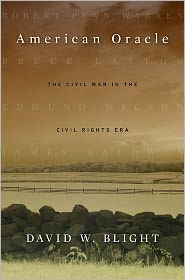
The Chronicle of Higher Education has an interview with David W. Blight on his new book American Oracle: The Civil War in the Civil Rights Era (Harvard University Press). Here's a snippet of the conversation:
Blight: I wrote this book, in great part, as a way of doing some good, serious history of the Civil War Centennial/Civil Rights eras and beginning to reflect on where we are now as a national culture in remembering and explaining the Civil War and Reconstruction. Looking back is almost always the best way of looking at ourselves.
In this week's edition of the New Republic: The Book, you'll find coverage of The Eichmann Trial (Schocken), by historian Deborah Lipstadt. Here's why the book is special, according to the review:
Lipstadt’s book combines a familiar genre of historical summation with a more unusual species of personal and historical reflection. It is a serviceable summary of the events and the major themes of the trial itself. But readers already familiar with this story will not find much to surprise them . . . . [W]hat will grab the reader’s attention most of all is the unusual way Lipstadt interweaves the narrative of the Eichmann trial with more speculative remarks on its significance in relation to revisionism.
Also reviewed: House of Exile: The Lives and Times of Heinrich Mann and Nelly Kroeger-Mann (Farrar Straus Giroux), by Evelyn Juers (here). In a format that is neither fiction nor non-fiction, the book "aim[s] . . . to capture . . . the experience of the European intellectual community in the period before, during, and immediately after World War II."

The New York Times Sunday Book Review is heavy on politics this week. Reviews include Ron Suskind's Confidence Men (here) (mentioned in last week's round-up) and journalist Joe McGinniss's account of his "search[] for the real Sarah Palin" (here).

But there is much for the historically minded, as well. The NYT covers The Swerve: How the World Became Modern (W. W. Norton and Co.), by literary historian Stephen Greenblatt (here); a bestselling biography of Gustav Mahler, now translated into English (here); and Destiny of the Republic: A Tale of Madness, Medicine, and the Murder of a President (Doubleday), by Candice Millard (here) ("Though [James A.] Garfield’s death had little historical significance, Millard has written us a penetrating human tragedy.").


A new issue of the London Review of Books is out.  Non-subscribers may read Daniel Soar's review of The Googlisation of Everything (and Why We Should Worry) (University of California Press), by Siva Vaidhyanathan; In the Plex: How Google Thinks, Works and Shapes Our Lives (Simon and Schuster), by Steven Levy; and I’m Feeling Lucky: The Confessions of Google Employee Number 59 (Houghton Mifflin Harcourt), by Douglas Edwards.

Subscribers will want to check out Neal Ascherson's review of To the Ends of the Earth: Scotland’s Global Diaspora, 1750-2010 (Allen Lane) by T.M. Devine, and The Inner Life of Empires: An 18th-Century History (Princeton University Press), by Emma Rothschild.

Also available to subscribers: Mark Mazower's review of Sarajevo, 1941-1945: Muslims, Christians and Jews in Hitler’s Europe (Cornell University Press), by Emily Greble, and Susan Pederson's review of three British social history festschrifts, honoring Ross McKibbin, Gareth Stedman Jones and Patrick Joyce.

This week the Nation reviews two books on China's transformation: Deng Xiaoping and the Transformation of China (Belknap Press), by Ezra Vogel, and On China (Penguin Press), by Henry Kissinger.  The reviews mentioned last week are now available to non-subscribers.

Saturday, October 1, 2011

Weekend Round-Up

  •  Around the colloquia (courtesy of Legal Scholarship Blog): On September 26, Mark Tushnet (Harvard Law ) presented "Civil Liberties After 1937 - The Justices and Their Theories” at Columbia Law," and Jonathan Miller (Southwestern Law) presented "Borrowing a Constitution: The U.S. Constitution in Argentina and the Heyday of the Argentine Supreme Court (1853-1930)” at UCLA Law.
  • Eric Yamamoto, Hawai'i Law, delivered the keynote address to a recent meeting of the Hawai'i State Bar Association, in which he noted "disturbing parallels"  between the internment of Japanese Americans during World War II and "post 9/11 national policies and actions."
  •  I was pleasantly surprised to learn this week, while noodling around a bit on Joseph Rucker Lamar, who served on the Supreme Court from 1911-1916, that the University of Georgia has posted scans of its holding of of his and his wife Clarinda's papers.  One folder reproduces popular treatments of the Court in middle-class periodicals, such as World's Work.  I've noted a tendency to deprecate Lamar's decisions, but those in two ICC cases (Union Pacific and Louisville & Nashville) do a much better job setting out a framework for the Court's administrative law jurisprudence than did those of Edward Douglass White, who usually gets the credit.  DRE
  • The Edinburgh Legal History Blog has posted a brief report of the recent meeting of the Société internationale Fernand de Visscher pour l'Histoire des Droits de l'Antiquité here.
  • The Society for Historians of American Foreign Relations (SHAFR) has announced a call for papers for its 2012 conference. The theme is "Revolutionary Aftermaths." More information is here. (Hat tip: H-LAW)
  • Over at the Browser, Dahlia Lithwick recommends 5 books on Supreme Court justices.
    The Weekend Round-Up is a weekly feature compiled by all the Legal History bloggers.