 Mary L. Clark, Professor and Associate Dean for Academic Affairs, at the American University Washington College of Law, has sent us an announcement of the symposium, Finding the Founders: Ellen Spencer Mussey and Emma Gillett and Other Early Women Legal Pioneers," to be held Monday, April 14, 2-5 pm at the law school, 4801 Massachusetts Avenue, NW, Washington, DC. It will examine “the roles and impacts of WCL's very own Ellen Spencer Mussey and Emma Gillett and other early women legal pioneers on legal education and the legal profession.” Panelists include Barbara Babcock of Stanford Law School, Jill Norgren of the City University of New York; Wendy Williams of the Georgetown University Law Center, with remarks by Mary Jane Mossman of the Osgoode Hall Law School. The symposium coincides with what Professor Clark calls an “amazing new archival exhibition” on WCL’s founders.
Thursday, April 10, 2014
Finding the Founders: A Symposium on Women Legal Pioneers
Mary L. Clark, Professor and Associate Dean for Academic Affairs, at the American University Washington College of Law, has sent us an announcement of the symposium, Finding the Founders: Ellen Spencer Mussey and Emma Gillett and Other Early Women Legal Pioneers," to be held Monday, April 14, 2-5 pm at the law school, 4801 Massachusetts Avenue, NW, Washington, DC. It will examine “the roles and impacts of WCL's very own Ellen Spencer Mussey and Emma Gillett and other early women legal pioneers on legal education and the legal profession.” Panelists include Barbara Babcock of Stanford Law School, Jill Norgren of the City University of New York; Wendy Williams of the Georgetown University Law Center, with remarks by Mary Jane Mossman of the Osgoode Hall Law School. The symposium coincides with what Professor Clark calls an “amazing new archival exhibition” on WCL’s founders.


Brewer Gets a Guggenheim!
 According to today's New York Times, among this year's recipients of John Simon Guggenheim Memorial Foundation Fellowships is Holly Brewer, Burke Chair of American History and Associate Professor at the University of Maryland, who received hers in the field of Constitutional Studies. Among other things, Professor Brewer is co-editor of the American Society for Legal History's book series and serves on the ASLH's Board of Directors.
Recipients in United States History were David Engerman, Karl Jacoby, Robin Kelley, and Jill Lepore; in European and Latin American History, Lillian Guerra, Eric Jennings, Steven Pincus, and Helmut Smith; in Medieval and Renaissance History, Marina Rustow; and in Law, Anver Emon.
Perry, Vogel, Barnes, and More Reviewed in the Law & Politics Book Review
The Law & Politics Book Review is out with a new batch of reviews. Items of interest include:
- Mark Rush (Washington and Lee University) reviews Michael J. Perry, HUMAN RIGHTS IN THE CONSTITUTIONAL LAW OF THE UNITED STATES (Cambridge University Press, 2013).
-
Herschel Nachlis (Department of Politics, Princeton University) reviews David Vogel, THE POLITICS OF PRECAUTION: REGULATING HEALTH, SAFETY, AND ENVIRONMENTAL RISKS IN EUROPE AND THE UNITED STATES (Princeton University Press, 2012).

- Jeb Barnes (Department of Political Science, University of Southern California) reviews Andrea Boggio, COMPENSATING ASBESTOS VICTIMS: LAW AND THE DARK SIDE OF INDUSTRIALIZATION (Ashgate, 2013).
- Samuel B. Hoff (Department of History, Political Science, and Philosophy, Delaware State University) reviews Douglas S. Massey, et al., CLIMBING MOUNT LAUREL: THE STRUGGLE FOR AFFORDABLE HOUSING AND SOCIAL MOBILITY IN AN AMERICAN SUBURB (Princeton University Press, 2013).
- Mariah Zeisberg (University of Michigan) reviews Graham Dodds, TAKE UP YOUR PEN: UNILATERAL PRESIDENTIAL DIRECTIVES IN AMERICAN POLITICS (University of Pennsylvania Press, 2013).
New Release: Loyd, "Health Rights Are Civil Rights"
New from the University of Minnesota Press: Health Rights Are Civil Rights: Peace and Justice Activism in Los Angeles, 1963–1978, by Jena Loyd (University of Wisconsin-Milwaukee). The Press explains:
Health Rights Are Civil Rights tells the story of the important place of health in struggles for social change in Los Angeles in the 1960s and 1970s. Jenna M. Loyd describes how Black freedom, antiwar, welfare rights, and women’s movement activists formed alliances to battle oppressive health systems and structural violence, working to establish the principle that health is a right. For a time—with President Nixon, big business, and organized labor in agreement on national health insurance—even universal health care seemed a real possibility.

Laura Pulido says:Health Rights Are Civil Rights documents what many Los Angeles activists recognized: that militarization was in part responsible for the inequalities in American cities. This challenging new reading of suburban white flight explores how racial conflicts transpired across a Southland landscape shaped by defense spending. While the war in Vietnam constrained social spending, the New Right gained strength by seizing on the racialized and gendered politics of urban crisis to resist urban reinvestment and social programs.
Recapturing a little-known current of the era’s activism, Loyd uses an intersectional approach to show why this diverse group of activists believed that democratic health care and ending war were essential to create cities of freedom, peace, and social justice—a vision that goes unanswered still today.
Health Rights are Civil Rights suggests an entirely new geography of Los Angeles based on both activism and geopolitics. Jenna M. Loyd makes pathbreaking connections between health, war-making, race, and the environment that offer us a new way of viewing midcentury Los Angeles. An essential text for all scholars of Los Angeles, health, race, and activism.More information is available here.
Wednesday, April 9, 2014
Davies on the Retiring Justice Nelson
 |
| Samuel Nelson (LC) |
In November 1872, Justice Samuel Nelson retired from the U.S. Supreme Court. The formal farewells were of the good-spirited kind that prominent public figures have almost always received: heavy on recitations of his virtues, light on mentions of flaws that were really, of course, merely misunderstood manifestations of his greatness. There were, however, two unusual features of the Nelson celebrations. This article sketches those oddities and makes a couple of suggestions about their significance then and now.
Legal History at OAH 2014
[Many thanks to Lael Weinberger, University of Chicago, for culling the following legal history sessions from the program of this week’s annual meeting of the Organization of American Historians.]
Crossing Professional Borders in America, 1890-2000
Friday, April 11, 2014
9:00am - 10:30am
After immigrants to America cross the physical border, they encounter a series of other borders that need to be crossed as they make their way in U.S. society. There are borders in jobs, in education, and in other aspects of American life. Those who make it into the professions will have normally made a big jump into the middle class, but even in the professions, there are borders that need to be understood, sometimes crossed, sometimes defended or attacked. The papers in this session all deal with professional borders: Susan Carle looks at the border between law/non-law from the perspective of gender and race in turn-of-the-century United States. Her lens is provided by women active in reform efforts. Christy Chapin looks at a later period in American history and studies organized physicians during the post-World War II years when borders were changing as individual practice gave way increasingly to practice within relatively large organizations. In many cases, professional boundaries were eroded; in other cases, the physicians themselves sought to experiment with new types of practices and new professional borders. Finally, Jeffrey Sturchio and Louis Galambos sweep over the twentieth century and explore the tensions that existed between businesses and the professions as they defined and re-defined their respective borders. Businesses needed professional expertise, but they initially often found it difficult to recruit and keep the professionals they needed. When corporations began to promote women and minorities to executive positions, professional standing became an important stepping stone for advancement.
Chair: Louis Galambos, Johns Hopkins University
Commentators: Christopher Tomlins, University of California- Irvine, and Melissa Fisher, New York University
"Doctors Without Borders: American Medical Practice in Diverse Organization Settings"
By: Christy Chapin, University of Maryland, Baltimore County
"Looking at the Law/Non-Law Divide Through The Lenses of Gender and Race in Turn-Of-The-Twentieth-Century American Women's Reform Activism"
By: Susan D. Carle of American University
American Business and the Challenge of Professionalism"
By: Jeffrey Sturchio, Rabin Martin
The Scope and Stakes of Reproductive Politics: Contesting Sexual Freedom, Abortion and Unwed Parenthood Since 1965
Friday, April 11, 2014
9:00am - 10:30am
Endorsed by: OAH Committee on the Status of Women in the Historical Profession
Since 1965, social movements have contested the meaning of legitimate sexual and reproductive decision-making. The history of these debates reveals a surprising and complex story about attitudes toward sex, choice, and licit reproduction the aftermath of the sexual revolution. This panel recovers this lost history by examining three settings in which activists, lawmakers, and judges have struggled to define the scope and stakes of reproductive and sexual freedom. Mary Ziegler’s paper uncovers a rich and unexpected dialogue about unwed motherhood among anti-abortion activists in the 1960s and 1970s. Serena Mayeri’s paper uses contemporaneous constitutional challenges to illegitimacy penalties to explore attitudes toward extramarital sexuality among various historical actors, including feminists, unmarried parents, and judges. Sara Dubow canvasses a long sweep of recent American history to trace the evolution of debates over conscience clauses that enabled individual physicians and hospitals with moral and religious objections to refuse to provide abortions and sterilizations.
Apart from their similar subject matter, several themes unite the three papers. The ideological diversity of activism on both sides of debates over reproductive and sexual freedom complicates narratives of longstanding polarization. To the extent that social movements reached internal consensus and defined themselves in contraposition to their adversaries, the process was often partial, messy, and gradual, rather than instantaneous and inevitable. Nor did economic and cultural ideologies automatically align in the ways that are familiar to twenty-first century political observers. For some activists, robust visions of gender and economic equality coexisted with profound misgivings about abortion. Others believed strongly in access to reproductive health services but also accepted arguments for conscience-based exemptions. Still others idealized marriage but opposed efforts to penalize unwed parenthood.
Each of these debates also illuminates the material stakes of “culture war” conflict, and the political costs and benefits of exposing the price of ideals such as liberty and equality. Disagreements among anti-abortion activists over the proper approach to unwed motherhood foregrounded the social and economic conditions that made reproductive “choice” a misnomer for poor unmarried women. Spotlighting discrimination against unmarried mothers in employment and elsewhere exposed the contingency of links between non-marriage and poverty, as well as the racial subtext of campaigns against “illegitimacy.” Anti-abortion lawmakers depicted conscience clauses as integral to religious liberty while masking their devastating impact on women’s access to abortion. The panel exposes the contradictory and ideologically charged history of the values, interests, and strategies that continue to shape debates about sexuality and reproduction.
Chair: Linda Gordon, New York University
Commentator: Regina G. Kunzel, Princeton University
"“A Constitutional right rendered utterly meaningless”: Federal Conscience Clause Laws and the Politics of Abortion, 1973-2013"By: Sara Dubow of Williams College
"Reproducing Inequality: Legal Challenges to Illegitimacy Penalties, 1968-1979"
By: Serena Mayeri of the University of Pennsylvania Law School
"Negotiating the Double Standard: Sex in the Abortion Debate, 1965 - 1980"
By: Mary Ziegler, Saint Louis University School of Law
Boundless War: The Legal, Military, and Psychological Effects of the Vietnam War across Time and Space
Endorsed by: SHAFR
Friday, April 11, 2014
1:50pm - 3:20pm
War is often seen as a bounded institution—fought by a specified class of people in a particular place over a defined period of time. But as the historian Mary Dudziak has recently shown in her discussion of the temporal boundaries of armed conflict, War•Time: An Idea, Its History, Its Consequences (Oxford University Press, 2012), this notion of war as bounded is increasingly difficult to sustain. Not only is the distinction between wartime and peacetime less clear than the American public often imagines but war also has consequences for politics, economics, and individual lives well beyond the battlefield. Our panel seeks to build on this insight by exploring some of the broader effects of the Vietnam War across time and space.
At the heart of this panel is one particular conflict—the Vietnam War—but in keeping with the panel’s theme, we seek to show a continuum of conflict in the post-1945 era and to place the Vietnam War in a broader spatial framework. The panel begins with an examination of how U.S. government lawyers developed ideas about the legality of certain types of conflict in Latin America in the 1960s which were then transferred to the Vietnam theater and beyond. This paper details how the efforts of American lawyers to reconsider the status of borders and the commitment not to violate them in international law contributed to the development of a mode of warfare less constrained by geographical boundaries. The panel continues with a discussion of how publicity surrounding war crimes committed by U.S. servicemen in Vietnam, particularly the My Lai Massacre, had a significant subsequent impact on both military policy with regard to war crimes and the American people’s views on the conduct of war. It suggests that the nature of fighting in Vietnam was influenced by a transnational context in which ideas of war circulated between the front line in Vietnam and the home front in the United States. The panel ends with a consideration of how return trips after the war by U.S. veterans to Vietnam for the purposes of promoting healing among civilians have played into similar efforts by veterans of America’s most recent wars. This paper illuminates the influence of war on veterans themselves even after they have left the war zone and the importance of crossing borders to the healing process in the lives of both Vietnam and Iraq veterans. Each of these papers demonstrates how individuals and institutions continued to respond to the war legally, in policy, and personally in new geographic spaces well beyond the height of hostilities.
Together, these papers show the unbounded nature of war. They demonstrate the sprawling effects and influences of the Vietnam War both temporally and geographically. Finally, this scholarship speaks to the early and potential effects of more recent undeclared wars in Iraq and Afghanistan.
Chair and Commentator: Edwin Martini, Western Michigan University
“American War Crimes: The My Lai Massacre in U.S. Military Policy”
by: Christine Lamberson, Angelo State University
“'More and More Americans are Taking Responsibility for What Was Done in Our Name': Vietnam’s Legacy and Transnational Healing After the Iraq War"
By: David Kieran of The George Washington University
"Wars without Borders: The American Challenge to International Law, 1961 - 1965"
by: Brian Cuddy, Cornell University
Legal Histories of Human Rights
Saturday, April 12, 2014
10:50am - 12:20pm
Endorsed by: SHAFR
Lawyers and political scientists had been working on the subject of “human rights” before professional historians came on the scene. But about 15 years ago, historians discovered human rights. Since then, the historiography of human rights has exploded. With the growth of human rights studies from within the disciplinary field of history, most of the work has moved away from looking at the narrow issues of treaties and tribunals that lawyers and political scientists focused on.
Yet this move away from law has left major issues unexplained. Most fundamentally, we still need an explanation for how and why the field of human rights came to be suffused with law and legality. Historians are now only beginning to look at the legal history of human rights and it promises to be an exciting field.
The papers presented on this panel will explore legal histories of modern human rights across a wide chronological span and from a variety of angles. How did human rights make their way into international law? Why have activists and national actors alike looked to international human rights law to advance their agendas? What role has the legal profession played in shaping the discourse of human rights? How have attorneys reacted to international human rights treaties, statements, and declarations?
By asking—and proposing answers to—these questions, this panel will be joining the ongoing historical discussion of how modern human rights discourse has developed. It will historicize the issue of how the field of human rights has become so widely infused with law and legality. And it will explore the diverse and complex relationships that can exist between national laws and international legal norms.
Chair: Heide Fehrenbach, Northern Illinois University
Commentator: Mark Bradley, University of Chicago
"Manley Hudson and the Quest for International Order: From Peace through Law to Human Rights"
by: Lael Weinberger, University of Chicago
"'Whittling Away' at Domestic Jurisdiction: The NAACP and the Afro-Asian Bloc’s Anti-Colonial Strategy in the United Nations"
By: Carol Anderson of Emory University
"America, the Exceptional: Morris Abram, Cold War Liberalism, and the Politics of Drafting the U.N. Race Convention"
By: H. Timothy Lovelace of Indiana University Mauer School of Law
"To Champion the Cause Through Law: Transnational Legal Efforts in the Fight Against the Apartheid"
by: Robert Smith, University of Wisconsin-Milwaukee, Milwaukee
Crossing Professional Borders in America, 1890-2000
Friday, April 11, 2014
9:00am - 10:30am
After immigrants to America cross the physical border, they encounter a series of other borders that need to be crossed as they make their way in U.S. society. There are borders in jobs, in education, and in other aspects of American life. Those who make it into the professions will have normally made a big jump into the middle class, but even in the professions, there are borders that need to be understood, sometimes crossed, sometimes defended or attacked. The papers in this session all deal with professional borders: Susan Carle looks at the border between law/non-law from the perspective of gender and race in turn-of-the-century United States. Her lens is provided by women active in reform efforts. Christy Chapin looks at a later period in American history and studies organized physicians during the post-World War II years when borders were changing as individual practice gave way increasingly to practice within relatively large organizations. In many cases, professional boundaries were eroded; in other cases, the physicians themselves sought to experiment with new types of practices and new professional borders. Finally, Jeffrey Sturchio and Louis Galambos sweep over the twentieth century and explore the tensions that existed between businesses and the professions as they defined and re-defined their respective borders. Businesses needed professional expertise, but they initially often found it difficult to recruit and keep the professionals they needed. When corporations began to promote women and minorities to executive positions, professional standing became an important stepping stone for advancement.
Chair: Louis Galambos, Johns Hopkins University
Commentators: Christopher Tomlins, University of California- Irvine, and Melissa Fisher, New York University
"Doctors Without Borders: American Medical Practice in Diverse Organization Settings"
By: Christy Chapin, University of Maryland, Baltimore County
"Looking at the Law/Non-Law Divide Through The Lenses of Gender and Race in Turn-Of-The-Twentieth-Century American Women's Reform Activism"
By: Susan D. Carle of American University
American Business and the Challenge of Professionalism"
By: Jeffrey Sturchio, Rabin Martin
The Scope and Stakes of Reproductive Politics: Contesting Sexual Freedom, Abortion and Unwed Parenthood Since 1965
Friday, April 11, 2014
9:00am - 10:30am
Endorsed by: OAH Committee on the Status of Women in the Historical Profession
Since 1965, social movements have contested the meaning of legitimate sexual and reproductive decision-making. The history of these debates reveals a surprising and complex story about attitudes toward sex, choice, and licit reproduction the aftermath of the sexual revolution. This panel recovers this lost history by examining three settings in which activists, lawmakers, and judges have struggled to define the scope and stakes of reproductive and sexual freedom. Mary Ziegler’s paper uncovers a rich and unexpected dialogue about unwed motherhood among anti-abortion activists in the 1960s and 1970s. Serena Mayeri’s paper uses contemporaneous constitutional challenges to illegitimacy penalties to explore attitudes toward extramarital sexuality among various historical actors, including feminists, unmarried parents, and judges. Sara Dubow canvasses a long sweep of recent American history to trace the evolution of debates over conscience clauses that enabled individual physicians and hospitals with moral and religious objections to refuse to provide abortions and sterilizations.
Apart from their similar subject matter, several themes unite the three papers. The ideological diversity of activism on both sides of debates over reproductive and sexual freedom complicates narratives of longstanding polarization. To the extent that social movements reached internal consensus and defined themselves in contraposition to their adversaries, the process was often partial, messy, and gradual, rather than instantaneous and inevitable. Nor did economic and cultural ideologies automatically align in the ways that are familiar to twenty-first century political observers. For some activists, robust visions of gender and economic equality coexisted with profound misgivings about abortion. Others believed strongly in access to reproductive health services but also accepted arguments for conscience-based exemptions. Still others idealized marriage but opposed efforts to penalize unwed parenthood.
Each of these debates also illuminates the material stakes of “culture war” conflict, and the political costs and benefits of exposing the price of ideals such as liberty and equality. Disagreements among anti-abortion activists over the proper approach to unwed motherhood foregrounded the social and economic conditions that made reproductive “choice” a misnomer for poor unmarried women. Spotlighting discrimination against unmarried mothers in employment and elsewhere exposed the contingency of links between non-marriage and poverty, as well as the racial subtext of campaigns against “illegitimacy.” Anti-abortion lawmakers depicted conscience clauses as integral to religious liberty while masking their devastating impact on women’s access to abortion. The panel exposes the contradictory and ideologically charged history of the values, interests, and strategies that continue to shape debates about sexuality and reproduction.
Chair: Linda Gordon, New York University
Commentator: Regina G. Kunzel, Princeton University
"“A Constitutional right rendered utterly meaningless”: Federal Conscience Clause Laws and the Politics of Abortion, 1973-2013"By: Sara Dubow of Williams College
"Reproducing Inequality: Legal Challenges to Illegitimacy Penalties, 1968-1979"
By: Serena Mayeri of the University of Pennsylvania Law School
"Negotiating the Double Standard: Sex in the Abortion Debate, 1965 - 1980"
By: Mary Ziegler, Saint Louis University School of Law
Boundless War: The Legal, Military, and Psychological Effects of the Vietnam War across Time and Space
Endorsed by: SHAFR
Friday, April 11, 2014
1:50pm - 3:20pm
War is often seen as a bounded institution—fought by a specified class of people in a particular place over a defined period of time. But as the historian Mary Dudziak has recently shown in her discussion of the temporal boundaries of armed conflict, War•Time: An Idea, Its History, Its Consequences (Oxford University Press, 2012), this notion of war as bounded is increasingly difficult to sustain. Not only is the distinction between wartime and peacetime less clear than the American public often imagines but war also has consequences for politics, economics, and individual lives well beyond the battlefield. Our panel seeks to build on this insight by exploring some of the broader effects of the Vietnam War across time and space.
At the heart of this panel is one particular conflict—the Vietnam War—but in keeping with the panel’s theme, we seek to show a continuum of conflict in the post-1945 era and to place the Vietnam War in a broader spatial framework. The panel begins with an examination of how U.S. government lawyers developed ideas about the legality of certain types of conflict in Latin America in the 1960s which were then transferred to the Vietnam theater and beyond. This paper details how the efforts of American lawyers to reconsider the status of borders and the commitment not to violate them in international law contributed to the development of a mode of warfare less constrained by geographical boundaries. The panel continues with a discussion of how publicity surrounding war crimes committed by U.S. servicemen in Vietnam, particularly the My Lai Massacre, had a significant subsequent impact on both military policy with regard to war crimes and the American people’s views on the conduct of war. It suggests that the nature of fighting in Vietnam was influenced by a transnational context in which ideas of war circulated between the front line in Vietnam and the home front in the United States. The panel ends with a consideration of how return trips after the war by U.S. veterans to Vietnam for the purposes of promoting healing among civilians have played into similar efforts by veterans of America’s most recent wars. This paper illuminates the influence of war on veterans themselves even after they have left the war zone and the importance of crossing borders to the healing process in the lives of both Vietnam and Iraq veterans. Each of these papers demonstrates how individuals and institutions continued to respond to the war legally, in policy, and personally in new geographic spaces well beyond the height of hostilities.
Together, these papers show the unbounded nature of war. They demonstrate the sprawling effects and influences of the Vietnam War both temporally and geographically. Finally, this scholarship speaks to the early and potential effects of more recent undeclared wars in Iraq and Afghanistan.
Chair and Commentator: Edwin Martini, Western Michigan University
“American War Crimes: The My Lai Massacre in U.S. Military Policy”
by: Christine Lamberson, Angelo State University
“'More and More Americans are Taking Responsibility for What Was Done in Our Name': Vietnam’s Legacy and Transnational Healing After the Iraq War"
By: David Kieran of The George Washington University
"Wars without Borders: The American Challenge to International Law, 1961 - 1965"
by: Brian Cuddy, Cornell University
Legal Histories of Human Rights
Saturday, April 12, 2014
10:50am - 12:20pm
Endorsed by: SHAFR
Lawyers and political scientists had been working on the subject of “human rights” before professional historians came on the scene. But about 15 years ago, historians discovered human rights. Since then, the historiography of human rights has exploded. With the growth of human rights studies from within the disciplinary field of history, most of the work has moved away from looking at the narrow issues of treaties and tribunals that lawyers and political scientists focused on.
Yet this move away from law has left major issues unexplained. Most fundamentally, we still need an explanation for how and why the field of human rights came to be suffused with law and legality. Historians are now only beginning to look at the legal history of human rights and it promises to be an exciting field.
The papers presented on this panel will explore legal histories of modern human rights across a wide chronological span and from a variety of angles. How did human rights make their way into international law? Why have activists and national actors alike looked to international human rights law to advance their agendas? What role has the legal profession played in shaping the discourse of human rights? How have attorneys reacted to international human rights treaties, statements, and declarations?
By asking—and proposing answers to—these questions, this panel will be joining the ongoing historical discussion of how modern human rights discourse has developed. It will historicize the issue of how the field of human rights has become so widely infused with law and legality. And it will explore the diverse and complex relationships that can exist between national laws and international legal norms.
Chair: Heide Fehrenbach, Northern Illinois University
Commentator: Mark Bradley, University of Chicago
"Manley Hudson and the Quest for International Order: From Peace through Law to Human Rights"
by: Lael Weinberger, University of Chicago
"'Whittling Away' at Domestic Jurisdiction: The NAACP and the Afro-Asian Bloc’s Anti-Colonial Strategy in the United Nations"
By: Carol Anderson of Emory University
"America, the Exceptional: Morris Abram, Cold War Liberalism, and the Politics of Drafting the U.N. Race Convention"
By: H. Timothy Lovelace of Indiana University Mauer School of Law
"To Champion the Cause Through Law: Transnational Legal Efforts in the Fight Against the Apartheid"
by: Robert Smith, University of Wisconsin-Milwaukee, Milwaukee
Bomhoff on Balancing Constitutional Rights in Postwar US and Germany
Published recently in Cambridge Studies in Constitutional Law is Balancing Constitutional Rights: The Origins and Meanings of Postwar Legal Discourse, by Jacco Bomhoff, Associate Professor of Law at the London School of Economics and Political Science. Saith CUP:
Professor Bomhoff writes to us:The language of balancing is pervasive in constitutional rights jurisprudence around the world. In this book, Jacco Bomhoff offers a comparative and historical account of the origins and meanings of this talismanic form of language, and of the legal discourse to which it is central. Contemporary discussion has tended to see the increasing use of balancing as the manifestation of a globalization of constitutional law. This book is the first to argue that 'balancing' has always meant radically different things in different settings. Bomhoff uses detailed case studies of early post-war US and German constitutional jurisprudence to show that the same unique language expresses both biting scepticism and profound faith in law and adjudication, and both deep pessimism and high aspirations for constitutional rights. An understanding of these radically different meanings is essential for any evaluation of the work of constitutional courts today.
Of most interest for legal historians (I hope) are the book's two central chapters which discuss the simultaneous advent of a discourse of 'balancing' rights, values and interest in US Supreme Court and German Constitutional Court jurisprudence in the late 1950s and early 1960s. While this early case law provoked well-known - infamous - debates on both sides of the Atlantic, these clashes had not yet been the subject of any extended comparison. From this comparative perspective, and in part because of their almost cliche status, they provide a perhaps surprisingly useful lens for looking at the character of US and Western European legalism and constitutionalism more generally.
The book also looks at the broader legal-intellectual context of the time, notably comparing efforts to develop 'new' standards for adequate judicial reasoning (the neutral principles and process jurisprudence currents in the US, and the 'topical jurisprudence' and dialectical reasoning movements in Germany). In this way, the book aims to uncover thicker, contextualized, understandings of key jurisprudential concepts such as objectivity, neutrality, and most importantly: legal formality and its opposites.
Tuesday, April 8, 2014
ASLH Call for Applications: 2014 Kathryn T. Preyer Scholars
The American Society for Legal History has issued the following call for applications:
Kathryn T. Preyer Scholars
Named after the late Kathryn T. Preyer, a distinguished historian of the law of early America known for her generosity to young legal historians, the program of Kathryn T. Preyer Scholars is designed to help legal historians at the beginning of their careers. At the annual meeting of the Society two younger legal historians designated Kathryn T. Preyer Scholars will present what would normally be their first papers to the Society. The generosity of Professor Preyer’s friends and family has enabled the Society to offer a small honorarium to the Preyer Scholars and to reimburse, in some measure or entirely, their costs of attending the meeting. The competition for Preyer Scholars is organized by the Society’s Kathryn T. Preyer Memorial Committee.
Submissions are welcome on any topic in legal, institutional and/or constitutional history. Early career scholars, including those pursuing graduate or law degrees, those who have completed their terminal degree within the previous year, and those independent scholars at a comparable stage, are eligible to apply. Papers already submitted to the ASLH Program Committee–whether or not accepted for an existing panel–and papers never previously submitted are equally eligible. Once selected, Preyer Award winners must present their paper as part of the Preyer panel, and they will be removed from any other panel.
Submissions should be a single MS Word document consisting of a complete curriculum vitae, contact information, and a complete draft of the paper to be presented. Papers must not exceed 40 pages (12 point font, double-spaced) and must contain supporting documentation. In past competitions, the Committee has given preference to draft articles and essays, though the Committee will still consider shorter conference papers. as one of the criteria for selection will be the suitability of the paper for reduction to a twenty-minute oral presentation. The deadline for submission is June 15, 2014.
Kathryn T. Preyer Scholars will receive a $500 cash award and reimbursement of expenses up to $750 for travel, hotels, and meals. Each will present the paper that s/he submitted to the competition at the Society’s annual meeting in Denver, Colorado, on November 6-9, 2014. The Society’s journal, Law and History Review, has published several past winners of the Preyer competition, though it is under no obligation to do so.
Please send submissions as Microsoft Word attachments by June 15, 2014, to the chair of the Preyer Committee, Gautham Rao <email>. He will forward them to the other committee members.
The 2014 Preyer Memorial Committee
Sam Erman, Assistant Professor of Law, University of Southern California
Serena Mayeri, Professor of Law and History, University of Pennsylvania
Gautham Rao, Assistant Professor of History, American University
Michael Schoeppner, Visiting Assistant Professor of History, University of Maine at Farmington
Karen Tani, Assistant Professor of Law, University of California, Berkeley
The Law in Action: A Graduate Student Conference at Northwestern

9:00- 10:45 Session One—Embodying Law: The Legal Construction of the Individual
Chair. Paul Ramirez (NU)
• Evelyn Atkinson (University of Chicago), "The Right to Bodily Integrity: Pratt v. Davis and the Origins of Informed Consent"
• Rachel Boyle (Loyola University), “From Hysteria to Insanity: Feminine Criminality and Husband Slaying in Chicago, 1870-1919”
• Jason Morgan (University of Wisconsin-Madison), “Suehiro Izutaro, Hozumi Shigeto, and the Case Law Revolution in Japan: Domesticating Taisho Democracy”
Commentator: Kate Masur (NU)
11:00- 12:45 Session Two—The Law, Violence, and the State
Chair: Joanna Grisinger (NU)
• Jesse Nasta (NU), “Navigating Freedom: African American Mobility and Legal Status on the Antebellum Mississippi”
• Matthew June (NU), “A History in Two Acts: Uses and Abuses of the Constitution's Commerce Power from the New Deal to Civil Rights and Controlled Substances”
• Andrew Baer (NU), "Police Torture and Other Pervasive Practices: The Role of Official Misconduct in the Rise of Mass Incarceration in the United States after 1970."
Commentator: Beth Lew-Williams (NU)
1:30- 3:00: Keynote Address—Rebecca Scott (University of Michigan)
“Free or Not? Eulalie Oliveau, the Kidnapped Midwife from False River”
3:00- 4:45: Session Three—Law in Culture and Culture in Law
Chair: Helen Tilley (NU)
• Melissa Vise (NU), “Free Speech, the Law, and Republican Ethics: The Medieval Case”
• Ian Saxine (NU), “Imperial Properties: Land Deeds and Anglo-Wabanaki Relations in Eighteenth-Century Maine”
• Géraldine Gudefin (Brandeis University), “Jewish Bigamists?: Rabbinical Divorces and Trials for Bigamy in New York at the Turn of the Twentieth Century"
Commentator: Mitra Sharafi (University of Wisconsin-Madison)
New Release: Huret, "American Tax Resisters"
This next new release is a fitting epilogue to Ajay Mehtrotra's fantastic posts on the "making of the modern American fiscal state" --
New from Harvard University Press: American Tax Resisters, by Romain D. Huret (University of Lyon). A description from the Press:
New from Harvard University Press: American Tax Resisters, by Romain D. Huret (University of Lyon). A description from the Press:
“The American taxpayer”—angered by government waste and satisfied only with spending cuts—has preoccupied elected officials and political commentators since the Reagan Revolution. But resistance to progressive taxation has older, deeper roots. American Tax Resisters presents the full history of the American anti-tax movement that has defended the pursuit of limited taxes on wealth and battled efforts to secure social justice through income redistribution for the past 150 years.
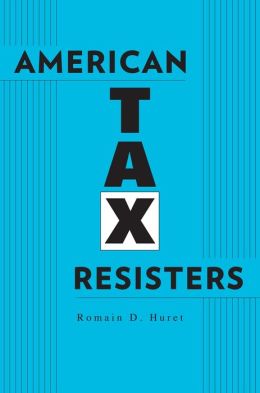
From the Tea Party to the Koch brothers, the major players in today’s anti-tax crusade emerge in Romain Huret’s account as the heirs of a formidable—and far from ephemeral—political movement. Diverse coalitions of Americans have rallied around the flag of tax opposition since the Civil War, their grievances fueled by a determination to defend private life against government intrusion and a steadfast belief in the economic benefits and just rewards of untaxed income. Local tax resisters were actively mobilized by business and corporate interests throughout the early twentieth century, undeterred by such setbacks as the Sixteenth Amendment establishing a federal income tax. Zealously petitioning Congress and chipping at the edges of progressive tax policies, they bequeathed hard-won experience to younger generations of conservatives in their pursuit of laissez-faire capitalism.
A few blurbs:Capturing the decisive moments in U.S. history when tax resisters convinced a majority of Americans to join their crusade, Romain Huret explains how a once marginal ideology became mainstream, elevating economic success and individual entrepreneurialism over social sacrifice and solidarity.
“In this important work, Romain Huret reconstructs as no one else has the durable political tradition out of which the Koch brothers, the Tea Partiers, and other prominent tax resisters of our time emerged. A fascinating and indispensable guide to 150 years of movements, personalities, and struggles that have done so much to shape the conservative temper in modern America.”—Gary Gerstle
“Romain Huret has written the definitive account of tax resistance in the United States. Rather than presenting opposition to taxation simply as part of American political culture, he meticulously traces the organizations and activists who fought and negotiated with the government as it developed its capacity to tax income. An important history that reveals the roots of contemporary debate.”—Julian E. ZelizerMore information is available here.
Klarman, Shugerman, Hartog & More Reviewed in Tulsa L. Rev. Book Review Issue
Via Ken Kersch at Balkinization, we have word that the
annual Tulsa Law Review book review
issue is now available. Kersch co-edited the issue with Linda
McClain. Here are some items of interest:

Thomas F. Burke reviews Michael J. Klarman, From the Closet to the Altar: Courts, Backlash, and the Struggle for Same-Sex Marriage (2012).

- Lisa L. Miller reviews Sotirios A. Barber, The Fallacies of States' Rights (2013), David Brian Robertson, Federalism and the Making of America (2012) and Erin Ryan, Federalism and the Tug of War Within (2011).
- Stephen M. Engel reviews Justin Crowe, Building the Judiciary: Law, Courts and the Politics of Institutional Development (2012) and Jed Handelsman Shugerman, The People's Courts: Pursuing Judicial Independence in America (2012).
- Patricia A. Caine reviews Hendrick Hartog, Someday All This Will Be Yours: A History of Inheritance and Old Age (2012).
- Emily Zackin reviews George I. Lovell, This is Not Civil Rights: Discovering Rights Talk in 1939 America (2012) and Ronald J. Krotoszynski, Jr., Reclaiming the Petition Clause: Seditious Libel, "Offensive" Protest, and the Right to Petition the Government for a Redress of Grievances (2012).

- William P. Marshall reviews Steven K. Green, The Bible, The School and the Constitution: The Clash That Shaped Modern Church-State Doctrine (2012.
- Mark A. Graber reviews Alexander Tsesis, For Liberty and Equality: The Life and Times of the Declaration of Independence (2012), Justin Buckley Dyer, Natural Law and the Antislavery Constitutional Tradition (2012), Nicholas Buccola, The Political Thought of Frederick Douglass (2012), and Brian R. Dirck, Lincoln and the Constitution (2012).
- Michael McCann Jr. reviews Kenneth W. Mack, Representing the Race: The Creation of The Civil Rights Lawyer (201), and Leigh Ann Wheeler, How Sex Became a Civil Liberty (2012).
- Devan O. Pendas reviews Allan A. Ryan, Yamashita's Ghost: War Crimes, MacArthur's Justice, and Command Accountability (2012), and Charles Anthony Smith, The Rise and Fall of War Crimes Trials: From Charles I to Bush II (2012).
Monday, April 7, 2014
Harris to Speak on State Trials and the Rule of Law under Charles II
Tim Harris, Brown University, will speak on State Trials and the Rule of Law under Charles II: Some Reflections on Thursday, April 10 from 4 p.m. to 5:30 p.m. at the Nicholas D. Chabraja Center for Historical Studies, Northwestern University
Two by Schorr on Water Law
David Schorr, Tel Aviv University Buchmann Faculty of Law, has recently posted two papers on SSRN. The first is Reform of Water Rights in Mandate Palestine, which is forthcoming in Water History. Here is the abstract:
This article surveys the water law of Palestine under British rule, identifying the legal norms governing the use of water and explaining some of the factors shaping the development of this area of the law. It argues that despite their lack of official lawmaking power, Arabs and Jews succeeded in decisively shaping the course taken by water law in this period.The second is Riparian Rights in Lower Canada and Canada East: Inter-Imperial Legal Influences. Here is the abstract:
After surveying the Ottoman water law in force when the British took power in 1917, the article examines influential court decisions in a case brought by the Arab residents of the village Artas against government expropriation of water, and explains the significance of this litigation for the subsequent development of Palestine's water law. It then turns to British initiatives meant to reform water law and subject the country's water to state control, plans frustrated by the opposition of Zionist groups fearful of increased government regulation. It closes by noting that water law was made in this colonial context neither by imposition from above nor by resistance from below, but by intervention of subject peoples at the highest levels of official lawmaking.
The development of the law of riparian rights in the Anglo-American world in the nineteenth century has been analyzed from several points of view, including economic property theory and Marxian legal history. Transnational aspects of the subject have not been neglected, as some have highlighted the transatlantic framework in which this body of doctrine developed, and others have examined the use of Continental, civil law sources by some of the American jurists responsible for that development. Yet the inter-imperial aspect of this story, in particular the meeting of the laws of the British and French Empires, has gone unremarked.
This paper examines the crossed histories of English common law, French civil law, and American law in the jurisprudence of water rights in Lower Canada/Canada East/Quebec in the mid-nineteenth century, and the influence of this jurisprudence on the developing water law of the British Empire.
New Release: Tsai, "America's Forgotten Constitutions"
New from Harvard University Press: America's Forgotten Constitutions: Defiant Visions of Power and Community, by Robert L. Tsai (American University). The Press explains:
 Two blurbs, from two big names:
The U.S. Constitution opens by proclaiming the sovereignty of all citizens: “We the People.” Robert Tsai’s gripping history of alternative constitutions invites readers into the circle of those who have rejected this ringing assertion—the defiant groups that refused to accept the Constitution’s definition of who “the people” are and how their authority should be exercised.
America’s Forgotten Constitutions is the story of America as told by dissenters: squatters, Native Americans, abolitionists, socialists, internationalists, and racial nationalists. Beginning in the nineteenth century, Tsai chronicles eight episodes in which discontented citizens took the extraordinary step of drafting a new constitution. He examines the alternative Americas envisioned by John Brown (who dreamed of a republic purged of slavery), Robert Barnwell Rhett (the Confederate “father of secession”), and Etienne Cabet (a French socialist who founded a utopian society in Illinois). Other dreamers include the University of Chicago academics who created a world constitution for the nuclear age; the Republic of New Afrika, which demanded a separate country carved from the Deep South; and the contemporary Aryan movement, which plans to liberate America from multiculturalism and feminism.
Countering those who treat constitutional law as a single tradition, Tsai argues that the ratification of the Constitution did not quell debate but kindled further conflicts over basic questions of power and community. He explains how the tradition mutated over time, inspiring generations and disrupting the best-laid plans for simplicity and order. Idealists on both the left and right will benefit from reading these cautionary tales.
Two blurbs, from two big names: “Tsai’s recovery of the constitutional plans of dissenting political communities challenges our sense of a stable constitutional history. America’s Forgotten Constitutions masterfully exposes the disturbingly shaky foundations of constitutional identity; yet it also shows the (mildly reassuring) consistency of constitutional thinking, even among white supremacists, land-grabbers, and moralistic ideologues.”—Sarah Barringer Gordon
“For two centuries, dissenters from the American mainstream have drawn inspiration from the U.S. Constitution—and chafed at it. Tsai elegantly maps the margins of our constitutional landscape to reveal one of the Framers’ great forgotten legacies. A brilliantly conceived book.”—John Fabian WittMore information is available here, at the book's HUP website. Read about the book's journey here, at Tsai's site.
Sunday, April 6, 2014
Sunday Book Roundup
 The New York Review of Books takes a look at two books in "Innovation: The Government was Crucial After All": Mariana's Mazzucato's The Entrepreneurial State: Debunking Public vs. Private Sector Myths (Anthem) and William Janeway's Doing Capitalism in the Innovation Economy: Markets, Speculation and the State (Cambridge). Of Mazzucato's book, Jeff Madrick writes
"We hear time and again from those who should know better that government is a hindrance to the innovation that produces economic growth. Above all, the government should not try to pick “winners” by investing in what may be the next great companies. Many orthodox economists insist that the government should just get out of the way. ...The Federal Lawyer has new online book reviews, all available here. Reviewed books include Michael Avery and Danielle McLaughlin's The Federalist Society: How Conservatives Took the Law Back from Liberals (Vanderbilt University Press), and Martin Clancy and Tim O'Brien's Murder at the Supreme Court: Lethal Crimes and Landmark Cases (Prometheus Books).
Fortunately, a new book, The Entrepreneurial State, by the Sussex University economist Mariana Mazzucato, forcefully documents just how wrong these assertions are. It is one of the most incisive economic books in years."
The New York Times interviews former Justice John Paul Stevens about his book interests here.
The Guardian reviews Trials of Passion: Crimes in the Name of Love and Madness (Virgao Press) by Lisa Appignanesi, who "is a novelist as well as a historian of ideas, and her relish for a good story sometimes gets the better of her analytical purpose. But her subject is serious, and its implications are far-reaching."

HNN also has several reviews this week. Randall Balmer's Redeemer: The Life of Jimmy Carter (Basic) is reviewed, as well as Phillip Deery's Red Apple: Communism and McCarthyism in Cold War New York (Fordham University Press) (here).
The Los Angeles Review of Books has a review of Ramin Jahanbegloo's The Gandhian Moment (Harvard University Press).
Saturday, April 5, 2014
Weekend Roundup
- Richard J. Ross, University of Illinois College of Law, presented "The Beginnings of American Law: A Comparative History," at the University of Wisconsin Law School on March 31, 2014. Hat tip: Legal Scholarship Blog
- Via Environment, Law, and History: Emory University's Trans-Atlantic Slave Trade database is very cool. The blog Not Even Past agrees.
- Ethiopian Legal History: The Movie. "A new documentary by Leyou Tameru, 'Chasing Modernity: A Reflection on Legal History,' will be screened on April 9th at Teachers College, Columbia University. The film highlights the evolution of Ethiopia’s legal system under three different authorities in the past five decades, paying particular attention to the Civil Code." Hat tip: Tadias.
- Renée Lettow Lerner, George Washington University Law School, will speak on a panel on the topic The Jury Trial is Dying: Should We Mourn its Demise? at NYU Law on Wednesday, April 9, 12:25-1:50 p.m. in Vanderbilt Hall, Greenberg Lounge. Partners from several law firms will join her in a session to be moderated by Arthur R. Miller.
Friday, April 4, 2014
Civil and Voting Rights in the Deep South
 We previously noted the oral history project on the civil rights movement of the American Folklife Center of the Library of Congress. As one in a series of public events, Many Paths to Freedom: Looking Back, Looking Ahead at the Long Civil Rights Movement, the Center will be hosting a “Scholars Roundtable” from 12 noon to 1:30 on April 17, entitled Locality and Nation: Civil Rights and Voting Rights in the Deep South, 1963-1966. The speakers will be Hasan Kwame Jeffries, Ohio State University, and Thomas Jackson, UNC-Greensboro.
New Release: Ferguson, "Inferno: An Anatomy of American Punishment"
New from Harvard University Press: Inferno: An Anatomy of American Punishment (March 2014), by Robert A. Ferguson (Columbia University). A description from the Press:
America’s criminal justice system is broken. The United States punishes at a higher per capita rate than any other country in the world. In the last twenty years, incarceration rates have risen 500 percent. Sentences are harsh, prisons are overcrowded, life inside is dangerous, and rehabilitation programs are ineffective. Police and prosecutors operate in the dark shadows of the legal process—sometimes resigning themselves to the status quo, sometimes turning a profit from it. The courts define punishment as “time served,” but that hardly begins to explain the suffering of prisoners.

Looking not only to court records but to works of philosophy, history, and literature for illumination, Robert Ferguson, a distinguished law professor, diagnoses all parts of a now massive, out-of-control punishment regime. He reveals the veiled pleasure behind the impulse to punish (which confuses our thinking about the purpose of punishment), explains why over time all punishment regimes impose greater levels of punishment than originally intended, and traces a disturbing gap between our ability to quantify pain and the precision with which penalties are handed down.
Ferguson turns the spotlight from the debate over legal issues to the real plight of prisoners, addressing not law professionals but the American people. Do we want our prisons to be this way? Or are we unaware, or confused, or indifferent, or misinformed about what is happening? Acknowledging the suffering of prisoners and understanding what punishers do when they punish are the first steps toward a better, more just system.
Thursday, April 3, 2014
Mayeri on Wheeler, "How Sex Became a Civil Liberty"
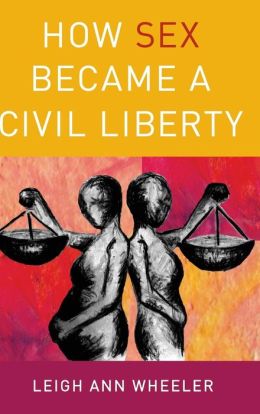
Over at JOTWELL, Serena Mayeri (University of Pennsylvania) has posted an appreciative review of How Sex Became a Civil Liberty (2012), by Leigh Ann Wheeler (Binghamton University). (We've mentioned the book previously, here.) Here's the first paragraph of Mayeri's review:
Read on here.Multiple paradoxes lie at the heart of Leigh Ann Wheeler’s How Sex Became a Civil Liberty: a constitutional doctrine of sexual privacy exists alongside a public culture saturated by sex; women and sexual minorities enjoy unprecedented rights and freedoms while pornography proliferates in plain sight and civil libertarian principles underwrite opposition to rape shield laws and hate speech codes. Meanwhile, liberals and conservatives alike speak in a common civil liberties idiom that embraces the individual’s right to access sexual material once considered an obvious and proper target of state regulation. As Wheeler’s engaging history of how the American Civil Liberties Union (ACLU) helped make sex a civil liberty reveals, commitments to sexual freedom and consumer rights grew out of the changing political and cultural milieu from which the organization emerged and drew its leaders.
Call for Applications: Berkeley Law Announces Darling Fellowship
I hope that many legal historians will apply for this new fellowship, from the University of California, Berkeley School of Law:
Berkeley Law is pleased to announce it seeks applications for the Darling Fellowship, made possible through a generous grant by the Hugh & Hazel Darling Foundation. Fellows must be committed to producing publishable work in public law and policy, which will help form the foundation for their entry into the job market for law teaching positions.
The Darling Fellowship is a one-year, residential, full-time position expected to run from July 1, 2014 through June 30, 2015. Fellows are required to devote their attention to research and writing, and to contribute to the intellectual life of the law school. Fellows will assist faculty in running the public law and policy workshop and may also be invited to guest lecture or teach in other law school classes. They may also help plan a small number of events related to law and public policy and advise interested students.
Berkeley Law will provide office space, an annual salary of $50,000 and benefits, and access to the UC Berkeley library system and resources for research. The University offers excellent health and retirement benefits which can be viewed online at http://atyourservice.ucop.edu/.
Applicants will be evaluated solely on the basis of their record of academic and scholarly achievement. Of particular importance will be the applicant’s potential for significant contributions to research in public law and policy.
Minimum Qualifications Required: A successful candidate for the Darling Foundation Fellowship must hold a J.D. or equivalent by application submission date.
Preferred Qualifications: Experience such as a judicial clerkship, or professional experience in private or government practice.
The final deadline for applications is May 1, 2014.More information is available here.
A Website on New York Legal History, 1776-1846
[The Historical Society of the New York Courts has brought online an excellent gallery on the legal history of the Empire State in the early national period and after, entitled Revolution and the Emerging State: Canals, Railroads & Steamboats, 1776-1846. Here is the introduction.]

Although New York adopted the Declaration of Independence at a meeting of the Fourth Provincial Congress in White Plains on July 9, 1776, it was not until November 25, 1783 that British troops finally departed from New York. In the midst of the ongoing war, New York drafted and adopted its first constitution, and set up a functioning government.
The New York State Constitution of 1777 continued the English statutory and common law, provided that it did not conflict with the State's constitution. In 1788, chapter 46 of the laws enacted that year rendered English statutory law invalid, providing that "none of the statutes of England or Great Britain shall operate or be considered as laws of this State." The common law was unaffected by this provision, and the State's second constitution, adopted in 1822, stated that "such parts of the common law and the acts of the legislature of the colony of New York would continue unless altered or repealed or found unconstitutional."
Looking at cases decided in those first 70 years, we can see how the New York judiciary resolved the issues encountered by the nascent State. The impact of the War of 1812 and the growing importance of international relations is readily apparent. Case law from this time shows the ongoing chilling effect of criminal libel actions on political speech, and controversies arising from slavery and colonial land tenure continued to populate court dockets. Judicial resolution of cases associated with New York's growing industrialization and rapidly-developing technology (canals, roads, steamboats and railways) enabled commerce to thrive.
The Bench and the Bar included men of outstanding intellect and achievement, who made a tremendous and lasting contribution to the State and the Nation. In their capable hands, jurisprudence developed through the arguments lawyers presented in court and the judicial decisions that resulted. New York's involvement in the development of the legal framework of the new nation, the ratification of the Federal Constitution and the drafting of Bill of Rights was significant and of lasting value.
Although New York adopted the Declaration of Independence at a meeting of the Fourth Provincial Congress in White Plains on July 9, 1776, it was not until November 25, 1783 that British troops finally departed from New York. In the midst of the ongoing war, New York drafted and adopted its first constitution, and set up a functioning government.
The New York State Constitution of 1777 continued the English statutory and common law, provided that it did not conflict with the State's constitution. In 1788, chapter 46 of the laws enacted that year rendered English statutory law invalid, providing that "none of the statutes of England or Great Britain shall operate or be considered as laws of this State." The common law was unaffected by this provision, and the State's second constitution, adopted in 1822, stated that "such parts of the common law and the acts of the legislature of the colony of New York would continue unless altered or repealed or found unconstitutional."
Looking at cases decided in those first 70 years, we can see how the New York judiciary resolved the issues encountered by the nascent State. The impact of the War of 1812 and the growing importance of international relations is readily apparent. Case law from this time shows the ongoing chilling effect of criminal libel actions on political speech, and controversies arising from slavery and colonial land tenure continued to populate court dockets. Judicial resolution of cases associated with New York's growing industrialization and rapidly-developing technology (canals, roads, steamboats and railways) enabled commerce to thrive.
The Bench and the Bar included men of outstanding intellect and achievement, who made a tremendous and lasting contribution to the State and the Nation. In their capable hands, jurisprudence developed through the arguments lawyers presented in court and the judicial decisions that resulted. New York's involvement in the development of the legal framework of the new nation, the ratification of the Federal Constitution and the drafting of Bill of Rights was significant and of lasting value.
Wednesday, April 2, 2014
Thanks And One Last Post on Field Building
Thanks to Dan and the rest of the folks at the LHB for the
opportunity this past month to share some of my thoughts on research and teaching. It’s been a lot of fun. Of course, no one likes a guest who overstays
his visit. But at the risk of boring
readers one last time, I thought I’d post one last entry on building a
subfield.
 As Dan mentioned previously, I’ve
had the honor and privilege of working with a group of interdisciplinary
scholars in developing a scholarly field that we’ve been referring to as the “new
fiscal sociology.”
As Dan mentioned previously, I’ve
had the honor and privilege of working with a group of interdisciplinary
scholars in developing a scholarly field that we’ve been referring to as the “new
fiscal sociology.”
Don’t let the name fool you – we’re trying to do more than just appeal to sociologists, though that’s not necessarily a bad thing. Over the last decade or so, my colleagues and friends, Isaac Martin and Monica Prasad, and I have been trying to build an interdisciplinary community of scholars interested in exploring how fiscal policy has shaped, and been shaped by, modern life. We took the inspiration for the field’s moniker from Rudolph Goldsheid and Joseph Schumpeter, who in the early twentieth century referred to “fiscal sociology” as an emerging science that could transcend increasingly narrow disciplines and unite the study of economics with the study of history, politics, and society. Like many such research projects, ours began in unexpected ways.
As Dan mentioned previously, I’ve
had the honor and privilege of working with a group of interdisciplinary
scholars in developing a scholarly field that we’ve been referring to as the “new
fiscal sociology.”Don’t let the name fool you – we’re trying to do more than just appeal to sociologists, though that’s not necessarily a bad thing. Over the last decade or so, my colleagues and friends, Isaac Martin and Monica Prasad, and I have been trying to build an interdisciplinary community of scholars interested in exploring how fiscal policy has shaped, and been shaped by, modern life. We took the inspiration for the field’s moniker from Rudolph Goldsheid and Joseph Schumpeter, who in the early twentieth century referred to “fiscal sociology” as an emerging science that could transcend increasingly narrow disciplines and unite the study of economics with the study of history, politics, and society. Like many such research projects, ours began in unexpected ways.
Stern on Blackstone's Legal Actors
Simon Stern, University of Toronto Faculty of Law, has posted Blackstone's Legal Actors: The Passions of a Rational Jurist, which is forthcoming in Nancy Johnson, ed., Impassioned Jurisprudence: Law, Literature and Emotion, 1660-1800 (Bucknell University Press, Aperçus series, 2014). Here is the abstract:
The success of Blackstone’s Commentaries is usually attributed to the ambition of his project: to give a synthetic and integrated overview of the common law. Blackstone’s effort, however strained, to display the law’s coherence, helps to explain why the Commentaries were taken up by so many generations of avid readers, but the book’s success also owes something to Blackstone’s method of showcasing this coherence and soliciting the reader’s enthusiasm for it. Blackstone does not simply methodize the law; he also personifies the law as an active force that produces consistency, and he similarly casts the reader as someone who partakes of the same sensibility and appreciates the same virtues. Blackstone places both the law and the law student in an affective relation to the rationalizing aims promoted in the Commentaries. By positing, within the text, a reader who attaches to the law in this fashion, Blackstone encourages his reader to take it for granted that this sense of attachment is part and parcel of the study of law.
The Library of Congress's Civil Rights History Project
[The Library of Congress's Civil Rights History Project is news to us. Hat tip: Paige Roberts.]
On May 12, 2009, the U. S. Congress authorized a national initiative by passing The Civil Rights History Project Act of 2009 (Public Law 111-19). The law directs the Library of Congress (LOC) and the Smithsonian Institution's National Museum of African American History and Culture (NMAAHC) to conduct a survey of existing oral history collections with relevance to the Civil Rights movement to obtain justice, freedom and equality for African Americans and to record new interviews with people who participated in the struggle, over a five year period beginning in 2010.
The activists interviewed for this project belong to a wide range of occupations, including lawyers, judges, doctors, farmers, journalists, professors, and musicians, among others. The video recordings of their recollections cover a wide variety of topics within the civil rights movement, such as the influence of the labor movement, nonviolence and self-defense, religious faith, music, and the experiences of young activists. Actions and events discussed in the interviews include the March on Washington for Jobs and Freedom (1963), the Albany Movement (1961), the Freedom Rides (1961), the Selma to Montgomery Rights March (1965), the Orangeburg Massacre (1968), sit-ins, voter registration drives in the South, and the murder of fourteen year old Emmett Till in 1955, a horrific event that galvanized many young people into joining the freedom movement.
Many interviewees were active in national organizations such as the National Association for the Advancement of Colored People (NAACP), the Congress of Racial Equality (CORE), and the Student Nonviolent Coordinating Committee (SNNC). Other interviewees were key members of specialized and local groups including the Medical Committee for Human Rights, the Deacons for Defense and Justice, the Cambridge (Maryland) Nonviolent Action Committee, and the Newark Community Union Project. Several interviews include men and women who were on the front lines of the struggle in places not well-known for their civil rights movement activity such as Oklahoma City, Oklahoma; Saint Augustine, Florida; and Bogalusa, Louisiana. Several of the interviews were conducted with the children of local civil rights leaders including Clara Luper, Robert Hicks, and Gayle Jenkins.
This site also guides researchers to collections in several Library divisions that specifically focus on the Civil Rights movement as well as the broader topic of African American history and culture. The Civil Rights History Project Collection (AFC 2010/039) contains 401 items consisting of video files, videocassettes, digital photographs and interview transcripts, with several more such items to be added once the interviews conclude in 2015.
On May 12, 2009, the U. S. Congress authorized a national initiative by passing The Civil Rights History Project Act of 2009 (Public Law 111-19). The law directs the Library of Congress (LOC) and the Smithsonian Institution's National Museum of African American History and Culture (NMAAHC) to conduct a survey of existing oral history collections with relevance to the Civil Rights movement to obtain justice, freedom and equality for African Americans and to record new interviews with people who participated in the struggle, over a five year period beginning in 2010.
The activists interviewed for this project belong to a wide range of occupations, including lawyers, judges, doctors, farmers, journalists, professors, and musicians, among others. The video recordings of their recollections cover a wide variety of topics within the civil rights movement, such as the influence of the labor movement, nonviolence and self-defense, religious faith, music, and the experiences of young activists. Actions and events discussed in the interviews include the March on Washington for Jobs and Freedom (1963), the Albany Movement (1961), the Freedom Rides (1961), the Selma to Montgomery Rights March (1965), the Orangeburg Massacre (1968), sit-ins, voter registration drives in the South, and the murder of fourteen year old Emmett Till in 1955, a horrific event that galvanized many young people into joining the freedom movement.
Many interviewees were active in national organizations such as the National Association for the Advancement of Colored People (NAACP), the Congress of Racial Equality (CORE), and the Student Nonviolent Coordinating Committee (SNNC). Other interviewees were key members of specialized and local groups including the Medical Committee for Human Rights, the Deacons for Defense and Justice, the Cambridge (Maryland) Nonviolent Action Committee, and the Newark Community Union Project. Several interviews include men and women who were on the front lines of the struggle in places not well-known for their civil rights movement activity such as Oklahoma City, Oklahoma; Saint Augustine, Florida; and Bogalusa, Louisiana. Several of the interviews were conducted with the children of local civil rights leaders including Clara Luper, Robert Hicks, and Gayle Jenkins.
This site also guides researchers to collections in several Library divisions that specifically focus on the Civil Rights movement as well as the broader topic of African American history and culture. The Civil Rights History Project Collection (AFC 2010/039) contains 401 items consisting of video files, videocassettes, digital photographs and interview transcripts, with several more such items to be added once the interviews conclude in 2015.
Freyfogle on US Property Law, 1776-1877
Eric T. Freyfogle, University of Illinois College of Law, has posted Property Law in a Time of Transformation: The Record of the United States, which is forthcoming in the South African Law Journal (2014). Here is the abstract:
Over the century-long period from just before the American Revolution until the end of the Civil War the United States underwent a profound transformation, beginning with its political break from Britain and expanding rapidly to embrace political and economic liberalism and elements of equality and social justice. Importantly, this transformation was aided by fundamental changes to the received English common law of property. Several property-law changes enhanced economic freedom and facilitated industrialization. Other legal changes diminished the power of landowners to dominate the poor socially and economically. Yet further reforms stabilized land tenure and expanded easy public access to natural resources, on private as well as public lands. Along the way, American courts embraced a more instrumental conception of law and carved out greater space for legislatures to regulate uses of property. Many of these changes involved substantial shifts of wealth, yet none was accompanied by significant compensation. In its transformation, South Africa is differently situated from the US of two centuries ago. Nonetheless, the American record may prove instructive, both in its particulars and as an example of how a developing nation, committed to private property and the rule of law, can nonetheless reform the legal elements of ownership without diminishing the institution’s stability and widespread benefits.
Tuesday, April 1, 2014
Property, Territory and Empire: A CFP
[We have the following call for papers for an international conference, Property Rights, Land and Territory in the European Overseas Empires, to be held in Lisbon, 26-27 June 2014.]
The occupation of territories, the rule over land and the definition of property rights, either de jure or de facto, were major concerns in the making and long-term development of almost every European overseas empire. They were also deeply interrelated with other key aspects of the empire-building process, including sovereignty claims, territorial expansion, settlement, taxation, power relations, social mobility, economic development, and the relationship with indigenous peoples. Therefore, those issues were of interest to all parts involved in the colonial venture - imperial governments, colonial authorities, first and later generations of settlers, native peoples and their elites - who dealt with them through complex and dynamic processes of negotiation and conflict.
The solutions adopted to regulate property rights and other territorial and land-related issues had their roots in legal norms, political concepts, institutions, ideologies and social practices transposed from each European metropole, then reframed and accommodated to each colonial context. Developing from different backgrounds in Europe, these theories and practices combined in a variety of ways with different conditions in the colonies, producing both contrasting and similar outcomes across time and space.
The research on these topics has already achieved a huge body of results, but, for the most part, it has been pursued in a piecemeal fashion, either by disciplinary fields, empires or regions of the world, thus overlooking their interconnections. How can we compare the way issues of land, territory and property rights were dealt with across a variety of empires (e.g. Portuguese, Spanish, British, Dutch, French) and their different geographies? What can different branches of scholarship (from legal, economic, political, social and cultural history) offer each other? This conference aims to provide answers to these questions, by bringing these previously separate studies together into a common forum and setting them in comparative perspective.
Details after the jump.
The occupation of territories, the rule over land and the definition of property rights, either de jure or de facto, were major concerns in the making and long-term development of almost every European overseas empire. They were also deeply interrelated with other key aspects of the empire-building process, including sovereignty claims, territorial expansion, settlement, taxation, power relations, social mobility, economic development, and the relationship with indigenous peoples. Therefore, those issues were of interest to all parts involved in the colonial venture - imperial governments, colonial authorities, first and later generations of settlers, native peoples and their elites - who dealt with them through complex and dynamic processes of negotiation and conflict.
The solutions adopted to regulate property rights and other territorial and land-related issues had their roots in legal norms, political concepts, institutions, ideologies and social practices transposed from each European metropole, then reframed and accommodated to each colonial context. Developing from different backgrounds in Europe, these theories and practices combined in a variety of ways with different conditions in the colonies, producing both contrasting and similar outcomes across time and space.
The research on these topics has already achieved a huge body of results, but, for the most part, it has been pursued in a piecemeal fashion, either by disciplinary fields, empires or regions of the world, thus overlooking their interconnections. How can we compare the way issues of land, territory and property rights were dealt with across a variety of empires (e.g. Portuguese, Spanish, British, Dutch, French) and their different geographies? What can different branches of scholarship (from legal, economic, political, social and cultural history) offer each other? This conference aims to provide answers to these questions, by bringing these previously separate studies together into a common forum and setting them in comparative perspective.
Details after the jump.
Law's Empire or Empire's Law: A CFP
[We have the following call for papers for the 33rd annual conference of the Australia and New Zealand Law and History Society, entitled Law's Empire or Empire's Law?: Legal Discourses of Colonies and Commonwealths.]
On behalf of the School of Law of the University of New England, Australia, the organising committee of the 33rd annual conference of the Australia and New Zealand Law and History Society takes pleasure in issuing a call for papers. The conference will be held at the BreakFree Aanuka Beach Resort, Coffs Harbour, on the magnificent mid-north coast of New South Wales, between December 10-13, 2014. More details can be found on the conference website which will be updated with further information as the conference date approaches.
The conference theme is "Law's Empire or Empire's Law?: Legal Discourses of Colonies and Commonwealths". The conference theme provides wide scope to discuss law and history in a variety of settings. Although an important context for the conference is the interrelation between imported laws of a parent jurisdiction and their application to other domains, both jurisdictional and geographical, we encourage potential presenters to interpret the conference theme broadly.
The keynote speakers for the conference are Professor Paul Mitchell, of the Faculty of Laws, University College London, and Professor Mike Grossberg, Sally M Reahard Professor of History & Professor of Law, Indiana University, Bloomington, USA. Professor Mitchell and Professor Grossberg have long standing research interests in the conference theme and we are delighted they are able to present keynote addresses.
The organising committee would welcome interest from lawyers and historians from any jurisdiction. The call for papers will be open until late June. Inquiries or paper proposals - including a title, brief abstract and brief biography - should be sent to mlunney@une.edu.au.
On behalf of the School of Law of the University of New England, Australia, the organising committee of the 33rd annual conference of the Australia and New Zealand Law and History Society takes pleasure in issuing a call for papers. The conference will be held at the BreakFree Aanuka Beach Resort, Coffs Harbour, on the magnificent mid-north coast of New South Wales, between December 10-13, 2014. More details can be found on the conference website which will be updated with further information as the conference date approaches.
The conference theme is "Law's Empire or Empire's Law?: Legal Discourses of Colonies and Commonwealths". The conference theme provides wide scope to discuss law and history in a variety of settings. Although an important context for the conference is the interrelation between imported laws of a parent jurisdiction and their application to other domains, both jurisdictional and geographical, we encourage potential presenters to interpret the conference theme broadly.
The keynote speakers for the conference are Professor Paul Mitchell, of the Faculty of Laws, University College London, and Professor Mike Grossberg, Sally M Reahard Professor of History & Professor of Law, Indiana University, Bloomington, USA. Professor Mitchell and Professor Grossberg have long standing research interests in the conference theme and we are delighted they are able to present keynote addresses.
The organising committee would welcome interest from lawyers and historians from any jurisdiction. The call for papers will be open until late June. Inquiries or paper proposals - including a title, brief abstract and brief biography - should be sent to mlunney@une.edu.au.
New Release: Brucken on "The United States, the United Nations, and Human Rights, 1941-1953"
New from Northern Illinois University Press: A Most Uncertain Crusade: The United States, the United Nations, and Human Rights, 1941-1953 (Dec. 2013), by Rowland
Brucken (Norwich University). A description from the Press:
A Most Uncertain Crusade traces and analyzes the emergence of human rights as both an international concern and as a controversial domestic issue for U.S. policy makers during and after World War II. Historian Brucken focuses on officials in the State Department, at the United Nations, and within certain domestic non-governmental organizations, and explains why, after issuing wartime declarations that called for the definition and enforcement of international human rights standards, the U.S. government refused to ratify the first U.N. treaties that fulfilled those twin purposes. The Truman and Eisenhower administrations worked to weaken the scope and enforcement mechanisms of early human rights agreements, and gradually withdrew support for Senate ratification. A small but influential group of isolationist–oriented senators, led by John Bricker (R-OH), warned that the treaties would bring about socialism, destroy white supremacy, and eviscerate the Bill of Rights. At the U.N., a growing bloc of developing nations demanded the inclusion of economic guarantees, support for decolonization, and strong enforcement measures, all of which Washington opposed.
Prior to World War II, international law considered the protection of individual rights to fall largely under the jurisdiction of national governments. Alarmed by fascist tyranny and guided by a Wilsonian vision of global cooperation in pursuit of human rights, President Roosevelt issued the Four Freedoms and the Atlantic Charter. Behind the scenes, the State Department planners carefully considered how an international organization could best protect those guarantees. Their work paid off at the 1945 San Francisco Conference, which vested the U.N. with an unprecedented opportunity to define and protect the human rights of individuals.
Subscribe to:
Posts (Atom)