[Thank you, LHB Founder Mary Dudziak, for drawing our attention to the call for papers for 82nd Annual Meeting of the Society for Military History, “Conflict and Commemoration: The Influence of War on Society,” April 9-12, 2015, Montgomery, Alabama.]
The Society for Military History is pleased to call for papers for its 82nd Annual Meeting, hosted by the Air University Foundation and the Montgomery Convention and Visitors Bureau.
The year 2015 marks the 200th anniversary of the conclusion of the Napoleonic Wars, the sesquicentennial commemoration of the end of the Civil War, 70th anniversary of the end of WWII, 65th anniversary of the start of the Korean War, and the 25th anniversary of Operation Desert Shield. The Society for Military History invites papers that examine these and other pivotal conflicts in terms of how they were conducted and how they have been remembered and assessed over time by individuals, institutions, and societies. The program committee will consider paper and panel proposals on all aspects of military history, while especially encouraging submissions that reflect on this important theme.
Panel proposals must include a panel title (along with the full names and institutional affiliations of each participant and the full title of each paper), a one-page abstract summarizing the theme of the panel, one-page abstracts for each paper proposed, and one-page curricula vitae for each panelist (including the chair and commentator, with email addresses provided for all participants), as well as panelist contact information. Submissions of pre-organized panels are strongly encouraged and will be given preference in the selection process. Individual paper proposals are also welcome and must include a one-page abstract of the paper, one-page vita, and contact information, including email. If accepted, individual papers will be assigned by the program committee to an appropriate panel with a chair and commentator. All proposals should be submitted as Microsoft Word documents so that pertinent contents can be cut and pasted into the conference program.
Participants may present one paper, serve on a roundtable, chair a panel, or provide panel comments. They may not fill more than one of these roles during the conference, nor should they propose to do so to the Program Committee. Members who act as panel chairs only for a session may deliver a paper, serve on a roundtable, or offer comments in a different session. Members who serve as chair and commentator of a session may not present in another session. THESE RULES WILL BE STRICTLY ENFORCED.
All proposals must be submitted electronically to the program committee by October 1, 2014. The address is: smh2015montgomery@gmail.com. All presenters, chairs, and commentators must be members of the Society for Military History by December 31, 2014.
The meeting will be held at the Renaissance Montgomery Hotel & Spa in Montgomery, Alabama. It is located right next to the Montgomery Convention Center and is within easy distance of Old Alabama Town, the State Capitol, the First White House of the Confederacy, and the Martin Luther King-Dexter Avenue Church among many other historic sites relevant to the military and civil rights history of the United States. Participants can reach the meeting site via cab from the Montgomery Regional Airport.
Monday, July 14, 2014
Sunday, July 13, 2014
Sunday Book Roundup
n+1 has an online review by Maggie Gram that asks “Did the Civil Rights Act change the Constitution?” Three books are examined in the piece, including We the People, Vol. 3: The Civil Rights Revolution by Bruce Ackerman (Belknap), An Idea Whose Time Has Come by Todd S. Pardum (Holt), and The Bill of the Century by Clay Risen (Bloomsbury).
 New Books in Law talks with Ian Haney Lopez about his new book, Dog Whistle Politics: How Coded Racial Appeals Have Reinvented Racism & Wrecked the Middle Class (Oxford University Press).
 H-Net adds a review on “New Directions in GAPE Indian Policy Studies” that examines four books: Cathleen Cahill’s Federal Fathers and Mothers: A Social History of the United States Indian Service, 1869-1933 (UNC Press); C. Joseph Genetin-Pilawa’s Crooked Paths to Allotment: The Fight over Federal Policy after the Civil War (UNC Press); Rose Stremlau’s Sustaining the Cherokee Family: Kinship and the Allotment of an Indigenous Nation (UNC Press); and Nicole Tonkovich’s The Allotment Plot: Alice C. Fletcher, E. Jane Gay, and Nez Perce Survivance (University of Nebraska Press). Cahill’s Federal Fathers and Mothers was on my reading list for exams, and I’d recommend it to anyone thinking and writing about mid- and local-level bureaucrats. From the review:
“[T[hat Ackerman’s book so clearly betrays its own longing for the Civil Rights Act to be locked in forever—and that it does so in the spotlight, and at that untouchable law school, and at the height of Ackerman’s own untouchable career—makes that book a profound political act, no matter how idiosyncratic its alchemical thesis may be. American citizens are weirdly and dangerously complacent about our civil rights laws; so is the American legal academy. We think that laws like the Civil Rights Act could never disappear, precisely because they did change America so utterly. But they could, and Shelby County shows us that they may. At this moment, then, we need accounts of the Civil Rights Act as something more than the historical artifact that Risen and Putnam can give us. We need accounts that cast it as, if not part of our Constitution, then part of what Jack Balkin has called our “constitutional redemption,” our ongoing collective pursuit of a more perfect union. Bruce Ackerman, in fashioning a philosophy that would make it so, has not, himself, made it so. But he ought to move us to want to make it so ourselves.”
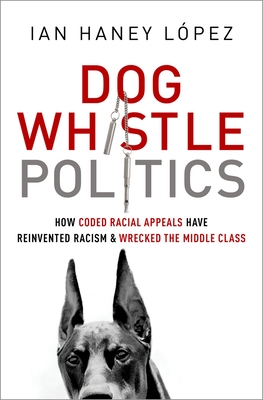 New Books in Law talks with Ian Haney Lopez about his new book, Dog Whistle Politics: How Coded Racial Appeals Have Reinvented Racism & Wrecked the Middle Class (Oxford University Press).
New Books in History interviews Lisa Gitelman about her new work, Paper Knowledge: Toward a Media History of Documents (Duke University Press). Given that I’m currently working in the archives on a research trip, the interview’s tag line, "One doesn’t so much read a death certificate, it would seem, as perform calisthenics on one…” caught my attention. From the interview abstract:
"Though all of these cases are carefully rooted within a US context, the insights gleaned from them potentially apply to a much wider and trans-local conversation about the documentary media of writers and readers. It is a history of documenting as an epistemic practice and documents as instruments, and that history is consistently and productively entangled with concerns about reproduction, access, labor, and the emergence of a bureaucratic self.”
The London Review of Books has a piece, “On Cruelty” by Judith Bulter reviewing The Death Penalty: Vol. I by Jacques Derrida and translated by Peggy Kamuf (University of Chicago Press).
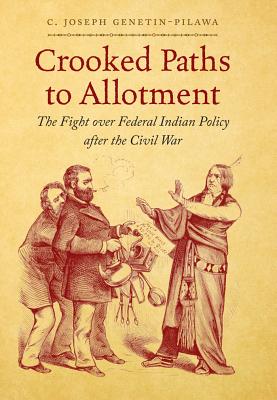 H-Net adds a review on “New Directions in GAPE Indian Policy Studies” that examines four books: Cathleen Cahill’s Federal Fathers and Mothers: A Social History of the United States Indian Service, 1869-1933 (UNC Press); C. Joseph Genetin-Pilawa’s Crooked Paths to Allotment: The Fight over Federal Policy after the Civil War (UNC Press); Rose Stremlau’s Sustaining the Cherokee Family: Kinship and the Allotment of an Indigenous Nation (UNC Press); and Nicole Tonkovich’s The Allotment Plot: Alice C. Fletcher, E. Jane Gay, and Nez Perce Survivance (University of Nebraska Press). Cahill’s Federal Fathers and Mothers was on my reading list for exams, and I’d recommend it to anyone thinking and writing about mid- and local-level bureaucrats. From the review:
 “Each of these books demonstrates that both Indian Affairs and Native peoples, often sidelined in GAPE [Guilded Age and Progressive Era] scholarship, are important for a complete understanding of the era. The stories of Indigenous peoples reflect numerous themes explored in broader studies of the period: the treatment of racial minorities, shifting gender roles, the formation of the national state, and colonialism. Within the more narrow range of policy history, these four monographs reveal Indian policy as more complex and nuanced than the traditional historiography has indicated, especially in how it was carried out “on the ground” by workers in the Indian Service. They emphasize the policy’s particular human costs and explore the ways in which these policies were gendered. Native strategies of adaptation and survival analyzed in these works appear as creative and multifaceted, highlighting the reasons for the policy’s ultimate failure. Despite the concerted efforts of a massive federal bureaucracy, American Indian nations remain within the United States."


Saturday, July 12, 2014
Weekend Roundup
- We missed the conference and the publication of the conference issue for Exploring Civil Society through the Writings of Dr. Seuss™ (New York Law School Law Review 58:3 [2013/14]) until just now. Congrats to my former colleague Georgetown colleague Richard Chused for his introduction and my present Georgetown colleague Naomi Mezey and the Georgetown student Gabe Lezra (L'15) for their paper Forms of affiliation: family, democracy, and civil society in Horton Hears a Who! [DRE]
- We also missed Kenneth M. Casebeer’s "Public . . . Since Time Immemorial": The Labor History of Hague v. CIO, Rutgers Law Review 66 (2013): 147-178.
- The National History Center's advice on researching at the Library of Congress.
- Seth Barrett Tillman has posted a letter on The Quorum Clause.
- NYC's Former Pro-Slavery Stance Examined in Governors Island Exhibit, a post by Emily Frost on the website DNAinfor New York, reports that “an exhibit on NYC's history during the Civil War that examines the city's ambivalent history on the institution of slavery — including a former city mayor's unwavering support for it — is headed to Governors Island this summer.”
- The Originalism Blog has gathered some pointers to posts on Philip Hamburger's Is Administrative Law Unlawful? The Wall Street Journal, National Review and the Cato Institute have all noticed the book.
- "The Declaration's influence wasn't limited to the American colonies of the late 18th century," writes David Armitage in the Wall Street Journal. "No American document has had a greater impact on the wider world. As the first successful declaration of independence in history, it helped to inspire countless movements for independence, self-determination and revolution after 1776 and to this very day. As the 19th-century Hungarian nationalist, Lajos Kossuth, put it, the U.S. Declaration of Independence was nothing less than "the noblest, happiest page in mankind's history." More.
- "Archives From Prisons in New York Are Digitized," reports the New York Times.
Friday, July 11, 2014
Call for Papers: Doctoral Scholarship Conference-Law and Responsibility
[We have the following call for papers.]
November 14-15, 2014
Deadline for Abstract Submission: August 1, 2014
Yale Law School is proud to host the 4th Doctoral Scholarship Conference, which will be held on November 14-15, 2014. The conference aims to provide doctoral students and recent graduates with a forum to present, share and discuss their work beyond conventional academic boundaries. It seeks to promote quality research and to facilitate discussion across diverse subject areas and methodological approaches, with a view towards fostering a community of aspiring legal scholars.
***
Law is a central social tool for establishing responsibility and for holding agents accountable for their actions and omissions. These functions of the law raise fundamental questions: What is it that the law does when it calls agents to account? What justifies its authority to do so? What values underlie the law’s call of those under its jurisdiction to responsibility? What are the limits of holding persons legally responsible? What modes of responsibility can and should the law impose? In what ways do these functions interact with the other social functions of the law? In what ways can and should legal institutions themselves be held responsible?
These questions materialize in idiosyncratic ways across the various areas of law, with different issues taking center stage in each area. At the same time, these questions illuminate aspects of law that should be considered across arbitrarily constructed disciplinary boundaries. Legal responsibility manifests itself in different ways in the realms of private and public law as well as in the domestic and international spheres. In a complex, global society, states, corporations and individuals must thus make sense of their multiple and shifting responsibilities in areas as diverse as the economic, the criminal, the environmental, the contractual and the international. In all these areas, and in many others, law engages with various modes of responsibility, including the personal, the social and the civic, each of which is situated within different legal relationships. This conference aims to examine the many and varied modes of responsibility with which the law interacts, as well as broader themes that emerge from taking a bird’s-eye view of the legal system as a whole.
***
The conference is open to current doctoral candidates, in law or law-related disciplines, and those who graduated during the previous academic year (2013-2014). We welcome submissions engaging any area of law. Papers will be selected based on quality and their capacity to provoke fruitful debate with other submissions. Selection will be informed – but not strictly bound – by fidelity to the theme.
Submissions
Abstracts of 300-500 words (with your institutional affiliations) should be submitted to yls.doctoralconference@gmail.com by August 1st, 2014. Selected applicants will be informed of acceptance in late August, and presenters will be asked to submit their papers of up to 10,000 words in length by October 10, 2014.
Lindseth on Europe's "Administrative" Legitimacy
Peter L. Lindseth, University of Connecticut School of Law, has posted Equilibrium, Demoi-cracy, and Delegation in the Crisis of European Integration, which appears in the German Law Journal 15 (2014): 529-567. Here is the abstract:
As my work has argued previously, European integration enjoys an “administrative, not constitutional” legitimacy. This view is in obvious tension with the deeply-rooted conceptual framework — what we might call the “constitutional, not international” perspective — that has dominated the public-law scholarship of European integration over many decades. Although the alternative presented in my work breaks from that traditional perspective, we should not view it as an all-or-nothing rejection of everything that has come before it. The administrative alternative can be seen, rather, as providing legal-historical micro-foundations for certain theories that also emerged out of the traditional perspective even as they too are in tension with it. I am referring in particular to Joseph Weiler’s classic notion of European “equilibrium” — now updated as “constitutional tolerance” — as well as Kalypso Nicolaïdis’s more recently developed theory of European “demoi-cracy” on which this article focuses in particular. The central idea behind the “administrative, not constitutional” interpretation — the historical-constructivist principal-agent framework rooted in delegation, as well as the balance demanded between supranational regulatory power and national democratic and constitutional legitimacy — directly complements both theories. The administrative alternative suggests how the relationship between national principals and supranational agents is one of “mediated legitimacy” rather than direct control. It has its origins in the evolution of administrative governance in relation to representative government over the course of the twentieth century (indeed before). By drawing on the normative lessons of that history — notably the need for some form of national oversight as well as enforcement of outer constraints on supranational delegation in order to preserve national democratic and constitutional legitimacy in a recognizable sense — this article serves an additional purpose. It suggests how theories of European equilibrium and demoi-cracy might be translated into concrete legal proposals for a more sustainable form of integration over time — a pressing challenge in the context of the continuing crisis of European integration.
Thursday, July 10, 2014
Bloch and Lamoreaux Weigh In on Hobby Lobby
From Ruth H. Bloch and Naomi R. Lamoreaux, Property v. Liberty: The Supreme Court's Radical Break with Its Historical Treatment of Corporatrions, Perspectives on History (July 2014): "We . . . trace the history of the Supreme Court's jurisprudence on
corporate rights and show that [Justice] Alito's opinion breaks with a long line
of decisions beginning in the 1880s that treated for-profit corporations
as 'persons' under the Constitution only for the purpose of protecting
the property rights-not the liberties-of individual members." More.
Research Nineteenth-Century Belgian Bankrupts and Their Creditors!
H-Law has posted a job listing on the research staff of a project at the Vrije Universiteit Brussel. Quite apart from its value as a job announcement, the notice is interesting for the research it describes:
The candidate will conduct research within the framework of the FWO-funded research project “Bringing creditors to the negotiating table. Reconsidering the law on indebtedness and economic failure in early nineteenth-century Belgium (1808-1850)”. The project purports to analyse the negotiation strategies between failed/insolvent traders and their creditors, on the basis of archives of the commercial courts . . . .More.
Dawson on "Public Danger" in the Grand Jury Clause
James Dawson, a Lecturer in Law at the Yale Law School, has posted Public Danger. Here is the abstract:
This paper provides the first account of the term “public danger,” which appears in the Grand Jury Clause of the Fifth Amendment. I argue that, in light of historical records from the seventeenth and eighteenth centuries, the proper reading of “public danger” is a broad one. On this theory, public danger includes not just impending enemy invasions, but also a host of less serious threats (such as financial panics, jail breaks, floods, fires, natural disasters, and plagues). This broad reading is further supported by constitutional history. In 1789, the first Congress rejected an amendment that would have replaced the phrase “public danger” in the proposed text of the Fifth Amendment with the narrower term “public invasion.” Several other tools of interpretation — such as an intratextual analysis of the text of the Constitution and a survey of other legal doctrines that use a “public danger” standard — also counsel in favor of an expansive reading. The paper then unpacks the practical implications of this reading. First, the fact that the Constitution expressly contemplates “public danger” as a gray area between war and peace informs the ongoing scholarly debate about whether the global war on terror is an endless war, a “wartime,” or something else entirely. “Public danger” provides a method of thinking about terrorism that is already built into the Constitution, and therefore calls into question the elaborate but nonconstitutional theories that some scholars have proposed to help order our thinking about terrorism. My second argument is that, since the Founders recognized the concept of “public danger” but yet declined to extend enhanced authority to the President during these periods, the Grand Jury Clause may operate as an implicit limitation on executive power in the post-9/11 era. Third, I suggest that a broad reading of public danger would allow Congress to massively expand the jurisdiction of courts martial merely by altering the definition of the phrase “actual service” in the Fifth Amendment.
Wednesday, July 9, 2014
New Release: Constable, "Our Word Is Our Bond: How Legal Speech Acts"
New from Stanford University Press: Our Word Is Our Bond: How Legal Speech Acts
Words can be misspoken, misheard, misunderstood, or misappropriated; they can be inappropriate, inaccurate, dangerous, or wrong. When speech goes wrong, law often steps in as itself a speech act or series of speech acts. Our Word Is Our Bond offers a nuanced approach to language and its interaction and relations with modern law. Marianne Constable argues that, as language, modern law makes claims and hears claims of justice and injustice, which can admittedly go wrong. Constable proposes an alternative to understanding law as a system of rules, or as fundamentally a policy-making and problem-solving tool. Constable introduces and develops insights from Austin, Cavell, Reinach, Nietzsche, Derrida and Heidegger to show how claims of law are performative and passionate utterances or social acts that appeal implicitly to justice.

Our Word Is Our Bond explains that neither law nor justice are what lawyers and judges say, nor what officials and scholars claim they are. However inadequate our law and language may be to the world, Constable argues that we know our world and name our ways of living and being in it through law and language. Justice today, however impossible to define and difficult to determine, depends on relations we have with one another through language and on the ways in which legal speech—the claims and responses that we make to one another in the name of the law—acts.
"Our Word is Our Bond transforms how we think about law, about language, and above all about the inextricable interdependencies that enmesh them. Marianne Constable explores the sovereignty of language in and over law with insight, eloquence, erudition, subtlety and imagination."—Martin Krygier, University of New South Wales, Australia
"Combining theory and case law, linguistics and jurisprudence, Our Word is Our Bond provides a uniquely sophisticated and dramatically accessible guide to the rhetoric of justice and the politics of judgment. Barack Obama's flubbed oath of office, Palsgraf v Long Island Railroad, the California Criminal Code are but a few of the diverse array of substantive examples that Constable subjects to coruscating critical disposition."—Peter Goodrich, Benjamin N. Cardozo Law School, Yeshiva University
Tuesday, July 8, 2014
Program from Conference on "The Law and the Child in Historical Perspective"
Earlier this year we noted a conference on "The Law and the Child in Historical Perspective," co-sponsored by the University of Minnesota Law School and History
Department, the Childhood and Youth Studies Across the Disciplines IAS
Research Collaborative at the University of Minnesota, the Indiana
University School of Law, the University of Pennsylvania Law School and
History Department, the University of Illinois College of Law, the
University of Michigan Law School, and the University of Chicago
Department of History. The conference took place in early June and included an exciting set of papers and comments. Here's the full schedule:
Sunday,
June 1
Panel
1: Age, Consent & Rights to Oneself
-Will Smiley “Three Fatwas
and a Treaty: A Historical Perspective on Childhood, Apostacy, and Islamic Law”
-Kristin McCabe Lashua
“Charitable Kidnappers? Children, Consent, and the Early English Empire”
-Serena Mayeri “’Hapless’
and ‘Innocent’ Children: Child-Centered Arguments in the Law of the Non-Marital
Family”
Commentator: Susanna Blumenthal
Keynote Address
Michael Grossberg “Why Kids Matter:
Age as a Useful Category of Analysis in Legal History”
Monday,
June 2
Panel
2: The Problem of Unattached Children
-Juandrea Bates “I Am Only
a Boy in These Courts: Immigration, Minority and Civil Law in Turn of the
Century Buenos Aires”
-Shani Roper “Childhood,
Delinquency and Social Control: Explorations of Legislation Tracking Juvenile
Delinquency in Colonial Jamaica, 1881-1904”
-Sharon Park “The Legal
Categorization of Child Refugees as Dependents & Recipients of U.S. Aid,
1945-1953”
Commentator: Michael Grossberg
Panel 3:
Parental
& Children’s Rights & the Consolidation of State Power
-Heather Hawkins “Getting
Them Back: Child Welfare, Parental Rights, and Administrative Power in 19th
Century Minnesota”
-Julia Bowes “The Limits
of Liberalism: Compulsory Schooling, Mandatory Vaccination and the End of
Laissez-Faire Parenting, 1870-1920”
-Kathryn Schumaker
“Discipline and Due Process: The Civil Rights Struggle and the Expansion of
Students’ Rights”
Commentator: Nick Syrett
Panel
4: Children, Families, & Colonialism
-Yen-Chi Liu “Colonial
Childhoods: Children and the Law under Japanese Colonial Rule in Taiwan
(1895-1945)”
-Tadashi Ishikawa “How Can
Adopted Daughters Be Treated in and between Households? Parental Authority,
Incomplete Transfers, and Japanese Courts in Colonial Taiwan, 1919-1936”
-Nurfadzilah Yahaya “Question
of Guardianship in Colonial Southeast Asia: Arab Children under British and
Dutch Rule”
Commentator: MJ Maynes &
Barbara Young Welke
Panel
5: Class, Sexuality, Race and Social Order
-Cynthia Greenlee “Due to
Her Tender Age: African-Americans, Child Rape and South Carolina Courts,
1885-1905”
-Sara Mayeux “Car Trouble:
Adolescence, Automobility, and the Law, 1890-1930”
-Marcia Chatelain
“’Questions We Cannot Answer’: The Brown v. Board Decision and Girl
Scouts of the United States”
Commentator: Martha
Jones
Closing
Comments: Sarah Barringer Gordon
Collins on Jus Sanguinis Citizenship
Kristin A. Collins, Boston University School of Law, has posted Illegitimate Borders: Jus Sanguinis Citizenship and the Legal Construction of Family, Race, and Nation, which appears in the Yale Law Journal 123 (2014): 2134-2235. Here is the abstract:
The citizenship status of children born to American parents outside the United States is governed by a complex set of statutes. When the parents of such children are not married, these statutes encumber the transmission of citizenship between father and child while readily recognizing the child of an American mother as a citizen. Much of the debate concerning the propriety and constitutionality of those laws has centered on the extent to which they reflect gender-traditional understandings of fathers’ and mothers’ respective parental roles, or instead reflect “real differences” between men and women. Based on extensive archival research, this Article demonstrates that an important yet overlooked reason for the development of restrictions on father-child citizenship transmission was officials’ felt need to enforce the racially nativist policies that were a core component of American nationality law for over 150 years. At formative moments in the development the laws governing jus sanguinis citizenship – what is now called derivative citizenship – gender- and marriage-based domestic relations laws were enlisted by administrators, judges, and legislators to deny the citizenship claims of nonwhite children, especially those who were excludable under the race-based immigration and naturalization laws.
For those who study citizenship and immigration law, Illegitimate Borders illustrates the concrete and enduring ways that ideas concerning family, gender, and race have shaped the rules that govern formal membership in the American polity. For legal historians and scholars interested in the development of the administrative state and nation building, this article provides a window onto the central role administrators played in crafting American nationality law. For family law scholars, Illegitimate Borders highlights the ways that laws regulating illegitimacy – long used to create and maintain racial hierarchies within the American polity – were regularly used to shape the racial composition of the polity as well. Finally, for constitutional law scholars, the history charted here undermines the view that gender-asymmetrical jus sanguinis citizenship laws reflect natural and inevitable means of regulating parent-child derivative citizenship – an understanding that has been embraced by a majority of the Supreme Court. Instead, the historical sources reveal that gender-asymmetrical citizenship laws are the product of choices made by officials and shaped by contemporary norms concerning gender, parental roles, and – as illustrated in great detail – the official imperative to enforce race-based nationality laws. To speak of gender-based distinctions drawn in modern citizenship law as inevitable obscures their origins and elides the ways that such laws continue to play an illiberal role in the practice and politics of citizenship.
Weiner's "Water, Paper, Law"
The latest legal history video by former LHB Guest Blogger Mark S. Weiner is Water, Paper, Law. Mark explains: “In my latest video, an eighteenth-century Italian legal treatise about water inspires some thoughts about law, rare books, and the passage of time. The video is part of a series I’m developing about rare law books.”
New Release: Chet, "The Ocean Is a Wilderness: Atlantic Piracy and the Limits of State Authority, 1688-1856"
New from the University of Massachusetts Press: The Ocean Is a Wilderness: Atlantic Piracy and the Limits of State Authority, 1688-1856 (May 2014), by Guy Chet (University of North Texas). The Press explains:
A few blurbs:Historians have long maintained that the rise of the British empire brought an end to the great age of piracy, turning the once violent Atlantic frontier into a locus of orderly commerce by 1730. In this book, Guy Chet reassesses that view by documenting the persistence of piracy, smuggling, and other forms of illegal trade throughout the eighteenth century despite ongoing governmental campaigns to stamp it out. The failure of the Royal Navy to police oceanic trade reflected the state’s limited authority and legitimacy at port, in the courts, and in the hearts and minds of Anglo-American constituents.
Chet shows how the traditional focus on the growth of the modern state overlooked the extent to which old attitudes and cultural practices continued to hold sway. Even as the British government extended its naval, legal, and bureaucratic reach, in many parts of the Atlantic world illegal trade was not only tolerated but encouraged. In part this was because Britain’s constabulary command of the region remained more tenuous than some have suggested, and in part because maritime insurance and wartime tax policies ensured that piracy and smuggling remained profitable. When Atlantic piracy eventually waned in the early nineteenth century, it had more to do with a reduction in its profitability at port than with forceful confrontation at sea.
Challenging traditional accounts that chronicle forces of civilization taming a wild Atlantic frontier, this book is a valuable addition to a body of borderlands scholarship reevaluating the relationship between the emerging modern state and its imperial frontiers.

"An interesting, well written, and well-conceived book. The primary sources and the secondary works consulted are extensive and sensible, and the book makes an effective contribution to a number of fields—Atlantic history, maritime history, government and the nature of the early modern state, and international history."—Trevor Burnard
"This thoughtful and persuasive volume is one of the most important contributions to the emerging understanding of the limited reach of state authority and empire during the early modern era. Focusing upon the British government’s inability to stop piracy, wrecking, and smuggling both on the sea and along the coastline of the Atlantic world throughout the eighteenth and much of the nineteenth centuries, this study underlines the vast gap between policy and enforcement within the British Empire, the widespread dispersal of authority endemic to state and empire and indeed essential to their success, and the weakness of metropolitan coercive resources. In the process, Guy Chet makes an overwhelmingly convincing case against those who have uncritically assumed state policy pronouncements can be taken as an accurate indication of how empires worked."—Jack P. GreeneMore information is available here.
Monday, July 7, 2014
JEV-Fellowship for European Administrative History
 At the end of 2012 Prof. Dr. Erk Volkmar Heyen, Professor of Public Law and European Administrative History at the Ernst-Moritz-Arndt University of Greifswald until his retirement and the editor of the "Jahrbuch für europäische Verwaltungsgeschichte/Yearbook of European Administrative History" (JEV) published from 1989 to 2008, donated a research fellowship in the field of European Administrative History ("The JEV-Fellowship for European Administrative History"). The fellowship falls within the framework of the German University Foundation (Bonn, Germany).
The scholarship is intended to benefit the next generation of scientific researchers, particularly doctoral and post-doctoral students, and specifically for the final phase of their research project for a duration of no longer than 12 months. The scholarship is based on the usual rates for doctoral fellowships of the German Research Foundation (DFG). Should a fellowship be awarded for research abroad, the local conditions will be the determining factor. Marital status will not be deemed a consideration, and neither will travel- nor other costs be reimbursed.
The Board of the German University Foundation decides on and awards the fellowship based on a proposal by a jury. This jury is based at the Max Planck Institute for European Legal History (MPI) in Frankfurt, where the founder worked in the 1980s. Currently the permanent members of the jury are: the Managing Director of the Max Planck Institute, Prof. Dr. Thomas Duve, Prof. Dr. Stefan Brakensiek, Professor of Early Modern History at the Institute for History of the University of Duisburg-Essen, and Priv.-Doz. Dr. Peter Collin, Research Fellow at the Max Planck Institute. The German University Foundation provides for the payment of the fellowships and informs the recipients about the terms and conditions and the legal requirements to be complied with by the recipients in their personal capacities.
Early stage researchers from Germany and abroad are invited to apply. In accordance with the thematic and methodological spectrum covered by the JEV, the scholarship is open to all historical disciplines, provided the research project addresses an aspect of European administrative history from the period of the sixteenth to the twentieth century. The importance of the research topic should impact beyond the national level. Comparative research questions are particularly welcome.
Brophy and Thie on Trust and Probate in the Antebellum Shenandoah
Alfred L. Brophy, University of North Carolina at Chapel Hill School of Law, and Douglas Bradley Thie have posted Land, Slaves, and Bonds: Trust and Probate in the Pre-Civil War Shenandoah Valley. Here is the abstract:
“Land, Slaves, and Bonds” samples wills filed for probate in Rockbridge County in Virginia’s Shenandoah Valley from 1820 to 1861, to detail the changes in probate practice during that era of market revolution. We report the gender, familial status, distributions, and use of trusts of the 128 testators sampled. Their choices often involved leaving part of their property to their surviving spouses for their lives, then outright to their sons and in trust to their daughters. Nearly forty percent owned enslaved human property and distributed their slaves among their children. Occasionally they freed their enslaved human property. This study also traces changes in sophistication of wills and accompanying trusts over time. Thus it provides an important window into how Rockbridge County residents used the legal process to transmit wealth between generations and to preserve it.
The forty years leading into Civil War were ones of extraordinary expansion in the economy, communication, transportation, and technology of the United States; the legal technology studied here reflects that growth in wealth and sophistication. At the same time, as the vigorous market economy was expanding -- as testators’ wealth was increasingly reflected in personal property such as stock rather than real property -- there were problems with identifying reliable agents (executors and trustees). Thus, testators continued to place a premium on family members to manage their wealth; and they also took extraordinary means, such as use of sophisticated trust documents and marriage settlements, to maintain property within their families. This study shows that testators turned frequently to legal technology to manage property and keep it within their families. They used the vehicles to keep property out of the hands of creditors, especially the creditors of their sons-in-laws, Thus, legal technology helped balance the impersonal market revolution.
The data have several implications. They reveal how people reacted to the expanding, impersonal economy where property owners frequently had to rely on trust, even if it was dangerous to do so because it was difficult to police the actions of agents. That era of the breakdown of “trust” was a central impetus to the turn to trust documents to protect a family’s wealth. The data show the importance of legal technology in adapting to a rapidly changing economy and a rapidly expanding world. They also demonstrate the rapid rise in sophistication of trusts and relocate the roots of modern trust law, such as the spendthrift trust, to the pre-Civil War era, even though it is frequently written about as a device of the post-War era.
Duffy Ponsa on Ablavsky, "The Savage Constitution"
Over at JOTWELL Christina Duffy Ponsa (Columbia Law School) has posted an appreciative review of "The Savage Constitution," by former guest blogger Greg Ablavsky (University of Pennsylvania). The article appeared in Volume 63 of the Duke Law Journal (2014). Here's the first paragraph:
In this tightly argued and thoroughly engaging article, Gregory Ablavsky makes the case for a revisionist history of the U.S. Constitution that places Native American Indians at its center. While it isn’t hard to show that conventional constitutional histories largely neglect Indians, it isn’t easy to prove that such neglect is not benign. That is, it’s one thing to argue that standard accounts should include a discussion of Indians, but it’s another thing entirely to make a convincing case that core constitutional understandings would be fundamentally altered if historians fully and prominently integrated the history of relations with Indians into their narratives of the Constitution. Ablavsky aims for the latter, arguing that the history of the creation, drafting, and ratification of the Constitution should be rewritten with Indians in a leading role—and he does not miss the mark.Read on here.
Sunday, July 6, 2014
A Sunday Book List: Women's Citizenship
[This is the third in a series of special book roundups. The first in the series can be found here.]
 By no means a work of traditional legal history, Wood writes an intimate narrative history of a small Midwestern city in the late nineteenth century. The "book examines how women who embraced the free-labor promise took up the tools of public and political life to assert the respectability of paid employment and to confront the demon of prostitution. It also examines how the policies these women championed were transformed in the hands of men who held very different views of male sexuality and political necessity—and far greater power.” (p. 8) What I like most about the book is Wood's meticulous source work: court dockets, newspapers, tax lists, census schedules, city directories, maps, records of women’s organizations and city council records are used imaginatively and scrupulously to construct not just her argument, but also an almost palpable world for the reader to inhabit alongside the book’s actors. Lastly, and perhaps most importantly, Wood’s book demonstrates that “great questions can be asked in small places.” (p. 13) Here’s a review from the Journal of the History of Sexuality via JSTOR.
A favorite set of readings from my “major field” of American history focused on women’s citizenship. So, in this third post, I’ve gathered those into a short list.
- Alexander Keyssar, The Right to Vote: The Contested History of Democracy in the United States (Basic, 2000)
- Alice Kessler-Harris, In Pursuit of Equality: Women, Men, and the Quest for Economic Citizenship in Twentieth-Century America (University of Oxford Press, 2001)
- Amy Dru Stanley, From Bondage to Contract: Wage Labor, Marriage, and the Market in the Age of Slave Emancipation (Cambridge University Press, 1998)
- Barbara Young Welke, Recasting American Liberty: Gender, Race, Law, and the Railroad Revolution, 1865-1920 (Cambridge University Press, 2001)
- Linda Gordon, Pitied but Not Entitled: Single Mothers and the History of Welfare (The Free Press, 1994)
- Linda Kerber, No Constitutional Right to Be Ladies: Women and the Obligations of Citizenship (Hill & Wang, 1999)
- Lizabeth Cohen, A Consumers’ Republic: The Politics of Mass Consumption in Postwar America (Vintage, 2003)
- Margot Canaday, The Straight State: Sexuality and Citizenship in Twentieth Century America (Princeton University Press, 2009)
- Meg Jacobs, Pocketbook Politics: Economic Citizenship in Twentieth-Century America (Princeton University Press, 2004)
- Nancy Cott, Public Vows: A History of Marriage and the Nation (Harvard University Press, 2000)
- Nancy Cott, The Grounding of Modern Feminism (Yale University Press, 1989)
- Sharon E. Wood, The Freedom of the Streets: Work, Citizenship, and Sexuality in a Gilded Age City (University of North Carolina Press, 2005)


Most of these books will be familiar to readers, but fewer readers may recognize Sharon Wood’s The Freedom of the Streets. Let me fix that.
 By no means a work of traditional legal history, Wood writes an intimate narrative history of a small Midwestern city in the late nineteenth century. The "book examines how women who embraced the free-labor promise took up the tools of public and political life to assert the respectability of paid employment and to confront the demon of prostitution. It also examines how the policies these women championed were transformed in the hands of men who held very different views of male sexuality and political necessity—and far greater power.” (p. 8) What I like most about the book is Wood's meticulous source work: court dockets, newspapers, tax lists, census schedules, city directories, maps, records of women’s organizations and city council records are used imaginatively and scrupulously to construct not just her argument, but also an almost palpable world for the reader to inhabit alongside the book’s actors. Lastly, and perhaps most importantly, Wood’s book demonstrates that “great questions can be asked in small places.” (p. 13) Here’s a review from the Journal of the History of Sexuality via JSTOR.
What other great books on women's citizenship are missing? What would other themed reading lists on citizenship look like? For example, here’s Charles Zelden’s essential reading list on the history of election law and voting rights. I’m especially curious if anyone has a reading list on American Indian citizenship…
Sunday Book Roundup
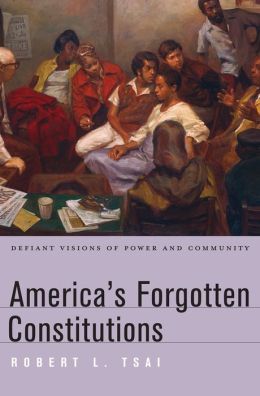 On this holiday weekend, there are plenty of reviews to read. Robert Tsai's America's Forgotten Constitutions: Defiant Visions of Power and Community (Harvard University Press) has been reviewed twice: here from The Daily Beast and here from Pop Matters.
Margaret Garb's Freedom's Ballot: African American Political Struggles in Chicago from Abolition to the Great Migration (University of Chicago Press) is reviewed in the Chicago Tribune.
 J. Douglas Smith's On Democracy's Doorstep: The Inside Story of How the Supreme Court Brought "One Person, One Vote" to the United States (Hill & Wang) is also popular this week. David Garrow reviews the book for The Washington Post, and Salon has an excerpt, "When SCOTUS still fixed things: What American looked like before the Warren Court."
In HistoryToday, two books on the politics of the Atlantic slave trade are reviewed: William Pettigrew's Freedom's Debt: The Royal African Company and the Politics of the Atlantic Slave Trade, 1672-1752 (University of North Carolina Press) and Brycchan Carey's From Peace to Freedom: Quaker Rhetoric and the Birth of American Slavery, 1657-1761 (Yale University Press).
Greg Lukianoff's Unlearning Liberty: Campus Censorship and the End of American Debate (Encounter Books) is reviewed on HNN.
The latest edition of Law and Politics Book Review is out with reviews of Alan Paterson's Final Judgement: The Last Law Lords and the Supreme Court (Hart) (here), Michael Boudreau's City of Order: Crime and Society in Halifax, 1918-35 (University of British Columbia Press) (here), and Gregg Frazer's The Religious Beliefs of America's Founding Fathers: Reason, Revelation and Revolution (University Press of Kansas) (here).
H-Net adds a review of Benjamin Ferencz: Nuremberg Prosecutor and Peace Advocate by Tom Hoffman (McFarland) and a review of Justice among Nations: A History of International Law by Stephen C. Neff (Harvard University Press).
The Washington Post reviews Price of Fame: The Honorable Clare Boothe Luce by Sylvia Jukes Morris (Random House).
"The hyperbole she inspired makes it impossible to distinguish her achievements from her personality and appearance. In 1943 such routine prejudice, which hounds powerful public women to this day, was exacerbated by her rarity: She was one of the few women in Congress, and the only one to show up on her first day wearing purple. Asked in later life whether she had felt disadvantaged in her career by being a woman, she seemed to duck the question: “I couldn’t possibly tell you. I have never been a man.” But the answer is more revealing than perhaps she knew: Because she was not a man, her words and actions were never separated from her appearance and emotions. For all else that brought her fame, from writing to politics to broadcasting, she was always judged as a woman first."

If you're looking for some Fourth of July themed readings, check out these reviews:
- In a piece titled, "If Only Thomas Jefferson Could Settle the Issue: A Period Is Questioned in the Declaration of Independence," The New York Times discusses Danielle Allen's Our Declaration: A Reading of the Declaration of Independence in Defense of Equality (Liveright).
- The Los Angeles Times reviews West of the Revolution: An Uncommon History of 1776 (WW Norton) by Claudio Saunt. "In "West of the Revolution: An Uncommon History of 1776," historian Claudio Saunt evokes this shadow saga of America's founding year in landscapes distinct from the 13 colonies. This is a history more terrible than wondrous, a necessary counternarrative to our enlightened Revolution."
- Also in the LA Times, Janet Napolitano reviews Liberty's Torch: The Great Adventure to Build the Statue of Liberty by Elizabeth Mitchell (Atlantic Monthly Press).
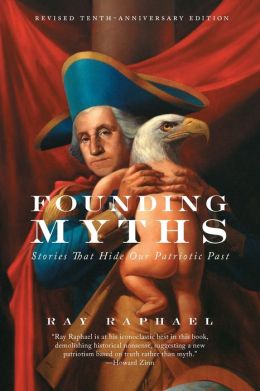
- The New Republic has a piece, "The Dangerous Lies We Tell About America's Founding," that reviews Ray Faphael's Founding Myths: Stories That Hide Our Patriotic Past (New Press) and Matthew Stewart's Nature's God: The Heretical Foundations of the American Republic (Norton).
- Washington Independent Review of Books has a review of Marc Leepson's What So Proudly We Hailed: Francis Scott Key, A Life (Palgrave Macmillan). "Key’s role in American history was greater than merely creating our national anthem. He was a lawyer who loved his work and worked on some major cases of the time, but he did not become interested in politics until Andrew Jackson ran for president. He was a family man who had a large brood. He was also a man of many contradictions, one of which was Key’s distaste for slavery while still owning slaves."
- Salon tells us "The Founding Fathers back Thomas Pitketty--and feared a powerful 1 percent."
- H-Net has a timely review of Remembering the Revolution: Memory, History, and Nation Making from Independence to the Civil War edited by Michael A. McDonnell, Clare Corbould, Frances M. Clarke, W. Fitzhugh Brundage (University of Massachusetts Press).


Saturday, July 5, 2014
The Criminalization of Race in History and Global Societies
[Via H-Law, we have the call for papers for the Fourth Biennial Interdisciplinary International Conference on Race, to be held at Monmouth University in West Long Branch, NJ, April 16-18, 2015.]
The Criminalization of Race in History and Global Societies: Social Activism and Equal Justice
The criminalization of race, mass incarceration, and the emergence of the prison industrial complex have been significant occurrences in modern world history. The U.S. has incarcerated more people (primarily men of color) than any other society in history with a current prison population of 2.3 million. The increase in the prison population in places such as the U.S., Brazil, and China has made mass incarceration a global social crisis.
This conference asks scholars from multiple disciplinary perspectives to explore race and criminal justice throughout history and across global societies with an emphasis on social activism and equal justice. How have scholars and activists in general responded to the social crisis of what Michel Foucault defined as the “carceral” state? What about prison education programs and challenges to such initiatives? What about the connections between race, gender, and class in the emergence of mass incarceration? How have the rates of incarceration varied over time and space? What are some of the connections between the criminalization of race, rates of incarceration, and the prison industrial complex in global societies?
We welcome individual papers or panel proposals that address these questions or other aspects of race and criminal justice from historical, anthropological, sociological, legal, cultural, political, etc. perspectives. Papers related to the topic of race more generally are also welcome. Please contact Hettie V. Williams, Lecturer in African American History, Department of History and Anthropology, athwilliam@monmouth.edu for more details. This conference webpage will be updated periodically: http://www.monmouth.edu/race/
Proposal Guidelines: Send a 150-word abstract and title for each paper, one page curriculum vitae for each participant, and contact information for each presenter by November 1, 2014 to Maryanne Rhett at:
muraceconference@monmouth.edu
Topics may include but are not limited to:
Race and the U.S. Criminal Justice System
Prison Education Programs
Prison Literature
Prison Labor and Corporations
Surveillance of Black Male Bodies
The Carceral State
African American Women in the U.S. Criminal Justice System
The School to Prison Pipeline
Race and the History of Mandatory Minimums
Race and the Criminal Justice System in Popular Media
African Americans and Police Brutality
Race, Gender, and Justice
Lynch Law in Global Perspective
Race and Sentencing
Mass Incarceration in World Societies
Race, Class, and Incarceration
The Monmouth University Conference on race is a biennial interdisciplinary and international conference on race that has taken place since 2008. This conference brings together scholars on race across multiple disciplines from more than fifteen U.S. states, four continents, and twelve nations. Alan H. Goodman, Robin D.G. Kelley, and David Roediger have all previously served as keynote speakers for this event.
The Criminalization of Race in History and Global Societies: Social Activism and Equal Justice
The criminalization of race, mass incarceration, and the emergence of the prison industrial complex have been significant occurrences in modern world history. The U.S. has incarcerated more people (primarily men of color) than any other society in history with a current prison population of 2.3 million. The increase in the prison population in places such as the U.S., Brazil, and China has made mass incarceration a global social crisis.
This conference asks scholars from multiple disciplinary perspectives to explore race and criminal justice throughout history and across global societies with an emphasis on social activism and equal justice. How have scholars and activists in general responded to the social crisis of what Michel Foucault defined as the “carceral” state? What about prison education programs and challenges to such initiatives? What about the connections between race, gender, and class in the emergence of mass incarceration? How have the rates of incarceration varied over time and space? What are some of the connections between the criminalization of race, rates of incarceration, and the prison industrial complex in global societies?
We welcome individual papers or panel proposals that address these questions or other aspects of race and criminal justice from historical, anthropological, sociological, legal, cultural, political, etc. perspectives. Papers related to the topic of race more generally are also welcome. Please contact Hettie V. Williams, Lecturer in African American History, Department of History and Anthropology, athwilliam@monmouth.edu for more details. This conference webpage will be updated periodically: http://www.monmouth.edu/race/
Proposal Guidelines: Send a 150-word abstract and title for each paper, one page curriculum vitae for each participant, and contact information for each presenter by November 1, 2014 to Maryanne Rhett at:
muraceconference@monmouth.edu
Topics may include but are not limited to:
Race and the U.S. Criminal Justice System
Prison Education Programs
Prison Literature
Prison Labor and Corporations
Surveillance of Black Male Bodies
The Carceral State
African American Women in the U.S. Criminal Justice System
The School to Prison Pipeline
Race and the History of Mandatory Minimums
Race and the Criminal Justice System in Popular Media
African Americans and Police Brutality
Race, Gender, and Justice
Lynch Law in Global Perspective
Race and Sentencing
Mass Incarceration in World Societies
Race, Class, and Incarceration
The Monmouth University Conference on race is a biennial interdisciplinary and international conference on race that has taken place since 2008. This conference brings together scholars on race across multiple disciplines from more than fifteen U.S. states, four continents, and twelve nations. Alan H. Goodman, Robin D.G. Kelley, and David Roediger have all previously served as keynote speakers for this event.
Friday, July 4, 2014
Tate on Revolutionary North Carolina's Ban on Perpertuities
Joshua C. Tate, Southern Methodist University Dedman School of Law, has posted Perpetuities and the Genius of a Free State, a comment in a forthcoming symposium in the Vanderbilt Law Review 67 (2014). Here is the abstract:
The recent rise of perpetual trusts has brought new attention to previously obscure state constitutional prohibitions of perpetuities. This comment examines the historical origins of the first such prohibition, Clause 23 of the 1776 North Carolina Constitution and Declaration of Rights, which provided that "perpetuities and monopolies are contrary to the genius of a free State, and ought not to be allowed." Although many good reasons can be offered for the provision, it is curiously absent from the constitutions of the twelve other original states. Why did this provision emerge only in North Carolina, and not in Virginia, Massachusetts, Pennsylvania, or any of the other “free states” that together rose up against their colonial masters?
This Comment suggests a possible answer to that question. Although the problems with perpetuities were well known to learned inhabitants of all the newly independent American states, those problems were particularly salient in North Carolina in 1776 due to that colony’s unique history as a former proprietary colony. The decision by the heir of one of the original Lords Proprietors not to sell his share back to the British crown gave rise to specific grievances in North Carolina that did not exist in the other twelve former colonies. Moreover, North Carolina was unique in witnessing a violent confrontation between the colonial authorities and backcountry farmers that stemmed in part from those grievances. The peculiar case of the Earl Granville and assorted problems in his Granville District shifted the problem of perpetuities from the periphery to the center of North Carolina politics in the late eighteenth century, and made perpetuities warrant an explicit mention in the 1776 North Carolina Constitution and Declaration of Rights.
New Release: "The Expanding Spaces of Law: A Timely Legal Geography"
New from Stanford University Press: The Expanding Spaces of Law: A Timely Legal Geography
Reviewers say:The Expanding Spaces of Law presents readers with cutting-edge scholarship in legal geography. An invaluable resource for those new to this line of scholarship, the book also pushes the boundaries of legal geography, reinvigorating previous modes of inquiry and investigating new directions. It guides scholars interested in the law-space-power nexus to underexplored empirical sites and to novel theoretical and disciplinary resources. Finally, The Expanding Spaces of Law asks readers to think about the temporality and dynamism of legal spaces.

"The Expanding Spaces of Law is the first book to encapsulate the trajectory of the legal geography field and point to its future possibilities in theoretical, methodological and substantive terms. Analyzing the increasing significance of the law-space nexus, this book highlights why all sociolegal scholars should take seriously the geo-political and spatial challenges to the prevailing understandings of law."—Eve Darian-Smith, Professor, Global & International Studies, University of California, Santa BarbaraMore information, including the TOC, is available here.
"The Expanding Spaces of Law vividly illuminates the significant contributions spatial analysis offers to sociolegal studies and to legal anthropology, making clear that an adequate analysis of law and society requires a focus on space and time. The theoretically sophisticated, wide-ranging introduction and empirically rich chapters demonstrate how legal geography enhances the analysis of sociological studies in settings as diverse as Indonesian villages, rural America, and urban Mexico. It offers a valuable introduction to the field as well as a collection of recent, path-breaking work."—Sally Engle Merry, New York University
Thursday, July 3, 2014
New Release: Garb's "Freedom's Ballot"
New from the University of Chicago Press: Freedom's Ballot: African American Political Struggles in Chicago from Abolition to the Great Migration (April 2014), by Margaret Garb (Washington University in St. Louis). From the Press:
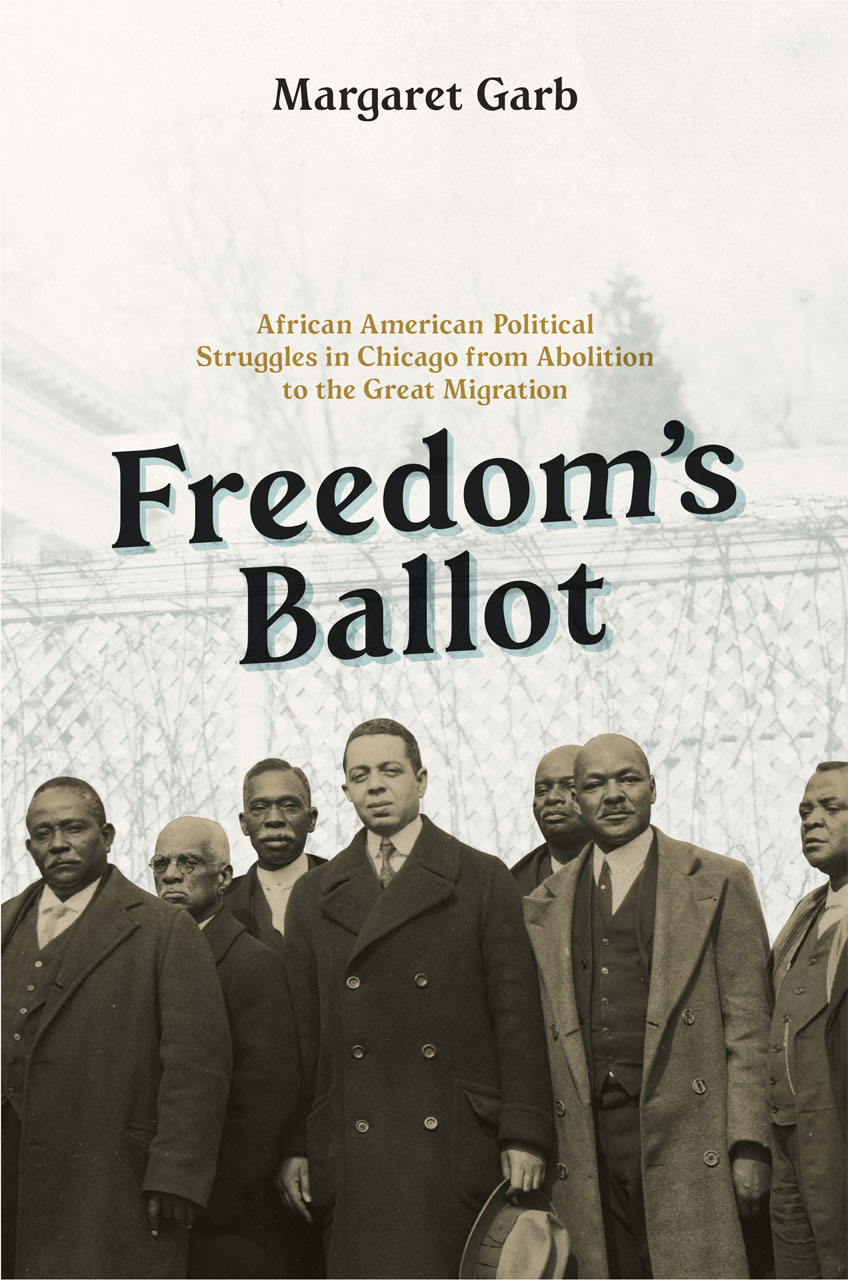
"In the spring of 1915, Chicagoans elected the city’s first black alderman, Oscar De Priest. In a city where African Americans made up less than five percent of the voting population, and in a nation that dismissed and denied black political participation, De Priest’s victory was astonishing. It did not, however, surprise the unruly group of black activists who had been working for several decades to win representation on the city council.
Freedom’s Ballot is the history of three generations of African American activists—the ministers, professionals, labor leaders, clubwomen, and entrepreneurs—who transformed twentieth-century urban politics. This is a complex and important story of how black political power was institutionalized in Chicago in the half-century following the Civil War. Margaret Garb explores the social and political fabric of Chicago, revealing how the physical makeup of the city was shaped by both political corruption and racial empowerment—in ways that can still be seen and felt today."And some blurbs:
“In this fascinating and original study, Margaret Garb traces the rise of black politics in Chicago from its mid-nineteenth-century origins to the early twentieth century. The book is a signal contribution to our understanding of the long civil rights movement on northern soil.” - Eric Foner, Columbia University
“By bringing post-bellum black Northern politics out from beneath the shadows of the South, Freedom's Ballot manages to radically alter the common story of the era of Reconstruction and Jim Crow. For Chicago’s African American leaders, what W.E.B. DuBois called that ‘magnificent drama’ of ex-slaves to bring democracy to America, took on a very different character. As Margaret Garb powerfully demonstrates, uplift ideology and demands for inclusion took a backseat to more militant goals of political power and racial solidarity. Anyone interested in how the Windy City became a national center of black political power must read this book.” - Robin D. G. Kelley, author of "Thelonious Monk: The Life and Times of an American Original"More info available here.
Legal History at the Harvard/Stanford/Yale Junior Faculty Forum
I am just back from the Harvard/Stanford/Yale Junior Faculty Forum, held this year at Stanford Law School, and I want to note the exciting amount of legal historical work on display. For those who are unfamiliar with the Forum, its "objective is to encourage the work of
young [legal] scholars by providing experience in the
pursuit of scholarship and the nature of the
scholarly exchange." Through a process of blind review, the conveners of the Forum choose 10-12 junior scholars to present each year, on topics ranging from environmental law to critical legal studies. Here are the titles and authors of the legal historical papers, with links to those that are available online:
“Glorious Precedents: When Gay Marriage Was Radical”
Michael Boucai, Associate Professor of Law, State University of New York Buffalo Law School
“Liberated Patriarchs: Fathers’ Rights Activism and the Revolution in Family Law, 1960-2000”
Deborah Dinner, Associate
Professor of Law and Israel Treiman Faculty Fellow for 213-2014,
Washington University School of Law, St. Louis, MO
Matthew Steilen, Associate Professor of Law, State University of New York Buffalo Law School
“Administrative Equal Protection: Cooperative Federalism in the Shadow of the Fourteenth Amendment”
Karen Tani, Assistant Professor of Law, University of California, Berkeley
An Interview of Drew S. Days
 |
| Credit: YLS) |
Drew S. Days, III, has lived an extraordinary life in the law. Born in the segregated South, Days graduated from Yale Law School in 1966 and pursued a career as a civil rights lawyer. In 1977, he was appointed Assistant Attorney General for Civil Rights. After his stint in the administration of President Jimmy Carter, Days became a professor at Yale Law School. Then, in 1993, he was appointed Solicitor General of the United States, serving in that position until 1996. He now holds the position of Alfred M. Rankin Professor Emeritus of Law and Professorial Lecturer in Law at Yale Law School. In 2011, he visited Touro Law Center to deliver the Howard A. Glickstein Civil Rights and Public Policy Lecture. As part of his visit, Professor Days was interviewed by Professor Rodger Citron about his life and career. . . .
Wednesday, July 2, 2014
Grisinger on Hearing Examiners and the APA, 1937-1960
Joanna L. Grisinger, Center for Legal Studies, Northwestern University has posted The Hearing Examiners and the Administrative Procedure Act, 1937-1960, in the Journal of the National Association of Administrative Law Judiciary 34 (2014).
New Books in U.S. Constitutional/Legal History: Spring 2014 Edition
And now what you've all been waiting for: the Spring 2014 edition of
Ackerman, Bruce. We the People, Volume 3: The Civil Rights Revolution. Cambridge, Mass.: Harvard University Press, 2014. 432 pp. (cloth, $35.00).Agee, Christopher Lowen. The Streets of San Francisco: Policing and the Creation of a Cosmopolitan Liberal Politics, 1950-1972. Chicago: University of Chicago Press, 2014. 256 pp. (cloth, $45.21, ebook).Anastaplo, George. Reflections on Slavery and the Constitution. Lanham, Md.: Lexington Books, 2013. 344 pp. Paperback ed. (paper, $39.99, ebook).Batvinis, Raymond J. Hoover’s Secret War Against Axis Spies: FBI Counterespionage during World War II. Lawrence, Kan.: University Press of Kansas, 2014. 312 pp. (cloth, $34.95).Barker, Gordon S. Fugitive Slaves and the Unfinished American Revolution: Eight Cases, 1848-1856. Jefferson, N.C.: McFarland, 2013. 232 pp. (paper, $45.00, ebook).Belton, Robert. The Crusade for Equality in the Workplace: The Griggs v. Duke Power Story. Stephen L. Wasby, ed. Lawrence, Kan.: University Press of Kansas, 2014. 424 pp. (cloth, $39.95, ebook).Ben-Atar, Doron S. and Richard D. Brown. Taming Lust: Crimes Against Nature in the Early Republic. Philadelphia, Pa.: University of Pennsylvania Press, 2014. 216 pp. (cloth, $34.95, ebook).Blee, Lisa. Framing Chief Leschi: Narrative and the Politics of Historical Justice. Chapel Hill, N.C.: University of North Carolina Press, 2014. 320 pp. (cloth, $32.95, ebook).Bravin, Jess. Terror Courts: Rough Justice at Guantanamo Bay. New Haven, Conn.: Yale University Press, 2014. 456 pp. Paperback ed. (paper, $20.00, ebook).
Subscribe to:
Posts (Atom)