Friday, September 16, 2011

Q & A with Lawrence Friedman: on writing

Note to readers: This is a part of a series of questions and answers with Lawrence Friedman. If you have a question you've wanted to ask him, please post it in a comment, or email me.

Question -- from Dan Ernst:
Among other things, you are the most successful synthesizer in the field of American legal history. What did you like about writing, say, A History of American Law, American Law in the Twentieth Century and Crime and Punishment in American History that you didn’t get from writing monographs, such as Contract Law in America or The Roots of Justice? Any advice for others contemplating writing a synthetic work?

Answer from Lawrence
:
I was very young-- or what I now think was very young-- when I started to work on A History of American Law; and maybe it was a case of fools rushing in where angels fear to tread. I wanted to do something new, something that hadn't been done before. This was, of course, a work of synthesis; but frankly there wasn't that much to synthesize, and I had to do a lot of digging and looking in primary sources. Today the literature is bursting at the seams, so a work of synthesis to a certain extent needs a different technique. Not necessarily easier. If nobody had written on a subject before, it was OK for me to make wild guesses. Now that is harder.

We need works of synthesis of course; but for anybody who wants to work in legal history, a monograph, an intense work with sources, a study that excavates buried cities, is something you need to do-- first, to establish your credentials, and more important, to teach you what it is like to do this kind of research. But I suppose that those of us who go into this field must love to do research; must love the excitement of uncovering something new, of looking at a record nobody saw before, of opening doorways that have been sealed shut and overgrown and forgotten.

Advice for potential synthesizers? First, know what you're getting into. It's harder than it looks. Second, what you are really doing is trying to interpret the meaning of whole masses of studies and whole ziggurats of data. You have to look for the general that is lost in a maze of particulars. You need dogged determination, and above all a vivid imagination. But not too vivid, I hope. And you need modesty too. You can't read everything, you can't know everything, and there's no sense even trying.

Grad Student Article Prize, Journal of Women's History

Journal of Women’s History  Graduate Student Article Prize

The Editorial Board of the Journal of Women’s History is proud to announce the initiation of a biennial prize for the best article manuscript in the field of women’s history authored by a graduate student. Manuscripts in any chronological and geographical area are welcome. We seek work that has broad significance for the field of women’s history in general by addressing issues that transcend the particulars of the case or by breaking new ground methodologically.

Manuscripts should be submitted electronically, along with a cover letter specifying the author’s graduate advisor, program, and status (i.e., year in program, ABD, etc.), by March 1, 2012 to each member of the committee: Durba Ghosh (dg256ATcornellDOTedu); Pamela Scully (pamelaDOTscullyATemoryDOTedu); and Judith Zinsser (zinssejpATmuohioDOTedu).

The winning author will receive $3000, and the article will be published in the Journal of Women’s History.

Hat tip to Historiann

The University of Wisconsin Legal History Working Group

Our friends at the University of Wisconsin write to announce that they have just launched a webpage for their Legal History Working Group. The Working Group's members include scholars from UW's Law School, History, African-American Studies, Languages and Cultures of Asia, American Indian Studies, the History of Science and other parts of the campus.


The Working Group considers itself continuing “the spirit of UW's legal history tradition begun by Willard Hurst.” With the support of Wisconsin’s Institute for Legal Studies, it also sponsors faculty workshops on various themes within legal history. In 2010-11, it held workshops on legal history and religion (organized by Mitra Sharafi) and colonial/postcolonial law in Asia and the Pacific (organized by Nancy Buenger). Consult the webpage for a list of affiliated faculty, courses with significant legal history content, and online legal-history resources hosted by UW or created by its faculty members.

Thursday, September 15, 2011

Q & A with Lawrence Friedman: on teaching

Note to readers: This is a part of a series of questions and answers with Lawrence Friedman. If you have a question you've wanted to ask him, please post it in a comment, or email me.

Question:
When you first began teaching American legal history, what was on your syllabus? And what was your class like?  Thinking about your legal history classes now, how have they changed over time? In what ways is your syllabus different? Are your teaching objectives different? Do your students expect something different?

Answer (from Lawrence):
I don't think my legal history classes have changed much over time. I ask people (shamelessly) to buy A History of American Law; but I teach mainly from unpublished class materials. I've never tried to publish these, because I feel they're too idiosyncratic. There really isn't a canon for legal history. At least I don't think so. Maybe the dear old Charles River Bridge case!

My materials are all primary sources-- statutes, a few cases, reports, excerpts from various texts-- for example, I have a section on criminal justice, and it includes some material from Beaumont and DeTocqueville on the penitentiary system; an excerpt from Dimsdate, Vigilantes from Montana, that sort of thing.

I am a law and society person through and through. I pay little or no attention to jurisprudence and schools of jurisprudence. I have a lot of material on criminal justice, family law, and (of course) slavery and race relations. The emphasis is not on constitutional law or the Supreme Court. Or on the founding fathers and the Constitutional convention.

I think all along my teaching objective has been to show the relationship between American law and American society, in different periods. A kind of historical sociology of law, but without grand theory; and rooted in concrete experience. I think I should add that it's basically a lecture course. This isn't a matter of pedagogical theory; I have enormous admiration for teachers who can teach legal history as a discussion course, when the size of the class is fairly large. I just don't know how to do it.

Another objective is to counteract the numbing effect of much of the law school experience, which is highly formal, and highly normative. And which also ignores history and culture. I also have some history students in my class-- I think they benefit, because the legal system is such a critical aspect of our society and our history, and it's good for them to be exposed to it.

I have no idea, frankly, what the students expect. Law school is full of academic refugees: doctors, English majors, engineering students who changed their mind; and quite a few history majors who are discouraged by the job prospects for historians. Probably there are as many expectations as there are students.

On the whole, I think the students really like the class. Unlike a lot of the rest of law school, history is really really interesting. At least that's my opinion.

Wisconsin's Law and Society Postdoctoral Fellowship

[Here's an announcement from the Institute for Legal Studies at the University of Wisconsin-Madison School of Law.]

The Institute for Legal Studies of the University of Wisconsin Law School will appoint a post-doctoral fellow for the 2012-13 academic year. We invite applications from scholars who are in the early (pre-tenure) stage of their career or whose careers have been interrupted or delayed. Eligibility is limited to humanities or social science scholars who work in the law and society tradition, for example, anthropologists, economists, historians, political scientists, and sociologists. Advanced ABD graduate students may apply, but the PhD must be completed before beginning the fellowship. The stipend will be $25,000, plus a research allowance of $5,000 and benefits that include health insurance.  More.

Hat tip: H-Law

Wednesday, September 14, 2011

ASLH Program Change

Two panels are changing places on the ASLH program at the conference in November.

Moved to Friday morning at 8:30 a.m.:

Insurrections & Infections: Rethinking the Legal History of Atlanta, 1920-1940 – Inman

Chair - Robert Baker, Georgia State University
Polly Price, Emory University, “Federalization of the Mosquito: Malaria and Public Health In the Southern United States, 1900-1945”
Maryan Soliman, University of Pennsylvania, “Racial Equality on Trial in Atlanta during the 1930s”
Anders Walker, Saint Louis University, “Scarlett’s Rainbow: Margaret Mitchell, Anti-Catholicism, & the Ku Klux Klan in Atlanta, 1920-1940”
Commentator- James W. Ely, Vanderbilt University

Moved to Saturday morning at 8:30 a.m.:

Civil Rights Era & Its Legacy - Salon G
Chair/Commentator- Mary L. Dudziak, University of Southern California,
Susan Carle, American University, “Late Nineteenth Century Civil Rights Organizations and their role in the Founding of the NAACP and the National Urban League”
Jeffrey Gonda, Yale University, “The Business of Civil Rights: Black Realtors and Shelley v. Kraemer”
Keith Mayes, University of Minnesota, “Of Deacons, Panthers, and Liberation Armies: Civil Rights, Black Power and the Second Amendment,”
Camille Walsh, Indiana University, “‘Taxpayer Citizenship’ and the Right to Education: 1929-1959”

Civil Rights Matters

Pete Souza for White House/"The Problem We All Live With"  in background

Civil rights matters have been in the news recently. Here are some developments that may be of interest to blog readers.

President Obama approved the installation of Norman Rockwell's famous painting "The Problem We All Live With," in a West Wing hallway near the Oval Office.  The painting depicts the 1960 desegregation of a New Orleans elementary school by Ruby Bridges, then 6 years old. When Obama met Bridges in July of this year, he noted, "I think it's fair to say that if it wasn't for you guys, I wouldn't be here today." You can view a short video about Bridges' meeting with the President and the installation of the Rockwell painting here. The New Orleans school desegregation case, Bush v. Orleans Parish School Board, has been the subject of several books, most notably, Liva Baker's The Second Battle of New Orleans: The Hundred- Year Struggle to Integrate the Schools.

Many commentators have praised the new Martin L. King Jr. National Memorial, but the civil rights icon's children came in for a blistering attack in an article by Charles Cobb, Jr., a veteran civil rights activist.  The title of Cobb's commentary for Slate and The Root speaks for itself: The Shakedown at the King Monument. In the article, Cobb vehemently objects to fees paid by the memorial's designers to Intellectual Properties Management Inc., a foundation established by elder King son, Dexter King, to control use of his father's words and images. The fees amounted to "extortion," in Cobb's view.  "I cannot know this for sure," Cobb continued, "but I doubt that the family of the murdered John F. Kennedy would charge a fee to a group organizing to place a memorial to him on the National Mall." David Garrow, the biographer of Dr. King and a frequent critic of King's children, added: "I don't think the Jefferson family, the Lincoln family [or] any other group of family ancestors has been paid a licensing fee for a memorial in Washington."  Here's my take on the situation: the Kings are as entitled as any other Americans to assert their intellectual property rights. But the family should expect to be scrutinized and even held to a higher ethical standard than others (whether or not the higher standard is fair is a different question).  The "what-would-the-Kennedys-do" standard is hardly the best one to use in assessing the King family's ethics.  If anything, the ways in which the children choose to control their father's words and images should be measured against the words and image of the man himself. What would Martin Luther King Jr. do?    

Lawyers, heirs, and property rights also are at the root of a controversy involving civil rights icon Rosa Parks. A recent editorial by Jeanne Theoharis (Brooklyn College--political science), the author of Fearless: Rosa Parks and the History of the Civil Rights Movement (Beacon Press), a forthcoming biography of Parks, and Julian Bond (UVA--history) explained that most of Parks' papers, held by Wayne State University, are closed to scholars.  According to the editorial, "Why Don't Scholars Have Access to Rosa Park's Archives," in 2007 a probate court presiding in a legal battle waged between Parks' heirs and a friend issued a troubling order. The court awarded custody of Parks’ possessions to Guernsey’s Auctioneers, ordered the collection sold to a single buyer, and the proceeds of the sale divided among the litigants. The single-buyer stipulation places the archive, valued at 8 to10 million dollars, out of reach of most universities and scholars. Bond and Theoharis argue that Parks' deification has contributed to the present state of affairs.  

It is unthinkable that a collection of Thomas Jefferson’s or Martin Luther King Jr.’s papers could be locked away for four years, let alone put up for auction without a single scholar being allowed a preliminary view to assess its value to American culture and history. [R]osa Parks has been reduced to a children’s book hero — lauded as the “mother of the civil rights movement,” not treated as a serious political thinker in her own right. Through the hype surrounding the posthumous sale of her possessions, which include her party gowns, glasses and sewing basket, she has been transformed into some sort of celebrity commodity.  This treatment is at odds with how Parks lived. One of her greatest commitments was to the preservation and dissemination of African American history. She read voluminously and participated in countless programs, school initiatives and museum exhibitions on black history. ...Parks spent her life working against the idea that wealth should determine access.
One lesson here: family matters.

Tuesday, September 13, 2011

Q & A with Lawrence Friedman: on writing

Note to readers:  This is the second in a series of questions and answers with Lawrence Friedman.  If you have a question you've wanted to ask him, please post it in a comment, or email me. 


Question:  How on earth do you write so much?  Just this year, you published two new scholarly books.  Do you write every day?  Do you write a certain amount at a time (some people set a goal, like 1000 words per day)?  Or do you write for a certain amount of time every day?  Please share your secrets.


Answer (from Lawrence):  How do I write so much?  Well, one flippant answer I give to this (frequently asked) question is:  I've lived a long time.  I'm not retired.  I'm still writing.  So in a way, that's cheating.

I haven't got a non-flippant answer.  My only secret is:  letting go.  I do the best I can, but I'm not the anal-retentive type of legal academic.  I like to finish whatever I'm doing and get on to the next thing.  I know that the work (whatever it is) isn't perfect, but I'm quick to recognize a point of diminishing returns.  Some scholars (particularly in law schools) feel they have to read everything written about the subject, and then some.  It doesn't pay.  And I get bored very quickly, which leads me to say (about whatever my current project is):  OK, enough is enough, let's declare victory and end the struggle with the material. 
 
Anyway, I hope there's no trade-off between quantity and quality.  I do write a lot.  Is that important?  Frederick Jackson Turner wrote very little.  I seem to remember reading somewhere something to that effect.  But the little he wrote was provocative and influential. 

New ASLH Conference Hotel Arrangements

 This just in:
The American Society has announced an overflow hotel for its annual meeting, to be held in Atlanta on November 10-13, 2011.  The Hotel Midtown Atlanta is offering  a discounted rate of $89.00 sgl/dbl occupancy + 15% tax per night.  The Midtown’s webpage is here.  It  is a 3-minute walk to the Loews Atlanta Hotel, the site of the annual meeting.  Meeting attendees can call the Midtown directly at 404-873-4800 or toll-free at 877-873-7829 and ask for the American Society for Legal History rate.
Thanks to Craig Joyce for passing this on.  Keep an eye on the ASLH webpage for any further announcements.

ASLH Conference Hotel Filling Up

If you are planning to attend the American Society for Legal History annual meeting in Atlanta in November, and you have not yet made hotel reservations (yes, it's still early -- the cut-off date for the hotel is Oct. 10), it would be wise to work on that soon.

H-Law has discussed trouble attendees are having making reservations for the first evening of the conference (Thursday, Nov. 10).  I know that a colleague was recently able to get a room at the hotel for Thursday, but not at the conference rate.  UPDATE:  The ASLH webpage now indicates that the hotel is sold out for Thursday.

If you have trouble getting the conference rate through the website, try phoning them.  If you find yourself closed out, scroll down to the first email in this thread, where Craig Joyce offers alternative hotel info:  Hotel Midtown (one block away), W Hotel (the link is to the midtown W -- please check maps to be sure that's the one closest to the conference), Four Seasons, and Renaissance.

My info may be dated, since I read H-Law via the weblogs.  If you have updates or advice for others, please post in the comments.

Monday, September 12, 2011

Q & A with Lawrence Friedman: the first book

Note to readers:  This is the first in a series of questions and answers with Lawrence Friedman.  If you have a question you've wanted to ask him, please post it in a comment, or email me.

Question:  For your first book, Contract law in America: a social and economic case study, what led you to that particular topic?  And why did you start writing books, when so many legal scholars, especially at the time, mostly wrote articles?

Answer
(from Lawrence Friedman):

It's an analysis and contrast between the case-law of the Wisconsin Supreme Court in three distinct historical periods.  It's pure socio-legal history, in the tradition of Willard Hurst, who indeed may have been the one who suggested the topic (I honestly don't remember).  But if he didn't suggest it, he inspired it.
Willard Hurst

And Hurst-- a wonderful man; it was a privilege to know him--always encouraged new faculty members to aim high; to choose a difficult, long-term project, and stick with it. We used to call this, jokingly, Willard's 5-year plans. But the "5-year plan" implies either a series of articles-- or a book. And I liked the idea of writing an actual book. I know that this wasn't the norm in legal academia. But I cared very little for the norm in legal academia. Then and now. And Wisconsin at that time was just the place to be for those who felt this way.

Novak to Address Montanans on Constitution Day

The Daily Missoulian reports: "William J. Novak, professor at the University of Michigan Law School, will present 'The Constitution and the Myth of the Weak American State' at 7:30 p.m. Thursday, Sept. 15, in Gallagher Business Building Room 123 at The University of Montana."  More.

Keating on Robert Rabin on the Historical Development of the Fault Principle in Tort Law

Recovering Rylands: An Essay for Bob Rabin has just been posted by my colleague Gregory C. Keating, University of Southern California Law School.  It is forthcoming in the DePaul Law Review.  Here's the abstract:
This paper, written for a Clifford Symposium Festschrift for Robert Rabin, comments on his lovely, widely admired, and yet still underappreciated paper The Historical Development of the Fault Principle: A Reinterpretation. Rabin’s paper teaches us something essential about the character and structure of modern tort law at the moment of its genesis, and it reminds us of the even more general truth that what the law does not cover is at least as important as what it does cover. The Historical Development of the Fault Principle is constructed around a simple, but powerful, distinction between fault as a breach of duty and fault as a cause of action. Negligence as a cause of action is an institution, a system of related rules, concepts, principles and policies. This simple but penetrating observation transforms the question of just what is at stake in the conventional thesis that the late nineteenth century was the heyday of “universal fault liability.”

Whether or not fault liability was “universal” at the end of the nineteenth century turns, Rabin teaches, not on whether tort liability for accidental injury is constructed around fault or strict liability. The “universality” of fault liability is, rather, a question about the percentage of the legal landscape for unintentional harm that the institution of negligence liability governs. Building on this point, The Historical Development of the Fault Principle shows that the age of “universal fault liability” is better described as an age where “no duty” predominated. Tort liability – fault liability retreated whenever contract was capable of taking hold of a domain of accidental injury. It retreated both in the presence of contractual relations (in the workplace context) and in the absence of contractual relations (in the product context). Property, contract, and “no duty” all trumped tort. This insight not only changes our understanding of the rise of fault liability; it also provides a powerful rebuttal of the still influential, if waning, view that the common law of torts circa 1870-1905 was economically efficient.

Rabin’s critique leaves intact the thesis that negligence liability itself emerged as a freestanding form of tort liability at the end of the nineteenth century. Prior to that time, negligence was merely the mental element of a number of discrete, nominate torts. Late in the nineteenth century, negligence transforms into a norm of conduct and thereby emerges as a distinctive form of tort liability. This development sets the stage for the expansion of fault liability into the domains of product accidents, landowner liability, and some forms of pure economic and emotional harm. The late nineteenth century thus sets the stage for the “universal fault liability” that it so conspicuously fails to achieve.

Recovering Rylands argues that Rylands v. Fletcher represents a parallel development with respect to strict liability. Rylands generalizes ancient forms of liability in nuisance and trespass into a coherent, general alternative to fault liability. The opinions in the case both articulate strict liability as a general principle of responsibility for harm done and clarify the fundamental perception on which strict liability rests, namely, that harm justifiability inflicted – harm which is unavoidable in the sense that it should be inflicted – can trigger responsibilities of repair. The idea that the justified infliction of harm gives rise to responsibilities of repair stands in sharp contrast to the root premise of fault liability, and accounts for the enduring significance of strict liability as form of legal responsibility for harm done.

After excavating the basis and nature of strict liability in Rylands, the paper traces the ebb and flow of the strand of strict liability that it inspired over the past century and a half. On the one hand, that history shows that fault liability is never universal, though generally dominant. On the other hand, that history suggests that the difficulty of attributing harms to activities without deploying a fault criterion may be a permanent, insurmountable barrier to universal, common law strict liability. Last, but surely not least, Rylands’ articulation of strict liability as a general idea is an essential part of the formative moment of modern tort law that Bob Rabin did so much to help us understand. Adding an account of Rylands is a way of building on his seminal contribution.

Okayama on the Judicialized Procedure of the Early ICC

Hioshi Okayama, Keio University, has posted The Interstate Commerce Commission and the Political Origins of a Judicialized Administrative State, which was a paper presented at the recently concluded annual meeting of the American Political Science Association.  Here is the abstract:
This paper seeks to explain why the US administrative process much resembles that of a court and, as a result, the administrative state as a whole is highly "judicialized." It does this by intensively analyzing the origins of the institutional form of the Interstate Commerce Commission, a prototypical and highly judicialized (quasi-judicial) administrative agency established in 1887. It is shown that, contrary to the prevailing assumption that the commission was modeled after existing railway commissions in and out of the United States, the ICC was designed to be a court-like administrative agency due to considerations on separation of powers and the rule of law. As the independent commissions later created were modeled after the ICC, the bulk of the key agencies constituting the core of the early administrative state turned out to be judicialized from the outset. This indicates that the transition from the early American state of "courts and parties" to the twentieth-century administrative state was a more gradual and nuanced one than has been suggested.

Sunday, September 11, 2011

"What We Still Don't Know": This Week in the Book Reviews

Book review coverage is down this week, owing to the effort that many newspapers and magazines devoted to the ten-year anniversary of the September 11 terrorist attacks. (See, for example, the special New York Times section "The Reckoning.") There seem to be many thoughtful articles and essays out there, so please post comments if you find something that would be of particular interest to this readership.

One essay that jumped out at me was David Cole's "After September 11: What We Still Don't Know,"in the new issue of the New York Review of Books. Cole writes about the resilience of the "rule of law" and the importance of continued appeals to "rule of law" ideals.

Also in the NYRB: Non-subscribers may read Peter Maass's review of four books on the Gulf Oil Disaster ("What Happened at the Macondo Well?") and Diane Ravitch's review of two books on school "reform" (scare quotes are hers). Subscribers get Darryl Pinckney's take on Manning Marable's Malcolm X ("The Two Conversions of Malcolm X"); Robert Gottlieb's review of a new biography of Ethel Waters ("The Mother of Us All"); and Eric J. Segall's conversation with Judge Richard Posner ("The Court").

The New York Times Sunday Book Review features That Used To Be Us: How America Fell Behind in the World It Invented and How We Can Come Back (Farrar, Straus and Giroux), by Thomas L. Friedman and Michael Mandelbaum. The review is here; the podcast interview, here; an excerpt, here.  Also making a comeback: Jane Fonda. She released a memoir not too long ago, and now comes a new biography. The review is here.

In the Los Angeles Times, you'll find a review of Grand Pursuit: The Story of Economic Genius (Simon and Schuster), by Sylvia Nasar. Nasar writes about the times and thought of Karl Marx, Joseph Schumpeter, Beatrice Potter Webb, Alfred Marshall, John Maynard Keynes, and others.

This week in the Nation, Benjamin Nathans reviews two books on "Khrushchev's thaw": Khrushchev’s Cold Summer: Gulag Returnees, Crime, and the Fate of Reform After Stalin (Cornell University Press), by Miriam Dobson, and Zhivago’s Children: The Last Russian Intelligentsia (Belknap Press of Harvard University Press), by Vladislav Zubok.

Last, a personal tale of hardening and thaw: week after week I see reviews of Hal Vaughan's book on Coco Chanel's collaboration with the Nazis, and week after week I don't tell you about them. I think it's the title: "Sleeping with the Enemy." I find it gauche (and it reminds me of the 1990s Julia Roberts thriller of the same name). After seeing the book once again featured on a prominent review page (the New Republic), I feel compelled to mention it. If this topic piques your interest, I give you "The Stench of Perfume."

Also in the New Republic, Adrian Vermeule reviews The Body of John Merryman: Abraham Lincoln and the Suspension of Habeas Corpus (Harvard University Press), by Brian McGinty.

Saturday, September 10, 2011

Weekend Round-Up

  • Fans of Barbara Babcock’s Woman Lawyer, a biography of Clara Foltz, can find the stops of her book tour this fall here.
  • A thoughtful story about Daniel Sharfstein’s The Invisible Line: Three American Families and the Secret Journey from Black to White appears in the on-line magazine Diverse: Issues in Higher Education. Sharfstein will appear at George Mason University’s annual fall book festival, September 18-23, and the Southern Festival of Books, October 14-16, in Nashville, Tennessee.
  • The UK National Archives has expanded the license of the Anglo-American Legal Tradition (AALT) website at the University of Houston. Now available, free on line, are a variety of Privy Council materials, as well as documents on the Boston Tea Party, the boarding of the Ship Gaspee, the Stamp Act Riots, and the Seven Bishops Case in the King's Bench. Hat tip: H-Law.

Friday, September 9, 2011

Law and Governance in Pre-Modern Britain

Here are the panels and papers for the conference Law and Governance in Pre-Modern Britain, to be held at the Faculty of Law, at the University of Western Ontario, on October 14-15, 2011. More information is here.

Friday, 14 October 2011

Panel 1: Reading Between the Lines
Chair: Sharon Wright, St Thomas More College
"Bodies and Nobodies in Medieval Wales." Robin Chapman Stacey, University of Washington.
"Portrait of a Surgeon in Fifteenth-Century England." Sara M. Butler, Loyola University (New Orleans).
"Legal Narrative and the Records of the Court of Kings Bench." Shannon McSheffrey, Concordia University.

Panel 2: Sources and Methods
"Early English Laws: Contents and Use." Bruce O'Brien, University of Mary Washington.
"Questions about Constitutionalism." Richard Kaeuper, University of Rochester.

Saturday, 15 October 2011

Panel 3: Centre and Locality
"Centre and Periphery in the Formation of the Common Law." James Masschaele, Rutgers University.
"Edward I and the Law." Paul Brand, All Souls College, Oxford.
"Local Courts." Robert C. Palmer, University of Houston.

Panel 4: Crossing Legal Boundaries
Chair: Kelly DeLuca, Algoma University.
"Laws across the North Sea: The Anglo-Frisian Connection in Early Medieval Europe." Lisi Oliver, Louisiana State University.
"The King's Peace and the King's Pardon in Later Medieval Scotland." Cynthia Neville, Dalhousie University.
"Real and Personal Actions in the Fourtheenth-Century Year Books." Charles Donahue Jr., Harvard University

Panel 5: Interpretation and Change
Chair: David Smith, Wilfrid Laurier University
"Natural Law as an Instrument of Governance in Early Modern Europe." R.H. Helmholz, University of Chicago.
"Married Women and the 'Procheine Amy' in the Seventeenth-Century Chancery." Tim Stretton, St. Mary's University.
"Law and 'Revolution': The mid-Seventeenth Century British Example." Christopher Brooks, University of Durham.

Hat tip: H-Law

This Fall at the Miller Center

The Miller Center for Public Affairs at the University of Virginia announces Fall 2011 line-up for its Governing America in a Global Era Colloquia Series.  More information is here.

Friday, September 16
Alan Brinkley, Columbia University
The Kennedy Crises: Cuba and Berlin, 1961

Friday, October 7
Suzanne Mettler, University of Chicago
Who Perceives Government's Role in Their Lives? How Policy Visibility Shapes American Democracy

Wednesday, October 12
David Lake, UC San Diego
America's Hegemonic Dilemmas: Building Legitimate and Loyal States in an Age of Global Insurgency

Dissertation and Summer Research Funding, American Bar Foundation

The American Bar Foundation welcomes applications from legal historians for these funding opportunities:
ABF Doctoral Fellowship Program: The American Bar Foundation is committed to developing the next generation of scholars in the field of law and social science. The purpose of the fellowships is to encourage original and significant research on law, the legal profession, and legal institutions.  Click here for more information.

Law and Social Science Dissertation Fellowship and Mentoring Program (LSS Fellowship)
The Law and Society Association, in collaboration with the American Bar Foundation and the National Science Foundation, has launched the Law and Social Science Dissertation Fellowship and Mentoring Program (LSS Fellowship) which is designed to foster scholars in the Law and Society tradition and whose scholarship is on Law and Inequality.  Click here for more information. 

ABF Summer Research Diversity Program: This program of summer research fellowships is designed to introduce undergraduates from diverse backgrounds to the rewards and demands of a research-oriented career in the field of law and social science.  Click here for more information.
These fellowships require residency at the ABF in Chicago.  Deadlines for dissertation fellowships are in December (follow links for details).  The summer fellowship deadline is February 15.

Boston College Legal History Roundtable


Jack Rakove, Stanford, leads off the schedule of this year's speakers at Boston College's Legal History Roundtable.  Here's the schedule:

Fall 2011

Thursday, September 15, 4:30p.m., Gasson 100
Jack Rakove, William Robertson Co Professor of History and American Studies, Stanford Law School.  Constitution Day Lecture: Beyond Belief: The Radical Significance of the Free Existence of Religion. Co-sponsored by the Clough Center and the Departments of History and Political Science

Thursday, October 27, 4:30 p.m., Gasson 100
Book Panel on Gerard Magliocca's book "The Tragedy of William Jennings Bryan: Constitutional Law and the Politics of Backlash" (Yale 2011)
Featuring Gerard N. Magliocca, Professor of Law, Indiana University School of Law-Indianapolis; Michael Kazin, Professor of History, Georgetown University; Kenneth Kersch, Associate Professor of Political Science and Director of the Clough Center for Constitutional Democracy, Boston College; M. Elizabeth Sanders, Professor of Government, Cornell University. Co-sponsored by the Clough Center.

Tuesday, November 15, 4:30 p.m., Gasson 100
Hon. Margaret H. Marshall, "To no one deny or delay right or justice"- Magna Carta 1215, Imperfect constitutions, imperfect courts and the ideal of justice. Co-sponsored with the McMullen Museum, the Department of History, and the Clough Center

Wednesday, November 16, 4:30, Law School Library Rare Book Room  
Aniceto Masferrer, Professor of Legal History, University of Valencia and President, the Society for Comparative Legal History' (ESCLH) (website) "The Principle of Legality and codification in the 19th-century Western Criminal Law Reform"

Spring 2012

Kristen Stilt, Northwestern University Law School, Week of January 23, 2012

Abigail Chandler, University of Massachusetts-Lowell, Thursday February 15, 2012 "I Charged Her to Speak the Truth": The Legal Role of the Colonial Midwife

Michael Hoeflich, University of Kansas Law School, Wednesday, April 11, 2012, "Lawyers and the Visual Arts, 1780-1870."


Full details are here.

Thursday, September 8, 2011

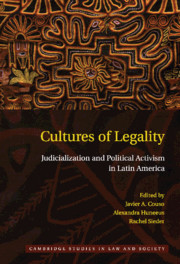
Schor reviews Cultures of Legality: Judicialization and Political Activism in Latin America

CULTURES OF LEGALITY: JUDICIALIZATION AND POLITICAL ACTIVISM IN LATIN AMERICA by Javier A. Couso, Alexandra Huneuus, and Rachel Sieder (eds). New York: Cambridge University Press, 2010, is reviewed by Miguel Schor, Drake University School of Law and Suffolk University Law School, for the Law and Politics Book Review. Schor begins:
Latin America democratized in the 1980s and underwent profound constitutional transformations. It has proven easier to implement electoral democracy, however, than to realize constitutional guaranties. How to institutionalize the operative rules of the democratic game has become, therefore, a pressing research issue. While there is a reasonably vast literature on democratization, the literature on how to make constitutions work, on the other hand, is significantly thinner. The relative dearth of literature on constitutionalism says less about the importance of the topic than it does about the state of interdisciplinary scholarship in academia.

CULTURES OF LEGALITY: JUDICIALIZATION AND POLITICAL ACTIVISM IN CONTEMPORARY LATIN AMERICA plays an important role in helping to fill this gap. It is a challenging collection of essays written by a group of first-rate scholars well versed in the political science literature on courts. The introduction (Huneeus et al. at pp.3, 7) defines legal culture as a set of contested and changing ideas and argues it is a useful construct in understanding the role that courts play in the new democracies throughout the region. Although ideas matter in understanding why citizens are increasingly turning to courts to deal with disputes once thought to be political in nature and why courts are responding with useful outputs, the role of legal ideas has been understudied and under-theorized by the social science scholarship on courts (Schor 2009, pp.188-192).

The various chapter studies both deepen and challenge the thesis that ideas matter in understanding judicial behavior. Kapiszewski’s (pp.51, 52) study of the Brazilian national high court argues that we need to combine institutional and cultural explanations for an adequate account of why courts “become engaged in politics.” Judicial independence and professional competence are a necessary but not a sufficient explanation for judicial behavior. Kapisweski (p.59) concludes that judicial “ideas about law and the judicial endeavor, and the practices they develop as they do their job, are at the heart of the cultural approach to explaining judicial decision-making.” The Mexican Supreme Court presents a puzzle since it first inserted itself into politics by vigorously enforcing separation of powers rather than effectuating constitutional rights. Ansolabehere (p.78) explores the role of “interpretive frameworks” in explaining why that court is becoming more active in effectuating rights. Huneeus [*457] examines why national high courts in Chile, Argentina, and Venezuela have resisted rulings from the Inter-American Court of Human Rights. The answer, she suggests (p.112), is that “judicialization and regional integration are not mutually reinforcing phenomena but, rather, in competition.”
Continue reading here.

Wednesday, September 7, 2011

ASLH Meeting Starts Early This Year

As we noted recently, registration is now open for the annual meeting of the American Society for Legal History, to he held in Atlanta, GA, November 10-13.  The meeting usually begins on Friday morning, but this year begins on Thursday afternoon, Nov. 10.   Two special panels are planned: a presidential panel honoring Philip Girard, and a roundtable discussion of legal history teaching, featuring two recent LHB guest bloggers, Elizabeth Dale and David Tanenhaus.  Here are the details:

Thursday, Session A, 2:00pm – 3:45pm
Presidential Panel: In Honor of Philip Girard – Salon G
Chair/Commentator- Constance Backhouse, University of Ottawa
Jim Phillips, University of Toronto, “The British North American Judiciary, 1754-1867: Independence, Politics, and the Emergence of an Indigenous Elite”
Jan-Philippe Garneau, Université du Québec à Montréal, “Lawyers and Legal Culture Across Borders: A Quebec Perspective”
Mary Stokes, Osgoode Hall Law School, “‘Municipal Law is my Speciality’: How Robert A. Harrison did not become Ontario’s Beamish Murdoch”

Thursday, Session B, 4:00pm - 5:30pm
Roundtable on Teaching American Legal History – Salon H
Chair- John Wertheimer, Davidson College
Barry Cushman, University of Virginia
Elizabeth Dale, University of Florida
Sally Hadden, Western Michigan University
Peter Karsten, University of Pittsburgh
David Tanenhaus, UNLV

Update
A post on the Canadian Legal History Blog discusses the occasion for the presidential panel.  DRE

GW Announces Legal History Research Grant

[We have the following announcement from GW Law.]

GW Law is pleased to invite applications for the Richard & Diane Cummins Legal History Research Grant for 2012.

The Cummins Grant provides a stipend of $10,000 to support short-term historical research using the Special Collections Department at GW's Jacob Burns Law Library, which is noted for its continental historical legal collections, especially its French collection, with strengths in Roman and canon law, church-state relations, international law, and many incunabula holdings.

The grant is awarded to one doctoral, LL.M., or S.J.D. candidate, postdoctoral researcher, faculty member, or independent scholar. The successful candidate may come from a variety of disciplines including, but not limited to, law, history, religion, philosophy, or bibliography.
More

Thomas on the History of First Term Abortion Regulation

Tracy A. Thomas, University of Akron School of Law, has posted a new paper: Back to the Future of Regulating Abortion in the First Term.  Here's the abstract:
In the first half of 2011, more abortion bills have passed to restrict abortion than ever before. The 162 new abortion bills passed by 19 states in the first six months of the year dwarf the average number of abortion bills for the last three decades of 15 per year. Even more, these bills propose significantly more stringent limits on abortion than in the past, including mandatory ultrasound viewings, intensive counseling, and bans after the first fetal heartbeat at six weeks. These restrictions seem blatantly to defy the holding of Roe v. Wade permitting abortion in the first trimester, yet they continue to proliferate.

This Article provides the historical context for the current onslaught of proposed abortion bills by returning to two of the earliest Supreme Court cases of indirect regulation of abortion in the first term. It offers a legal history of the case, City of Akron v. Akron Center for Reproductive Health, and its follow-on case, Ohio v. Akron Center for Reproductive Health. For before the dust had even settled in the Supreme Court’s 1973 landmark decision in Roe v. Wade, legislators had moved to restrict its impact by passing laws to “protect women’s health and voluntary and informed consent.” In the Akron cases, the Court first rejected such attempts to limit abortion in the first term, but then subsequently upheld a first-term regulation, casting doubt upon its continued commitment to Roe.

This legal history offers insights and analyses into the legislation of abortion gleaned from a review of the historical record in the Akron cases found in archives and long-forgotten files in dusty basements. It relies on interviews with key players in the cases to provide a fuller explanation of the political and social motivations behind the legal disputes. Revisiting the legal and factual details of these foundational cases of first-term abortion regulation offers a more nuanced understanding of the opposition to abortion and the unsatisfactory nature of the judicial compromises. For only one thing is clear: “The decision in Roe v. Wade neither started nor ended the debate over abortion.”

Tuesday, September 6, 2011

On C-Span: The Historical Legacy of September 11

Apparently airing this afternoon at 2:04 pm Eastern, on C-Span 3:  a plenary panel on The Historical Legacy of September 11, from this year's annual meeting of the Society for Historians of American Foreign Relations.  Speakers are:  Marilyn Young, NYU; Andrew Bacevich, Boston University, Melani McAlister, George Washington University, and yours truly.  The program is archived on the C-Span website.

Bacevich is especially compelling on this topic.  My remarks address the fusion of law and war in the post-9/11 years -- at home as well as on the battlefield.

Blog glitch

There are many great recent posts on the blog, including Karen's excellent Sunday book review round-up, but we are having a formatting glitch that I am unable to fix quickly, so that only yesterday's posts appear on the front page.  To get to the rest, just click on "Older Posts" below the posts.  I'll restore our original settings as soon as I am able to.

I know it's Tuesday, but this feels like a Monday morning....