Showing posts with label Ottoman. Show all posts

Tuesday, June 27, 2023

Barakat, "Bedouin Bureaucrats: Mobility and Property in the Ottoman Empire"

Stanford University Press has published Bedouin Bureaucrats: Mobility and Property in the Ottoman Empire (2023), by Nora Elizabeth Barakat (Stanford University). A description from the Press:
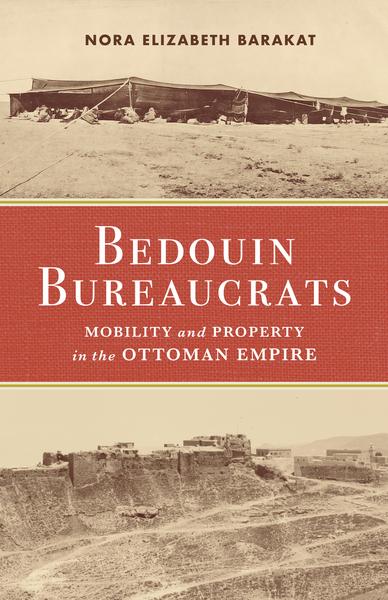
In the late nineteenth century, the Ottoman government sought to fill landscapes they legally defined as "empty." Both land and people were incorporated into territorially bounded grids of administrative law. Bedouin Bureaucrats examines how tent-dwelling, seasonally migrating Bedouin engaged in these processes of Ottoman state transformation on local, imperial, and global scales. As the "tribe" became a category of Ottoman administration, Bedouin in the Syrian interior used this category both to gain political influence and to organize community resistance to maintain control over land.

Narrating the lives of Bedouin individuals involved in Ottoman administration, Nora Elizabeth Barakat brings this population to the center of modern state-making, from their involvement in the pilgrimage administration in the eighteenth century and their performance of land registration and taxation as the Ottoman bureaucracy expanded in the nineteenth, to their eventual rejection of Ottoman attempts to reallocate the "empty land" they inhabited in the twentieth. She places the Syrian interior in a global context of imperial expansion into regions formerly deemed marginal, especially in relation to American and Russian empires. Ultimately, the book illuminates Ottoman state formation attempts within Bedouin communities and the unique trajectory of Bedouin in Syria, who maintained their control over land.

Praise from reviewers:

"Bedouin Bureaucrats is a marvel. It is necessary reading for anybody interested in the complexities of state-building, governance, and sovereignty. Nora Barakat has given us a book that will be debated and admired for years to come." —Pekka Hämäläinen

"Through rigorous research and exceptional prose, Nora Barakat shows how Bedouin chiefs participated in the creation of new state structures to ensure their power and privilege and the long-term survival of their communities. Bedouin Bureaucrats convinces us to rethink our assumptions about tribes and their place in the modern Middle East."—Reşat Kasaba,

More information is available here. An interview with Professor Barakat is available here, at New Books Network.

-- Karen Tani

Wednesday, June 26, 2019

Smiley on the Ottoman Empire, Russia, and International Law

Will Smiley, Reed College published From Slaves to Prisoners of War: The Ottoman Empire, Russia, and International Law with Oxford University Press in 2018. From the publisher: 
From Slaves to Prisoners of War: The Ottoman Empire, Russia, and International Law (The History and Theory of International Law)The Ottoman-Russian wars of the eighteenth century reshaped the map of Eurasia and the Middle East, but they also birthed a novel concept--the prisoner of war. For centuries, hundreds of thousands of captives, civilians and soldiers alike, crossed the legal and social boundaries of these empires, destined for either ransom or enslavement. But in the eighteenth century, the Ottoman state and its Russian rival, through conflict and diplomacy, worked out a new system of regional international law. Ransom was abolished; soldiers became prisoners of war; and some slaves gained new paths to release, while others were left entirely unprotected. These rules delineated sovereignty, redefined individuals' relationships to states, and prioritized political identity over economic value. In the process, the Ottomans marked out a parallel, non-Western path toward elements of modern international law. Yet this was not a story of European imposition or imitation-the Ottomans acted for their own reasons, maintaining their commitment to Islamic law. For a time even European empires played by these rules, until they were subsumed into the codified global law of war in the late nineteenth century. This story offers new perspectives on the histories of the Ottoman and Russian Empires, of slavery, and of international law.
 Praise for the book: 

"This is an extensively detailed history of Ottoman Turkish relations primarily but not entirely with...the Russian Empire, the Hapsburgs, and the West, dealing with the numerous wars in which it was involved between 1700 and 1876...Recommended" -- CHOICE

Further information is available here.

--Mitra Sharafi

Wednesday, January 23, 2019

Ferguson on Ottoman administrative discourses

Heather L. Ferguson, Claremont McKenna College, has published The Proper Order of Things: Language, Power, and Law in Ottoman Administrative Discourses with Stanford University Press. From the publisher: 
Cover of The Proper Order of Things by Heather L. FergusonThe "natural order of the state" was an early modern mania for the Ottoman Empire. In a time of profound and pervasive imperial transformation, the ideals of stability, proper order, and social harmony were integral to the legitimization of Ottoman power. And as Ottoman territory grew, so too did its network of written texts: a web of sultanic edicts, aimed at defining and supplementing imperial authority in the empire's disparate provinces. With this book, Heather L. Ferguson studies how this textual empire created a unique vision of Ottoman legal and social order, and how the Ottoman ruling elite, via sword and pen, articulated a claim to universal sovereignty that subverted internal challengers and external rivals. 
The Proper Order of Things offers the story of an empire, at once familiar and strange, told through the shifting written vocabularies of power deployed by the Ottomans in their quest to thrive within a competitive early modern environment. Ferguson transcends the question of what these documents said, revealing instead how their formulation of the "proper order of things" configured the state itself. Through this textual authority, she argues, Ottoman writers ensured the durability of their empire, creating the principles of organization on which Ottoman statecraft and authority came to rest.
Praise for the book: 

 "The Proper Order of Things invites us to rethink Ottoman empire-building with its capacity to codify, categorize, and monopolize symbolic violence. A brilliant book." —Ali Yaycioglu

"The Proper Order of Things offers an ambitious treatment of Ottoman bureaucratic textual production. Heather Ferguson's intelligent discursive analysis of the different bureaucratic genres as both texts and spatial practices allows for a new understanding of the nature of Ottoman governance and the longevity of the empire." —Dana Sajdi

Further information is available here.