Showing posts with label Violence. Show all posts

Wednesday, August 12, 2026

Cohen's "Gangster of New York"

Andrew Wender Cohen, Syracuse University, has published Gangster of New York: A Violent Life in Nineteenth Century America (Cambridge University Press, 2026).

 This is the story of Louis Bieral, a nineteenth-century gangster, politician, sportsman, and Civil War hero. Kidnapped from his birthplace in revolutionary South America, he doused fires in Jacksonian New York, battled Sumatran pirates with the US Navy, and panned for California gold. As a crime boss, he raced horses, boxed champions, and ran brothels. Yet Bieral's adventurous life was also steeped in the brutality of his time. He befriended rowdies like 'Butcher' Bill Poole, returned fugitives like Anthony Burns to slavery, and assaulted abolitionists such as Richard Henry Dana. As a Union officer, Bieral won fame in battle. He was a Gilded-age bodyguard for 'Boss' Tweed, William Seward, and Jim Fisk, becoming a suspect in that tycoon's murder. From the docks of Valparaíso to the dining room of Delmonico's to the cells of Auburn Prison, Bieral's remarkable journey illustrates the violence that bound nineteenth-century America together.

Professor Cohen is interviewed about the book here. 

--Dan Ernst

Wednesday, December 17, 2025

LHR 43:2

Law and History Review 43:2 (2025), a special issue, has now been published on-line.  Here is the TOC:

Archives of Sexual Violence in Conflict Zones
Rosemary Byrne, Stephanie McCurry, Jane Ohlmeyer

Women and Sexual Violence in the “1641 Depositions”
Jane Ohlmeyer

Ku Klux Klan Violence and the Problem of Evidence
Stephanie McCurry

Collective Sexual Violence in Turkey, 1894–1924: What we know and how we know it
Benny Morris

Archives of Sexual Violence: Some Testimonies from the Partition of India
Sucheta Mahajan

Women on the Death Railway: A Microhistory of Victimization and Agency
W.L. Cheah

“Hints” of Sexual Violence: What the Akayesu Trial Archive at the International Criminal Tribunal for Rwanda Tells Us About Uncovering Sexual Violence Testimony in Conflict Archives
Rosemary Byrn

--Dan Ernst 

Tuesday, December 16, 2025

CFP: Violence in the Medieval and Early Modern North

[We have the following CFP.  DRE]

"Violence in the Medieval and Early Modern North."  Aberdeen Medieval and Early Modern North Conference, University of Aberdeen, Scotland

In 1336, a battle took place in the Wars of Scottish Independence in which Edward III of England burnt Aberdeen to the ground. In 1644, the Battle of Aberdeen saw the clash between Covenanter and Royalist forces in the Wars of the Three Kingdoms, with the battle and its aftermath shaking Aberdeen and its denizens. While living memory of these events has faded away, their scars can still faintly be seen. Battles, plague, witch trials and legal cases of domestic abuse have all left their mark on Aberdeen and have shaped the way we view the past. 

Violence in the medieval and early modern world is central to our construction and understanding of the past. Although we have dates and locations, the details of violent enaction are often hazy. Violence, then as now, heavily colours the pages of history, with societal expectations often being enforced through threat of violence. Thus, we propose an exploration of violence for this year's conference, inspecting closely what is considered violence, what is determined as avoiding violence, and who decides the definitions of such things.

We encourage researchers to explore how violence was interpreted, enacted and avoided in the medieval and early modern north. How does the reality of the medieval and early modern world reflect how we view the past? How did Vikings, Knights and Musketeers handle the violence of their occupations? Do we still enact violence on the past as researchers? What were the aftereffects of violence, on the body, on architecture, and on society? From witch trials, war, bizarre medical practices, and natural phenomenon, this conference will investigate the violence of the past. 

We're seeking papers on the topic of violence and its intersections with:

  • Memory and Trauma 
  • Judicial and Legal Systems
  • Literature and Artistic Representations
  • Domestic and Public Spheres
  • Gender, Race, Class, and Disability Studies
  • Military and War Studies
  • Religious and Ecclesiastical History
  • Histories of Medicine and the Body
  • Medievalism and Early Modern Reception
  • History of Emotions (e.g. anger, humour etc.)
  • Ecocriticism 
  • Manuscript Studies and Material Culture 

While we invite papers on all parts of the north, we especially welcome papers on Aberdeen and northern Scotland. The conference will be held on 25-26 May 2026 at the University of Aberdeen, Scotland.  Please email abstracts of no more than 250 words to medievalandearlymodernaberdeen@gmail.com.  Deadline:15 January 2026 @ 23:59(GMT).

Friday, November 21, 2025

Gadson's "Sedition"

Marcus Alexander Gadson, UNC Law, has published Sedition: How America's Constitutional Order Emerged from Violent Crisis (NYU Press):

Since protestors ripped through the Capitol Building in 2021, the threat of constitutional crisis has loomed over our nation. The foundational tenets of American democracy seem to be endangered, and many citizens believe this danger is unprecedented in our history. But Americans have weathered many constitutional crises, often accompanied by the same violence and chaos experienced on January 6. However, these crises occurred on the state level. In Sedition, Marcus Alexander Gadson uncovers these episodes of civil unrest and examines how state governments handled them.

Sedition takes readers through six instances of constitutional crisis: The Buckshot War, Dorr’s Rebellion, Bleeding Kansas, the Brooks-Baxter War, a successful terrorist campaign to overthrow South Carolina’s government during Reconstruction, and the Wilmington Insurrection of 1898. He chronicles these turbulent periods of violent anti-government conflict on the state level, explaining what it was like to experience coup d’états, rival governments fighting in the streets, and disputed elections that gave way to violence. As he addresses constitutional breakdown, Gadson urges Americans to pay increased attention to the risk of constitutional instability in their home states. His sweeping historical analysis provides new insights on the fight to protect democracy today.

As Americans mobilize to prevent future crises, Sedition reminds us that our constitutional order can fail, that democratic collapse is possible, and offers us advice on how to save our constitutional system

--Dan Ernst

Tuesday, July 30, 2024

Dale's "Fight for Rights"

Forgive us, but we only recently became aware of Elizabeth Dale's "digital monograph," Fight for Rights: The Chicago 1919 Riots and the Struggle for Black Justice, a publication of LibraryPress@UF, an imprint of the UF Press and the George A. Smathers Library at the University of Florida:

This is a history of the fight for rights and citizenship undertaken by Black people in Chicago in that city’s first century. Covering the period from the 1830s to 1930s, this book looks at their successes and the forces that arose—in the streets, in city government, in the courts, and on the police force—to limit their extent. And it looks at how, and why, individuals and institutions attempted to justify those limits over time.

Fight for Rights is instructive not only on the Chicago riots but also as an example of a digital monograph and the publication initiatives of university libraries.

--Dan Ernst

Wednesday, July 10, 2024

The History Behind Rahimi

[We have the following announcement from the National Association of Women Lawyers of the first of a two-part series of podcasts, The History Behind U.S. v. Rahimi.  DRE.]

Join NAWL Advocacy Committee Members, Siobhan Barco, Princeton PhD Candidate, and Nicolette Sullivan, Milbank LLP Associate, as they interview a distinguished panel of historians and advocates for freedom from gender-based violence, including, Laura Edwards, Class of 1921 Bicentennial Professor in the History of American Law and Liberty in the History Department at Princeton University, Sara Mayeux, Associate Professor of Law and History at Vanderbilt University, and Margaret Drew, Associate Professor at UMass Law School. This episode kicks off a compelling two-part series exploring the historical context surrounding the Supreme Court case, U.S. v. Rahimi.

Please note that this episode was recorded before the Supreme Court decision was issued in this case. NAWL strongly supports the Supreme Court's decision in U.S. v. Rahimi, upholding federal restrictions preventing those under domestic violence restraining orders from possessing firearms. This ruling reaffirms critical protections against gun violence, particularly for individuals at heightened risk in domestic abuse situations. NAWL remains committed to advocating for policies against gender-based violence recognizing that gender equality cannot be achieved without freedom from gender-based violence.

Wednesday, June 26, 2024

Lanham on the NYC Draft Riots and the Equal Protection Clause

Andrew J. Lanham, a Climenko Fellow and Lecturer on Law, Harvard Law School, has published “Protection for Every Class of Citizens”: The New York City Draft Riots of 1863, the Equal Protection Clause, and the Government’s Duty to Protect Civil Rights, in the UC Irvine Law Review 13 (December 2023): 1067-1118:

Burning of the 2d Avenue Armory (NYPL)
This Article examines an important but little-noticed moment in the intellectual history of the Equal Protection Clause: the New York City draft riots of 1863. In mid-July of that year, New York was engulfed by a weeklong riot against the Union military draft, as mobs of predominantly working-class white men beat and murdered Black New Yorkers, looted and burned stores and government buildings, and battled the police in the streets. The scale and intensity of the violence foreshadowed the white supremacist terrorism that subsequently consumed the postwar South. In the wake of the draft riots, though, New York City embarked on a remarkable project of remediation, mobilizing a variety of legal processes as it prosecuted rioters, paid civil damages to riot victims, raised philanthropic funds to provide free legal aid, charged police officers with dereliction of duty, and published extensive volumes of witness testimony to build a record of the events. Those measures anticipated the wider legal efforts at racial redress that were made during Reconstruction, and they also resonate with urgent debates about civil rights protections, racial justice, and police accountability today.

Crucially, moreover, as this remedial process unfolded in New York, a powerful discourse of equality took shape, and it sheds new light on the meaning of the Equal Protection Clause. In particular, it demonstrates that the idea of equal protection in 1863 included affirmative duties for the government to protect its people against harms caused by private parties, which stands in sharp contrast to the limitations on equal protection law set by the modern state action doctrine. Republican leaders in New York City, for example, promised to “protect” Black New Yorkers’ “full and equal right[s]” and “call[ed] upon the proper authorities to take immediate steps to afford them such protection,” while the Board of Police Commissioners charged one of its own officers, Sergeant Jones, with failing to provide “protection for every class of citizens[,] black or white, rich or poor,” during the draft riots. Sergeant Jones’s trial was then covered in the press under the front-page headline “Equal Protection Under the Law,” directly linking the affirmative duty to guarantee “protection for every class of citizens” with the “Equal Protection” vocabulary that would be written into the Fourteenth Amendment just over two years later. Rereading the Fourteenth Amendment in the context of the New York City draft riots, this Article therefore argues that the state action doctrine is an anachronism and that a much broader vision of equality, equal rights, and antidiscrimination law resides within the Equal Protection Clause.

--Dan Ernst

Thursday, February 1, 2024

Collins's "Tragedy on Trial"

Ronald K. L. Collins has published Tragedy on Trial: The Story of the Infamous Emmett Till Murder Trial (Carolina Academic Press):

Tragedy on Trial reveals as never before the entire and shocking story of the 1955 trial of Emmett Till's murderers. Based on extensive research, and accompanied by photos of the trial and a “For the Record” Introduction by Lonnie G. Bunch, III (Secretary of the Smithsonian), the brisk narrative brings the story alive, revealing all its manipulations of justice, including:
  • the sheriff who from beginning to end put the fix in for the defendants;
  • the ethically conflicted county attorney who selected the jurors;
  • the successful scheme to never charge the guilty defendants with kidnapping;
  • the defense lawyers who corruptly built their case on racism of the cruelest kind;
  • the White woman who falsely accused Emmett Till, inflaming an already bigoted all-White male jury;
  • the Black witnesses for the defense who were rounded up and secretly jailed in distant jurisdictions;
  • the defense's medical “experts” who were not experts; and
  • the defense's closing arguments (never recorded but now reconstructed) directed to “every Anglo-Saxon” member of the jury.
Ronald Collins offers an original and in-depth account that highlights the fearless efforts of Mamie Till and the courageous friends and family who testified. Collins also uncovers the truth behind the widely read 1956 Look magazine story, correcting falsehoods that persist to this day.

--Dan Ernst

Saturday, November 18, 2023

Weekend Roundup

  • The Richmond Free Press has reported the discovery of “144 moldy boxes filled with the decaying legal papers of one of Richmond’s legal giants, Roland J. 'Duke' Ealey,” a 1939 graduate of the Howard Law School.  Topics include “Poll tax litigations and campaign information; Richmond Crusade For Voters literature and training materials; Prince Hall Fraternal Order of Black Freemasonry documents; Massive Resistance and the Byrd Machine; Interstate Highway System family displacement records; [and] Brown v. Board of Education paperwork. 
  • The Annual General Meeting of the Irish Legal History Society on Friday, December 1, 2023, includes, at 6.45 GMT, the Winter Discourse, “The Trials of Bad Bridge,” by Elaine Farrell and Leanne McCormick.  It is open to non-members who register for the event.
  • Richard W. Ireland, on delight in legal history, especially as engendered by "Characters, Not Caricatures: Sketches taken from life principally in Court on the Western Circuit" (Legal History Miscellany).
  • From the American Historical Review, an interesting Call for Proposals: AHR Special Issue: “The Mistakes I Have Made." 
  • Speaking of the Supreme Court Historical Society, the discussion it hosted on Cliff Sloan’s The Court at War: FDR, His Justices, and the World They Made is now on YouTube.
  • Asheesh Kapur Siddique has published The Ideological Origins of “Written” Constitutionalism in Early American Studies: An Interdisciplinary Journal. "Building on recent scholarship on the coproduction of writing practices and state formation, it argues that the mode of constitution-making inaugurated in the aftermath of the American Revolution represented less a moment of origin than an ideological project of revising the relationship between document and statecraft characteristic of the early modern British Empire."
  • Over at Credit Slips, my Georgetown Law colleague Adam Levitin is part of a discussion, arising from the briefing in the Purdue Pharma bankruptcy case before the Supreme Court, about the constitutional significance of unpublished English opinions.  See here and here.  DRE
  • Brad Snyder discusses his book, Democratic Justice: Felix Frankfurter, the Supreme Court, and the Making of the Liberal Establishment, with Jeffrey Rosen at the New-York Historical Society on Tuesday, December 12, 6:30 – 7:30 pm ET.  The charge for livestream access for nonmembers is $30.
  • ICYMI: “American LGBTQ+ Museum’s first traveling exhibition celebrates Lambda Legal’s history" (gay city news). "More Than 100 Years Later, Army Overturns Convictions of 110 Black Soldiers After 1917 Houston Riots" (Military.com).
  • Update:  "Leviathan Production has entered development on a feature adaptation of Henry Ford’s War on Jews and the Legal Battles Against Hate Speech, a historical work penned by Victoria Saker Woeste" (Deadline).

Weekend Roundup is a weekly feature compiled by all the Legal History bloggers.

Tuesday, October 31, 2023

CFP: New Approaches to Rape Studies in the Long Eighteenth Century

 [We have the following CFP.  H/t: H-Announce.  DRE]

New Approaches to Rape Studies in the Long Eighteenth Century


Co-Editors: Jolene Zigarovich (University of Northern Iowa, USA) & Doreen Thierauf (North Carolina Wesleyan University, USA)

Frances Ferguson’s foundational ‘Rape and the Rise of the Novel’ (1987) drew attention to the ‘perverse collusion between the structural passivity of the female body’ and legal as well as psychological obstacles in women’s capacity to consent. Toni Bowers powerfully asserts in Force or Fraud: British Seduction Stories and the Problem of Resistance, 1660-1760 (2011), ‘Eighteenth-century seduction stories … shed light on anxieties with “British” self-definition that remain pertinent in our own day’ and ‘reveal connections between resistance practices of many kinds’. Valuing these and other earlier debates, this special issue acknowledges that critical discourse has evolved in its priorities and politics.

To reflect new strategies of addressing rape, this special issue seeks to bring together writing by scholars of art, literature, history, feminist studies, and legal studies to engage current movements against sexual violence and assess how we approach gender-based violence in eighteenth-century literature and culture. Moving beyond the legal implications of Lord Chief Justice Matthew Hale’s claim that rape was a charge ‘easily to be made and hard to be proved’, a context detailed at length by Gregory Durston (JECS 2005;2006), we invite contributions that consider rape from feminist, anti-racist, and/or queer perspectives with the goal to foster solidarity and transform the analysis of sexual violence in eighteenth-century studies.

The wide circulation of the #MeToo movement in online spaces since 2017 has renewed scholarly interest in eighteenth-century sexual violence and leads us to call for revisions of older methodological approaches. We take our cue from Erin Spampinato who, writing in differences (2021), deprioritizes ‘adjudicative’ methods of approaching rape in literature—that is, scholars’ legalistic weighing of characters’ motivation and criminal conduct. Spampinato offers a ‘capacious’ conception of sexual violence enabling critics to register a greater number of acts as harmful and worthy of scholarly engagement. Supporting Spampinato’s wider definition of rape, the editors particularly welcome articles on gender-based violence in nonheterosexual, queer, colonial, and working-class contexts to destabilise traditional critical approaches that center literary and historical representations of middle-class heterosexual violence. Questions articles may address, but are not limited to, include: What are the historical continuities—and discontinuities–between eighteenth-century sexual violence and contemporary definitions of ‘rape culture’? What methodological strategies can bring sexual assault in historic depictions from the margins to the centre of critical attention? What kinds of scholarly futures can a focus on sexual violence, broadly conceived, unlock? How can twenty-first century lenses resituate and reconfigure former methodologies and offer responsible ways to analyse literary and historical representations of sexual violence?

Please send 300-word abstracts with working title for a 6,000-8,000 word article and CV by 1 March 2024 to Jolene Zigarovich (jolene.zigarovich@uni.edu) and Doreen Thierauf (dthierauf@ncwu.edu). Authors will be notified if their proposals have been accepted by 15 March 2024 and complete articles will be due by 1 November 2024. This special issue is being considered at The Journal for Eighteenth-Century Studies.

Contact Email: jolene.zigarovich@uni.edu

Thursday, May 18, 2023

JACH Spring 2023

The  Spring 2023 issue of the Journal of American Constitutional History is now online. 

“Charlottesville” as Legal History
Risa Goluboff

The “Cruel and Unusual” Legacy of the Star Chamber
Donald A. Dripps

Franklin’s Talmud: Hebraic Republicanism in the Constitutional Convention and the Debate Over Ratification, 1787-1788
Daniel D. Slate

Reviews and Responses–A MARvel of Constitutional Demythologizing
Jack N. Rakove 

--Dan Ernst

Friday, April 14, 2023

Robbins on Citizen's Arrest and Race

Ira P. Robbins, American University Washington College of Law, has posted Citizen's Arrest and Race, which appears in the Ohio State Journal of Criminal Law:

I begin with a mea culpa. In 2016, I published an article about citizen’s arrest. The idea for the article arose in 2014, when a disgruntled Virginia citizen came in off the street and attempted to arrest a law school professor while class was in progress. I set out to research and write a “traditional” law review article. In it, I traced the origins of the doctrine of citizen’s arrest to medieval England, imposing a positive duty on citizens to assist the King in seeking out suspected offenders and detaining them. I observed that the need for citizen’s arrest lessened with the development of organized and widespread law-enforcement entities. I surveyed developments across the United States and highlighted numerous problems with the doctrine that led to confusion and abuse. I concluded by recommending abolition of the doctrine in most instances, and proposed a model statute to address appropriate applications of citizen’s arrest.

But I did not discuss race. Indeed, I did not even use that word in the entire forty-three page article. It is not that I had intentionally ignored the issue. Rather, my research stopped short and I failed to consider the bigger picture. Until three men killed Ahmaud Arbery in Brunswick, Georgia on February 23, 2020.

In this Article, I examine the history of citizen’s arrest laws through a racial lens, drawing a direct line from the slave patrol laws of the eighteenth and nineteenth centuries to the Fugitive Slave Acts, to emancipation, to the discriminatory use and disparate impact of citizen’s arrest laws today. I consider the background and context of Georgia’s codification of citizen’s arrest in 1863—the first state statute of its kind in the United States—enacted just thirteen years after the repeal of the Fugitive Slave Acts and the same year as the Emancipation Proclamation. The deeply rooted racism that permeated this enactment almost 160 years ago must inform the use of any law giving private individuals the right to arrest others. While in my earlier article I did not discuss the racial aspects of the citizen’s arrest doctrine, it is clear that citizen’s arrest in this country has been mostly about race. Coupled with the reality of systemic racism, the perpetuation of citizen’s arrest laws provides unwarranted justification for the vigilante justice—or, better said, the vigilante injustice—that killed Ahmaud Arbery and so many others. Under the pretext of citizen’s arrest, what happened to each of these individuals was nothing short of a modern-day lynching. This point is too obvious to ignore.
--Dan Ernst

Wednesday, August 18, 2021

CFP: Perspectives on Political Violence

[We have the following CFP.  DRE]

Historical, Philosophical and Theological Perspectives on Political Violence
March 31-April 2, 2022
The Centre of Excellence in Law, Identity and the European Narratives (EuroStorie)
Faculty of Social Sciences
University of Helsinki

The conference provides a multidisciplinary venue for critical appraisal of the central questions concerning political violence and aggression. The conference’s aim is to scrutinize and delineate the current discussion (academic and non-academic) on political violence by discussing its contemporary forms, character and modes justification, especially within context of development of the idea of Europe and modern European identity. What is meant by political violence and aggression? When and under which conditions is it justified? Who has the right to exercise it and against whom?

The keynote address will be given by professor Samuel Moyn (Yale University). Professor Moyn is a leading scholar of the intellectual history of human rights and European intellectual history.

The EuroStorie Centre of Excellence (University of Helsinki) is inviting abstracts for the conference. Please see the full call for papers on the conference website.

The deadline for the abstracts is October 31, 2021. Abstracts should be sent to eurostorie@gmail.com.  For general enquiries, please contact Panu-Matti Pöykkö (panu-matti.poykko@helsinki.fi)

Tuesday, May 11, 2021

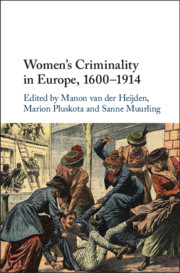
van der Heijden, Pluskota, Muurling and friends on women's criminality in Europe

Manon van der Heijden, Marion Pluskota, and Sanne Muurling (all at Universiteit Leiden) have co-edited the volume, Women's Criminality in Europe, 1600-1914 with Cambridge University Press. From the publisher: 

Bringing together the most current research on the relationship between crime and gender in the West between 1600 and 1914, this authoritative volume places female criminality within its everyday context. It reveals how their socio-economic and cultural contexts provided women with 'agency' against a range of European backdrops, despite a fundamentally patriarchal criminal justice system, and includes in-depth analysis of original sources to show how changing living standards, employment, schooling and welfare arrangements had a direct impact on the quality of life of working class women, their risk of becoming involved in crime, and the likelihood of being prosecuted for it. Rather than treating women's criminality as always exceptional, this study draws out the similarities between female and male criminality, demonstrating how an understanding of specific cultural and socio-economic contexts is essential to explain female criminality, both why their criminal patterns changed, and how their crimes were represented by contemporaries.

Table of Contents after the jump: 

Friday, August 9, 2019

Campbell and Jewel, "Death in the Shadows"

Mary Campbell and Lucy A. Jewell (University of Tennessee College of Law) have posted "Death in the Shadows," which appears in the most recent issue of the Hastings Race and Poverty Law Journal. Here's the abstract:
This paper is about the law and visual culture. Its centerpiece is Parson Weems’ Fable (1939), a painting by the American artist Grant Wood (1891-1942) that depicts the apocryphal story of George Washington and the cherry tree. At first glance, Wood’s image appears to celebrate an enduring myth of American virtue, namely Washington’s precocious inability to tell a lie. Studying the picture more closely, however, one finds a pair of black figures, presumably two of the Washingtons’ slaves. Stationed beneath dark storm clouds and harvesting cherries from a second tree, these slaves invoke yet another national myth, that of the domestic serenity that supposedly reigned on Virginia’s colonial plantations. In the process, they quietly invoke the country’s grievous history of racial oppression, coercion, and brutality.

This isn’t the only place where Woods’ painting speaks of racial violence. To the contrary, Parson Weems’ Fable also raises the specter of lynching. Examining the shadows directly beneath the Washingtons and their fabled tree, one discovers a hanging black body. Intentional or not, this dangling corpse conjures the spectacular acts of theatrical violence that mobs of Euro-Americans inflicted on African Americans during the late nineteenth century and well into the twentieth. By the 1930s, heated protests emerged against lynching—in popular songs, magazines, and art exhibitions, as well as more traditional political arenas. Unlike the painters most closely associated with him, Wood didn’t participate directly in such moments of artistic protest. Nonetheless, he would have been exposed to them as he painted Parson Weems’ Fable in the winter of 1939.

Regardless of Wood’s intentions, the work he created persistently connects the country’s origin myths to the murderous violence the U.S. has repeatedly inflicted on persons of color. Moreover, as the painting itself seems to realize, the law and culture forged by colonial Virginia planters like George Washington eventually morphed into a collective white psychopathy that found vicious expression in the practice of spectacle lynching. This colonial legal regime was deeply visual—a fact that accounts for not only its power, but also for the fundamental influence it continues to exert on current American conceptions of race.

A deep reading of Parson Weems’ Fable in the context of both its time (1939) and its setting (1736) reveals the extent to which the law is visual and the visual is legal. Indeed, the painting gives us a valuable lens for perceiving the pervasive connections that run between the two. Our thesis is that the profoundly visuo-legal nature of the country’s racial foundations helps explain the lack of progress the nation has made in dismantling the color line. As a result, the impulse to join the seemingly unrelated disciplines of legal study and art history isn’t an academic gimmick, but rather a necessity. For centuries, images have worked in tandem with statutes, judicial decisions, and various forms of legal (and illegal) punishment to indelibly imprint a logic of racial violence in our collective mindset. In order to fully excavate this logic, we need scholars who can analyze pictures as well as the law.

In terms of structure, we begin by introducing the painting and our analytical framework and method. After that, we explain the theoretical foundations for studying law and culture in this context. Finally, we connect colonial Virginia’s legal and cultural landscape to the traumatic racial violence that continues to haunt our national mythology.
The full article is available here.

-- Karen Tani

Tuesday, May 28, 2019

Morrison on legal lynching

In 2018, Melanie S. Morrison published Murder on Shades Mountain: The Legal Lynching of Willie Peterson and the Struggle for Justice in Jim Crow Birmingham with Duke University Press. From the publisher: 
Murder on Shades Mountain
One August night in 1931, on a secluded mountain ridge overlooking Birmingham, Alabama, three young white women were brutally attacked. The sole survivor, Nell Williams, age eighteen, said a black man had held the women captive for four hours before shooting them and disappearing into the woods. That same night, a reign of terror was unleashed on Birmingham's black community: black businesses were set ablaze, posses of armed white men roamed the streets, and dozens of black men were arrested in the largest manhunt in Jefferson County history. Weeks later, Nell identified Willie Peterson as the attacker who killed her sister Augusta and their friend Jennie Wood. With the exception of being black, Peterson bore little resemblance to the description Nell gave the police. An all-white jury convicted Peterson of murder and sentenced him to death.
In Murder on Shades Mountain Melanie S. Morrison tells the gripping and tragic story of the attack and its aftermath—events that shook Birmingham to its core. Having first heard the story from her father—who dated Nell's youngest sister when he was a teenager—Morrison scoured the historical archives and documented the black-led campaigns that sought to overturn Peterson's unjust conviction, spearheaded by the NAACP and the Communist Party. The travesty of justice suffered by Peterson reveals how the judicial system could function as a lynch mob in the Jim Crow South. Murder on Shades Mountain also sheds new light on the struggle for justice in Depression-era Birmingham. This riveting narrative is a testament to the courageous predecessors of present-day movements that demand an end to racial profiling, police brutality, and the criminalization of black men.
Praise for the book: 

 "In this passionate account of Jim Crow–era injustice, educator and activist Morrison exposes how courtrooms 'could function like lynch mobs when the defendant was black.'... Morrison, who is white, shares this painful story with clarity and compassion, emphasizing how much has changed since the 1930s, how much white people need to 'critically interrogate' the past, and how much 'remains to be done' in the fight for justice." - Publishers Weekly

"The author deserves praise for identifying Peterson’s trial as an important precursor to the 1960s civil rights movement. Audiences will be enthralled and angered by this all-too-familiar account of a criminal justice system that was and remains biased against black Americans." - Karl Helicher

"Morrison digs deeply into period newspapers and archives to uncover this story of injustice long overshadowed by the more famous Scottsboro Boys trial. A thoughtful look into a tale of prejudice and stolen justice that will find many readers who are interested in African American history, the early civil rights movement, and Southern history." - Chad E. Statler

Further information is available here.

-Mitra Sharafi

Monday, January 14, 2019

Thornberry on Rape in South Africa

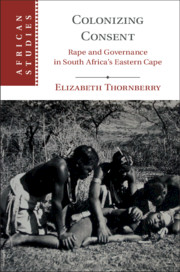
Out this month with Cambridge University Press is Colonizing Consent: Rape and Governance in South Africa's Eastern Cape by Elizabeth Thornberry, Johns Hopkins University. From the publisher: 
Colonizing ConsentElizabeth Thornberry uses historical evidence to shed light on South Africa's contemporary epidemic of sexual violence. Drawing on over a thousand cases from a diverse set of courts, Thornberry reconstructs the history of rape in South Africa's Eastern Cape, from the precolonial era to the triumph of legal and sexual segregation, and digs deep into questions of conceptions of sexual consent. Through this process, Thornberry also demonstrates the political stakes of disputes over sexual consent, and the ways in which debates over the regulation of sexuality shaped both white and black politics in this period. From customary authority to missionary Christianity and humanitarian liberalism to segregationism, political claims implied theories of sexual consent, and enabled distinctive claims to control female sexuality. The political history of rape illuminates not only South Africa's contemporary crisis of sexual violence, but the entangled histories of law, sexuality, and politics across the globe.
Here is the Table of Contents:

  • Introduction: writing the history of rape
  • 1. Custom and consent in Xhosaland
  • 2. Sex and spiritual power
  • 3. Liberalism and the colonial law of sexual violence
  • 4. Rape and racial boundaries
  • 5. Navigating the politics of consent
  • Conclusion: rape and the postcolony.
Further information is available here.

Wednesday, January 9, 2019

Darr on Sexual Offences in Mandate Palestine

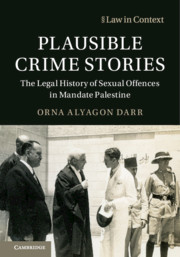
Out this month is Plausible Crime Stories: The Legal History of Sexual Offences in Mandate Palestine by Orna Alyagon Darr (Sapir Academic College, Israel and Ono Academic College, Israel) with Cambridge University Press. From the publisher: 
Plausible Crime StoriesPlausible Crime Stories is not only the first in-depth study of the history of sex offences in Mandate Palestine but it also pioneers an approach to the historical study of criminal law and proof that focuses on plausibility. Doctrinal rules of evidence only partially explain which crime stories make sense while others fail to convince. Since plausibility is predicated on commonly held systems of belief, it not only provides a key to the meanings individual social players ascribe to the law but also yields insight into communal perceptions of the legal system, self-identity, the essence of normality and deviance and notions of gender, morality, nationality, ethnicity, age, religion and other cultural institutions. Using archival materials, including documents relating to 147 criminal court cases, this socio-legal study of plausibility opens a window onto a broad societal view of past beliefs, dispositions, mentalities, tensions, emotions, boundaries and hierarchies.
 Praise for the book:

 "This remarkable book, by one of Israel’s leading legal historians, explores the fascinating history of sex crimes in mandatory Palestine. Innovative and theoretically sophisticated, it is a must-read for historians of law, but also for anyone interested in the social and cultural context in which the law of evidence, and criminal law, are embedded." -Assaf Likhovski

"Darr’s masterful study of evidence law in Mandate Palestine decouples absolute truth from knowledge derived through its social context. With keen awareness of the differences among British colonials and Arab and Jewish subjects, she shows how sexual offenses pose particular challenges to courts. What we consider fact is often simply a legal presumption." -Steven Wilf

"This is a deft historical case study of the law in action in a colonial context with broad significance. Based on court records relating to sexual offences during the British Mandate in Palestine, Darr examines colonial and local attitudes to sex and its regulation in a multicultural situation and shows that whether evidence and narratives are accepted as plausible is intimately related to the local political, social and religious context." -William Twining

Further information is available here.


Friday, September 21, 2018

Pfeifer on lynching around the world

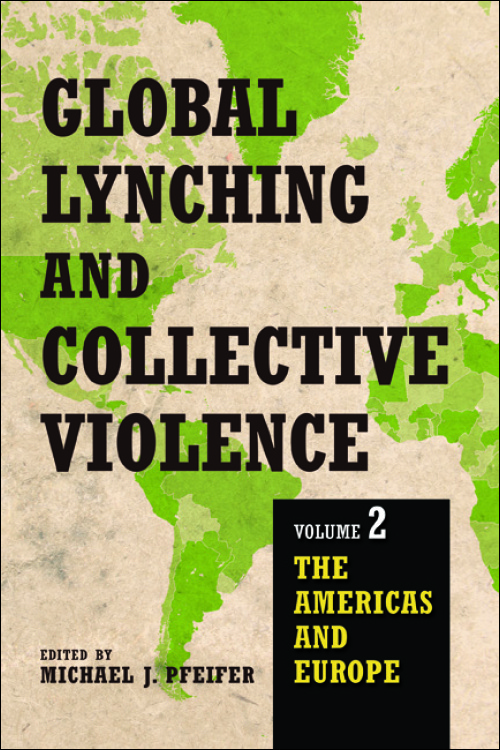
Michael J. Pfeifer (John Jay College of Criminal Justice and the CUNY Graduate Center) published Global Lynching and Collective Violence. Vol.2: The Americas and Europe with the University of Illinois Press in 2017. From the publisher:
In this second volume of the groundbreaking survey, Michael J. Pfeifer edits a collection of essays that illuminates lynching and other extrajudicial "rough justice" as a transnational phenomenon responding to cultural and legal issues.
The volume's European-themed topics explore why three communities of medieval people turned to mob violence, and the ways exclusion from formal institutions fueled peasant rough justice in Russia. Essays on Latin America examine how lynching in the United States influenced Brazilian debates on race and informal justice, and how shifts in religious and political power drove lynching in twentieth-century Mexico. Finally, scholars delve into English Canadians' use of racist and mob violence to craft identity; the Communist Party's Depression-era campaign against lynching in the United States; and the transnational links that helped form--and later emanated from--Wisconsin's notoriously violent skinhead movement in the late twentieth century.
Praise: 

"Global Lynching and Collective Violence, Volume 2 broadens our perspective on lynching beyond the American South. The essays in the collection are theoretically sophisticated and well documented. This book will be a standard work in the field." -Margaret Vandiver

"This impressive collection greatly contributes to our understanding of lynching, calling attention to its long-neglected global and transnational dimensions. It is an indispensable resource for anyone interested in studying mob violence from an international perspective." -Simon Wendt

Further information is available here.

Tuesday, May 15, 2018

Howard on Ending Extralegal Violence in West Virginia

Josh Howard’s Defending Person and Reputation: Efforts to End Extralegal Violence in Western Virginia, 1890-1900, is now available online in the American Journal of Legal History:
Violence peaked in Virginia during the early-1890s with a series of racially-motivated lynchings and honor killings in the western mountains. Governor Charles O'Ferrall responded by demanding county courts rededicate themselves to enforcing law and preventing extralegal violence, which led to a statewide decrease in lynchings. The governor's demands were not intended to create better race or labor relations, but were more to create social stability attractive to outside investors. As a result, county courts did just that: prevent extralegal violence, make arrests, and hold trials all in the interest of presenting an image of stability. One specific town in western Virginia – Clifton Forge – provides an excellent case study to explore this phenomenon. Clifton Forge became a major railroad hub in 1888, and residents committed one of the state's most brutal lynchings in 1891. The governor's call for order certainly targeted Clifton Forge, yet violence persisted there throughout the mid-1890s. Most visible to outsiders was two murders and the subsequent trials. A railroad conductor shot dead a prominent Natural Bridge businessman, and a young African-American man assaulted a white woman and murdered a black girl. Clifton Forge residents demanded different types of mob justice in each of these cases, but the legal system prevailed. However, both trials had flaws; one was overturned on appeal, the other a clear sham. These trials reveal that judges and local media were committed to both justice and presenting the image of justice, the latter of which being more important both for the town's future and in appeasing the governor.