Tuesday, September 22, 2009

Donlan on Edmund Burke, law and lawyers

Seán Patrick Donlan, University of Limerick, has posted three papers on Edmund Burke:
‘Law and Lawyers in Edmund Burke’s Scottish Enlightenment’ appeared in Studies in Burke and His Time, (ns) Vol. 20, No. 1, p. 38, 2005. Here's the abstract:

On the margins of 'patriotism' and 'popery', Edmund Burke's essential Irishness remains poorly understood, not least in Ireland. But Burke was himself twice lord rector of Glasgow - he preceded Adam Smith - and there are few aspects of his life so neglected and so potentially rewarding as his relationships - personal,professional, and philosophical - to Scots jurists and the 'Scottish enlightenment'. Between them, Burke and the Scots exemplified the most pressing debates and developments of the century.

‘Beneficence Acting by a Rule:' Edmund Burke on Law, History, and Manners appeared in Irish Jurist , Vol. 36, p. 227, 2001, and 'A Very Mixed and Heterogeneous Mass:' Edmund Burke and English Jurisprudence, 1757-62 appeared in the University of Limerick Law Review, Vol. 4, p. 79, 2003 . Alas, there are no abstracts for these two.

Elyn Saks wins MacArthur Foundation Award

I hope you will forgive a non-history aside:

I am very proud to announce that my USC colleague Elyn Saks has been named a MacArthur Foundation Fellow. Saks is an expert in mental health law, and the author of a remarkable book about her own experience with schizophrenia, The Center Cannot Hold: My Journey Through Madness.

The announcement is here. The full list of 2009 fellows is here. (I'm sorry to report that historians have been left out this year.)

Monday, September 21, 2009

Raustiala on The Evolution of Territoriality in American Law

From Kal Raustiala, UCLA Law School, is a post on his new book, Does the Constitution Follow the Flag?: The Evolution of Territoriality in American Law.

Does the Constitution Follow the Flag? is a book about the way that geography shapes legal rules and understandings—and how fundamental changes in American power and in world politics have challenged and sometimes altered the traditionally territorial system of American law. The ongoing debate over the rights of detainees held at Guantanamo Bay has brought the territorial limits of American law into sharp relief in recent years, but--as my book endeavors to show--this topic actually has a long and fascinating history.

As many readers of this blog are aware, the book appropriates for its title a famous question from the election of 1900. The US had just acquired several overseas colonies in the wake of the Spanish-American War. Yet it was entirely unclear what the status of these islands was. Were the inhabits citizens? Did the federal government have to abide by the Constitution when governing them? The Democratic Party platform of 1900 declared that “We hold that the Constitution follows the flag, and denounce the doctrine that [the federal government] can exercise lawful authority beyond it or in violation of it." Lined up in opposition were those who believed that normal legal rights did not apply fully—or at all—to the new possessions. For these individuals, sovereign borders did not line up with constitutional borders.

At stake in this debate was the ability of the U.S. to participate in an age of vast empires. As proponents of empire knew, if the Constitution indeed followed the flag any American empire was going to remain very small. At stake as well was the self-conception of the nation as a constitutional republic. Was the U.S. like other great powers of the day, all of whom had embraced a vigorous imperialism? Or did the Constitution provide powerful limits that could not be circumvented simply by (re)drawing lines on maps and declaring some areas beyond the reach of the Bill of Rights?

In short, the question of territoriality was central to the first stirrings of America as a truly global power. Territoriality continues to be central today, though it often hides in plain sight. The territorial scope of American law is central to the ability of the federal government to regulate foreign cartels; to protect investors; to station our troops in the myriad overseas U.S. bases; to capture foreign drug traffickers; to govern in Indian country; to combat offshore pollution; and to administer occupied foreign lands. These issues, in short, raises questions of territoriality and extraterritoriality; the book discusses each of them and more.

Does the Constitution Follow the Flag? has several aims. The first and most basic to explain why territoriality is a significant concept and why the American legal system, like other legal systems, has traditionally been presumptively territorial. The Westphalian system of sovereignty is fundamentally premised on territoriality. Yet what is less often recognized is the significance of imperialism and territorial expansion, not only to the development of the modern states system but also to the rules and principles of extraterritoriality. In short, while sovereignty has long been a central concern of lawyers, I make the case that sovereignty's twin, territoriality, deserves the same intense scrutiny.

My second aim is to trace, in broad brushstrokes, the evolution of territoriality in American law from the founding era to today. Parts of this history are well known, such as the extraterritorial application of antitrust law in the postwar era. Others, such as the U.S. District Court for China, or the late 19th century "Guano Islands Act," are less well known. Regardless, until now these parts have not been put together and treated as an interconnected, if occasionally wide-ranging, narrative.

My third aim is to advance several more specific claims about this legal evolution. First, the central concept of extraterritoriality has shown surprising continuity in its purpose even as its form has changed dramatically. Extraterritoriality meant very different things to nineteenth-century lawyers than it does to contemporary lawyers. But the primary function of extraterritoriality has remained, at a fundamental level, the same. That function, I argue, is to manage and minimize the legal differences entrenched by Westphalian sovereignty. Second, extraterritoriality is paralleled by what I call intraterritoriality. Just as extraterritoriality has long been a way to conceptually redraw maps, to redefine what is inside and outside the scope of a sovereign’s law, intraterritoriality has served to delineate differences within national borders, particularly as the U.S. grew in size and power. Intraterritorial doctrines, such as the claim that some constitutional rights do not apply in some U.S. territory (such as Indian country or federal territories), reflect the tension between America's constitutional traditions and its global ambitions.

Throughout this book I pay close attention to the international context, particularly to the changing global role of the U.S. In this sense the book is an example of what political scientists call "2nd image-reversed" analysis: I look carefully at how the international system shaped the content and direction of domestic law. As a weak power, the U.S. showed considerable solicitude for traditional Westphalian principles. As a superpower, it was far more willing to bend and even break established doctrine in the pursuit of its national interest. This transformation, and related shifts in international politics and economics, helped to shape the kinds of territorial claims that were made, even if the fundamental aim of these claims—to manage and sometimes manipulate legal differences—remained broadly constant.

In sum, Does the Constitution Follow the Flag? offers a framework that connects a disparate set of territorial doctrines over time and explores their purpose and function. My overarching goal is to make sense of a world in which the United States applies its law to some actors in some places while denying it to other actors in other places. I hasten to add that I am not a historian (my doctorate is in political science) and I certainly don't view this book as the last word on territoriality. I nonetheless hope I have written an account that brings clarity to the topic, that links its political and legal aspects in an interdisciplinary manner, and that helps to vividly and engagingly ground current debates in an historical context.

Weiner-in-Iceland Round-up

Many thanks to Mark Weiner, who joined us for some captivating guest blogging from Iceland, where he is beginning a semester-long Fulbright Fellowship at the University of Akureyri. Mark's usual home is Rutgers School of Law, Newark. Here are his posts:


White's Law in American History

G. Edward White, University of Virginia School of Law, has posted Law in American History: Volume One, from the Colonial Years through the Civil War. As the abstract explains:
This paper is an early draft of the first chapter in a forthcoming book, Law in American History: Volume One, From the Colonial Years Through the Civil War. Two or three more volumes are planned. The book seeks to find that elusive middle ground between specialized monographs and works in American legal and constitutional history that are designed for general audiences. This chapter attempts to be revisionist as well as synthetic. I would welcome any comments.
Image credit.

Portail Numérique de Histoire du Droit

We note with interest the appearance of Portail Numérique de Histoire du Droit, a portal to news, sources and other matters involving French legal history.

Sunday, September 20, 2009

Book news round-up

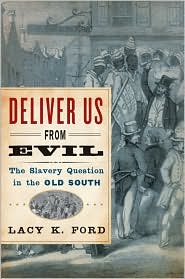
DELIVER US FROM EVIL: The Slavery Question in the Old South by Lacy K. Ford is reviewed in the New York Times. Ira Berlin writes:

For Lacy K. Ford, the division between the states of the upper South (Virginia along with the border slave states) and those of the lower South (South Carolina and the cotton-producing states to its south and west) best explains how white Southerners “understood their position with regard to slavery, and how they saw themslves as citizens of the United States right down to secession and Civil War.”...

In extraordinarily close detail, he demonstrates how white slave-owning Southerners in the two regions followed sharply different trajectories in addressing the slavery question, and he argues that the development of a Southern nationality and its controversy with the North must be understood from the inside out rather than the outside in.

David Cole discusses his new book, The Torture Memos: Rationalizing the Unthinkable, with the Boston Globe, and takes up the case against the lawyers in an essay in the New York Review of Books.

Saturday, September 19, 2009

Thinking Gender

The UCLA Center for the Study of Women announces “Thinking Gender,” the Twentieth Annual Graduate Student Research Conference, to be held Friday, February 5, 2010, at the UCLA Faculty Center. Here is the announcement:
Thinking Gender is a public conference highlighting graduate student research on women, sexuality and gender across all disciplines and historical periods. We invite submissions for individual papers or pre-constituted panels.

This year we are particularly interested in research on labor, social justice, public policy, the global and globalization, race and ethnicity in the Americas, and the “new” economy (austerity) and its effects on women and people of color. Additionally, because this year is the Center for the Study of Women’s 25th anniversary, we are especially interested in topics relating to feminism’s past and present, such as the state of feminism, changing notions of feminism, post-feminism or third-wave feminism, feminist community/ies both off and online, and feminist icons and leaders.

For individual papers, please submit a Thinking Gender cover sheet, 250-word abstract, a CV (2 pages max, no resumes, please), and a brief bibliography (1 page max). For panels, please submit a 250-word description of the panel topic in addition to the materials required for the individual paper submissions. Please download cover sheet form and reference submission guidelines at http://www.csw.ucla.edu/thinkinggender.html, and note that only complete applications adhering to the stated guidelines will be accepted. Please also note that the Center for the Study of Women cannot provide travel funds for conference presenters.

Deadline for Submissions: Monday, October 19, 2009, by Noon. We will only accept completed submissions emailed by the deadline, without exception. Please send submissions to: thinkinggender@women.ucla.edu.
Hat tip: H-Law.

The Law Library of Harlan Père

Kurt X. Metzmeir and Scott Campbell, University of Louisville School of Law, have posted Nursery of a Supreme Court Justice: The Library of James Harlan of Kentucky, Father of John Marshall Harlan, which appeared in Law Library Journal 100 (2008). Here's the abstract:
Probate records show that James Harlan, the father of Supreme Court Justice John Marshall Harlan, assembled during his lifetime a law library impressive in its breadth and balance. This paper discusses how Harlan might have acquired the collection, analyzes its content, and attempts to identify titles listed in the executor's inventory.

Friday, September 18, 2009

Raustiala, Does the Constitution Follow the Flag? The Evolution of Territoriality in American Law

Territoriality has been a topic of study in legal history in recent years, for example in the work of Christina Duffy Burnett. An important new work by Kal Raustiala, Does the Constitution Follow the Flag? The Evolution of Territoriality in American Law, has been published by Oxford University Press. At a readable 247 pages of text, the book is a great fit for U.S. legal or constitutional history courses. For those seeking to expand the boundaries of their teaching or writing in U.S. constitutional history, this new book is a good place to start.
Book info follows, and then Raustiala will discuss the book in a subsequent post.

Here's the book description:

The Bush Administration has notoriously argued that detainees at Guantanamo do not enjoy constitutional rights because they are held outside American borders. But where do rules about territorial legal limits such as this one come from? Why does geography make a difference for what legal rules apply? Most people intuitively understand that location affects constitutional rights, but the legal and political basis for territorial jurisdiction is poorly understood. In this novel and accessible treatment of territoriality in American law and foreign policy, Kal Raustiala begins by tracing the history of the subject from its origins in post-revolutionary America to the Indian wars and overseas imperialism of the 19th century. He then takes the reader through the Cold War and the globalization era before closing with a powerful explanation of America's attempt to increase its extraterritorial power in the post-9/11 world. As American power has grown, our understanding of extraterritorial legal rights has expanded too, and Raustiala illuminates why America's assumptions about sovereignty and territory have changed. Throughout, he focuses on how the legal limits of territorial sovereignty have diminished to accommodate the expanding American empire, and addresses how such limits ought to look in the wake of Iraq, Afghanistan, and the war on terror. A timely and engaging narrative, Does the Constitution Follow the Flag? will change how we think about American territory, American law, and-ultimately-the changing nature of American power.
And the blurbs:
"Kal Raustiala's 'Does the Constitution Follow the Flag?' turns some of the crucial debates of the Bush years into a guide to a new era in law and foreign policy. He examines the old fashioned notions of borders and boundaries in the context of a changed and changing world, and asks all the right questions about what they will mean in the future."--Jeffrey Toobin, author of The Nine

"As Kal Raustiala shows in his marvelous new book, Elihu Root was correct a century ago when he quipped that 'the Constitution indeed follows the flag, but it doesn't quite catch up.' Does the Constitution Follow the Flag? shows in fascinating detail how politics and law interact in shaping legal constraints on the conduct of American foreign policy."--Robert O. Keohane, Professor of International Affairs, Princeton University

"This book ties together many different historical strands of our extraterritorial Constitution in a compelling, remarkably accessible, and genuinely illuminating narrative."--Jack Goldsmith, author of The Terror Presidency

"As an act both of dispassionate scholarship and passionate citizenship, Does the Constitution Follow the Flag? compels attention. Its rich account of the outsized reach of American law is informed by a deep understanding of history, jurisprudence, and global affairs. Illuminating and incisive, the book's riveting account of territoriality and law in American political development could not be more timely."--Ira Katznelson, author of When Affirmative Action Was White

"Does the Constitution Follow the Flag? is a brilliant, wide-ranging and timely book. In a world where supra-national forces, from global markets and mass migration, to international terrorist organizations, present an ever-increasingly challenge to the limits of the law, it shows just what territorial sovereignty is, and why it matters. It is also a highly compelling work of intellectual and political history."--Anthony Pagden, author of Worlds at War
Raustiala discusses the book here. The book is blogged about on Opinio Juris.

Hagley Research Seminar Series, 2009-2010

Here's the year's line-up at the Hagley Research Seminar Series at the Hagley Museum and Library. The seminar meets Thursday evenings at 6 p.m. in the Copeland Room of the Library, which is located off Route 100 and Buck Road in Greenville, Delaware, approximately four miles from downtown Wilmington. Papers are all unpublished works in progress and circulated in advance to seminar participants. To join the seminar email list and obtain copies of the papers, contact Carol Lockman at clockman@hagley.org or (302) 658-2400, ext 243.

Oct. 1. Jennifer Armiger (University of Delaware)
"Gender, Beauty & Fraternity: The Western Electric Kearny Works and the Industrial Family"

Nov. 12 Janneken Smucker (University of Delaware)
"The Amish Brand: Cottage Industries Making and Selling Quilts"

Dec. 3 Victoria Saker Woeste (American Bar Foundation)
“Henry Ford: Unmasking the Self-Made Myth”

Feb. 11 Melanie Gustafson (University of Vermont)
"Beautiful Faces, Strong Bodies: Harriet Hubbard Ayer and the Business of Beauty Culture in Gilded Age America"

March 11 Thomas Zeller (University of Maryland)
"Consuming Landscapes: The View from the Road in the United States and Germany, 1920-70"

April 15 Jonathan Rees (University of Southern Colorado)
"Inventing the Cold Chain: Technology and Marketing in the Nineteenth Century American Natural Ice Industry"

Image credit.

Thursday, September 17, 2009

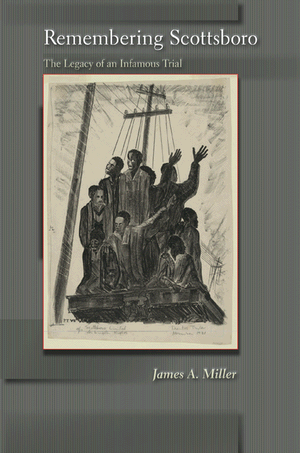
Miller's 'Remembering Scottsboro'


Princeton University Press has published James A. Miller's book, Remembering Scottsboro: The Legacy of an Infamous Trial with Princeton University Press. Miller is a professor of English and American Studies at GWU. Here is the publisher's description of the book.
In 1931, nine black youths were charged with raping two white women in Scottsboro, Alabama. Despite meager and contradictory evidence, all nine were found guilty and eight of the defendants were sentenced to death--making Scottsboro one of the worst travesties of justice to take place in the post-Reconstruction South. Remembering Scottsboro explores how this case has embedded itself into the fabric of American memory and become a lens for perceptions of race, class, sexual politics, and justice. James Miller draws upon the archives of the Communist International and NAACP, contemporary journalistic accounts, as well as poetry, drama, fiction, and film, to document the impact of Scottsboro on American culture.

The book reveals how the Communist Party, NAACP, and media shaped early images of Scottsboro; looks at how the case influenced authors including Langston Hughes, Richard Wright, and Harper Lee; shows how politicians and Hollywood filmmakers invoked the case in the ensuing decades; and examines the defiant, sensitive, and savvy correspondence of Haywood Patterson--one of the accused, who fled the Alabama justice system. Miller considers how Scottsboro persists as a point of reference in contemporary American life and suggests that the Civil Rights movement begins much earlier than the Montgomery Bus Boycott of 1955.

A sample chapter is available for download here.

American Academy in Berlin Fellowship Program

This is a terrific opportunity:


The American Academy in Berlin
invites applications for its residential fellowships on a yearly basis. Applications for 2010-2011 are due in Berlin on October 1, 2009.

The Academy welcomes emerging as well as established scholars, writers, and professionals who wish to engage in independent study in Berlin. Around two dozen Berlin Prizes are conferred annually. Past Berlin Prize recipients have included historians, economists, poets, art historians, journalists, legal scholars, anthropologists, musicologists, public policy experts, and writers, among others. The Academy does not accept project proposals in mathematics and the hard sciences.

In addition to placing a high priority on the independent work of its fellows, the Academy is in a unique position to aid fellows in establishing professional and general networks both in Berlin and beyond. The Academy’s public outreach, which facilitates the introduction of a fellow's work to a wider audience, serves its mission of fostering transatlantic ties through cultural exchange.

Fellowships are typically awarded for an academic semester or, in some cases, for an entire academic year. Only the Bosch Fellowships in Public Policy may be for shorter stays of six to eight weeks. Fellowship benefits include round-trip airfare, housing at the Academy, partial board, and a stipend of $5,000 per month. The Academy’s elegantly furnished apartments at the Hans Arnhold Center are suitable for individuals and couples; limited accommodations are available for families with children. All fellows are expected to reside at the Hans Arnhold Center during the entire term of the award.

Fellowships are restricted to candidates who are based permanently in the US (US citizenship is not required and American expatriates are not eligible.) Candidates in academic disciplines must have completed a doctorate at the time of application. The Academy weighs the general excellence of professional accomplishment and the proposal more than a project’s specific relevance to Germany. Although it is helpful to explain how a Berlin residency might contribute to the project’s further development, candidates need not be working on German topics.

Applications for Fellowships
during 2010–2011 or future academic years are due in Berlin on Thursday, October 1, 2009.
The American Academy in Berlin
Attn: Berlin Prize Fellowship Applications
Am Sandwerder 17-19
14109 Berlin
Germany
Tel: + 49 30 804 83 0

Note that the October 1 deadline is for receipt in Berlin of your hardcopy application. No e-mail. More information is here.

Law & Society Workshop at Indiana-Bloomington

Here's the Fall lineup for the Law and Society Workshop at Indiana University, Bloomington, which is presented by the Center for Law, Society & Culture. All workshops will take place at 4:00pm in the Law School Faculty Conference Room, Room 335, Law School, 211 S. Indiana Avenue. Light snacks and refreshments will be served. For more information, please contact amehrotr@indiana. edu.

Thursday, Sept. 17

Troubled No More by Death: Legal and Moral Hierarchies in a Rwandan Genocide Trial
Tim Waters, Maurer School of Law, IU—Bloomington

Thursday, Oct. 1

The Limits of Liberalism: Reflecting on the Impact of the 1988 Indian Gaming Regulatory Act
Eve Darian-Smith, Law & Society/Anthropology, University of California, Santa Barbara

Thursday, Oct. 15

An Interpretive History of the Voting Rights Act
Luis Fuentes-Rohwer, Maurer School of Law, IU—Bloomington

Thursday, Oct. 29

The NAACP, Mob Violence, and the Unexpected Breakthrough in Constitutional Law
Megan Francis, Jerome Hall Post-Doctoral Fellow, IU—Bloomington

Thursday, Nov. 5

Emotion in Judging
Terry Maroney, Law School, Vanderbilt University

Constitution Week at the U.S. Capitol

The U.S. Capitol Visitor Center announces If Documents and Objects Could Talk, a series of 15 minute talks by the staff of the National Archives and the Library of Congress for Constitution Week, to be held in the Exhibition Hall at the Center. No reservations or passes required.

Thursday, September 17
Noon — Ken Kato (Political Scientist, Center for Legislative Archives at the National Archives) talks about constitutional government and the decision to start the Civil War.

1 p.m. — Gerry Gawalt (Curator of the Creating the United States Exhibition at the Library of Congress) discusses the creation of the Bill of Rights.

Friday, September 18
Noon — Richard Hunt (Director, Center for Legislative Archives, National Archives) explores Congress, the Bill of Rights, and amending the Constitution.

1 p.m. — Mark Dimunation (Chief of the Rare Book and Special Collections Division, the Library of Congress) focuses on stories about the burning of the Capitol and Thomas Jefferson’s library.

Monday, September 21
Noon — Richard McCulley (Historian, Center for Legislative Archives at the National Archives) talks about the Constitution and the Civil War

1 p.m. — Daun van Ee, (Historical Specialist, Manuscript Division, the Library of Congress) explores the period when the United States became involved in Europe and in the Pacific declaring war on two fronts.

Tuesday, September 22
Noon — Ken Kato and Martha Grove (Archivist, Center for Legislative Archives at the National Archives) talk about the Constitution, Congressional records and the War of 1812.

1 p.m. — Barbara Bair (Historical Specialist, Manuscript Division, the Library of Congress) looks at the first national parks and the conservationists and photographers who created support for the National Park Service.

Wednesday, September 23
Noon — Christine Blackerby (Educational Specialist, Center for Legislative Archives at the National Archives) talks about Reconstruction and the Constitution.

1 p.m. — Julie Miller (Historical Specialist, Manuscript Division, the Library of Congress) explores stories about the drafting of the Constitution

Hat tip: Ruth Ernst!

Image Credit; The Swamp.

Wednesday, September 16, 2009

Barzun on Jerome Frank

Charles L. Barzun, University of Virginia School of Law, has posted Jerome Frank and the Modern Mind. Here’s the abstract:
Jerome Frank occupies an odd place in the intellectual history of American law. He and Karl Llewellyn were long considered the two thought-leaders of probably the most important movement in legal thought of the twentieth century, legal realism. And his most famous contribution to legal theory, Law & the Modern Mind, is still regarded as a legal classic. But at a time of renewed scholarly attention to legal realism, Frank is typically characterized these days as an “extreme” realist, who was a peripheral figure within that movement. He tends to be treated as an erratic, if perhaps brilliant, thinker who made some insightful critiques but who never even attempted to develop anything like a coherent theory of adjudication or a constructive vision for legal reform. This view of Frank seems to me deeply mistaken, and the aim of this essay is to correct it. I do so by offering a close reading of his most famous and controversial work, Law & the Modern Mind. My argument, in short, is that generations of scholars have misinterpreted this book because they have misunderstood Frank’s philosophical worldview and, therefore, his intellectual ambitions. If one takes Law and the Modern Mind on its own terms and if one reads its argument as a whole, rather than simply as a series of one-off critiques, one can see that Frank did not deny the possibility of rational legal decisionmaking, but rather sought to articulate the habits of mind and character on which he believed the sound administration of justice depended. Understanding Frank’s true concerns matters today because the questions he raised remain unanswered, and many of today’s proponents of a “new legal realism” deem them hardly worth asking.
Image credit.

Rogers reviews Hulliung, The Social Contract in America

Mark Hulliung, The Social Contract in America: From the Revolution to the Present Age (University Press of Kansas, 2007) is reviewed for H-Law by Donald Rogers, Central Connecticut State University. Rogers writes:

The great success of The Social Contract in America is to show that the social contract was not just a fossil of Lockean theory left over from the American Revolution in the Declaration of Independence, but alive idea very much at play throughout American history. The book is not a systematic study of social contract theory, but an examination of the social contract's role in American political discourse from the revolutionary era to the present. Indeed, it treats social contract thinking as a sign of American exceptionalism. Whereas historicist and utilitarian theories quickly supplanted social contract philosophy in Europe, the book contends, "America stands alone in its preoccupation... with the social contract" (p. 7). In the fashion of Louis Hartz's The Liberal Tradition in America (1955), Hulliung maintains that Americans across the political spectrum embraced social contract theory, and he specifically denies that they sustained conservative thought in the tradition of Edmund Burke. With social contract theory a given, he asserts, Americans typically argued about which version of the social contract should apply....

In the opening chapter on the revolutionary era, the book makes clear that most Americans, patriots and loyalists alike, were Whigs who rejected English Tory Robert Filmer's patriarchal views of government, and worked from social contract theory instead, though not initially John Locke's understanding of it. Like most English Whigs, Hulliung explains,future American loyalists and patriots both for a long time drew onHugo Grotius's and Samuel Pufendorf's conservative conceptions of the social contract. Putting their emphasis on the preservation of"constituted authority" (p. 16), both of these theorists imagined contracts in which the people surrendered certain rights to their rulers to secure social stability, including the right to rebel....

Unlike historians like John Phillip Reid who regard American revolutionary rhetoric of the 1770s as largely a reiteration of the Whig "original contract," Hulliung sees the American Revolution as an event that truly, if belatedly, transformed American thinking. The need to justify rebellion and then establish new state governments, he argues, prompted Americans to adopt and then apply John Locke's more radical reasoning from first principles--that governments originate in contracts formed by the people emerging from the state of nature, and that the people always retain residual rights to abolish governments not protecting their natural rights....

Subsequent chapters of The Social Contract in America demonstrate that the social contract idea enjoyed a lively career in America after the revolution, even as it died in Europe....

Continue reading here.

Tuesday, September 15, 2009

ASLH election underway

If you are a member of the American Society for Legal History, it's time to vote!

Balloting is open from now through September 30. Bruce Mann, Harvard Law School, is nominated for the uncontested position of President-elect.

The slate for Board of Directors (you can vote for five):

Mary Sarah Bilder, Boston College Law School
Holly Brewer, NC State University
Risa L. Goluboff, University of Virginia Law School
Sarah Hanley, University of Iowa
Ron Harris, Tel-Aviv University
Randy McGowen, University of Oregon
Kunal Parker, University of Miami Law School
Dylan C. Penningroth, Northwestern University
Mitra Sharafi, University of Wisconsin Law School
Victoria Saker Woeste, American Bar Foundation

The slate for Nominating Committee (vote for two):

Sally Gordon, University of Pennsylvania Law School
David T. Konig, Washington University,St. Louis
Kenneth F. Ledford, Case Western Reserve University
Claire Priest, Yale Law School

Candidate bios and information about how to vote is here.

Telford Tells It as He Sees It: HLS vs. YLS

Over at Et Seq., the Harvard Law Library Blog, David Warrington has posted excerpts from a letter written by the New Deal lawyer Telford Taylor to a young family friend seeking his advice in 1935 on whether to attend law school at Harvard or Yale. The letter made its way to the library at HLS when Taylor's correspondent, William A. Waldron, sent it to Dean Robert Clark in 2000. (The main body of Taylor's papers are at Columbia.)

Taylor (HLS 1932) tried to be fair, but in assessing how well each school instructed students "in the regular tools of the lawyers trade—legal technique, in other words," he gave what I think of as the standard HLS line on YLS:
I’m pretty well convinced that the honors lie with Harvard. Most of the well-known men at Yale are men who are themselves bored with the law & have turned experimentalist. They’re brilliant enough, & their writings are worth reading, but they are too interested in explaining to you how the law is a very different thing from what most people think, & how there really isn’t any such thing as law anyhow. Now this is all very well & worth knowing, but you don’t practice law by telling a client or a judge that his traditional concepts are all screwy. Defective as the tools of the law may be, you’ve got to be familiar with them & know how to use them. I think the system & faculty at Harvard does this much better.

Waldron, not all that surprisingly, chose Harvard.

(For more of the same, see Spencer Tracy's wisecrack to Katherine Hepburn in "Adams Rib" (1949)--"Is that what they taught you at Yale?"--and Laura Kalman's Legal Realism at Yale. Thanks to David Warrington for the heads up and transcription!)

Image credit: Prints and Photographs Division, Library of Congress

Friedman at American University

On Friday, September 25, 2009 American University Washington College of Law and the Institute for Constitutional History will host a roundtable discussion of Barry Friedman’s The Will of the People: How Public Opinion Has Influenced the Supreme Court and Shaped the Meaning of the Constitution (2009). The event will take place from 3:30 pm to 5:00 pm in Room 603 at American University Washington College of Law.

Comments will be provided by:

Lynda Dodd, Assistant Professor, Washington College of Law
Mark Graber, Professor of Law & Government, University Maryland
Steven Teles, Associate Professor, Johns Hopkins University
Mark Tushnet, William Nelson Cromwell Professor, Harvard Law School

Register here. For further information, please contact: Office of Special Events & Continuing Legal Education, American University Washington College of Law Phone: 202.274.4075; Fax: 202.274.4079; or secle@wcl.american.edu

Monday, September 14, 2009

Tsuk Mitchell and Mitchell on The Financial Determinants of Corporate Governance

The Financial Determinants of Corporate Governance by Dalia Tsuk Mitchell and Lawrence E. Mitchell, both of George Washington University Law School, is forthcoming in THE FINANCIAL DETERMINANTS OF CORPORATE GOVERNANCE, H. Kent Baker, Ronald Anderson, eds. (2010). Just this abstract is now on SSRN:
This chapter is a preliminary exploration of the interdependence of finance and the rules of corporate governance. The authors argue that the surviving rules and norms of corporate governance, among many that jurists articulated throughout the twentieth century, were primarily those that reflected the financial realities of their times. Finance drove the reconceptualization of New Jersey corporate law at the turn of the twentieth century, which in turn facilitated the great merger wave that catalyzed the intertwined movements for federal incorporation and antitrust reform. Finance made the 1920s’ and 1930s’ attempts to restrain corporate power ineffective. Finance shaped our understanding of the form and function of the board of directors during the mid-century age of managerialism; and finance led to the broad acceptance of the monitoring board and the norm of shareholder valuism in the last decades of the twentieth century. The current financial crisis illustrates some of the consequences of law’s deference to finance.

Applying for a Fulbright


As the term here in Akureyri begins get into full swing, I want to take the occasion of this final post to talk a bit about the Fulbright Program and about how to investigate the various opportunities the program offers.  I’ll also speak generally about my own experience as a fellow here in Iceland (a picture of our new home is at left).

The Fulbright Program provides a wide variety of grants to American and foreign scholars and to U.S. institutions to promote the international exchange of ideas. It is considered the “flagship international exchange program” of the United States.  The program was created by Congress in 1946 through legislation introduced by Senator J. William Fulbright of Arkansas and was designed to “increase mutual understanding between the people of the United States and the people of other countries.”  The program is administered on behalf of the U.S. Department of State’s Bureau of Educational and Cultural Affairs by the Council for International Exchange of Scholars (CIES), a nonprofit organization founded in 1947 by the American Council of Learned Societies, the National Academy of Sciences, the Social Science Research Council, and the American Council on Education.  Since 1996, the CIES has been a division of the Institute of International Education (IIE), a nonprofit created in the aftermath of World War I by Columbia University President Nicholas Murray Butler, former Secretary of State Elihu Root, and Stephen Duggan, Sr., Professor of Political Science at CCNY.  The Fulbright Program is funded by an annual appropriation from Congress—the appropriation for FY 2008 was over $215 million—and by contributions from foreign governments, which recently totaled about $60 million.

The Fulbright Program is vast, and it offers many different types of awards. A helpful list and description of its grant categories can be found here (scroll down) and here.  A list of its programs designed solely for scholars from the United States can be found here.  Of the 7,500 total grants the program awards annually, about 800-1,100 send individual Americans like me abroad to conduct teaching and research as part of the traditional Fulbright Scholar Program.  This is the program one generally has in mind when one hears about academics “getting a Fulbright,” and it is the one that will be of most immediate interest to readers of this blog.  Just what opportunities will be available for teaching and research through the scholar program is determined within the 125 host countries in which the program operates, generally through binational commissions and foundations, such as the Iceland-United States Educational Commission. The next cycle of awards, for 2011-12, will be announced beginning this coming February, and you will be able to find a list here (click “catalogue of awards,” but make sure keep checking back as new awards are announced on an ongoing basis). That’s also the link you should use as your portal to investigating the program generally and entering its on-line application site. 

As awards are announced, you’ll see that they come in many shapes and sizes.  Some last for a semester, others for a year.  Some are purely for teaching, whereas others are for research—and others, like the one I received, combine the two.  Most important to bear in mind is that advertised awards are usually content specific.  Some foreign universities do send out a “calling all cars” announcement, but typically they are looking for Americans to teach in specific subject areas.  The host institutions of course can’t be too particular about this, and so award announcements typically call for applications from academics in the fields of, say, “American history or literature,” or “foreign relations or comparative public policy,” but they are limited all the same—and probably only a handful will be appropriate for any given applicant.  So pay close attention to the list, and check back from year to year.  Of the awards for which you’re potentially suited, you’ll be able to list three, in order of preference, for which you’d like to be considered in your application.  When I applied, for example, I listed the award I currently hold as my first choice (the University of Akureyri had advertised a teaching/research award in the field of constitutional law), and then as my second and third choices I listed awards given to scholars of history and cultural studies in Germany and Austria.  Most of the advertised awards do not require any proficiency in the foreign language of the host country, though some do.

Once you’ve found a set of awards that interest you, take some time to examine how the program describes how to construct a good application, here.  For awards involving research, you will need to write a five-page project statement and include three letters of recommendation; for teaching awards, you will need course syllabi, two letters of recommendation, and an evaluative teaching report.  Some awards require a specific letter of invitation from a host institution.  I spent a couple of days putting together my project statement, and it took a couple more days to fill in the application and gather all the necessary application materials.  A Fulbright award, by the way, will not make you rich, especially if you are bringing along a spouse or a family.  My own award provides $3,300/month for the two of us, in a country where we recently paid seven dollars for a single tube of dental floss (don’t feel too bad: yesterday we bought three large pieces of haddock for about $4.50).  Fortunately, Fulbright awards are prestigious, and it’s very much in the interest of universities to have faculty who hold them, so many schools, certainly research institutions, have salary programs that supplement the award and enable you to live above a student level.  Here is an example of such a program from my own institution, Rutgers—to be shown to any Dean or Provost who thinks about cutting you off entirely while you’re abroad.

Two caveats regarding time.  First, once you’ve applied for a fellowship, be prepared for a very, very long wait.  Applications go through an extended review process in host countries and in the United States, and it can take many months to hear any direct word from the program.  I applied in the summer and didn’t know for sure that I received the award until the middle of the spring (in the late fall I received an ambiguous letter that could have been read as indicating that it was possible I’d receive an award, but it wasn’t anything on which I was going to plan my future).  Naturally, the long wait can create real problems for Associate Deans looking to schedule courses for the following year, so keep them apprised.  Second, if you do receive an award, you may need to establish residency in your host country, and that can be very time consuming—make sure to get on top of the application right away and work with a sense of urgency at every stage.  Establishing Icelandic residency, for instance, required me to get fingerprinted at my local police station, send the fingerprints to the FBI for a background check, send the background check statement to the Secretary of State of West Virginia for an authentication seal, order an original copy of my marriage license from the town hall in New Haven and send it to the Connecticut Secretary of State for further authentication, purchase Icelandic health insurance for my wife, make a special visit and numerous phone calls to the Danish consulate in New York—not to mention fill out numerous unfamiliar bureaucratic forms and send them snail mail to Iceland.  In the end, our visas arrived with just two weeks to spare. 

Is it worth it?  Without question.  Speaking personally, the Fulbright Program has given me the opportunity to expand my intellectual horizons in a fundamental way, and I expect it will result in a profound, long-term reorientation and internationalization of my research interests.  Since arriving in Iceland, my status as a Fulbrighter has enabled me to meet a wide variety of scholars who haven’t hesitated for a moment to make me feel welcome when I indicate why I’m visiting their country, and it’s already opened numerous doors.  It’s also been just an incredible amount of fun.  After spending a couple of days at a fascinating conference on law and policy in the Arctic (whose attendees included, among others, the President of Iceland and the ambassadors of Russia and France), I spent the other morning hiking in some nearby hills and picking wild blueberries with my wife—after which we spent some time soaking in a crystal-clean geothermal hot tub in one of Akureyri’s marvelous public pools—after which we stood in the sun for half an hour by the fjord and watched two bottlenose whales playing about three hundred feet away—after which we bought some amazing fresh cod from a blond-haired descendant of Vikings in a deli located two minutes from our apartment—after which we cooked a New England chowder and hosted dinner for a local corporate lawyer and part-time law professor, who after promising soon to show me the nearby courthouse stayed until a boozy midnight talking animatedly about the ways in which the sagas illustrate the niceties of medieval legal procedure.  For a legal historian, what’s not to like? 

I want to thank everyone again for your emails in response to my earlier posts.  I really appreciate your responses, and I send you all warm wishes from the far north.  I also want especially to thank Mary for the invitation to be a guest blogger.  I haven’t always appreciated the intellectual utility of blogging, but now I’m a complete convert.  For that, I tip my hat to her.  


Best wishes from Iceland ...

Dailey on The Politics of Miscegination After Brown, at ABF/Univ. of Illinois legal history seminar

Jane Dailey, Department of History, University of Chicago, kicks off the American Bar Foundation/Illinois Legal History Seminar for Fall 2009 on September 17. She will speak on "The Politics of Miscegenation After Brown." Details about the fall schedule are here.

Researching the Neighborhoods

Over at PropertyProf Blog, Tanya Marsh, an adjunct at Indiana University School of Law in Indianapolis, has an interesting post on conducting research on the neighborhood level:
I just finished a piece for the Indiana Historical Society magazine about the Brightwood neighborhood in Indianapolis and one family that called it home for over seventy years. The exercise of researching the history of the neighborhood has been time-consuming, but fascinating.
More.

Sunday, September 13, 2009

Dervan on Selective Use of History in the Supreme Court's States' Rights Opinions

Selected Conceptions of Federalism: The Selective Use of History in the Supreme Court's States' Rights Opinions has just been posted by Lucian E. Dervan, Southern Illinois University School of Law. It appeared in the Emory Law Journal (2001). Here's the abstract:
In the period leading to the Civil War, debate over federalism and states’ rights developed into the seeds of a war that would forever change America. Over one hundred years later, the debate over federalism continues, unanswered by the blood of more than half a million soldiers. Over the last decade, the United States Supreme Court has increased state sovereignty and state immunity to levels unseen since the pre-Civil War period. The Court’s opinions are structured in a manner that relies significantly on historical methodologies. The multiple rationales used to structure the Justices’ arguments clash, and the Justices spar with one another over who is being more true to history. This current historical tug of war may be better understood through an analysis of the different historical methodologies employed in the Court’s sharply divided opinions. While arguments over history will never end, understanding the methods used by the Justices to find support in the past will better explain the ways the Supreme Court brings history into the issues that affect our lives today. Part I of this article begins with an explanation of the significance of the current federalism debate and the importance of examining the historical
arguments used to support the various Justices’ opinions of state sovereignty today. Part II describes the manner in which history has been used by the Supreme Court in the past, especially since the 1980s. In Part III, this article dissects four recent states’ rights cases and examines the use of history by the Justices. Finally, Part IV argues that the Justices employ multiple rationales, and these different methodologies, along with the incorporation of selective historical evidence, explain the sharp split in the Court’s states’ rights opinions. Through the use of four historical methodologies – the founding period, precedent, the Civil War and New Deal, and pre-ratification American history – the Justices examine selective historical evidence to construct competing Tenth and Eleventh Amendment federalism opinions.

Slavery's Constitution, a cultural history of the Great Depression, and more in the book pages

In this weekend's book pages,
Slavery’s Constitution: From Revolution to Ratification
, by David Waldstreicher is reviewed in the Boston Globe. The Globe also reviews THE GI BILL: A New Deal for Veterans by Glenn C. Altschuler and Stuart M. Blumin.

DANCING IN THE DARK: A Cultural History of the Great Depression by Morris Dickstein is reviewed in the Washington Post and the Los Angeles Times. Also taken up in the Post is THE HAWK AND THE DOVE: Paul Nitze, George Kennan, And the History Of the Cold War, by Nicholas Thompson.

And Lawrence Solum's Legal Theory Bookworm recommends The Idea of Justice by Amartya Sen.

Saturday, September 12, 2009

German Refugees at Historically Black Colleges: "Beyond Swastika to Jim Crow"

There is a great temporary exhibit showing at the Museum of Jewish Heritage in Lower Manhattan from now until January. "Beyond Swastika and Jim Crow: Jewish Refugee Scholars at Black Colleges" tells the interesting story of German Jewish refugee scholars who found positions at historically black colleges in the U.S. South. The exhibit borrows its name (and materials) from the 1993 book From Swastika to Jim Crow by Gabrielle Simon Edgcomb and the related PBS documentary by Joel Sucher and Steven Fischler. Here is the museum's overview of the exhibit:

By the time World War II began on September 1, 1939, Germany had purged itself of its Jewish professors, scientists, and scholars. Some of these academics, deprived of their livelihoods by the Nazis, found refuge in the United States. But in this new world, they faced an uncertain future.

A few dozen refugee scholars unexpectedly found positions in historically black colleges in the American South. There, as recent escapees from persecution in Nazi Germany, they came face to face with the absurdities of a rigidly segregated Jim Crow society. In their new positions, they met, taught, and interacted with students who had grown up in, and struggled with, this racist environment.

The exhibit draws the obvious parallels between the German anti-Jewish laws and the social, legal and political segregation and disenfranchisement of African-Americans in the United States. The exhibit highlights some of the refugee-scholars' early acts of civil disobedience (before it was even called "civil disobedience") in solidarity with their students.


Ernst on Securities Regulation in the New Deal

I've posted Lawyers, Bureaucratic Autonomy, and Securities Regulation during the New Deal as a working paper on "The Scholarly Commons," Georgetown Law's website for prepublication drafts. Here's the abstract:
The federal regulation of financial markets was one of the success stories of the New Deal. It was also the realm of New Deal statebuilding most dominated by lawyers who had either worked in large corporate law firms or had all the credentials to do so but were excluded on grounds of ethnicity, gender or race. Government lawyers looked to the "law factories" of Wall Street for inspiration as they built bureaucratic autonomy at the Securities and Exchange Commission and gave private practitioners their own stake in securities regulation. The SEC lawyers also learned to address the partisan needs of their allies in Congress, who were as hostile to Eastern capital as they were solicitous of investors, while maintaining the independence that made their agency useful to politicians in the first place. Their experiences are instructive for the architects of financial regulation today.
Update: Here's the SSRN link.

Image Credit: Library of Congress (William O. Douglas)

Friday, September 11, 2009

September 11 and the Meaning of America

Eighth anniversaries are a bit awkward. Across the nation, Americans did not stop in their tracks today, as they did seven years ago, at the first moment of impact. Perhaps two years from now, when it is a full decade, church bells around the world will again toll as they did in 2002. September 11 was a global moment in 2001, as peoples around the world stopped in shock and horror, and then gathered flowers and candles to place at American embassy gates. At the same time, September 11 was an American moment. American flags quickly became the symbol for remembering. At home and internationally, engaging September 11 meant engaging the meaning of America.

Here is what I wrote about remembering in the fall of 2002:

Twelve months after the terrorist attacks, the nation remembered September 11, 2001. One year exactly after the first plane exploded into the World Trade Center, a moment of silence was observed in New York City. Across the nation, at the very same time, vigils were held, some in the dark of the early morning. Around the world, many stopped to remember....In Bangkok, Thailand, the Bangkok Orchestra singers joined 180 choirs around the world in singing Mozart’s Requiem, “to replace the cries of shock and fear that rang out one year ago” with song....

Reflecting a theme that permeated anniversary news coverage, Neil Conan of National Public Radio began his program that morning by reflecting on the moment when “we were all about to change, together.” The banner headline on America Online was simply “The Day We Changed.” The assumption that September 11 had been a moment of change was again ubiquitous. Yet, in an unscientific poll taken by the website for historians History News Network, 67 percent of respondents answered “no” to the question, “On balance, would you say that 9-11 changed America in a decisive way?” Only 28 percent thought that it had....

Within the United States and across the world, memories of September 11 have become ways of negotiating our relationship with America. American flag lapel pins, flags draped from buildings, flags on car windows, now tattered. The American flag itself has become an icon for remembering....

September 11 is remembered as an American event, yet it is a contested memory. “We Are all Americans,” was a headline in Le Monde on September 13, 2001; “We are still Americans – but not every day now,” wrote a Le Monde columnist a year later. By calling the dead “Americans,” a reader [of names of victims] at Ground Zero can be seen as resonating with this capacious identification with America, with the sea of American flags after September 11 across the world. Yet the Americanness of the event is called forth in a different way in some political rhetoric that sees the terrorist attacks as one moment in a struggle between the United States and the forces of evil in the world....And so, although memories of September 11 converge on constructions of and engagements with America, in that very site of narrative convergence lies the basis for division....
Years later, historians push back from the idea that September 11, 2001, was a date when “everything changed,” as if history had begun anew. But one thing seems clear. Even as memories of that difficult day begin to fade, and a new generation appears for whom 2001 is their parents’ history, this date and its meaning, like another “day that will live in infamy” has become part of the story of what the nation is, and what the nation means, in the early 21st century.

More from the book September 11 in History: A Watershed Moment? is here. More photographs from around the world are here. And for research about that day, a place to begin is the September 11 Digital Archive.

Cross-posted from Balkinization. The photos are of the U.S. Embassy in Warsaw, and the U.S. Embassy in Moscow, September 2001.