If you are a member of the American Society for Legal History, it's time to do your civic duty. It's election time, and ballots must be postmarked September 26, 2007.
For the ASLH and most scholarly organizations, voter turnout is, well, pathetic. An amazingly small number of ballots are returned. This is a problem all scholarly organizations try to overcome. But what it means for you is that your vote really counts. But only if you mail it in.
Your ballot and election information is in the ASLH Summer 2007 Newsletter. If you're like me, it's hiding somewhere under too much mail on your desk. You can also find it online here. Because election information and candidate bios are not easy to find on-line, I will post them all here. Apologies for the long post if you forgot to renew your membership! You can do there here, and vote next time around.
NOMINEES FOR ASLH ELECTION 2007
President Elect (Uncontested)
Professor Constance Backhouse is Distinguished University Professor and University Research Chair at the University of Ottawa. Professor Backhouse teaches in the University of Ottawa’s Faculty of Law in the areas of criminal law, human rights, legal history, and women and the law. During her academic career to date Professor Backhouse has taught at four Canadian universities and colleges, and served as director of the University of Ottawa’s Human Rights Centre form 2001 to 2003. She is a graduate of the University of Manitoba, Osgoode Hall Law School, and Harvard University.
During a long and energetic career, Professor Backhouse has been the recipient of many awards and honors: an honorary doctorate (2002) and law society medal (1998) from the Law Society of Upper Canada, the Bora Laskin Human Rights Fellowship (1999), the Joseph Brant Award for multicultural history (2002), the Jules and Gabrielle Léger Fellowship (2006), the Trudeau Fellowship (2006), and the Ramon Hnatyshyn Award of the Canadian Bar Association for outstanding contributions to legal scholarship in Canada (2006). Early in her career she was awarded the Augusta Stowe-Gullen Affirmative Action Medal by the Southwestern Ontario Association for the Advancement of Learning Opportunities for Women (1981). In 2004,
Professor Backhouse became a Fellow of the Royal Society of Canada. Professor Backhouse has also received teaching awards from the University of Ottawa in 2001-02 and 2002-03, and in 2006 she was selected by the University of Ottawa for its “Award for Excellence in Research.”
Professor Backhouse is known internationally for her feminist research and publications on sex discrimination and the legal history of gender and race in Canada. Her work documents violations of human rights, and, in particular, past neglect of gender equality in the Canadian legal system. A legal scholar who uses a narrative style of writing, her most recent books and articles have concentrated on the ways in which women and racialized communities have struggled for justice within the legal system. Professor Backhouse’s most recent book, coauthored with her sister, the Hon. Justice Nancy L. Backhouse, is The Heiress versus the Establishment: Mrs. Campbell’s Campaign for Legal Justice (Vancouver: UBC Press, 2004). Her other books include Colour-Coded: A Legal History of Racism in Canada,1900-1950 (Toronto: University of Toronto Press, 1999), winner of the 2002 Joseph Brant Award of the Ontario Historical Society (“best book in multicultural history published within the past three years”), and Petticoats and Prejudice: Women and the Law in Nineteenth-Century Canada (Toronto: Women’s Press, 1991), winner of the 1992 Willard Hurst Prize in American Legal History of the Law and Society Association. In 1993, another of her books, Challenging Times: The Women’s Movement in Canada and the United States (Montreal and Kingston: McGill-Queen’s U. Press), co-edited with David H. Flaherty, was named “Outstanding Book on the Subject of Human Rights in the United States” by the Gustavus Myers Center for the Study of Human Rights in the U.S. She is, additionally, the co-author with Leah Cohen of two books on sexual harassment: Sexual Harassment on the Job (Englewood Cliffs, NJ: Prentice-Hall, 1981) and The Secret Oppression: Sexual Harassment of Working Women (Toronto: Macmillan, 1979). The latter was the first book published in Canada on the topic, and the second in North America. All told, Professor Backhouse has over 50 publications to her credit. Her work has been supported by the Law Foundation of Ontario, the Osgoode Society, the Department of Justice, and the Social Sciences and Humanities Research Council of Canada, most recently (2005-07) for her current project on the history of sexual assault law in Canada, 1900-1975.
In addition to her academic and scholarly activities, Professor Backhouse has served for many years as a mediator and adjudicator of human rights complaints. In that capacity she served as an adjudicator for the compensation claims arising from the physical, sexual and psychological abuse of the former inmates of the Grandview Training School for Girls (1995-98), and continues to adjudicate compensation claims for the former students of Aboriginal residential schools across Canada. She has served as an expert witness and consultant on various aspects of sexual abuse and violence against women and children. She is a member of the board of directors for the Claire L’Heureux-Dubé Fund for Social Justice and the Women’s Education and Research Foundation of Ontario, Inc.
Board of Directors: “at large” positions (choice of 8 candidates; the 4 candidates receiving most votes will be deemed elected)
Alfred L. Brophy is Professor of Law at the University of Alabama School of Law, Tuscaloosa. He has been book reviews editor of the Law and History Review since 2003. He has written Reconstructing the Dreamland: The Tulsa Riot of 1921 (Oxford University Press, 2002), Reparations Pro and Con (Oxford University Press, 2006) as well as a number of articles on colonial and antebellum law. He is currently working on moral philosophy in the old South. He graduated from Columbia Law School and has a Ph.D. in the History of American Civilization from Harvard. Al Brophy writes: “I hope the Society will continue its important role in bringing together scholars who are interested in the history of law and reach out to historians and others who work in legal sources, but who have not been as frequent participants in the legal history world. Along those lines, I hope the Society will focus on making membership inviting and affordable to a wide range of scholars, particularly those in early stages of their careers.”
Christina Duffy Burnett has recently been appointed to the faculty of Columbia Law School, where she will be in residence as an Associate Research Scholar during the 2007-08 year before commencing full-time teaching in the fall of 2008. Burnett’s scholarship focuses on the constitutional and international legal history of American empire. Her current project examines the encounter among multiple constitutional traditions (American, Latin American, Spanish) in the context of empire at the turn of the twentieth century. Burnett is the co-editor (with Burke Marshall) of Foreign in a Domestic Sense: Puerto Rico, American Expansion, and the Constitution (Duke University Press, 2001), and the author of “Untied States: American Expansion and Territorial Deannexation,” University of Chicago Law Review 72 (2005), among other articles. A Puerto Rican and an advocate of self-determination for the territories of the United States, Professor Burnett has spoken to audiences throughout the country about the historical, constitutional, and political dimensions of territorial status under U.S. sovereignty. She holds a J.D. from Yale Law School, an M.Phil. in political thought and intellectual history from Cambridge University, and a Master’s degree in American history from Princeton University where she is currently completing a doctorate in American legal history. Burnett served as a law clerk to Associate Justice Stephen G. Breyer on the United States Supreme Court in the October 2004 Term and to Judge José A. Cabranes on the Second Circuit Court of Appeals in the August 2000 Term.
Mary L. Dudziak is the Guirado Professor of Law, History and Political Science at the University of Southern California, and a Member of the School of Social Science, Institute for Advanced Study, Princeton (2007-08). She has also taught at Harvard Law School and the University of Iowa. Publications include Cold War Civil Rights: Race and the Image of American Democracy (Princeton University Press, 2000); editor, September 11 in History: A Watershed Moment? (Duke University Press, 2003); co-editor (with Leti Volpp), Legal Borderlands: Law and the Construction of American Borders, published as a special issue of the American Quarterly (September 2005), republished by the Johns Hopkins University Press (2006); and articles on civil rights history and 20th-century constitutional history in law reviews and history journals. Exporting American Dreams: Thurgood Marshall’s African Journey, is forthcoming from Oxford University Press in 2008, and How War Made America: A 20th Century History is under contract with OUP. She is the author of the Legal History Blog. Education: A.B., University of California, Berkeley; J.D., M.A., M.Phil., Ph.D. (American Studies), Yale University. Honors include: Guggenheim Fellowship, 2007-08; ACLS Fellowship, 2006-07; Distinguished Lecturer, Organization of American Historians; and others. Past ASLH service (partial list): Chair, Nominating Committee, 2001; Board of Directors and Executive Committee, 1/1995-12/1997, and 1989-92; Program Committee Chair, 1993; Program Committee, 1988; Editorial Board Law and History Review since 2005. Mary Dudziak writes: “I would bring to the Board ideas from my work in other historical organizations, an interest in transnational and comparative legal history, and interest and experience in promoting legal history on the web.”
Annette Gordon-Reed is Professor of Law at New York Law School and Professor of History at Rutgers University (Newark). Born and raised in Texas, she is a graduate of Dartmouth College and Harvard Law School, where she was a member of the Harvard Law Review. At NYLS she teaches Property, Legal History, Criminal Procedure, and American Slavery and the Law. At Rutgers she teaches “Topics in American Political and Legal History 1776-1828” (graduate level) and “The Creation of the American Republic, 1776-1828” (undergraduate). In 1997 Gordon-Reed published Thomas Jefferson and Sally Hemings: An American Controversy. She has also written numerous articles and book reviews, edited Race on Trial: Law and Justice in American History, and worked with civil rights leader Vernon Jordan on his memoir, Vernon Can Read. Two books are in press: The Hemings Family of Monticello: A Story of American Slavery, the first volume of two, forthcoming from W.W. Norton in fall, 2008; and Andrew Johnson, on the presidency of Andrew Johnson, forthcoming from Times Books, also 2008. Those works will be followed by A Jefferson Reader on Race for Princeton University Press. Gordon-Reed is active in several scholarly societies, and currently serves on the Advisory Council of the Society for Historians of the Early American Republic (SHEAR). She also serves on the Advisory Committee for the Omohundro Institute of Early American History and Culture and on the Editorial Board of the William & Mary Quarterly; the Advisory Committee for the International Center for Jefferson Studies; the Advisory Committee on African American Interpretation at Monticello; the Advisory Board of The Papers of Thomas Jefferson (where she serves on the Executive Committee) and the Council on Foreign Relations. She is also currently a Non-Fiction judge for the 2007 National Book Award. Gordon-Reed has previously served on the ASLH Nominating Committee and is one of the judges for the Society’s John Philip Reid Prize. She lives in Manhattan with her husband Robert Reed, and their children Susan and Gordon.
Adam Kosto is Associate Professor of History and Department Chair at Columbia University, New York. He specializes in the institutional history of medieval Europe, with a focus on Catalonia and the Mediterranean. He received his B.A. from Yale in 1989, an M.Phil. from Cambridge in 1990, and his Ph.D. from Harvard in 1996. He is the author of Making Agreements in Medieval Catalonia: Power, Order, and the Written Word, 1000-1200 (Cambridge University Press, 2001), and co-editor of The Experience of Power in Medieval Europe, 950-1350 (Ashgate, 2005) and of Charters, Cartularies and Archives: The Preservation and Transmission of Documents in the Medieval West (Pontifical Institute of Medieval Studies, 2002). He is currently working on a book on hostages as a mode of surety in Medieval Europe and a project on the legal and documentary practices of laypeople in the Early Middle Ages. Kosto has served the ASLH most recently as chair of the Nominating Committee (2005-6). Adam Kosto writes: “I am particularly interested in maintaining the chronological, geographical, and disciplinary breadth of the Society’s membership and its work.”
Andrea McKenzie is Assistant Professor in the Department of History at the University of Victoria, British Columbia. She received her PhD in History from the University of Toronto in 1999. From 2000-2004 she was an adjunct lecturer and honorary research advisor at the University of Queensland in Brisbane, Australia. She took up her current position in July 2004. McKenzie has presented numerous papers on crime and print culture in seventeenth- and eighteenth-century England at conferences in Canada, Australia, the United States and Britain, and has published articles in The Huntington Library Quarterly, Cultural and Social History, Law and History Review, London Journal, and the Journal of British Studies. Her article, “‘This Death Some Strong and Stout Hearted Man Doth Choose’: The Practice of Peine Forte et Dure in Seventeenth- and Eighteenth-Century England,” published in the Law and History Review, 23, 2 (2006) was awarded both the ASLH Surrency prize and the ASLH Sutherland prize for 2006. Her first book, Tyburn’s Martyrs: Execution in England, 1675-1775, is in press with Hambledon Continuum (forthcoming October 2007). Her next project, a history of the cultural politics of manly courage in early modern England, is tentatively entitled Playing the Man: Masculinity and Courage in England, 1660-1750. McKenzie’s scholarly interests lie at the intersection of the criminal law and cultural and social history, with an emphasis on class, gender, power, legitimation and inequality. Andrea McKenzie writes “I have had several years’ experience organizing a province-wide graduate student history conference, and I am keen to contribute to the ASLH.”
Dylan C. Penningroth is an Associate Professor of History at Northwestern University and a Research Fellow at the American Bar Foundation. He is also affiliated with Northwestern University’s Department of African American Studies. He received a BA from Yale University (1993) and an MA and PhD from Johns Hopkins (2000). Before joining Northwestern he taught at the University of Virginia. Penningroth works in African American history, and in U.S. social and legal history. His research has focused on the history of black family and community life, on the ownership of property by slaves, and on ideologies of slavery in the U.S. and Ghana. Recent publications include “The Preacher’s Wife: Law, Divorce, and Respectability Among African Americans, 1865-1930” (Journal of Family History, forthcoming) and “The Claims of Slaves and Ex-Slaves to Family and Property: A Transatlantic Comparison” (American Historical Review, forthcoming). His book, The Claims of Kinfolk: African American Property and Community in the Nineteenth-Century South (University of North Carolina Press, 2003) won the Avery O. Craven Award of the OAH (2004); as a dissertation it was awarded the Allan Nevins Prize of the Society of American Historians. Penningroth is currently at work on two projects: a study of African Americans’ engagement with local courts in the late-nineteenth and early-twentieth century South, and a study of the legacy of slavery in early-twentieth-century Gold Coast/Ghana colonial courts. He has held fellowships from the Smithsonian Institution, the Carter G. Woodson Institute, and the Newberry Library/NEH. A member of ASLH since 2002, he has presented papers at the annual meeting and has served for the past two years on the Surrency Prize Committee. Dylan Penningroth writes: “If elected to the Board, I would be particularly interested in exploring ways of bringing the ASLH into closer engagement with scholars of the legal histories of Africa.”
Jonathan Rose is Professor of Law and Willard H. Pedrick Distinguished Research Scholar at the Sandra Day O’Connor College of Law, Arizona State University. He is active in the American Society of Legal History and is currently Chair, Local Arrangements Committee, and Co-Chair, Program Committee for the 2007 Annual Conference. His published research focuses on medieval and early modern English legal history, including the regulation of the legal profession (“The Ambidextrous Lawyer: Conflict of Interest and the Medieval Legal Profession,” 7 U. Chi. Law School Roundtable 136 (2000), and “The Legal Profession in Medieval England: A History of Regulation,” 48 Syracuse L. Rev. 1 (1998)); early defamation law (“Early Occupational Defamation and Disloyal Lawyers: ‘He is Ambodexter. There Cannot Be A Greater Slander’,” 33 Cambrian L. Rev. 53-66 (2002), and “Of Ambidexters and Daffidowndillies: Defamation of Lawyers, Legal Ethics and Professional Reputation,” 8 U. Chi. Law School Roundtable 423 (2001)); and historiography (“English Legal History and Interdisciplinary Legal Studies,” in Anthony Musson, ed., Boundaries of the Law: Geography, Gender and Jurisdiction in Medieval and Early Modern Europe (Ashgate, 2005), “Doctrinal Development: Legal History, Law, and Legal Theory,” 22 Oxford J. Legal Studies 323 (2002), and “Learning to be a Legal Historian: Reflections of a Non-Traditional Student,” 51 J. Legal Educ. 294 (2001). Recent research involves the operation of the 15th century justice system: “Feodo de Compedibus Vocato le Sewet: The 15th Century Prison ‘Oeconomy’,” in Paul Brand, Andrew Lewis & Paul Mitchell eds., Law In The City: Proceedings of the Seventeenth BLHC, 2005 (2007), and “Litigation and Political Conflict in Fifteenth-Century East Anglia: Conspiracy and Attaint Actions and Sir John Fastolf,” 27 Journal of Legal History 53-80 (2006). Work currently in progress examines the legal and social norms governing maintenance in late medieval England.
Board of Directors: graduate student position (choice of 2 candidates; the candidate receiving most votes will be deemed elected)
Roman J. Hoyos is a Ph.D. Candidate in American History at the University of Chicago. He also holds a law degree from Northwestern University School of Law (2001), where he served as the Special Sections Editor for the Law Review. Mr. Hoyos’ primary interests lie in nineteenth century American legal and constitutional history. Currently, he is working on his dissertation, “In Convention Assembled: Constitutional Conventions, Law and Democracy in 19th Century America,” which explores the role of state constitutional conventions in nineteenth century American public life. For the past five years, Mr. Hoyos has been a Board of Trustees Fellow at the University of Chicago. In 2007 he was a Fellow at the ASLH Hurst Summer Institute in Legal History at the University of Wisconsin, Madison.
Karen Tani is a doctoral candidate at the University of Pennsylvania and a law clerk to the Honorable Guido Calabresi, Second Circuit Court of Appeals. She holds degrees from Dartmouth College (B.A.) and the University of Pennsylvania (J.D., M.A.). Her research focuses on twentieth-century poverty policy, poverty law, and the development of the American welfare state. She is the author of “Flemming v. Nestor: Anticommunism, the Welfare State, and the Making of the New Property,” forthcoming in the Law and History Review (Summer 2008), for which she was named an ASLH Kathryn T. Preyer Scholar in 2006. Her dissertation, supervised by Sarah Barringer Gordon, Michael Katz, and Tom Sugrue, is tentatively titled “Litigating the American Welfare State, 1937-1976.” Recent honors include graduating magna cum laude, Order of the Coif from the University of Pennsylvania Law School, where she also won the Fred G. Leebron Memorial Prize for the Best Paper in Constitutional Law. Karen Tani writes: “I hope to bring to the Board my enthusiasm for the field of legal history and my desire to make it even more accessible to graduate and undergraduate students. I also hope that my perspective as a graduate student and a participant in a growing joint degree program will help the Society find ways to continue encouraging young scholars.”
Nominating Committee (choice of 4 candidates; the 2 candidates receiving most votes will be deemed elected)
Bernie D. Jones is Assistant Professor in the Department of Legal Studies at the University of Massachusetts-Amherst, where she is also Adjunct Assistant Professor in the Department of History. She received her J.D. from the New York University School of Law and her Ph.D. in History from the University of Massachusetts. She is currently working on a book manuscript, Policing the Color Line: Southern Justices on Miscegenation in the Antebellum Will Contest. The book is a study of slaveholding men in the antebellum South who used trusts and estates law to recognize slave women partners and their mixed-race slave children, in contravention of the law of slavery which denied the women and children status as family members. In 2005 Jones was the recipient of an American Society for Legal History William Nelson Cromwell foundation fellowship to work on this project. More recently (Spring 2007), she received an American Association of University Women short-term research publication grant for the same project. Her publications include “When Critical Race Theory Meets Legal History,” 8 Rutgers Race and the Law Review 1-25 (fall 2006); “Righteous Fathers, Vulnerable Old Men and Degraded Creatures: Southern Justices on Miscegenation in the Antebellum Will Contest,” 40 Tulsa Law Review 699-750 (summer 2005); “International and Transracial Adoptions: Toward a Global Critical Race Feminist Practice?” 10 Washington and Lee Race and Ethnic Ancestry Journal, 43-64 (spring 2004); “Single Motherhood By Choice, Libertarian Feminism, and the Uniform Parentage Act,” 12 Texas Journal of Women and the Law 419-449 (spring 2003); and "Critical Race Theory: New Strategies for Civil Rights in the New Millennium?” 18 Harvard BlackLetter Law Journal 1-90 (spring 2002). Jones has taught classes in legal history, slavery and the law, law and the family, women and the law, and legal theory. In 2005 she was a Fellow at the ASLH Hurst Summer Institute in Legal History at the University of Wisconsin, Madison.
Martha S. Jones is Associate Professor at the University of Michigan, Ann Arbor, in the Department of History, the Center for Afroamerican and African Studies and the Law School. She holds a Ph.D. in history from Columbia University (2001) and a J.D. from the CUNY School of Law (1987). She is the author of All Bound Up Together: The Woman Question in African American Public Culture, 1830-1900 (2007), which examines nineteenth-century African American debates over the rights of women, and “Leave of Court: African-American Legal Claims Making In the Era of Dred Scott v. Sandford” forthcoming in Manisha Sinha and Penny Von Eschen, editors, Contested Democracy: Politics, Ideology and Race in American History (2007). Jones has been a fellow with the University of Michigan Institute for the Humanities, the Library Company of Philadelphia, and the Gilder-Lehrman Institute of American History. She was a recipient of the AHA’s Littleton-Griswold research grant (2002), and a visiting professor at the École des Hautes Études en Sciences Sociales, in Paris (2006 and 2007). She irects, with Rebecca J. Scott (Michigan) and Jean Hébrard (EHESS), the Law and Slavery and Freedom Project, an international research collaborative, and serves on the editorial board of the Journal of Women’s History. Her current book project, Riding the Atlantic World Circuit, is a comparative study of slavery and law in the late-eighteenth and early-nineteenth century French Caribbean and United States. She has been a regular attendee and presenter at ASLH conferences since 2002.
Amalia D. Kessler is Associate Professor of Law and (by courtesy) History at Stanford University. She holds an A.B. from Harvard (1994), a J.D. from Yale (1999), and a Ph.D. from Stanford (2001). Her book, A Revolution in Commerce: The Parisian Merchant Court and the Rise of Commercial Society in Eighteenth-Century France, will appear in the fall of 2007. She has also written several articles concerning early-modern French commercial law and culture, including: “Enforcing Virtue: Social Norms and Self-Interest in an Eighteenth-Century Merchant Court,” Law and History Review 22 (2004), which received the ASLH’s Surrency prize; and “Limited Liability in Context: Lessons from the French Origins of the American Limited Partnership,” Journal of Legal Studies 32 (2003). Her current research explores the procedural tradition of early American equity courts and its surprising, continental European parallels. She has published an article on these themes—”Our Inquisitorial Tradition: Equity Procedure, Due Process, and the Search for an Alternative to the Adversarial,” Cornell Law Review (2005)—and is now undertaking a new book project, research for which is being funded by a Ryskamp Fellowship from the ACLS. She is actively involved with the ASLH, having served on the 2006 Program Committee and, since May 2007, as Associate Editor (Book Reviews, Non-Americas) for the Law and History Review. In addition, she is currently serving as a member of the Executive Committee of the AALS Section on Comparative Law. Amalia Kessler writes: “Should I be elected to the Nominations Committee, one of my main goals will be to try to ensure a greater representation of topics and scholars from outside the U.S. in ASLH activities.”
Barbara Y. Welke is Associate Professor of History and Professor of Law at the University of Minnesota. Welke received her Ph.D. in History from the University of Chicago (1995) and her J.D. from the University of Michigan Law School (1983). Her current work addresses legal personality and citizenship in the long nineteenth century and the history of product liability from the last quarter of the nineteenth century through the twentieth century. Publications include Recasting American Liberty: Gender, Race, Law and the Railroad Revolution, 1865-1920 (Cambridge 2001), awarded the AHA Littleton-Griswold Prize; and “When All the Women Were White, and All the Blacks Were Men: Gender, Class, Race, and the Road to Plessy, 1855-1914,” Law & History Review, awarded the ASLH Surrency Prize. Welke has been involved in the ASLH since the early 1990s and has served on the Board of Directors (2002-2005), the Editorial Board of Law and History Review (1995-Present), the Cromwell Prize Committee (2004-2006), and the Program Committee (2005, 2001, 1998). In 2007 she has been chair of the Hurst Summer Institute in Legal History (June 2007).
To print out a ballot and vote, go here (pdf), and scroll down.
Sunday, September 16, 2007
Word Lust
And so begins Nick Owchar's review of the sixth edition of "The Shorter Oxford English Dictionary" (Oxford University Press), in today's Los Angeles Times.
She was beautiful, and I let her go. I was in college at the time, and my means were limited. I remember her simple elegance, her knowledge and, above all, her Britishness. Her age didn't bother me. But she wanted $100 to go home with me -- so I left behind that set of the Oxford English Dictionary (there were 12 or 13 volumes, dating to the 1930s) on the library clearance table. Too expensive. And I've never quite gotten over it.
Until now.


Fall books from the Boston Globe
The Boston Globe highlights Clarence Thomas's memoir, Arthur Schlesinger's Journals, Richard Rhodes on the making of the nuclear arms race, a new book on the CIA, and more in its Fall Books Recommendations.
Note to U.C. Irvine: Don't Muzzle Chemerinsky
I have not weighed in until today on the calamity at U.C. Irvine that developed after Chancellor Michael Drake extended an offer to Erwin Chemerinsky (my  former USC colleague) to be the founding Dean of the new U.C. Irvine Law School, only to fire him a week after Chemerinsky signed a contract with Irvine. It seems clear from the reporting that the turn-about was due to pressure from right-wing figures in California, unhappy with Chemerinsky's politics. ("Making Chemerinsky the head of the law school 'would be like appointing al-Qaida in charge of homeland security,' Michael Antonovich, a longtime Republican member of the county Board of Supervisors, said in a voicemail left with The Associated Press." Hat tip.) This matter has been covered extensively elsewhere, including here, here, here and here.
The news today is that overtures are being made to bring the parties back together, and many, including a New York Times op-ed, have argued that putting the Chemerinsky Deanship back on track is the only way Irvine can move forward and establish a credible new law school. Meanwhile, the LA Times today carries a story on the nature of law school deanships, and whether or not deans should be outspoken. Two models emerge: the outspoken dean, and the dean who removes herself from the public stage to focus on internal law school matters.
Whether one model or another is the best model for Irvine is no longer the relevant question. They selected a candidate who embodies the model of a public deanship, and it is Chemerinsky's very prominence that would have immediately put U.C. Irvine's new law school on the map.
Chancellor Drake seems to have suffered buyer's remorse. He selected one kind of dean, but now wants another. Having selected a high-profile dean, whose national visibility comes from his public advocacy, the Chancellor has now expressed a desire that Irvine's first dean retreat from a national public stage. The Chancellor certainly could have selected a less visible dean for U.C. Irvine. But he didn't do that. If Irvine moves forward and tries to put the Chemerinsky Deanship back on track, a condition cannot be putting Chemerinsky in a muzzle.
It was a brilliant move to recruit Chemerinsky in the first place. His very prominence would give UC Irvine's new law school wide exposure, in California and nation-wide, from its founding. The Chancellor can expect that the Dean will make the law school's interests his first priority, something Chemerinsky has pledged to do. Deans can use their public role to enhance their law schools, especially a new school trying to create a national reputation from scratch. What the Chancellor cannot expect is to take one model of deanship, embodied by the Dean he hired, and after the contract is signed, morph it into another.
 former USC colleague) to be the founding Dean of the new U.C. Irvine Law School, only to fire him a week after Chemerinsky signed a contract with Irvine. It seems clear from the reporting that the turn-about was due to pressure from right-wing figures in California, unhappy with Chemerinsky's politics. ("Making Chemerinsky the head of the law school 'would be like appointing al-Qaida in charge of homeland security,' Michael Antonovich, a longtime Republican member of the county Board of Supervisors, said in a voicemail left with The Associated Press." Hat tip.) This matter has been covered extensively elsewhere, including here, here, here and here.
The news today is that overtures are being made to bring the parties back together, and many, including a New York Times op-ed, have argued that putting the Chemerinsky Deanship back on track is the only way Irvine can move forward and establish a credible new law school. Meanwhile, the LA Times today carries a story on the nature of law school deanships, and whether or not deans should be outspoken. Two models emerge: the outspoken dean, and the dean who removes herself from the public stage to focus on internal law school matters.
Whether one model or another is the best model for Irvine is no longer the relevant question. They selected a candidate who embodies the model of a public deanship, and it is Chemerinsky's very prominence that would have immediately put U.C. Irvine's new law school on the map.
Chancellor Drake seems to have suffered buyer's remorse. He selected one kind of dean, but now wants another. Having selected a high-profile dean, whose national visibility comes from his public advocacy, the Chancellor has now expressed a desire that Irvine's first dean retreat from a national public stage. The Chancellor certainly could have selected a less visible dean for U.C. Irvine. But he didn't do that. If Irvine moves forward and tries to put the Chemerinsky Deanship back on track, a condition cannot be putting Chemerinsky in a muzzle.
It was a brilliant move to recruit Chemerinsky in the first place. His very prominence would give UC Irvine's new law school wide exposure, in California and nation-wide, from its founding. The Chancellor can expect that the Dean will make the law school's interests his first priority, something Chemerinsky has pledged to do. Deans can use their public role to enhance their law schools, especially a new school trying to create a national reputation from scratch. What the Chancellor cannot expect is to take one model of deanship, embodied by the Dean he hired, and after the contract is signed, morph it into another.
Saturday, September 15, 2007
Toobin, The Nine, Roundup
Jeffrey Toobin's new book on the Court, The Nine: Inside the Secret World of the Supreme Court (Doubleday, release date 9/18) is getting a lot of play. A short excerp t is here.
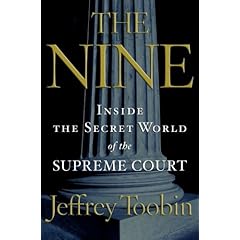 t is here.
Nina Totenberg likes the book and described this way in on NPR:
The plot is simple: the decades-long fight by a new and more extreme brand of conservative to take control of the Supreme Court. It is a fight that fails during the '80s and '90s and even in the early 21st century, despite the fact that Republican appointees far outnumbered Democratic appointees on the court.
The dénouement of the plot comes in 2005 when Justice Sandra Day O'Connor retires and Chief Justice William Rehnquist dies. Both would be replaced by appointees far more conservative — Roberts as chief justice and Alito as associate justice — men in the new conservative mold. Or, as Toobin puts it, "in the mold of the new Republican Party of George W. Bush."
The central thesis, or one might argue, the central disclosure of Toobin's book is his portrayal of Sandra Day O'Connor as increasingly alienated from the Republican Party she loved.
At Concurring Opinions, Frank Pasquale had this to say:
Toobin's book accelerates the classic dynamics of celebrity: it feeds public interest in the justices' quirks and peccadilloes, then leaves us wondering: why are these people so powerful, anyway? As Britney wilted under constant media scrutiny, so too do the justices appear all-too-human under the glare of Toobin's meticulous reporting. Toobin claims that the last five justices appointed have "turned out precisely as might have been expected by" their presidential sponsors. He gives the impression that they mechanically advance the interests of the political machines that elevated them.
Garret Epps in a Salon.com review concludes:
"The Nine," the latest book from the indefatigable New Yorker legal correspondent Jeffrey Toobin, provides fascinating glimpses into the humanity of these mortals. But in the end, Toobin falls prey to the temptation to reduce them to "conservative" or "liberal" votes. That temptation is widespread in media coverage of the court, and often obscures the real process of change that takes place inside its closed chambers.
Peter Latman at the Wall Street Journal Law Blog leads off an author Q&A with Toobin by noting that "Everyone at the WSJ is in a tizzy over next week’s publication of Alan Greenspan’s memoirs, but we’re more stoked for the release of “The Nine: Inside the Secret World of the Supreme Court,” by Jeff Toobin." (As an aside: I didn't know they got "stoked" at WSJ. Do "in a tizzy" and "stoked" fit in the same sentence? I can't decide whether this is generational dissonance, or the WSJ's form of generational harmony.)
You can participate in an "Ask the Author" event on SCOTUS Blog, by submitting a question.
More reviews will hit the newspaper stands soon.
Adler on The Dignity of Sex
Libby Adler, Northeastern University School of Law, has posted a new article, The Dignity of Sex. It is forthcoming in the UCLA Women's Law Journal. Here's the abstract: Dignity, for a long time, has stood for at least two broad ideas. The first idea is that all human beings have dignity innately. This idea has a theological incarnation, according to which human beings have dignity because they were created in the image of God, as well as a secular incarnation, according to which human beings have dignity because they have rationality. Dignity in its second usage derives from social rank. It distinguishes rather than equalizes us. This article reviews the concept of dignity historically, examines contemporary constitutional cases regarding sex from a few different national jurisdictions, and urges that dignity poses legal hazards to gaining constitutional protection for a wide array of sexual practices. It argues that while aristocratic dignity might appear outdated in modern legal systems with an egalitarian ethos, it is still very much alive. While universalist and aristocratic dignity appear at first blush to stand in stark opposition to one another, the former analytically relies on the latter - that is, an assertion of egalitarian dignity is one side of a coin, the other side of which is necessarily degradation of something excluded and therefore the establishment of a hierarchy. When universalist dignity is invoked, therefore, it is worth investigating the basis for the assertion of dignity, what - lacking that basis - is excluded, and consequently what hierarchy has been produced or maintained. A key basis that appears across a handful of national jurisdictions for dignifying constitutionally protected sexual practices is the nature of the relationship in which the sex occurs, producing a hierarchy between sex that occurs in the context of a normatively privileged relationship and sex that occurs outside of that context. This paper highlights the under-acknowledged importance of relationship in constitutional law governing sex and proposes and skeptically evaluates reasons for this preoccupation. It also examines dignity's connection to rationality, and situates that connection historically, devoting particular attention to developments that occurred at the time of the Enlightenment and after World War II, and finds that the interplay among dignity, rationality and sex presents a formidable obstacle to achieving broad constitutional protection for sexual practices.
Friday, September 14, 2007
Reviewed: Federalism in America: An Encyclopedia
Joseph R. Marbach, Ellis Katz, and Troy E. Smith, eds., Federalism in America: An Encyclopedia (Greenwood Press, 2006) is reviewed on H-Law by Christopher N. Fritsch, Independent Scholar. The editors have assembled a two volume set of nearly 400 entries on federalism. Fritsch writes:
The result...is a set of volumes with entries which are relatively concise and very to the point. The individual entries vary in length. Topics such as abortion and the Constitution of 1787 encompass the better part of five pages; other topics such as Shreveport Rate Case (1914) and West Coast Hotel Company v. Parrish (1937) receive much less space, often less than a page. This variety, however, was planned and executed quite well. Smaller entries provide a description of their importance in relation to federalism and then, as is true with all of the entries, the authors provide key links to other entries within the encyclopedia. The more lengthy articles contain not only a reasonable understanding of their relationship to the topic of federalism, but often give significant historical detail and summation. The entries often provide new and insightful thoughts on both the subject and federalism. Authors frequently move beyond the conventional context of the United States and incorporate the origin of ideas from outside. For these entries, authors give historiographical analysis and description, such as the discussion of Harold Berman's Law and Revolution (1983) in the entry on self-government and federalism (pp.559-561). Often entries provide new and insightful thoughts, which move beyond an analysis through a strict American or North American context.
If this was the only strength of the volumes, we still would have four hundred outstanding entries. However, many entries provide scholars with bibliographies containing the standard works within a subject and more recent studies. These entries provide a brief bibliography that spans the entry's history. For example, on the aforementioned topic of self-government and federalism, Professor Vincent Ostrom provides a bibliography which includes the works of Harold Berman, James M. Buchanan and Gordon Tullock, and JohnR. Commons as historical and political science investigations, along with The Federalist Papers and Alexis de Tocqueville's Democracy in America. Here lies the second strength of these volumes--the ability of readers to understand the subject and its relationship to other related topics and to have a brief, but comprehensive,bibliography providing primary and secondary sources for further examination.
The rest is here. The book description from the press is more precise about the encyclopedia's content: When the representatives of the 13 former British colonies convened in Philadelphia in 1787, they sought to create a governing document that would define the nature of the government for their new country. Many delegates, having long experience in colonial legislatures battling royal officials for control of the functions of local government, were hesitant to give up the rights of their separate constituencies. Others, cognizant of the great difficulties that a weak Congress had caused throughout the Revolution, were in favor of granting power to a strong central government at the expense of the new states. Those varying views were reflected in the new draft constitution that proposed a federal system where power was shared between the new states and a central government consisting of an elected congress, president and a supreme court. However, no sooner than the compromises were struck to create a new constitution did the debate begin over what the words meant. The first fruit of those initial debates over the limits of the power of government yielded the Bill of Rights. However, the give and take over the role of the federal government has been going on ever since. This new encyclopedia examines the course of that debate in American history. The 378 articles explain the constitutional provisions, Congressional legislation and Supreme Court decisions that have shaped the relationships of the state and federal governments in the United States. Also noted are the roles played by leading political figures, from John Adams to Sandra Day O'Connor, in defining various areas of jurisdiction. From abortion and Affirmative Action to slavery and welfare policy, historic policy debates are used to illustrate the changing roles of government. Other entries examine the current and historical relationships of different levels of government, including federal, state, and municipal sectors. The influence of historic events and national organizations is explored. Finally, competing theories of federalism, from states' rights to Ronald Reagan's "New Federalism," are explained. Appendices include the Articles of Confederation plus the US Constitution and its amendments. This scholarly survey provides students of political science and history with an excellent introduction to one of the fundamental issues of American government. The set is recommended for high school, public and academic libraries.
The result...is a set of volumes with entries which are relatively concise and very to the
 point. The individual entries vary in length. Topics such as abortion and the Constitution of 1787 encompass the better part of five pages; other topics such as Shreveport Rate Case (1914) and West Coast Hotel Company v. Parrish (1937) receive much less space, often less than a page. This variety, however, was planned and executed quite well. Smaller entries provide a description of their importance in relation to federalism and then, as is true with all of the entries, the authors provide key links to other entries within the encyclopedia. The more lengthy articles contain not only a reasonable understanding of their relationship to the topic of federalism, but often give significant historical detail and summation. The entries often provide new and insightful thoughts on both the subject and federalism. Authors frequently move beyond the conventional context of the United States and incorporate the origin of ideas from outside. For these entries, authors give historiographical analysis and description, such as the discussion of Harold Berman's Law and Revolution (1983) in the entry on self-government and federalism (pp.559-561). Often entries provide new and insightful thoughts, which move beyond an analysis through a strict American or North American context.
If this was the only strength of the volumes, we still would have four hundred outstanding entries. However, many entries provide scholars with bibliographies containing the standard works within a subject and more recent studies. These entries provide a brief bibliography that spans the entry's history. For example, on the aforementioned topic of self-government and federalism, Professor Vincent Ostrom provides a bibliography which includes the works of Harold Berman, James M. Buchanan and Gordon Tullock, and JohnR. Commons as historical and political science investigations, along with The Federalist Papers and Alexis de Tocqueville's Democracy in America. Here lies the second strength of these volumes--the ability of readers to understand the subject and its relationship to other related topics and to have a brief, but comprehensive,bibliography providing primary and secondary sources for further examination.
The rest is here. The book description from the press is more precise about the encyclopedia's content: When the representatives of the 13 former British colonies convened in Philadelphia in 1787, they sought to create a governing document that would define the nature of the government for their new country. Many delegates, having long experience in colonial legislatures battling royal officials for control of the functions of local government, were hesitant to give up the rights of their separate constituencies. Others, cognizant of the great difficulties that a weak Congress had caused throughout the Revolution, were in favor of granting power to a strong central government at the expense of the new states. Those varying views were reflected in the new draft constitution that proposed a federal system where power was shared between the new states and a central government consisting of an elected congress, president and a supreme court. However, no sooner than the compromises were struck to create a new constitution did the debate begin over what the words meant. The first fruit of those initial debates over the limits of the power of government yielded the Bill of Rights. However, the give and take over the role of the federal government has been going on ever since. This new encyclopedia examines the course of that debate in American history. The 378 articles explain the constitutional provisions, Congressional legislation and Supreme Court decisions that have shaped the relationships of the state and federal governments in the United States. Also noted are the roles played by leading political figures, from John Adams to Sandra Day O'Connor, in defining various areas of jurisdiction. From abortion and Affirmative Action to slavery and welfare policy, historic policy debates are used to illustrate the changing roles of government. Other entries examine the current and historical relationships of different levels of government, including federal, state, and municipal sectors. The influence of historic events and national organizations is explored. Finally, competing theories of federalism, from states' rights to Ronald Reagan's "New Federalism," are explained. Appendices include the Articles of Confederation plus the US Constitution and its amendments. This scholarly survey provides students of political science and history with an excellent introduction to one of the fundamental issues of American government. The set is recommended for high school, public and academic libraries.

Bickers on Congress, the Freedmen's Bureau, and the Constitutional Imagination
John M. Bickers, Northern Kentucky University, Salmon P. Chase College of Law, has posted a new article, The Power to Do What Manifestly Must Be Done: Congress, the Freedmen's Bureau, and Constitutional Imagination. It appeared in the Roger Williams University Law Review. Here's the abstract: This article considers the example of one of the odder entities in American legal history: the Bureau of Refugees, Freedmen, and Abandoned Lands. This agency, more commonly called the Freedmen's Bureau, existed from the late days of the Civil War through the end of Reconstruction. It did extraordinary, unprecedented things. It spent all of its days in turmoil, beset by enemies on many sides. This new federal agency, given a broad mandate to remedy some of the evils of slavery, aroused opposition among border state politicians, former slave owners, and other defenders of the status quo. More surprising are the concerns raised even by some of its supporters in Congress, concerns over not only the practical nature of its operation but, importantly, the constitutional bases on which it rested. The Bureau functioned in a wholly new frontier of American law. For the first time, the federal government would operate directly in the personal lives of a large body of citizens: it would review private contracts, settle labor and property disputes, operate schools, and even serve as a licenser of marriages. These activities were virtually, if not entirely, unknown before - and some of them since - within what the Framers had called the general government. This article examines the arguments in Congress over that extension of federal power. It reviews the arguments of opponents and supporters as to the appropriateness of the Bureau within our constitutional system. It attempts to derive some constitutional principles from that debate which may be of value for the future as we continue our endless dialogue about the nature of the federal system.
Thursday, September 13, 2007
Reviewed: Baker, The Rescue of Joshua Glover: A Fugitive Slave, the Constitution, and the Coming of the Civil War
H. Robert Baker, The Rescue of Joshua Glover: A Fugitive Slave, the Constitution, and the Coming of the Civil War (Ohio University Press, 2006) is reviewed on H-SHEAR by Stanley Harrold, Department of Social Sciences, South Carolina State University. It was noted earlier by Mark Graber on Balkinization, who called it "a nice page turner" and "a serious read because Professor Baker raises important questions about popular constitutionalism, a hot topic in contemporary legal discourse."
Harrold writes, in part:
Professor Baker responds to Harrold on H-Shear. Although author responses to reviews are not always recommended, Baker uses the opportunity to provide a helpful clarification of his purpose and method. In Baker's post, we can see what Graber found so compelling. Baker writes:
Harrold writes, in part:

H. Robert Baker's The Rescue of Joshua Glover: A Fugitive Slave, the Constitution, and the Coming of the Civil War...begins with an account of a slave rescue in Wisconsin and proceeds to analyze antebellum constitutionalism in that state and the United States.The book is a worthy effort that deserves to be read by students of the Civil War era and the U.S. Constitution. Baker demonstrates an impressive scholarship, especially in his command of secondary sources. But his approach (and the fact that his real subject is dense and complicated constitutional history) may frustrate many readers.As an aside: some of us find constitutional history rather compelling and important. So this aspect will not frustrate LHB readers. Harrold continues:
Northern resistance to the fugitive slave laws of 1793 and 1850 took two forms. First, alleged fugitive slaves, their neighbors, and mobs fought against masters, their agents, and U.S. marshals. Second, northern magistrates (sometimes acting under state-level personal liberty laws)employed a variety of legal means to prevent rendition or protect those who rescued fugitive slaves. The Joshua Glover case that Baker describes in his first chapter involved both forms. Glover had escaped from Missouri in 1852. In what appears to have been the first attempt in Wisconsin to enforce the Fugitive Slave Law of 1850, his master apprehended him near Racine in March 1854 and after a violent struggle took him to jail in Milwaukee. The next day, a crowd gathered. Some of its members broke into the jail, released Glover, and helped him get to Canada. Federal indictments against two of the mob leaders followed, and, as Baker carefully documents, their cases (not Glover's) became a significant part of Wisconsin's politics for the rest of the decade. Baker emphasizes that the legal points involved in these cases produced a public and lawyerly debate over the right of U.S. citizens to resist federal law, the meaning of the U.S. constitution, and the role of citizens as well as courts in interpreting it.The full review is here.
Once Glover got to Canada, his rescuers and other white Wisconsinites lost interest in him. This, for Baker, illustrates a tendency among the state's white residents to ignore the few African Americans who lived among them....Baker locates the constitutional roots of resistance to the Fugitive Slave Law of 1850 in republican principles, popular defense of natural rights, and antebellum views of state sovereignty. He provides an insightful discussion of the long national debate over the constitutionality of fugitive slave laws. He points out that the Constitution's fugitive slave clause and the Fugitive Slave Law of 1793 were compromises that allowed masters to recover slaves from states in which the escapees would otherwise be free under international law. The 1793 law, however, encouraged the kidnapping into slavery of free African Americans. Kidnapping in turn led to legal conflict between the national government and northern states as the states took "seriously their duty to protect their free blacks" (p. 36).
[snip]
Baker ends his book with interesting and informative analyses of two apparent ironies. The first is that the white South relied on a constitutionalism similar to that prevalent in antebellum Wisconsin to secede from the Union in 1860-1861. The second is that it seemed to do so again a century later in defense of segregation against the U.S. Supreme Court ruling in Brown v. Topeka Board of Education. Readers should appreciate Baker's explanation of how Wisconsin's antislavery state rights differed from secessionist and segregationist state rights. It provides a strong finish to an uneven book.
Professor Baker responds to Harrold on H-Shear. Although author responses to reviews are not always recommended, Baker uses the opportunity to provide a helpful clarification of his purpose and method. In Baker's post, we can see what Graber found so compelling. Baker writes:
The subject of my book is not dense and complicated constitutional history as such, but rather the way in which everyday antebellum peoples resisted encroachments upon their constitutional rights. I state this quite clearly in my preface when I write that this book "traces the means by which Wisconsinites resisted the Fugitive Slave Act" (xi). I go on to clarify that this means of resistance sprang from a constitutional source: "the popular belief that the Constitution belonged in the last instance to the people" (xii). In short, my goal was to recover the popular culture of resistance and how this influenced constitutional thinking. This necessitated engaging discourse on a variety of levels--at public meetings, in newspaper articles, in speeches at the legislature, and before justices of high courts. It was a polyvalent discourse that mixed legal arguments, political debate, and popular culture.The rest is here. The book is here.
Langbein on Why Did Trust Law Become Statute Law in the United States?
John H. Langbein, Yale, has posted a new article, Why Did Trust Law Become Statute Law in the United States? It is forthcoming in the Alabama Law Review. Here's the abstract: The Uniform Trust Code, the first national-level codification of the American law of trusts, was promulgated in 2000. The Code was the product of a five-year Uniform Law Commission drafting process that entailed extensive consultation with the trust and estates bar and the trust banking industry. The Code is being widely enacted. Eighteen states and the District of Columbia have thus far adopted it, and many others are likely to follow. Alabama's enactment comes into effect in 2007. For the future, trust law in Alabama and the other Code states will be prevailingly statute law, although the principles developed in prior case law will continue to inform the interpretation and application of the Code. In one sense, the Code marks a great departure by codifying a previously uncodified field. In another sense, however, the Code is simply the latest step in a trend toward statutory intervention in American trust law that has been underway for decades. If we focus on the Uniform Laws, and I shall have more to say about why uniform legislation has so characterized the trust field, we can identify a steady progression of enactments from the 1930s onward.
The End of H-Net?
Mills Kelly at edwired sees a decline in traffic at some prominent history listservs and asks whether it is a sign that H-Net is on the way out. Hat tip. He writes:
His conclusion:
The most active H-Net listserv I subscribe to is H-Diplo, which hosts roundtables on new books and commentary on articles in the most recent issue of Diplomatic History. As long as listservs provide this sort of content, they are likely to maintain a loyal readership. And e-mail programs make it a bit easier to manage the flood of messages. My e-mail from high volume listservs goes directly into a dedicated folder in Outlook, so that I can read them when I have time.
But Kelly does raise important questions, and at least in the law blogophere, there seems to be a migration in some areas from listservs to blogs. I suspect that more organizations will follow the lead of the American Historical Association, creating their own blogs. In legal history, hopefully we will see the growth of a broad legal history blogosphere, with new blogs focusing on different areas of the field.
Update: A follow-up post on edwired is here, and links to other blogs discussing this issue are here.
Looking at the volume of messages in March-May 2005, 2006 and 2007, he finds a decline in traffic at H-World, H-High-S, and H-Africa, and no change at H-South.Back in the late 1990s H-Net was the coolest way for academics, teachers, and others with an interest in the humanities and social sciences to connect, discuss, and even engage in some serious scholarship online. Of course, in the late 1990s, email was still the killer app of the Internet and we still hadn’t experienced non-stop spamming, nor could we imagine the rapid growth of blogs as a means of communication and community building. And we certainly didn’t know how social networking would take off.
His conclusion:
But the objective measure of traffic–at least in this small snapshot–seems to indicate that H-Net has ridden the email horse a little too long. Given the rapid growth in history blogs as a way for those in our discipline to communicate with one another, I suspect that more an more scholars and teachers are turning away from email and to the newer forms of scholarly communication.But see the comments, suggesting that H-Net provides a service distinct from blogs and other on-line sites, like this one from JH:
If H-Net is going to survive into a second decade, I would urge its leadership to give up on email and move on. Digital communities in the Web 2.0 world just aren’t created in email any more.
Yes, there is way too much mail. But I can always ignore and delete messages once I’ve decided the topic isn’t worth my time.
Meanwhile, I probably read the comments of a couple of score of historians every week, and on topics that I know (from the subject lines) are likely to interest me, and from a single source: my email in-box.
What’s not to love?...
The most active H-Net listserv I subscribe to is H-Diplo, which hosts roundtables on new books and commentary on articles in the most recent issue of Diplomatic History. As long as listservs provide this sort of content, they are likely to maintain a loyal readership. And e-mail programs make it a bit easier to manage the flood of messages. My e-mail from high volume listservs goes directly into a dedicated folder in Outlook, so that I can read them when I have time.
But Kelly does raise important questions, and at least in the law blogophere, there seems to be a migration in some areas from listservs to blogs. I suspect that more organizations will follow the lead of the American Historical Association, creating their own blogs. In legal history, hopefully we will see the growth of a broad legal history blogosphere, with new blogs focusing on different areas of the field.
Update: A follow-up post on edwired is here, and links to other blogs discussing this issue are here.
Wednesday, September 12, 2007
Warren Center Fellowships on Race-Making and Law Making in The Long Civil Rights Movement
The Charles Warren Center at Harvard University is inviting applications for 2008-09. The Center's focus will be Race-Making and Law-Making in The Long Civil Rights Movement. The program next year will be lead by Evelyn Brooks Higginbotham and Kenneth W. Mack. The Charles Warren Center, Harvard's American history research center, invites applications from historians and scholars in related disciplines to participate in a workshop on Race-Making and Law-Making in “the Long Civil Rights Movement” – a term originally put into academic discourse by the noted historian Jacquelyn Dowd Hall. As its title indicates, the workshop invites scholars to question and rethink the conventional time period during which the movement for racial equality in America is believed to have taken place, including the extension of that period beyond the bounds of the twentieth century. It also invites a rethinking of the movement's geographic scope, both within and outside the United States . Finally, participants are invited to consider the long civil rights movement in relation to organizational strategies and leadership, personnel and successes in claims-making within state apparatuses such as courts, war and wartime contexts, and the processes of racial and cultural formation that were associated with the push for equality. The workshop will focus less on the origins, successes and failures of the modern movement than on discontinuities, disruptions and ironies that attended the creation of equal citizenship in America .
Fellows will participate in a seminar led by Evelyn Brooks Higginbotham (History and African American Studies) and Kenneth W. Mack (Law), presenting their work and discussing that of invited speakers. Applicants may not be degree candidates and should have a Ph.D., J.D. or equivalent. Fellows are Harvard University members with library access, and receive a private office which they must use for at least the nine-month academic year. Stipends are individually determined in accordance with each fellow's needs and the Center's resources. The Center encourages applications, otherwise consistent with the Workshop theme, relating to the nation's life during and as a consequence of wars, and from qualified applicants who can contribute, through their research and service, to the diversity and excellence of Harvard's academic community. Application deadline: January 15, 2008 . Decisions announced: early March. Obtain an application from the Center (Emerson Hall 400, Harvard University , Cambridge , MA 02138 ) or our web site.
Update: On the idea of "the long civil rights movement," Sally Greene has a nice post on Jacqueline Dowd Hall at Greenspace.
Fellows will participate in a seminar led by Evelyn Brooks Higginbotham (History and African American Studies) and Kenneth W. Mack (Law), presenting their work and discussing that of invited speakers. Applicants may not be degree candidates and should have a Ph.D., J.D. or equivalent. Fellows are Harvard University members with library access, and receive a private office which they must use for at least the nine-month academic year. Stipends are individually determined in accordance with each fellow's needs and the Center's resources. The Center encourages applications, otherwise consistent with the Workshop theme, relating to the nation's life during and as a consequence of wars, and from qualified applicants who can contribute, through their research and service, to the diversity and excellence of Harvard's academic community. Application deadline: January 15, 2008 . Decisions announced: early March. Obtain an application from the Center (Emerson Hall 400, Harvard University , Cambridge , MA 02138 ) or our web site.
Update: On the idea of "the long civil rights movement," Sally Greene has a nice post on Jacqueline Dowd Hall at Greenspace.
Kahn on Federalism, Democratization and the Rule of Law in Russia
Jeffrey Kahn, Southern Methodist University, Dedman School of Law, has two new SSRN postings on Russian legal history. The first is the Introduction to his book, Federalism, Democratization, and the Rule of Law in Russia (Oxford University Press, 2002). The second is an article, The Parade of Sovereignties: Establishing the Vocabulary of the New Russian Federalism, which appeared in the journal Post-Soviet Affairs.
Here's the book abstract: Combining the approaches of three fields of scholarship – political science, law and Russian area studies – the author of this 2002 Oxford University Press book explores the foundations and future of the Russian Federation. Russia's political elite have struggled to build an extraordinarily complex federal system, one that incorporates eighty-nine different units and scores of different ethnic groups, which sometimes harbor long histories of resentment against Russian imperial and Soviet legacies. This book examines the public debates, official documents and political deals that built Russia's federal house on very unsteady foundations, often out of the ideological, conceptual and physical rubble of the ancien régime. One of the major goals of this book is, where appropriate, to bring together the insights of comparative law and comparative politics in the study of the development of Russia's attempt to create – as its constitution states in the very first article – a 'democratic, federal, rule-of-law state'.
Here's the abstract for the article, The Parade of Sovereignties: Establishing the Vocabulary of the New Russian Federalism: On the basis of extensive on-site interviews and documentary sources, the author interprets the dynamics of the collapse of the Soviet Union by analyzing the cascade of sovereignty declarations issued by republics of the USSR as well as by autonomous republics and other subunits of the Russian republic, in 1990-1991. Interrelationships among the declarations, and other putative causes of their content and timing, are explored. A case study of Tatarstan is provided. The study also analyzes the impact of the process on subsequent Russian approaches to federalism.
Here's the book abstract: Combining the approaches of three fields of scholarship – political science, law and Russian area studies – the author of this 2002 Oxford University Press book explores the foundations and future of the Russian Federation. Russia's political elite have struggled to build an extraordinarily complex federal system, one that incorporates eighty-nine different units and scores of different ethnic groups, which sometimes harbor long histories of resentment against Russian imperial and Soviet legacies. This book examines the public debates, official documents and political deals that built Russia's federal house on very unsteady foundations, often out of the ideological, conceptual and physical rubble of the ancien régime. One of the major goals of this book is, where appropriate, to bring together the insights of comparative law and comparative politics in the study of the development of Russia's attempt to create – as its constitution states in the very first article – a 'democratic, federal, rule-of-law state'.
Here's the abstract for the article, The Parade of Sovereignties: Establishing the Vocabulary of the New Russian Federalism: On the basis of extensive on-site interviews and documentary sources, the author interprets the dynamics of the collapse of the Soviet Union by analyzing the cascade of sovereignty declarations issued by republics of the USSR as well as by autonomous republics and other subunits of the Russian republic, in 1990-1991. Interrelationships among the declarations, and other putative causes of their content and timing, are explored. A case study of Tatarstan is provided. The study also analyzes the impact of the process on subsequent Russian approaches to federalism.
Boston College Legal History Roundtable, 2007-08
Boston College Law School announces the Boston College Legal History Roundtable for 2007-08. Legal historians and others in the Boston area are welcome to attend. Conveners are Professor Mary Sarah Bilder, Professor Daniel R. Coquillette, and Professor James S. Rogers.
2007-2008 Schedule
Boston College Law School
885 Centre Street, Newton, Massachusetts
Faculty Lounge – Room 414
Presentation begins at 4:30 p.m.
Please join us for refreshments at 4:15 p.m.
Thursday, September 27, 2007
Professor Adriaan Lanni, Harvard Law School
Social Norms in the Courts of Classical Athens
Thursday, November 15, 2007
Professor Gerald Leonard, Boston University Law School
Rethinking Dred Scott
Thursday, December 6, 2007
Karen Beck, Curator of Rare Books, Boston College Law School
The Nineteenth-Century American Lawyer's Private Library: A Look at the Evidence
Thursday, February 7, 2008
Professor Warren Billings, Distinguished Professor of History, Emeritus, University of New Orleans History Department
Just Laws for the Happy Guiding and Governing of the People There Inhabiting: Laws in the Colonial South
Thursday, April 3, 2008
Professor Paul Halliday, University of Virginia History Department
The Liberty of the Subject: Conceiving Habeas Corpus in England and Empire
Please contact Ms. Marissa Vicario if you plan to attend the roundtables. Ms. Vicario will then send you copies of the papers (617-552-4125; vicariom@bc.edu). Please contact Prof. Mary Bilder for further questions (617-552-0648; bilder@bc.edu). Directions to the law school are here.
NOTE: If you have a legal history colloquium and you would like to have it noted on the Legal History Blog, please contact me.
2007-2008 Schedule
Boston College Law School
885 Centre Street, Newton, Massachusetts
Faculty Lounge – Room 414
Presentation begins at 4:30 p.m.
Please join us for refreshments at 4:15 p.m.
Thursday, September 27, 2007
Professor Adriaan Lanni, Harvard Law School
Social Norms in the Courts of Classical Athens
Thursday, November 15, 2007
Professor Gerald Leonard, Boston University Law School
Rethinking Dred Scott
Thursday, December 6, 2007
Karen Beck, Curator of Rare Books, Boston College Law School
The Nineteenth-Century American Lawyer's Private Library: A Look at the Evidence
Thursday, February 7, 2008
Professor Warren Billings, Distinguished Professor of History, Emeritus, University of New Orleans History Department
Just Laws for the Happy Guiding and Governing of the People There Inhabiting: Laws in the Colonial South
Thursday, April 3, 2008
Professor Paul Halliday, University of Virginia History Department
The Liberty of the Subject: Conceiving Habeas Corpus in England and Empire
Please contact Ms. Marissa Vicario if you plan to attend the roundtables. Ms. Vicario will then send you copies of the papers (617-552-4125; vicariom@bc.edu). Please contact Prof. Mary Bilder for further questions (617-552-0648; bilder@bc.edu). Directions to the law school are here.
NOTE: If you have a legal history colloquium and you would like to have it noted on the Legal History Blog, please contact me.
Tuesday, September 11, 2007
Fairfax on The Jurisdictional Heritage of the Grand Jury Clause
Roger Fairfax, George Washington, has posted an article, The Jurisdictional Heritage of the Grand Jury Clause. It appeared in the Minnesota Law Review. Here's the abstract: For the first 150 years of our constitutional history, a valid grand jury indictment was deemed to be a mandatory prerequisite to a federal court's exercise of criminal subject matter jurisdiction. Under that view of the Grand Jury Clause, a defendant in a federal felony case could neither waive nor forfeit the right to grand jury indictment. A critical examination of the historical evidence reveals that the legal realist criminal procedure reform project of the early twentieth century advanced a pragmatic critique of the usefulness of the grand jury that culminated in a provision of the Federal Rules of Criminal Procedure allowing for waiver of grand jury indictment for the purpose of facilitating a pre-indictment guilty plea, a procedural efficiency mechanism still used with regularity in federal courts today. The reformers were able to secure the waiver provision - despite serious constitutional concerns - by shaping a pro-efficiency modern understanding of the grand jury that obscured - but did not disprove - the grand jury's jurisdictional significance. This Article argues that the reformers prompted the subversion of the mandate of the Grand Jury Clause, and burdened our legal consciousness with a diminished respect for the grand jury that affects our understanding of the grand jury's place in the constitutional structure to this day. This Article recovers the “jurisdictional heritage” of the grand jury and criticizes the modern understanding for its unjustified dismissal of the grand jury's jurisdictional significance. The Article places blame for the continued confusion in the federal courts regarding the relationship of grand jury and jurisdiction squarely on the weak historical and logical underpinnings of the modern understanding. The Article also contextualizes the grand jury's jurisdictional heritage within the broader contemporary discussion of “pro-defendant” formalist or originalist approaches to defining criminal procedural rights recently applied by the Supreme Court. Finally, the Article argues that the failure to account properly for the jurisdictional heritage of the grand jury frustrates the grand jury's fulfillment of its role in the constitutional design.
9.11


This screen shot of Google at 9:54 a.m. September 11, 2001 is a jolting reminder. The same user options are there, but "I'm Feeling Lucky" seems out of place. The screen directs readers elsewhere. "If you are looking for news, you will find the most current information on TV or radio. Many online news service are not available, because of extremely high demand."
It has never been too early to begin writing the histories of September 11. There are extraordinary resources. This screen shot is captured on a site with 9/11 screen shots from around the world, reminding us that September 11 was a world event that, at least for a moment, knitted Americans together with their global neighbors.
The Library of Congress maintains a multidimensional website: Witness and Response: September 11 Acquisitions at the Library of Congress. For example, the Geography and Map Division provides cartographic resources, with aerial views and thermal imaging of the World Trade Center site. U.S. and international newspapers are here.
The Library of Congress maintains a multidimensional website: Witness and Response: September 11 Acquisitions at the Library of Congress. For example, the Geography and Map Division provides cartographic resources, with aerial views and thermal imaging of the World Trade Center site. U.S. and international newspapers are here.
The most extraordinary on-line resource that I'm aware of remains the September 11 Digital Archive, created by the Center for History and New Media and American Social History Project/Center for Media and Learning. The archive began collecting stories and images shortly after September 11. Update: A redesign of the Digital Archive and other on-line resources are discussed today in the New York Times, with images and links.
It is sometimes said that reflecting on recent events is not the job of historians. Instead, our role is wait, as if our form of understanding requires that we hold off until the facts are not so full of feeling. But it is simply a duty of citizenship in the world to bring one's tools, whatever they may be, to the most pressing problems of our age. In October 2001, I argued that understanding September 11 and its aftermath cannot be left to others for a decade or more. It is our job, our responsibility.
Monday, September 10, 2007
Legal History is Rated "R"

And you thought legal history was tame. Mingle2 gives The Legal History Blog an "R" rating because of the appearance of these words:
murder (5x)
dangerous (2x)
pain (1x)
And they seem to have misconstrued a nickname for "Richard," which appears 3 times, e.g. in a reference to the Vice President. But the search engine missed references to torture and other matters. Words like this have led other law blogs to be rated NC-17, including this, this and this. Lots of history is, apparently, not for little ones. Cliopatria is also rated R. Hat tip.
Appleby: Let's Do Something Constitutional on Constitution Day
Joyce Appleby, emerita professor of history, UCLA, follows up on a 2002 Constitution Day petition by 1200 historians in an op-ed Let's Do Something Constitutional on Constitution Day. Her recommendation: give meaning to the war powers clauses in which war powers are shared between the President and Congress.
Krieger on The Place of Storytelling in Legal Reasoning: Abraham Joshua Heschel's Torah Min Hashamayim
Stefan H. Krieger, Hofstra, has posted a new paper, The Place of Storytelling in Legal Reasoning: Abraham Joshua Heschel's Torah Min Hashamayim. Here's the abstract: This article reads the teachings of two rabbis from the Second Century through the lenses of cognitive science on legal thinking and shows the relationship of their narratives and legal opinions. Cognitive scientists posit that both logical and narrative thinking are essential modes of cognitive functioning. The stories and legal decisions of Rabbi Akiva and Rabbi Ishmael, as described by Abraham Joshua Heschel in his masterpiece, Torah Min Hashamayim (Heavenly Torah) support these insights. Both rabbis lived in a critical period in Jewish history. The Temple, the central focus of the people's connection with God, had been destroyed; large numbers of Jews were exiled from the land; the practice of Judaism had been criminalized; and Jews, including prominent rabbis, were humiliated and persecuted. In this culture, both rabbis wove narratives in an attempt to give meaning to this catastrophe. Rabbi Akiva's stories centered on God's supernatural and miraculous intervention in the world; God's anthropomorphic manifestations and loving relationship with Israel; and a passive, dependent role for Israel which one day would be miraculously redeemed from its present misery. Rabbi Ishmael's narratives, on the other hand, focused on the natural cycles of the world, a clear demarcation between heaven and earth, and an autonomous role for humans in the decision-making process. Faced with the misery around him, Rabbi Ishmael composed stories, in which, humans, not God, played a prominent role in directing life. Consistent with the findings of cognitive scientists, these narrative themes and images permeate the legal rulings of each rabbi. In his decisions, Ishmael takes a middle of the road, down-to-earth approach focusing on the humanity of the parties, the realities of the decision-making process, and the commonsense meaning of the written text. He puts into action his story that at Mount Sinai only general principles were given; the particulars were left for later real cases. Likewise, Akiva's opinions reflect his narratives. They are usually extreme, demand strict compliance with commandments, and attempt to give meaning to every word and letter given by God. His jurisprudence puts into action his story that at Sinai God gave all the law once and for all. Nothing was left for later. Heavenly Torah also reflects Heschel's own narrative, his attempts to make meaning after the Holocaust and in the midst of 1960s America. As with Rabbis Akiva and Ishmael, Heschel's narrative infuses his own approach to legal decision making. This article demonstrates that in rendering decisions, all judges attempt to relate abstract legal principles to actual cases using both the logical principles of their legal system and the narrative themes and images they have created to find meaning in the world in which they live.
Lee on Freedom of the Press 2.0
Edward Lee, Ohio State, links the history of technology and the first amendment in a new paper on copyright, Freedom of the Press 2.0. Here's the abstract: In today's digital age, copyright law is changing. It now attempts to regulate machines. Over the past twenty years, and particularly with the advent of the Internet, copyright holders have increasingly invoked copyright law to regulate directly - indeed, even to prohibit - the manufacture and sale of technology that facilitates the mass dissemination of expressive works. Although the concerns of copyright holders about the ease of digital copying are understandable, the expansion of copyright law to regulate - and, in some cases, to prohibit -technologies raises a troubling question. Can the government regulate under copyright law technologies that facilitate the dissemination of speech, consistent with the First Amendment? If so, are there any limits to what the government can do? Or does copyright law have constitutional carte blanche to regulate technologies, without any First Amendment scrutiny? Because copyright law, dating back to the first Copyright Act of 1790, traditionally refrained from regulating technologies directly, these questions were scarcely considered before. But, today, these questions have vital importance as copyright law and other laws proposed in service of copyright holders contemplate even greater regulation of emerging technologies that are revolutionizing the ability of individuals to create expressive content on the Internet, in the “Web 2.0” culture of user-created content. However, despite their importance, these questions have escaped attention in legal scholarship. This Article attempts to answer these questions by tracing the historical development of the “freedom of the press” that led to the Framers' inclusion of the concept in the First Amendment. My core thesis is twofold: (i) the Framers understood the freedom of the press as the freedom of the printing press - a speech technology - to be free of intrusive governmental regulation, including restrictions on technology imposed under copyright law; and (ii) today, the Sony safe harbor operates as a “First Amendment safeguard” within copyright law that is designed to protect the freedom of the press and the development of speech technologies. All future attempts by Congress to regulate speech technologies under copyright law must answer to the Free Press Clause or the Sony safe harbor.
Sunday, September 9, 2007
Quick links
Apologies for the radio silence. I have just moved to Princeton, but not yet signed on to the IAS network. A few new items:
Notable fall books are previewed in today's Washington Post, including Toobin on the Court, Faludi on 9/11 and Gingrich on the earth. Really. Hat tip.
Forty years ago, Harold Cruse's classic, The Crisis of the Negro Intellectual, appeared. Scott McLemee of Inside Higher Ed discusses the book with Peniel E. Joseph, Brandeis University, author of Waiting ’Til the Midnight Hour: A Narrative History of Black Power in America.
Michael Stanislawski, A Murder in Lemberg: Politics, Religion, and Violence in Modern Jewish History (Princeton University Press, 2007) is reviewed for H-Law by Piotr Wróbel, University of Toronto.
Bruce Laurie, Beyond Garrison: Antislavery and Social Reform (Cambridge University Press, 2007) is reviewed for H-SHEAR by Frederick J. Blue, Department of History, Youngstown State University. It is available via H-Law
Notable fall books are previewed in today's Washington Post, including Toobin on the Court, Faludi on 9/11 and Gingrich on the earth. Really. Hat tip.
Forty years ago, Harold Cruse's classic, The Crisis of the Negro Intellectual, appeared. Scott McLemee of Inside Higher Ed discusses the book with Peniel E. Joseph, Brandeis University, author of Waiting ’Til the Midnight Hour: A Narrative History of Black Power in America.
Michael Stanislawski, A Murder in Lemberg: Politics, Religion, and Violence in Modern Jewish History (Princeton University Press, 2007) is reviewed for H-Law by Piotr Wróbel, University of Toronto.
Bruce Laurie, Beyond Garrison: Antislavery and Social Reform (Cambridge University Press, 2007) is reviewed for H-SHEAR by Frederick J. Blue, Department of History, Youngstown State University. It is available via H-Law
Saturday, September 8, 2007
Opderbeck on Socially Rivalrous Information: Of Candles, Code, and Virtue
David W. Opderbeck, Seton Hall, has posted a new paper, Socially Rivalrous Information: Of Candles, Code, and Virtue. Here's the abstract: This article presents a novel historical and philosophical critique of the prevailing view among intellectual property theorists that information is best modeled as a non-rival economic resource. The article traces the prevailing view about information back to the philosophers and scientists whose thought dominated the Eighteenth Century Enlightenment - particularly Francis Bacon, Isaac Newton, and John Locke. In fact, one of the enduring metaphors for the non-rival nature of information - Thomas Jefferson's candle – depends on a view of “nature” drawn directly from Bacon, Newton and Locke. It is surprising that this metaphor endures. Contrary to the Enlightenment project, the epistemology and ontology that informs the notions of “cyberspace” and the “information commons” are non-foundationalist and constructivist. Indeed, the predominant postmodern critique of intellectual property revolves around the social construction of the “romantic author.” This paper demonstrates, however, that Claude Shannon's mathematical information theory fuels the trope that information is a sort of “code” that can be abstracted from any context and freely shared without diminution. The aphorism “code is law,” then, represents a curious mix of Enlightenment and postmodern thought. This mix does not work well. It leads to a groundless pragmatism pitted with intractable empirical lacunae. The article proposes instead a critical realist perspective on the socially rivalrous aspects of information. This perspective recognizes that information has a real relation to an external reality and yet, at the same time, that information is both socially constructed and a tool of social construction. The paper demonstrates that the law recognizes how information plays precisely such a community-constructive role in areas outside “hard” intellectual property law and cyberlaw. In particular, the law of trade secrets, insider trading, and pre-contract disclosures regulates the socially rivalrous aspects of information. The article then suggests that information policy should attend to virtues and practices enhance human flourishing in communities constructed by rivalrous information, using the network neutrality debate as an example.
Morrison on Suspension and the Extrajudicial Constitution
Trevor W. Morrison, Cornell, takes up the history of habeas corpus and its implications in a new article, Suspension and the Extrajudicial Constitution. It is forthcoming in the Columbia Law Review. Here's the abstract: What happens when Congress suspends the writ of habeas corpus? Everyone agrees that suspending habeas makes that particular - and particularly important - judicial remedy unavailable for those detained by the government. But does suspension also affect the underlying legality of the detention? That is, in addition to making the habeas remedy unavailable, does suspension convert an otherwise unlawful detention into a lawful one? Some, including Justice Scalia in the 2004 case Hamdi v. Rumsfeld and Professor David Shapiro in an important recent article, answer yes. This Article answers no. I previously offered that same answer in a symposium essay; this Article develops the position more fully. Drawing on previously unexamined historical evidence, the first half of the article shows that treating suspension of the writ as legalizing detention is at odds with the dominant historical understanding in both England and the United States. According to that understanding, suspension affects neither the legality of detention nor the availability of post detention remedies (like money damages) for unlawful detention. Suspension of the writ, post detention liability, and legality are distinct questions. My aims go beyond providing a positive account of suspension, however. In the second half of the Article, I examine a set of broader issues that my account of suspension raises but that the current literature almost entirely overlooks. The core question here is this: If suspension does not equal legalization, what are the roles and obligations of the legislative and executive branches when the writ is validly suspended? I suggest ways to think about those branches' independent obligation to uphold and enforce the Constitution during periods of suspension, especially with regard to constitutional norms that might seem to be associated exclusively with the courts. In that respect, the article uses suspension as a window into larger issues regarding the theory and mechanics of constitutional interpretation and implementation outside the courts.
Friday, September 7, 2007
Eyal-Cohen on Preventive Tax Policy: Chief Justice Roger J. Traynor's Tax Philosophy
Mirit Eyal-Cohen, UCLA, has posted a new paper, Preventive Tax Policy: Chief Justice Roger J. Traynor's Tax Philosophy. Here's the abstract: Justice Roger J. Traynor is best known for his judicial innovations in the fields of conflict of laws, product liability, and civil procedure. However, few would trace Traynor's roots to the field of tax law. In the late 1930's Traynor collaborated with Stanley S. Surrey, our nation's foremost authorities on federal tax law, and together they called for a substantial transformation of existing mechanisms for settling tax disputes. At that crucial time in history, high marginal tax rates intensified the friction between taxpayers and the government, boosted litigation and multiplied the number of tax controversies. Traynor and Surrey developed the idea of “preventive tax policy” aimed at preventing controversies from arising, and where they cannot be prevented, reducing the area in which they occur. This paper explores the joint project of these extraordinary men in its historical context and its implementation in Justice Traynor's understanding of tax adjudication. Their proposal serves as proxy for the evolution of tax avoidance in a time when tax acts became complex followed by frequent tax revisions enacted in response to tax evasion. It offers valuable guidance for reducing the complexity and vagueness inherent in our tax system, and for improving the relationship between taxpayers and government. Some of today's most important mechanisms to prevent tax avoidance originated in Traynor & Surrey's proposal, such as private letter ruling and advanced pricing agreements. Their proposition for a single court of tax appeals continues to be deliberated.
Thursday, September 6, 2007
Shelton, An Introduction to the History of International Human Rights Law
Dinah L. Shelton, George Washington University, has posted a new essay, An Introduction to the History of International Human Rights Law. Here's the abstract:
As part of a lecture series given at the International Institute of Human Rights, in Strasbourg, France, in July 2003, the author presents an overview of the history of international human rights law. The author explores numerous religious, political, cultural, philosophical, economic and intellectual movements throughout history that have informed and guided the development of human rights law on the global stage. In doing so, the author examines the moral and ethical dimensions which underpin international human rights law, including what she defines as the innate human desire for protection from abuse. The author highlights the world's most significant historical events and people who have influenced modern concepts of human rights law. Despite the many successes of the human rights movement, the author draws attention to international institutions established to protect human rights, which are often too weak to address many contemporary human rights violations and atrocities occurring in failed states or at the hands of non-state actors. As this area of international law continues to develop, these shortcomings must be addressed if human rights progress is to continue.
As part of a lecture series given at the International Institute of Human Rights, in Strasbourg, France, in July 2003, the author presents an overview of the history of international human rights law. The author explores numerous religious, political, cultural, philosophical, economic and intellectual movements throughout history that have informed and guided the development of human rights law on the global stage. In doing so, the author examines the moral and ethical dimensions which underpin international human rights law, including what she defines as the innate human desire for protection from abuse. The author highlights the world's most significant historical events and people who have influenced modern concepts of human rights law. Despite the many successes of the human rights movement, the author draws attention to international institutions established to protect human rights, which are often too weak to address many contemporary human rights violations and atrocities occurring in failed states or at the hands of non-state actors. As this area of international law continues to develop, these shortcomings must be addressed if human rights progress is to continue.
Tuesday, September 4, 2007
Tamanaha on Understanding Legal Pluralism: Past to Present, Local to Global
Brian Z. Tamanaha, St. John's University, has posted a new article, Understanding Legal Pluralism: Past to Present, Local to Global. It is forthcoming in the Sydney Law Review. Here's the abstract: Although it has not yet penetrated mainstream legal academia, the notion of legal pluralism is gaining momentum across a range of law-related fields. It has been a major topic in legal anthropology and legal sociology for about two decades, and is now getting attention in comparative law and international law. This recent convergence on the notion of legal pluralism is fueled by the apparent multiplicity of legal orders, from the local level to global level. There are village, town, or municipal laws of various types; there are state, district or regional laws of various types; there are national, transnational, and international laws of various types. In addition to these familiar bodies of law, in many societies there are more exotic forms of law, like customary law, indigenous law, religious law, or law connected to distinct ethnic or cultural groups. There is also an evident increase in quasi-legal forms, from private policing and private judging, to privately run prisons, to the ongoing creation of the new lex mercatoria, a body of transnational commercial law that is almost entirely the product of private law making activities. These multiple, often uncoordinated, coexisting or overlapping bodies of law may make competing claims of authority; they may impose conflicting demands or norms; and they may have different styles and orientations. This potential conflict generates uncertainty or jeopardy for individuals and groups in society, who cannot be certain in advance which legal regime will be applied to their situation. It also creates opportunities for individuals and groups to strategically invoke or pit one legal order against another. This article will lay out a framework to help examine and understand the pluralistic form that law increasingly takes today. Legal pluralism, it turns out, is a common historical condition. Part I of this article will portray the rich legal pluralism that characterized the medieval period, and it will describe how this pluralism was reduced in the course of the consolidation of state power. The article will then elaborate on new forms of legal pluralism that were produced in the course of colonization. These historical contexts will set the stage for contemporary legal pluralism, which combines the legacy of this past with more recent developments connected to the processes of globalization. Part II of the article will focus on the academic discussion of legal pluralism. Although the notion of legal pluralism is gaining popularity, from its very inception it has been plagued by a fundamental conceptual problem: the difficulty of defining “law.” Debates over this conceptual problem have continued unabated for three decades. Moreover, just as the notion of legal pluralism has begun to take off, the theorist who contributed the most to its development announced that, owing to its insoluble conceptual problems, legal pluralism should be discarded. This turnabout is a fascinating intellectual story in itself. Part II will lay out a brief account of the conceptual problem that plagues legal pluralism and will indicate why it cannot be resolved. Scholars who invoke legal pluralism without an awareness of this conceptual problem and its implications risk building upon an incoherent and unstable foundation. Finally, Part III will articulate an approach to contemporary legal pluralism that avoids the conceptual problems suffered by most current approaches, while framing the important features of legal pluralism. It is drawn from and combines the insights produced in legal anthropology, comparative law, international law, and globalization studies, in the hope that the framework can provide common ground for a cross-disciplinary focus on legal pluralism. This article was delivered as the 2007 Julius Stone Address at the University of Sydney School of Law
Subscribe to:
Posts (Atom)