Friday, November 4, 2022
Northwestern Legal Studies is Hiring
Northwestern University’s Center for Legal Studies invites applications for a full-time, benefits-eligible, faculty appointment as Assistant or Associate Professor of Instruction, beginning September 1, 2023. This is a teaching-track position that offers good prospects of job security and promotion, contingent upon continuing excellence in job performance. Duties include teaching six quarter-long undergraduate courses per academic year.
We welcome applications from stellar teachers, especially those with proven ability to teach a range of lower- and upper-division courses on law and society. We particularly welcome applicants who can teach courses in the following area(s): race, ethnicity, and the law; law and courts; international and comparative law. Minimum qualifications include a Ph.D. in Political Science, Sociology, History, or a related field, which must be conferred by September 1, 2023. A J.D. is welcome but not required. Preference will be given to candidates who have demonstrated experience working with diverse student communities.
Yahaya to Lecture on the Capitalisms of the Indian Ocean
Nurfadzilah Yahaya, Yale University, will virtually present Capitalisms of the Indian Ocean, in the Global History of Capitalism Seminar of the Oxford Centre for Global History on Tuesday, November 8, at 15:00. Click here to link to the talk.
This paper explores the dark side of powers of attorney used to administer property in Yemen and Southeast Asia. I highlight how the popularity of this legal device in the early twentieth century produced a different kind of belonging beyond official ‘citizenship’ as property-owners based 4000 miles away became important stakeholders in British and Dutch colonies at the opposite end of the Indian Ocean because actions specified in the powers of attorney had no end date based the assumption that conditions such as ownership, sovereign rulers, and legal systems will remain the same over several generations. These documents constructed new temporalities. Building on my first book, I explore the subversive side of this phenomenon to shed light on the full dimension of this common practice which is normally hailed as an empowering tool. I pay attention to how death is the direct impetus for the proliferation of powers of attorney across the Indian Ocean because testators produced powers of attorney close to the end of their lives. Were they drawn up in panic? Many unprepared heirs transferred their power to another person almost immediately upon inheriting property. It took a high level of trust to invest power in others perpetually across the Indian Ocean, and to entrust them to appoint someone who would in turn appoint someone unknown down the line resulting in a chain of faceless agents whose power emanated from one single document produced once upon a time. There was much potential for dysfunction across centuries.
--Dan Ernst
Thursday, November 3, 2022
Court Historian
Several LHB readers have drawn our attention to the order of Judge Carlton Reeves, United States District Court for the Southern District of Mississippi, in U.S. v. Bullock, a challenge to a federal statute prohibiting felons from possessing firearms. Under last term's New York State Rifle & Pistol Association v. Bruen, the Supreme Court charged the lower federal judiciary with determining whether such laws are “consistent with this Nation’s historical tradition of firearm regulation.” Noting that Fordham Law professor Saul Cornell had called the Court’s history in Bruen “cherry-picked” and “an ideological fantasy,” Judge Reeves observed:
This Court is not a trained historian. The Justices of the Supreme Court, distinguished as they may be, are not trained historians. We lack both the methodological and substantive knowledge that historians possess. The sifting of evidence that judges perform is different than the sifting of sources and methodologies that historians perform. See [Bruen] at 2177 (Breyer, J., dissenting) (“Courts are, after all, staffed by lawyers, not historians”). And we are not experts in what white, wealthy, and male property owners thought about firearms regulation in 1791. Yet we are now expected to play historian in the name of constitutional adjudication.***
Not wanting to itself cherry-pick the history, the Court now asks the parties whether it should appoint a historian to serve as a consulting expert in this matter. See Fed. R. Evid. 706. This Court is acquainted with the historical record only as it is filtered through decisions of the Supreme Court and the Courts of Appeals. An expert may help the Court identify and sift through authoritative sources on founding-era firearms restrictions.
Professor Cornell commented on Judge Reeves's order to the National Law Journal. “This is a great idea in the abstract," he said, "but in any kind of practical sense, it’s hard to see how it won’t generate a lot of complaints and questioning about how to implement this idea." Perhaps, Professor Cornell suggested, law schools should teach students rules of historical interpretation and familiarize them with historical sources, and judges could hire historians as law clerks.
--Dan Ernst H/t: SM
Wednesday, November 2, 2022
Queen Mary Book Event: Daston's "Rules"
The School of Law is delighted to be hosting a special book symposium on Professor Lorraine Daston's Rules: A Short History of What We Live By (Princeton, 2022). The event is organised by Professor Maksymilian Del Mar. Book here.
Lorraine Daston, Max Planck/ChicagoMary Morgan, London School of Economics
Andrew Mendelsohn, Queen Mary
Alice Taylor, King’s College London
Caroline Humfress, St Andrews
Programme
3;00pm: Arrival and Welcome
3.05pm – 3.20pm: Introduction to the book by Lorraine Daston
Panel I: Chaired by Maksymilian Del Mar
3.20pm-3.40pm: Comment by Mary Morgan
3.40pm-4;00pm: Comment by Andrew Mendelsohn
4;00pm-4.45pm: Response and Discussion
4.45pm-5:00pm: Break
Panel II: Chaired by Amalia Amaya
5:00pm – 5.20pm: Comment by Caroline Humfress
5.20pm – 5.40pm: Comment by Alice Taylor
5.40pm – 7pm: Response and Discussion
Tuesday, November 1, 2022
Travers's "Empires of Complaints"
In this deeply researched and revealing account, Robert Travers offers a new view of the transition from Mughal to British rule in India. By focusing on processes of petitioning and judicial inquiry, Travers argues that the East India Company consolidated its territorial power in the conquered province of Bengal by co-opting and transforming late Mughal, Persianate practices of administering justice to petitioning subjects. Recasting the origins of the pivotal 'Permanent Settlement' of the Bengal revenues in 1793, Travers explores the gradual production of a new system of colonial taxation and civil law through the selective adaptation and reworking of Mughal norms and precedents. Drawing on English and Persian sources, Empires of Complaints reimagines the origins of British India by foregrounding the late Mughal context for colonial state-formation, and the ways that British rulers reinterpreted and reconstituted Persianate forms of statecraft to suit their new empire.Here are two endorsements:
"Deeply researched and carefully argued, this masterful study tracks the influence of Mughal legal practices and Indian petitioners on the emerging colonial state. A must read for anyone interested in the history of property and credit, legal writing, and British imperial policies in South Asia."--Dan Ernst
Lauren Benton, Yale University
"This is a path-breaking piece of scholarship that offers a rare bridge between the pre-colonial and the colonial in South Asian history. Using a wealth of Persian materials in addition to better-known colonial sources, the book reconceives East India Company rule in late eighteenth-century Bengal as a Persianate empire, showing how Mughal governance practices, laws and ideologies continued to be adopted and repurposed by the incoming colonial regime."
Nandini Chatterjee - University of Exeter
Monday, October 31, 2022
CFP: Law and Humanities Interdisciplinary Workshop
[We have the following CFP. DRE]
2023 Law and Humanities Interdisciplinary Workshop
Georgetown University Law Center, Stanford Law School, UCLA School of Law, the University of Pennsylvania, and the University of Southern California Center for Law, History, and Culture invite submissions for the 22nd meeting of the Law and Humanities Interdisciplinary Workshop, to be held at Georgetown Law Center, Washington, DC, on May 24-25, 2023.
About the workshop. The workshop is open to untenured professors, advanced graduate students, post-doctoral scholars, and independent scholars working in law and the humanities. In addition to drawing from numerous humanistic fields, including Black and Indigenous studies, history, literature, political theory, critical race theory, feminist theory, and philosophy, we welcome critical, qualitative work in the social sciences, including anthropology and sociology. While the scope of the Workshop is broad, we cannot consider proposals that are focused solely on quantitative social science research or that are limited to purely doctrinal legal research. We are especially interested in submissions from members of traditionally underrepresented groups and submissions touching on themes of anti-racism and anti-subordination. We welcome submissions from those working at regional and teaching-intensive institutions.
Based on anonymous evaluation by an interdisciplinary selection committee, between six and eight papers will be chosen for presentation at the Workshop. At the Workshop, two senior scholars will comment on each paper. Commentators and other Workshop participants will be asked to focus specifically on the strengths and weaknesses of the selected scholarly projects, with respect to subject and methodology. The selected papers will then serve as the basis for a larger conversation among all the participants that may include themes connecting all of the projects, as well as discussion of the evolving standards by which we judge excellence and creativity in interdisciplinary scholarship.
The selected papers will appear in a special issue of the Legal Scholarship Network; there is no other publication commitment. (We will accommodate the wishes of chosen authors who prefer not to have their paper posted publicly with us because of publication commitments to other journals.) However, we will only accept Workshop participants whose papers are true works in progress; articles or chapters that are already in page proofs or are otherwise unable to be revised by the time of the Workshop are ineligible.
The Workshop will pay the domestic travel and hotel expenses of authors whose papers are selected for presentation. For authors requiring airline travel from outside the United States, the Workshop will cover such travel expenses up to a maximum of $1250.
Submission instructions. Applications should include a 1500-2000 word summary of the paper (including footnotes or endnotes), plus an optional 1-2 page bibliography, and, if your paper is a chapter in a book or dissertation, an optional 1-page chapter outline. Applications are due on December 15, 2022.
If your application advances to the final stage of consideration, you will be asked to submit the full paper on February 1, 2023. Please do not apply if you will not have a full paper on February 1. The application is intended to be a summary of existing, ongoing work rather than a proposal for new or planned work.
Final paper submissions must be works-in-progress that do not exceed 10,000 words in length (including footnotes/ endnotes). A dissertation chapter may be submitted, but we strongly suggest that it be edited so as to stand alone as a piece of work with its own integrity. A paper that has been submitted for publication is eligible for selection so long as it will not be in galley proofs or in print at the time of the Workshop; it is important that authors still be in a position at the time of the Workshop to consider comments they receive there and to incorporate them as they think appropriate in their revisions.
We ask that those submitting applications be careful to omit or redact any information in the paper summary or the body of the paper that might serve to identify them, as we adhere to an anonymous or “blind” selection process.
Applications (in Microsoft Word—no pdf files, please) will be accepted until December 15, 2022, and should be sent by e-mail to: juniorscholarsworkshop@sas.upenn.edu. Please be sure to include your name, institutional affiliation (if any), and phone and email contact information in your covering email, not in the paper itself. For more information, please send an email inquiry to juniorscholarsworkshop@sas.upenn.edu.
Program Committee, 2023 Law and Humanities Interdisciplinary Workshop
Ariela Gross, USC, Law & History, Chair
Aomar Boum, UCLA, Anthropology
Anne Dailey, UConn, Law
Sarah Barringer Gordon, Penn Law & History
Martha Jones, Johns Hopkins University, History
Sherally Munshi, Georgetown University, Law
Simon Stern, University of Toronto, Law & English
The Law and Humanities Interdisciplinary Workshop is committed to anti-racism both inside and outside the academy.
Saturday, October 29, 2022
Weekend Roundup
- The Organization of American Historians has announced a free webinar, Immigration Restriction Then and Now: Re-Examining the Impact and Legacy of the 1921 and 1924 Immigration Acts
We invite you to join us on November 10, at 7pm ET, for a webinar with the contributors from the September 2022 Journal of American History special issue on immigration. Register here.
- The 2022 Jefferson Memorial Lecture at the University of California, Berkeley, was “The Status Quo Loves To Say No”: Disability Rights and the Battle Against Structures of Exclusion, a conversation of the disability rights activist Judith Heumann in conversation with LHB's Karen Tani.
- Applications for the REU Site Summer Research Program open on November 1. "Building an interactive and relational database of petitions for freedom, our lab is committed to training undergraduates in critical legal inquiry, archival research methods, data collection and processing, and in transcription and encoding techniques that allow us to demonstrate patterns and strategies in legal mobilization and legal decision making." More.
- To mark the centenary of the passage of the Irish Free State Constitution, “a theatrical reconstruction of the process that led to its drafting was held in the very room where it was agreed - the appropriately named Constitution Room in the Shelbourne Hotel” (Irish Times).
- Harvard Law Professor Adrian Vermeule delivered a lecture, "The Original Scalia," on October 19, 2022, with comments from Lawrence Lessig and the Hon. Andrew Oldham, of the United States Court of Appeals for the Fifth Circuit. Jack Goldsmith moderated.
- ICYMI: Harvard University appoints Richard Cellini to lead its "Legacy of Slavery Remembrance Program (Harvard Gazette). Michael C. Dorf on "The Injustice, Insincerity, and Destabilizing Impact of the SCOTUS Turn to History" (Verdict). Harvard Law Professor Molly Brady on the spooky side of property law (Harvard Law Today).
- Updates: A conference on Roman criminal law at University of Trento, November 17-18. Recollections of A. Leon Higginbotham ahead of the official unveiling of a mural in his honor on November 2 (Philadelphia Citizen).
Weekend Roundup is a weekly feature compiled by all the Legal History bloggers.
Friday, October 28, 2022
NEH Public Scholars Grant
Apply for an NEH Public Scholars Grant
The National Endowment for the Humanities (NEH) is accepting applications for the Public Scholars program. The program offers grants to individual authors for research, writing, travel, and other activities leading to the creation and publication of well researched nonfiction books in the humanities written for the broad public.
The program welcomes projects in all areas of the humanities, regardless of geographic or chronological focus. The resulting books might present a narrative history, tell the stories of important individuals, analyze significant texts, provide a synthesis of ideas, revive interest in a neglected subject, or examine the latest thinking on a topic. Books supported by this program must be written in a readily accessible style, must clearly explain specialized terms and concepts, and must frame their topics to have wide appeal.
The Public Scholars program is open to independent writers as well as applicants with an institutional affiliation. It offers a stipend of $5,000 per month for a period of six to twelve months. The maximum stipend is $60,000 for a twelve-month period. Applicants must have U.S. citizenship or residency in the U.S. for the three years preceding the application deadline. In addition, they must have previously published a book with a university or trade press or at least three articles or essays in general-interest publications reaching a large audience.
More information (including a full statement of the eligibility requirements) is available on the NEH’s website. The application deadline for this cycle is November 30, 2022. Recipients may begin the term of the grant as early as September 1, 2023 or as late as September 1, 2024.
An informational video, a list of previously funded projects, and nine examples of successful applications are also available on the webpage linked above. Questions may be directed to publicscholars@neh.gov.
Tushnet in Conversation with Goluboff on the Hughes Court
--Dan Ernst
Thursday, October 27, 2022
Rechtsgeschichte – Legal History 30
Rechtsgeschichte – Legal History issue 30 published
Now in its 20th year of publication, the latest issue of Rechtsgeschichte – Legal History (Journal of the Max Planck Institute for Legal History and Legal Theory) once again brings together outstanding research contributions on legal historical topics as well as a considerable number of wide-ranging reviews.
This year’s Research section begins with Elizabeth Papp Kamali’s study on the consequences of the excessive consumption of alcohol in medieval English criminal law. Jan Schröder offers a close analysis of the sources to investigate the meaning of words in early modern legal and linguistic theories. The editors of the four-volume Handbuch zur Geschichte der Konfliktlösung in Europa – Handbook on the History of Conflict Resolution in Europe (Peter Collin, Wim Decock, Nadine Grotkamp,David von Mayenburg, Anna Seelentag) explain the conceptualisation underlying this standard reference work (published in 2021), and provide a brief overview of some of the overall patterns and findings emerging from this major project.
The Focus sections cover two fields of modern legal history from an international perspective. Karl Härter and Valeria Vegh Weis provide a substantial introduction to the topics discussed in the Focus on Transnational Criminal Law in Transatlantic Perspective (1870–1945), which comprises contributions by three authors (Elizabeth Gómez Alcorta, Nicolás Duffau, Paul Knepper) who particularly explore Latin American dimensions. The second Focus is dedicated to the complex field of labour law history and includes studies from both German and British researchers (Gerd Bender, Rebecca Zahn, Thorsten Keiser, Martin Otto, Johanna Wolf, Tim-Niklas Vesper, Benjamin Spendrin, Matthias Ebbertz).
As always, the reviews in this edition cover a broad spectrum of regions and epochs, ranging from the cuneiform transmission of the Codex Hammurabi to a three-volume history of Chinese legal culture and the European banking union – and for the first time also includes reviews of digital source editions. Finally, two Marginalia on the visualisation of law conclude this volume – and they could not be more different: Erk Volkmar Heyen’s contribution investigates the figuration of iustitia in the context of the political aspects of Marian devotion in the early 16th century. Daniel Damler, on the other hand, takes the reader into the dark canyons of Batman’s hometown Gotham City. This last contribution also inspired this year’s atmospheric picture series of black-and-white photographs of New York City by Otto Danwerth.
Rechtsgeschichte – Legal History 30 is now available in print from the publisher Vittorio Klostermann and online in Open Access via the journal's website.
Wednesday, October 26, 2022
SCLH Grad Student Conference: Legal Histories of the Body and the State
The Stanford Center for Law and History will invite paper submissions from graduate students for its fifth annual conference, “Legal Histories of the Body and the State: Dobbs and the Legacies of Regulating Gender and Sex.” This conference seeks to bring together scholars who examine the intersectional legal histories of regulating and policing sex, gender, and reproduction. As attacks on gender and sexual equality are on the rise, advocates point towards history as justification for state-enforced heteronormativity and traditional gender roles. This conference addresses the court’s claim to diagnose Roe’s “faulty historical analysis” and invites attendees to examine the interwoven legal histories of gender, race, class, and sexuality that have shaped today’s sociolegal and political landscape. As women, migrants, LGBTQIA, and many more are left trying to navigate a post-Dobbs present, this conference aims to give us a better understanding of how past communities have challenged the law to guarantee greater equality for all. This one-day conference will be held on Friday, May 5th, 2023, at Stanford and is cosponsored by the Stanford Humanities Center. This conference will include three panels and a book talk focused on Felicia Kornbluh’s forthcoming book, A Woman’s Life is a Human Life: My Mother, Our Neighbor, and the Journey from Reproductive Rights to Reproductive Justice. It will conclude with a keynote session featuring Professor Mary Zeigler of UC Davis Law who will present, “Dobbs v Jackson Women’s Health Organization and the Remaking of Constitutional Politics.”
Areas of possible, but certainly not exhaustive, legal-historical interest for the conference include:
Reproductive Rights and Race
Race, Gender, and Access to Medical Care/Medical Decisions
Reproductive Rights and Disability
Rhetoric around Reproductive Rights
Race, Law, and Gender
Barriers to Reproductive Autonomy
Race and Eugenics
Law and Contraception
More.
Tuesday, October 25, 2022
Littleton-Griswold Prize to Masur
![]() |
| Credit |
--Dan Ernst
Monday, October 24, 2022
Myers to Deliver Chase Lecture on Frederick Douglass's Antislavery Constitution
![]() |
| Frederick Douglass (NYPL) |
--Dan Ernst
Saturday, October 22, 2022
Weekend Roundup
- Former ASLH President Constance Backhouse delivered the 14th Annual DeLloyd J. Guth Visiting Lecture in Legal History at the University on Manitoba on her forthcoming book on the RDS case, “in which the Supreme Court of Canada struggled with a claim of racial bias against Canada’s first Black female judge" (UM Today).
- The exhibit of the Radcliffe Institute’s Schlesinger Library on the history of abortion in the U.S. will open on October 24. It is curated by Mary Ziegler, UC Davis School of Law (Harvard Gazette).
- Randall Kennedy, HLS, interviewed on Walker v. City of Birmingham, one of the cases he will discuss in his forthcoming book, From Protest to War, Triumphs and Defeats in Struggles for Racial Justice, 1950 to 1970 (wbhm).
- Kate Redburn, an Academic Fellow at the Columbia Law School and a JD-PhD candidate at Yale University reviews Anna Lvovsky’s Vice Patrol: Cops, Courts, and the Struggle over Urban Gay Life before Stonewall in the University of Chicago Law Review.
- I previously noted my Georgetown Law colleague John Mikhail’s research on the North Carolina judge William Gaston and slavery. He and Georgetown's Adam Rothman have updated a list of the 163 people Gaston enslaved and posted it with Professor Mikhail’s letter to the Georgetown Slavery Archive. See also this separate page on Gaston's estate inventory. (A link to another one on Gaston's will is pending.) DRE
- “In 2006 and again in 2016, the University of Pennsylvania denied having any connections to the institution of slavery. In 2017, five students under the direction of history professor Kathleen Brown formed the Penn and Slavery Project to investigate those claims, ultimately concluding that Penn both supported and relied on the institution of slavery in its early days” (AHA Perspectives).
- The Lawbook Exchange has published The Comparative Method in the Science of Law, written in Ukrainian by Lev Rebet in 1947-48 and now edited and translated by William E. Butler and O.V. Kresin. “This study, previously unknown to the world of comparative law, may be considered to be the first monograph in the world devoted to the methodology of comparative jurisprudence.”
- "The Big in Jewish Law: A Day Conference on the Legal Issues, Phenomena, and Epochs that Often Seem ‘Too Big’ for Scholarly Analysis.” Jewish Law Association. November 1, 2022, 08:50–17:15 EDT, CUNY Graduate Center 365 5th Avenue, New York, NY. More.
- ICYMI: The U.S. Supreme Court denied certiorari in an appeal seeking to overturn The Insular Cases (NPR).
Friday, October 21, 2022
McLay on the Removal of NZ Justice Edwards
Geoff McLay, Victoria University of Wellington, Te Herenga Waka, has posted The Removal of Justice Edwards and the Struggle between the 'Legal' and the 'Constitutional' in Late Nineteenth-Century New Zealand, which appears in the Victoria University of Wellington Law Review:
This article examines an extraordinary episode in New Zealand's constitutional history: the 1892 removal of Justice Worley Bassett Edwards as a Supreme Court judge after having been invalidly appointed by the previous government. Edwards' case is important as the only time a New Zealand government has formally sought to remove a sitting judge of the Supreme or (as it is now) High Court. But the article argues that the Edwards controversy is also an example of how New Zealand politicians and lawyers thought about judges within the developing New Zealand state, and even more profoundly about what was constitutional, as opposed to just legal, within that state.--Dan Ernst
Thursday, October 20, 2022
Hatzis on Byron and Stanhope's Greek Newspapers
Aristides N. Hatzis, University of Athens, has posted Establishing a Revolutionary Newspaper: Transplanting Liberalism in a Pre-Modern Society, which appeared in Human Rights in Times of Illiberal Democracies: Liber Amicorum in Memoriam of Stavros Tsakyrakis, ed. (Nomiki Vivliothiki, 2020), 293-317:
In late 1823 two representatives of the London Philhellenic Committee (a Philhellenic group established to support the Greek War of Independence from Ottoman rule) arrived in Missolonghi in Western Greece to administer a loan to the revolutionary Greek government and help the Greek cause. The visit of Lord Byron and Col. Leicester Stanhope was short. Lord Byron died in early April of 1824 and Col. Stanhope was recalled to Britain one month later. During this short period, they managed to establish three newspapers in liberated Greece but also to antagonize each other on the ideology and content of these newspapers. The objective of Stanhope was to disseminate Bentham’s liberal ideas in Greece and the objective of Byron was the international recognition of the Greek War of Independence. Their never-ending fights led to the first major episode of newspaper censorship in the history of modern Greece: Byron confiscated an issue of a newspaper because he thought it was damaging to the revolutionaries’ international standing and he tried to undermine Stanhope’s position by discrediting him to the London Committee. Stanhope did the same by accusing Byron of illiberalism. Byron and Stanhope were also involved in the civil war that erupted during the revolution. Their brief stay in Greece brought out major antinomies in their conceptions of liberty, liberalism, democracy and radicalism but also of national interest and revolution. In this paper I am presenting the establishment of three newspapers by Byron and Stanhope, their inevitable conflict and the different ways they perceived the ideas of liberty by drawing on their extensive correspondence and on the memoirs of Byron’s companions to the Greek adventure.--Dan Ernst
Wednesday, October 19, 2022
Xiao on Modernizing Chinese and Japanese Family Law
Weilin Xiao, a J.S.D. Candidate at Yale Law School, has posted Expansion and Restriction: Two Paths Towards Modernizing Family Laws in Japan and China, 1868-1930:
Before their encounters with the Western powers in the 19th century, Chinese and Japanese societies were both deeply rooted in traditional family systems that constituted their basic social formations. However, as legal modernization dawned, these two countries took nearly antithetical approaches to reforming their customary family laws. For the most part, the Japanese legal elites of the Meiji regime expanded the power of the family and emphasized its political function. In sharp contrast, the Chinese legal elites of the late Qing and Republican eras restricted the power of the family and downplayed its significance. Although many scholars have studied the modernization of family laws in Japan and China, respectively, the differences between the two countries and the underlying reasons for these differences have not been adequately explored. This study seeks to fill the gap.A draft of this article won the 2021 Colin B. Picker Graduate Prize by the Young Comparativist Committee of the American Society of Comparative Law.
By comparing the legislative history of two nations, I argue that this divergence originated from the different historical roles that family systems played and the different political contexts legal elites found themselves in during legal modernization. In Japan, the family system was historically “politically connected” with the state, and the Meiji regime had fully established its authority over this system during the process of modern codification. Hence, Meiji political elites thought it best to integrate people into the new absolutist Emperor regime by leveraging the political obedience of the family. In contrast, the Chinese family system had become “politically disconnected” from the state by late imperial times. Following the Republican Revolution, the Guomindang regime faced competing political forces, which seriously threatened its power. Therefore, political elites hoped to abolish customary family laws, thereby weakening the traditional family system that may have jeopardized governmental centralization and social integration. They also believed that this would help them portray themselves as liberal and modern, which in turn would help them win broader political support from society.
--Dan Ernst
Diversity, Dilemmas and Discoveries: Legal History in the Curriculum
Diversity, dilemmas and discoveries: Legal history in the curriculum
15 December 2022, The Open University Law School, Legal History Research Cluster
What is the place and purpose of legal history in the wider law school curriculum? Research in the field increasingly engages with socio-legal approaches, histories of oppression and discrimination, and critical perspectives on the role of law. As law schools seek to diversify, liberate and decolonise the curriculum, legal history can and should play a vital role.
This online conference will explore how legal history contributes to the curriculum of the modern law school. We invite proposals for 15-minute papers on any aspect, and particularly welcome those which address the central theme of diversity, dilemmas and discoveries.
Abstracts (not exceeding 300 words) should be submitted by email to OULS-legalhistory@open.ac.uk by Friday 11 November 2022.
Tuesday, October 18, 2022
Snyder Interviewed by Kalman on "Democratic Justice"
--Dan Ernst
Hurst Summer Institute
Applications are now being accepted for the J. Willard Hurst Summer Institute in Legal History,
a biennial event sponsored by the American Society for Legal History (ASLH). It is traditionally held in June in Madison, Wisconsin, with support from the Institute for Legal Studies of the University of Wisconsin–Madison, where the late Professor James Willard Hurst was a founding member of the modern field of legal history.The 2023 Hurst Summer Institute
Each Hurst Institute is organized and chaired by a well-known legal historian and includes visiting senior scholars who lead specialized sessions. An ASLH committee reviews applications and selects 12 early career scholars from around the world as Institute Fellows. The Fellows participate in seminars, meet other legal historians, and present their own work. The program is structured but informal, and features discussions of core readings in legal history and analysis of the work of the participants in the Institute. Fellowships are supported by dedicated funds donated in honor of leading mentors in the field, by the alumni of past Hurst fellows, and for other worthy ASLH goals that reflect the Institute's commitment to supporting early career scholars.
Scholars in law, history and other disciplines pursuing research on legal history of any part of the world and all time periods are eligible to apply. The seminar and written materials are conducted in English, and we cannot consider non-anglophone applications. Applicants with no formal training in legal history are encouraged to apply. Traditionally, the selection committee has sought to create a cohort of fellows with varying degrees of familiarity with the field, and welcome applications from scholars at an early stage of their career (beginning faculty members, doctoral students who have completed or almost completed their dissertations, and J.D. graduates).
Please visit the Hurst Institute Archives (UW Law School Repository) for more information about J. Willard Hurst, the legal history tradition at UW Law School and previous Hurst sessions.
The twelfth Hurst Summer Institute will take place June 18-30, 2023. Additional information regarding application deadlines will be forthcoming. The 2023 Hurst Institute will be chaired by Sarah Barringer Gordon, Arlin M. Adams professor of constitutional law and professor of history at the University of Pennsylvania and Michelle McKinley, the Bernard B. Kliks professor of law at the University of Oregon School of Law.
Monday, October 17, 2022
Peterson on "Our Constitution of Force"
Farah Peterson, University of Chicago Law School, has posted Our Constitutionalism of Force, which is forthcoming in the Columbia Law Review:
The Founders’ constitution—the one they had before the Revolution and the one they fought the Revolution to preserve—was one in which violence played a lawmaking role. An embrace of violence to assert constitutional claims is worked deeply into our intellectual history and culture. It was entailed upon us by the Founding generation, who sincerely believed that people “are only as free as they deserve to be” and that one could tell how much freedom people deserved by how much blood they were willing to shed to obtain it. This constitutionalism of force survived ratification. Its legacy is a constitutional order that legitimizes the violent assertion of rights, especially by groups of armed white men—a legacy that showed itself in the Republican National Committee’s statement that the January 6 Insurrection amounted to “legitimate political discourse.” We must acknowledge this heritage and the pressure it imposes on the rule of law if we are to survive today’s authoritarian challenges to our democracy.--Dan Ernst
Zhang Discusses "Ideological Foundations of Qing Taxation"
Taisu Zhang, Yale Law School, is on the latest episode of “Digging a Hole: The Legal Theory Podcast” to discuss The Ideological Foundations of Qing Taxation: Belief Systems, Politics, and Institutions, which comes out in November. The moderators, Professor Zhang’s YLS colleagues, continue:
Taisu starts by explaining why understanding the Qing dynasty is a prerequisite to understanding the modern era of Chinese history and modern Chinese politics. We then debate theories of the Great Divergence, or why many countries in the Western world emerged as the most powerful economies in the 19th and 20th centuries while Qing China, Mughal India, and others failed to launch. Taisu argues that the absence of the Chinese fiscal state and agricultural taxes led to a military and economic decline because of a lack of state investment. He also argues that the Qing dynasty was wrong to assume that agricultural taxes would lead to rebellion, pointing to similar taxation elsewhere in the world.--Dan Ernst
As we love to do here at Digging a Hole, we also took a step back to think about broader methodological and institutional questions. First, Sam and Taisu discuss humanist and social science approaches to history and causal arguments. Taisu intentionally makes his work structured, clear, and empirically falsifiable, putting it against most causal theories of Chinese fiscal decline, which are done by economists. Second, David jumps in to ask whether the broader question here is about institutions. Can divergence be explained by excessive centralization in the Qing government or the role of underdeveloped financial markets? In addition, we delve in constitutional questions and interrogate whether Qing China had a constitutional system and the role that system played.
Saturday, October 15, 2022
Weekend Roundup
- It is rare for a seven-year-old law review article to prompt much debate, but with the Indian Child Welfare Act before the Supreme Court this term (in Brackeen v. Haaland), Greg Ablavsky's "Beyond the Indian Commerce Clause" (published in the Yale Law Journal in 2015) is newly relevant. In a recently posted SSRN piece (also available on the Stanford Law School website), Ablavsky details how and why his article came to be "cite-checked" by another scholar earlier this year and what the stakes are of getting this history right.
- From the Washington Post's "Made by History" section: Ansley L. Quiros (University of North Alabama), "A vital civil rights activist you never heard of has died" (on Charles Sherrod); Emily Frazier (Missouri State University), "Geopolitics, not humanitarianism, has long guided U.S. refugee policy"; Evan Turiano (Queens College, CUNY), "Justice Jackson offered Democrats a road map for securing equal rights."
- ICYMI: Eight Landmark Supreme Court Cases That Were Overturned (History Channel). Enslaved family history records brought to public light by Mississippi project (Clarion, MS, Ledger).
Friday, October 14, 2022
Duve on Normativity as a Framework for Legal History
Thomas Duve, Max Planck Institute for Legal History and Legal Theory, has two papers on normativity as a framework for legal history. The first is Legal History as an Observation of Historical Regimes of Normativity:
In the last few years, the research at the Department “Historical Regimes of Normativity” at the Max Planck Institute for Legal History and Legal Theory has increasingly been guided by two conceptual ideas: the analysis of “legal history as a history of the translation of knowledge of normativity” and the integration of these findings into an analytical framework called “Historical Regimes of Normativity”. The understanding of “legal history as a history of the translation of knowledge of normativity” is explained in a separate working paper (mpilhlt research paper series N°. 2022-16). It is recommended to read the paper on "translation of knowledge of normativity" first. The present paper introduces the concept of “Historical Regimes of Normativity”.It consists of five parts. In a first part, I sketch out in a very general way our understanding of “Historical Regimes of Normativity” (I.). In the second part, I give an example (II.). In the third part, I add some comments on the different uses of the term “regime” (III.). In the fourth section, I briefly point out some intellectual opportunities this concept offers (IV.). I close with a brief remark on the relation between this approach and other theories (V.).The second is Legal History as a History of the Translation of Knowledge of Normativity:
In the last few years, the research at the Department “Historical Regimes of Normativity” at the Max Planck Institute for Legal History and Legal Theory has increasingly been guided by two conceptual ideas: the analysis of “legal history as a history of the translation of knowledge of normativity” and the integration of these findings into an analytical framework called “Historical Regimes of Normativity”. The understanding of “legal history as an observation of Historical Regimes of Normativity” is explained in a separate working paper (mpilhlt research paper series N°. 2022-17). This paper consists of five parts. In a first part, I sketch out in a very general way our understanding of legal history as a history of the translation of knowledge of normativity (I.). I then introduce the legal-theoretical foundations of this perspective (II.) and explain some advantages of speaking of “knowledge” and “normativity” and not of “law” and “legal knowledge” (III.). In the fourth part, I summarize some intellectual opportunities of using the concept of (cultural) translation (IV.). In the epilogue, I connect this paper with the paper on "Historical Regimes of Normativity" (V.).--Dan Ernst
Wednesday, October 12, 2022
Sepper and Nelson on Berle's "Corporate Conscience"
Elizabeth Sepper, University of
Texas at Austin School of Law, and James David Nelson, University of
Houston Law Center, have posted Adolf Berle's Corporate Conscience,
which they previously published in 45 Seattle University Law Review 97
(2021):
In this contribution to the symposium on “Corporate Capitalism and the City of God,” we bring Adolf Berle’s distinctive views of morality in corporate life into contemporary conversations about corporate religion. Today’s debates over corporate religious exemptions tend to gravitate toward an entity view of conscience focused on the moral integrity of institutions or an associational view keyed to shareholders’ deep commitments. The foremost corporate law scholar of his day, Berle instead conceived of corporate conscience as a “public consensus” guiding and bounding managerial decision-making. Although he would have sympathized with efforts to integrate faith and business, he would have rejected the conclusion that faith at work requires religious exemptions for corporations. Berle instead would structure analysis around corporate power and its potential to threaten individual personality. His corporate conscience, we argue, offers fresh insights to debates in corporate law, constitutional law, and beyond.--Dan Ernst
The Docket 5:3
Lisa Cowan, Review of Johnston’s Roman Law in Context (2nd Edition)
Bruce W. Dearstyne, Revisiting the “Brandeis Brief”
John Henry Schlegel, Meeting Willard Hurst in the Seminar Room: On the Humility in Historical Judgment
Symposium on William Novak’s New Democracy
Karen M. Tani, The Modern American State as a Democratic State: Questions Inspired by Novak’s New Democracy
Sophia Z. Lee, Evolution or Revolution in Novak’s New Democracy
Joanna Grisinger, Novak’s A New Democracy: By and For Whom?
Ajay K. Mehrotra, Continuity and Change from Novak’s People’s Welfare to New Democracy
--Dan Ernst
Tuesday, October 11, 2022
Mack to Lecture on Frederick Morrow
On Thursday, October 13, from 12:45 to 2:00, Kenneth W. Mack, the Lawrence D. Biele Professor of Law and Affiliate Professor of History at Harvard University, will deliver the Annual Distinguished Lecture at the Boston University School of Law, entitled E. Frederic Morrow and the Historical Time of the Civil Rights Movement:
In this Lecture, Professor Mack will tell the story of lawyer E. Frederick Morrow, who was the first African American to work in the White House in a professional capacity. His official title—Assistant Administrator for Special Projects—does not reveal that he “became the person who both Black Americans and white federal officials expected to explain race and civil rights to a President who was reticent about enforcing civil rights law in the South, and to explain the Eisenhower’s views to an increasingly skeptical Black public. Morrow’s tenure would encompass many of legal and political milestones of the postwar era: not only the debate over Brown v. Board of Education and Emmet Till’s murder, but also the emergence of Martin Luther King, Jr. as a national leader, the birth of the sit-in movement, and the Presidential election of 1960. Nevertheless, he would leave the White House in January 1961 with his reputation, and his self-respect, in tatters. He penned a bitter memoir/diary of his time in the government, titled A Black Man in the White House. More memoirs would follow, each tinged with anger, and each an attempt at self-justification, but to no avail. Morrow quickly slipped into obscurity, largely forgotten by historians and the public alike, just as the civil rights movement was etching itself into law, American public consciousness and transnational collective memory.
--Dan Ernst
Sharfstein on Cecil Sims, Massive Resistance, and Nashville
Daniel J. Sharfstein, Vanderbilt University Law School, has posted Brown, Massive Resistance, and the Lawyer's View: A Nashville Story, which appeared in the Vanderbilt Law Review:
This Essay explores the work of attorney Cecil Sims in resisting Nashville school desegregation in the 1950s and 1960s. As Nashville's most successful litigator and power broker -- founder of one of the city's most prominent law firms, member of the Davidson County School Board, and trustee of Vanderbilt University and Meharry Medical College -- Sims was an independent insider who argued that massive resistance to Brown v. Board of Education was unnecessary. Instead, he crafted the "Nashville Plan" for local school boards, a 12-year course of exceedingly gradual desegregation that nominally complied with Brown without integrating the schools in any meaningful way.--Dan Ernst
The Essay focuses on two aspects of Sims's practice: his "long history" of civil rights resistance and his much heralded "moderation." First, his work on issues relating to segregated education was not merely a reaction to Brown. In the late 1940s, as Southern states responded to U.S. Supreme Court decisions desegregating graduate education, Sims assumed a central role in developing complex, formalistic, and nominally race-neutral proposals that would have the effect of keeping education segregated. Just as the Civil Rights Movement began years before Brown, Sims is emblematic the segregated South's "long history" of resistance to civil rights. While massive resistance moderated in the mid-1960s and assumed more race-neutral forms, Sims's story suggests that the arguments that massive resistance mellowed into were there all along -- lost in the glare, but taking root in the shadows.
Second, while historians have regarded the kind of advocacy in which Sims engaged as moderate, Sims's pre-Brown positions were criticized as segregationist, obstructionist, and hypocritical. How did his position become a moderate position? The lawlessness of massive resistance moved the goalposts. The construction of Sims's moderation reveals the utility and legitimating function of extreme white supremacist claims and methods. If ultimately his position prevailed over massive resistance, it also prevailed because of massive resistance.
Finally, the Essay reflects on Sims's legacy at Vanderbilt Law School. The legal history of resistance to integration in Nashville has a long cast of characters with Vanderbilt Law diplomas -- unsurprising for a private university educating white students to assume leadership positions in the Jim Crow South. Even so, Sims stands out. For more than half a century, Sims was a singular force in turning Vanderbilt Law School into an elite, national institution. Making sense of his choices is a first step towards a candid and transparent account of the Law School's relationship to Nashville's infrastructure of inequality and the start of a necessary conversation about the responsibility of Vanderbilt and its community of students and teachers to Nashville and beyond.
Monday, October 10, 2022
Rector, "Toxic Debt: An Environmental Justice History of Detroit"
We missed this April 2022 release from the University of North Carolina Press: Toxic Debt: An Environmental Justice History of Detroit, by Josiah Rector (University of Houston). A description from the Press:
From the mid-nineteenth until the mid-twentieth century, environmentally unregulated industrial capitalism produced outsized environmental risks for poor and working-class Detroiters, made all the worse for African Americans by housing and job discrimination. Then as the auto industry abandoned Detroit, the banking and real estate industries turned those risks into disasters with predatory loans to African American homebuyers, and to an increasingly indebted city government. Following years of cuts in welfare assistance to poor families and a devastating subprime mortgage meltdown, the state of Michigan used municipal debt to justify suspending democracy in majority-Black cities. In Detroit and Flint, austerity policies imposed under emergency financial management deprived hundreds of thousands of people of clean water, with lethal consequences that most recently exacerbated the spread of COVID-19.
Toxic Debt is not only a book about racism, capitalism, and the making of these environmental disasters. It is also a history of Detroit's environmental justice movement, which emerged from over a century of battles over public health in the city and involved radical auto workers, ecofeminists, and working-class women fighting for clean water. Linking the histories of urban political economy, the environment, and social movements, Toxic Debt lucidly narrates the story of debt, environmental disaster, and resistance in Detroit.
A sample of the advance praise:
“Josiah Rector’s history of environmental justice in Detroit is breathtaking in its ambition and scope. Integrating environmental justice, urban history, and political economy, Rector lays out how environmental inequality came to be, as a confluence of white segregationists working with capitalists in industry, finance, and real estate at the expense of workers and communities. This dazzling debut is extensively researched, innovative, and a must-read for those interested in environmental justice, labor history, and contemporary problems that continue to land particularly hard on Black, Brown, and poor bodies and communities in Detroit and beyond.”—Julie Sze
More information is available here.
-- Karen Tani
Saturday, October 8, 2022
Weekend Roundup
- In the New York Times: Justin Driver (Yale Law School) reviews Waging a Good War: A Military History of the Civil Rights Movement, 1954-1968, by Thomas E. Ricks. "The book could prove highly influential, inspiring scholars to use the lens of military history to re-examine the victories and defeats of other consequential social movements."
- From the Washington Post's "Made by History" section: Franco Paz (Harvard University), "Who should own historical images of enslaved people?" (discussing the Lanier case); Nicolas Foreman (Oregon State University in Corvallis), "The case of Aaron Burr suggests Donald Trump won’t face consequences"; Adam Jortner (Auburn University), "The Supreme Court’s biggest case this term threatens American democracy"; Eddie R. Cole (University of California, Los Angeles), "Limiting academics’ freedom to tell the truth about racism is not new."
- Have you registered yet for the annual meeting of the American Society for Legal History (Nov. 10-12 in Chicago)? Follow the link to do so.
- We missed this 2021 book, written for young adult readers, on the Vincent Chin trial and its importance for modern U.S. history: Paula Yoo, From a Whisper to a Rallying Cry: The Killing of Vincent Chin and the Trial that Galvanized the Asian American Movement. This history was important to my path toward becoming a historian and I'm glad to know of this book! [KMT]
- The Journal of American History has just published a special issue (109:2) on immigration law and policy.
- Via Twitter, we discovered that Elizabeth Dale has a website for "writings and related projects." Check out her post spotlighting a wrongful conviction from 1929.
- Buffalo Law's interviewed John Henry Schlegel about his new book, While Waiting for Rain: Community Economy and Law in a Time of Change.
- Mary Ziegler (UC Davis) spoke at Stockton University’s annual Constitution Day event “on a journey of the anti-abortion movement from the 19th century to this summer’s Supreme Court ruling overturning the Constitutional right to an abortion.”
- ICYMI: Justice Alito on originalism and Catholicism at Catholic University (Aleteia). A notice of a play about “Joseph Knight – a slave who made legal history in 1778, when he persuaded a court that he should be free to leave the employment of the man who had bought him in Jamaica” (The Scotsman). The heirs of Serranus Clinton Hastings are suing (Michael Hiltzik in the LA Times). The Center for Civil Rights History and Research at the University of South Carolina "is partnering with the National Park Service to expand its work in civil rights education and scholarly research" (Greenville Journal). A brief notice of Richard S. Kay and Joel Colon-Rios’s Adjudicating Revolution: Courts and Constitutional Change (UConn Today).
Friday, October 7, 2022
Mikhail on Gaston and Slavery
![]() |
| William Gaston (LC) |
--Dan Ernst
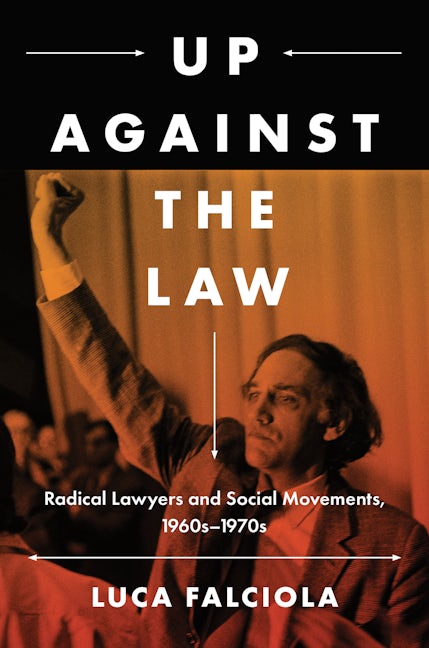
Falciola, "Up Against the Law: Radical Lawyers and Social Movements, 1960s–1970s"
Out this month from the University of Carolina Press (as part of the excellent Justice, Power, and Politics series): Up Against the Law: Radical Lawyers and Social Movements, 1960s–1970s, by Luca Falciola (Columbia University). A description from the Press:
As protest movements took to the streets during the 1960s and 1970s, a group of lawyers joined forces with America's most confrontational activists. In pursuit of radical change themselves, these militant attorneys went beyond providing mere representation. They identified with their clients, defied the habits of a conservative profession, and formulated a corrosive critique of the legal system, questioning the neutrality and transformative power of law. While exploiting the courtrooms as political forums, they developed aggressive litigation strategies and became involved with the organization of protest. Drawing on extensive archival research and interviews, historian Luca Falciola reconstructs this largely unmapped phenomenon and challenges the reader to think anew about the pivotal role of lawyers in social movements.
At the heart of this book is the story of the National Lawyers Guild. Founded in 1937, the Guild represented the first integrated and progressive bar association of America. The Guild returned to prominence in the early 1960s, at the vanguard providing legal aid to civil rights workers in the South. Since then, leftist students, disobedient soldiers, rebellious inmates, radical minorities, and revolutionary groups such as the Black Panther Party and the Weather Underground have relied on this cadre of sympathetic lawyers to defend and empower them.
Advance praise:
"Up Against the Law finally provides the history of the National Lawyers Guild that has been missing from the historical literature until now. As both a history of what Guild lawyers did and a roadmap for what radical lawyering might look like in its relationship to social movements, this book has much to say not only to historians but also to lawyers and law students seeking out ways in which law can produce true social change."—Felice Batlan
"This is the best book I've read on the important contributions of radical lawyers to a wide range of social movements during the 'long 1960s.' Falciola demonstrates in fascinating detail how law was both a target and a tool of lawyers associated with the National Lawyers Guild during these years."—Jeff Goodwin
More information is available here.
-- Karen Tani
Thursday, October 6, 2022
Atkinson on the "Affective" Responsibilities of Public Utilities
Evelyn Atkinson, a Postdoctoral Fellow at the University of Chicago, has posted Telegraph Torts: The Lost Lineage of the Public Service Corporation, which is forthcoming in the Michigan Law Review:
At the turn of the twentieth century, state courts were roiled by claims against telegraph corporations for mental anguish resulting from the failure to deliver telegrams involving the death or injury of a family member. Although these “telegraph cases” at first may seem a bizarre outlier, they in fact reveal an important and understudied moment of transformation in the nature of the relationship between the corporation and the public: the role of affective relations in the development of the public utility corporation. Even as powerful corporations were recast as private, rights-bearing, profit-making market actors in constitutional law, a significant minority of rural state courts deviated from the common law to impose liability for mental anguish on negligent telegraph corporations. They did so on the basis that telegraph companies bore an affirmative duty to protect the emotional well-being and family connections of their customers. In this, courts gave voice to the popular view, voiced by telegraph users and promoted by the companies themselves, of the telegraph corporation as a faithful servant of individual families and communities. In so doing, they embedded the historical and popular perception of the corporation as “servant” into the definition of “public service.”
Central Telegraph Office Operator (NYPL)
This Article exposes the private law of the public service corporation and the non-economic dimension of the legal category of “public utility.” Current scholarship has focused on how turn-of-the-century jurists developed the category of “public utility” or “public service” corporation to justify state economic regulations that would otherwise infringe on corporations’ newfound constitutional rights. The telegraph cases reveal a concurrent and complementary development in tort law: the imposition of affective responsibilities on certain corporations as well. Illuminating this doctrine offers an example of how the public utility category could be mobilized to protect the emotional as well as economic well-being of the public today.
The article received the Kathryn T. Preyer Award for Early-Career Scholars of the American Society for Legal History.
Wednesday, October 5, 2022
Mohr on Founding the Irish Free State
Thomas Mohr, Sutherland School of Law, University College Dublin, has posted The Foundation of the Irish State on 6 December 1922:
This article examines the importance of 6 December 1922 as the foundation date of the Irish State. It does so through analysis of the reaction of contemporary media to events on that date and the days that surrounded it. The importance of this date is highlighted by its inseparable connection with three major themes in the history of the early years of the Irish State. These are the Civil War, partition and acceptance of Dominion status under the 1921 Treaty. This article also analyses media reaction to the 1922 Constitution of the Irish Free State that formally came into force on 6 December 1922. It also examines the reaction of a selection of foreign media to the birth of the Irish State. The analysis includes hopes for the future of the new State expressed in contemporary media. The article concludes that, although the date of 6 December 1922 has not been the subject of substantial commemoration in the decades that followed, the significance ascribed to it by people alive at the time underlines its importance as the birth date of the self-governing Irish State.--Dan Ernst
Tuesday, October 4, 2022
AJLH 62:3
Class, Conservation, and the Police Power in the American Gilded Age: The Origins of Lawton v. Steele
William B Meyer
A Well-Outfitted Militia: German–American Translations of the Second Amendment and Original Public Meaning
Brandon Kinney
The State before the State: A Critique of New Democracy: The Creation of the Modern American State, by William J Novak
Christopher Tomlins
Book Reviews
Russell Sandberg, Subversive Legal History: A Manifesto for the Future of Legal Education
William Eves
William Phelan, Great Judgments of the European Court of Justice: Rethinking the Landmark Decisions of the Foundational Period
Jaka Kukavica
--Dan Ernst
Judt on the Wagner Act and the "Social Self"
Daniel Judt, a PhD candidate at Yale University, has published The Tragic Pragmatism of the Wagner Act in the American Journal of Legal History:
The Wagner Act established a right to collective action as the keystone of industrial democracy. In doing so, it also articulated a radical conception of the self: that individuals form genuine desires and attain full self-actualization through collective action. This conception ran counter to the traditional liberal idea of selfhood, which took possessive individualism as the fundament of democratic governance. This paper places the Wagner Act and its reception in the context of changing conceptions of the self in American political thought from 1920 to 1950. The Wagner Act derived its conception of democratic activity from a pragmatist and progressivist theory of the “social self.” But its reception took place amidst a very different intellectual context. By midcentury, a liberal hostility to “mass society” and its deleterious effects on individual choice had repudiated the older pragmatist collectivism. In other words, the Act’s core provision—the notion of collective action as central to the formation of workers’ individual desires—was born of a dying moment in American thought. The immediate hostility that the new labor law regime faced in Congress and the courts was a consequence, in part, of that disjuncture.--Dan Ernst