If you follow this blog, you are likely also familiar with H-Law, a "Humanities Social Sciences Online
discussion network sponsored by the American Society for Legal History." After much deliberation and preparation, H-Law is officially transitioning to a new platform, H-Net Commons. If you're wondering what this means for you, here's a full explanation from H-Law's Lead Editor, Charles Zelden (after the jump):
Monday, March 24, 2014
Sunday, March 23, 2014
Sunday Book Roundup

In the Los Angeles Review of Books, you'll find a review of Friend of the Court: On the Front Lines with the First Amendment (Yale University Press), by attorney and law professor Floyd Abrams. "A recurring theme," writes Jim Lafferty, "is Abrams’s contention that attacks on First Amendment freedoms come from the left as well as the right."
We've been seeing lots of reviews lately of Walter Benjamin: A Critical Life (Harvard University Press, 2014), by Howard Eiland and Michael W. Jennings. The most recent review comes from Benjamin Balint at Books&Ideas.net.
The Los Angeles Times has a review of The Age of Radiance: The Epic Rise and Dramatic Fall of the Atomic Era (Scribner), by Craig Nelson. Reviewer Scott Martelle calls the book "a readable and fresh romp through a familiar history while artfully defending nuclear benefits, especially in medicine."


Saturday, March 22, 2014
The Politics of Legality in a Neo-liberal Age
[Via H-Law, we have the following call for papers for the conference “The Politics of Legality in a Neo-liberal Age.]
This symposium will examine the nexus between the political dominance of liberal legal ideas and the economic dominance of neo-liberal capitalism.
According to classical liberal theory the state is legitimate to the extent that it respects legality. The idea that the state should respect individual rights and the rule of law continues to have considerable purchase on our political discourse: the language of human rights is used by NGOs to criticise state violence, and by the same states to justify the violence of military interventions; those concerned with the legal response to terrorism often invoke the rule of law to criticise the expansion of powers for the executive branch of government; while the very same executive pays meticulous attention to justifying actions such as torture in legal terms. Indeed, law is so central to the contemporary political imagination that the theorist Norberto Bobbio has dubbed our time the 'age of rights'. Economically, however, the age in which we live is that of neo-liberal capitalism. The critique of the regulatory state and the advocacy of the 'free market' developed by neo-liberal thinkers such as Frederich Hayek, Milton Friedman, and Ludwig von Mises have had a serious impact on practices of government over the last 30 years. Indeed, it has been argued that neo-liberalism has played a major role in the concentration of economic power in this time, profoundly influencing the policies that have shaped the course of economic globalisation; those that led to Global Financial Crisis of 2008; and the politics of austerity that has characterised the state response to this crisis in the US and the EU.
Neo-liberalism is not, however, simply an economic theory but a political philosophy that has legality at its core, defining itself against the regulatory state for violating individual liberty and advocating private property rights and a certain vision of the rule of law as crucial to the functioning of capitalist economies. The rule of law has also been central to the processes of neo-liberal globalisation with 'rule of law promotion' playing a crucial role in developing markets in the global South. And, while human rights are often used as tools for political critique and resistance, the historian Samuel Moyn has illustrated that the language of human rights has colonised political discourse since the late 1970s. This is the very same period in which neo-liberalism has restructured the relationship between economy and society and state, raising the question of whether there is a relationship between these two phenomena.
An understanding of the contemporary political conjuncture, and the possibilities for its transformation, demands an analysis of the relationship between liberal legality and the current hegemony of neo-liberal capitalism. This symposium will address this conjuncture through papers which engage, among a range of other possibilities, the following themes and topics:
This symposium will examine the nexus between the political dominance of liberal legal ideas and the economic dominance of neo-liberal capitalism.
According to classical liberal theory the state is legitimate to the extent that it respects legality. The idea that the state should respect individual rights and the rule of law continues to have considerable purchase on our political discourse: the language of human rights is used by NGOs to criticise state violence, and by the same states to justify the violence of military interventions; those concerned with the legal response to terrorism often invoke the rule of law to criticise the expansion of powers for the executive branch of government; while the very same executive pays meticulous attention to justifying actions such as torture in legal terms. Indeed, law is so central to the contemporary political imagination that the theorist Norberto Bobbio has dubbed our time the 'age of rights'. Economically, however, the age in which we live is that of neo-liberal capitalism. The critique of the regulatory state and the advocacy of the 'free market' developed by neo-liberal thinkers such as Frederich Hayek, Milton Friedman, and Ludwig von Mises have had a serious impact on practices of government over the last 30 years. Indeed, it has been argued that neo-liberalism has played a major role in the concentration of economic power in this time, profoundly influencing the policies that have shaped the course of economic globalisation; those that led to Global Financial Crisis of 2008; and the politics of austerity that has characterised the state response to this crisis in the US and the EU.
Neo-liberalism is not, however, simply an economic theory but a political philosophy that has legality at its core, defining itself against the regulatory state for violating individual liberty and advocating private property rights and a certain vision of the rule of law as crucial to the functioning of capitalist economies. The rule of law has also been central to the processes of neo-liberal globalisation with 'rule of law promotion' playing a crucial role in developing markets in the global South. And, while human rights are often used as tools for political critique and resistance, the historian Samuel Moyn has illustrated that the language of human rights has colonised political discourse since the late 1970s. This is the very same period in which neo-liberalism has restructured the relationship between economy and society and state, raising the question of whether there is a relationship between these two phenomena.
An understanding of the contemporary political conjuncture, and the possibilities for its transformation, demands an analysis of the relationship between liberal legality and the current hegemony of neo-liberal capitalism. This symposium will address this conjuncture through papers which engage, among a range of other possibilities, the following themes and topics:
Weekend Roundup
- Hey, women legal historians: consider citing yourself for that point. Via the Chronicle of Higher Education, there is a new gender gap in academia: "Even as citation rates become a key measure of productivity, women don’t refer to their own research nearly as often as men do."
- Also via the Chronicle of Higher Ed, some great news: "The American Historical Association and four universities will split a $1.6-million grant from the Andrew W. Mellon Foundation aimed at broadening the career paths of history Ph.D.’s . . . ."
- Leiden University's Department of Child Law will hold a conference to mark the 25th anniversary of the UN Convention of the Rights of the Child (Nov. 17-19, 2014). Abstracts are due by April 1, 2014. (Hat tip: Legal Scholarship Blog)
- Adam Wolkoff is guest blogging over at Environment, Law, and History. Check out his first post, on "teaching the history of law and the environment," here.
Friday, March 21, 2014
The Legal Foundations of Modern American Capitalism
When I first began teaching I was rather optimistic about developing
synergies between teaching and research.
And, so, I choose this title as a rubric for some of the readings that I
wanted, and needed, to do for my own research projects. As a new faculty member, I was also
apprehensive about attracting students to a new course, and so I figured a capacious
and bombastic title like this one might appeal to law students and graduate
students in history and the social sciences.
It turns out I was half right.
Rana's "Two Faces of American Freedom"
Just out in paper from the Harvard University Press is The Two Faces of American Freedom, by Aziz Rana, Cornell Law School. It
Rana discusses the book here. TOC after the jump.boldly reinterprets the American political tradition from the colonial period to modern times, placing issues of race relations, immigration, and presidentialism in the context of shifting notions of empire and citizenship. Today, while the U.S. enjoys tremendous military and economic power, citizens are increasingly insulated from everyday decision-making. This was not always the case. America, Aziz Rana argues, began as a settler society grounded in an ideal of freedom as the exercise of continuous self-rule—one that joined direct political participation with economic independence. However, this vision of freedom was politically bound to the subordination of marginalized groups, especially slaves, Native Americans, and women. These practices of liberty and exclusion were not separate currents, but rather two sides of the same coin.
However, at crucial moments, social movements sought to imagine freedom without either subordination or empire. By the mid-twentieth century, these efforts failed, resulting in the rise of hierarchical state and corporate institutions. This new framework presented national and economic security as society’s guiding commitments and nurtured a continual extension of America’s global reach. Rana envisions a democratic society that revives settler ideals, but combines them with meaningful inclusion for those currently at the margins of American life.
Mikhail on the Necessary and Proper Clauses
My Georgetown University Law Center colleague John Mikhail, has posted The Necessary and Proper Clauses, which appears in the Georgetown Law Journal 102 (2014). Here is the abstract:
The Article's main purpose is to provide a new and more accurate account of the origins of the Necessary and Proper Clauses. I refer to the Necessary and Proper “Clauses” rather than to the Necessary and Proper “Clause” to emphasize that the relevant constitutional text is comprised of three distinct provisions, only the first of which concerns the enumerated powers in Article I, Section 8:
1. “Congress shall have Power . . . To make all Laws which shall be necessary and proper for carrying into Execution the foregoing Powers”
2. “Congress shall have Power . . . To make all Laws which shall be necessary and proper for carrying into Execution . . . all other Powers vested by this Constitution in the Government of the United States”
3. “Congress shall have Power . . . To make all Laws which shall be necessary and proper for carrying into Execution . . . all other Powers vested by this Constitution in . . . any Department or Officer [of the United States]”
James Wilson was probably the most skilled and accomplished lawyer at the constitutional convention, and he appears to have devoted great care and attention to drafting these clauses for the Committee of Detail. Just why he drafted these clauses in this manner and how they influenced the subsequent development of American constitutional law are the primary subjects of this Article and of the broader research project of which it forms a part.
Among other things, the Article contends that the second Necessary and Proper Clause is particularly important for understanding the basic design of the Constitution. Unless it is treated as surplusage, this second clause indicates that the Constitution vests powers in the Government of the United States that are not merely identical or coextensive with the powers vested in Congress or other Departments or Officers of the United States. Because these additional powers are not specified or enumerated in the Constitution, they must be understood to be implied or unenumerated powers. The existence of implied or unenumerated powers is thus explicitly recognized by the precise text of the Constitution, much like the existence of unenumerated rights. Moreover, these “other powers” are distinct from the powers encompassed by the first Necessary and Proper Clause, which by its terms are limited to whatever instrumental powers are necessary and proper to carry into effect the “foregoing powers” vested in Congress by Article I, Section 8.
Tushnet to Lead ICH Seminar on History of Administrative Law
Another Jordan Saunders Seminar in Constitutional History for advanced graduate students and junior faculty has been announced for the fall. It's "The History of US Administrative Law," and it will be taught by Mark Tushnet, the William Nelson Cromwell Professor of Law at Harvard Law School, the author of, among many other books, Making Constitutional Law: Thurgood Marshall and the Supreme Court, 1961-1991. According to the announcement:
The seminar is designed for graduate students and junior faculty in history, political science, law, and related disciplines. All participants will be expected to complete the assigned readings and participate in seminar discussions. Although the Institute cannot offer academic credit directly for the seminar, students may be able to earn graduate credit through their home departments by completing an independent research project in conjunction with the seminar. Please consult with your adviser and/or director of graduate studies about these possibilities. Space is limited, so applicants should send a copy of their c.v. and a short statement on how this seminar will be useful to them in their research, teaching, or professional development. Materials will be accepted only by email at MMarcus@nyhistory.org until May 15, 2014. Successful applicants will be notified soon thereafter. For further information, please contact Maeva Marcus at (202) 994-6562 or send an email to MMarcus@nyhistory.org.
There is no tuition or other charge for this seminar, though participants will be expected to acquire the assigned books on their own.
The Institute for Constitutional History (ICH) is the nation's premier institute dedicated to ensuring that future generations of Americans understand the substance and historical development of the U.S. Constitution. Located at the New York Historical Society and the George Washington University Law School, the Institute is co-sponsored by the American Historical Association, the Organization of American Historians, and the American Political Science Association. The Association of American Law Schools is a cooperating entity. ICH prepares junior scholars and college instructors to convey to their readers and students the important role the Constitution has played in shaping American society. ICH also provides a national forum for the preparation and dissemination of humanistic, interdisciplinary scholarship on American constitutional history.
This Reading Group will examine the development of the administrative state from the Progressive Era through the Great Society. We will examine the interaction between academic theorizing about the administrative state as a Fourth Branch of government, and Supreme Court doctrine, and political controversies over the expansion of the administrative state and their resolution in theory and practice.The seminar will meet Thursday evenings, 6:00-8:00 p.m., September 11, 18, October 2, 30, November 13, and 20, 2014, at The George Washington University Law School, 2000 H Street NW, Washington, DC 20052.
The seminar is designed for graduate students and junior faculty in history, political science, law, and related disciplines. All participants will be expected to complete the assigned readings and participate in seminar discussions. Although the Institute cannot offer academic credit directly for the seminar, students may be able to earn graduate credit through their home departments by completing an independent research project in conjunction with the seminar. Please consult with your adviser and/or director of graduate studies about these possibilities. Space is limited, so applicants should send a copy of their c.v. and a short statement on how this seminar will be useful to them in their research, teaching, or professional development. Materials will be accepted only by email at MMarcus@nyhistory.org until May 15, 2014. Successful applicants will be notified soon thereafter. For further information, please contact Maeva Marcus at (202) 994-6562 or send an email to MMarcus@nyhistory.org.
There is no tuition or other charge for this seminar, though participants will be expected to acquire the assigned books on their own.
The Institute for Constitutional History (ICH) is the nation's premier institute dedicated to ensuring that future generations of Americans understand the substance and historical development of the U.S. Constitution. Located at the New York Historical Society and the George Washington University Law School, the Institute is co-sponsored by the American Historical Association, the Organization of American Historians, and the American Political Science Association. The Association of American Law Schools is a cooperating entity. ICH prepares junior scholars and college instructors to convey to their readers and students the important role the Constitution has played in shaping American society. ICH also provides a national forum for the preparation and dissemination of humanistic, interdisciplinary scholarship on American constitutional history.
Thursday, March 20, 2014
New Voices
[I'm moving this up to correct my mistaken assumption that New Voices is an on-line journal. It's not: its an ink-on-paper journal, and it will appear on Westlaw as part of the Journal of Law.]
Here's word from Vanderbilt Law's Suzanna Sherry, of a new journal for the work of law students, which she and Daniel J. Hay edit:
Here's word from Vanderbilt Law's Suzanna Sherry, of a new journal for the work of law students, which she and Daniel J. Hay edit:
I’ve just started a new journal, and I need your submissions of your students’ top-quality work. New Voices will publish only student papers submitted by professors – you submit it with an explanation of why readers should be interested, and if we’re persuaded we edit and publish it along with your explanation as a preface. [The first issue] includes a description of the journal and information on how to submit your students’ papers. The deadline for the next issue is coming up soon, so if you taught a seminar or sponsored an independent project any time in the past year or so, pick out the best paper(s) and send it/them to me right away! And spread the word.And, while we're on the subject, don't forget the Yale model for disseminating student work in legal history.
Schmidt on the Baseball Revolution
If Opening Day is in sight, so, evidently, is the latest contribution to the historical literature on law and baseball. Now comes Explaining the Baseball Revolution, by Christopher W. Schmidt of the Chicago-Kent College of Law and American Bar Foundation. It appears in Arizona State Law Journal 45 (2013): 1471-1535. Here is the abstract:
Between 1966 and 1976, Major League Baseball players won from their club owners a dramatic redistribution of the game’s operational control and revenues. A new era was born, with athletes regularly moving between teams in search of multi-million dollar contracts, periodic strikes, and collective bargaining as the sports industry’s primary policy-making mechanism. In this Article, I offer a new interpretation of how the baseball revolution happened.
In contrast to most accounts, which attribute baseball’s transformation to a convergence of strong personalities and serendipity, I argue that the baseball revolution was the culmination of a reform campaign that is best understood as an instance of what sociolegal scholars call legal mobilization. This campaign revolved around a basic legal claim: that baseball’s “reserve” system denied fundamental rights to the players. This claim failed in court — most famously in Flood v. Kuhn (1972) — yet it resonated elsewhere. The leaders of the baseball revolution — beginning with Marvin Miller, the head of the players’ union — drew upon this rights-based claim for purposes other than winning litigation challenges. In essence, the language of the law allowed the players to reframe the terms of the debate over the reserve system. A struggle that was essentially over power and money became widely understood as a battle for individual freedom. In this way, an improbable legal argument served both to unite and mobilize the players and to secure enough outside support so as to ultimately force the team owners to concede to their demands. Considered through the lens of sociolegal analysis, with its appreciation for the ways in which legal norms function in diverse settings, the baseball revolution offers a valuable case study of the complex interrelation between legal claims, legal institutions, and movement mobilization.
March 2014 JAH
The March 2014 issue of the Journal of American History is out. Articles of interest include:
Privileges of Locomotion: Expatriation and the Politics of Southwestern Border Crossing
By the early 1830s, nearly twenty thousand U.S. citizens had quit their country for lives as colonists in Mexican Texas. asks readers to consider this migration without presupposing the inevitable rise of a U.S. empire in North America. To gain this perspective, he explores the history of Anglo colonization in Texas as an expression of expatriation, or a personal right under international law to change political allegiance at will. This right proved deeply resonant to Mexican officials in Texas and Anglo colonists alike. Tracing how the principle of expatriation influenced life in Mexican Texas during the 1820s and the 1830s reveals individuals from both groups creating a legal order at the U.S.-Mexico border determined by agreement that free individuals possessed natural rights to move throughout world.
Suffragettes and Soviets: American Feminists and the Specter of Revolutionary Russia
That the U.S. woman suffrage amendment passed within a few years of the Russian Revolution was no mere coincidence. Many know that antisuffragists (the “antis”) used charges of socialism and “bolshevism” to discredit American suffragists. Some know that proponents of woman suffrage taunted their opponents with reminders that women in “darkest Russia” had obtained the vote before their American sisters. But historians have been so loathe to validate red baiters’ accusations that they have ignored U.S. feminists’ abiding attention to revolutionary Russia. In her essay, argues that the Russian revolutionary agenda–in theory if not in practice–provided a framework for reimagining the terms of women’s citizenship, and as such, was of vital interest to U.S. feminists. It also reveals historical continuities between abolitionists, feminists, and “friends of Russian freedom.”
A Higher “Standard of Life” for the World: U.S. Labor Women’s Reform Internationalism and the Legacies of 1919
Worker and democracy movements surged around the world in 1919, as did hope for a more just international world order. recovers the surprisingly robust traditions of social justice internationalism among U.S. labor women in the aftermath of World War I. She chronicles the internationalist initiatives of the Women’s Trade Union League of America, the largest U.S. working women’s organization in this era, and uses U.S. and non-U.S. sources to compare the class and gender politics of U.S. and European women trade unionists. Her study challenges reigning scholarly tropes of American exceptionalism, expands understandings of U.S. internationalism in the World War I era, and reveals the significance of the 1919 moment for later transformations in global gender and economic policy.
A full list of the book reviews is available here.“Don’t Agonize, Organize!”: The Displaced Homemakers Campaign and the Contested Goals of Postwar Feminism
In an article that challenges portrayals of 1970s feminism as a movement that demeaned and neglected middle-class housewives, examines a major feminist campaign on behalf of “displaced homemakers”–middle-aged housewives who had lost men’s financial support after divorce or widowhood. The leaders of this campaign participated in national feminist efforts to secure social policies that recognized the economic value of middle-class women’s household labor. Fearing that these policies would attract broad popular support, conservatives misrepresented the displaced homemakers campaign and claimed that feminists sought to penalize full-time mothers. At the same time, left-wing activists condemned displaced homemaker advocates for neglecting the struggles of welfare recipients. Such criticisms contributed to the reorientation of modern feminism away from advocacy on behalf of housewives and agitation that emphasized the economic value of women’s unpaid labor in the home.
Wednesday, March 19, 2014
Ursin on Legal Pragmatism and Enterprise Liabilty
Edmund Ursin, University of San Diego School of Law, has posted Holmes, Cardozo, and the Legal Realists: Early Incarnations of Legal Pragmatism and Enterprise Liability, which appeared in the San Diego Law Review 50 (2013). Here is the abstract:
Enterprise liability is a term associated with the tort lawmaking of the liberal “Traynor era” California Supreme Court of the 1960s and 1970s. Legal pragmatism, in turn, is associated with the conservative jurist Richard Posner. This manuscript examines the evolution of each of these theoretical movements from Holmes’s great 1897 essay, “The Path of the Law,” to the present day. Its focus is on the great judges and scholars whose views have shaped our own: Holmes, Cardozo, the Legal Realists Leon Green and Karl Llewellyn, Traynor, and Posner.
Stated simply, the shared jurisprudential view of these great judges and scholars is that in our system judges are legislators as well as adjudicators — and policy plays a role in their lawmaking. In the common law subjects, in fact, judges are the primacy lawmakers. In constitutional adjudication they are also lawmakers but lawmakers aware of the general need for deference to other branches. No fancy formulas such as “neutral principle “or “original meaning” can capture this role. Indeed, the leading academic theorists of the past century — and today — have been out of touch with the reality of judicial lawmaking as it has been expressly articulated by these great judge. We also see in the works of these judges and scholars the origins of the enterprise liability doctrines that the pragmatic Traynor era court of the 1960s and 1970s, would adopt, including the doctrine of strict products liability and expansive developments within the negligence system.
Bellow on Poverty Law, 1964-65, and a Bibliography on the War on Poverty
[H-Law has scooped me on a development at my own law school! According to a recent message to the listserv:]
As one of the contributions marking the 50th anniversary of the War on Poverty, the National Equal Justice Library has launched a blog earlier this year, Right On. In the most recent blog entry, Reflections on a Bibliography, Fifty Years Later, Elisa Minoff writes about a bibliography that Gary Bellow, supported by a group of students, compiled for a seminar on "Poverty and the Administration of Justice," taught at Georgetown Law in the 1964-65. The course was conceived to stimulate "law students in becoming more concerned with the legal problems of the poor and the urban condition." Minoff's article serves as an excellent guide through Bellows' broadly conceived readings, which represent the state of popular and scholarly writing about poverty in the mid 1960s, while giving a "taste of the ambition of practitioners like Bellow who were considering how to use the law in the fight against poverty," she writes.
 The collaborative War on Poverty bibliography, developed fifty years after Bellow's Selected Readings in Law and Poverty, follows Bellow's spirit by approaching scholarship on poverty and the War on Poverty from a broad perspective. Elisa Minoff, who has conceptualized and developed the initial bibliography, aimed to highlight some of the most enduring scholarship on the War on Poverty and to present the most recent work being done by social scientists, legal scholars, and historians on the subject. For context, Minoff includes a list of useful sources on social welfare in America before and after the War on Poverty, as well as some recent analyses of the legacies of the War on Poverty. A section with literature covering the most significant poverty law cases is also planned.
The bibliography is designed to be an ongoing collaborative effort, and anyone is encouraged to contribute additional entries, and well as annotations to existing and new entries.
The document is available as a google doc here, which is also linked from the NEJl's War on Poverty - Legal Services Resources Center website.
If you would like to contribute citations and commentary, please e-mail Elisa at elisa.minoff [at] gmail.com. Elisa can either give you permission to edit the document directly or add your suggested citations herself.
Katharina Hering | National Equal Justice Library Project Archivist
Special Collections | E.B. Williams Law Library
Georgetown University Law Center
202-662-4043 | kh781@law.georgetown.edu
As one of the contributions marking the 50th anniversary of the War on Poverty, the National Equal Justice Library has launched a blog earlier this year, Right On. In the most recent blog entry, Reflections on a Bibliography, Fifty Years Later, Elisa Minoff writes about a bibliography that Gary Bellow, supported by a group of students, compiled for a seminar on "Poverty and the Administration of Justice," taught at Georgetown Law in the 1964-65. The course was conceived to stimulate "law students in becoming more concerned with the legal problems of the poor and the urban condition." Minoff's article serves as an excellent guide through Bellows' broadly conceived readings, which represent the state of popular and scholarly writing about poverty in the mid 1960s, while giving a "taste of the ambition of practitioners like Bellow who were considering how to use the law in the fight against poverty," she writes.
The collaborative War on Poverty bibliography, developed fifty years after Bellow's Selected Readings in Law and Poverty, follows Bellow's spirit by approaching scholarship on poverty and the War on Poverty from a broad perspective. Elisa Minoff, who has conceptualized and developed the initial bibliography, aimed to highlight some of the most enduring scholarship on the War on Poverty and to present the most recent work being done by social scientists, legal scholars, and historians on the subject. For context, Minoff includes a list of useful sources on social welfare in America before and after the War on Poverty, as well as some recent analyses of the legacies of the War on Poverty. A section with literature covering the most significant poverty law cases is also planned.The bibliography is designed to be an ongoing collaborative effort, and anyone is encouraged to contribute additional entries, and well as annotations to existing and new entries.
The document is available as a google doc here, which is also linked from the NEJl's War on Poverty - Legal Services Resources Center website.
If you would like to contribute citations and commentary, please e-mail Elisa at elisa.minoff [at] gmail.com
Katharina Hering | National Equal Justice Library Project Archivist
Special Collections | E.B. Williams Law Library
Georgetown University Law Center
202-662-4043 | kh781@law.georgetown.edu
Tomlins at Queen Mary, May 2014
 In May 2014, the School of History and the Department of Law at Queen Mary University of London will be hosting Professor Christopher Tomlins as a Distinguished Visiting Fellow. Professor Tomlins is Chancellor’s Professor of Law at University of California, Irvine, Affiliated Research Professor with The American Bar Foundation, Chicago, and from July 2014, Professor at the University of California, Berkeley School of Law.
Professor Tomlins will be involved in the following three events during his Fellowship:
Seminar on the Methodology of Legal History
3pm to 5pm, 13 May 2014
L103/L104 Institute of Advanced Legal Studies, Russell Square, London
Chaired by Professor Michael Lobban (LSE)
Commentators: Professor Eric Heinze (Queen Mary), Professor Axel Korner (UCL), Professor
Gareth Stedman-Jones (Queen Mary) and Professor David Sugarman (Lancaster)
To register, please visit here. There is a pre-circulated paper for this session. Please email m.delmar@qmul.ac.uk to receive the paper.
Seminar for Doctoral Students
2pm to 4pm, 19 May 2014
Room 3.16, Arts 2 Building, Queen Mary University of London, Mile End Road, London E1 4NS
Featuring a discussion of ‘After Critical Legal History: Scope, Scale, Structure’ (2012).
Please register with m.delmar@qmul.ac.uk to receive the paper.
Lecture: “Debt, Death, and Redemption: Toward a Soterial-Legal History of the Turner Rebellion”
3pm to 5pm, 22 May 2014
Room 100, Law Building, Queen Mary University of London, Mile End Road, London E1 4NS
To register, please visit here.
Tuesday, March 18, 2014
LPBR reviews "The Secrets of Law," "The Health Care Case," and More
The Law & Politics Book Review has released a new batch of reviews:
- Kevin M. Wagner (Florida Atlantic University) reviews Austin Sarat, Lawrence Douglas and Martha Merrill Umphrey, eds., THE SECRETS OF LAW (Stanford University Press, 2012) ("explor[ing" the ways law both traffics in and regulates secrecy").

- David Glick (Boston University) reviews Nathaniel Persily, Gilian E. Metzger, and Trevor W. Morrison, eds., THE HEALTH CARE CASE: THE SUPREME COURT'S DECISION AND ITS IMPLICATIONS (Oxford University Press, 2013), which includes a historical chapter by John Fabian Witt ("The Secret History of the Chief Justice's Obamacare Decision").
- Thérèse O’Donnell (University of Strathclyde) reviews Caroline Fournet, GENOCIDE AND CRIMES AGAINST HUMANITY: MISCONCEPTIONS AND CONFUSION IN FRENCH LAW AND PRACTICE (Hart Publishing, 2013).
- Nessa Lynch (Victoria University of Wellington) reviews Antonella Invernizzi and Jane Williams, eds., THE HUMAN RIGHTS OF CHILDREN: FROM VISIONS TO IMPLEMENTATION (Ashgate Publishing, 2011).
Palmer on the NZ Bill of Rights at 21
Geoffrey Winston Russell Palmer, Victoria University of Wellington, has posted The Bill of Rights after Twenty-One Years: The New Zealand Constitutional Caravan Moves On? Which appeared in the New Zealand Journal of Public and International Law 11 (2013): 257-88. Here is the abstract:
The New Zealand Bill of Rights Act 1990 was an important constitutional development in New Zealand. Twenty-one years after its enactment it appears to have made a positive contribution to the protection of human rights in New Zealand. It is a significant check on executive power. Perhaps the time has come to entrench the Bill of Rights Act and make it superior law. In this article the author, who was then the minister in charge of its production and parliamentary passage, looks at how the Bill of Rights Act has fared and considers its future. With a constitutional consideration now drawing to a close in New Zealand, the future of the Bill of Rights Act is being reviewed. The author considers that the Bill of Rights Act needs to be measured along with other constitutional changes. Thus, the wider context and the overall constitutional balance must be assessed before deciding where next the New Zealand constitutional caravan should travel. The author examines the nature of the constitutional consideration currently underway. He concludes there is a strong case for making the Bill of Rights Act superior law.
New Release: Gutfield, "Treasure State Justice: Judge George M. Bourquin, Defender of the Rule of Law"
New from Texas Tech University Press: Arnon Gutfield, Treasure State Justice: Judge George M. Bourquin, Defender of the Rule of Law (Feb. 2014). From the Press:
Few works reveal anything about the role of federal judges in the early twentieth-century American West. Arnon Gutfeld fills that void by analyzing the major issues and dilemmas those judges faced as the West moved rapidly from frontier justice to twentieth-century legal realities. George M. Bourquin served as Federal District judge in Montana from 1912 to 1934. He dared to issue rulings that captured national attention and aroused the ire of the Department of Justice. During the mass fear and hysteria of World War I and the Red Scare, he was one of very few judges to defend individual liberty. His decision in the Ves Hall Case elicited a knee-jerk reaction from Washington--the notorious Anti-Sedition Act of 1918.
A Jeffersonian conservative-libertarian—in the tradition of Edmund Burke—Bourquin believed the Constitution to be the sole barrier between civilization and barbarism. Especially important were his decisions in labor, Native American, and immigration issues.Coinciding with the federal government’s largest role over the destiny of the American West, Bourquin’s judicial career provides a unique opportunity to examine the great impact that the legal system and a very unusual judge had in the post-territorial frontier period.
Monday, March 17, 2014
An Internship at the Federal Judicial Center
 [Via H-Law, we’ve been pointed to the following announcement of a paid summer internship at the Federal Judicial Center in Washington, DC.]
The Federal Judicial Center in Washington, DC, seeks to hire a paid intern to work in the FJC’s Federal Judicial History Office during the summer of 2014. The position is available from mid-May through August. Responsibilities will include historical research and editorial work related to the Center’s compilation of judicial history reference works. Applicants must have completed an undergraduate degree, preferably in history, and enrollment in a graduate history program is desirable. Knowledge of federal history sources preferred.
A vacancy announcement is also available on the Federal Judicial Center Home Page. Persons interested in the positions should send a cover letter referring to position #14-03T, with a resume and the names of three references attached, to Human Resources Office, Federal Judicial Center, Thurgood Marshall Federal Judiciary Building, One Columbus Circle NE, Washington, DC 20002-8003.
The positions will remain open until filled. To insure full consideration for the opening, applications should reach the Federal Judicial Center by April 4, 2014. The Federal Judicial Center is an Equal Opportunity Employer.
Sharafi on Two Legal Views of Colonial Bombay
Mitra J. Sharafi, University of Wisconsin Law School, has posted Two Lives in Law: The Reminiscences of A.J.C. Mistry and Sir Norman Macleod, 1884-1926, which was published in A Heritage of Judging: The Bombay High Court through 150 Years (Mumbai: Maharashtra Judicial Academy, Indian Mediation Centre and Training Institute, 2012), 259-283. Here is the abstract:
Few legal professionals in colonial India left memoirs or collections of personal papers. This article examines two rare exceptions from Bombay around the turn of the twentieth century. The Scottish Chief Justice of Bombay, Sir Norman Macleod, left a rich collection of private papers, including letters to his young son who was studying in Britain. A. J. C. Mistry was a Parsi managing clerk of the solicitors' firm Wadia Ghandy and Co. He published detailed accounts of the firm's creation and growth, and of his life there. On the occasion of the Bombay High Court's 150th anniversary, the article offers a portrait of late colonial views on mortality, mobility, loyalty and regret, in addition to the rising independence movement and the Indianization of the legal profession.
New Release: Risen, "The Bill of the Century: The Epic Battle for the Civil Rights Act"
New from Bloomsbury Press: The Bill of the Century: The Epic Battle for the Civil Rights Act, by Clay Risen. From the Press:
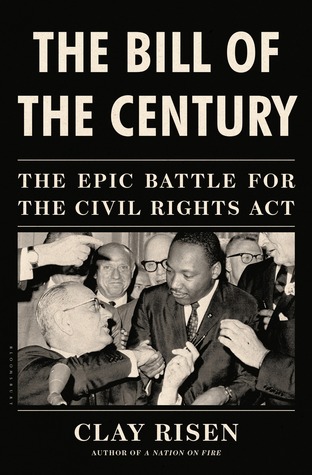
The Civil Rights Act of 1964 was the single most important piece of legislation passed by Congress in American history. This one law so dramatically altered American society that, looking back, it seems preordained—as Everett Dirksen, the GOP leader in the Senate and a key supporter of the bill, said, “no force is more powerful than an idea whose time has come.” But there was nothing predestined about the victory: a phalanx of powerful senators, pledging to “fight to the death” for segregation, launched the longest filibuster in American history to defeat it.A few blurbs:
The bill's passage has often been credited to the political leadership of President Lyndon Johnson, or the moral force of Martin Luther King. Yet as Clay Risen shows, the battle for the Civil Rights Act was a story much bigger than those two men. It was a broad, epic struggle, a sweeping tale of unceasing grassroots activism, ringing speeches, backroom deal-making and finally, hand-to-hand legislative combat. The larger-than-life cast of characters ranges from Senate lions like Mike Mansfield and Strom Thurmond to NAACP lobbyist Charles Mitchell, called “the 101st senator” for his Capitol Hill clout, and industrialist J. Irwin Miller, who helped mobilize a powerful religious coalition for the bill. The "idea whose time had come" would never have arrived without pressure from the streets and shrewd leadership in Congress--all captured in Risen's vivid narrative.
This critical turning point in American history has never been thoroughly explored in a full-length account. Now, New York Times editor and acclaimed author Clay Risen delivers the full story, in all its complexity and drama.
“What a compelling story for our times! Clay Risen’s riveting account of the actual legislative history of the Civil Rights Act of 1964 reveals the infinite complexity of its passage, never certain until the end. And for us now, Bill of the Century explains the crucial roles played by many thousands inside and outside Washington, especially civil rights campaigners and religious believers: ordinary citizens galvanized into civic engagement. This book speaks to a broad readership at our own critical point in American history.” – Nell Irvin Painter
“The Bill of the Century is edge-of-your-seat, as-it-happens history. It’s a thrill to read and an invaluable contribution to our understanding of the civil rights era. Clay Risen makes clear that the passage of the Civil Rights Act was not, as popular mythology would have it, a one- or two-man show; it took a movement in the truest sense. Risen renders that effort—and its unsung heroes—in vivid prose, and shows just how much they had to overcome, working together, in order to bend the arc of history toward justice.” – Jeff ShesolMuch more information is available here, at the author's website.
Sunday, March 16, 2014
Sunday Book Roundup
The Los Angeles Review of Books reviews Floyd Abrams's Friends of the Court: On the Front Lines with the First Amendment (Yale University Press).
The New Republic reviews Doris Kearns Goodwin's The Bully Pulpit: Theodore Roosevelt, William Howard Taft, and the Golden Age of Journalism (Simon & Schuster).
New Books in History has an interview with Benjamin Elman, author of Civil Examinations and Meritocracy in Late Imperial China (Harvard University Press).
H-Net adds a review of Lester Langley's America and the Americas: The United States in the Western Hemisphere (University of Georgia Press).
And the Times Literary Supplement reviews Rana Mitter's China's War with Japan, 1937-1945: The Struggle for Survival (Allen Lane) and Frank Dikotter's The Tragedy of Liberation: A History of the Chinese Revolution, 1945-57 (Bloomsbury).
The New Republic reviews Doris Kearns Goodwin's The Bully Pulpit: Theodore Roosevelt, William Howard Taft, and the Golden Age of Journalism (Simon & Schuster).
New Books in History has an interview with Benjamin Elman, author of Civil Examinations and Meritocracy in Late Imperial China (Harvard University Press).
H-Net adds a review of Lester Langley's America and the Americas: The United States in the Western Hemisphere (University of Georgia Press).
And the Times Literary Supplement reviews Rana Mitter's China's War with Japan, 1937-1945: The Struggle for Survival (Allen Lane) and Frank Dikotter's The Tragedy of Liberation: A History of the Chinese Revolution, 1945-57 (Bloomsbury).
Saturday, March 15, 2014
Bancroft Winners Announced
In case you missed it, the Bancroft Prize winners were announced Thursday. They are Fear Itself: The New Deal and the Origins of Our Time by Ira Katznelson (Liveright Publishing Corporation / W.W. Norton & Company, 2013) and A Misplaced Massacre: Struggling over the Memory of Sand Creek by Ari Kelman (Harvard University Press, 2013). HUP kvells over Kelman's book here.
Reinvigorating Sociolegal Studies: A Workshop
[We have the following call for participants for a workshop on "reinvigorating sociolegal studies" with "approaches that involve undergraduates."]
The Consortium of Undergraduate Law and Justice Programs (CULJP) invites interested scholars to participate in a workshop this July to refresh and reinforce sociolegal research, especially that involving undergraduates.
With support from the National Science Foundation, CULJP will be hosting a workshop to help identify and advance the next wave of research questions in four key subfields of sociolegal studies and to expand the involvement of undergraduates in this research. Those subfields include legal consciousness, legal mobilization, cause lawyering, and judicial decision making.
In addition to presentations and moderated discussion, participating scholars with shared interests will be paired with one another to provide suggestions, constructive criticism, and encouragement as they hone potential research projects. Time also will be set aside for participants to consider and begin planning possible future research experiences for undergraduates (REU) that, with additional organizing, might be submitted to the National Science Foundation for support.
The workshop, which will involve 30 sociolegal scholars, will take place July 21-22, 2014 at the offices of the National Science Foundation in Arlington, Virginia. Participants’ travel expenses will be covered.
Interested faculty are invited to apply to participate. Scholars should send no more than a two-page summary describing their current research agenda, what larger issues they would like to tackle in future work, and how they believe they would benefit from participating in the workshop. Please submit this summary and a current CV to alorenz@ramapo.edu by April 18. Those selected will be notified by May 12.
Please direct any questions to gould@american.edu. The organizers are especially interested in reaching scholars at under-served sociolegal undergraduate programs,
The Consortium of Undergraduate Law and Justice Programs (CULJP) invites interested scholars to participate in a workshop this July to refresh and reinforce sociolegal research, especially that involving undergraduates.
With support from the National Science Foundation, CULJP will be hosting a workshop to help identify and advance the next wave of research questions in four key subfields of sociolegal studies and to expand the involvement of undergraduates in this research. Those subfields include legal consciousness, legal mobilization, cause lawyering, and judicial decision making.
In addition to presentations and moderated discussion, participating scholars with shared interests will be paired with one another to provide suggestions, constructive criticism, and encouragement as they hone potential research projects. Time also will be set aside for participants to consider and begin planning possible future research experiences for undergraduates (REU) that, with additional organizing, might be submitted to the National Science Foundation for support.
The workshop, which will involve 30 sociolegal scholars, will take place July 21-22, 2014 at the offices of the National Science Foundation in Arlington, Virginia. Participants’ travel expenses will be covered.
Interested faculty are invited to apply to participate. Scholars should send no more than a two-page summary describing their current research agenda, what larger issues they would like to tackle in future work, and how they believe they would benefit from participating in the workshop. Please submit this summary and a current CV to alorenz@ramapo.edu by April 18. Those selected will be notified by May 12.
Please direct any questions to gould@american.edu. The organizers are especially interested in reaching scholars at under-served sociolegal undergraduate programs,
Weekend Roundup
- This month, Cato Unbound, the online journal of the Cato Institute, is hosting a symposium on The Rule of the Clan, by the former Legal History Guest Blogger Mark Weiner. Weiner’s lead essay, The Paradox of Modern Individualism, is already posted, as are several response essays. John Fabian Witt's is due up on March 17.
- Another former guest blogger, Elizabeth Dale (University of Florida), is currently blogging over at the Faculty Lounge on the theme of "teaching legal history as applied legal history." Check out her first posts, here and here. She also weighs in, here, on the hot topic of skills training in legal education. [KMT]
- From bookforum: the hidden histories of war crimes trials.
- "In honor of Linda and Richard Kerber’s enduring support for scholarship in the history of women, the Iowa Women’s Archives (University of Iowa Libraries) announces a grant of $1000 to fund travel to Iowa City, Iowa, to conduct research in the Iowa Women’s Archives." More information on the Linda and Richard Kerber Fund here.
- Via the Legal Scholarship Blog: Harvard, Stanford, and Yale Law Schools announce the 15th session of the Harvard/Stanford/Yale Junior Faculty Forum, to be held at Stanford Law School on June 27-28, 2014. The deadline for submissions is March 31, 2014.
Friday, March 14, 2014
Transnational Legal Histories
 For readers of this blog, the notion of placing a country’s
legal history into a broader transnational perspective is, of course, not new. After all, LHB founder Mary Dudziak
has been a leading pioneer in the internationalization of American history. And there are certainly many subfields of
American legal history that have regularly viewed the United States as “a
nation among nations,” to use Thomas Bender’s apt phrase. The history of immigration law and colonial
legal histories, not to mention the new literature in the history of human rights, obviously take a more cosmopolitan
view of the past. Transnational
histories of the fiscal state, however, appear to have lagged behind this
growing trend. Why?
For readers of this blog, the notion of placing a country’s
legal history into a broader transnational perspective is, of course, not new. After all, LHB founder Mary Dudziak
has been a leading pioneer in the internationalization of American history. And there are certainly many subfields of
American legal history that have regularly viewed the United States as “a
nation among nations,” to use Thomas Bender’s apt phrase. The history of immigration law and colonial
legal histories, not to mention the new literature in the history of human rights, obviously take a more cosmopolitan
view of the past. Transnational
histories of the fiscal state, however, appear to have lagged behind this
growing trend. Why?
Hansford on "Cause Judging"
Justin Hansford, Saint Louis University School of Law, has posted Cause Judging, which is forthcoming in the Georgetown Journal of Legal Ethics 27 (2014). Here is the abstract:
 |
| Judge Julian Mack (LC) |
Building on the framework of “cause lawyering” scholarship, this Article explores the fact that, in the tradition of “cause lawyering”, law practice animated by dedication to a cause, “cause judging” exists as well. This insight has implications for judicial ethics norms. The hyper-partisan nature of modern American life has already cast doubt on the possibility that politically appointed judges can ever truly attain the “appearance of impartiality” demanded by judicial recusal standards. Instead, for the sake of fairness, accuracy, and public respect for the judiciary, judicial ethics norms should embrace the fact that judges have moral and political ideals that inform their rulings when they exercise judicial discretion, and some judges are cause judges. This acknowledgment would allow for an analysis of our judicial recusal regime that delineates between fair and unfair instances of cause judging. To illustrate, the case of United States v. Marcus Garvey and the Agent Orange case are juxtaposed. The comparison demonstrates that, in light of the reality of cause judging, an “appearance of fairness” standard would work better than the current regime. It would recognize that transparent cause judging adds value to the profession in the same way that cause lawyering does, while additionally improving public confidence in the judiciary and reinforcing a sense of fairness.
New Release: de Bolla on the Historical Formation of Human Rights
New from Fordham University Press: Peter de Bolla, The Architecture of Concepts: The Historical Formation of Human Rights (Dec. 2013). The Press explains:
The Architecture of Concepts proposes a radically new way of understanding the history of ideas. Taking as its example human rights, it develops a distinctive kind of conceptual analysis that enables us to see with precision how the concept of human rights was formed in the eighteenth century.Project Muse subscribers may access the full text here.
The first chapter outlines an innovative account of concepts as cultural entities. The second develops an original methodology for recovering the historical formation of the concept of human rights based on data extracted from digital archives. This enables us to track the construction of conceptual architectures over time.
Having established the architecture of the concept of human rights, the book then examines two key moments in its historical formation: the First Continental Congress in 1775 and the publication of Tom Paine's Rights of Man in 1792. Arguing that we have yet to fully understand or appreciate the consequences of the eighteenth-century invention of the concept "rights of man," the final chapter addresses our problematic contemporary attempts to leverage human rights as the most efficacious way of achieving universal equality.
Thursday, March 13, 2014
Ruskola on Legal Orientalism
Teemu Ruskola, Emory University School of Law, has posted The World According to Orientalism, which is the foreword to a special issue on “Legal Orientalism" in the Journal of Comparative Law 7 (2013). “The essay considers briefly the methodological status of Orientalism in the study of law.”
Policy History 2014
The preliminary program for the Policy History Conference, to be held in Columbus, Ohio, June 4-7, is here. Two of your Legal History Bloggers are on it. Karen is presenting “Administrative Constitutionalism and the Welfare State: An Historical Case Study,” and I am chairing the session “Building a Weak State: Public-Private Governance in Twentieth Century America,” with papers by Laura Phillips Sawyer, Sarah Milov, Quinn Mulroy, and Joanna Grisinger, and a comment by Edward Balleisen.
New Release: "Law, Rulership, and Rhetoric: Selected Essays of Robert L. Benson"
New from the University of Notre Dame Press: Law, Rulership, and Rhetoric: Selected Essays of Robert L. Benson, edited by Loren J. Weber in collaboration with Giles Constable and Richard H. Rouse. From the Press:
Robert L. Benson (1925–1996), professor of history at the University of California, Los Angeles, was one of the most learned and original medievalists of his generation. At his untimely death he left behind a considerable body of unpublished writings, many of which he had revised and refined and in some cases presented in lectures and at conferences over many years. The best and most significant of these previously unpublished writings are collected in this volume.

The essays in Law, Rulership, and Rhetoric span Benson’s entire career from 1955 to 1994. They comprise a rich collection covering a vast range of topics in political, intellectual, legal, and ecclesiastical history, rhetoric, and historiography. Art historians will find the three essays on medieval images of rulership and medieval art valuable, and literary scholars will be interested in the essays on, among others, Boncompagno da Signa. The volume concludes with several occasional, historiographical essays, including a spirited defense of Ernst Kantorowicz against Norman Cantor and an entertaining talk on “the medievalist as literary hero.” The volume begins with a brief biographical sketch and appreciation of Benson by Horst Fuhrmann.An excerpt and the Table of Contents are available here.
Wednesday, March 12, 2014
Deadline Extended for Morris L. Cohen Student Essay Competition
We've previously announced this year's Morris L. Cohen Student Essay Competition: The Competition Committee has decided to extend the deadline from March 17, 2014, to April 14, 2014. Here's the text of our previous announcement
The competition is named in honor of Morris L. Cohen, Professor Emeritus of Law at Yale Law School. Professor Cohen’s scholarly work is in the fields of legal research, rare books, and historical bibliography. The purpose of the competition is to encourage scholarship in the areas of legal history, rare law books, and legal archives, and to acquaint students with the American Association of Law Libraries (AALL) and law librarianship.
Students currently enrolled in accredited graduate programs in library science, law, history, or related fields are eligible to enter the competition. Both full- and part-time students are eligible. Membership in AALL is not required.
Essays may be on any topic related to legal history, rare law books, or legal archives.More information is available here.
The winner will receive a $500.00 prize from Gale Cengage Learning and up to $1,000 for expenses associated with attendance at the AALL Annual Meeting.The runner-up will have the opportunity to publish the second-place essay in LH&RB’s online scholarly journal Unbound: An Annual Review of Legal History and Rare Books.
New Release: Molina, "How Race Is Made in America"
New from the University of California Press: Natalia Molina, How Race Is Made in America: Immigration, Citizenship, and the Historical Power of Racial Scripts (Nov. 2013). The Press describes the book as follows:
A few blurbs:How Race Is Made in America examines Mexican Americans—from 1924, when American law drastically reduced immigration into the United States, to 1965, when many quotas were abolished—to understand how broad themes of race and citizenship are constructed. These years shaped the emergence of what Natalia Molina describes as an immigration regime, which defined the racial categories that continue to influence perceptions in the United States about Mexican Americans, race, and ethnicity.
Molina demonstrates that despite the multiplicity of influences that help shape our concept of race, common themes prevail. Examining legal, political, social, and cultural sources related to immigration, she advances the theory that our understanding of race is socially constructed in relational ways—that is, in correspondence to other groups. Molina introduces and explains her central theory, racial scripts, which highlights the ways in which the lives of racialized groups are linked across time and space and thereby affect one another. How Race Is Made in America also shows that these racial scripts are easily adopted and adapted to apply to different racial groups.

"Molina provides a fresh, sophisticated analysis of the powerful racial 'scripts' generated in twentieth-century US political and legal culture, and of the Mexican population's unique vulnerability in the 1920s and after as eminently 'deportable.' This book's importance is sadly substantiated by twenty-first-century headlines about immigration policy, 'papers please' laws, and urban policing. A critical contribution." --Matthew Frye JacobsonMore information is available here.
"A compelling, briskly written, deeply researched, and closely argued book that makes signal contributions on many fronts." --David Roediger
Washington History Seminar, Spring 2014
Here are the remaining meetings of the Washington History Seminar for Spring 2014:
March 17: David Chappell, University of Oklahoma, U.S. Civil Rights Movement (tentative)
March 24: Nancy Beck Young, University of Houston on Why We Fight: The Politics of World War II.
March 31: Sergey Radchenko, former Wilson Center fellow, on his new book Unwanted Visionaries: The Soviet Failure in Asia at the End of the Cold War.
April 7: Sophia Rosenfeld, University of Virginia, on the history of choice
April 14: First night of Passover, no meeting
April 21: Hugh Wilford, California State University at Santa Barbara, on the history of the CIA (confirmed, checking funding)
April 28: James Graham Wilson, U.S. Department of State, on his new book, The Triumph of Improvisation, on who and what led to the end of the Cold War
May 5: Thomas Boghardt, U.S. Army Center of Military History, on U.S. intelligence operations in early Cold War Europe
May 12: Thomas Sugrue, University of Pennsylvania, “Bankrupt: Detroit and the Past and Future of Urban America”
Sponsored jointly by the National History Center and the Woodrow Wilson International Center for Scholars, the Washington History Seminar meets each week, January to May and September to December, on Monday afternoons at 4 o’clock at the Wilson Center. It aims to facilitate understanding of contemporary affairs in light of historical knowledge of all times and all places and from a variety of perspectives.
March 17: David Chappell, University of Oklahoma, U.S. Civil Rights Movement (tentative)
March 24: Nancy Beck Young, University of Houston on Why We Fight: The Politics of World War II.
March 31: Sergey Radchenko, former Wilson Center fellow, on his new book Unwanted Visionaries: The Soviet Failure in Asia at the End of the Cold War.
April 7: Sophia Rosenfeld, University of Virginia, on the history of choice
April 14: First night of Passover, no meeting
April 21: Hugh Wilford, California State University at Santa Barbara, on the history of the CIA (confirmed, checking funding)
April 28: James Graham Wilson, U.S. Department of State, on his new book, The Triumph of Improvisation, on who and what led to the end of the Cold War
May 5: Thomas Boghardt, U.S. Army Center of Military History, on U.S. intelligence operations in early Cold War Europe
May 12: Thomas Sugrue, University of Pennsylvania, “Bankrupt: Detroit and the Past and Future of Urban America”
Sponsored jointly by the National History Center and the Woodrow Wilson International Center for Scholars, the Washington History Seminar meets each week, January to May and September to December, on Monday afternoons at 4 o’clock at the Wilson Center. It aims to facilitate understanding of contemporary affairs in light of historical knowledge of all times and all places and from a variety of perspectives.
Tuesday, March 11, 2014
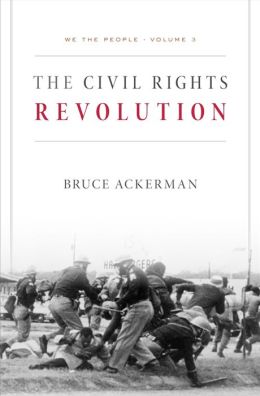
New Release: Ackerman, "We the People, Volume 3: The Civil Rights Revolution"
New from Harvard University Press: the third volume of Bruce Ackerman's We the People. From the Press:
The Civil Rights Revolution carries Bruce Ackerman’s sweeping reinterpretation of constitutional history into the era beginning with Brown v. Board of Education. From Rosa Parks’s courageous defiance, to Martin Luther King’s resounding cadences in “I Have a Dream,” to Lyndon Johnson’s leadership of Congress, to the Supreme Court’s decisions redefining the meaning of equality, the movement to end racial discrimination decisively changed our understanding of the Constitution.
Ackerman anchors his discussion in the landmark statutes of the 1960s: the Civil Rights Act of 1964, the Voting Rights Act of 1965, and the Fair Housing Act of 1968. Challenging conventional legal analysis and arguing instead that constitutional politics won the day, he describes the complex interactions among branches of government—and also between government and the ordinary people who participated in the struggle. He showcases leaders such as Everett Dirksen, Hubert Humphrey, and Richard Nixon who insisted on real change, not just formal equality, for blacks and other minorities.
A few blurbs:The Civil Rights Revolution transformed the Constitution, but not through judicial activism or Article V amendments. The breakthrough was the passage of laws that ended the institutionalized humiliations of Jim Crow and ensured equal rights at work, in schools, and in the voting booth. This legislation gained congressional approval only because of the mobilized support of the American people—and their principles deserve a central place in the nation’s history. Ackerman’s arguments are especially important at a time when the Roberts Court is actively undermining major achievements of America’s Second Reconstruction.
“Bruce Ackerman has already transformed our understanding of the Constitution and constitutional interpretation. With this essential volume, he enables us to view the civil rights revolution in an entirely new way.”—Laura Kalman
“The American people have reconstructed their constitutional system from time to time, but these ‘constitutional moments’ never roll out exactly the same way. The Civil Rights Revolution, the third volume of the Ackerman synthesis, sorts through the differences among these transformations, bringing to light the common principles and processes that impart foundational status to their institutional and normative commitments. Today, with the legacy of the civil rights revolution in doubt, Ackerman’s benchmarks are invaluable, both for assessing the constitutional commitments established in those years and for evaluating the legitimacy of efforts to upend them.”—Stephen SkowronekMore information is available here.
Konig on Thomas Jefferson, Antislavery Lawyer
On March 28, David Konig, Washington University, will present the paper “Thomas Jefferson, Antislavery Lawyer” to the Early American Seminar Series at the University of Maryland. The respondent is Maryland’s Ashley Towle. According to the Seminar:
Free and open to all, the Early American Seminar Series brings senior scholars, junior faculty, and advanced graduate students to College Park to discuss their work in progress. The seminar is composed of graduate students and faculty from the University of Maryland and a host of other area institutions and is convened by Professors Rick Bell, Holly Brewer, Clare Lyons, and Whit Ridgway.
The seminar meets at regular intervals throughout the academic year on Fridays at 5pm in Taliaferro Hall 2110. Papers (typically 30-40 pages) are pre-circulated among seminar participants seven days in advance of each meeting. The ninety-minute workshop is followed by dinner with the presenter at a local restaurant.
To join the seminar email list or to apply to present a work in progress in future cycles, please contact Prof. Rick Bell (rjbell@umd.edu) or Prof. Holly Brewer (hbrewer@umd.edu).
Medieval Legal History: An ASLH "Preconference"
[We're moving this post up, as the deadline of April 1 is approaching.]
[Via H-Law, we have the following call for submissions for a preconference at next year's annual meeting of the American Society for Legal History.]
The American Society for Legal History (ASLH) invites paper submissions for its second annual pre-conference workshop, which will be held immediately preceding the ASLH annual meeting in Denver on Nov. 6, 2014. The ASLH Workshop is intended to promote scholarship in areas of legal history that have been traditionally underrepresented at ASLH meetings and in the Law and History Review. This year's workshop topic is Medieval Legal History, with medieval broadly defined as between late antiquity and early modernity. We are particularly interested in papers discussing Byzantine, Canon, Chinese, Islamic, or Jewish law, as well as other legal traditions or systems that operated in wide-ranging parts of the medieval world. The workshop is being sponsored by the ASLH in order to promote innovative approaches to the study of medieval legal history across geographic boundaries and to create a community of legal historians who grapple with medieval legal texts and contexts.
 The ASLH Legal History Workshop will bring together authors and noted scholars in the field in order to work collaboratively toward refining scholarly writing. In order to keep the workshop size small, only three to four papers will be selected from among responses to this general call. Each selected paper will be assigned one commentator who will prepare substantive feedback about the structure, organization, methodology, and theoretical approaches of the paper. All papers will be pre-circulated to participants and to commentators in advance of the workshop and must be read prior to the workshop meeting. Authors will not present their papers. At the workshop, each commentator will be given half an hour to discuss his/her assigned paper, followed by an hour of general discussion in the larger group. In this way, each individual author will receive feedback from all the participants of the workshop. ASLH will provide limited funding for travel expenses and accommodations for authors of selected papers. (Participation in the ASLH Legal History Workshop does not preclude individuals from presenting at the ASLH annual meeting.)
We invite submissions that engage any aspect of medieval legal history from scholars at any point in their academic careers. Interested authors should submit their work-in-progress papers to aslh.workshop@gmail.com on or before April 1, 2014. Papers should include complete contact information, word count, and an abstract (identifying the geographic and temporal scope of the article); papers should not exceed 15,000 words (including footnotes). Submissions must not have already appeared in print or have been accepted for publication. Authors of selected papers will be informed on or before June 15, 2014. Please direct questions to the ASLH Workshop Coordinator: Lena Salaymeh, Robbins Postdoctoral Fellow (lenas@law.berkeley.edu).
By participating in the workshop, authors agree to revise their papers thoroughly and to submit them for publication consideration (i.e. blind peer review) with Law & History Review on or before February 1, 2015. (Submissions to Law & History Review should be not more than 12,000 words, including footnotes.) Upon peer review approval, Law & History Review will publish the papers either together (in an issue dedicated to medieval legal history) or separately. Authors participating in the Workshop consent to publishing in Law & History Review, even if publication delays occur. However, participation in the ASLH Workshop is not a guarantee of publication in the Law & History Review. (Also, the ASLH Workshop organizers and the Editor of Law & History Review cannot guarantee a specific publication date.)
[Via H-Law, we have the following call for submissions for a preconference at next year's annual meeting of the American Society for Legal History.]
The American Society for Legal History (ASLH) invites paper submissions for its second annual pre-conference workshop, which will be held immediately preceding the ASLH annual meeting in Denver on Nov. 6, 2014. The ASLH Workshop is intended to promote scholarship in areas of legal history that have been traditionally underrepresented at ASLH meetings and in the Law and History Review. This year's workshop topic is Medieval Legal History, with medieval broadly defined as between late antiquity and early modernity. We are particularly interested in papers discussing Byzantine, Canon, Chinese, Islamic, or Jewish law, as well as other legal traditions or systems that operated in wide-ranging parts of the medieval world. The workshop is being sponsored by the ASLH in order to promote innovative approaches to the study of medieval legal history across geographic boundaries and to create a community of legal historians who grapple with medieval legal texts and contexts.
The ASLH Legal History Workshop will bring together authors and noted scholars in the field in order to work collaboratively toward refining scholarly writing. In order to keep the workshop size small, only three to four papers will be selected from among responses to this general call. Each selected paper will be assigned one commentator who will prepare substantive feedback about the structure, organization, methodology, and theoretical approaches of the paper. All papers will be pre-circulated to participants and to commentators in advance of the workshop and must be read prior to the workshop meeting. Authors will not present their papers. At the workshop, each commentator will be given half an hour to discuss his/her assigned paper, followed by an hour of general discussion in the larger group. In this way, each individual author will receive feedback from all the participants of the workshop. ASLH will provide limited funding for travel expenses and accommodations for authors of selected papers. (Participation in the ASLH Legal History Workshop does not preclude individuals from presenting at the ASLH annual meeting.)We invite submissions that engage any aspect of medieval legal history from scholars at any point in their academic careers. Interested authors should submit their work-in-progress papers to aslh.workshop@gmail.com
By participating in the workshop, authors agree to revise their papers thoroughly and to submit them for publication consideration (i.e. blind peer review) with Law & History Review on or before February 1, 2015. (Submissions to Law & History Review should be not more than 12,000 words, including footnotes.) Upon peer review approval, Law & History Review will publish the papers either together (in an issue dedicated to medieval legal history) or separately. Authors participating in the Workshop consent to publishing in Law & History Review, even if publication delays occur. However, participation in the ASLH Workshop is not a guarantee of publication in the Law & History Review. (Also, the ASLH Workshop organizers and the Editor of Law & History Review cannot guarantee a specific publication date.)
Monday, March 10, 2014
Women's Legal History: A Reading List
In observance of Women's History Month, over at Gender and the Law Blog Tracy Thomas, Akron Law, has posted a reading list on women's legal history.
Walker on the Progressive Origins of Mass Incarceration
Anders Walker, Saint Louis University School of Law, has posted The New Jim Crow? Recovering the Progressive Origins of Mass Incarceration, which is forthcoming in the Hastings Constitutional Law Quarterly. Here is the abstract:
This article revisits the claim that mass incarceration constitutes a new form of racial segregation, or Jim Crow. Drawing from historical sources, it demonstrates that proponents of the analogy miss an important commonality between the two phenomena, namely the debt that each owe to progressive and/or liberal politics. Though generally associated with repression and discrimination, both Jim Crow and mass incarceration owe their existence in part to enlightened reforms aimed at promoting black interests; albeit with perverse results. Recognizing the aspirational origins of systematic discrimination marks an important facet of comprehending the persistence of racial inequality in the United States.
Sunday, March 9, 2014
Sunday Book Roundup
This week the internet world of book reviews is light on legal history. But the Washington Post has an engaging review of Myra MacPherson's The Scarlet Sisters: Sex, Suffrage and Scandal in the Gilded Age (Twelve).
Two pieces this week, one in the Washington Post and a second in the New York Times, write about Peniel E. Joseph's Stokely, A Life (Basic).
The Los Angeles Review of Books has a detailed review of The Death Penalty, Volume I: The Seminars of Jacques Derrida translated by Peggy Kamuf (University of Chicago Press)."Given how much scurrilous chatter surrounded the sisters, and how far they bent the truth to suit their ends, MacPherson is often tasked with choosing between rival tall tales. However, she resists the temptation to pick the most flattering story and cast the sisters simply as progressive heroines. Both were willing to use their femininity, as well as their feminism, to get what they wanted; Victoria especially could be self-centered and obsessed with her own persecution; and both sisters became conservative in later life, publicly repudiating most of their “sex radical” beliefs.
They left New York for London in 1877, in the wake of the Beecher trial, and “decided to use draconian measures to sanitize their image.” Like many of their most outlandish ruses, it worked — within a few years, both were married to wealthy Englishmen. By the early 20th century, they were recognized as suffrage pioneers, although to improve society they now prescribed religion and eugenics rather than female emancipation."
Common-Place reviews three books on emancipation in a piece titled, "The (Not So) Distant Kinship of Race, Family, and Law in the Struggle for Freedom." Books reviewed are Rebecca J. Scott and Jean M. Hébrard's Freedom Papers: An Atlantic Odyssey in the Age of Emancipation (Harvard University Press), Sydney Nathans's To Free a Family: The Journey of Mary Walker (Harvard University Press), and Mark Auslander's The Accidental Slaveowner: Revisiting a Myth of Race and Finding an American Family (University of Georgia Press)."Jacques Derrida’s The Death Penalty (Volume I), the first half of a two-year seminar he gave from 1999 to 2001 in Paris and then again at American universities, offers a new perspective on the vexing, seemingly intractable debates that surround capital punishment in this country. The book’s appearance will undoubtedly be greeted with enthusiasm by those who have read and appreciated Derrida’s writings for some time (and there are many), but do its observations and arguments have the potential to reach a broader audience? During his lifetime, Derrida’s scholarly work exerted enormous influence on academic practices around the world, profoundly changing the ways people in numerous disciplines thought and wrote about thinking and writing. Like Jean-Paul Sartre or Michel Foucault, Derrida also came to enjoy considerable celebrity beyond the ivory tower. Profiled in news features and documentary films, he met with world leaders and figured in pop songs. His impact beyond the academy was registered in more subtle ways, as well. To this day, many who have never read a word of his work casually use the verb “to deconstruct.” For his part, Derrida expressed considerable unease about the “temptation” for intellectuals to “renounce the academic discipline normally required ‘inside’ the university and to try instead to exert pressure through the press and through public opinion, in order to acquire an influence or a semblance of authority that has no relation to their own work.”"
Two pieces this week, one in the Washington Post and a second in the New York Times, write about Peniel E. Joseph's Stokely, A Life (Basic).
"With “Stokely: A Life,” the historian Peniel E. Joseph says he set out to “recover” Stokely Carmichael, the man who popularized the phrase “black power” and led the Student Nonviolent Coordinating Committee, known as SNCC, a man whose diminished historical footprint, Mr. Joseph writes, “impoverishes our understanding of the most important movement in our national history.”"New Books in History talks with Jose Angel Hernandez, author of Mexican American Colonization during the Nineteenth Century: A History of US-Mexico Borderlands (Cambridge).
On HNN, Rot, Riot, and Rebellion: Mr. Jefferson's Struggle to Save the University that Changed America (University of Virginia Press) by journalists Rex Bowman and Carlos Santos is reviewed."Americans talk a lot about the flow of Mexican immigrants across their southern border. To some that flow is seen as patently illegal and dangerous. To others it’s seen as unstoppable and essential for the functioning of the U.S. economy. Everyone agrees that something must be done about it though, in fact, little is ever done. It’s an American problem that seems to have no American solution. But, as José Angel Hernández points out in his pathbreaking book Mexican American Colonization during the Nineteenth Century: A History of the U.S.-Mexico Borderlands (Cambridge University Press, 2012) , it’s not just an American problem: it’s also a Mexican one and always has been. "
Saturday, March 8, 2014
A Socio-Legal History of the Fiscal State
As I mentioned in the conclusion of my last post, I thought I
would share with LHB readers how I came to write a socio-legal history of the
modern fiscal state.

 Like many first books by academics, Making the Modern American Fiscal State began as a
dissertation. After graduating from law
school and working for a couple of years in the field of taxation and
structured finance, I entered graduate school to study American intellectual
and legal history. I had intended to
write a thesis exploring the economic ideas undergirding modern American law
and political economy, a sort of cross between the work of Ed Purcell and
Martin Sklar.
Like many first books by academics, Making the Modern American Fiscal State began as a
dissertation. After graduating from law
school and working for a couple of years in the field of taxation and
structured finance, I entered graduate school to study American intellectual
and legal history. I had intended to
write a thesis exploring the economic ideas undergirding modern American law
and political economy, a sort of cross between the work of Ed Purcell and
Martin Sklar.
Like many first books by academics, Making the Modern American Fiscal State began as a
dissertation. After graduating from law
school and working for a couple of years in the field of taxation and
structured finance, I entered graduate school to study American intellectual
and legal history. I had intended to
write a thesis exploring the economic ideas undergirding modern American law
and political economy, a sort of cross between the work of Ed Purcell and
Martin Sklar.
In fact, Purcell’s Crisis
of Democratic Theory was an inspirational book for me. It was an assigned text in college (in a
survey course with David Hollinger), in law school (in a Jurisprudence class
with Gary Peller), and in graduate school (in a seminar with Amy Stanley). But while I came to grad school with a particular
set of interests, a funny thing happened along the way.
Weekend Roundup
 |
| Philip Girard |
- Philip Girard (Osgoode Hall Law School), a recently named honorary fellow of the American Society for Legal History, is scheduled to give the plenary address at this year's annual meeting. (Hat tip: Canadian Legal History Blog)
- Via In Custodia Legis: The Magna Carta is coming to the Library of Congress.
- Stop defending the humanities? Simon During makes the case. (Hat tip: Arts & Letters Daily)
- Via H-Law: the Center for Presidential History at Southern Methodist University has announced a call for short articles on the Election of 2004.
- If you're in New Haven, check out the Yale Law Library's new exhibit, "350 Years of Rebellious Lawyering."
- Legal History Blogger Tomiko Brown-Nagin, Harvard Law School, is to deliver the Maurice and Muriel Fulton Lecture in Legal History at the University of Chicago Law School on May 8, 2014.
- "A Constitutional History of the Long 1960s,” Risa Goluboff’s lecture on November 12, 2013, marking her appointment as John Allan Love Professor of Law at the University of Virginia School of Law is downloadable here.
Friday, March 7, 2014
Kennedy to Lecture on Thurgood Marshall at N-YHS
The New-York Historical Society is offering a limited number of free tickets to the latest lecture in the Barnard and Irene Schwartz Distinguished Speakers Series, Justice Thurgood Marshall, to be delivered by Randall Kennedy of the Harvard Law School. According to the announcement:
As a powerful voice in the battle for Civil Rights and the first African American appointed to the nation's highest court, Justice Thurgood Marshall was among the scores of African Americans across the country who were conquering color barriers in government, sports, music, and culture. Randall Kennedy, former law clerk to Justice Marshall, offers an in-depth look at this monumental figure and his enduring legacy.The lecture will take place at the Society on Tuesday, March 11, commencing at 6:30 PM. To obtain a free ticket, “please use code HIST77 when ordering over the phone at (212) 485-9268 or in person at the Museum Admission desk.” The offer is not available online.
Subscribe to:
Posts (Atom)