Showing posts with label interview. Show all posts

Friday, May 26, 2023

Guido’s Religious Egalitarianism - Redburn on "Outside In: The Oral History of Guido Calabresi

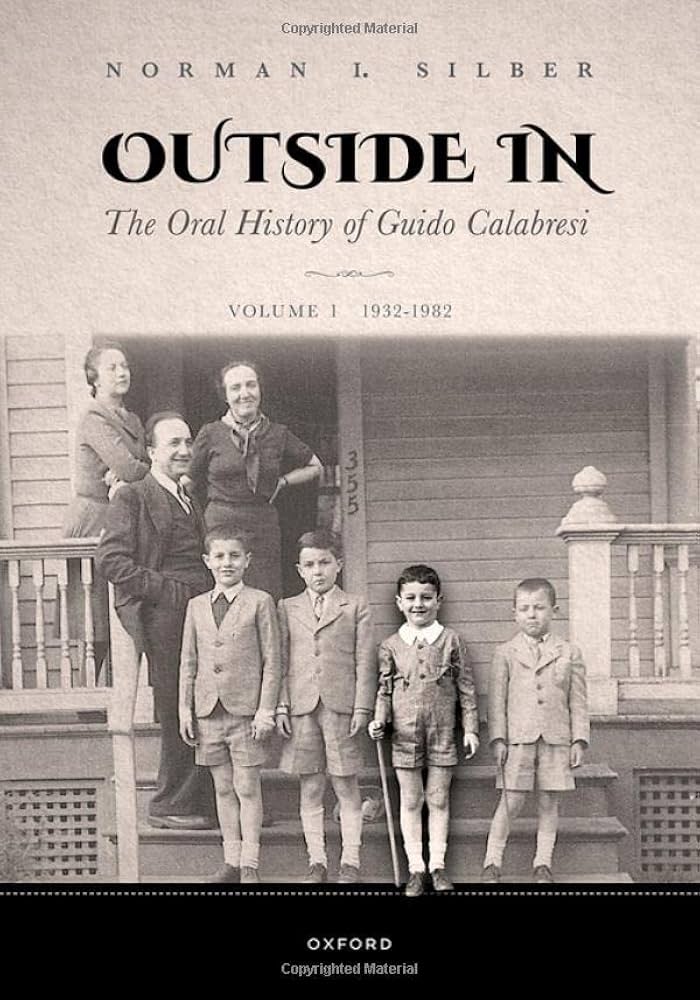
This post, by Kate Redburn, is the seventh in a series of posts in which legal historians reflect on Outside In: The Oral History of Guido Calabresi (Oxford University Press), by Norman I. Silber. Redburn is currently an Academic Fellow at Columbia Law School.

Guido Calabresi is famous for his transformative scholarship on torts, his leadership as dean of Yale Law School, and his tenure on the Second Circuit Court of Appeals. But above and beyond those accolades, Guido defines himself as an outsider, “a Catholic Jewish Italian,” (OI, v.1, 104) “an immigrant, and a refugee” (OI, v1, 1). In this post, I want to suggest that the religious dimension of Guido’s outsider experience is reflected in his famous majority opinion in Galloway v. Town of Greece. Normally I would be hesitant to read the personal biography so directly into judicial philosophy, but Outside In encourages it. Readers can’t help but see the conversation between volume one, a narrative oral history of Guido’s childhood through early adulthood, and volume two, a more thematic look at his work as dean and judge. In my own reading, I was struck by how much of Guido’s youth was shaped by the tension between religious inclusion and exclusion, and how Guido connects that experience to his “egalitarian believer’s First Amendment” (TOC).
 
Guido’s religious heritage made him both sensitive to being an outsider and appreciative of religious pluralism. Both of his parents had roots in the small community of Jews in Italy (his mother converted to Catholicism), marking his family as outsiders even before the rise of fascism drove them across the Atlantic. And as he narrates in volume one of Outside In, the starkest experiences of being an outsider came in his family’s transition to life in the United States.
 
The social terrain of mid-century New Haven was defined in large part by religious and ethnic differences. An historically Congregationalist town, the New Haven that greeted the Calabresi family was also home to Catholic and Jewish communities where they might have found fellowship. The Calabresis were outsiders even here, however. As migrants from wealthy northern Italian Jewish extraction, they felt little commonality with the southern Italian-American community in Wooster Square, or the Ashkenazim at a local summer camp (OI, v1, Ch. 5). In Guido’s words, “We really did not belong to anyone” (OI, v.1, 101).

Dwight Hall YMCA building at Yale (credit)

New Haven was also Guido’s introduction to the American civic religion – a kind of non-denominational Christian public faith present in his Boy Scout Troop and public schooling (OI, v.1, 102-103). Although he was sensitive to the pressure on Italian Americans to assimilate, he also appreciated the welcoming Protestant community that embraced the young brothers. One anecdote is particularly illuminating – after trying out a Jewish summer camp and a Catholic school, someone suggested to Guido’s parents that they send the boys to a YMCA camp. “The idea of some association that would define itself as ‘Christian’ sounded anti-Semitic,” at first, but they were informed that the YMCA was an inclusive place, “open to everybody” (OI, v.1, 101-102). Guido remembers it fondly.
 
With the benefit of hindsight I was struck by the parallels between this story and Guido’s opinion in Town of Greece. The case arose in a suburb of Rochester, New York, where town officials invited local clergy to open monthly town meetings with a prayer. Over eight years, every prayer was offered by a Christian leader, with only four exceptions. According to the record on appeal, two-thirds of the prayers had overtly Christian theological references. Two residents objected that the use of Christian prayers in city government violated the Establishment Clause by giving Christianity preferential treatment through “sectarian” religious practice. Town officials responded that they had only invited Christian clergy because there were no places of worship for other faiths within the town boundaries. The Supreme Court’s Establishment Clause precedents turned the Second Circuit’s attention toward the content of the prayers – whether they promoted particular Christian denominations, or instead reflected a non-denominational message.

Town Hall, Town of Greece (credit)

But Guido saw things differently. The important issue was not the content of any particular legislative prayer, but whether the practice “conveyed the view that the town favored or disfavored certain religious beliefs.” (Galloway v. Town of Greece, 681 F.3d 20, 29 (2d Cir. 2012). By selecting (essentially) only Christian prayers, town officials had “affiliated the town with a single creed.” (at 22). The opinion reasoned that government cannot define the religious character of a civic institution to the exclusion of other faiths. Unlike the YMCA of his childhood, whose Christian identity informed its inclusivity, the Town of Greece risked an exclusionary religious affiliation.
 
Reflecting on the opinion in Outside In, Guido explains: “My compromise was one that said, ‘You can have local establishments, locally defined identities, so long as you do it in a way that also states that your place is open to everybody.’” (OI, v.2, 330). The problem from Guido’s point of view was not religion in public life, but religious exclusivity. If the town opened up the selection process in an inclusive way, “the town can also have plenty of Christian prayer leaders” without any problem. (OI, v.2, 330). His view of the issue celebrates free exercise as a progressive value while emphasizing that religious equality cannot thrive where some faiths are excluded.
 
The Supreme Court reversed the Second Circuit, reasoning that Town of Greece’s prayer practice was constitutional because it did not coerce non-Christians. Justice Kennedy’s majority opinion asserted that attendees at the meeting would presume that an opening prayer was meant to solemnize the proceedings, not to define the polity as Christian. This kind of coercion analysis has become a lodestar of contemporary Establishment Clause cases, including last term’s Kennedy v. Bremerton School District, which found no coercion where a football coach – who had previously prayed with and given religious speeches to his players – invited both teams to pray with him on the fifty-yard line after games ended.
 
In Guido’s alternative, “coercion is of course forbidden, but it is not enough” (OI, v.2, 331). He would draw the Establishment Clause line beyond coercion, to prohibit religiously-motivated exclusion. And while this principle derives from caselaw, it also reflects his childhood experience.  He explains that “growing up in New Haven, I never felt coerced, but nevertheless, I did not like it when we recited the Lord’s Prayer, Protestant version, in all these local elementary schools, which were loaded with Irish Catholic kids” (OI, v.2, 331). In other words, his interpretation of the Establishment Clause protects against more than active inducement to a particular religious practice. The appellate decision in Town of Greece, and the foundational school prayer decisions that undergirded it, drew the line instead at government imbuing public institutions or spaces with religious identities that would leave outsiders feeling excluded.

-- Kate Redburn

Thursday, May 11, 2023

Guido Calabresi and the “Economic Style,” Part 3: Partial Views and “Pearls Beyond Price”

This post, by Karen Tani (University of Pennsylvania), is the fourth in a series of posts in which legal historians reflect on Outside In: The Oral History of Guido Calabresi (Oxford University Press), by Norman I. Silber.

In earlier posts in this series, I suggested the fruitfulness of placing Guido Calabresi’s career alongside the rise of what sociologist Elizabeth Popp Berman has called “the economic style of reasoning”—an approach to governance that flourished in the later decades of the twentieth century and remains prominent. [All the Berman quotes in what follows are from Thinking Like an Economist: How Efficiency Replaced Equality in U.S. Public Policy (Princeton University Press, 2022) (“TLE”).] My first post described Calabresi’s education in economics and in law, as recounted in Outside In. My second post turned to his scholarship and began to explore its fit with “the economic style.” When I left off, I had covered Calabresi's writings on “the decision for accidents” (a.k.a. “the cost of accidents”), and I had mentioned both his excitement and his discomfort at the growing influence of Law & Economics. Looking back on this period, Calabresi said this to Silber: “Because of the way the field was taking off, I was becoming afraid that people would start to think of the economic approach to law as the only thing that is legal scholarship” (OI, v.1, 332).*

Rouen Cathedral, West Façade, Sunlight, 1894 by Claude Monet

This worry is apparent in the use of the phrase “one view of the Cathedral” in the subtitle of Calabresi’s famous 1972 article (with Douglas Melamed) on “Property Rules, Liability Rules, and Inalienability.” Calabresi explains:

[B]ecause of a generic reference Harry Wellington made, I called it “One View of the Cathedral.” I do not think Harry was talking about law and economics at the time; he was talking about art and about how you couldn’t understand the cathedral at Reims by looking at only one of Monet’s impressionist paintings. To understand . . . you had to look at all the paintings. I liked that, and I used it because I wanted to say that law and economics was one important way of looking at legal issues, but it was not the only way.
(OI, v.1, 331). [Image at right: Rouen Cathedral, West Façade, Sunlight, 1894 by Claude Monet, oil on canvas. Credit: National Gallery of Art.]
 
This caveat is important because the article undoubtedly did further expand economics into law--from Torts into Property and beyond. And the intervention was framed in such a way that others felt inspired to push further. As Silber’s commentary explains, “[the article] attracted attention quickly, and a small swarm of academics stepped forward to build upon the ‘Cathedral’ approach” (that is, a modeling approach, in which one plays with different possible configurations of private law rights and remedies and asks about their consequences) (OI, v.1, 337). Soon Calabresi and Melamed’s schema “was being applied to scores of legal fields of study and invoked in many cases” (OI, v.1, 339).

Tuesday, May 9, 2023

Guido Calabresi and the “Economic Style,” Part 2: On "Economic Methods" and "Social Democratic Values"

This post, by Karen Tani (University of Pennsylvania), is the third in a series of posts in which legal historians reflect on Outside In: The Oral History of Guido Calabresi (Oxford University Press), by Norman I. Silber.
 
In an earlier post in this series, I suggested the fruitfulness of placing Guido Calabresi's career alongside the rise of what sociologist Elizabeth Popp Berman has called “the economic style of reasoning”—an approach to governance that flourished in the later decades of the twentieth century and remains prominent. [All the Berman quotes in what follows are from Thinking Like an Economist: How Efficiency Replaced Equality in U.S. Public Policy (Princeton University Press, 2022) ("TLE").] That first post described Calabresi’s education in economics and in law, as recounted in Outside In. This post turns to his scholarship and asks about how it fits (or doesn't) with “the economic style.” This question holds interest because the spread of “the economic style” had consequences—which I’ll address in more depth in a subsequent post.
 
As I noted in my last post, “the economic style of reasoning” is Berman’s term for “a distinctive way of thinking about policy” that became visible in Washington “as early as the 1950s, but really spread in policymaking between about 1965 and 1985” (TLE 3, 5). Berman’s account is nuanced, emphasizing that “the economic style” had multiple points of origin*, that various factors contributed to its spread within government, and that the economists at the core of her account “were neither monolithic nor monomaniacally committed to efficiency” (TLE  16). Nonetheless, she does identity two “stances” that are at the “core” of the “the economic style” (TLE 6). The first is “a deep appreciation of markets as efficient allocators of resources” (TLE 6). Importantly, this does not translate into a consistent preference for deregulation or minimal government, but it does mean the application of “a market lens” to all sorts of problems and “an affinity for introducing market-like elements . . . into areas, such as education or healthcare, that are not governed primarily or solely as markets” (TLE 6). The second is a tendency to “place[] a very high value on efficiency as the measure of good policy” (TLE 6). This value might come into play when deciding the best way to achieve a democratically chosen objective. It might also come into play earlier in the process, when deciding which objectives should be pursued. (For more on this argument, without reading the full book, check out Berman's September 2022 LPE blog post.)  
 
To what extent are these “core stances” apparent in Calabresi’s work? As a dilettante in the world of Law & Economics, I am not the best positioned to answer this question, but I can convey what Outside In suggests and hope to generate further conversation. (I can also point readers to more expert discussions of Calabresi's scholarly legacy, such as the contributions to this 2014 special issue of Law & Contemporary Problems.)  
 
There is no doubt that Calabresi’s writings, alongside those of Ronald Coase and others, brought economics precepts and insights into legal domains where they had not previously had much purchase. Here is Calabresi** in Outside In discussing the influence of Coase’s “The Problem of Social Cost” and his “Some Thoughts on Risk Distribution and the Law of Torts”: 

Of course, the interplay of law and economics was there before; but the relationship had focused on particular areas of law where economics had been directly relevant, like antitrust. What Coase’s article and mine did was to invite—indeed to require—people to look at areas of law that were not expressly focused on economics, like torts. In fact, to look at the legal system generally.” 

(OI, v.1, 228) (emphasis added). At this early stage of his career, Calabresi also encountered critics who seemed appalled by what he was doing—to which his general response was to concede that economic theory could not always supply an answer, but to insist that this “most dismal of theories” (as he jokingly put it in “Some Thoughts”) might still yield important insights.

Thursday, May 4, 2023

Legal Historians’ Reflections on “Outside In: The Oral History of Guido Calabresi” – Introduction

As we noted earlier this year, Oxford University Press recently published a two-volume oral history (titled Outside In) of the well-known legal scholar, former law school dean, and federal judge Guido Calabresi. Author Norman I. Silber (Hofstra University) conducted many interviews with Calabresi over a period of years, then arranged the contents of the interviews into chapters, which he supplemented with commentary (his own original research on the topics and figures in each chapter). (The TOC is available here.)
 
The oral histories will be a fascinating read for the many people who have encountered Calabresi over the course of his life, including his many former students and colleagues, his scholarly interlocutors, and the lawyers and litigants who have appeared before him as a judge on the U.S. Court of Appeals for the Second Circuit. 

But the oral histories are also a treasure trove for legal historians, as our forthcoming series of posts will show. Over the coming weeks, we will post reflections from scholars who were once law clerks for Calabresi and who have since made careers out of the study of legal history. Stay tuned! 

-- Karen Tani

Wednesday, October 14, 2020

Zelden on Talking Legal History

 New on “Talking Legal History” with Siobhan M. M. Barco is her interview of Charles L. Zelden

"about the new expanded edition of his book, Bush v. Gore: Exposing the Growing Crisis in American Democracy (University Press of Kansas, 2020). Zelden is a professor in the Department of History and Political Science at Nova Southeastern University’s Halmos College of Arts and Sciences, where he teaches courses in history, government and legal studies.

"In this third expanded edition Zelden offers a powerful history of voting rights and elections in America since 2000. Bush v. Gore exposes the growing crisis by detailing the numerous ways in which the unlearned and wrongly learned “lessons of 2000” have impacted American election law through the growth of voter suppression via legislation and administrative rulings, and, provides a clear warning of how unchecked partisanship arising out of Bush v. Gore threatens to undermine American democracy in general and the 2020 election in particular."
–Dan Ernst

Thursday, March 7, 2019

Scholar Spotlight: Helle Vogt

Today's Scholar Spotlight interview features Helle Vogt, University of Copenhagen. In our earlier interviews, we noted that only three of the fifty contributors to the recently published Oxford Handbook of European Legal History were women. Like Women Also Know History, this Scholar Spotlight series aims to showcase female scholars and their work. Its special focus is scholars of European legal history. 


Helle Vogt is a professor at the University of Copenhagen (UCH).


Alma maters:  2001 MA in History (UCH), 2005 PhD in Legal science (UCH) 2009, BA in Law (UCH)

Fields of interest: Scandinavian legal history, primarily medieval and early modern. Family, inheritance and penal law, as well as the connection between law and religion. Currently, I am also core scholar at the interdisciplinary Centre for Privacy Studies, a centre of excellence founded by the National Research Council. The Centre focuses on early modern privacy. The Centre’s focus is on how the notion of the private starts to be developed in the early modern period. My work in the Centre is two-fold. I participate in the case-team that works with Copenhagen, and I help my non-legal history colleagues work with legal sources.

Describe your career path. What led you to where you are today? I started as an historian and wanted to work at a museum, but after I finished my MA, I could only get a job as sale assistant. When I was offered a PhD-scholarship in legal history, I thought it would increase my chances of a museum job, but after 3 years at a law faculty, I was labelled a lawyer, and after a while, I decided to get the official qualifications as well. At the same time, I was given the responsibility for the mandatory course in legal history and was made assistant professor in 2007, 2 years later associate, and last year I got the chair.

What do you like the most about where you live and work? Copenhagen is a pleasant town to live in, and I agree with the basic principles of the Danish welfare state – most people are middle class, and things like health care and education (including university education) are free. I have a lot of freedom in my job, good opportunities to do interdisciplinary work, and not least, I have great colleagues at the faculty.

What projects are you currently working on? A textbook about Danish legal history in a European context for the mandatory BA course in legal history, an article about drunkenness and disorder in the Danish courts, and how the concept of privacy is used in the eighteenth-century Danish newspapers.

Have your interests evolved since finishing your studies? Yes, teaching 2000 years of legal history makes it very difficult not to want to get interested in a lot of different aspects of legal history, even property law, which I would never have thought possible ten years ago. However, the Danish laws from the middle ages have a special place in my heart, and one of the main reasons for translating them into English (Routledge, 2016) was to share these wonderful sources with my non-Nordic speaking colleagues.

What is the most fascinating thing you have ever found in your primary sources? In 2007 I was gathering material for a little article about how the Danish-Norwegian Lutheran state dealt with noble killers in the sixteenth century. A year after the Reformation (1536) wergeld was replaced with ‘a life for a life’ for all non-nobles. The courts, however, did not know how to deal with noble killers, and put them into the hands of the king. I was very surprised to find out that the king gave most of them the choice between losing their honour forever or going to Austria and joining the fight against the Turks. It was fascinating to see how the king managed to balance honour and religious atonement. 

Thursday, February 14, 2019

Scholar Spotlight: Sara McDougall

Our Scholar Spotlight series continues, today featuring Sara McDougall, John Jay College and CUNY Graduate Center. In our first interview, we noted that only three of the fifty contributors to the recently published Oxford Handbook of European Legal History were women. Like Women Also Know History, this Scholar Spotlight series aims to showcase female scholars and their work. Its special focus is scholars of European legal history. 

Sara McDougall is Associate Professor of History at John Jay College of the City University of New York (CUNY) and appointed to the CUNY Graduate Center in French, History, and Medieval Studies. She lives in New York.


Alma maters: Yale University, Ph.D. in History, May 2009. BA in History Boston University, 2003.

Fields of interest: legal history, family history and family law, culture, gender studies, social history, comparative law, medieval studies, world history.

Describe your career path. What led you to where you are today?
My childhood dream was to become an opera singer and I started college as a voice performance major but was shocked to find myself desperately missing reading and writing. I seriously flirted with the idea of becoming a playwright but in the end it was reading and writing and teaching history, legal history, that I found the most satisfying and engaging way of spending most of my time, and I still feel that way.

What do you like the most about where you live and work?
I love the social justice mission of John Jay College, and our wonderfully diverse student body. I find teaching at CUNY satisfying - if always challenging - and take greatest pleasure in the fact that graduating from CUNY seems to improve students' economic mobility out of poverty. I am also really looking forward to co-teaching a graduate seminar with Julie Suk in 2019, "Mothers-in-Law," which will examine the legal history of mothers as legal subjects, as lawmakers, and as lawbreakers.

What projects are you currently working on? I am writing a book on the consequences of illicit pregnancy for mothers in medieval France. It investigates what women pregnant out of wedlock could do and did do, what was done to and for them. I have found a wide range of responses. They run a gamut from horror stories of domestic violence and killing to far happier stories in which mothers and children are provided for, and the mothers able to find work or husbands, and even able to resume monastic life as nuns (or abbesses!). While late medieval France generally deserves its reputation as a dangerous and intolerant place, for a variety of reasons it was more charitable towards women pregnant out of wedlock than we might expect. Certainly I have been surprised how often the medieval sources suggest efforts at better treatment of pregnant women, and of singlemothers, than we can find in the United States today.
I am also co-authoring an article on infanticide in late medieval Burgundy with Rudi Beaulant, and working as well with a wonderful group of scholars on the long history of infanticide in Europe and the Americas.

Have your interests evolved since finishing your studies? Not really! Many of the topics I write about are those that attracted me to legal history in the first place, the human stories we can find in historical sources, and court records in particular. Comparative work has always been important to me. I am hoping to begin more work with biographical and public-facing history.

What's the most fascinating thing you've ever found in your primary sources?
The records of royal pardon from late medieval France are a treasure trove for the social historian, or for anyone interested in law, culture, gender, or crime, of course. Reading these pardons we are drawn in and drawn out, we find ourselves alternatively rooting for the criminal, or deploring what to us seems like a miscarriage of justice when a villain escapes punishment. The storytelling in these pardon narratives reveal something about us as well as the behaviors of the past they document and justify.
For example, I was surprised and more than a little horrified to find myself cheering after reading a sad story of an abandoned young pregnant woman who at every stage seemed likely to seek to harm her infant and herself, but who instead decided to burn down her lover's house and subsequently sought and obtained royal pardon. I had not expected to find myself ever smiling at arson, but there was something that felt good in that her dangerous act, which allegedly caused no harm or injury beyond loss of property, but which also seemed to take vengeance not just on her lover but on the oppressive and intolerant patriarchy that we might assume would be all too quick to forgive his indiscretion while condemning her for "allowing herself to be impregnated by him." Much harder to enjoy are the all-too frequent accounts of rape and domestic violence that were also pardoned. These pardons, therefore, force us to confront both the complex role of mercy in medieval justice, and also some inconsistencies in our own ideas about right and wrong and the appropriate use of punishment.

Update: read Sara McDougall's recent Made by History op-ed in the Washington Post here.