Showing posts with label legal anthropology. Show all posts

Tuesday, December 7, 2021

Pirie's "Rule of Laws"

Fernanda Pirie, Centre for Socio-Legal Studies, Oxford, has published The Rule of Laws: A 4000-Year Quest to Order the World (Basic Books):

Almost without exception, the laws enforced throughout the world today are modelled on systems developed in Western Europe in the eighteenth and nineteenth centuries. For two hundred years, European colonisers exported their laws everywhere they could. But in many places they weren't filling a void: again and again, they displaced local traditions that were already ancient when Vasco Da Gama first made landfall in India. Even the Romans, first framers of the European tradition, were inspired by earlier precedents.  

Where, then, did it all begin? And what sophisticated approaches to justice have been lost in the drive for uniformity? In The Rule of Laws, anthropologist Fernanda Pirie traces the development of the world's great legal systems - Chinese, Indian, Roman, and Islamic. But she also shows how common people-tribal assemblies, merchants, farmers-have called on laws to define their communities, regulate trade, and resist outsiders. The variety of the world's laws, Pirie reveals, has long been almost as great as the variety of its societies. Although legal principles originating in Western Europe now seem to dominate the globe, a more complicated legal reality persists on the ground, one that is evident everywhere from the influence of Islamic law across the Middle East, to the persistence of traditional codes among nomadic Tibetan yak herders, to the unwritten rules of gangs worldwide.

At the heart of this story is a persistent paradox. Rulers throughout history have used laws to impose order. But they have also offered ordinary people a way to resist authority and to express their diverse visions for a better world. 
--Dan Ernst

Tuesday, December 11, 2018

Kirkby on Modern Jurists and Ancient Law

Coel Kirkby, University of Sydney Law School, has posted Law Evolves: The Uses of Primitive Law in Anglo-American Concepts of Modern Law, 1861-1961, which is forthcoming in the American Journal of Legal History:
This study traces how Anglo-American legal thinkers used primitive law to develop their concepts of modern law in the century from Austin to Hart. It first examines how Maine developed his historical jurisprudence as a form of social evolutionary analysis of law. Next, it traces the development of legal anthropology as a distinct discipline combining the scientific method of participant observation with the legal method of the case study. Finally, it looks at how Hart uses primitive law to make his famous argument that law was ‘the union of primary and secondary rules’. In each case, legal thinkers develop their concepts of modern law through a foundational contrast with primitive law. This is a striking feature of much Anglo-American jurisprudence that cuts across the borders of the positivist, natural, historical, realist, and other schools of jurisprudence. Appreciating these new uses of primitive law is a first step in excavating an intellectual history of legal thought grounded in the context of colonial knowledge.

Thursday, February 1, 2018

Messick on Sharia in Yemen

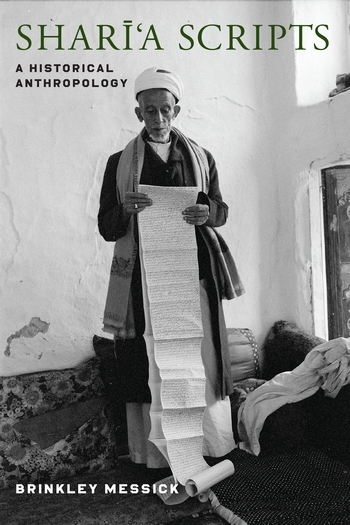
Out this month with Columbia University Press is Shari'a Scripts: A Historical Anthropology by Brinkley Messick, Columbia University. From the publisher: 
Shari'a ScriptsA case study in the textual architecture of the venerable legal and ethical tradition at the center of the Islamic experience, Sharīʿa Scripts is a work of historical anthropology focused on Yemen in the early twentieth century. There—while colonial regimes, late Ottoman reformers, and early nationalists wrought decisive changes to the legal status of the sharīʿa, significantly narrowing its sphere of relevance—the Zaydī school of jurisprudence, rooted in highland Yemen for a millennium, still held sway.  
Brinkley Messick uses the richly varied writings of the Yemeni past to offer a uniquely comprehensive view of the sharīʿa as a localized and lived phenomenon. Sharīʿa Scripts reads a wide spectrum of sources in search of a new historical-anthropological perspective on Islamic textual relations. Messick analyzes the sharīʿa as a local system of texts, distinguishing between theoretical or doctrinal juridical texts (or the “library”) and those produced by the sharīʿa courts and notarial writers (termed the “archive”). Attending to textual form, he closely examines representative books of madrasa instruction; formal opinion-giving by muftis and imams; the structure of court judgments; and the drafting of contracts. Messick’s intensive readings of texts are supplemented by retrospective ethnography and oral history based on extensive field research. Further, the book ventures a major methodological contribution by confronting anthropology’s longstanding reliance upon the observational and the colloquial. Presenting a new understanding of Islamic legal history, Sharīʿa Scripts is a groundbreaking examination of the interpretative range and historical insights offered by the anthropologist as reader.
Praise for the book: 

"Sharīʿa Scripts explores debates within an Islamic legal tradition about the status of writing and thus of recorded truth. This is an impressive piece of work that draws upon the author’s four decades of thought and reading. No one else can move among these Yemeni texts with such assurance, and classic works such as Kitāb al-azhārSharḥ al-azhār, and Sayl al-jarrārare read more closely than any Western academic has attempted previously. A formative and distinguished book." -Paul Dresch

"Multicentury approaches of the sharīʿa have regrettably transformed law into a banal history of ideas without much connection to practice. Messick’s Sharīʿa Scripts instead takes the sharīʿa right from the economy of the local, that of central Yemen, and places research at a micro level. Historical anthropology makes possible the tracing of genealogical lines of power relations, and the depiction of narratives and discourses in relation to local practices. This book, which takes the logic of texts and their practices to new heights, stands out as a masterful contribution to sharīʿa studies worldwide." -Zouhair Ghazzal

"What would be an anthropology of an Islamic juridical tradition? Anthropology aims to describe the whole as lived. Hence the ambition is larger than the historical genealogies or analytical interpretation of textual scholarship. This book examines both the structure of the jurisprudential ‘library,’ using the techniques of textual scholarship, and the ‘archive’ of day-to-day documentation of life in law, situating documents in the practices of writing and orality. Such an undertaking is virtually unique: the late survival of scriptural practice, the living interface of Zaydī and Shāfiʿī traditions, and the political centrality of Islamic jurisprudence made never-colonized highland Yemen of the mid-twentieth century a unique site for such an anthropology. The result is a mature work that quietly destroys clichés ever reproduced not only by journalism (and political revivalist movements) but also by textual scholarship. There cannot be another like it." -Martha Mundy

Further information is available here.