Showing posts with label medical jurisprudence. Show all posts

Thursday, February 18, 2021

Morse on the Insanity Defense

Stephen Morse, University of Pennsylvania Law School, has posted Before and after Hinckley: Legal Insanity in the United States, which is forthcoming in The Insanity Defence: International and Comparative Perspectives (2022), edited by Ronnie Mackay and  Warren Brookbanks:

This chapter first considers the direction of the affirmative defense of legal insanity in the United States before John Hinckley was acquitted by reason of insanity in 1982 for attempting to assassinate President Reagan and others and the immediate aftermath of that acquittal. Since the middle of the 20th Century, the tale is one of the rise and fall of the American Law Institute’s Model Penal Code test for legal insanity. Then it turns to the constitutional decisions of the United States Supreme Court concerning the status of legal insanity. Finally, it addresses the substantive and procedural changes that have occurred in the insanity defense since the wave of legal changes following the Hinckley decision.

--Dan Ernst

Tuesday, January 19, 2021

Thompson on crime, violence, and phrenology

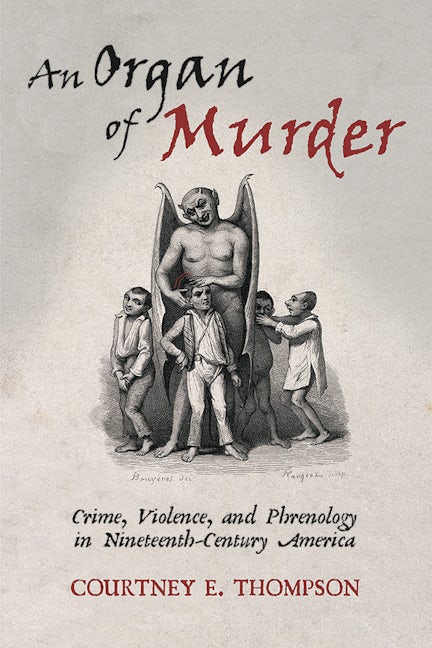
Courtney E. Thompson (Mississippi State University) has published An Organ of Murder: Crime, Violence, and Phrenology in Nineteenth-Century America with Rutgers University Press. From the publisher: 

An Organ of Murder explores the origins of both popular and elite theories of criminality in the nineteenth-century United States, focusing in particular on the influence of phrenology. In the United States, phrenology shaped the production of medico-legal knowledge around crime, the treatment of the criminal within prisons and in public discourse, and sociocultural expectations about the causes of crime. The criminal was phrenology’s ideal research and demonstration subject, and the courtroom and the prison were essential spaces for the staging of scientific expertise. In particular, phrenology constructed ways of looking as well as a language for identifying, understanding, and analyzing criminals and their actions. This work traces the long-lasting influence of phrenological visual culture and language in American culture, law, and medicine, as well as the practical uses of phrenology in courts, prisons, and daily life.

 Praise for the book:

"Courtney Thompson provocatively measures the face, head, and soul of American phrenology and invites us to a discovery of the historical origins of scientific criminology." - Stephen Casper

"In this compelling book, Courtney Thompson takes readers to the prisons, courtrooms, and streets of antebellum cities to expose just how phrenology claimed authority on criminality. Rich in detail and analysis, An Organ of Murder vividly illustrates the long history of making criminal minds and bodies into objects of medical and scientific inquiry." - Carla Bittel

Further information is available here.

--Mitra Sharafi