Showing posts with label prisons; penology. Show all posts

Thursday, April 9, 2026

Ritger's "Houses of Correction"

Matthew Ritger, Dartmouth College, has published Houses of Correction: Carceral Institutions and Humanist Culture in Early Modern England (University of Pennsylvania Press):

More than 250 years before the rise of the modern penitentiary, houses of correction pioneered the use of forced labor and individualized sentences within institutions of confinement, promoting reform and the “hope of amendment” for every individual. Yet these earlier carceral institutions faced many of the problems that remain familiar today: corruption scandals, recidivism, and abuses of power.

In Houses of Correction, Matthew Ritger turns to the archives of England’s first house of correction, Bridewell, to show how humanist reformers provided ideas, justifications, and administration for what came to be called bridewells, workhouses, and “Literary worke-houses,” even as repeated scandals made it clear that these coercive institutions would forever be at odds with the ideals of humanist culture. Examining how the work of writers including More, Shakespeare, and Milton dealt with humanism’s entanglements with these new prisons, Houses of Correction constructs the first book-length literary history of some of early modern Europe’s most influential carceral institutions. 

--Dan Ernst 

Saturday, February 24, 2024

Weekend Roundup

  • John Mikhail, Georgetown Law, has a post up on Balkinization entitled A Reality Check on "Officers of the United States" at the Founding, in which he draws upon the research he conducted on the phrase in connection with his study of the Necessary and Proper Clause.  Much of the research he presents "has been ignored or overlooked in the existing scholarship on Section Three, and most of it does not appear in any of the briefs in Trump v. Anderson."
  • Rosemarie Zagarri and Holly Brewer argue that the anti-monarchical origins of the Constitution and the presidency do not support Former President Trump’s claim of immunity (Brennan Center).   
  • "The Department of History at the University of Alabama invites applications for a full-time Renewable Contract Instructor position. The appointment is for a three-year term with the possibility of renewal. The holder of the position will be expected to serve undergraduate teaching and advising needs in American history, with particular expertise sought in legal and/or constitutional history. Minimum qualifications include a PhD in History or related field. Position begins August 15, 2024."
  • On Wednesday, February 28, at 2pm ET , the FDR Library will livestream the first of five short films on civil rights that it will release this year, “created from interviews with our expert advisory panel for the Special Exhibit: Black Americans, Civil Rights, and the Roosevelts 1932-1962.”  This one “examines two critical Supreme Court cases that laid the groundwork for the civil rights movement of later decades.”  More.
  • Kathleen Ayers, a recently retired register of probate got Kennebec County, will lead the workshop "Maine's County Probate Courts," sponsored by the Greater Portland Chapter of the Maine Genealogical Society, on Saturday, March 2, at 1 p.m. and held online.  "Her session aims to demystify the complex world of probate records, offering attendees an overview of the treasures these documents contain."  Register via email at gpcmgsgmail.com (BNN).
  • Update: As it happens, the Fulton County Probate Court is similarly presenting A Night in the Archives on Wednesday, February 28 from 5:30 to 7:30 p.m (Fulton Neighbor). 

    Attendees can join historians, researchers, librarians, scholars, and preservationists as they explore historic probate records dating from 1847.

    The event will take place at the Historic Fulton County Courthouse, 136 Pryor Street, SW, second floor, Atlanta. The afterhours entrance is at 185 Central Avenue.
  • "U.S. Supreme Court Justice Stephen G. Breyer (Ret.) unveils his new book at the National Constitution Center in conversation with NCC President and CEO Jeffrey Rosen. In Reading the Constitution: Why I Chose Pragmatism, Not Textualism, Justice Breyer deconstructs the textualist philosophy of the current Supreme Court’s majority and makes the case for a better way to interpret the Constitution" (NCC).
  • Kate Masur and Saladin Ambar discuss Lincoln's Lyceum Address in a webinar on March 12 from 7 to 8, hosted by the Lincoln Presidential Foundation.
  • That Congressional Briefing the American Historical Association hosted on “the history of the role and impact of sanctions as instruments of international relations” is now up on the AHA’s YouTube channel.
  • Ronald Collins discusses his new book, Tragedy on Trial: The Story of the Infamous Emmett Till Murder Trial, with Jason Downs at the Politics & Prose on Connecticut Avenue in Washington, DC, on Sunday, March 17, 2024, at 1:00pm.
  • "The latest issue of Historical Review, a publication of the Florida Supreme Court Historical Society, celebrates the 75th anniversary of the opening of the Florida Supreme Court’s building in Tallahassee” (Florida Bar News).
  • Via JOTWELL: Suja Thomas praises Thomas Framptom's article on The First Black Jurors and the Integration of the American Jury, 24 N.Y.U. L. Rev. __ (forthcoming, 2024)
  • ICYMI: Black History Is Inextricably Intertwined With American Legal History, says U.S. District Judge Curtis L. Collier  (Chattanoogan.com).  The US Postal Service dedicates a stamp to Constance Baker Motley (Columbia Law School).  U.S. Circuit Judge Kevin Newsom criticized the U.S. Supreme Court’s use of historical “tradition” to justify its constitutional opinions because it leaves “too much to individual judges' discretion" (Reuters). Austin Sarat on The Gas Chamber, 100 Years of Cruelty (Verdict).

Weekend Roundup is a weekly feature compiled by all the Legal History bloggers. 

Wednesday, August 17, 2022

CFP: History of Prison Reform in Colonial and Postcolonial Contexts

[Here is a legible version of a previously posted call for papers.  DRE]

History of Prison Reform in Colonial and Postcolonial Contexts: Hope and Disappointment
17-19 June 2024, Sapir Academic College, Israel

This workshop will explore the history of prison reform in the colonial context, its hopes and failures. It seeks to broaden our understanding of the distinctiveness of penal reform in colonial and postcolonial territories, and to clarify how it differs from its implementation in other, non-colonial settings. The claim of promoting penal reform was often an explicit part of the colonial 'civilizing mission' and its application an indicator of progress. Proclaimed reformist intentions, however, were often not fulfilled in practice. Historians have examined the violent and oppressive practices of colonial penal regimes. A considerable part of this scholarship criticizes the Eurocentricity of the progressive reformist narratives, often underpinned by the Foucauldian argument about a shift from corporal punishment to imprisonment, and laced with disciplinary and surveillance knowledge-power technologies. These studies reveal that within the colonial context, the European penal model underwent transformations, both deliberate and unintended ones.

Postcolonial accounts of penal regimes critically analyze the implementation of reformist, humanitarian institutions and ideas. While reformist ideology explicitly advocates for humanistic values, in practice it can nonetheless support imperial projects of control over foreign bodies. The proposed workshop will explore the implementation, rejection and manipulation of reform mechanisms of the penal system in colonial settings by the various social players that were involved in these practices. Who were the players advocating for reform and what was their agenda? When reformist practices and institutions were transplanted to colonial settings, how did they change? In what ways were the subalterns able to influence the meaning of these practices? What impact did the broader political, administrative and societal context have on these practices? In what ways are the achievements and failures of reform different in a colonial and non-colonial context? The participants in the proposed international workshop will work together towards providing answers to these fundamental questions that stand at the heart of current debates on colonial punishment and the shortcomings of penal reforms.

Submission Guidelines:  The workshop will be held at Sapir Academic College, Israel on 17-19 June 2024. All participants will be expected to submit a working paper by 10 May 2024, to be distributed to the other participants. Those interested in participating in the workshop are welcome to send a one-page proposal in English, along with a short C.V., by 18 October 2022. The proposal should briefly state the topic and outline how the paper contributes to the aims of the workshop. We hope to publish selected papers from the workshop as a book or a special journal issue. Please send the above and refer any questions to Orna Alyagon Darr (oad@mail.sapir.ac.il). Financial assistance for airfare and accommodation will be offered depending on funding.

Thursday, March 18, 2021

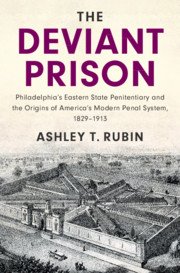
Rubin on the deviant prison

 Ashley T. Rubin (University of Hawaii) has published The Deviant Prison: Philadelphia's Eastern State Penitentiary and the Origins of America's Modern Penal System, 1829-1913 with Cambridge University Press. From the publisher: 

Early nineteenth-century American prisons followed one of two dominant models: the Auburn system, in which prisoners performed factory-style labor by day and were placed in solitary confinement at night, and the Pennsylvania system, where prisoners faced 24-hour solitary confinement for the duration of their sentences. By the close of the Civil War, the majority of prisons in the United States had adopted the Auburn system - the only exception was Philadelphia's Eastern State Penitentiary, making it the subject of much criticism and a fascinating outlier. Using the Eastern State Penitentiary as a case study, The Deviant Prison brings to light anxieties and other challenges of nineteenth-century prison administration that helped embed our prison system as we know it today. Drawing on organizational theory and providing a rich account of prison life, the institution, and key actors, Ashley T. Rubin examines why Eastern's administrators clung to what was increasingly viewed as an outdated and inhuman model of prison - and what their commitment tells us about penal reform in an era when prisons were still new and carefully scrutinized.

 Praise for the book:

"Ashley Rubin's fascinating new book is a powerful reinterpretation of one of prison history's best-known episodes: the early 19th-century competition between 'silent' and 'separate' systems of penitentiary discipline. With a sociologist's grasp of organizational dynamics and a historian's concern for individual agency and contingent events, Rubin retells the remarkable story of the world-famous Eastern State Penitentiary with new depth and insight. The result is a sociologically-informed history that reveals the abiding significance of this 'deviant prison' and uses its flawed idealism to point up the abject deformation of American prisons in the age of mass incarceration." - David Garland

"In a compelling analysis, Ashley Rubin examines how a 'deviant' commitment to solitary confinement persisted in one of the earliest American prisons, Eastern State Penitentiary. She convincingly argues that Eastern State's very outlier status undergirded the deep, decades-long institutional commitment to a doomed system of punishment, shedding new light on how penal aberrations speak to both past and current state punishment practices." - Mona Lynch

"Ashley Rubin has set a new bar for historical social science. Through dogged archival research and incisive analysis, she explains why Eastern State Penitentiary retained its unique system of prison discipline for so long: prison administrators couldn't let go because their status depended on the survival of the deviant prison. Demonstrating the power of personal institutionalization, Rubin shows that forces inside the criminal justice system shape both penal history and paths to change." - Joshua Page

Further information is available here.

--Mitra Sharafi