Friday, September 22, 2023
LHR 41:3
Paper Empires: Layers of Law in Colonial South Asia and the Indian Ocean
Nandini Chatterjee, Alicia Schrikker, Dries Lyna
An Empire in Disguise: The Appropriation of Pre-Existing Modes of Governance in Dutch South Asia, 1650–1800
Alicia Schrikker, Byapti Sur
Material Pluralism and Symbolic Violence: Palm Leaf Deeds and Paper Land Grants in Colonial Sri Lanka, 1680–1795
Dries Lyna, Luc Bulten
The Power of Parwanas: Indo-Persian Grants and the Making of Empire in Eighteenth-Century Southern India
Leonard R. Hodges, Nandini Chatterjee
Registering and Regulating Family Life: The School Thombos in Dutch Sri Lanka
Bente de Leede, Nadeera Rupesinghe
A New Language of Rule: Alwar's Administrative Experiment, c. 1838–58
Elizabeth M. Thelen
A True Copy? Documents and the Production of Legality in the Bombay Inam Commission
Dominic Vendell
Oceanic Mobility and the Empire of the Pass System
Bhavani Raman
The Sailing Scribes: Circulating Law in the Twentieth-Century Indian Ocean
Fahad Ahmad Bishara
Persistence of Practice in Law's Parwana and Palm Leaf Empire
Paul D. Halliday
–Dan Ernst
Monday, September 18, 2023
University of Pennsylvania Legal History Workshop Schedule
I am delighted to announce the schedule for the Legal History Workshop at my home institution, the University of Pennsylvania. (We have kept the fall schedule fairly light because of our hosting duties for this year's meeting of the American Society for Legal History. We are honored to be hosting the plenary address and reception on October 27.)
October 5, 2023: Aziza Ahmed (Boston University School of Law), "'We Are Not Immune': How Feminists Transformed the Law and Science of AIDS"
November 9, 2023: Aaron Hall (University of Minnesota), "U.S. Constitutionalism Before 'the Founding,' 1789-1818"
January 25, 2024: Yanay Israeli (University of Michigan)
February 29, 2024, Danielle Boaz (University of North Carolina, Charlotte)March 21, 2024: Rabia Belt (Stanford Law School)
April 18, 2024: Hardeep Dhillon (University of Pennsylvania)
May 2, 2024: Fahad Bishara (University of Virginia)
If you convene a legal history workshop series and would like us to post your schedule, please reach out!
-- Karen Tani
Wednesday, August 10, 2022
ASLH Program Now Available
The American Society for Legal History has released the program for the 2022 meeting: here.
More from the announcement:
Thanks so much to the Program Committee, chaired by Sophia Lee and Fahad Bishara, for crafting such exciting offerings, representing some of the best that the ASLH community has to offer.
We look forward to seeing you in Chicago. As a reminder, preconference events begin Thursday, November 10. Panels will begin on Friday, November 11. We will gather Friday evening at the University of Chicago for our plenary lecture, by Risa Goluboff (University of Virginia), entitled, "'Charlottesville' as Legal History." Saturday's closing reception will be held at Northwestern Pritzker School of Law. We are grateful, as ever, for the support of our partner institutions.
Please take this opportunity to register early. Early registration is available until October 19, but the Society is grateful for members' early registration as it helps us greatly in our planning. Our conference will take place in the Sheraton Grand Chicago, right in the heart of downtown. We kindly ask that you use the conference hotel, as registration there is important for the continued financial health of the society.
Further announcements and reminders will follow, but we invite you to peruse the program and register for the conference. As a reminder, registrants are required to demonstrate vaccination against COVID-19 (by presenting their vaccination card or a photo of it at the registration desk in Chicago), and are required to abide by the ASLH Policy on Professional Conduct.
-- Karen Tani
Tuesday, March 8, 2022
CFP: ASLH 2022
The Program Committee of the [American Society for Legal History] invites proposals for complete panels and individual papers for the 2022 meeting to be held November 10-12 in Chicago. Panels and papers on any facet or period of legal history from anywhere in the world are welcome. We encourage thematic proposals that transcend traditional periodization and geography.
Limited financial assistance (covering airfare and ground transportation only) is available for presenters in need, with priority given to graduate students, post-doctoral fellows and scholars from abroad.
Panel proposals should include the following: a c.v. with complete contact information for each person on the panel, including chairs and commentators; 300-word abstracts of individual papers; and a 300-word description of the panel.
The Program Committee also welcomes other forms of structured presentation for a 90-minute slot, including lightning round (1-2 chairs, 8-12 presenters for a few minutes each on projects in a related field at any stage of development), skills/pedagogical workshop (chair, 3-4 presenters), or roundtable format (1-2 chairs, 3-4 presenters). The Committee will also consider author-meets-reader panel proposals concerning books with a copyright date of 2021. We encourage panels that put two or three books in conversation, with up to three commentators total. Sufficient information following the general guidelines for panel proposals should be provided for the Committee to assess the merits of the presentation.
The Program Committee additionally seeks proposals for full-day or half-day pre-conference symposia crafted around related themes to augment traditional conference offerings. Please provide a program title, the intended length of program, a program description, a c.v. and contact information for each presenter, and any information technology requirements. The Program Committee is available to consult with organizers of such symposia as they develop their proposal. Pre-conference symposia must be self-funded. Organizers are encouraged but not required to host their symposia at the conference hotel. Please note that the deadline for these submissions is earlier than the deadline for main conference submissions so that organizers whose symposia are not selected have an opportunity to submit their panels to the main conference.
As a general matter, we will not be able to accommodate special scheduling requests, so prospective presenters, chairs, and commentators at the main conference should plan to be available on Friday, November 11, and Saturday, November 12. The ASLH has a strict one-appearance policy (excluding appearances at pre-conference symposia). Prospective participants may submit proposals for multiple sessions, with the understanding that the panel chair will be responsible for promptly finding an appropriate substitute member for any session from which a participant has to withdraw.
The Program Committee encourages panels that include participants from groups historically under-represented in the organization, and that include participants who represent a diversity of rank, experience, and institutional affiliation.
The members of the Program Committee are Nora Bakarat, Nikolas Bowie, Sara Butler, Nandini Chatterjee, Adriana Chira, Samuel F. C. Daly, Catherine Evans, Rui Hua, Jessica Marglin, and Kyle Volk. The co-chairs of the Program Committee are Fahad Bishara (fab7b@virginia.edu) and Sophia Lee (slee@law.upenn.edu).
All program presenters must be current members of the Society by the date of the Annual Meeting. All proposals must be submitted through the ASLH website, which will be available to take submissions starting January 3, 2022. Please visit [here] for updates and additional information.
The deadline for Pre-Conference submissions is Friday February 18, 2022. The deadline for all other submissions is Friday March 18, 2022.
Monday, September 27, 2021
LHR 39:3
Law and History Review 39:3 (August 2021) is out:
The Enigma of a Taiping Fugitive: The Illusion of Justice and the “Political Offence Exception” in Extradition from Hong Kong
Jenny Huangfu Day
Uncertain Comparisons: Zionist and Israeli Links to India and Pakistan in the Age of Partition and Decolonization
Rephael G. Stern
From Disestablishment to Dartmouth College v. Woodward: How Virginia's Fight over Religious Freedom Shaped the History of American Corporations
Alyssa Penick
“A New Ethnology”: The Legal Expansion of Whiteness under Early Jim Crow
Benjamin H. Pollak
The Conservative Press and the Interwar Origins of First Amendment Lochnerism
Sam Lebovic
Voting Trusts and Antitrust: Rethinking the Role of Shareholder Litigation in Public Regulation, from the 1880s to the 1930s
Naomi R. Lamoreaux, Laura Phillips Sawyer
Book Reviews
Bronach C. Kane, Popular Memory and Gender in Medieval England: Men, Women, and Testimony in the Church Courts, c.1200–1500. Woodbridge, UK: The Boydell Press, 2019. Pp. vii, 301. $99.00 hardcover (ISBN 9781783273522).
Emily J. Hutchison
Thomas J. McSweeney, Priests of the Law: Roman Law and the Making of the Common Law's First Professionals. Oxford: Oxford University Press, 2019. Pp. xvi, 287. $90.00 hardcover (ISBN 9780198845454).
Tom Johnson
Nurfadzilah Yahaya, Fluid Jurisdictions: Colonial Law and Arabs in Southeast Asia. Ithaca, NY: Cornell University Press, 2020. Pp. xi, 241. $49.95 hardcover (ISBN 9781501750878).
Fahad Ahmad Bishara
Christopher Tomlins, In the Matter of Nat Turner: A Speculative History. Princeton: Princeton University Press, 2020. Pp. 352. $29.95 hardcover (ISBN 9780691198668).
Honor Sachs
Doreen Lustig, Veiled Power: International Law and the Private Corporation, 1886–1981. Oxford: Oxford University Press, 2020. Pp. 256. £80.00 hardcover (ISBN 9780198822097).
Peter Muchlinski
Edward A. Purcell, Antonin Scalia and American Constitutionalism: The Historical Significance of a Judicial Icon. New York: Oxford University Press, 2020. Pp. 310. $34.95 hardcover (ISBN 9780197508763).
Matthew Steilen
Susan Bartie, Free Hands and Minds: Pioneering Australian Legal Scholars. Oxford: Hart, 2019. Pp. 323. $94.00 hardcover (ISBN 8791509922611).
John Henry Schlegel
Alison C. Carey, Pamela Bloch, and Richard K. Scotch, Allies and Obstacles: Disability Activism and Parents of Children with Disabilities. Philadelphia: Temple University Press, 2020. Pp. 334. $109.50 hardcover (ISBN 9781439916322); $34.95 paperback (ISBN 9781439916339); $34.95 ebook (ISBN 9781439916346).
Elinoam Abramov, Michael Ashley Stein
--Dan Ernst
Saturday, January 23, 2021
CFP: ASLH 2021
[We have the following, updated Call for Papers for the 2021 annual meeting of the American Society for Legal History. DRE]
The Program Committee of the ASLH invites proposals for complete panels and individual papers for the 2021 meeting to be held November 4-6 in New Orleans. Panels and papers on any facet or period of legal history from anywhere in the world are welcome. We encourage thematic proposals that transcend traditional periodization and geography. Due to the cancellation of the Society’s 2020 in-person conference, some of the panel slots for the 2021 conference will be filled by previously accepted proposals. However, there is ample room on the program for new submissions and we look forward to developing a rich and diverse program for our meeting in New Orleans.
The Program Committee welcomes traditional panel proposals (1 chair, 1-2 commentators, 3-4 paper presentations), and other forms of structured presentation for a 90-minute slot, including lightning round (1-2 chairs, 8-12 presenters for a few minutes each on projects in a related field at any stage of development), skills/pedagogical workshop (chair, 3-4 presenters), or roundtable format (1-2 chairs, 3-4 presenters). The Committee will also consider author-meets-reader panel proposals concerning books with a publication date of 2020. We encourage panels that put two or three books in conversation, with up to three commentators total. Requirements for proposals each type of session are outlined below.
Panel Type: Traditional
Format: 1 chair, 3-4 participants, 1-2 commentators
Session abstract/description: Yes, up to 300 words
Individual abstract: Yes, up to 300 words
Panelist CVs: Yes
Panel Type: Lightening Round
Format: 1-2 chairs, 8-12 presenters
Session abstract/description: Yes, 300-500 words
Individual abstract: Yes, up to 300 words
Panelist CVs: Yes
Panel Type: Skills/Pedagogical Session
Format: 1 chair, 3-4 presenters
Session abstract/description: Yes, up to 300 words
Individual abstract: Yes, up to 300 words
Panelist CVs: Yes
Panel Type: Roundtable
Format: 1-2 chairs, 2-3 commentators
Session abstract/description: Yes, 300-500 words
Individual abstract: Yes, up to 300 words
Panelist CVs: Yes
Panel Type: Author meets Readers
Format: 1-2 chairs, 2-3 commentators
Session abstract/description: Yes, 300-500 words
Individual abstract: No
Panelist CVs: Yes
As a general matter, we will not be able to accommodate special scheduling requests, so prospective presenters, chairs, and commentators at the main conference should plan to be available on Friday, November 5, and Saturday, November 6. The ASLH has a strict one-appearance policy. Prospective participants may submit proposals for multiple sessions, with the understanding that the panel chair will be responsible for promptly finding an appropriate substitute member for any session from which a participant has to withdraw.
The Program Committee encourages panels that include participants from groups historically under-represented in the organization, and that include participants who represent a diversity of rank, experience, and institutional affiliation.
Limited financial assistance (covering airfare and ground transportation only) is available for presenters in need, with priority given to graduate students, post-doctoral fellows and scholars from abroad.
The members of the Program Committee are Fahad Bishara, Eliga Gould, Sophia Lee, Tahirih Lee, Alison Lefkovitz, Cynthia Nicoletti, Bhavani Raman, Karl Shoemaker, Simon Stern, and Victor Uribe. The co-chairs of the Program Committee are professors Kristin Collins (collinsk@bu.edu) and Ari Bryen (ari.z.bryen@vanderbilt.edu).
All program presenters must be current members of the Society by the date of the Annual Meeting. All proposals must be submitted through the ASLH website, which will be available to take submissions shortly.
The submission portal will open on February 15, 2021 and will close on March 15, 2021.
Monday, January 4, 2021
Virtual conference: Paper Empires
[We share the following announcement for a virtual conference happening on 7-8 Jan. 2021. To register, e-mail Nandini Chatterjee: n.chatterjee@exeter.ac.uk]
The Forms of Law Project, in collaboration with the Colonialism Inside Out Project and hosted
by the University of Exeter’s Centre for Imperial and Global History, will be holding the online conference ‘Paper Empires: Layers of law in colonial South Asia and the Indian Ocean‘ on 7 and 8 January 2021.
Concept Note:
Anthropologists and historians have recently underscored the ways in which European colonialism created novel regimes of legality and record-keeping, associated with ambitious and exclusive state-centred claims to both truth and rights, while being constantly preoccupied with the spectre of forgery and corruption. However, the attention so far has been focussed on English/European-language records and the colonial institutions that produced, stored and deployed them. This focus has communicated a monolithic sense of power and normativity that unwittingly replicates the aspirations of colonial states. In addition, a more sociologically-inspired historiographical focus on colonial intermediaries as small cogs in the larger bureaucratic machinery tends to blur the underlying materiality and performative nature of record-keeping as such. Drawing on case studies from in and around South Asia, we propose instead that the law of empires was rooted in the highly localised, often multilingual, and fragmented bureaucracies that produced its records.
This conference brings together historians of pre-colonial Indian regimes with historians of British, Dutch and French colonialism in order to unearth genealogies of records in Bengali, Marathi, Persian, Sinhala and Tamil, besides French, Dutch and English, between the eighteenth and mid-twentieth centuries. In exploring that extended period, we place equal valence on subcontinental India and Sri Lanka, on European-ruled South Asia and indirectly controlled princely states, and on the search for sovereignty on water as much as land. While each paper deals with a specific mode of legal or institutional recording, our collective aim is to understand how indigenous regimes co-emerged and competed with incipient European Company-states, creating new forms and potentialities, and indeed, a whole gamut of novel record-making and -keeping strategies, in line with evolving ideas of legality.
In doing so, we engage the following questions:
How have not just documents but also legal concepts and state frameworks been translated? How were pre-existing forms displaced or repurposed by using seemingly traditional forms for novel purposes?
In what ways do these bureaucracies defy compartmentalisation in indigenous and colonial regimes? What do such co-constituted regimes tell us about power, empire, and law?
How did the materiality and ceremoniality of bureaucracies and records embody the processes of colonial law and generate the reality of colonial governance?
How does emphasizing the forms, concepts, and frameworks of law and bureaucracy change our understanding of the role of state agents and intermediaries?
How were the notions of law and language enacted in the everyday locality related to cosmopolitan cultures or vice versa? What commonalities or tensions existed between the specifics of mundane legal and bureaucratic acts versus the totalizing visions of colonial states?
How do these processes look different in different periods of colonial rule, from protracted transitions to high colonialism?
More after the jump:
Friday, March 13, 2020
ASLH 2020: Deadline Extended
Call for Papers: 2020 ASLH Annual Meeting
The Program Committee of the ASLH invites proposals for complete panels and individual papers for the 2019 meeting to be held November 11-14 in Chicago. Panels and papers on any facet or period of legal history from anywhere in the world are welcome. We encourage thematic proposals that transcend traditional periodization and geography.
Limited financial assistance (covering airfare and ground transportation only) is available for presenters in need, with priority given to graduate students, post-doctoral fellows and scholars from abroad.
Panel proposals should include the following: a c.v. with complete contact information for each person on the panel, including chairs and commentators; 300-word abstracts of individual papers; and a 300-word description of the panel.
The Program Committee also welcomes other forms of structured presentation for a 90-minute slot, including lightning round (1-2 chairs, 8-12 presenters for a few minutes each on projects in a related field at any stage of development), skills/pedagogical workshop (chair, 3-4 presenters), or roundtable format (1-2 chairs, 3-4 presenters). The Committee will also consider author-meets-reader panel proposals concerning books with a publication date of 2019. We encourage panels that put two or three books in conversation, with up to three commentators total. Sufficient information following the general guidelines for panel proposals should be provided for the Committee to assess the merits of the presentation.
Individual paper submissions should consist of an abstract, a draft paper (where possible), and a c.v. Given the number and high quality of panel and other complete sessions submitted, individual papers are much less likely than full sessions to be accepted. Would-be individual paper submitters are encouraged to connect with other scholars to coordinate the submission of complete session proposals. [They may do so in the comments to this post, which LHB moderators will occasionally move up.]
The Program Committee additionally seeks proposals for full-day or half-day pre-conference symposia crafted around related themes to augment traditional conference offerings. Please provide a program title, the intended length of program, a program description, a c.v. and contact information for each presenter, and any information technology requirements. The Program Committee is available to consult with organizers of such symposia as they develop their proposal.
As a general matter, we will not be able to accommodate special scheduling requests, so prospective presenters, chairs, and commentators at the main conference should plan to be available on Friday, November 13, and Saturday, November 14. The ASLH has a strict one-appearance policy. Prospective participants may submit proposals for multiple sessions, with the understanding that the panel chair will be responsible for promptly finding an appropriate substitute member for any session from which a participant has to withdraw.
The Program Committee encourages panels that include participants from groups historically under-represented in the organization, and that include participants who represent a diversity of rank, experience, and institutional affiliation.
The members of the Program Committee are Fahad Bishara, Eliga Gould, Sophia Lee, Tahirih Lee, Alison Lefkowitz, Cynthia Nicoletti, Bhavani Raman, Karl Shoemaker, Simon Stern, and Victor Uribe. The co-chairs of the Program Committee are professors Kristin Collins (collinsk@bu.edu) and Ari Bryen (ari.z.bryen@vanderbilt.edu).
All program presenters must be current members of the Society by the date of the Annual Meeting. All proposals must be submitted through the ASLH website, which will be available to take submissions shortly. Please visit [here] http://aslh.net for updates and additional information.
The deadline for submissions is [Friday, March 27, 2020.]
Thursday, October 31, 2019
Thank you, Fahad Bishara!
- Swimming with the Law
- A World of Law in a Scrap of Paper
- Law and Economic Life in the Islamic World: A Teaching Post
Tuesday, October 22, 2019
Law and Economic Life in the Islamic World: A Teaching Post
Monday, October 7, 2019
A World of Law in a Scrap of Paper
Thursday, October 3, 2019
Swimming with the Law
Although I have written a lot in legal history, I wouldn’t primarily identify as a legal historian. I am, above all, a historian of the Indian Ocean – a broad, maritime space that stretches from East Africa to Southeast Asia. For me, working on the Indian Ocean intertwines challenges and opportunities, particularly in conceptualizing a project and in writing it. How does one write oceanically? I’ll leave that question on the table, since this isn’t an oceanic history blog, but it is worth asking: what does it mean to do legal history in an oceanic context?
Tuesday, October 1, 2019
Welcome, Fahad Bishara!
In October 2019, Fahad Bishara, Assistant Professor of History at the University of Virginia will be guest blogging here. Prof. Bishara is currently working on two projects. The first narrates 500 years of world history from the deck of an Indian Ocean dhow, and takes on issues of global capitalism, international law, empire, mobility, and scale in historical writing. The second explores the Indian Ocean trade in dates and uses it as a platform for examining the dynamics of a transregional bazaar economy in the 19th and early 20th centuries, but also sets that story against the backdrop of a longer connected history of the Gulf and Indian Ocean.
Welcome, Fahad Bishara!
--Mitra Sharafi
Saturday, December 22, 2018
Weekend Roundup
- On October 16, 2018, Robert Tsai, American University College of Law, delivered What Might Have Been, the keynote lecture of a program on the 75th Anniversary of the Barnette decision at the Robert H. Jackson Center in Jamestown, NY. It is now up on YouTube. The lecture draws upon Professor Tsai’s archival research on the switch between Gobitis to Barnette and especially Justice Jackson’s revisions of his opinion in the latter case. He argues that Jackson should gone with his first instincts. Professor Tsai also discussed the cases in Reconsidering Gobitis: An Exercise in Presidential Leadership, 86 Wash. U. L. Rev. 363 (2008).
- The Institute for Justice has posted a podcast to commemorate the 150th anniversary of the Fourteenth Amendment. The participants are Daniel Harawa, NAACP Legal Defense and Educational Fund; Aderson Francois, Georgetown Law; Kurt Lash, University of Richmond School of Law; and Gerard Magliocca, Indiana University Robert H. McKinney School of Law.
- Fahad Bishara and Cynthia Nicoletti discuss their ASLH-prize-winning books over at UVA Today.
- An advance alert from Cambridge Core has brought news of the on-line publication of A Deep History of Chinese Shareholding, by Madeleine Zelin, Columbia University, in Law and History Review. Also, no, you’re not going to make it through the final days of 2018 without yet another reference to Hamilton the musical.
Wednesday, November 14, 2018
2018 Stein Award to Bishara for Sea of Debt
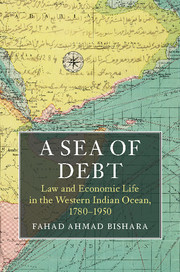
The 2018 Stein Book Award winner is Fahad A. Bishara, University of Virginia, for A Sea of Debt: Law and Economic Life in the Western Indian Ocean, 1780-1950 (Cambridge University Press, 2017).Fahad A. Bishara’s Sea of Debt is an ambitious and imaginatively conceived study that shows how law was a crucial force in tying together actors across the western Indian Ocean. Bishara follows Islamic law and its paperwork as they circulated between the Arabian Peninsula and East Africa. We learn how merchants from South Asia engaged with Islamic legal norms and institutions, and how all of this shifted as the British imperial presence intensified from the 1860s. Sea of Debt’s use of Arabic sources is particularly impressive, and sets the book apart from much work on the British imperial world. Illuminating the intersection of law and capitalism from Muscat to Mombasa (with a special focus on Zanzibar), Sea of Debt reveals how local actors—including qāḍis, jurists, traders, moneylenders, clerks, lawyers, and judges—shaped transoceanic commercial practices across the trade in dates, cloves, ivory and slaves through legal norms and networks.
Thursday, October 4, 2018
Special Issue: Indian Ocean of Law
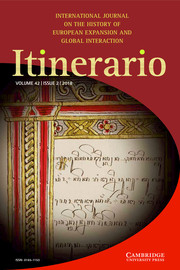
Itinerario's new special issue on "The Indian Ocean of Law: Hybridity and Space" is now out. Here is the table of contents for the journal, 42:2 (August 2018):Introduction:
- Mahmood Koorie and Sanne Ravensbergen, "The Indian Ocean of Law: Hybridity and Space"
- Fahad Ahmad Bishara, “Imagining Oceans of Law: Oman and East Africa, circa 1910”
- Nathan Perl-Rosenthal, “On Mobile Legal Spaces and Maritime Empires: The Pillage of the East Indiaman Osterley (1779)”
- Mahmood Kooria, “The Dutch Mogharaer, Arabic Muḥarrar, and Javanese Law Books: A VOC Experiment with Muslim Law in Java, 1747–1767″
- Nadeera Rupesinghe, “Navigating Pluralities Reluctantly: The Marriage Contract in Dutch Galle”
- Sanne Ravensbergen, “Anchors of Colonial Rule: Pluralistic Courts in Java, ca. 1803–1848”
- Elizabeth Lhost, "Writing Law at the Edge of Empire: Evidence from the Qazis of Bharuch (1799-1864)"
- Byapti Sur, “Individual Interests Behind the Institutional Façade: The Dutch East India Company’s Legal Presence in Seventeenth-Century Mughal Bengal”
(H/t: Elizabeth Lhost's Law, Religion, History)
Friday, August 17, 2018
A conversation between Bishara and Seng
LEGAL ANOMALY
FAHAD AHMAD BISHARA, “‘No country but the ocean”: Reading International Law from the Deck of an Indian Ocean Dhow, ca. 1900”
GUO-QUAN SENG, “The Gender Politics of Confucian Family Law: Contracts, Credit, and Creole Chinese Bilateral Kinship in Dutch Colonial Java (1850s–1900)”
In “No country but the ocean”: Reading International Law from the Deck of an Indian Ocean Dhow, ca. 1900,” Fahad Ahmad Bishara considers the legal imaginaries of Indian Ocean mariners sailing out of the port of Sur, on the Arabian Peninsula. Maritime legal culture entailed a domestication and vernacularization of international law, not least in the ways it was materially manifested in flags and, for these captains, efficacious French documents (titres). These objects-at-sea extended legal regimes of the land, but also refracted and transformed them to captains’ own idiosyncratic purposes. Flags and documents were used to foment exchanges far beyond what they actually secured or promised; for example, titres were freely transferred from one ship, and sailor, to another. Bishara recounts a microhistory of a 1905 court case of Muscat-based dhows suspected of slave-trading, arbitrated at the Hague. The essay reveals the affordances and limits presented to seafarers sailing under a French flag and bearing French papers, though on a mostly British sea. At the same time, it highlights the processes by which dhow captains from Sur appropriated these imperial technologies and grounded them in their own world, framing their encounter with the British navy as the latest in a long string of imperial entanglements at sea, and anchoring the French titres in a regional regime of safe-conduct passes.
Attending to a different form of legal anomaly, Guo-Quan Seng’s essay, “The Gender Politics of Confucian Family Law: Contracts, Credit, and Creole Chinese Bilateral Kinship in Dutch Colonial Java (1850s–1900)” documents the extraordinary economic power enjoyed by creole Chinese women in nineteenth-century Java. These women possessed inheritance rights and directed their household economies, often retaining substantial wealth independent from husbands’ debts or other family liabilities. Beginning in the 1860s, though, Dutch officials began to administer Chinese family law in the colonial courts, and they did so relying on abstract ideals of Confucianist ethics grounded in Sinological studies and formalist textual interpretations. Confucianist legal doctrines of the male as natural head of the household began to inform Dutch legal norms. As a result, by the 1880s women’s autonomous wealth was made vulnerable to husbands’ debt and obligations. Seng shows that Dutch Confucianism, installed in the name of Chinese “tradition,” deprived creole Chinese women of legal rights that they had long enjoyed in actual tradition and practice.
Follow the rest of the conversation here.
Sunday, April 15, 2018
Sunday Book Review Roundup
At Dissent, Gaiutra Bahadur reviews Peter James Hudson's Bankers and Empire: How Wall Street Colonized the Caribbean and Stuart Hall's Familiar Stranger: A Life Between Two Islands.Kathleen Belew's Bring the War Home: The White Power Movement and Paramilitary America is reviewed in the Los Angeles Review of Books. Also at LARB is a review of Steven J. Zipperstein's Pogrom: Kishinev and the Tilt of History
The Republic of Arabic Letters: Islam and the European Enlightenment by Alexander Bevilacqua is reviewed in The New Republic. Also in The New Republic is Linda Gordon's review of R. Marie Griffith's Moral Combat: How Sex Divided American Christians and Fractured American Politics
Beth Lew-Williams' The Chinese Must Go: Violence, Exclusion, and the Making of the Alien in America is reviewed at Slate. Also on the site is a review of Behemoth: A History of the Factory and the Making of the Modern World by Joshua B. Freeman.
Ronit Stahl's Enlisting Faith: How the Military Chaplaincy Shaped Religion and State in Modern America is reviewed at H-Net.
In The Nation, William P. Jones reviews Steven M. Gillon's Separate and Unequal: The Kerner Commission and the Unraveling of American Liberalism . Separate and Unequal is also reviewed in The Atlantic.

In the New York Review of Books is a review of Lawrence James' Empires in the Sun: The Struggle for the Mastery of Africa.
The Washington Post has a review of Show Trial: Hollywood, HUAC , and the Birth of the Blacklist by Thomas Doherty.
Ben Austen's High-Risers: Cabrini-Green and the Fate of American Public Housing is reviewed in The New York Times. Also reviewed in the paper is Benn Steil's The Marshall Plan: Dawn of the Cold War. Priya Satia's Empire of Guns: The Violent Making of the Industrial Revolution is also reviewed.
Fahad Bishara discusses his A Sea of Debt: Law and Economic Life in the Western Indian Ocean, 1780-1950. Also on the site, Jimmy Patino speaks about his Raza Sí, Migra No: Chicano Movement Struggles for Immigrant Rights in San Diego.
Saturday, March 17, 2018
Weekend Roundup
- As best we can make out from this story in the Providence Journal, Frederick Schroeder Jr., of Providence, who, according to his attorney, “buys boxes of documents at estate sales,” was auctioning off on eBay a docket book from Inferior Court of the Common Pleas in Providence County for the years 1746 to 1749, when “a legal history researcher at the University of Pennsylvania” alerted Rhode Island state archivist, Ashley Selima. Bidding opened at $9.99 and had reached $960 when the state obtained an injunction halting the sale.
- Congratulations to Samantha Barbas, Buffalo Law, for silver medaling in the History category of the 2017 Independent Publisher Book Awards, for Newsworthy: The Supreme Court Battle Over Privacy and Press Freedom (Stanford University Press).
- This week, in the Washington Post’s Made by History series, Christopher W. Schmidt, Chicago-Kent Law, published The Parkland students can transform the gun-control movement.
- We learn from H-Law that Siobhan Barco has posted a new H-Law Podcast, a discussion with Fahad Ahmad Bishara about his A Sea of Debt: Law and Economic Life in the Western Indian Ocean, 1780-1950 (Cambridge University Press). In earlier podcasts, Barco spoke with Daniel Sharfstein, Eric Foner, William Domnarski, Al Brophy, Sara L. Crosby, Samantha Barbas, and Mary Ziegler.
- Also on H-Law, Jay Gates, John Jay College of Criminal Justice, reviews Tom Lambert’s Law and Order in Anglo-Saxon England (Oxford University Press).
- H. T. Smith, FIU Law, recently spoke to the Dade County Bar Association on the “history of the challenges Black lawyers have faced over the years in Miami-Dade County.”
- If you’re interested in more from David Abraham, University of Miami Law, on immigration, you might try Circumcision: Immigration, Religion, History, and Constitutional Identity in Germany and the U.S., published in the German Law Journal.
- ICYMI: The New York Times thinks we should look back to Philip Kurland's review of Raoul Berger on impeachment for perspective on Cass Sunstein's latest book. Dr. Mary Frances Berry on How History Repeats Itself: an excerpt from Dr. Berry’s new book, History Teaches Us to Resist: How Progressive Movements Have Succeeded in Challenging Times. Adam Winkler interviewed about We the Corporations on Alternet.
Monday, March 27, 2017
Bishara on Debt in the Indian Ocean
In this innovative legal history of economic life in the Western Indian Ocean, Bishara examines the transformations of Islamic law and Islamicate commercial practices during the emergence of modern capitalism in the region. In this time of expanding commercial activity, a mélange of Arab, Indian, Swahili and Baloch merchants, planters, jurists, judges, soldiers and seamen forged the frontiers of a shared world. The interlinked worlds of trade and politics that these actors created, the shared commercial grammars and institutions that they developed and the spatial and socio-economic mobilities they engaged in endured until at least the middle of the twentieth century. This major study examines the Indian Ocean from Oman to India and East Africa over an extended period of time, drawing together the histories of commerce, law and empire in a sophisticated, original and richly textured history of capitalism in the Islamic world.
Prologue
1. Life and debt
2. Inscribing obligation
3. Paper routes
Interlude
4. Translating transactions
5. Making Africa Indian
6. Muslim mortgages
7. Capital moves
8. Unravelling obligation
Epilogue