Friday, September 14, 2007

Reviewed: Federalism in America: An Encyclopedia

Joseph R. Marbach, Ellis Katz, and Troy E. Smith, eds., Federalism in America: An Encyclopedia (Greenwood Press, 2006) is reviewed on H-Law by Christopher N. Fritsch, Independent Scholar. The editors have assembled a two volume set of nearly 400 entries on federalism. Fritsch writes:
The result...is a set of volumes with entries which are relatively concise and very to the point. The individual entries vary in length. Topics such as abortion and the Constitution of 1787 encompass the better part of five pages; other topics such as Shreveport Rate Case (1914) and West Coast Hotel Company v. Parrish (1937) receive much less space, often less than a page. This variety, however, was planned and executed quite well. Smaller entries provide a description of their importance in relation to federalism and then, as is true with all of the entries, the authors provide key links to other entries within the encyclopedia. The more lengthy articles contain not only a reasonable understanding of their relationship to the topic of federalism, but often give significant historical detail and summation. The entries often provide new and insightful thoughts on both the subject and federalism. Authors frequently move beyond the conventional context of the United States and incorporate the origin of ideas from outside. For these entries, authors give historiographical analysis and description, such as the discussion of Harold Berman's Law and Revolution (1983) in the entry on self-government and federalism (pp.559-561). Often entries provide new and insightful thoughts, which move beyond an analysis through a strict American or North American context.
If this was the only strength of the volumes, we still would have four hundred outstanding entries. However, many entries provide scholars with bibliographies containing the standard works within a subject and more recent studies. These entries provide a brief bibliography that spans the entry's history. For example, on the aforementioned topic of self-government and federalism, Professor Vincent Ostrom provides a bibliography which includes the works of Harold Berman, James M. Buchanan and Gordon Tullock, and JohnR. Commons as historical and political science investigations, along with The Federalist Papers and Alexis de Tocqueville's Democracy in America. Here lies the second strength of these volumes--the ability of readers to understand the subject and its relationship to other related topics and to have a brief, but comprehensive,bibliography providing primary and secondary sources for further examination.


The rest is here. The book description from the press is more precise about the encyclopedia's content:
When the representatives of the 13 former British colonies convened in Philadelphia in 1787, they sought to create a governing document that would define the nature of the government for their new country. Many delegates, having long experience in colonial legislatures battling royal officials for control of the functions of local government, were hesitant to give up the rights of their separate constituencies. Others, cognizant of the great difficulties that a weak Congress had caused throughout the Revolution, were in favor of granting power to a strong central government at the expense of the new states. Those varying views were reflected in the new draft constitution that proposed a federal system where power was shared between the new states and a central government consisting of an elected congress, president and a supreme court. However, no sooner than the compromises were struck to create a new constitution did the debate begin over what the words meant. The first fruit of those initial debates over the limits of the power of government yielded the Bill of Rights. However, the give and take over the role of the federal government has been going on ever since.
This new encyclopedia examines the course of that debate in American history. The 378 articles explain the constitutional provisions, Congressional legislation and Supreme Court decisions that have shaped the relationships of the state and federal governments in the United States. Also noted are the roles played by leading political figures, from John Adams to Sandra Day O'Connor, in defining various areas of jurisdiction. From abortion and Affirmative Action to slavery and welfare policy, historic policy debates are used to illustrate the changing roles of government. Other entries examine the current and historical relationships of different levels of government, including federal, state, and municipal sectors. The influence of historic events and national organizations is explored. Finally, competing theories of federalism, from states' rights to Ronald Reagan's "New Federalism," are explained. Appendices include the Articles of Confederation plus the US Constitution and its amendments. This scholarly survey provides students of political science and history with an excellent introduction to one of the fundamental issues of American government. The set is recommended for high school, public and academic libraries.

Bickers on Congress, the Freedmen's Bureau, and the Constitutional Imagination

John M. Bickers, Northern Kentucky University, Salmon P. Chase College of Law, has posted a new article, The Power to Do What Manifestly Must Be Done: Congress, the Freedmen's Bureau, and Constitutional Imagination. It appeared in the Roger Williams University Law Review. Here's the abstract:
This article considers the example of one of the odder entities in American legal history: the Bureau of Refugees, Freedmen, and Abandoned Lands. This agency, more commonly called the Freedmen's Bureau, existed from the late days of the Civil War through the end of Reconstruction. It did extraordinary, unprecedented things. It spent all of its days in turmoil, beset by enemies on many sides. This new federal agency, given a broad mandate to remedy some of the evils of slavery, aroused opposition among border state politicians, former slave owners, and other defenders of the status quo. More surprising are the concerns raised even by some of its supporters in Congress, concerns over not only the practical nature of its operation but, importantly, the constitutional bases on which it rested. The Bureau functioned in a wholly new frontier of American law. For the first time, the federal government would operate directly in the personal lives of a large body of citizens: it would review private contracts, settle labor and property disputes, operate schools, and even serve as a licenser of marriages. These activities were virtually, if not entirely, unknown before - and some of them since - within what the Framers had called the general government. This article examines the arguments in Congress over that extension of federal power. It reviews the arguments of opponents and supporters as to the appropriateness of the Bureau within our constitutional system. It attempts to derive some constitutional principles from that debate which may be of value for the future as we continue our endless dialogue about the nature of the federal system.

Thursday, September 13, 2007

Reviewed: Baker, The Rescue of Joshua Glover: A Fugitive Slave, the Constitution, and the Coming of the Civil War

H. Robert Baker, The Rescue of Joshua Glover: A Fugitive Slave, the Constitution, and the Coming of the Civil War (Ohio University Press, 2006) is reviewed on H-SHEAR by Stanley Harrold, Department of Social Sciences, South Carolina State University. It was noted earlier by Mark Graber on Balkinization, who called it "a nice page turner" and "a serious read because Professor Baker raises important questions about popular constitutionalism, a hot topic in contemporary legal discourse."

Harrold writes, in part:

H. Robert Baker's The Rescue of Joshua Glover: A Fugitive Slave, the Constitution, and the Coming of the Civil War...begins with an account of a slave rescue in Wisconsin and proceeds to analyze antebellum constitutionalism in that state and the United States.The book is a worthy effort that deserves to be read by students of the Civil War era and the U.S. Constitution. Baker demonstrates an impressive scholarship, especially in his command of secondary sources. But his approach (and the fact that his real subject is dense and complicated constitutional history) may frustrate many readers.
As an aside: some of us find constitutional history rather compelling and important. So this aspect will not frustrate LHB readers. Harrold continues:

Northern resistance to the fugitive slave laws of 1793 and 1850 took two forms. First, alleged fugitive slaves, their neighbors, and mobs fought against masters, their agents, and U.S. marshals. Second, northern magistrates (sometimes acting under state-level personal liberty laws)employed a variety of legal means to prevent rendition or protect those who rescued fugitive slaves. The Joshua Glover case that Baker describes in his first chapter involved both forms. Glover had escaped from Missouri in 1852. In what appears to have been the first attempt in Wisconsin to enforce the Fugitive Slave Law of 1850, his master apprehended him near Racine in March 1854 and after a violent struggle took him to jail in Milwaukee. The next day, a crowd gathered. Some of its members broke into the jail, released Glover, and helped him get to Canada. Federal indictments against two of the mob leaders followed, and, as Baker carefully documents, their cases (not Glover's) became a significant part of Wisconsin's politics for the rest of the decade. Baker emphasizes that the legal points involved in these cases produced a public and lawyerly debate over the right of U.S. citizens to resist federal law, the meaning of the U.S. constitution, and the role of citizens as well as courts in interpreting it.

Once Glover got to Canada, his rescuers and other white Wisconsinites lost interest in him. This, for Baker, illustrates a tendency among the state's white residents to ignore the few African Americans who lived among them....Baker locates the constitutional roots of resistance to the Fugitive Slave Law of 1850 in republican principles, popular defense of natural rights, and antebellum views of state sovereignty. He provides an insightful discussion of the long national debate over the constitutionality of fugitive slave laws. He points out that the Constitution's fugitive slave clause and the Fugitive Slave Law of 1793 were compromises that allowed masters to recover slaves from states in which the escapees would otherwise be free under international law. The 1793 law, however, encouraged the kidnapping into slavery of free African Americans. Kidnapping in turn led to legal conflict between the national government and northern states as the states took "seriously their duty to protect their free blacks" (p. 36).

[snip]

Baker ends his book with interesting and informative analyses of two apparent ironies. The first is that the white South relied on a constitutionalism similar to that prevalent in antebellum Wisconsin to secede from the Union in 1860-1861. The second is that it seemed to do so again a century later in defense of segregation against the U.S. Supreme Court ruling in Brown v. Topeka Board of Education. Readers should appreciate Baker's explanation of how Wisconsin's antislavery state rights differed from secessionist and segregationist state rights. It provides a strong finish to an uneven book.
The full review is here.

Professor Baker responds to Harrold on H-Shear. Although author responses to reviews are not always recommended, Baker uses the opportunity to provide a helpful clarification of his purpose and method. In Baker's post, we can see what Graber found so compelling. Baker writes:
The subject of my book is not dense and complicated constitutional history as such, but rather the way in which everyday antebellum peoples resisted encroachments upon their constitutional rights. I state this quite clearly in my preface when I write that this book "traces the means by which Wisconsinites resisted the Fugitive Slave Act" (xi). I go on to clarify that this means of resistance sprang from a constitutional source: "the popular belief that the Constitution belonged in the last instance to the people" (xii). In short, my goal was to recover the popular culture of resistance and how this influenced constitutional thinking. This necessitated engaging discourse on a variety of levels--at public meetings, in newspaper articles, in speeches at the legislature, and before justices of high courts. It was a polyvalent discourse that mixed legal arguments, political debate, and popular culture.
The rest is here. The book is here.

Langbein on Why Did Trust Law Become Statute Law in the United States?

John H. Langbein, Yale, has posted a new article, Why Did Trust Law Become Statute Law in the United States? It is forthcoming in the Alabama Law Review. Here's the abstract:
The Uniform Trust Code, the first national-level codification of the American law of trusts, was promulgated in 2000. The Code was the product of a five-year Uniform Law Commission drafting process that entailed extensive consultation with the trust and estates bar and the trust banking industry. The Code is being widely enacted. Eighteen states and the District of Columbia have thus far adopted it, and many others are likely to follow. Alabama's enactment comes into effect in 2007. For the future, trust law in Alabama and the other Code states will be prevailingly statute law, although the principles developed in prior case law will continue to inform the interpretation and application of the Code. In one sense, the Code marks a great departure by codifying a previously uncodified field. In another sense, however, the Code is simply the latest step in a trend toward statutory intervention in American trust law that has been underway for decades. If we focus on the Uniform Laws, and I shall have more to say about why uniform legislation has so characterized the trust field, we can identify a steady progression of enactments from the 1930s onward.

The End of H-Net?

Mills Kelly at edwired sees a decline in traffic at some prominent history listservs and asks whether it is a sign that H-Net is on the way out. Hat tip. He writes:

Back in the late 1990s H-Net was the coolest way for academics, teachers, and others with an interest in the humanities and social sciences to connect, discuss, and even engage in some serious scholarship online. Of course, in the late 1990s, email was still the killer app of the Internet and we still hadn’t experienced non-stop spamming, nor could we imagine the rapid growth of blogs as a means of communication and community building. And we certainly didn’t know how social networking would take off.

Looking at the volume of messages in March-May 2005, 2006 and 2007, he finds a decline in traffic at H-World, H-High-S, and H-Africa, and no change at H-South.

His conclusion:
But the objective measure of traffic–at least in this small snapshot–seems to indicate that H-Net has ridden the email horse a little too long. Given the rapid growth in history blogs as a way for those in our discipline to communicate with one another, I suspect that more an more scholars and teachers are turning away from email and to the newer forms of scholarly communication.

If H-Net is going to survive into a second decade, I would urge its leadership to give up on email and move on. Digital communities in the Web 2.0 world just aren’t created in email any more.
But see the comments, suggesting that H-Net provides a service distinct from blogs and other on-line sites, like this one from JH:
Yes, there is way too much mail. But I can always ignore and delete messages once I’ve decided the topic isn’t worth my time.
Meanwhile, I probably read the comments of a couple of score of historians every week, and on topics that I know (from the subject lines) are likely to interest me, and from a single source: my email in-box.
What’s not to love?...

The most active H-Net listserv I subscribe to is H-Diplo, which hosts roundtables on new books and commentary on articles in the most recent issue of Diplomatic History. As long as listservs provide this sort of content, they are likely to maintain a loyal readership. And e-mail programs make it a bit easier to manage the flood of messages. My e-mail from high volume listservs goes directly into a dedicated folder in Outlook, so that I can read them when I have time.

But Kelly does raise important questions, and at least in the law blogophere, there seems to be a migration in some areas from listservs to blogs. I suspect that more organizations will follow the lead of the American Historical Association, creating their own blogs. In legal history, hopefully we will see the growth of a broad legal history blogosphere, with new blogs focusing on different areas of the field.

Update: A follow-up post on edwired is here, and links to other blogs discussing this issue are here.

Wednesday, September 12, 2007

Warren Center Fellowships on Race-Making and Law Making in The Long Civil Rights Movement

The Charles Warren Center at Harvard University is inviting applications for 2008-09. The Center's focus will be Race-Making and Law-Making in The Long Civil Rights Movement. The program next year will be lead by Evelyn Brooks Higginbotham and Kenneth W. Mack.
The Charles Warren Center, Harvard's American history research center, invites applications from historians and scholars in related disciplines to participate in a workshop on Race-Making and Law-Making in “the Long Civil Rights Movement” – a term originally put into academic discourse by the noted historian Jacquelyn Dowd Hall. As its title indicates, the workshop invites scholars to question and rethink the conventional time period during which the movement for racial equality in America is believed to have taken place, including the extension of that period beyond the bounds of the twentieth century. It also invites a rethinking of the movement's geographic scope, both within and outside the United States . Finally, participants are invited to consider the long civil rights movement in relation to organizational strategies and leadership, personnel and successes in claims-making within state apparatuses such as courts, war and wartime contexts, and the processes of racial and cultural formation that were associated with the push for equality. The workshop will focus less on the origins, successes and failures of the modern movement than on discontinuities, disruptions and ironies that attended the creation of equal citizenship in America .
Fellows will participate in a seminar led by Evelyn Brooks Higginbotham (History and African American Studies) and Kenneth W. Mack (Law), presenting their work and discussing that of invited speakers. Applicants may not be degree candidates and should have a Ph.D., J.D. or equivalent. Fellows are Harvard University members with library access, and receive a private office which they must use for at least the nine-month academic year. Stipends are individually determined in accordance with each fellow's needs and the Center's resources. The Center encourages applications, otherwise consistent with the Workshop theme, relating to the nation's life during and as a consequence of wars, and from qualified applicants who can contribute, through their research and service, to the diversity and excellence of Harvard's academic community. Application deadline: January 15, 2008 . Decisions announced: early March. Obtain an application from the Center (Emerson Hall 400, Harvard University , Cambridge , MA 02138 ) or our web site.

Update: On the idea of "the long civil rights movement," Sally Greene has a nice post on Jacqueline Dowd Hall at Greenspace.

Kahn on Federalism, Democratization and the Rule of Law in Russia

Jeffrey Kahn, Southern Methodist University, Dedman School of Law, has two new SSRN postings on Russian legal history. The first is the Introduction to his book, Federalism, Democratization, and the Rule of Law in Russia (Oxford University Press, 2002). The second is an article, The Parade of Sovereignties: Establishing the Vocabulary of the New Russian Federalism, which appeared in the journal Post-Soviet Affairs.

Here's the book abstract:
Combining the approaches of three fields of scholarship – political science, law and Russian area studies – the author of this 2002 Oxford University Press book explores the foundations and future of the Russian Federation. Russia's political elite have struggled to build an extraordinarily complex federal system, one that incorporates eighty-nine different units and scores of different ethnic groups, which sometimes harbor long histories of resentment against Russian imperial and Soviet legacies. This book examines the public debates, official documents and political deals that built Russia's federal house on very unsteady foundations, often out of the ideological, conceptual and physical rubble of the ancien rĂ©gime. One of the major goals of this book is, where appropriate, to bring together the insights of comparative law and comparative politics in the study of the development of Russia's attempt to create – as its constitution states in the very first article – a 'democratic, federal, rule-of-law state'.

Here's the abstract for the article, The Parade of Sovereignties: Establishing the Vocabulary of the New Russian Federalism:
On the basis of extensive on-site interviews and documentary sources, the author interprets the dynamics of the collapse of the Soviet Union by analyzing the cascade of sovereignty declarations issued by republics of the USSR as well as by autonomous republics and other subunits of the Russian republic, in 1990-1991. Interrelationships among the declarations, and other putative causes of their content and timing, are explored. A case study of Tatarstan is provided. The study also analyzes the impact of the process on subsequent Russian approaches to federalism.

Boston College Legal History Roundtable, 2007-08

Boston College Law School announces the Boston College Legal History Roundtable for 2007-08. Legal historians and others in the Boston area are welcome to attend. Conveners are Professor Mary Sarah Bilder, Professor Daniel R. Coquillette, and Professor James S. Rogers.

2007-2008 Schedule
Boston College Law School
885 Centre Street, Newton, Massachusetts
Faculty Lounge – Room 414
Presentation begins at 4:30 p.m.
Please join us for refreshments at 4:15 p.m.

Thursday, September 27, 2007
Professor Adriaan Lanni, Harvard Law School
Social Norms in the Courts of Classical Athens

Thursday, November 15, 2007
Professor Gerald Leonard, Boston University Law School
Rethinking Dred Scott

Thursday, December 6, 2007
Karen Beck, Curator of Rare Books, Boston College Law School
The Nineteenth-Century American Lawyer's Private Library: A Look at the Evidence

Thursday, February 7, 2008
Professor Warren Billings, Distinguished Professor of History, Emeritus, University of New Orleans History Department
Just Laws for the Happy Guiding and Governing of the People There Inhabiting: Laws in the Colonial South

Thursday, April 3, 2008
Professor Paul Halliday, University of Virginia History Department
The Liberty of the Subject: Conceiving Habeas Corpus in England and Empire

Please contact Ms. Marissa Vicario if you plan to attend the roundtables. Ms. Vicario will then send you copies of the papers (617-552-4125; vicariom@bc.edu). Please contact Prof. Mary Bilder for further questions (617-552-0648; bilder@bc.edu). Directions to the law school are here.

NOTE: If you have a legal history colloquium and you would like to have it noted on the Legal History Blog, please contact me.

Tuesday, September 11, 2007

Fairfax on The Jurisdictional Heritage of the Grand Jury Clause

Roger Fairfax, George Washington, has posted an article, The Jurisdictional Heritage of the Grand Jury Clause. It appeared in the Minnesota Law Review. Here's the abstract:
For the first 150 years of our constitutional history, a valid grand jury indictment was deemed to be a mandatory prerequisite to a federal court's exercise of criminal subject matter jurisdiction. Under that view of the Grand Jury Clause, a defendant in a federal felony case could neither waive nor forfeit the right to grand jury indictment. A critical examination of the historical evidence reveals that the legal realist criminal procedure reform project of the early twentieth century advanced a pragmatic critique of the usefulness of the grand jury that culminated in a provision of the Federal Rules of Criminal Procedure allowing for waiver of grand jury indictment for the purpose of facilitating a pre-indictment guilty plea, a procedural efficiency mechanism still used with regularity in federal courts today. The reformers were able to secure the waiver provision - despite serious constitutional concerns - by shaping a pro-efficiency modern understanding of the grand jury that obscured - but did not disprove - the grand jury's jurisdictional significance. This Article argues that the reformers prompted the subversion of the mandate of the Grand Jury Clause, and burdened our legal consciousness with a diminished respect for the grand jury that affects our understanding of the grand jury's place in the constitutional structure to this day. This Article recovers the “jurisdictional heritage” of the grand jury and criticizes the modern understanding for its unjustified dismissal of the grand jury's jurisdictional significance. The Article places blame for the continued confusion in the federal courts regarding the relationship of grand jury and jurisdiction squarely on the weak historical and logical underpinnings of the modern understanding. The Article also contextualizes the grand jury's jurisdictional heritage within the broader contemporary discussion of “pro-defendant” formalist or originalist approaches to defining criminal procedural rights recently applied by the Supreme Court. Finally, the Article argues that the failure to account properly for the jurisdictional heritage of the grand jury frustrates the grand jury's fulfillment of its role in the constitutional design.

9.11

This screen shot of Google at 9:54 a.m. September 11, 2001 is a jolting reminder. The same user options are there, but "I'm Feeling Lucky" seems out of place. The screen directs readers elsewhere. "If you are looking for news, you will find the most current information on TV or radio. Many online news service are not available, because of extremely high demand."

It has never been too early to begin writing the histories of September 11. There are extraordinary resources. This screen shot is captured on a site with 9/11 screen shots from around the world, reminding us that September 11 was a world event that, at least for a moment, knitted Americans together with their global neighbors.

The Library of Congress maintains a multidimensional website: Witness and Response: September 11 Acquisitions at the Library of Congress. For example, the Geography and Map Division provides cartographic resources, with aerial views and thermal imaging of the World Trade Center site. U.S. and international newspapers are here.

The most extraordinary on-line resource that I'm aware of remains the September 11 Digital Archive, created by the Center for History and New Media and American Social History Project/Center for Media and Learning. The archive began collecting stories and images shortly after September 11. Update: A redesign of the Digital Archive and other on-line resources are discussed today in the New York Times, with images and links.

It is sometimes said that reflecting on recent events is not the job of historians. Instead, our role is wait, as if our form of understanding requires that we hold off until the facts are not so full of feeling. But it is simply a duty of citizenship in the world to bring one's tools, whatever they may be, to the most pressing problems of our age. In October 2001, I argued that understanding September 11 and its aftermath cannot be left to others for a decade or more. It is our job, our responsibility.

Monday, September 10, 2007

Legal History is Rated "R"

And you thought legal history was tame. Mingle2 gives The Legal History Blog an "R" rating because of the appearance of these words:

murder (5x)
dangerous (2x)
pain (1x)

And they seem to have misconstrued a nickname for "Richard," which appears 3 times, e.g. in a reference to the Vice President. But the search engine missed references to torture and other matters. Words like this have led other law blogs to be rated NC-17, including this, this and this. Lots of history is, apparently, not for little ones. Cliopatria is also rated R. Hat tip.

Appleby: Let's Do Something Constitutional on Constitution Day

Joyce Appleby, emerita professor of history, UCLA, follows up on a 2002 Constitution Day petition by 1200 historians in an op-ed Let's Do Something Constitutional on Constitution Day. Her recommendation: give meaning to the war powers clauses in which war powers are shared between the President and Congress.

Krieger on The Place of Storytelling in Legal Reasoning: Abraham Joshua Heschel's Torah Min Hashamayim

Stefan H. Krieger, Hofstra, has posted a new paper, The Place of Storytelling in Legal Reasoning: Abraham Joshua Heschel's Torah Min Hashamayim. Here's the abstract:
This article reads the teachings of two rabbis from the Second Century through the lenses of cognitive science on legal thinking and shows the relationship of their narratives and legal opinions. Cognitive scientists posit that both logical and narrative thinking are essential modes of cognitive functioning. The stories and legal decisions of Rabbi Akiva and Rabbi Ishmael, as described by Abraham Joshua Heschel in his masterpiece, Torah Min Hashamayim (Heavenly Torah) support these insights.
Both rabbis lived in a critical period in Jewish history. The Temple, the central focus of the people's connection with God, had been destroyed; large numbers of Jews were exiled from the land; the practice of Judaism had been criminalized; and Jews, including prominent rabbis, were humiliated and persecuted. In this culture, both rabbis wove narratives in an attempt to give meaning to this catastrophe. Rabbi Akiva's stories centered on God's supernatural and miraculous intervention in the world; God's anthropomorphic manifestations and loving relationship with Israel; and a passive, dependent role for Israel which one day would be miraculously redeemed from its present misery. Rabbi Ishmael's narratives, on the other hand, focused on the natural cycles of the world, a clear demarcation between heaven and earth, and an autonomous role for humans in the decision-making process. Faced with the misery around him, Rabbi Ishmael composed stories, in which, humans, not God, played a prominent role in directing life.
Consistent with the findings of cognitive scientists, these narrative themes and images permeate the legal rulings of each rabbi. In his decisions, Ishmael takes a middle of the road, down-to-earth approach focusing on the humanity of the parties, the realities of the decision-making process, and the commonsense meaning of the written text. He puts into action his story that at Mount Sinai only general principles were given; the particulars were left for later real cases. Likewise, Akiva's opinions reflect his narratives. They are usually extreme, demand strict compliance with commandments, and attempt to give meaning to every word and letter given by God. His jurisprudence puts into action his story that at Sinai God gave all the law once and for all. Nothing was left for later.
Heavenly Torah also reflects Heschel's own narrative, his attempts to make meaning after the Holocaust and in the midst of 1960s America. As with Rabbis Akiva and Ishmael, Heschel's narrative infuses his own approach to legal decision making.
This article demonstrates that in rendering decisions, all judges attempt to relate abstract legal principles to actual cases using both the logical principles of their legal system and the narrative themes and images they have created to find meaning in the world in which they live.

Lee on Freedom of the Press 2.0

Edward Lee, Ohio State, links the history of technology and the first amendment in a new paper on copyright, Freedom of the Press 2.0. Here's the abstract:
In today's digital age, copyright law is changing. It now attempts to regulate machines. Over the past twenty years, and particularly with the advent of the Internet, copyright holders have increasingly invoked copyright law to regulate directly - indeed, even to prohibit - the manufacture and sale of technology that facilitates the mass dissemination of expressive works. Although the concerns of copyright holders about the ease of digital copying are understandable, the expansion of copyright law to regulate - and, in some cases, to prohibit -technologies raises a troubling question. Can the government regulate under copyright law technologies that facilitate the dissemination of speech, consistent with the First Amendment? If so, are there any limits to what the government can do? Or does copyright law have constitutional carte blanche to regulate technologies, without any First Amendment scrutiny? Because copyright law, dating back to the first Copyright Act of 1790, traditionally refrained from regulating technologies directly, these questions were scarcely considered before. But, today, these questions have vital importance as copyright law and other laws proposed in service of copyright holders contemplate even greater regulation of emerging technologies that are revolutionizing the ability of individuals to create expressive content on the Internet, in the “Web 2.0” culture of user-created content. However, despite their importance, these questions have escaped attention in legal scholarship. This Article attempts to answer these questions by tracing the historical development of the “freedom of the press” that led to the Framers' inclusion of the concept in the First Amendment. My core thesis is twofold: (i) the Framers understood the freedom of the press as the freedom of the printing press - a speech technology - to be free of intrusive governmental regulation, including restrictions on technology imposed under copyright law; and (ii) today, the Sony safe harbor operates as a “First Amendment safeguard” within copyright law that is designed to protect the freedom of the press and the development of speech technologies. All future attempts by Congress to regulate speech technologies under copyright law must answer to the Free Press Clause or the Sony safe harbor.

Sunday, September 9, 2007

Quick links

Apologies for the radio silence. I have just moved to Princeton, but not yet signed on to the IAS network. A few new items:

Notable fall books are previewed in today's Washington Post, including Toobin on the Court, Faludi on 9/11 and Gingrich on the earth. Really. Hat tip.

Forty years ago, Harold Cruse's classic, The Crisis of the Negro Intellectual, appeared. Scott McLemee of Inside Higher Ed discusses the book with Peniel E. Joseph, Brandeis University, author of Waiting ’Til the Midnight Hour: A Narrative History of Black Power in America.

Michael Stanislawski, A Murder in Lemberg: Politics, Religion, and Violence in Modern Jewish History (Princeton University Press, 2007) is reviewed for H-Law by Piotr WrĂ³bel, University of Toronto.

Bruce Laurie, Beyond Garrison: Antislavery and Social Reform (Cambridge University Press, 2007) is reviewed for H-SHEAR by Frederick J. Blue, Department of History, Youngstown State University. It is available via H-Law

Saturday, September 8, 2007

Opderbeck on Socially Rivalrous Information: Of Candles, Code, and Virtue

David W. Opderbeck, Seton Hall, has posted a new paper, Socially Rivalrous Information: Of Candles, Code, and Virtue. Here's the abstract:
This article presents a novel historical and philosophical critique of the prevailing view among intellectual property theorists that information is best modeled as a non-rival economic resource. The article traces the prevailing view about information back to the philosophers and scientists whose thought dominated the Eighteenth Century Enlightenment - particularly Francis Bacon, Isaac Newton, and John Locke. In fact, one of the enduring metaphors for the non-rival nature of information - Thomas Jefferson's candle – depends on a view of “nature” drawn directly from Bacon, Newton and Locke.
It is surprising that this metaphor endures. Contrary to the Enlightenment project, the epistemology and ontology that informs the notions of “cyberspace” and the “information commons” are non-foundationalist and constructivist. Indeed, the predominant postmodern critique of intellectual property revolves around the social construction of the “romantic author.” This paper demonstrates, however, that Claude Shannon's mathematical information theory fuels the trope that information is a sort of “code” that can be abstracted from any context and freely shared without diminution. The aphorism “code is law,” then, represents a curious mix of Enlightenment and postmodern thought.
This mix does not work well. It leads to a groundless pragmatism pitted with intractable empirical lacunae. The article proposes instead a critical realist perspective on the socially rivalrous aspects of information. This perspective recognizes that information has a real relation to an external reality and yet, at the same time, that information is both socially constructed and a tool of social construction.
The paper demonstrates that the law recognizes how information plays precisely such a community-constructive role in areas outside “hard” intellectual property law and cyberlaw. In particular, the law of trade secrets, insider trading, and pre-contract disclosures regulates the socially rivalrous aspects of information. The article then suggests that information policy should attend to virtues and practices enhance human flourishing in communities constructed by rivalrous information, using the network neutrality debate as an example.

Morrison on Suspension and the Extrajudicial Constitution

Trevor W. Morrison, Cornell, takes up the history of habeas corpus and its implications in a new article, Suspension and the Extrajudicial Constitution. It is forthcoming in the Columbia Law Review. Here's the abstract:
What happens when Congress suspends the writ of habeas corpus? Everyone agrees that suspending habeas makes that particular - and particularly important - judicial remedy unavailable for those detained by the government. But does suspension also affect the underlying legality of the detention? That is, in addition to making the habeas remedy unavailable, does suspension convert an otherwise unlawful detention into a lawful one? Some, including Justice Scalia in the 2004 case Hamdi v. Rumsfeld and Professor David Shapiro in an important recent article, answer yes.
This Article answers no. I previously offered that same answer in a symposium essay; this Article develops the position more fully. Drawing on previously unexamined historical evidence, the first half of the article shows that treating suspension of the writ as legalizing detention is at odds with the dominant historical understanding in both England and the United States. According to that understanding, suspension affects neither the legality of detention nor the availability of post detention remedies (like money damages) for unlawful detention. Suspension of the writ, post detention liability, and legality are distinct questions.
My aims go beyond providing a positive account of suspension, however. In the second half of the Article, I examine a set of broader issues that my account of suspension raises but that the current literature almost entirely overlooks. The core question here is this: If suspension does not equal legalization, what are the roles and obligations of the legislative and executive branches when the writ is validly suspended? I suggest ways to think about those branches' independent obligation to uphold and enforce the Constitution during periods of suspension, especially with regard to constitutional norms that might seem to be associated exclusively with the courts. In that respect, the article uses suspension as a window into larger issues regarding the theory and mechanics of constitutional interpretation and implementation outside the courts.

Friday, September 7, 2007

Eyal-Cohen on Preventive Tax Policy: Chief Justice Roger J. Traynor's Tax Philosophy

Mirit Eyal-Cohen, UCLA, has posted a new paper, Preventive Tax Policy: Chief Justice Roger J. Traynor's Tax Philosophy. Here's the abstract:
Justice Roger J. Traynor is best known for his judicial innovations in the fields of conflict of laws, product liability, and civil procedure. However, few would trace Traynor's roots to the field of tax law. In the late 1930's Traynor collaborated with Stanley S. Surrey, our nation's foremost authorities on federal tax law, and together they called for a substantial transformation of existing mechanisms for settling tax disputes. At that crucial time in history, high marginal tax rates intensified the friction between taxpayers and the government, boosted litigation and multiplied the number of tax controversies. Traynor and Surrey developed the idea of “preventive tax policy” aimed at preventing controversies from arising, and where they cannot be prevented, reducing the area in which they occur. This paper explores the joint project of these extraordinary men in its historical context and its implementation in Justice Traynor's understanding of tax adjudication. Their proposal serves as proxy for the evolution of tax avoidance in a time when tax acts became complex followed by frequent tax revisions enacted in response to tax evasion. It offers valuable guidance for reducing the complexity and vagueness inherent in our tax system, and for improving the relationship between taxpayers and government. Some of today's most important mechanisms to prevent tax avoidance originated in Traynor & Surrey's proposal, such as private letter ruling and advanced pricing agreements. Their proposition for a single court of tax appeals continues to be deliberated.

Thursday, September 6, 2007

Shelton, An Introduction to the History of International Human Rights Law

Dinah L. Shelton, George Washington University, has posted a new essay, An Introduction to the History of International Human Rights Law. Here's the abstract:
As part of a lecture series given at the International Institute of Human Rights, in Strasbourg, France, in July 2003, the author presents an overview of the history of international human rights law. The author explores numerous religious, political, cultural, philosophical, economic and intellectual movements throughout history that have informed and guided the development of human rights law on the global stage. In doing so, the author examines the moral and ethical dimensions which underpin international human rights law, including what she defines as the innate human desire for protection from abuse. The author highlights the world's most significant historical events and people who have influenced modern concepts of human rights law. Despite the many successes of the human rights movement, the author draws attention to international institutions established to protect human rights, which are often too weak to address many contemporary human rights violations and atrocities occurring in failed states or at the hands of non-state actors. As this area of international law continues to develop, these shortcomings must be addressed if human rights progress is to continue.

Tuesday, September 4, 2007

Tamanaha on Understanding Legal Pluralism: Past to Present, Local to Global

Brian Z. Tamanaha, St. John's University, has posted a new article, Understanding Legal Pluralism: Past to Present, Local to Global. It is forthcoming in the Sydney Law Review. Here's the abstract:
Although it has not yet penetrated mainstream legal academia, the notion of legal pluralism is gaining momentum across a range of law-related fields. It has been a major topic in legal anthropology and legal sociology for about two decades, and is now getting attention in comparative law and international law. This recent convergence on the notion of legal pluralism is fueled by the apparent multiplicity of legal orders, from the local level to global level. There are village, town, or municipal laws of various types; there are state, district or regional laws of various types; there are national, transnational, and international laws of various types. In addition to these familiar bodies of law, in many societies there are more exotic forms of law, like customary law, indigenous law, religious law, or law connected to distinct ethnic or cultural groups. There is also an evident increase in quasi-legal forms, from private policing and private judging, to privately run prisons, to the ongoing creation of the new lex mercatoria, a body of transnational commercial law that is almost entirely the product of private law making activities.
These multiple, often uncoordinated, coexisting or overlapping bodies of law may make competing claims of authority; they may impose conflicting demands or norms; and they may have different styles and orientations. This potential conflict generates uncertainty or jeopardy for individuals and groups in society, who cannot be certain in advance which legal regime will be applied to their situation. It also creates opportunities for individuals and groups to strategically invoke or pit one legal order against another.
This article will lay out a framework to help examine and understand the pluralistic form that law increasingly takes today. Legal pluralism, it turns out, is a common historical condition. Part I of this article will portray the rich legal pluralism that characterized the medieval period, and it will describe how this pluralism was reduced in the course of the consolidation of state power. The article will then elaborate on new forms of legal pluralism that were produced in the course of colonization. These historical contexts will set the stage for contemporary legal pluralism, which combines the legacy of this past with more recent developments connected to the processes of globalization.
Part II of the article will focus on the academic discussion of legal pluralism. Although the notion of legal pluralism is gaining popularity, from its very inception it has been plagued by a fundamental conceptual problem: the difficulty of defining “law.” Debates over this conceptual problem have continued unabated for three decades. Moreover, just as the notion of legal pluralism has begun to take off, the theorist who contributed the most to its development announced that, owing to its insoluble conceptual problems, legal pluralism should be discarded. This turnabout is a fascinating intellectual story in itself. Part II will lay out a brief account of the conceptual problem that plagues legal pluralism and will indicate why it cannot be resolved. Scholars who invoke legal pluralism without an awareness of this conceptual problem and its implications risk building upon an incoherent and unstable foundation.
Finally, Part III will articulate an approach to contemporary legal pluralism that avoids the conceptual problems suffered by most current approaches, while framing the important features of legal pluralism. It is drawn from and combines the insights produced in legal anthropology, comparative law, international law, and globalization studies, in the hope that the framework can provide common ground for a cross-disciplinary focus on legal pluralism.
This article was delivered as the 2007 Julius Stone Address at the University of Sydney School of Law

What Leiter’s Study Doesn’t Show: Overall Scholarly Impact

Much attention will surely be paid to Brian Leiter’s new ranking of top law schools based on "scholarly impact," but Deans and law faculties should keep in mind the study’s limitations when gauging their reactions to it.

Leiter may well be right that "one will learn more about faculty quality at leading American law schools" from his study of citation counts in legal publications "than from U.S. News." And Leiter is careful to note several caveats. But there is more to say about what is missing.

Leiter’s study is not a measure of overall scholarly impact, but only scholarly impact within a subset of the academy. The study is confined to the Westlaw JLR database which only includes legal publications.

What does this miss? Leading scholars will have an impact that ranges beyond their fields and beyond their nations. But the Westlaw database cannot measure impact beyond the legal academy, and the important global reach of many American legal scholars is not measured. All but a very few journals in the database are U.S.-based.

The impact of interdisciplinary scholars, in particular, will be under-counted. For serious interdisciplinary scholars, especially J.D./Ph.D.s, the true measure of scholarly success is to be seen as leading figure both within the legal academy and within the Ph.D. field. To further one’s scholarship within the Ph.D. field, an interdisciplinary scholar will publish in the field’s leading peer-reviewed journals. If in the humanities and perhaps social sciences, they will publish books.

This leads to two under-counting problems. First, the Westlaw JLR database will miss citations to the scholar’s work in journals other than law reviews. Second, legal scholars often confine their research to the same Westlaw database, and so they don’t find and cite to relevant books and articles.

Why should we care about this? If the focus is on ranking law schools, and undercounted faculty are evenly distributed across law schools, then the law school rankings may still be fine. But some law schools (for example the University of Southern California) have a higher percentage of faculty with Ph.D.s than many others. It strikes me that some law schools will be disadvantaged.

But also, individuals are singled out, with the top ten at each school listed. Once something is seen as "countable," and both law schools and individual faculty are identified based on how their numbers line up...you’ve seen the next step before. Law schools decide they need to move up the rankings. Perhaps they reward faculty based on how far up their numbers are. All of a sudden, that leading, peer-reviewed journal, outside the Westlaw JLR database, is no longer a great prize on your C.V. Your efforts on that were a waste of your law school’s resources.

Leiter has good intentions, but his rankings have a weakness that warrants more than a footnote. Every law school faculty should aspire to the broad impact, beyond the walls of the legal academy and beyond the nation’s borders, that his study does not measure.

Turn the pages of British Library treasures at new on-line digital gallery

Leaf through the oldest printed 'book,' and other treasures from the British Library though its new digital gallery, Turning the Pages. From Elizabeth Grant at the AHA Blog:
The British Library is reaching out to readers online by allowing them to digitally “leaf through our great books” on their Turning the Pages page. Through the use of Adobe’s Shockwave player, visitors can interactively page through exceptional digital copies of a number of volumes from the library’s collections. Works like the first atlas of Europe, the Diamond Sutra hailed as the “oldest printed book,” and the original Alice’s Adventures Under Ground by Lewis Carroll. The Shockwave format allows readers “turn pages” with their mouse, making the illusion of reading a book online more real. The contents of each work are expanded upon through the use of the “text,” “magnify,” and “audio” buttons at the bottom of each page, which when clicked on respectively explain, enhance, and read to the user. Some works have even more features. For example, “Mozart’s Musical Diary” is presented with 75 audio clips to go along with the written music in his journal. Turning the Pages is a creative and innovative web experience that definitely deserves a look.
The AHA Blog has great examples, here. This is a very cool new resource. Once you download the software, you can use your mouse to actually unroll a Chinese scroll from the year 868 here. Or turn the pages of the illustrated medieval manuscript the Luttrell Psalter here.

Griffin critiques the "New Originalism"

Stephen M. Griffin, Tulane, has posted a new article, Rebooting Originalism. Here's the abstract:
This article is a critique of the "new originalism." New originalists such as Keith Whittington and Randy Barnett assert that the turn to emphasizing the public meaning of the Constitution, along with other improvements, has enabled originalism to answer the most serious objections leveled against it. This claim is questionable. I argue that these changes are more akin to an attempt to "reboot" the old originalism. On the positive side, I provide a theory that, unlike originalism, is capable of explaining and justifying the persistence in the federal courts of alternative legitimate forms of constitutional interpretation and the reality and legitimacy of informal constitutional change outside Article V.
Originalism insists that only certain sorts of historical evidence, such as the understandings of constitutional meaning of the Philadelphia framers or ratifiers of the Constitution, are legitimate in constitutional interpretation. But in the long-running debates over originalism, its status has been left unclear. When the case for originalism is pressed, are its advocates claiming its legitimacy as one form of interpretation among others, or that it is the only legitimate method of interpretation? My critique is directed solely against the latter view, which I call "exclusive originalism." Exclusive originalism has real bite as a constitutional theory. It asserts that other methods of interpretation are wrong or illegitimate and thus that some long-standing constitutional doctrines are wrong or illegitimate. Exclusive originalists claim that the Supreme Court should use public meaning originalism as the sole way of interpreting the Constitution. I argue that exclusive originalism should be rejected, presenting two substantial arguments that have been relatively neglected in recent scholarly debates.
I develop my critique in four parts. In the first, I describe the new originalism, focusing especially on recent comprehensive works by Whittington and Barnett. In Part II, I devote attention to defining the alternative to originalism, a topic that seems neglected of late. As earlier debates should have made apparent, the alternative is not "nonoriginalism," but rather traditional constitutional interpretation, which features a variety of methods.
In Part III I advance my first objection against originalism, arguing that because it is offered as an alternative to the status quo of constitutional interpretation, it must be justified. The justification must match the significance of the change being advocated, which means it must be quite substantial. To date, no originalist has offered such a justification. This argument reveals that originalists have depended on an equivocation between advocating greater use of a current method of interpretation and advocating that we adopt only one method.
In Part IV I present a second objection, arguing that originalism depends on using history without historicism, the use of evidence from the past without paying attention to historical context. Understanding American constitutionalism requires an appreciation of changing contexts, something originalism has difficulty acknowledging. The alternative to originalism here is not the somewhat nebulous idea of the living Constitution, but rather what I call "developmental theory," or historicist theories of constitutional change. These theories represent a genuinely new development in constitutional theory and offer an important perspective on how constitutional meaning can legitimately change over time.

Monday, September 3, 2007

Advice for New Faculty

Whether in the humanities, law, or elsewhere, Tenured Radical has advice for new faculty, including:
  • Saying 'thank you' is perhaps one of the most underrated academic skills I know.

  • If you do something that harms the interests of another untenured person, no matter how unconscious or innocent it was, a lot of people will view you as a snake, and not just your peers.

  • Do not have sex with anyone you work with this year. Wait until next year, when people know other things about you. [And even then, hands off the students!]

And much more, with great photos, right here.

Labor Day

Via PBS: In 1898, Samuel Gompers, head of the American Federation of Labor, called it "the day for which the toilers in past centuries looked forward, when their rights and their wrongs would be discussed...that the workers of our day may not only lay down their tools of labor for a holiday, but upon which they may touch shoulders in marching phalanx and feel the stronger for it."...

The movement for a national Labor Day had been growing for some time. In September 1892, union workers in New York City took an unpaid day off and marched around Union Square in support of the holiday. But now, protests against President Cleveland's harsh methods [in putting down the American Railway Union's strike against the Pullman Company] made the appeasement of the nation's workers a top political priority. In the immediate wake of the strike, legislation was rushed unanimously through both houses of Congress, and the bill arrived on President Cleveland's desk just six days after his troops had broken the Pullman strike.

1894 was an election year. President Cleveland seized the chance at conciliation, and Labor Day was born. He was not reelected.
The News Hour with Jim Lehrer
remembers the origins of Labor Day, with links, here, while Progressive Historians remembers on the Knights of Labor.
Image: The Pullman strike.

Remembering Peet


Intellectuals and other coffee addicts everywhere must pause and raise a mug to Alfred H. Peet, who died last Wednesday in Ashland, Oregon at the age of 87. "The way Americans think about coffee and drink coffee are a direct result of his teachings," said Corby Kummer, author of The Joy of Coffee. "His influence cannot be underestimated."

When Peet, who was Dutch, came to the United States in 1955, "America had a reputation internationally as having coffee that tasted like dishwater," Jim Reynolds of Peet's Coffee said. "He looked at it as something of a crime." "Everybody was drinking coffee that came out of a can," remembered Alice Waters. Peet came to be called "the grandfather of specialty coffee," and trained the founders of Starbucks. "He was the big bang," said Kumer. "It all started with him."


Even as the coffee revolution took off, Peet chose to keep his company small. The original Peet's (where I stood in line many years ago) is still in north Berkeley. And, of course, you can find Peet's on-line, and order a pound of Major Dickason's.


The New York Times obituary is here. Peet is remembered on the Peet's Coffee website here.

James J. Brudney on Liberal Justices' Reliance on Legislative History: Principle, Strategy, and the Scalia Effect

James J. Brudney, Ohio State, has posted a new paper, Liberal Justices' Reliance on Legislative History: Principle, Strategy, and the Scalia Effect. Here's the abstract:
This article conducts an in-depth examination of Supreme Court Justices' reliance on legislative history during the Burger, Rehnquist, and early Roberts eras. In doing so, it makes two important contributions to current statutory interpretation debates.
First, the article presents a powerful case against the conventional wisdom that legislative history is a “politicized” resource, invoked opportunistically by federal judges. The premise that judges regularly rely on legislative history to promote their preferred policy positions - if true - should find ample support in the majority opinions of liberal Supreme Court Justices construing liberal (pro-employee) labor and civil rights statutes. By analyzing all 320-plus majority opinions in workplace law authored by eight liberal Justices from 1969-2006, the authors establish that legislative history reliance is actually associated with a constraining set of results. When these eight liberals use legislative history as part of their majority reasoning, they do so to justify a higher proportion of their pro-employer outcomes than their pro-employee decisions. The authors then review individual majority opinions to demonstrate how this surprising pattern of reliance is based on neutral doctrinal considerations. Liberal Justices use legislative history to illuminate the existence and contours of complex statutory bargains that often favor conservative or pro-employer positions. The authors consider alternative explanations, premised on the institutional factor of who assigns majority opinions and also the instrumental possibility that liberals withhold use of legislative history in “minor” cases to enhance its value in more important decisions. They conclude, however, that Justices Brennan, Marshall, Souter, Stevens, and others are willing to follow so frequently a legislative history trail leading away from their presumed ideological preferences mainly because they have invoked this interpretive resource in principled fashion.
The article's second major contribution is to identify and analyze the Scalia Effect that has arisen with respect to liberal Justices' use of legislative history since 1986. In the face of Justice Scalia's fervently expressed opposition to legislative history, liberal Justices have opted not to rely on that resource in a series of pro-employer majorities that Scalia joins. One result of the liberals' strategic restraint is to make their use of legislative history in remaining (mostly pro-employee) majority opinions appear more ideological than was true before Scalia joined the Court. The authors also show that liberal justices have special reasons for acting strategically in this regard. When liberals rely on legislative history, Justice Scalia is significantly less likely to join their majority opinions even when he votes on their side; he also is significantly less likely to vote for the majority result when these liberals rely on legislative history than when they do not. Intriguingly, Justice Scalia's strong resistance to legislative history usage does not extend to majorities authored by his conservative colleagues. Scalia seems prepared to give these conservative colleagues a free ride: he is every bit as likely to join their majorities, or vote for their results, when they rely on legislative history as when they do not.

Sunday, September 2, 2007

How to "Internationalize" Your American Legal History Class: A New Book

The internationalization of American history has been a major theme in U.S. history and American Studies for over a decade. Even though most law schools have taken up the implications of globalization in their curricula, there has been less discussion among American legal historians about how to rethink the nature and subject of American legal history in light of these developments.

For those wanting to internationalize their American legal history courses, but unsure of where to start, a new American history survey can be a starting point. Transnational Nation, United States History in Global Perspective Since 1789 by Ian Tyrrell, just out from Palgrave/Macmillan, is a fairly short (286 pp.), accessible one-volume take on the topic from an Australian historian of U.S. history. Tyrrell of the University of New South Wales participated in a series of discussions among historians around the world, held over a few years, organized by Tom Bender of NYU, and held at La Pietra, outside of Florence, Italy. Out of these conversations came a collection of essays Rethinking American History in a Global Age (Thomas Bender, ed.), and Bender's own book, A Nation Among Nations: America's Place in World History. The legacy of La Pietra is apparent in Tyrrell's new volume, which is dedicated to "the La Pietra Gang." (I should note that this would include me. I attended the 1998 La Pietra conference, and have participated in follow-up panels at various conferences. I also offered comments on a few chapters of Tyrrell's book manuscript before publication.)


US history is increasingly being studied in a global context, and no study of world history or transnational history can fail to take into account the impact of the US. This essential volume challenges the tendency to see the US as a product of mainly internal political and economic forces which stress American difference from the larger world. Covering the period from 1789 to the time of 9/11 and its aftermath, Ian Tyrrell argues that the shaping of the United States was part of wider economic, social, cultural and political processes, such as:

- political democracy
- reform movements
- economic development
- migration
- the rise of the nation state
- American cultural expansion abroad
- imperialism
- the dramatic impacts of war and revolutions.
Tyrrell explains that the US did not grow in isolation from the forces of globalization and other transnational pressures; rather, the nation has had an uneasy relationship with the rest of the world, in which key movements and institutions promoted globalizing processes while, at the same time, preserving and developing American distinctiveness. Examining the contemporary legacy of these enduring tensions for post-war America, this stimulating study offers readers a fresh, comparative perspective on the relationship between events and movements in the US and wider world.

Contents:
Preface
Introduction
1. Born in the Struggles of Empires: The American Republic in War and Revolution, 1789-1815
2. Commerce Pervades the World: Economic Connections and Disconnections
3. The Beacon of Improvement: Political and Social Reform
4. People in Motion: Nineteenth-Century Migration Experiences
5. Unwilling Immigrants and Diaspora Dreams
6. Racial and Ethnic Frontiers
7. America's Civil War and Its World Historical Implications
8. How Culture Travelled: Going Abroad, c. 1865-1914
9. Building the Nation-state in the Progressive Era: The Transnational Context
10. The Empire That Did Not Know Its Name
11. The New World Order in the Era of Woodrow Wilson
12. Forces of Integration: War and the Coming of the American Century, 1925-1970
13. Insular Impulses: Limits on International Integration, 1925 to 1970
14. From the 1970s to New Globalization: American Transnational Power and its Limits, 1971-2001
Epilogue: "Nothing Will Ever Be the Same": 9/11 and the Return of History

Reviewed: New Books on Bush and Cheney

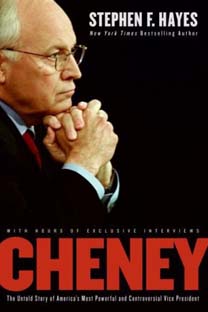
New Bush and Cheney books by reporters are reviewed today. Takeover: The Return of the Imperial Presidency and the Subversion of American Democracy, by Charlie Savage (Little, Brown) is reviewed by Elbert Ventura in today's San Francisco Chronicle, and CHENEY: The Untold Story of America’s Most Powerful and Controversial Vice President (HarperCollins), by Stephen F. Hayes, is reviewed by Carl M. Cannon in the New York Times. While Savage's compass is broader, both books zero in on the role of Vice President Cheney, but from quite different perspectives.

On CHENEY, Cannon writes:

The project, like so much surrounding Cheney, was a bit of a hush-hush undertaking, and some readers may wonder if Hayes, a conservative writer with an established view of the vice president (one of his articles was titled “Dick Cheney Was Right”), is an appropriate author for this biography. But the access he received was unique. His nearly 30 hours with Cheney, including sessions on Air Force Two heading home from Afghanistan and Iraq, may equal the time the vice president has spent with all other journalists put together.

Hayes, who writes for The Weekly Standard, is known primarily for trying to debunk the debunkers on the questions surrounding Saddam Hussein’s relationship, if any, with Al Qaeda before 9/11....

Hayes chooses to provide what is essentially a chronological account of Cheney’s life. The strength of this approach is that it places him in a context — and a rich context at that. We see Cheney trying to hang on to an academic career that never quite got off the ground, resisting jobs in politics twice before finally succumbing to its lures....

It’s a tenet of journalism that you show the readers, you don’t tell them, and Hayes does this well. He demonstrates that Cheney didn’t transmogrify himself into a hard case overnight. But this approach has drawbacks, too, particularly in a biography. We learn that the “secure undisclosed location” where Cheney and his staff spent so much time after 9/11 was usually Camp David, but we don’t learn whether living this way helped induce a bunker mentality. We are made to understand that Cheney views The New York Times as liberal and partisan. We are not told why Cheney’s solution to negative press coverage is to avoid reporters altogether.

Other questions about Cheney’s actions are left unanswered as well. How could anyone ignore John McCain on the question of torture — didn’t McCain’s horrific experiences in Hanoi earn him a great deal of deference? For that matter, why did Cheney not listen to himself on Iraq? In 1991, while defending the first Bush administration’s decision to halt the victorious United States forces at the Kuwait border, Cheney explained that occupying Iraq would alienate other Arab nations; immerse Washington in the differences among Iraqi Kurds, Sunnis and Shiites; and cost considerable American lives.

“The question in my mind,” Cheney said then, “is how many additional American casualties is Saddam worth? And the answer is not very damned many.”

What changed? Hayes’s answer is apparently 9/11. He suggests that having a Secret Service agent lift you, the second most powerful man in government, by your belt buckle and escort you to a secure bunker, where you sit for two hours believing you gave an order that downed an American passenger jet — well, these things change a man. Undoubtedly, but Hayes also quotes Cheney on his 1991 skepticism about occupying Iraq. Those words remain the more persuasive.
The rest is here.
Ventura's review of Takeover is more positive, and this is surely in part because of his admiration for the author, Charlie Savage, a "rarity in a Washington journalist, an assiduous digger who isn't content with playing court stenographer." Ventura sees this book as "a reproach of a press corps whose complacency greased the tracks for the dismantling of a balanced constitutional order." Ventura hopes Savage's book will not be lost in the "deluge of books taking on the Bush administration and its dismal legacy," and finds it "a masterful work of investigative journalism" that should be "remembered as one of the key texts of the Bush years." Savage, a Boston Globe reporter, won a Pulitzer Prize for his reporting on the Bush Administration, including the president's use of signing statements.

"Takeover" builds on Savage's work for the Globe to offer a broad discussion of the age-old debate over executive authority - and the repercussions of the Bush-Cheney White House's expansion of presidential power. In Savage's telling, the Bush administration has engineered nothing less than a wide-ranging power grab, asserting its primacy on issues ranging from the momentous (torture, wiretapping, executive privilege) to the trivial (the hiring of interns).

At the center of it all, Savage writes, is Dick Cheney. As the chief of staff in the Ford White House, Cheney was witness to the erosion of presidential power. The Nixon years were the apotheosis of what historian Arthur Schlesinger dubbed "the imperial presidency," the period following World War II when the executive gained power at the expense of Congress. But as the abuses of the Nixon White House came to light, Congress began pushing back. During the mid-1970s, Congress passed laws on war powers, the right to review classified documents and wiretapping and ramped up its oversight authority over the government's security apparatus. That experience of a presidency in retreat left a mark on the young Cheney....

In the current administration, exploiting 9/11 and a supine Republican Congress, the Bush-Cheney White House has pushed through a series of policies and precedents that, seen as a whole, can only be described as radical. Savage probes the litany of constitutionally questionable episodes: illegal wiretapping, military tribunals, withdrawal from treaties, the firing of U.S. attorneys, politically motivated hirings and the broadening of executive privilege, among others.

"Takeover's" unique contribution is to put all of these moves into a coherent ideological framework: the expansion of presidential power, as envisioned by the conservative movement. The advancement of the agenda even extends to the judiciary. As Savage's narrative reveals, some of the names that figured in the evolution of presidentialist legal theory are now familiar, such as John Roberts and Samuel Alito Jr. Also figuring prominently in the story are David Addington, Cheney's chief of staff, and John Yoo, a legal theorist and adviser to the White House.

Their collective efforts have led us to a crucial pass, argues Savage. The aggressive expansion of executive authority under the Bush-Cheney regime has led to the creation of powers that "are now an immutable part of American history - not controversies, but facts." Savage points out (as do other conservatives alarmed at the administration's actions) that these new powers are there for a future president, Republican or Democrat, to use as well - a prospect that may have been obscured by the presidentialists' ideological myopia.
The rest is here.

Saturday, September 1, 2007

Reviewed: Kronman, Education's End: Why Our Colleges and Universities Have Given Up on the Meaning of Life

"With a quiet fury against the many malefactors he sees everywhere in schools across the nation, Anthony Kronman, the former dean of Yale Law School, now submits to the public his brief for the prosecution against professors teaching the humanities in this country," writes William Chance, President emeritus of Emory University, in a review in the New York Sun of Kronman's new book, Education's End: Why Our Colleges and Universities Have Given Up on the Meaning of Life (Yale University Press). Chance writes that the book claims: "these professors have failed, one and all, in their primary duty — that of teaching 'the meaning of life.' Surrounded as they are by the deep richness of Western literature, philosophy, and political thought, they have been blind to the magnitude of this bounty and have instead witlessly surrendered to the forces of political correctness, affirmative action, feminism, and vapid theorizing."

Let's cut to the book description itself, from Yale University Press:
The question of what living is for - of what one should care about and why - is the most important question a person can ask. Yet under the influence of the modern research ideal, our colleges and universities have expelled this question from their classrooms, judging it unfit for organized study. In this eloquent and carefully considered book, Tony Kronman explores why this has happened and calls for the restoration of life's most important question to an honoured place in higher education.
The author contrasts an earlier era in American education, when the question of the meaning of life was at the center of instruction, with our own times, when this question has been largely abandoned by college and university teachers. In particular, teachers of the humanities, who once felt a special responsibility to guide their students in exploring the question of what living is for, have lost confidence in their authority to do so. And they have lost sight of the question itself in the blinding fog of political correctness that has dominated their disciplines for the past forty years.
Yet Kronman sees a readiness for change, a longing among teachers as well as students to engage with questions of ultimate meaning. He urges a revival of the humanities' lost tradition of studying the meaning of life through the careful but critical reading of great works of literary and philosophical imagination. And he offers here the charter document of that revival.
Back to the review:
With lawyer-like diligence, Mr. Kronman builds his case carefully and patiently — but with one startling omission, to which I will turn. He describes the way in which higher learning in America has evolved — first with small colleges founded on religious principles and an awareness of moral responsibility, followed then by public universities dedicated to practical learning that would enhance the productivity of the individual states, and most recently by the advent of institutions of advanced learning based on the German model of scientific research. His prose is lucid, his patience exemplary, and his extensive scholarship elegantly preserved in 30 pages of footnotes.
Mr. Kronman's prosecution is fueled by his devotion to what he calls secular humanism and by his revulsion toward constructivism. Secular humanism is the perfect method "to explore the meaning of life in a deliberate and organized way even after its religious foundations have been called into doubt." Constructivism, the instrument of surrender to which all humanists have co-signed, affirms "the artificiality of all human values and the absence of any natural standards by which to judge them." Thus Western values wind up as no better than any others, there is no hierarchy of virtues, and power alone counts, but must be unmasked.
According to Chance, Kronman "argues that the natural sciences and the 'harder' social sciences, uninfected by relativism and lack of courage, have surged ahead to become the dominant practices of the academy," while "the humanities are no more than a 'laughingstock.'"
The one extraordinary omission in Mr. Kronman's bill of particulars is, alas, evidence. It is one thing to claim that humanists across the country have defaulted on what he believes is their primary duty — to teach "the meaning life." It is quite another to accumulate the facts — by analysis of curricula, by interviews with teachers and students, by a continuing exposure to what actually goes on within classroom after classroom, and by other forms of painstaking research. Then and only then can we ever know for sure what professors do.
Is it truly possible, even plausible, that the question about the meaning of life — the only real question, as far as Mr. Kronman is concerned — is never posed by any American professor? My own experience tells me that it is asked in thousands of ways, but often indirectly and only rarely at the outset of discussion. Smaller questions come first — how words work in books, who the characters are, what the sequence of action is, and what is at stake.
Chance also wonders whether "Mr. Kronman's question [is] the only one worth asking? If one were to teach The Iliad, might one not instead ask how to read the poem; or inquire about what heroism means; or investigate the nature of friendship, bravery, and loyalty? Might a humanist ask how wars start...?"
The rest is here.

Center for the Study of Law and Society, U.C. Berkeley, seeks Visiting Scholars

The Center for the Study of Law and Society at the University of California, Berkeley invites applications for visiting scholars for 2008-2009.

Note: This is a terrific opportunity, but is unfunded. It is perfect for those with a "portable" fellowship or funded sabbatical.

The Center fosters empirical research and theoretical analysis concerning legal institutions, legal processes, legal change, and the social consequences of law. Closely linked to Boalt Hall School of Law, the Center creates a multidisciplinary milieu with a faculty of distinguished socio-legal scholars in sociology of law, political science, criminal justice studies, law and economics, legal history, and legal and social philosophy, along with visiting scholars from the United States and around the world. U.C. Berkeley faculty members affiliated with the Center include K.T. Albiston, Mark Brilliant, Marianne Constable, Robert Cooter, Lauren B. Edelman, Samera Esmeir, Sean Farhang, Malcolm M. Feeley, Robert A. Kagan, Linda Krieger, Christopher Kutz, David Lieberman, Kristin Luker, Robert MacCoun, Laura Nader, Daniel L. Rubinfeld, Harry N. Scheiber, Gordon Silverstein, David Sklansky, Jonathan Simon, David Vogel, David Winickoff and Frank Zimring.


Application Requirements
1. Applicants normally must possess a Ph.D. or J.D. (or foreign equivalent).
2. Applicants must submit a full curriculum vitae.
3. Applicants must submit a cover letter describing their proposed program of research or study and specifying the time period they wish to be in residence at the Center. Applicants must pursue a program of research or study which is of mutual interest to faculty members at the Center for the Study of Law and Society.
4. Applicants must indicate the source of funding while visiting Berkeley, e.g. sabbatical pay, scholarship, government funding, personal funds, etc. Unfortunately, the Center cannot offer stipends or other financial assistance. Monthly minimum requirements for foreign exchange scholars are: $1600 per month for the J-1 scholar, $500 per month for the J-2 spouse, $200 per month for each J-2 child.
Among privileges and opportunities of Center visiting scholars are: library privileges at the Law School and all campus libraries; invitations to our weekly bag lunch speaker series and other scholarly exchanges; other campus privileges, including athletic facilities; and, when possible, assignment to shared or other office accommodations with computer, internet, etc.
The Center will consider applications for varying time periods, from one month duration to the full academic year. Applicants should submit the information listed above by November 16, 2007 by e-mail to csls@uclink.berkeley.edu or by mail to: Visiting Scholars Program, Center for the Study of Law and Society, University of California, Berkeley, CA 94720-2150.

Inquiries may be made to the Director, Professor Lauren B. Edelman, ledeman@law.berkeley.edu or to the Executive Director, Dr. Rosann Greenspan, rgreenspan@ law.berkeley.edu . For more information, go to the Center's website.